

The Law of Human Relationships
 |
Description
Book Introduction
The second keyword about humans suggested by Robert Greene in 『The Laws of Human Nature』, What is the optimal strategy for governing relationships? The essential edition of "The Art of Seduction," a book by Robert Greene, the world-renowned bestselling author who rose to prominence as a "master of the art of power" with "The Laws of Power" and "The Art of War." The author, who has consistently explored the power that dominates human society and the desire for it, focuses on the ways in which the weak, those farthest from power, gain power in this lighter and smaller version of human relations strategy. Until a few centuries ago, the only means of gaining power was through violence and brute force. In such a system, only a select few could have power. The socially vulnerable, especially women, who had neither military power nor financial resources, had no choice but to simply conform to reality and endure the pain. However, people began to emerge who could overcome unfavorable conditions and effectively create power through their wit and strategy. The author defines the means by which the socially weak, powerless, gain power in interpersonal relationships as "seduction," and introduces 24 psychological strategies that can bring any opponent to your side. This book is both a humanities treatise offering insight into human psychology through extensive references to classics and history, and a complete self-help guide offering practical skills for overcoming challenges in business and interpersonal relationships. |
- You can preview some of the book's contents.
Preview
index
Prologue _ The Best Relationship Strategy to Capture Your Partner's Heart: Seduction
PART 1.
9 Types of People Who Lead Relationships
TYPE 1.
Siren - Ruler of Primal Desire
TYPE 2.
Lake _ A passionate man who liberates pent-up desires
TYPE 3.
Ideal Lover - A savior who makes your dreams come true
TYPE 4.
Dandy _ The magic of neutrality that gathers followers
TYPE 5.
Natural _ An innocent child who stimulates nostalgia
TYPE 6.
Coquette _ The cold weapon of indifference
TYPE 7.
Charmer - Infinite positivity that brings joy and comfort
TYPE 8.
Charisma - an instinctive, innate, powerful appeal
TYPE 9.
Star _ An eye that reads the public's longing
FILE 1.
People who can't take the lead in a relationship
FILE 2.
People who are prone to becoming victims in relationships
PART 2.
24 Strategies to Lead Your Relationships
CHAPTER 1.
Target your opponent's hidden desires
STRATEGY 1.
Target Selection - Choose someone who has something you don't have.
STRATEGY 2.
Social distancing: a step back to move forward
STRATEGY 3.
Attitude projection - Hiding your true intentions with a conflicting attitude
STRATEGY 4.
Induce competition - Stimulate competitiveness to maximize contrast effects
STRATEGY 5.
Stimulation _ Stimulate the emptiness and anxiety within you.
STRATEGY 6.
Suggestion - Dig into the other person's subconscious with subtle hints.
STRATEGY 7.
Mirror _ Become a mirror that reflects the other person's broken dreams.
STRATEGY 8.
Focus - Find the suppressed desire and throw the bait.
CHAPTER 2.
Drive them into confusion and isolation
STRATEGY 9.
Attitude _ Arouse curiosity with unpredictable behavior
STRATEGY 10.
Language _ Use the language of a hypnotist who stimulates fantasy.
STRATEGY 11.
Expression _ Create a moving spectacle by stacking small expressions.
STRATEGY 12.
Idealization - Allow yourself time to idealize yourself.
STRATEGY 13.
Disarmament - The public is on the side of the victims.
STRATEGY 14.
Fantasy _ Show a daydream that lies on the border between reality and unreality.
STRATEGY 15.
Isolation - Isolate the other person as if you were the only two people in the world.
CHAPTER 3.
Don't give me any room to escape
STRATEGY 16.
Chivalry - Dispel doubts by proving sincerity
STRATEGY 17.
Dependence - Touching the infantile psyche with unconditional affection
STRATEGY 18.
Bonding - Share your guilt by overcoming taboos together.
STRATEGY 19.
Sublimation - Give them the satisfaction of pursuing noble values.
STRATEGY 20.
Fear-mongering - Provide appropriate levels of fear and anxiety.
CHAPTER 4.
Throw the final blow
STRATEGY 21.
Reversal _ Seduce, but act as if you are being seduced.
STRATEGY 22.
Bait - Focus on one sense
STRATEGY 23.
Surprise Attack - When the opportunity arises, rush in boldly.
STRATEGY 24.
Summary: Prepare for the second temptation at the moment of separation.
FILE 3.
A good situation to implement relationship strategies
FILE 4.
How to captivate the masses
PART 1.
9 Types of People Who Lead Relationships
TYPE 1.
Siren - Ruler of Primal Desire
TYPE 2.
Lake _ A passionate man who liberates pent-up desires
TYPE 3.
Ideal Lover - A savior who makes your dreams come true
TYPE 4.
Dandy _ The magic of neutrality that gathers followers
TYPE 5.
Natural _ An innocent child who stimulates nostalgia
TYPE 6.
Coquette _ The cold weapon of indifference
TYPE 7.
Charmer - Infinite positivity that brings joy and comfort
TYPE 8.
Charisma - an instinctive, innate, powerful appeal
TYPE 9.
Star _ An eye that reads the public's longing
FILE 1.
People who can't take the lead in a relationship
FILE 2.
People who are prone to becoming victims in relationships
PART 2.
24 Strategies to Lead Your Relationships
CHAPTER 1.
Target your opponent's hidden desires
STRATEGY 1.
Target Selection - Choose someone who has something you don't have.
STRATEGY 2.
Social distancing: a step back to move forward
STRATEGY 3.
Attitude projection - Hiding your true intentions with a conflicting attitude
STRATEGY 4.
Induce competition - Stimulate competitiveness to maximize contrast effects
STRATEGY 5.
Stimulation _ Stimulate the emptiness and anxiety within you.
STRATEGY 6.
Suggestion - Dig into the other person's subconscious with subtle hints.
STRATEGY 7.
Mirror _ Become a mirror that reflects the other person's broken dreams.
STRATEGY 8.
Focus - Find the suppressed desire and throw the bait.
CHAPTER 2.
Drive them into confusion and isolation
STRATEGY 9.
Attitude _ Arouse curiosity with unpredictable behavior
STRATEGY 10.
Language _ Use the language of a hypnotist who stimulates fantasy.
STRATEGY 11.
Expression _ Create a moving spectacle by stacking small expressions.
STRATEGY 12.
Idealization - Allow yourself time to idealize yourself.
STRATEGY 13.
Disarmament - The public is on the side of the victims.
STRATEGY 14.
Fantasy _ Show a daydream that lies on the border between reality and unreality.
STRATEGY 15.
Isolation - Isolate the other person as if you were the only two people in the world.
CHAPTER 3.
Don't give me any room to escape
STRATEGY 16.
Chivalry - Dispel doubts by proving sincerity
STRATEGY 17.
Dependence - Touching the infantile psyche with unconditional affection
STRATEGY 18.
Bonding - Share your guilt by overcoming taboos together.
STRATEGY 19.
Sublimation - Give them the satisfaction of pursuing noble values.
STRATEGY 20.
Fear-mongering - Provide appropriate levels of fear and anxiety.
CHAPTER 4.
Throw the final blow
STRATEGY 21.
Reversal _ Seduce, but act as if you are being seduced.
STRATEGY 22.
Bait - Focus on one sense
STRATEGY 23.
Surprise Attack - When the opportunity arises, rush in boldly.
STRATEGY 24.
Summary: Prepare for the second temptation at the moment of separation.
FILE 3.
A good situation to implement relationship strategies
FILE 4.
How to captivate the masses
Detailed image
Into the book
Lake engages in extreme behavior that society considers taboo.
Because of this, he is often perceived as dangerous and cruel.
Byron hated being bound by convention.
He fell in love with his half-sister, had a child with her, and told the whole of England about it.
He was cruel to everyone, including his wife, but the more he was cruel to her, the more women adored him.
Women who lived in a culture that demanded a refined and demure image of women, saw him breaking social taboos and engaging in risky behavior, and this unleashed the suppressed desires in their hearts.
--- p.34
Warhol suffered from conflicting emotions from an early age.
He wanted fame, but he was born with a passive and shy personality.
At first, Warhol actively sought the attention and love of others.
But it didn't work.
After ten years of effort proved futile, he returned to his original passive self.
Then, surprisingly, people started to pay attention.
Warhol began applying the lessons he learned from such experiences to his own work in the early 1960s.
He painted common objects he saw around him, such as soup cans and speeding tickets.
Since his paintings did not contain any particular meaning, viewers could appreciate them without feeling forced at all.
People were curious and thought about the meaning contained in the painting in their own way.
Immediate expression, visual impact, and a calm and cool atmosphere were the characteristics of his paintings.
Warhol began to change not only his paintings but also himself in this way.
He no longer tried to assert himself.
--- p.70~71
Political leaders often use coquette tactics to captivate the masses.
They get the public excited and then suddenly distance themselves from the public.
German political scientist Robert Michels called such politicians “cold coquettes.”
Napoleon used 'coquette tactics' against France.
After the successful completion of his Italian expedition, he suddenly became a national hero.
But he soon left France and set out on an expedition to Egypt.
His intention was that without him, the government would be torn apart, and then the people would desperately yearn for his return.
That's how he grew his power.
Mao Zedong also idolized himself by stirring up public sentiment with inflammatory speeches and then suddenly disappearing for a few days.
All these politicians were clear narcissists.
'Coquette tactics', which stimulate jealousy, affection and intense emotions, are especially effective when dealing with groups.
--- p.75~76
Malcolm X had a kind of Moses-like charisma.
He was a liberator.
The liberator presents an opportunity for others to vent their pent-up anger, their resentment trapped within the shell of enforced politeness.
The liberator must live a life of suffering because he wants to become one with the suffering people (Malcolm X was assassinated during a speech in 1965).
To be charismatic, you must have the ability to convey your emotions through your body language and voice.
To do that, you need a deeper sensitivity and insight than others.
People are impressed by the charisma of those who boldly reveal what others are afraid to reveal.
Charisma should be able to say what people want to say but cannot.
Charisma is born the moment you stand on the side of the oppressed and cry for liberation.
--- p.91
A few months later, Kennedy won the Democratic presidential nomination and faced Republican candidate Richard Nixon in a televised debate.
Nixon was sharp.
He answered questions accurately and engaged in the discussion calmly, citing precise statistics about the accomplishments of the Eisenhower administration, of which he was once Vice President.
But Nixon's appearance on the black-and-white television looked like a corpse.
His anxious movements, frequent blinking of the eyes, his stiff posture, his tired face, and the sweat running down his eyebrows and cheeks gave him a bad impression.
But Kennedy showed a contrasting picture.
While Nixon had his eyes fixed on his rival, Kennedy, he sat in his living room watching television and expressed his views to the nation.
While Nixon was focused on petty issues, hawking his data, Kennedy appealed to the pioneering spirit of Americans, talking about freedom and building a new society.
Although his words were not specific, they stimulated the audience's imagination about a beautiful future.
--- p.100
As people grow up, they have to compromise with their childhood dreams, whether willingly or not.
Because of this, people live with some regrets that are not apparent on the outside.
The seducer must bring to the surface this regret that lies deep within people, making them realize how far they have strayed from their past dreams.
Furthermore, if you offer the other person a chance to regain their lost dreams and youth, they will naturally be drawn to you.
Businessmen and politicians know that to get people to buy what they want to sell or do what they want, they must first awaken the public's needs and discontents.
Make the other person question their own identity, then offer a helping hand.
This story applies not only to individuals, but also to groups and entire nations.
--- p.169~170
To plant seductive ideas in people's minds, you must stimulate their imagination, their fantasy, and their deepest longings.
The key to success is the ability to subtly suggest things people desire, such as pleasure, wealth, health, and adventure.
(…) Words that come out without thinking, words that seem to slip out before going to bed, words that attract the other person’s attention have a tremendous suggestive effect.
These words, like poison, seep under people's skin and take on a life of their own.
It's best to try this type of suggestion when the other person is relaxed or distracted.
Usually, when people are having a conversation, they think about what to say next or get lost in their own thoughts.
If you take advantage of that gap and say something suggestive, the other person won't notice at all.
--- p.175~176
The purpose of the language of seduction is to hypnotize the other person.
Hypnotists put their subjects into a state of trance through the techniques of repetition and affirmation.
It is especially important to choose words that stimulate emotions and use them repeatedly.
When you use strong, assertive language, your audience becomes emotionally stimulated without even having time to decide whether what you are saying is true or not.
For example, rather than saying, “I don’t think those people are smart,” try saying, “We deserve better” or “Those people are the ones who screwed everything up.”
The language of affirmation should be short and positive, like a command.
You should not use words like “I think” or “probably”.
--- p.205
An isolated person is weak.
If you isolate your opponent slowly, he becomes much easier to deal with.
First of all, psychological isolation is necessary.
You have to grab the other person's attention by making them happy, and then you have to push away all other thoughts.
In short, you must make them look at and think only of the seducer.
Second, physical isolation is necessary.
It is necessary to create a world where you can escape from the trivialities of daily life, friends, family, and home and enter another world.
Once this isolation operation is successful, the opponent will be unable to receive any outside help and will inevitably fall deeper into the swamp of temptation.
Therefore, the seducer must be able to draw the other person deep into his world.
Then, the person who has entered an unfamiliar world becomes more and more dependent on the seducer in confusion.
--- p.234
It is better to stimulate your opponent than to bore him.
Being more hurtful than kind can make someone more emotionally dependent.
Identify your opponent's weaknesses and then exploit them to incite conflict.
Then, at the crucial moment, resolve that conflict.
The more brutal it is, the more amplified the effect.
In his book, On Love, Stendhal described the influence of fear on desire.
According to Stendhal, the more one thinks that one's loved one might soon abandon one, the more one becomes disoriented and loses control of oneself.
We must be able to leverage this insight and apply it to the target of our temptation.
You should never reassure the other person.
Rather, it should make you feel fear and anxiety.
Show a cold and indifferent attitude.
Make them feel anxious about breaking up by frequently implying that you could break up at any time.
Then, when you think that an appropriate amount of time has passed, give them peace of mind again.
Because of this, he is often perceived as dangerous and cruel.
Byron hated being bound by convention.
He fell in love with his half-sister, had a child with her, and told the whole of England about it.
He was cruel to everyone, including his wife, but the more he was cruel to her, the more women adored him.
Women who lived in a culture that demanded a refined and demure image of women, saw him breaking social taboos and engaging in risky behavior, and this unleashed the suppressed desires in their hearts.
--- p.34
Warhol suffered from conflicting emotions from an early age.
He wanted fame, but he was born with a passive and shy personality.
At first, Warhol actively sought the attention and love of others.
But it didn't work.
After ten years of effort proved futile, he returned to his original passive self.
Then, surprisingly, people started to pay attention.
Warhol began applying the lessons he learned from such experiences to his own work in the early 1960s.
He painted common objects he saw around him, such as soup cans and speeding tickets.
Since his paintings did not contain any particular meaning, viewers could appreciate them without feeling forced at all.
People were curious and thought about the meaning contained in the painting in their own way.
Immediate expression, visual impact, and a calm and cool atmosphere were the characteristics of his paintings.
Warhol began to change not only his paintings but also himself in this way.
He no longer tried to assert himself.
--- p.70~71
Political leaders often use coquette tactics to captivate the masses.
They get the public excited and then suddenly distance themselves from the public.
German political scientist Robert Michels called such politicians “cold coquettes.”
Napoleon used 'coquette tactics' against France.
After the successful completion of his Italian expedition, he suddenly became a national hero.
But he soon left France and set out on an expedition to Egypt.
His intention was that without him, the government would be torn apart, and then the people would desperately yearn for his return.
That's how he grew his power.
Mao Zedong also idolized himself by stirring up public sentiment with inflammatory speeches and then suddenly disappearing for a few days.
All these politicians were clear narcissists.
'Coquette tactics', which stimulate jealousy, affection and intense emotions, are especially effective when dealing with groups.
--- p.75~76
Malcolm X had a kind of Moses-like charisma.
He was a liberator.
The liberator presents an opportunity for others to vent their pent-up anger, their resentment trapped within the shell of enforced politeness.
The liberator must live a life of suffering because he wants to become one with the suffering people (Malcolm X was assassinated during a speech in 1965).
To be charismatic, you must have the ability to convey your emotions through your body language and voice.
To do that, you need a deeper sensitivity and insight than others.
People are impressed by the charisma of those who boldly reveal what others are afraid to reveal.
Charisma should be able to say what people want to say but cannot.
Charisma is born the moment you stand on the side of the oppressed and cry for liberation.
--- p.91
A few months later, Kennedy won the Democratic presidential nomination and faced Republican candidate Richard Nixon in a televised debate.
Nixon was sharp.
He answered questions accurately and engaged in the discussion calmly, citing precise statistics about the accomplishments of the Eisenhower administration, of which he was once Vice President.
But Nixon's appearance on the black-and-white television looked like a corpse.
His anxious movements, frequent blinking of the eyes, his stiff posture, his tired face, and the sweat running down his eyebrows and cheeks gave him a bad impression.
But Kennedy showed a contrasting picture.
While Nixon had his eyes fixed on his rival, Kennedy, he sat in his living room watching television and expressed his views to the nation.
While Nixon was focused on petty issues, hawking his data, Kennedy appealed to the pioneering spirit of Americans, talking about freedom and building a new society.
Although his words were not specific, they stimulated the audience's imagination about a beautiful future.
--- p.100
As people grow up, they have to compromise with their childhood dreams, whether willingly or not.
Because of this, people live with some regrets that are not apparent on the outside.
The seducer must bring to the surface this regret that lies deep within people, making them realize how far they have strayed from their past dreams.
Furthermore, if you offer the other person a chance to regain their lost dreams and youth, they will naturally be drawn to you.
Businessmen and politicians know that to get people to buy what they want to sell or do what they want, they must first awaken the public's needs and discontents.
Make the other person question their own identity, then offer a helping hand.
This story applies not only to individuals, but also to groups and entire nations.
--- p.169~170
To plant seductive ideas in people's minds, you must stimulate their imagination, their fantasy, and their deepest longings.
The key to success is the ability to subtly suggest things people desire, such as pleasure, wealth, health, and adventure.
(…) Words that come out without thinking, words that seem to slip out before going to bed, words that attract the other person’s attention have a tremendous suggestive effect.
These words, like poison, seep under people's skin and take on a life of their own.
It's best to try this type of suggestion when the other person is relaxed or distracted.
Usually, when people are having a conversation, they think about what to say next or get lost in their own thoughts.
If you take advantage of that gap and say something suggestive, the other person won't notice at all.
--- p.175~176
The purpose of the language of seduction is to hypnotize the other person.
Hypnotists put their subjects into a state of trance through the techniques of repetition and affirmation.
It is especially important to choose words that stimulate emotions and use them repeatedly.
When you use strong, assertive language, your audience becomes emotionally stimulated without even having time to decide whether what you are saying is true or not.
For example, rather than saying, “I don’t think those people are smart,” try saying, “We deserve better” or “Those people are the ones who screwed everything up.”
The language of affirmation should be short and positive, like a command.
You should not use words like “I think” or “probably”.
--- p.205
An isolated person is weak.
If you isolate your opponent slowly, he becomes much easier to deal with.
First of all, psychological isolation is necessary.
You have to grab the other person's attention by making them happy, and then you have to push away all other thoughts.
In short, you must make them look at and think only of the seducer.
Second, physical isolation is necessary.
It is necessary to create a world where you can escape from the trivialities of daily life, friends, family, and home and enter another world.
Once this isolation operation is successful, the opponent will be unable to receive any outside help and will inevitably fall deeper into the swamp of temptation.
Therefore, the seducer must be able to draw the other person deep into his world.
Then, the person who has entered an unfamiliar world becomes more and more dependent on the seducer in confusion.
--- p.234
It is better to stimulate your opponent than to bore him.
Being more hurtful than kind can make someone more emotionally dependent.
Identify your opponent's weaknesses and then exploit them to incite conflict.
Then, at the crucial moment, resolve that conflict.
The more brutal it is, the more amplified the effect.
In his book, On Love, Stendhal described the influence of fear on desire.
According to Stendhal, the more one thinks that one's loved one might soon abandon one, the more one becomes disoriented and loses control of oneself.
We must be able to leverage this insight and apply it to the target of our temptation.
You should never reassure the other person.
Rather, it should make you feel fear and anxiety.
Show a cold and indifferent attitude.
Make them feel anxious about breaking up by frequently implying that you could break up at any time.
Then, when you think that an appropriate amount of time has passed, give them peace of mind again.
--- p.270~271
Publisher's Review
The author of monstrous writing skills that captivated 2 million readers worldwide.
A chance to see Robert Greene's true colors again.
Robert Greene, who emerged as a master of the art of power, earning the titles of “The Prince” and “Revived Machiavelli” with his trilogy of “The Laws of Power,” “The Art of War,” and “The Art of Seduction.”
His books, which have consistently explored the power that dominates human society and the desires that pursue it, have garnered an unusual following from hip-hop artists (Jay-Z, Kanye West, Drake, etc.) who are major pillars of modern American popular culture, and have generated a lot of buzz, from rumors that the late Fidel Castro read them to information that they are one of the most checked out books in American prisons.
Along with Robert Greene's widespread popularity as a writer, these are examples of how his insightful ideas have been followed by those seeking power in life's battles and in business.
Another important characteristic of his books, which delve into a single topic with honesty, is their vast volume.
His books, so-called "brick books" because they are too thick to be carried around and read easily, have an average page count of 636 pages (based on the 6 books published in Korea).
This is thanks to the writer's outstanding talent for drawing on numerous references from classics and history and analyzing them with insight and wisdom appropriate for modern society.
Accordingly, one of his representative trilogy, 『The Art of Seduction』, has been re-edited and republished as the definitive, easier-to-read 『The Laws of Human Relationships』, focusing on the core theme of 'types and strategies that lead human relationships.'
This will be an opportunity to once again see the true face of Robert Greene, the author with a monstrous writing ability that has captivated 2 million readers around the world.
Human nature is never good, and all relationships are psychological warfare!
If you don't lead, someone else will drag you along.
While his most recent work, The Laws of Human Nature, explores the inner drives and motivations of human beings, this book explores the power that governs relationships between people and the dynamics that drive it.
In particular, it focuses on the way in which the weak, who are farthest from the existing strong who hold visible power, use their base to gain power.
People who easily take the lead, that is, power, in human relationships already have this skill instinctively.
A person who leads conversations without hesitation in any situation, a person who doesn't back down even in front of their boss at work and pushes ahead with their own opinions, a person who is exceptionally popular with the opposite sex, a star politician who receives all the public's attention...
Whether it's a one-on-one relationship or a relationship with many people, one person in the group always takes the lead in the relationship.
In other words, all humans fall into one of two types: either 'relationship leaders' or 'relationship leaders.'
Relationship-driven people can have a positive influence on others through their positive energy, but they also often exert a negative influence by manipulating others for their own benefit.
There are common character types, like bad friends or bad dates, and there are also rarer ones, like con artists, cult leaders, and dictators, who seriously ruin many lives.
What's even more remarkable is that these relationship-driven strategists use invisible techniques.
The ultimate psychological tactic to win over any opponent
9 Types and 24 Strategies for Captivating and Leading People
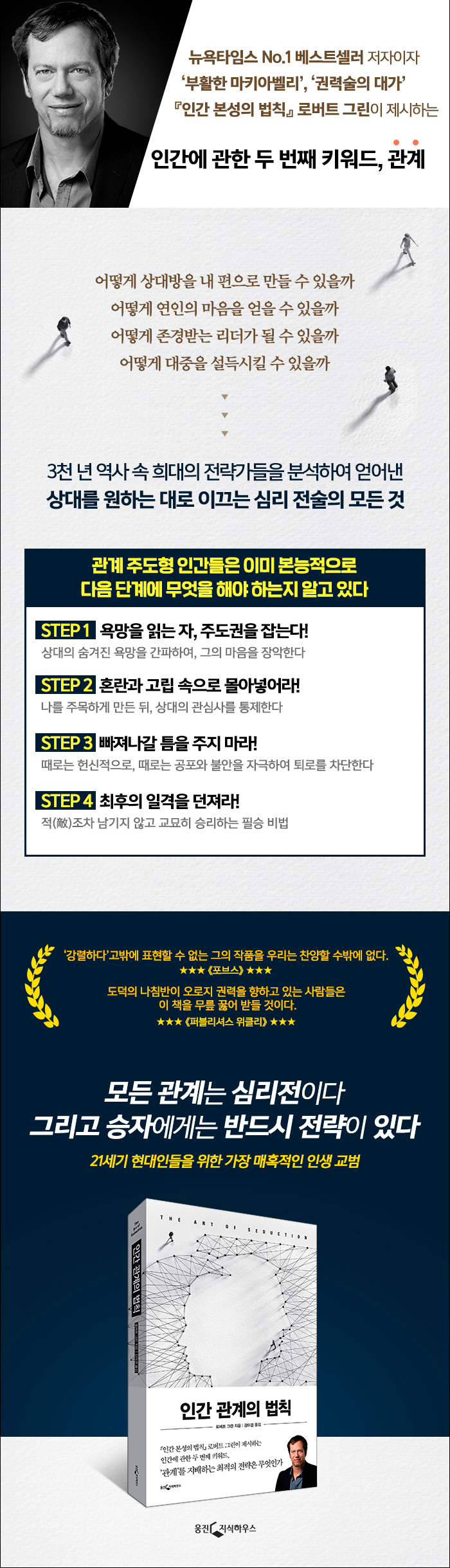
The author assumes that "seduction" is the core strategy for transferring power in human relationships, and by selecting examples of outstanding seducers from classics and history, he meticulously analyzes nine character types and 24 strategies that lead relationships.
From Cleopatra, who wrote the last chapter of ancient Egypt, to Zhou Enlai, a politician who led the cooperation between China and Taiwan, to John F.
Kennedy, and Andy Warhol, who became an icon of modern art by changing the way they promoted themselves 180 degrees, provide a compelling example of typical seduction strategies.
This book is largely divided into two parts.
Part 1, "9 Types of Seducers," breaks down all seducers into nine types.
The author says that everyone has attributes that fall into one of nine types, and that identifying your type is the beginning of relationship strategy.
Part 2, "24 Strategies to Lead Relationships," demonstrates practical techniques for winning others over.
Based on fundamental human psychology, the entire process of seduction is described in detail, from the moment of approaching the target to the final moment of completing the seduction strategy.
In addition, we also added a thorough analysis of the types of people who are ‘unable to take the lead in relationships’ and ‘people who are prone to becoming victims in relationships.’
Just as you must know your enemy to win, you must know yourself to avoid defeat.
The era of the victor who fights, steals, and oppresses is over!
The most fascinating life guide for 21st-century modern people
How can you win the hearts of your voters, how can you become not only a competent leader but also a respected boss, how can you win the heart of your lover…
True power in a relationship comes not from outward displays of authority, but from the ability to subtly penetrate and control the other person's heart.
If I could just get the other person to voluntarily give me what I want, that would be the best strategy.
In uncertain and unstable times, what is needed is not a strategy to become a one-shot winner, but to remain a sustainable powerhouse.
The era of the victor who fights, steals, and suppresses is over.
Those who can win hearts and captivate others are the ones who can remain truly strong.
So, no matter who you are or who your opponents are, this book is not a strategy to defeat and destroy others, but rather a guide to elegant human relations that will help you master yourself and cultivate a captivating power from within, leading to elegant victory in life and business.
A chance to see Robert Greene's true colors again.
Robert Greene, who emerged as a master of the art of power, earning the titles of “The Prince” and “Revived Machiavelli” with his trilogy of “The Laws of Power,” “The Art of War,” and “The Art of Seduction.”
His books, which have consistently explored the power that dominates human society and the desires that pursue it, have garnered an unusual following from hip-hop artists (Jay-Z, Kanye West, Drake, etc.) who are major pillars of modern American popular culture, and have generated a lot of buzz, from rumors that the late Fidel Castro read them to information that they are one of the most checked out books in American prisons.
Along with Robert Greene's widespread popularity as a writer, these are examples of how his insightful ideas have been followed by those seeking power in life's battles and in business.
Another important characteristic of his books, which delve into a single topic with honesty, is their vast volume.
His books, so-called "brick books" because they are too thick to be carried around and read easily, have an average page count of 636 pages (based on the 6 books published in Korea).
This is thanks to the writer's outstanding talent for drawing on numerous references from classics and history and analyzing them with insight and wisdom appropriate for modern society.
Accordingly, one of his representative trilogy, 『The Art of Seduction』, has been re-edited and republished as the definitive, easier-to-read 『The Laws of Human Relationships』, focusing on the core theme of 'types and strategies that lead human relationships.'
This will be an opportunity to once again see the true face of Robert Greene, the author with a monstrous writing ability that has captivated 2 million readers around the world.
Human nature is never good, and all relationships are psychological warfare!
If you don't lead, someone else will drag you along.
While his most recent work, The Laws of Human Nature, explores the inner drives and motivations of human beings, this book explores the power that governs relationships between people and the dynamics that drive it.
In particular, it focuses on the way in which the weak, who are farthest from the existing strong who hold visible power, use their base to gain power.
People who easily take the lead, that is, power, in human relationships already have this skill instinctively.
A person who leads conversations without hesitation in any situation, a person who doesn't back down even in front of their boss at work and pushes ahead with their own opinions, a person who is exceptionally popular with the opposite sex, a star politician who receives all the public's attention...
Whether it's a one-on-one relationship or a relationship with many people, one person in the group always takes the lead in the relationship.
In other words, all humans fall into one of two types: either 'relationship leaders' or 'relationship leaders.'
Relationship-driven people can have a positive influence on others through their positive energy, but they also often exert a negative influence by manipulating others for their own benefit.
There are common character types, like bad friends or bad dates, and there are also rarer ones, like con artists, cult leaders, and dictators, who seriously ruin many lives.
What's even more remarkable is that these relationship-driven strategists use invisible techniques.
The ultimate psychological tactic to win over any opponent
9 Types and 24 Strategies for Captivating and Leading People
The author assumes that "seduction" is the core strategy for transferring power in human relationships, and by selecting examples of outstanding seducers from classics and history, he meticulously analyzes nine character types and 24 strategies that lead relationships.
From Cleopatra, who wrote the last chapter of ancient Egypt, to Zhou Enlai, a politician who led the cooperation between China and Taiwan, to John F.
Kennedy, and Andy Warhol, who became an icon of modern art by changing the way they promoted themselves 180 degrees, provide a compelling example of typical seduction strategies.
This book is largely divided into two parts.
Part 1, "9 Types of Seducers," breaks down all seducers into nine types.
The author says that everyone has attributes that fall into one of nine types, and that identifying your type is the beginning of relationship strategy.
Part 2, "24 Strategies to Lead Relationships," demonstrates practical techniques for winning others over.
Based on fundamental human psychology, the entire process of seduction is described in detail, from the moment of approaching the target to the final moment of completing the seduction strategy.
In addition, we also added a thorough analysis of the types of people who are ‘unable to take the lead in relationships’ and ‘people who are prone to becoming victims in relationships.’
Just as you must know your enemy to win, you must know yourself to avoid defeat.
The era of the victor who fights, steals, and oppresses is over!
The most fascinating life guide for 21st-century modern people
How can you win the hearts of your voters, how can you become not only a competent leader but also a respected boss, how can you win the heart of your lover…
True power in a relationship comes not from outward displays of authority, but from the ability to subtly penetrate and control the other person's heart.
If I could just get the other person to voluntarily give me what I want, that would be the best strategy.
In uncertain and unstable times, what is needed is not a strategy to become a one-shot winner, but to remain a sustainable powerhouse.
The era of the victor who fights, steals, and suppresses is over.
Those who can win hearts and captivate others are the ones who can remain truly strong.
So, no matter who you are or who your opponents are, this book is not a strategy to defeat and destroy others, but rather a guide to elegant human relations that will help you master yourself and cultivate a captivating power from within, leading to elegant victory in life and business.
GOODS SPECIFICS
- Date of issue: February 25, 2020
- Page count, weight, size: 320 pages | 506g | 140*210*30mm
- ISBN13: 9788901239866
- ISBN10: 8901239868
You may also like
카테고리
korean


korean

![GQ KOREA Mark (Monthly): December [2025]](http://librairie.coreenne.fr/cdn/shop/files/8ef265dbbfbf186523ed75ba7319009d.jpg?v=1765340328&width=3840)


