

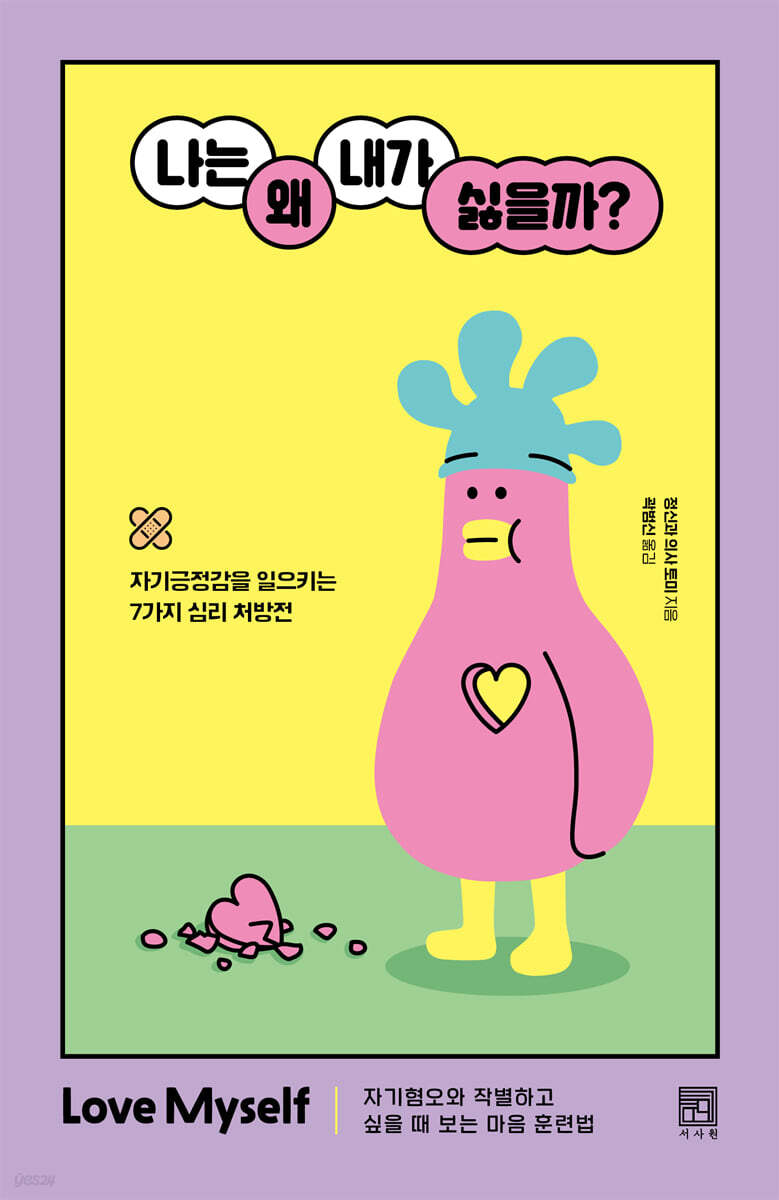
Why do I hate myself?
 |
Description
Book Introduction
“The feeling of hatred for myself is born from the process of evaluating myself.”
A psychiatrist who led 200,000 patients to the light
7 Everyday Thinking Techniques That Don't Make You Hate Me &
8 Challenges to Turn Inferiority Feelings into Goals
In our daily lives, we encounter moments when we 'dislike ourselves' more easily than we think.
When I look back on the day and regret, thinking, “I shouldn’t have said that,” there are times when I feel disappointed in myself and internally scold myself, saying, “I really hate myself for being like this.”
This feeling of not being able to accept yourself as you are and hating yourself is self-hatred, and feeling that you are inferior to others and further increasing self-hatred is an inferiority complex.
These two emotions often overwhelm our thoughts and shake up our daily lives.
Many people want to escape these feelings, but are at a loss as to how to do so.
“Why Do I Hate Myself?” is a book that started from such concerns.
The author, a psychiatrist who has counseled 200,000 clients and nurtured countless hearts, emphasizes that self-loathing and feelings of inferiority are universal emotions experienced by everyone. In today's society, where we constantly compare ourselves to others through social media and prioritize performance and efficiency, it's difficult to live without feeling self-loathing.
The author says that if you can avoid falling into the swamp of self-loathing and turn it into a positive force, you can use it to move toward the life you want.
To help readers who want to change their lives, this book analyzes the causes and triggers of self-loathing, divides it into seven types, and suggests different psychological treatments for each.
It also includes specific mind training methods that can be put into practice in everyday life to help you break free from the shackles of self-loathing and live your own life with peace of mind.
The 'Why Me' series is a humanities self-development series that easily and comfortably solves concerns that anyone can easily face in their daily lives from the perspective of brain science and psychology.
Through this book, readers will be able to accurately examine their emotions, identify their causes, and find solutions for everything from minor everyday inconveniences to deep-seated inner problems.
Instead of blaming myself, I hope this will be a warm and kind guide to helping me grow into a person who understands myself and leads my life in a better direction.
A psychiatrist who led 200,000 patients to the light
7 Everyday Thinking Techniques That Don't Make You Hate Me &
8 Challenges to Turn Inferiority Feelings into Goals
In our daily lives, we encounter moments when we 'dislike ourselves' more easily than we think.
When I look back on the day and regret, thinking, “I shouldn’t have said that,” there are times when I feel disappointed in myself and internally scold myself, saying, “I really hate myself for being like this.”
This feeling of not being able to accept yourself as you are and hating yourself is self-hatred, and feeling that you are inferior to others and further increasing self-hatred is an inferiority complex.
These two emotions often overwhelm our thoughts and shake up our daily lives.
Many people want to escape these feelings, but are at a loss as to how to do so.
“Why Do I Hate Myself?” is a book that started from such concerns.
The author, a psychiatrist who has counseled 200,000 clients and nurtured countless hearts, emphasizes that self-loathing and feelings of inferiority are universal emotions experienced by everyone. In today's society, where we constantly compare ourselves to others through social media and prioritize performance and efficiency, it's difficult to live without feeling self-loathing.
The author says that if you can avoid falling into the swamp of self-loathing and turn it into a positive force, you can use it to move toward the life you want.
To help readers who want to change their lives, this book analyzes the causes and triggers of self-loathing, divides it into seven types, and suggests different psychological treatments for each.
It also includes specific mind training methods that can be put into practice in everyday life to help you break free from the shackles of self-loathing and live your own life with peace of mind.
The 'Why Me' series is a humanities self-development series that easily and comfortably solves concerns that anyone can easily face in their daily lives from the perspective of brain science and psychology.
Through this book, readers will be able to accurately examine their emotions, identify their causes, and find solutions for everything from minor everyday inconveniences to deep-seated inner problems.
Instead of blaming myself, I hope this will be a warm and kind guide to helping me grow into a person who understands myself and leads my life in a better direction.
- You can preview some of the book's contents.
Preview
index
Preface to the Korean edition
Chapter 1: Why Do I Hate Myself?
The identity of the self-loathing that makes me hate myself
Why I Fall Into Self-Loathing
Six Causes of Self-Loathing
Why It's Okay to Not Like Yourself
The difference between people who hate themselves and those who don't
Hints for Overcoming Self-Loathing
Chapter 2: Examining the Seven Types of Self-Loathing
The Deep Link Between Upbringing and Self-Loathing
Find out your self-loathing type
Chapter 3: A Prescription for Escape from Self-Loathing
① Perfectionism Type: Recognizing Perfectionism
② Multi-talented type: Helping others
③ Type of comparison with others: Matching actions and thoughts
④ Self-censoring type: Focus on the present
⑤Normative Thinking Type: Writing about your thoughts and feelings
⑥ The type that cannot refuse: Objectively assessing one's own situation
⑦ Good Person Complex Type: Prioritizing Choices
Chapter 4: How to Confront Inferiority Complexes That Cause Self-Loathing
The 'inferiority complex' at the root of self-loathing
Why does inferiority complex arise?
There is no one in the world without an inferiority complex.
Inferiority is never a flaw.
Six Ways to Skillfully Confront Inferiority Complexes
What you can only see when you shake off self-loathing
Chapter 5: Practical Tasks for Overcoming Self-Loathing and Inferiority Feelings
Turning the causes of self-loathing and inferiority into goals
In conclusion
Chapter 1: Why Do I Hate Myself?
The identity of the self-loathing that makes me hate myself
Why I Fall Into Self-Loathing
Six Causes of Self-Loathing
Why It's Okay to Not Like Yourself
The difference between people who hate themselves and those who don't
Hints for Overcoming Self-Loathing
Chapter 2: Examining the Seven Types of Self-Loathing
The Deep Link Between Upbringing and Self-Loathing
Find out your self-loathing type
Chapter 3: A Prescription for Escape from Self-Loathing
① Perfectionism Type: Recognizing Perfectionism
② Multi-talented type: Helping others
③ Type of comparison with others: Matching actions and thoughts
④ Self-censoring type: Focus on the present
⑤Normative Thinking Type: Writing about your thoughts and feelings
⑥ The type that cannot refuse: Objectively assessing one's own situation
⑦ Good Person Complex Type: Prioritizing Choices
Chapter 4: How to Confront Inferiority Complexes That Cause Self-Loathing
The 'inferiority complex' at the root of self-loathing
Why does inferiority complex arise?
There is no one in the world without an inferiority complex.
Inferiority is never a flaw.
Six Ways to Skillfully Confront Inferiority Complexes
What you can only see when you shake off self-loathing
Chapter 5: Practical Tasks for Overcoming Self-Loathing and Inferiority Feelings
Turning the causes of self-loathing and inferiority into goals
In conclusion
Into the book
Modern society is changing at an incredible pace.
With the proliferation of smartphones and social media, we live in an age where we can constantly connect with others and share information instantly.
But these "relationships" sometimes cast a heavy shadow over our hearts. On social media, everyone tends to portray a "perfect version of themselves."
Glamorous travel photos, posts flaunting success, and idealized lifestyles.
Surrounded by such dazzling images, we naturally compare ourselves to others.
But this comparison creates self-loathing, belittling us with thoughts like, "I'm wrong," "I need to try harder," and "Why can't I do this better?"
In these times, facing self-loathing is a challenge no one can avoid.
The problem arises when this feeling becomes excessive and drives us into a corner.
In this book, I propose that instead of viewing self-loathing as an "enemy" and trying to drive it out, we embrace that feeling.
It won't disappear overnight, but if you face your self-loathing little by little, your heart will definitely begin to feel lighter.
--- p.4
As we go through life, we are faced with countless decisions and actions to take every day.
But choosing something also means not choosing something.
And people prone to self-loathing are prone to anxiety, thinking, "What if my decisions or actions lead to failure?" or "What if I cause trouble to someone?"
As a result, you end up not liking yourself.
And people who are prone to self-loathing choose to hate themselves as a way to avoid this anxiety.
If things didn't go as planned, if others were right, it was the fault of the 'me who hates', and it was natural for me to hate myself, so I tried to relieve my anxiety.
But this way, you will only end up hating yourself more and more.
Every time you feel like something isn't working out, you blame yourself and have more reasons to hate yourself.
Even if things go well, you end up thinking, 'This is bound to work out, anyone can do it.'
Once self-loathing becomes a habit, you gradually become unable to see yourself positively.
--- p.13
In fact, the act of ‘letting go of self-loathing’ is also a way to affirm yourself.
The concept of self-affirmation is so abstract that it's not easy to get a clear picture of it in your head.
Therefore, the first step to applying specific actions for self-affirmation to your life can be to start by ‘letting go of self-loathing.’
In other words, this could be expressed as a ‘passive form of self-affirmation.’
So, how can we specifically overcome self-loathing? To do so, we need to carefully reflect on when we begin to dislike ourselves.
In fact, in the course of our daily lives, moments when we think, 'I hate myself' do not occur that often.
As I mentioned before, such moments tend to come unexpectedly and without warning.
--- p.37
Self-loathing occurs when you compare yourself to something else.
That something could be someone else, or it could be a high ideal within yourself.
Based on this logic, it can be seen that the higher one's ideals, the more likely one is to fall into self-loathing due to the discrepancy between them and reality.
A person with high ideals is what is called a 'perfectionist'.
Perfectionists set goals that are higher than necessary and strive to achieve them.
I cannot tolerate the mindset of, ‘This will be enough’ or ‘Moderation will do.’
They are commonly characterized by high levels of anxiety, low self-esteem, and poor prioritization.
But the problem is that many people don't realize that they are perfectionists.
This is because they perceive it as natural to aim high. However, even with one or more high goals, things often don't go as planned.
At that moment, the thought that I hadn't even done what I should have done crossed my mind and I fell into self-loathing.
--- p.46
The reason why it is difficult to get rid of inferiority complex is because it is not a simple emotion, but an emotion that is deeply rooted in one's personality, complexly intertwined with factors such as the environment in which one grew up, one's way of thinking, and one's personality.
It is a very strong and stubborn emotion.
One of the symptoms of mental illness is a symptom called ‘delusion.’
Delusions have the following characteristics:
'I am convinced even though the content is unrealistic and different from the truth', 'I cannot accept it no matter how much evidence is presented to correct it'.
Doesn't this sound similar to the characteristics of the inferiority complex I mentioned earlier? Inferiority complexes, too, are sometimes similar to delusions in that they're difficult to correct.
However, there are some differences between delusion and inferiority complex.
The most important difference is that feelings of inferiority can be recognized by oneself and can be changed little by little through effort.
This is a matter of changing your values, so it is not something that can be easily solved in a short period of time, but it is certainly possible to gradually eliminate your inferiority complex.
--- p.116
I believe that the act of writing is the most fundamental task for overcoming a certain state of mind.
The reason why our worries are not easily resolved is because they are not clearly verbalized.
If you don't verbalize it, you can't even tell what you're thinking about.
Of course, no solution comes to mind, and only vague and frustrating feelings continue.
Also, if your worries are not organized into words, their substance or outline will not clearly emerge.
If your identity is unclear, your anxiety will only increase.
It's like walking through fog.
The same goes for self-loathing.
It is necessary to write down as specifically as possible when, in what situation, and about what you feel self-loathing.
Also, as you become accustomed to writing, you will be able to naturally verbalize various worries and emotions in your life.
Then it becomes easier to find clues to all kinds of worries other than self-loathing.
With the proliferation of smartphones and social media, we live in an age where we can constantly connect with others and share information instantly.
But these "relationships" sometimes cast a heavy shadow over our hearts. On social media, everyone tends to portray a "perfect version of themselves."
Glamorous travel photos, posts flaunting success, and idealized lifestyles.
Surrounded by such dazzling images, we naturally compare ourselves to others.
But this comparison creates self-loathing, belittling us with thoughts like, "I'm wrong," "I need to try harder," and "Why can't I do this better?"
In these times, facing self-loathing is a challenge no one can avoid.
The problem arises when this feeling becomes excessive and drives us into a corner.
In this book, I propose that instead of viewing self-loathing as an "enemy" and trying to drive it out, we embrace that feeling.
It won't disappear overnight, but if you face your self-loathing little by little, your heart will definitely begin to feel lighter.
--- p.4
As we go through life, we are faced with countless decisions and actions to take every day.
But choosing something also means not choosing something.
And people prone to self-loathing are prone to anxiety, thinking, "What if my decisions or actions lead to failure?" or "What if I cause trouble to someone?"
As a result, you end up not liking yourself.
And people who are prone to self-loathing choose to hate themselves as a way to avoid this anxiety.
If things didn't go as planned, if others were right, it was the fault of the 'me who hates', and it was natural for me to hate myself, so I tried to relieve my anxiety.
But this way, you will only end up hating yourself more and more.
Every time you feel like something isn't working out, you blame yourself and have more reasons to hate yourself.
Even if things go well, you end up thinking, 'This is bound to work out, anyone can do it.'
Once self-loathing becomes a habit, you gradually become unable to see yourself positively.
--- p.13
In fact, the act of ‘letting go of self-loathing’ is also a way to affirm yourself.
The concept of self-affirmation is so abstract that it's not easy to get a clear picture of it in your head.
Therefore, the first step to applying specific actions for self-affirmation to your life can be to start by ‘letting go of self-loathing.’
In other words, this could be expressed as a ‘passive form of self-affirmation.’
So, how can we specifically overcome self-loathing? To do so, we need to carefully reflect on when we begin to dislike ourselves.
In fact, in the course of our daily lives, moments when we think, 'I hate myself' do not occur that often.
As I mentioned before, such moments tend to come unexpectedly and without warning.
--- p.37
Self-loathing occurs when you compare yourself to something else.
That something could be someone else, or it could be a high ideal within yourself.
Based on this logic, it can be seen that the higher one's ideals, the more likely one is to fall into self-loathing due to the discrepancy between them and reality.
A person with high ideals is what is called a 'perfectionist'.
Perfectionists set goals that are higher than necessary and strive to achieve them.
I cannot tolerate the mindset of, ‘This will be enough’ or ‘Moderation will do.’
They are commonly characterized by high levels of anxiety, low self-esteem, and poor prioritization.
But the problem is that many people don't realize that they are perfectionists.
This is because they perceive it as natural to aim high. However, even with one or more high goals, things often don't go as planned.
At that moment, the thought that I hadn't even done what I should have done crossed my mind and I fell into self-loathing.
--- p.46
The reason why it is difficult to get rid of inferiority complex is because it is not a simple emotion, but an emotion that is deeply rooted in one's personality, complexly intertwined with factors such as the environment in which one grew up, one's way of thinking, and one's personality.
It is a very strong and stubborn emotion.
One of the symptoms of mental illness is a symptom called ‘delusion.’
Delusions have the following characteristics:
'I am convinced even though the content is unrealistic and different from the truth', 'I cannot accept it no matter how much evidence is presented to correct it'.
Doesn't this sound similar to the characteristics of the inferiority complex I mentioned earlier? Inferiority complexes, too, are sometimes similar to delusions in that they're difficult to correct.
However, there are some differences between delusion and inferiority complex.
The most important difference is that feelings of inferiority can be recognized by oneself and can be changed little by little through effort.
This is a matter of changing your values, so it is not something that can be easily solved in a short period of time, but it is certainly possible to gradually eliminate your inferiority complex.
--- p.116
I believe that the act of writing is the most fundamental task for overcoming a certain state of mind.
The reason why our worries are not easily resolved is because they are not clearly verbalized.
If you don't verbalize it, you can't even tell what you're thinking about.
Of course, no solution comes to mind, and only vague and frustrating feelings continue.
Also, if your worries are not organized into words, their substance or outline will not clearly emerge.
If your identity is unclear, your anxiety will only increase.
It's like walking through fog.
The same goes for self-loathing.
It is necessary to write down as specifically as possible when, in what situation, and about what you feel self-loathing.
Also, as you become accustomed to writing, you will be able to naturally verbalize various worries and emotions in your life.
Then it becomes easier to find clues to all kinds of worries other than self-loathing.
--- p.148
Publisher's Review
In an age where it's easy to hate yourself through comparison and evaluation,
A psychiatrist's psychological prescription for a mind shaken by self-loathing
How many people would readily answer "yes" to the question, "Do you love yourself?" Conversely, how many would firmly say "no" to the question, "Do you hate yourself?" Many people aspire to be "people with high self-esteem," accepting themselves for who they are.
But in reality, it's far more common to find ourselves unable to accept ourselves as we are, and sometimes even living with a self-loathing. In an age where social media has become deeply ingrained in our daily lives, we naturally compare ourselves to others, and in a performance-oriented society, we often find ourselves feeling inferior as we constantly discover "someone better than us."
The more this happens, the deeper the disappointment and self-loathing towards oneself becomes.
The author, a spiritual mentor for the Japanese 2030 generation with 390,000 followers, has counseled countless young people and personally confirmed that many of them hate themselves and are in pain.
We've all had the experience of berating ourselves and criticizing ourselves by saying things like, "I'm wrong," "I need to try harder," or "Why can't I do more than this?"
The author says he wrote this book in the hopes of being of some help to such people.
The author says:
“You can start by facing the feeling of self-loathing and gradually reducing the ‘dislike’.”
This book is a psychological guide to help you make that change.
I hope this book will be a small guidebook that you can easily open and refer to whenever you feel tired and worn out, containing practical methods and mind training methods that can be applied directly to daily life.
From the roots of inferiority complex to patterns of self-loathing
5-Step Mind Training to Transform Your Daily Life
This book calmly unravels 'self-loathing' and 'inferiority complex', which we often encounter but find difficult to talk about.
Chapter 1 examines self-loathing from a psychological perspective and explores why people hate themselves.
This helps readers understand that their emotions are not a personal flaw, but a universal experience shared by many.
Chapter 2 introduces the seven types of self-loathing identified by the author.
From perfectionist, multi-talented, comparative, self-censoring, normative, intransigent, and good-guy complex types—the characteristics of each type are specifically pointed out, allowing readers to check their own patterns.
Chapter 3 presents psychological prescriptions tailored to each type.
Additionally, through the 'Tommy Counseling Room' corner, you can indirectly see how to apply the theory to everyday life by consulting on real-life cases.
Chapter 4 deals with the identity of the inferiority complex that lies at the core of self-loathing.
It explains in detail how inferiority complex is formed, why this feeling exists in everyone, and how to deal with it in a healthy way.
This chapter provides a crucial foundation for understanding self-loathing.
Chapter 5 proposes action tasks to help you put the above into practice in your daily life.
From how to record your emotions to small daily exercises to adjust your mindset, it contains practical ways to take care of yourself.
Self-loathing sometimes makes us lonely and robs us of the joy of life, but behind it lies the desire to be happy.
Throughout this book, the author's heart is filled with the hope that it will serve as a solid guide for readers to discover that desire for themselves and take the first step toward loving themselves.
I hope that through this book, readers will reflect on their emotions, form new relationships with themselves, and build small happiness in their daily lives.
A psychiatrist's psychological prescription for a mind shaken by self-loathing
How many people would readily answer "yes" to the question, "Do you love yourself?" Conversely, how many would firmly say "no" to the question, "Do you hate yourself?" Many people aspire to be "people with high self-esteem," accepting themselves for who they are.
But in reality, it's far more common to find ourselves unable to accept ourselves as we are, and sometimes even living with a self-loathing. In an age where social media has become deeply ingrained in our daily lives, we naturally compare ourselves to others, and in a performance-oriented society, we often find ourselves feeling inferior as we constantly discover "someone better than us."
The more this happens, the deeper the disappointment and self-loathing towards oneself becomes.
The author, a spiritual mentor for the Japanese 2030 generation with 390,000 followers, has counseled countless young people and personally confirmed that many of them hate themselves and are in pain.
We've all had the experience of berating ourselves and criticizing ourselves by saying things like, "I'm wrong," "I need to try harder," or "Why can't I do more than this?"
The author says he wrote this book in the hopes of being of some help to such people.
The author says:
“You can start by facing the feeling of self-loathing and gradually reducing the ‘dislike’.”
This book is a psychological guide to help you make that change.
I hope this book will be a small guidebook that you can easily open and refer to whenever you feel tired and worn out, containing practical methods and mind training methods that can be applied directly to daily life.
From the roots of inferiority complex to patterns of self-loathing
5-Step Mind Training to Transform Your Daily Life
This book calmly unravels 'self-loathing' and 'inferiority complex', which we often encounter but find difficult to talk about.
Chapter 1 examines self-loathing from a psychological perspective and explores why people hate themselves.
This helps readers understand that their emotions are not a personal flaw, but a universal experience shared by many.
Chapter 2 introduces the seven types of self-loathing identified by the author.
From perfectionist, multi-talented, comparative, self-censoring, normative, intransigent, and good-guy complex types—the characteristics of each type are specifically pointed out, allowing readers to check their own patterns.
Chapter 3 presents psychological prescriptions tailored to each type.
Additionally, through the 'Tommy Counseling Room' corner, you can indirectly see how to apply the theory to everyday life by consulting on real-life cases.
Chapter 4 deals with the identity of the inferiority complex that lies at the core of self-loathing.
It explains in detail how inferiority complex is formed, why this feeling exists in everyone, and how to deal with it in a healthy way.
This chapter provides a crucial foundation for understanding self-loathing.
Chapter 5 proposes action tasks to help you put the above into practice in your daily life.
From how to record your emotions to small daily exercises to adjust your mindset, it contains practical ways to take care of yourself.
Self-loathing sometimes makes us lonely and robs us of the joy of life, but behind it lies the desire to be happy.
Throughout this book, the author's heart is filled with the hope that it will serve as a solid guide for readers to discover that desire for themselves and take the first step toward loving themselves.
I hope that through this book, readers will reflect on their emotions, form new relationships with themselves, and build small happiness in their daily lives.
GOODS SPECIFICS
- Date of issue: December 20, 2025
- Page count, weight, size: 164 pages | 130*200*10mm
- ISBN13: 9791168224834
You may also like
카테고리
korean


korean

![GQ KOREA Mark (Monthly): December [2025]](http://librairie.coreenne.fr/cdn/shop/files/8ef265dbbfbf186523ed75ba7319009d.jpg?v=1765340328&width=3840)


