

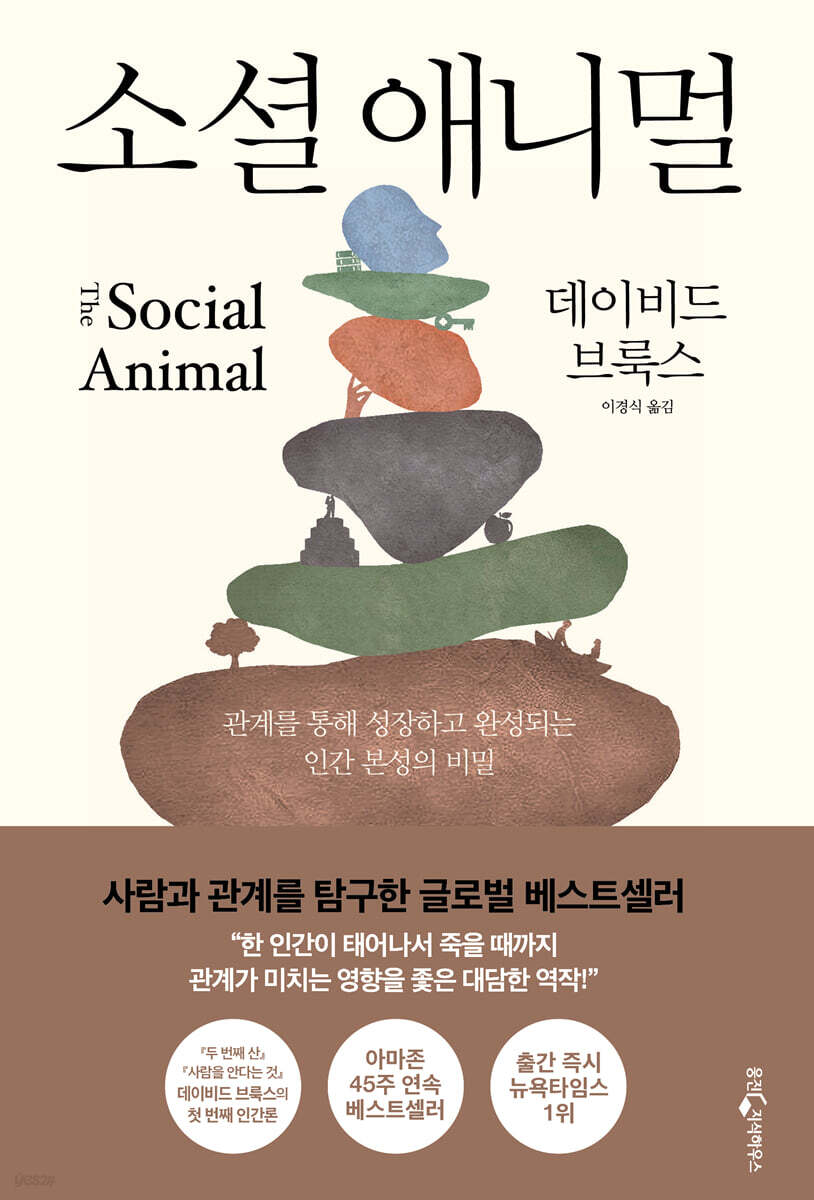
social animal
 |
Description
Book Introduction
★ #1 New York Times Bestseller immediately after publication ★
★ Amazon Bestseller for 45 Consecutive Weeks ★
★ Overwhelming praise from leading media outlets such as the Wall Street Journal, the Guardian, and Newsweek ★
The Second Mountain: Knowing People
David Brooks's Origins of Relational Exploration
From the time a human is born until he dies
A bold masterpiece that explores the impact of relationships.
The monumental masterpiece of America's leading journalist David Brooks is finally being republished.
Having observed society with a keen eye for decades and keenly grasped the trends of the times, he began to question the absurd failures that were repeated in various systems and policies of modern society.
And 『The Social Animal』, which meticulously uncovers the causes from various personal and socio-cultural perspectives, is a controversial work that overturns existing perceptions of what drives our achievements and happiness, and immediately caused a stir in all areas of society, including education, politics, and culture, upon its publication.
It also accurately reflects the vast academic achievements exploring human relationships onto various processes in life, such as parenting, education, love, family, culture, success, marriage, politics, morality, and aging, earning it the reputation of “comprehending the wisdom of life that can be gained from reading a million books in one book.”
What leads our lives to happiness and satisfaction? The author finds the answer in deep interactions with others.
Relationships are not something we can choose, nor are they a tool of worldly wisdom we must hone to gain an advantage over others.
Relationships are the foundation of human nature, and each interaction is a wondrous experience deeply engraved in the subconscious.
This great exploration, which crosses the boundaries of various disciplines and examines the dynamics of encounters that a person encounters from birth to death, is the starting point of David Brooks' philosophy of life, 'relationism', and serves as the foundation for the weighty questions raised in his later books, 'The Second Mountain' and 'Knowing People'.
This bold attempt to follow the lives of two people, Harold and Erica, and unfold the captivating insights they finally come to as they face death will redefine the meaning of success and happiness, offering a deeper perspective that will challenge you to look at life in a new way.
★ Amazon Bestseller for 45 Consecutive Weeks ★
★ Overwhelming praise from leading media outlets such as the Wall Street Journal, the Guardian, and Newsweek ★
The Second Mountain: Knowing People
David Brooks's Origins of Relational Exploration
From the time a human is born until he dies
A bold masterpiece that explores the impact of relationships.
The monumental masterpiece of America's leading journalist David Brooks is finally being republished.
Having observed society with a keen eye for decades and keenly grasped the trends of the times, he began to question the absurd failures that were repeated in various systems and policies of modern society.
And 『The Social Animal』, which meticulously uncovers the causes from various personal and socio-cultural perspectives, is a controversial work that overturns existing perceptions of what drives our achievements and happiness, and immediately caused a stir in all areas of society, including education, politics, and culture, upon its publication.
It also accurately reflects the vast academic achievements exploring human relationships onto various processes in life, such as parenting, education, love, family, culture, success, marriage, politics, morality, and aging, earning it the reputation of “comprehending the wisdom of life that can be gained from reading a million books in one book.”
What leads our lives to happiness and satisfaction? The author finds the answer in deep interactions with others.
Relationships are not something we can choose, nor are they a tool of worldly wisdom we must hone to gain an advantage over others.
Relationships are the foundation of human nature, and each interaction is a wondrous experience deeply engraved in the subconscious.
This great exploration, which crosses the boundaries of various disciplines and examines the dynamics of encounters that a person encounters from birth to death, is the starting point of David Brooks' philosophy of life, 'relationism', and serves as the foundation for the weighty questions raised in his later books, 'The Second Mountain' and 'Knowing People'.
This bold attempt to follow the lives of two people, Harold and Erica, and unfold the captivating insights they finally come to as they face death will redefine the meaning of success and happiness, offering a deeper perspective that will challenge you to look at life in a new way.
- You can preview some of the book's contents.
Preview
index
Introduction: What Leads Us to Achievement and Happiness
Part 1: The Birth of Social Animals
Chapter 1: First Encounter: The Secret of the Flame That Recognizes Your Destiny
Chapter 2 Marriage: How Two Completely Different People Can Live Together
Chapter 3: Bonding: Humans Know How to Relate from the Moment They Are Born
Chapter 4 Identity: What Changes When Self-Awareness Achieves
Chapter 5: Attachment: Planting Solid Roots in Life
Part 2: What Makes Us Grow
Chapter 6: Teach so that educational ideas naturally boil over.
Chapter 7: The Difference Between Those Who Inherit Poverty and Those Who Do Not
Chapter 8 Self-Control Why can't I even control myself?
Chapter 9: Shaking Off the Heavy Shadow of the Cultural Family
Chapter 10: Traps that Smart People Fall Into
Part 3: The Path to True Success
Chapter 11: Why We Need to Understand Other People's Needs
Chapter 12: Wandering: When to Worry About a Better Life
Chapter 13: Love: The Pleasure of Becoming One with Someone Other Than Oneself
Chapter 14: Failure We fail when we forget that we are social animals.
Chapter 15 Problem Solving: The Secret You'll Know at First Sight
Chapter 16 Leadership: What Wise Leaders Never Do
Part 4: Am I Living Well?
Chapter 17: Loneliness: The Inside Story of a Couple Who Hated Each Other
Chapter 18 Morality: Reason or Emotion?
Chapter 19: The Art of Elegant Persuasion: Turning Political Opponents into Your Own People
Chapter 20: A Social Legacy for the Next Generation
Chapter 21: A Second Life in Old Age: Find Something That Makes Your Heart Beat
Chapter 22: Death: Was My Life Meaningful?
Letter from the author
Acknowledgements
Translator's Note
Part 1: The Birth of Social Animals
Chapter 1: First Encounter: The Secret of the Flame That Recognizes Your Destiny
Chapter 2 Marriage: How Two Completely Different People Can Live Together
Chapter 3: Bonding: Humans Know How to Relate from the Moment They Are Born
Chapter 4 Identity: What Changes When Self-Awareness Achieves
Chapter 5: Attachment: Planting Solid Roots in Life
Part 2: What Makes Us Grow
Chapter 6: Teach so that educational ideas naturally boil over.
Chapter 7: The Difference Between Those Who Inherit Poverty and Those Who Do Not
Chapter 8 Self-Control Why can't I even control myself?
Chapter 9: Shaking Off the Heavy Shadow of the Cultural Family
Chapter 10: Traps that Smart People Fall Into
Part 3: The Path to True Success
Chapter 11: Why We Need to Understand Other People's Needs
Chapter 12: Wandering: When to Worry About a Better Life
Chapter 13: Love: The Pleasure of Becoming One with Someone Other Than Oneself
Chapter 14: Failure We fail when we forget that we are social animals.
Chapter 15 Problem Solving: The Secret You'll Know at First Sight
Chapter 16 Leadership: What Wise Leaders Never Do
Part 4: Am I Living Well?
Chapter 17: Loneliness: The Inside Story of a Couple Who Hated Each Other
Chapter 18 Morality: Reason or Emotion?
Chapter 19: The Art of Elegant Persuasion: Turning Political Opponents into Your Own People
Chapter 20: A Social Legacy for the Next Generation
Chapter 21: A Second Life in Old Age: Find Something That Makes Your Heart Beat
Chapter 22: Death: Was My Life Meaningful?
Letter from the author
Acknowledgements
Translator's Note
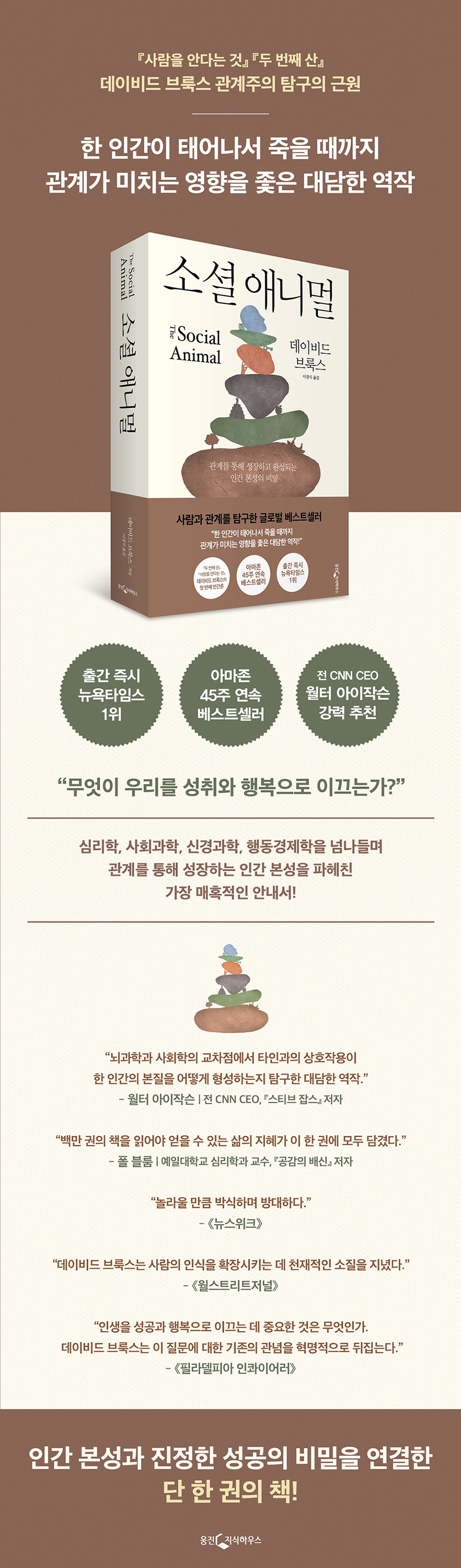
Detailed image
Publisher's Review
“Our lives should aim not higher, but deeper.”
― A revolutionary exploration that overturns our perceptions of success and happiness.
Who do we consider successful?
A genius born with exceptional talent or intelligence? A graduate of a prestigious university and working at a prestigious company? A wealthy person who has amassed a staggering amount of money? The author argues that while countless celebrities and millions of books have talked about success and advancement, most of these emphasize academic ability, IQ, and diligence, dealing only with the superficial aspects of life.
However, the dictionary definition of success is “achieving one’s goal.”
This means that the meaning and direction of life can change depending on what you consider important.
The author argues that if we focus on the external aspects of life and become obsessed with climbing the ladder, we miss the essence of life.
At the same time, we constantly ask ourselves what are the 'qualities of success' that enable a person to achieve outstanding achievements and feel deep happiness in life.
This book finds the answer in relationships.
Each interaction we have with our parents, teachers, children, friends, colleagues, and the culture that surrounds us is deeply engraved in our subconscious and becomes the foundation of our individuality.
It is relationships that lead to outstanding growth and build a strong inner self that can overcome failure.
Therefore, in order to achieve extraordinary success and feel satisfaction in life, we need to make deep relationships with others our 'purpose' and closely examine their functioning.
How can relationships have such a profound impact on a person's life?
This book goes down a level of life to explore that process.
It heads toward the wondrous inner consciousness of humans, “a space where personality is formed and the wisdom to live in the world grows, including emotions, intuition, prejudices, longings, genetic characteristics, personality, and social norms” (p. 11) created through encounters with others, and crosses over a wide range of academic fields such as psychology, biology, social science, and brain science to reveal in detail how we can grow, achieve, and get closer to happiness in our relationships with others, society, and culture.
It keenly captures the secret nature of human beings that cannot be easily measured quantitatively, but which brings happiness and fulfillment in real life.
“The relationship between money and happiness is complex, but the relationship between social bonds and happiness is simple and clear.
“The deeper the human relationships, the happier people live.” (p. 321)
“Are humans truly animals capable of making rational choices?”
― Uncovering the most obvious causes of individual and social failure.
David Brooks, who has long been interested in the study of human consciousness and the brain, decided to write this book after an encounter.
“When Gordon Brown was British Prime Minister, he called me to the consulate for a cup of coffee.
At that time, I was trying to help him by explaining the results of my brain science research in detail, and he asked, "So what does that mean for policy?"
There wasn't much I could say to him right then and there.
“It was from that moment, from the moment I was asked that question, that this book began.”
Do you wonder what immediate relevance brain research has to urgent policymaking and tangible results? The author argues that individual and societal failures stem from this very gap.
Despite the remarkable research across numerous disciplines offering insights into human nature, we tend to forget all cultural and social connections when making important decisions, relying on visible, numerical information to make our decisions.
Because they believe it is a 'rational' choice.
Those who create welfare policies for the poor are ignorant of the culture of poverty and only provide economic support, and those who create education policies only consider ways to increase academic achievement and employment rates, ignoring the relationship between teachers and students.
Although we know that we should pass on good habits and culture to our children at home, we are more focused on passing on more wealth.
This 'rational' decision-making based on a shallow understanding of humanity has caused countless failures in our society for decades.
Humans are not rational animals, but social animals.
We are born into the interaction of society, family, and culture, and as we relate to various people and environments, we encounter countless possibilities, interpenetrating and influencing each other.
The author focuses on the near-infinite number of unconscious judgments made during this process.
Because I believe that applying this emotional and relational judgment to real life is the key to solving all of these problems.
He argues that to make better choices, we need a deeper understanding of the interrelationships between people and groups, rather than quantitative information.
“From birth to death, how relationships shape a person’s life.”
―A combination of astonishingly vast knowledge and captivating storytelling.
This book applies theoretical research from various academic disciplines to the lives of two characters, Harold and Erica, and weaves them into a storytelling format using the author's signature flowing writing style.
This captivating and engaging book follows the lives of Harold and Erica, born into contrasting backgrounds, as they grow up, meet, fall in love, marry, achieve career success, retire, and face death.
In the process, it describes in detail how attachment shapes an individual's life, what chemical reactions occur in the brain when we fall in love, and how family structures and sociocultural models transform lives.
Born ordinary, these two people rose to socially respected positions, matured internally, and lived happily and contentedly.
How could this be possible? This book seeks the secret from people.
It is argued that a dense web of human relationships leads to a meaningful and fulfilling life.
In particular, the point at which Erica, born into a particularly poor and unstable family, sheds the vast culture of the family and transforms her life perfectly embodies David Brooks's idea of 'social mobility' as a personal and institutional way of realizing it.
Furthermore, in chapter 17, which describes the process of two people who have become a couple in their twilight years hating each other and then reconciling because of loneliness, the various aspects of our lives are vividly depicted. As vivid faces around us come to mind, we vaguely understand the meaning behind that person's actions and what we have gained or lost in our relationship with that person.
As we read this book, following the lives of Harold and Erica, who are so similar to our own, we inevitably ask ourselves how the relationships we have had so far have changed us, and what we should value in the relationships we form in the future.
And finally, in the final chapter, Harold, facing death, is forced to seriously consider his own answers to the four questions: “Have I lived a meaningful life?”
This is why the author has written this book in an immersive narrative format, and why it is considered a masterpiece that fundamentally changes not only our perception of relationships but also our understanding of life and ourselves.
“I hope that through the lives of Harold and Erica, we can apply the deepest secrets of the human spirit, as revealed in various academic disciplines, to our own lives.
We must change the way we raise and educate our children, the way we run our businesses, the way we manage our relationships, the way we conduct our political affairs, and the way we approach success.
In other words, we need to change the way we treat ourselves.” (p. 615)
― A revolutionary exploration that overturns our perceptions of success and happiness.
Who do we consider successful?
A genius born with exceptional talent or intelligence? A graduate of a prestigious university and working at a prestigious company? A wealthy person who has amassed a staggering amount of money? The author argues that while countless celebrities and millions of books have talked about success and advancement, most of these emphasize academic ability, IQ, and diligence, dealing only with the superficial aspects of life.
However, the dictionary definition of success is “achieving one’s goal.”
This means that the meaning and direction of life can change depending on what you consider important.
The author argues that if we focus on the external aspects of life and become obsessed with climbing the ladder, we miss the essence of life.
At the same time, we constantly ask ourselves what are the 'qualities of success' that enable a person to achieve outstanding achievements and feel deep happiness in life.
This book finds the answer in relationships.
Each interaction we have with our parents, teachers, children, friends, colleagues, and the culture that surrounds us is deeply engraved in our subconscious and becomes the foundation of our individuality.
It is relationships that lead to outstanding growth and build a strong inner self that can overcome failure.
Therefore, in order to achieve extraordinary success and feel satisfaction in life, we need to make deep relationships with others our 'purpose' and closely examine their functioning.
How can relationships have such a profound impact on a person's life?
This book goes down a level of life to explore that process.
It heads toward the wondrous inner consciousness of humans, “a space where personality is formed and the wisdom to live in the world grows, including emotions, intuition, prejudices, longings, genetic characteristics, personality, and social norms” (p. 11) created through encounters with others, and crosses over a wide range of academic fields such as psychology, biology, social science, and brain science to reveal in detail how we can grow, achieve, and get closer to happiness in our relationships with others, society, and culture.
It keenly captures the secret nature of human beings that cannot be easily measured quantitatively, but which brings happiness and fulfillment in real life.
“The relationship between money and happiness is complex, but the relationship between social bonds and happiness is simple and clear.
“The deeper the human relationships, the happier people live.” (p. 321)
“Are humans truly animals capable of making rational choices?”
― Uncovering the most obvious causes of individual and social failure.
David Brooks, who has long been interested in the study of human consciousness and the brain, decided to write this book after an encounter.
“When Gordon Brown was British Prime Minister, he called me to the consulate for a cup of coffee.
At that time, I was trying to help him by explaining the results of my brain science research in detail, and he asked, "So what does that mean for policy?"
There wasn't much I could say to him right then and there.
“It was from that moment, from the moment I was asked that question, that this book began.”
Do you wonder what immediate relevance brain research has to urgent policymaking and tangible results? The author argues that individual and societal failures stem from this very gap.
Despite the remarkable research across numerous disciplines offering insights into human nature, we tend to forget all cultural and social connections when making important decisions, relying on visible, numerical information to make our decisions.
Because they believe it is a 'rational' choice.
Those who create welfare policies for the poor are ignorant of the culture of poverty and only provide economic support, and those who create education policies only consider ways to increase academic achievement and employment rates, ignoring the relationship between teachers and students.
Although we know that we should pass on good habits and culture to our children at home, we are more focused on passing on more wealth.
This 'rational' decision-making based on a shallow understanding of humanity has caused countless failures in our society for decades.
Humans are not rational animals, but social animals.
We are born into the interaction of society, family, and culture, and as we relate to various people and environments, we encounter countless possibilities, interpenetrating and influencing each other.
The author focuses on the near-infinite number of unconscious judgments made during this process.
Because I believe that applying this emotional and relational judgment to real life is the key to solving all of these problems.
He argues that to make better choices, we need a deeper understanding of the interrelationships between people and groups, rather than quantitative information.
“From birth to death, how relationships shape a person’s life.”
―A combination of astonishingly vast knowledge and captivating storytelling.
This book applies theoretical research from various academic disciplines to the lives of two characters, Harold and Erica, and weaves them into a storytelling format using the author's signature flowing writing style.
This captivating and engaging book follows the lives of Harold and Erica, born into contrasting backgrounds, as they grow up, meet, fall in love, marry, achieve career success, retire, and face death.
In the process, it describes in detail how attachment shapes an individual's life, what chemical reactions occur in the brain when we fall in love, and how family structures and sociocultural models transform lives.
Born ordinary, these two people rose to socially respected positions, matured internally, and lived happily and contentedly.
How could this be possible? This book seeks the secret from people.
It is argued that a dense web of human relationships leads to a meaningful and fulfilling life.
In particular, the point at which Erica, born into a particularly poor and unstable family, sheds the vast culture of the family and transforms her life perfectly embodies David Brooks's idea of 'social mobility' as a personal and institutional way of realizing it.
Furthermore, in chapter 17, which describes the process of two people who have become a couple in their twilight years hating each other and then reconciling because of loneliness, the various aspects of our lives are vividly depicted. As vivid faces around us come to mind, we vaguely understand the meaning behind that person's actions and what we have gained or lost in our relationship with that person.
As we read this book, following the lives of Harold and Erica, who are so similar to our own, we inevitably ask ourselves how the relationships we have had so far have changed us, and what we should value in the relationships we form in the future.
And finally, in the final chapter, Harold, facing death, is forced to seriously consider his own answers to the four questions: “Have I lived a meaningful life?”
This is why the author has written this book in an immersive narrative format, and why it is considered a masterpiece that fundamentally changes not only our perception of relationships but also our understanding of life and ourselves.
“I hope that through the lives of Harold and Erica, we can apply the deepest secrets of the human spirit, as revealed in various academic disciplines, to our own lives.
We must change the way we raise and educate our children, the way we run our businesses, the way we manage our relationships, the way we conduct our political affairs, and the way we approach success.
In other words, we need to change the way we treat ourselves.” (p. 615)
GOODS SPECIFICS
- Date of issue: May 20, 2024
- Page count, weight, size: 621 pages | 856g | 150*220*35mm
- ISBN13: 9788901283371
- ISBN10: 8901283379
You may also like
카테고리
korean


korean

![GQ KOREA Mark (Monthly): December [2025]](http://librairie.coreenne.fr/cdn/shop/files/8ef265dbbfbf186523ed75ba7319009d.jpg?v=1765340328&width=3840)


