

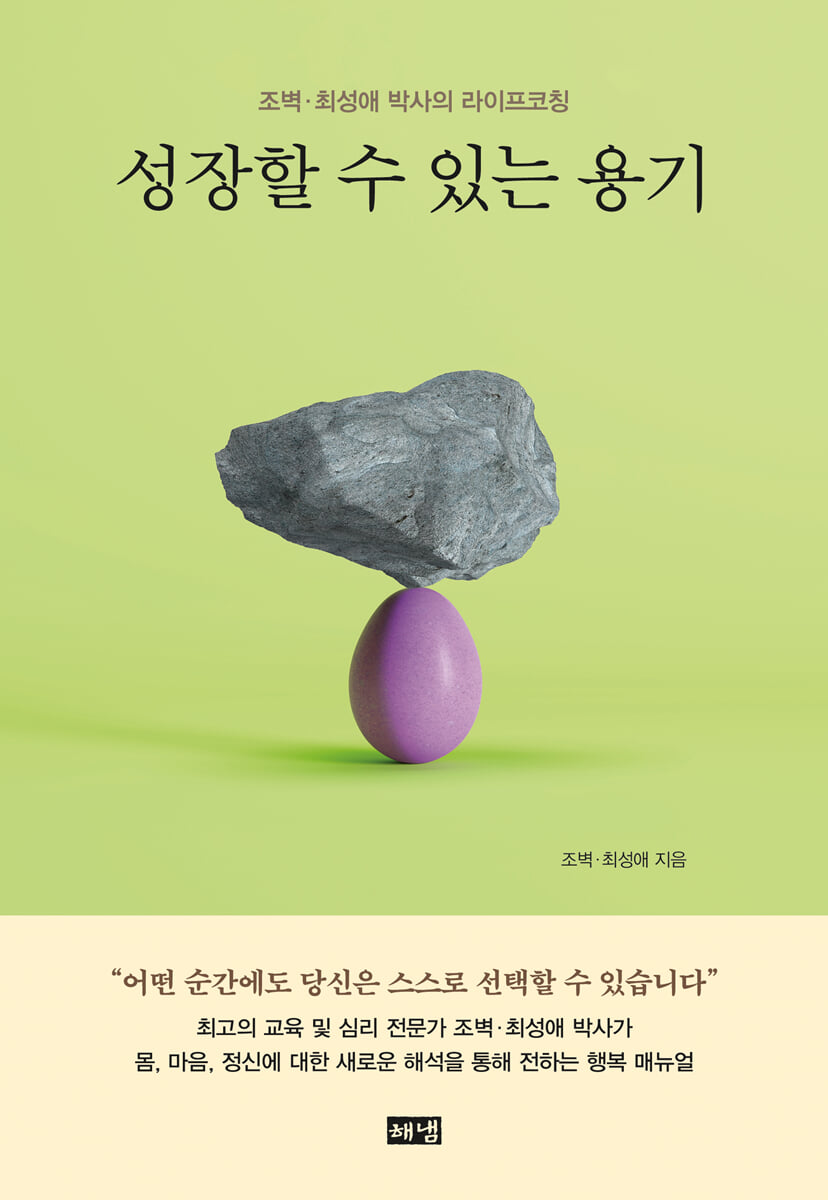
The courage to grow
 |
Description
Book Introduction
“At any moment you can choose for yourself.”
It's not that I'm happy because the future is bright,
When you choose happiness, your future becomes brighter.
Look at the problems and suffering that have come upon me from a different perspective
The art of the mind that changes the direction of one's life
A Mental Manual Essential for a Happy Life Journey
Dr. Cho Byeok and Dr. Choi Seong-ae, the best education experts and psychotherapy experts
A method of mental and spiritual health that has been researched and spread for over 40 years.
Work issues, relationship conflicts, unexpected accidents... In today's increasingly complex social and economic environment, stress is bound to increase.
People try to relieve stress in their own ways, whether through intense entertainment, hobbies, or successful careers, but these methods fail to resolve the fundamental suffering of life and bring about true happiness.
Dr. Cho Byeok and Dr. Choi Seong-ae, who have been working to spread the energy of healing and hope in our society and to contribute to the growth and happiness of individuals, say, "We cannot change the situation, but there are things we can do."
We all have a moment to choose between the stimulus and the response to stress, and our lives can take on a very different shape depending on the choice we make in that moment.
Will you survive by being caught up in problems or will you grow by solving them?
At that crossroads, we need the courage and wisdom to choose growth.
In their new book, "The Courage to Grow," the authors, who are leading education experts and psychotherapy specialists, aim to teach the mental skills to look into one's inner state and reset the direction of one's life through insights and scientific research and evidence derived from over 40 years of domestic and international education and counseling experience.
It is a method of maintaining physical, mental, and spiritual health and wisdom of happiness to keep one centered and navigate the long journey of life.
It's not that I'm happy because the future is bright,
When you choose happiness, your future becomes brighter.
Look at the problems and suffering that have come upon me from a different perspective
The art of the mind that changes the direction of one's life
A Mental Manual Essential for a Happy Life Journey
Dr. Cho Byeok and Dr. Choi Seong-ae, the best education experts and psychotherapy experts
A method of mental and spiritual health that has been researched and spread for over 40 years.
Work issues, relationship conflicts, unexpected accidents... In today's increasingly complex social and economic environment, stress is bound to increase.
People try to relieve stress in their own ways, whether through intense entertainment, hobbies, or successful careers, but these methods fail to resolve the fundamental suffering of life and bring about true happiness.
Dr. Cho Byeok and Dr. Choi Seong-ae, who have been working to spread the energy of healing and hope in our society and to contribute to the growth and happiness of individuals, say, "We cannot change the situation, but there are things we can do."
We all have a moment to choose between the stimulus and the response to stress, and our lives can take on a very different shape depending on the choice we make in that moment.
Will you survive by being caught up in problems or will you grow by solving them?
At that crossroads, we need the courage and wisdom to choose growth.
In their new book, "The Courage to Grow," the authors, who are leading education experts and psychotherapy specialists, aim to teach the mental skills to look into one's inner state and reset the direction of one's life through insights and scientific research and evidence derived from over 40 years of domestic and international education and counseling experience.
It is a method of maintaining physical, mental, and spiritual health and wisdom of happiness to keep one centered and navigate the long journey of life.
- You can preview some of the book's contents.
Preview
index
Introduction: What You Need to Know for the Journey of a Lifetime
Chapter 1: Don't Fight Stress, Respond to It
Life's Unavoidable Stress | Finding Small but Certain Happiness | Now is the Age of Believing | 'Fake Happiness' to Avoid | Don't Over-Emotionalize | How to Satisfy the 3 As and 3 Ms
Chapter 2 From body survival mode to growth mode
Distinguishing between Emotions and Actions | Should You Expose Your Emotions or Suppress Them? | Attack or Run | Harvard University's Secret: 6 Seconds of Respite | The Body's Only Gateway, the Lungs | How to Switch on Growth Mode
Chapter 3: Listening to the Messages Your Emotions Send
"Oh, this is how I feel" | People who have become numb to emotions | Reinterpret the signals your emotions send | When anger starts to rise | Breathing exercises that focus on the heart
· Deep Reading_ Brain Science and Physiology
Chapter 4: The Heart: Why My Heart Doesn't Do What I Want
The mind is a state where emotions and thoughts are connected | The heart also has a brain | A package containing countless emotions | Understanding the characteristics of the mind | Characteristics of emotions ① Transcend time and space | Characteristics of emotions ② Transcend all ages, genders, and the East and the West | Characteristics of thoughts ① Tend to the negative | Characteristics of thoughts ② Thoughts themselves do not bother us
Chapter 5: Anchor your positivity
The best option is to be free of thoughts and thoughts; meditation is the next best option. The golden ratio for a virtuous cycle of happiness. Imagine positivity. Reminisce: Recall happy memories. Imagination: Embrace dreams. Anticipation: Draw a blueprint for the future. Which will you choose?
· Deep Reading_The Origin of Emotions and Thoughts
Chapter 6: What to Focus on for Mental Happiness
What is the mind? |Characteristics of the mind ① Perceiving only a very small portion of information |Characteristics of the mind ② Back and forth, entertainment
It's a melody|Characteristics of the mind ③ It's conscious of abnormal things|
Mental Characteristics ④ Focus on Pleasure | Mental Characteristics ⑤ Can Be Addicted to Productive Activities
Chapter 7 Gratitude: Recognizing the Value of Precious Things
Living with a conscious mind | 'Thank you and I am grateful' | You are a recipient of gifts | Will you encounter loneliness or happiness? | Even regrets become gratitude | Things you can only see when you are conscious
· Deep Reading_The Four Areas That Make Up Humans
Chapter 8: Knowing Myself and Moving Forward
I am in my problems | Judging with wisdom, not knowledge | Pursuing meaning can lead to freedom | Beyond self-realization to self-transcendence | Body-me, mind-you, spirit-us
· Deep Reading_Balance and Harmony of the Four Energy Realms
Chapter 9: Finding the Calm Center Within Yourself
Take control of your body first | The behavior you must be most wary of: self-restraint | Creativity comes from a relaxed mind and body | There's a difference between indifference and composure | When you're in a state of composure, you have the freedom to choose.
Chapter 10: Relationship Happiness Depends on "Little by Little, Often"
Preconceptions about human relationships that need to be abandoned | Conflict is something to be managed, not resolved | Build trust between people | The ten stages of a relationship's breakdown | Even broken relationships can be restored | Maintain five times more positivity than negativity | Love is something to be shared.
Chapter 11: Becoming a Precious Gift to Someone in the Community
What Negativity Has in Common | Give and Take is the Natural Law of Life | A Mature Life | Scientifically Proven Benefits of Caregiving | The Era of Contributing Humans | Why We Need 'Wesdom' | The Ultimate Talent Model, Admiral Yi Sun-sin
The text that appears: Thank you to all beings.
supplement
References
Chapter 1: Don't Fight Stress, Respond to It
Life's Unavoidable Stress | Finding Small but Certain Happiness | Now is the Age of Believing | 'Fake Happiness' to Avoid | Don't Over-Emotionalize | How to Satisfy the 3 As and 3 Ms
Chapter 2 From body survival mode to growth mode
Distinguishing between Emotions and Actions | Should You Expose Your Emotions or Suppress Them? | Attack or Run | Harvard University's Secret: 6 Seconds of Respite | The Body's Only Gateway, the Lungs | How to Switch on Growth Mode
Chapter 3: Listening to the Messages Your Emotions Send
"Oh, this is how I feel" | People who have become numb to emotions | Reinterpret the signals your emotions send | When anger starts to rise | Breathing exercises that focus on the heart
· Deep Reading_ Brain Science and Physiology
Chapter 4: The Heart: Why My Heart Doesn't Do What I Want
The mind is a state where emotions and thoughts are connected | The heart also has a brain | A package containing countless emotions | Understanding the characteristics of the mind | Characteristics of emotions ① Transcend time and space | Characteristics of emotions ② Transcend all ages, genders, and the East and the West | Characteristics of thoughts ① Tend to the negative | Characteristics of thoughts ② Thoughts themselves do not bother us
Chapter 5: Anchor your positivity
The best option is to be free of thoughts and thoughts; meditation is the next best option. The golden ratio for a virtuous cycle of happiness. Imagine positivity. Reminisce: Recall happy memories. Imagination: Embrace dreams. Anticipation: Draw a blueprint for the future. Which will you choose?
· Deep Reading_The Origin of Emotions and Thoughts
Chapter 6: What to Focus on for Mental Happiness
What is the mind? |Characteristics of the mind ① Perceiving only a very small portion of information |Characteristics of the mind ② Back and forth, entertainment
It's a melody|Characteristics of the mind ③ It's conscious of abnormal things|
Mental Characteristics ④ Focus on Pleasure | Mental Characteristics ⑤ Can Be Addicted to Productive Activities
Chapter 7 Gratitude: Recognizing the Value of Precious Things
Living with a conscious mind | 'Thank you and I am grateful' | You are a recipient of gifts | Will you encounter loneliness or happiness? | Even regrets become gratitude | Things you can only see when you are conscious
· Deep Reading_The Four Areas That Make Up Humans
Chapter 8: Knowing Myself and Moving Forward
I am in my problems | Judging with wisdom, not knowledge | Pursuing meaning can lead to freedom | Beyond self-realization to self-transcendence | Body-me, mind-you, spirit-us
· Deep Reading_Balance and Harmony of the Four Energy Realms
Chapter 9: Finding the Calm Center Within Yourself
Take control of your body first | The behavior you must be most wary of: self-restraint | Creativity comes from a relaxed mind and body | There's a difference between indifference and composure | When you're in a state of composure, you have the freedom to choose.
Chapter 10: Relationship Happiness Depends on "Little by Little, Often"
Preconceptions about human relationships that need to be abandoned | Conflict is something to be managed, not resolved | Build trust between people | The ten stages of a relationship's breakdown | Even broken relationships can be restored | Maintain five times more positivity than negativity | Love is something to be shared.
Chapter 11: Becoming a Precious Gift to Someone in the Community
What Negativity Has in Common | Give and Take is the Natural Law of Life | A Mature Life | Scientifically Proven Benefits of Caregiving | The Era of Contributing Humans | Why We Need 'Wesdom' | The Ultimate Talent Model, Admiral Yi Sun-sin
The text that appears: Thank you to all beings.
supplement
References
Detailed image
.jpg)
Into the book
What you need to know for the journey of a lifetime
You can drive your car around town or drive in a straight line on the highway without knowing the science behind how a car engine works.
But if you're going on a long road trip across the continent, you'll need to be able to handle simple car repairs yourself.
To do this, you need to have some knowledge of how cars work and their key components.
The same goes for the journey of life.
It is possible to get through an ordinary day without having a detailed understanding of your body, mind, and spirit.
But these days, every single day is often a series of particularly difficult days.
Given these circumstances, having a deeper understanding of the mind and spirit will allow you to better protect your own health.
In this book, we present in detail the mind and mental health methods we have taught and guided students, teachers, parents, employees, and clients over the past 40 years.
---From the "Introductory Note"
“If you’re not happy, you’re not successful.”
The wisdom to live today as a person who has grown a little more than yesterday.
When faced with significant stress, our entire body can become hyperactive in an instant, we lose control, and we can act like animals.
Emotions can occur in 0.2 seconds, the time it takes to blink an eye, and stability can be achieved in 5 seconds, the time it takes to take a breath.
In other words, both collapsing from stress and recovering from stress happen in an instant.
In that split second, depending on how we interact with our bodies, we either maintain our humanity or our animality emerges.
You can regain your composure by taking deep breaths and relaxing your body for 5 seconds.
In this way, deep breathing is a way to separate emotions from actions.
---From "Chapter 2 Body_ From Survival Mode to Growth Mode"
I liken the mind to an Easter egg.
The pictures drawn on the Easter eggshells are the storyline (thoughts) of who did what, when, and where, and the yolk inside the egg is the emotion felt at that moment.
Even now, I often remember the first time I went on an outing with my father when I was little, we stopped at a Chinese restaurant and ate jajangmyeon.
When I think about that thought, I feel again the respect, gratitude, and reassurance I felt for my father that day.
Later in my adolescence, my father seemed shabby, uncomfortable, and sad.
But as time went by, my father became a person I respected and missed in my heart.
In this way, different feelings can coexist within us, even for the same person.
My heart also contains thoughts and feelings about my mother, my wife, and many other people and events.
Some hearts contain positive emotions, while others contain negative emotions.
Of course, you can have both of these at the same time.
With so many minds, it's only natural that we don't know our own.
Because you never know when a certain feeling will appear, your own mind feels fickle and it is difficult to control it.
---From "Chapter 4: The Heart_ The Reason Why My Heart Doesn't Do What I Want"
The best way to escape from suffering is to empty your mind.
But how easy is this? That's why, I guess, second-best options have been recommended since ancient times.
It's meditation.
When I try to meditate, instead of my thoughts disappearing, they keep coming back and troubling me, making me feel even more miserable.
Having found it difficult to practice the first method of escaping suffering, the non-existence of thoughts, and the second method, meditation, I have chosen the third method, the second-best method, and I would like to recommend this method to you as well.
It is about having many good thoughts, that is, having many good thoughts.
Since humans are creatures who think a lot and are good at it, this method is intended to encourage us not to try to restrain that ability but rather to actively utilize it.
This is a way to move the mind by adjusting the thoughts.
---From “Chapter 5: Positivity_ Drop the Anchor of Positivity”
There are two kinds of values.
One is objective value, such as the price of a product on the market, and the other is subjective value.
Subjective value is something that each of us assigns to ourselves.
Someone hands me a 5,000 won cup of coffee.
I can accept that coffee and just say “thank you” to show my appreciation.
But if I looked not only at the objective value of the coffee but also at the heart of the person who gave it to me, I would feel much more grateful.
I am so grateful for the thought that you thought of me and felt that I would like it, so you went out of your way to stop by a cafe, holding a coffee in one hand, walking slowly to give it to me in case it got cold.
In this way, gratitude is something that is ‘discovered.’
Discovery is not something you just see wherever your eyes go, but something that catches your eye when you focus and make an effort.
Discovery is not making up what isn't there.
---From “Chapter 7 Gratitude_Recognizing the Value of Precious Things”
The biggest reason why the problem isn't actually solved lies with us.
Because we don't have a perspective to look at ourselves.
For example, when a couple argues, they blame each other more than themselves; when their children misbehave, they try to correct them; and when they don't like their job, they want to change jobs.
But these things are no solution at all unless you can see yourself.
I must not forget that I am involved in every problem I face.
If my influence is not half, then at least 10 percent of the fights between my husband and I.
I think that parents' influence on their children's troubles is well over half, perhaps as much as 90 percent.
I also need to realize that my workplace is a place where I am involved, so I must have had some influence on the problems that arise there.
If you exclude me from my problems, you will not get a clue to the solution.
Even if I only account for 1 percent of the problem, if I don't change that 1 percent, the chances of changing the remaining 99 percent are low.
---From “Chapter 8 Meaning_ Knowing Myself and Moving Forward to Us”
If we want to be happy, we need to be able to spend most of our time in a state of emotional neutrality.
There are two types of emotional neutrality.
It's indifference and calmness.
Apathy refers to a state of not being able to feel any emotions at all.
Even if someone is next to you, you don't react as if they aren't there.
Even when we eat delicious food together, he doesn't say a word that it's delicious, and even when I buy him nice clothes, he doesn't show any expression.
So it's hard to live with an indifferent person.
If you can't feel emotions, you can't empathize, and if you can't empathize, not only can you not communicate, but it's also difficult to form relationships.
On the other hand, calmness is a state in which one immediately recovers comfort even if one temporarily feels negative emotions due to stress.
As you can see from the emotional distribution chart, this is the image of people who live centered and not swayed by external stimuli in the center where all kinds of emotions intersect.
Indifference is the appearance of a dull person, and composure is the appearance of a dull person.
Maintain composure, not indifference
---From “Chapter 9: Self-Catching the Calm Center Within Me”
Many people view caring for and caring for someone as a sacrifice and dedication.
It's obvious when you just look at the moments of consideration and care.
Whether it is material, spiritual, or emotional, if I give something I have to someone else, it becomes a negative for me.
So, we hesitate and hesitate to step forward in front of someone who needs consideration and care.
If you do this, you will gradually become an immature person who is stingy with consideration and giving.
A dwarf can only see what is right in front of him.
The ability to think and feel outside of a self-centered way of thinking has not yet been developed.
In contrast, the petty person only considers short-term and minor gains and pursues only what benefits him or herself.
The phrase 'mature' means that you have gained the ability to see further ahead and think more broadly.
Adults who realize that everyone is interconnected can make the grand calculation that "what's good for you is ultimately good for me."
Contributing to the benefit of all in this way is Hongik (弘益), and the person who can do so is a great person (大人).
You can drive your car around town or drive in a straight line on the highway without knowing the science behind how a car engine works.
But if you're going on a long road trip across the continent, you'll need to be able to handle simple car repairs yourself.
To do this, you need to have some knowledge of how cars work and their key components.
The same goes for the journey of life.
It is possible to get through an ordinary day without having a detailed understanding of your body, mind, and spirit.
But these days, every single day is often a series of particularly difficult days.
Given these circumstances, having a deeper understanding of the mind and spirit will allow you to better protect your own health.
In this book, we present in detail the mind and mental health methods we have taught and guided students, teachers, parents, employees, and clients over the past 40 years.
---From the "Introductory Note"
“If you’re not happy, you’re not successful.”
The wisdom to live today as a person who has grown a little more than yesterday.
When faced with significant stress, our entire body can become hyperactive in an instant, we lose control, and we can act like animals.
Emotions can occur in 0.2 seconds, the time it takes to blink an eye, and stability can be achieved in 5 seconds, the time it takes to take a breath.
In other words, both collapsing from stress and recovering from stress happen in an instant.
In that split second, depending on how we interact with our bodies, we either maintain our humanity or our animality emerges.
You can regain your composure by taking deep breaths and relaxing your body for 5 seconds.
In this way, deep breathing is a way to separate emotions from actions.
---From "Chapter 2 Body_ From Survival Mode to Growth Mode"
I liken the mind to an Easter egg.
The pictures drawn on the Easter eggshells are the storyline (thoughts) of who did what, when, and where, and the yolk inside the egg is the emotion felt at that moment.
Even now, I often remember the first time I went on an outing with my father when I was little, we stopped at a Chinese restaurant and ate jajangmyeon.
When I think about that thought, I feel again the respect, gratitude, and reassurance I felt for my father that day.
Later in my adolescence, my father seemed shabby, uncomfortable, and sad.
But as time went by, my father became a person I respected and missed in my heart.
In this way, different feelings can coexist within us, even for the same person.
My heart also contains thoughts and feelings about my mother, my wife, and many other people and events.
Some hearts contain positive emotions, while others contain negative emotions.
Of course, you can have both of these at the same time.
With so many minds, it's only natural that we don't know our own.
Because you never know when a certain feeling will appear, your own mind feels fickle and it is difficult to control it.
---From "Chapter 4: The Heart_ The Reason Why My Heart Doesn't Do What I Want"
The best way to escape from suffering is to empty your mind.
But how easy is this? That's why, I guess, second-best options have been recommended since ancient times.
It's meditation.
When I try to meditate, instead of my thoughts disappearing, they keep coming back and troubling me, making me feel even more miserable.
Having found it difficult to practice the first method of escaping suffering, the non-existence of thoughts, and the second method, meditation, I have chosen the third method, the second-best method, and I would like to recommend this method to you as well.
It is about having many good thoughts, that is, having many good thoughts.
Since humans are creatures who think a lot and are good at it, this method is intended to encourage us not to try to restrain that ability but rather to actively utilize it.
This is a way to move the mind by adjusting the thoughts.
---From “Chapter 5: Positivity_ Drop the Anchor of Positivity”
There are two kinds of values.
One is objective value, such as the price of a product on the market, and the other is subjective value.
Subjective value is something that each of us assigns to ourselves.
Someone hands me a 5,000 won cup of coffee.
I can accept that coffee and just say “thank you” to show my appreciation.
But if I looked not only at the objective value of the coffee but also at the heart of the person who gave it to me, I would feel much more grateful.
I am so grateful for the thought that you thought of me and felt that I would like it, so you went out of your way to stop by a cafe, holding a coffee in one hand, walking slowly to give it to me in case it got cold.
In this way, gratitude is something that is ‘discovered.’
Discovery is not something you just see wherever your eyes go, but something that catches your eye when you focus and make an effort.
Discovery is not making up what isn't there.
---From “Chapter 7 Gratitude_Recognizing the Value of Precious Things”
The biggest reason why the problem isn't actually solved lies with us.
Because we don't have a perspective to look at ourselves.
For example, when a couple argues, they blame each other more than themselves; when their children misbehave, they try to correct them; and when they don't like their job, they want to change jobs.
But these things are no solution at all unless you can see yourself.
I must not forget that I am involved in every problem I face.
If my influence is not half, then at least 10 percent of the fights between my husband and I.
I think that parents' influence on their children's troubles is well over half, perhaps as much as 90 percent.
I also need to realize that my workplace is a place where I am involved, so I must have had some influence on the problems that arise there.
If you exclude me from my problems, you will not get a clue to the solution.
Even if I only account for 1 percent of the problem, if I don't change that 1 percent, the chances of changing the remaining 99 percent are low.
---From “Chapter 8 Meaning_ Knowing Myself and Moving Forward to Us”
If we want to be happy, we need to be able to spend most of our time in a state of emotional neutrality.
There are two types of emotional neutrality.
It's indifference and calmness.
Apathy refers to a state of not being able to feel any emotions at all.
Even if someone is next to you, you don't react as if they aren't there.
Even when we eat delicious food together, he doesn't say a word that it's delicious, and even when I buy him nice clothes, he doesn't show any expression.
So it's hard to live with an indifferent person.
If you can't feel emotions, you can't empathize, and if you can't empathize, not only can you not communicate, but it's also difficult to form relationships.
On the other hand, calmness is a state in which one immediately recovers comfort even if one temporarily feels negative emotions due to stress.
As you can see from the emotional distribution chart, this is the image of people who live centered and not swayed by external stimuli in the center where all kinds of emotions intersect.
Indifference is the appearance of a dull person, and composure is the appearance of a dull person.
Maintain composure, not indifference
---From “Chapter 9: Self-Catching the Calm Center Within Me”
Many people view caring for and caring for someone as a sacrifice and dedication.
It's obvious when you just look at the moments of consideration and care.
Whether it is material, spiritual, or emotional, if I give something I have to someone else, it becomes a negative for me.
So, we hesitate and hesitate to step forward in front of someone who needs consideration and care.
If you do this, you will gradually become an immature person who is stingy with consideration and giving.
A dwarf can only see what is right in front of him.
The ability to think and feel outside of a self-centered way of thinking has not yet been developed.
In contrast, the petty person only considers short-term and minor gains and pursues only what benefits him or herself.
The phrase 'mature' means that you have gained the ability to see further ahead and think more broadly.
Adults who realize that everyone is interconnected can make the grand calculation that "what's good for you is ultimately good for me."
Contributing to the benefit of all in this way is Hongik (弘益), and the person who can do so is a great person (大人).
---From "Chapter 11 Community_Becoming a Precious Gift to Someone"
Publisher's Review
Switch from survival mode to growth mode
In fact, when we are stressed, we have a survival response of "fight or flight," but when we are safe, we have a growth response of broadening our perspective and finding ways to solve the problem.
In this way, not only survival but also growth is a human instinct.
However, the transition from survival mode to growth mode requires artificial effort, and to understand its operating principles and interrelationships, we need to make an effort to understand more deeply about 'body, mind, and spirit.'
If you first keep your body, mind, and spirit healthy and comfortable, you can quickly regain comfort even if you feel negative emotions due to stress.
This allows for wiser judgment, more leeway in relationships, and more flexibility in thinking.
It starts with relaxing your body through deep breathing.
In addition, we must cultivate a positive outlook on life by making mental skills such as positive thinking and finding gratitude a habit.
This book, consisting of 11 chapters, first examines the characteristics of body, mind, and spirit, and then contains wisdom to move from survival to growth.
Chapter 1 examines stressors and current situations, and introduces sustainable stress coping methods.
Chapter 2 explains the body, which is the first to receive external stimuli, and Chapter 3 examines the role of emotions that arise when the body is stimulated.
Chapter 4 explains the mind, which is a state in which emotions and thoughts are connected, and examines why the mind cannot do what it wants.
Chapter 5 encourages us to cultivate good thoughts as a way to escape suffering, and chapters 6 and 7 explore the six characteristics of the mind and suggest focusing the mind on what is valuable.
Chapter 8 explains that we can find freedom when we recognize that we are within our problems and pursue meaning in life.
Chapters 9 through 11 present the attitudes of adults who connect body, mind, and spirit at the levels of self, relationships, and community, understand and govern themselves, manage conflicts in relationships, and contribute to the community.
You can choose happiness in every breath you take.
'We have a choice.'
The authors emphasize that by having a deep understanding of your resources and developing the psychological capacity to cope with stress, you can make balanced choices regardless of external circumstances.
These choices accumulate and become the foundation for growth and happiness.
This book, which compiles the authors' expertise in happiness and growth over 40 years of research, does not simply offer comfort or popular problem-solving methods. Rather, it condenses extensive knowledge about humanity and cool-headed, realistic life advice.
The authors, who are also master trainers at the HeartMath Institute, a pioneering stress management research institute, also share their know-how on how to build resilience from a preventative perspective.
At a time when anxiety and stress are on the rise due to increasing uncertainty, following this life manual will provide you with the wisdom to understand yourself, build harmonious relationships with others, and contribute to your community.
Especially for those who want to lead their lives towards growth, it will empower them to center themselves, solve problems with a broad perspective, and move forward little by little.
In fact, when we are stressed, we have a survival response of "fight or flight," but when we are safe, we have a growth response of broadening our perspective and finding ways to solve the problem.
In this way, not only survival but also growth is a human instinct.
However, the transition from survival mode to growth mode requires artificial effort, and to understand its operating principles and interrelationships, we need to make an effort to understand more deeply about 'body, mind, and spirit.'
If you first keep your body, mind, and spirit healthy and comfortable, you can quickly regain comfort even if you feel negative emotions due to stress.
This allows for wiser judgment, more leeway in relationships, and more flexibility in thinking.
It starts with relaxing your body through deep breathing.
In addition, we must cultivate a positive outlook on life by making mental skills such as positive thinking and finding gratitude a habit.
This book, consisting of 11 chapters, first examines the characteristics of body, mind, and spirit, and then contains wisdom to move from survival to growth.
Chapter 1 examines stressors and current situations, and introduces sustainable stress coping methods.
Chapter 2 explains the body, which is the first to receive external stimuli, and Chapter 3 examines the role of emotions that arise when the body is stimulated.
Chapter 4 explains the mind, which is a state in which emotions and thoughts are connected, and examines why the mind cannot do what it wants.
Chapter 5 encourages us to cultivate good thoughts as a way to escape suffering, and chapters 6 and 7 explore the six characteristics of the mind and suggest focusing the mind on what is valuable.
Chapter 8 explains that we can find freedom when we recognize that we are within our problems and pursue meaning in life.
Chapters 9 through 11 present the attitudes of adults who connect body, mind, and spirit at the levels of self, relationships, and community, understand and govern themselves, manage conflicts in relationships, and contribute to the community.
You can choose happiness in every breath you take.
'We have a choice.'
The authors emphasize that by having a deep understanding of your resources and developing the psychological capacity to cope with stress, you can make balanced choices regardless of external circumstances.
These choices accumulate and become the foundation for growth and happiness.
This book, which compiles the authors' expertise in happiness and growth over 40 years of research, does not simply offer comfort or popular problem-solving methods. Rather, it condenses extensive knowledge about humanity and cool-headed, realistic life advice.
The authors, who are also master trainers at the HeartMath Institute, a pioneering stress management research institute, also share their know-how on how to build resilience from a preventative perspective.
At a time when anxiety and stress are on the rise due to increasing uncertainty, following this life manual will provide you with the wisdom to understand yourself, build harmonious relationships with others, and contribute to your community.
Especially for those who want to lead their lives towards growth, it will empower them to center themselves, solve problems with a broad perspective, and move forward little by little.
GOODS SPECIFICS
- Publication date: November 10, 2022
- Page count, weight, size: 280 pages | 442g | 145*210*18mm
- ISBN13: 9791167140531
- ISBN10: 1167140532
You may also like
카테고리
korean


korean

![GQ KOREA Mark (Monthly): December [2025]](http://librairie.coreenne.fr/cdn/shop/files/8ef265dbbfbf186523ed75ba7319009d.jpg?v=1765340328&width=3840)


