

Weird
 |
Description
Book Introduction
Includes a special recommendation from Professor Choi Jae-cheon!
Highly recommended by Joshua Green, Cass Sunstein, and Francis Fukuyama!
“How did the unique psychology, culture, and institutions of Western society become the world’s mainstream?”
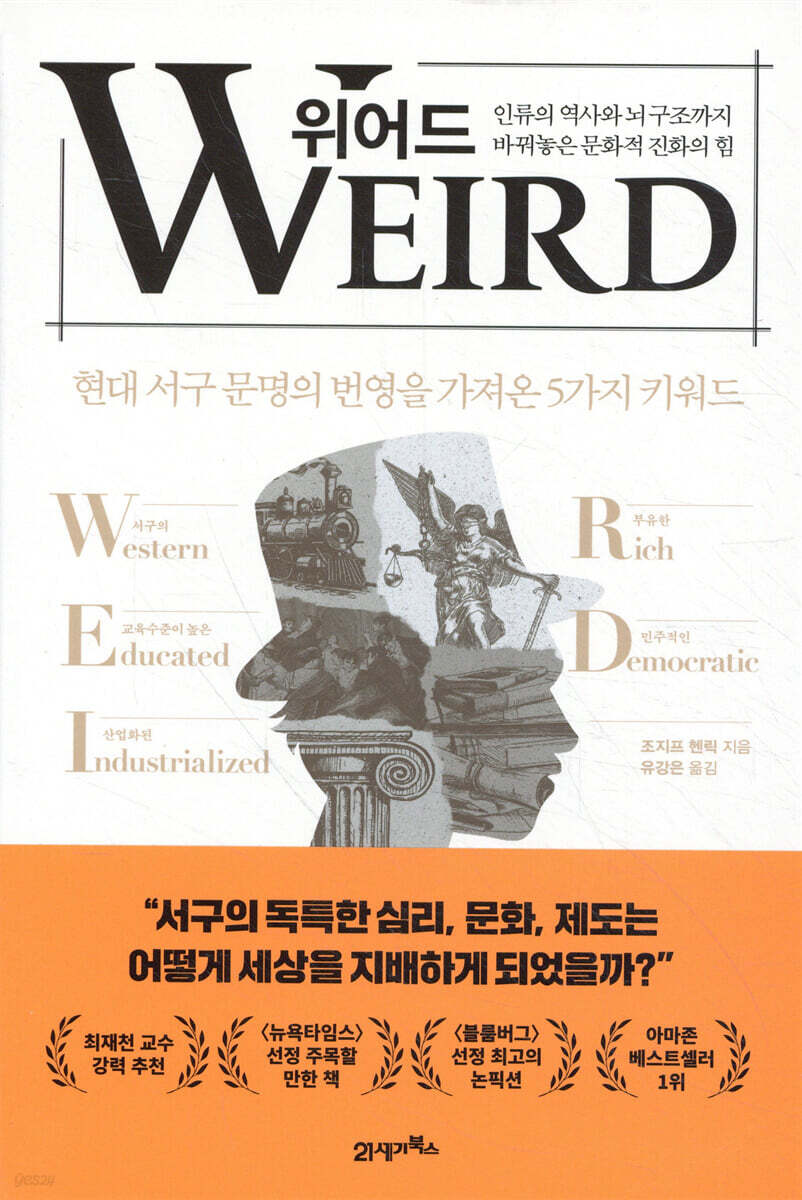
Western, educated, industrialized, rich, and democratic people.
The world calls them 'WEIRD'.
This group, whose demographic characteristics are considered the mainstream of today's international society, is unlike many parts of the world that have appeared throughout history, and unlike most people who have ever lived, they are highly individualistic, self-obsessed, control-oriented, non-conformist, analytical, and trusting of strangers.
They focus on themselves—their characteristics, achievements, and aspirations—rather than on relationships and social roles.
How did this group develop such a unique psychology? And what role did these psychological differences play in the Industrial Revolution and Europe's global expansion over the past several centuries?
"Weird" addresses these questions, weaving together cutting-edge research in anthropology, psychology, economics, and evolutionary biology.
After exploring the origins and evolution of family structure, marriage, and religion, the author documents how these institutions shape the way humans think, feel, and perceive the world.
It also traces the origins of the monogamous nuclear family to late antiquity and shows how the Roman Catholic Church, by transforming the most fundamental human institutions—marriage and kinship—unintentionally transformed human psychology and shifted the trajectory of Western civilization.
Digging into a stunningly detailed account of the vast scope of the story, this provocative and engaging book explores how culture, institutions, and psychology shape one another, and how this influences both our most personal perceptions of ourselves and the larger social, political, and economic forces that shape human history.
Highly recommended by Joshua Green, Cass Sunstein, and Francis Fukuyama!
“How did the unique psychology, culture, and institutions of Western society become the world’s mainstream?”
Western, educated, industrialized, rich, and democratic people.
The world calls them 'WEIRD'.
This group, whose demographic characteristics are considered the mainstream of today's international society, is unlike many parts of the world that have appeared throughout history, and unlike most people who have ever lived, they are highly individualistic, self-obsessed, control-oriented, non-conformist, analytical, and trusting of strangers.
They focus on themselves—their characteristics, achievements, and aspirations—rather than on relationships and social roles.
How did this group develop such a unique psychology? And what role did these psychological differences play in the Industrial Revolution and Europe's global expansion over the past several centuries?
"Weird" addresses these questions, weaving together cutting-edge research in anthropology, psychology, economics, and evolutionary biology.
After exploring the origins and evolution of family structure, marriage, and religion, the author documents how these institutions shape the way humans think, feel, and perceive the world.
It also traces the origins of the monogamous nuclear family to late antiquity and shows how the Roman Catholic Church, by transforming the most fundamental human institutions—marriage and kinship—unintentionally transformed human psychology and shifted the trajectory of Western civilization.
Digging into a stunningly detailed account of the vast scope of the story, this provocative and engaging book explores how culture, institutions, and psychology shape one another, and how this influences both our most personal perceptions of ourselves and the larger social, political, and economic forces that shape human history.
- You can preview some of the book's contents.
Preview
index
preface
Prologue: The Power of Cultural Evolution That Changed Human History
Part 1_ The Evolution of Human Psychology and Society
Chapter 1: WEIRD, Strangely Personal and Analytical People
The Strange and Unique Psychology of WEIRDs │ The Marshmallow Effect and the Relationship Between Social Norms │ UN Diplomats Who Received Parking Tickets │ The Obsession with Moral Judgment and Intention │ Analytical Thinking vs.
holistic thinking
Chapter 2 Cultural Evolution and the Birth of New Species
Evolving to Learn │ Evolving Society │ Coevolution of Human Psychology and Institutions
Chapter 3: The Disintegration of Collective Kinship and the Emergence of the State
A Special Ritual of the Great Community, Illichta │ Prerequisites for a Greater Community │ Forming a Pre-Military State │ Towards a Modern State Again
Chapter 4: A Cultural and Psychological Community Built on the Foundation of Religion
The Development of Supernatural Beliefs │ The Evolution of Gods and Rituals │ What Free Will and Moral Universalism Change │ The Meaning of 'Showing Off' to Increase Trustworthiness │ The Foundation of WEIRD Psychology Completed
Part 2_ WEIRD, the birth of the world's strangest group
Chapter 5: The Church Reforms the European Family
The Disintegration of the Traditional Family │ The Carolingian Dynasty and the Strange Manorial System │ Continuing Social and Psychological Change
Chapter 6: Psychological Changes Brought About by Changes in the Family System
The psychological shifts in Europeans, as revealed by the concentration of kinship, reveal the political, economic, and psychological differences brought about by the church, and the emergence of a psychology for new institutions and organizations.
Chapter 7: How Farming Changed the Psychology of the Chinese People
The Psychology of Modern Man, Formed in the Medieval Church │ Psychological Differences Between Chinese and Indians │ The Institutional Foundation for Economic Prosperity Formed
Chapter 8: The Psychology and Sociology of Monogamy
The unique institution of monogamy │ The mathematical problem of polygamy │ The influence of marriage on male hormones │ The psychological changes brought about by male hormones │ The birth of monogamy and the equal family
Part 3_ WEIRD, Shaping New Psychology and Institutions
Chapter 9: Individuals Freed from Kinship Lead the Commercial Revolution
Market Norms and the Positive-Sum Worldview │ Without the Hui, There Would Be No Markets │ The Commercial and Urban Revolutions │ The Development of Market Norms and the Formation of a New Psychology
Chapter 10: Competition between groups and the growth of voluntary associations
Psychological changes brought about by war │ Urban growth sparked by war in Europe │ Intergroup conflict becomes a driving force for cultural evolution │ The emergence of voluntary associations │ The power of competition becomes a driving force
Chapter 11: The Market Mindset Forms
A Society Where Labor Becomes a Virtue │ The Origins of WEIRD Personality │ The Formation and Evolution of WEIRD Personality
Part 4_ WEIRD, Opening the Door to the Modern World
Chapter 12 Law, Science, and Religion Created by WEIRD
The Development of Individual Rights and Western Legal Systems | Representative Government and Democracy | The Weirdest Religion: Protestantism | The Role of Enlightenment Thinkers
Chapter 13: The Explosion of Collective Intelligence in Europe
Prerequisites for Expanding Collective Intelligence │ More Creativity Takes Root │ Psychology and Innovation in the Modern World │ Escaping the Malthusian Trap
Chapter 14 Guns, Germs, Steel, and Other Factors
The Origins of Economic Inequality | Globalization and Beyond
Acknowledgements
supplement
main
References
Prologue: The Power of Cultural Evolution That Changed Human History
Part 1_ The Evolution of Human Psychology and Society
Chapter 1: WEIRD, Strangely Personal and Analytical People
The Strange and Unique Psychology of WEIRDs │ The Marshmallow Effect and the Relationship Between Social Norms │ UN Diplomats Who Received Parking Tickets │ The Obsession with Moral Judgment and Intention │ Analytical Thinking vs.
holistic thinking
Chapter 2 Cultural Evolution and the Birth of New Species
Evolving to Learn │ Evolving Society │ Coevolution of Human Psychology and Institutions
Chapter 3: The Disintegration of Collective Kinship and the Emergence of the State
A Special Ritual of the Great Community, Illichta │ Prerequisites for a Greater Community │ Forming a Pre-Military State │ Towards a Modern State Again
Chapter 4: A Cultural and Psychological Community Built on the Foundation of Religion
The Development of Supernatural Beliefs │ The Evolution of Gods and Rituals │ What Free Will and Moral Universalism Change │ The Meaning of 'Showing Off' to Increase Trustworthiness │ The Foundation of WEIRD Psychology Completed
Part 2_ WEIRD, the birth of the world's strangest group
Chapter 5: The Church Reforms the European Family
The Disintegration of the Traditional Family │ The Carolingian Dynasty and the Strange Manorial System │ Continuing Social and Psychological Change
Chapter 6: Psychological Changes Brought About by Changes in the Family System
The psychological shifts in Europeans, as revealed by the concentration of kinship, reveal the political, economic, and psychological differences brought about by the church, and the emergence of a psychology for new institutions and organizations.
Chapter 7: How Farming Changed the Psychology of the Chinese People
The Psychology of Modern Man, Formed in the Medieval Church │ Psychological Differences Between Chinese and Indians │ The Institutional Foundation for Economic Prosperity Formed
Chapter 8: The Psychology and Sociology of Monogamy
The unique institution of monogamy │ The mathematical problem of polygamy │ The influence of marriage on male hormones │ The psychological changes brought about by male hormones │ The birth of monogamy and the equal family
Part 3_ WEIRD, Shaping New Psychology and Institutions
Chapter 9: Individuals Freed from Kinship Lead the Commercial Revolution
Market Norms and the Positive-Sum Worldview │ Without the Hui, There Would Be No Markets │ The Commercial and Urban Revolutions │ The Development of Market Norms and the Formation of a New Psychology
Chapter 10: Competition between groups and the growth of voluntary associations
Psychological changes brought about by war │ Urban growth sparked by war in Europe │ Intergroup conflict becomes a driving force for cultural evolution │ The emergence of voluntary associations │ The power of competition becomes a driving force
Chapter 11: The Market Mindset Forms
A Society Where Labor Becomes a Virtue │ The Origins of WEIRD Personality │ The Formation and Evolution of WEIRD Personality
Part 4_ WEIRD, Opening the Door to the Modern World
Chapter 12 Law, Science, and Religion Created by WEIRD
The Development of Individual Rights and Western Legal Systems | Representative Government and Democracy | The Weirdest Religion: Protestantism | The Role of Enlightenment Thinkers
Chapter 13: The Explosion of Collective Intelligence in Europe
Prerequisites for Expanding Collective Intelligence │ More Creativity Takes Root │ Psychology and Innovation in the Modern World │ Escaping the Malthusian Trap
Chapter 14 Guns, Germs, Steel, and Other Factors
The Origins of Economic Inequality | Globalization and Beyond
Acknowledgements
supplement
main
References
Detailed image
Publisher's Review
More fun than Guns, Germs, and Steel,
The birth of a masterpiece more specific than Sapiens!
There is a book that has recently been receiving a lot of praise from the publishing world and media around the world.
This book, which has received numerous recommendations from world-renowned scholars such as The Times, the Wall Street Journal, Cass Sunstein, Joshua Green, and Francis Fukuyama, has been ranked #1 on Amazon's bestseller list, among the best nonfiction books selected by Bloomberg, and among the notable books selected by the New York Times.
“A brilliant work that integrates anthropology, history, psychology, and economics to clearly explain how modern Western culture differs from all other cultures,” “A book that fundamentally challenges the assumptions of psychology and economics that human nature is universally the same,” “A book that ambitiously explains the transition from kinship-based societies to the modern world from a radically different perspective, drawing on a variety of disciplines and a wealth of data to help us understand key issues in social theory.” These are the praises heaped on Weird by Joseph Henrik, Professor of Human Evolutionary Biology at Harvard University.
Why has this book captured the world's attention and enthusiastic response? Numerous scholars have delved into the question, "Why did the West rise?"
In the author's bold and engaging answer to this question, we can clearly see how history changes human psychology and how human psychology drives history.
The author's writing, which is praised for adding depth to the book by combining interesting research from various fields such as evolutionary biology and cultural evolution, psychological research and field experiments, and cutting-edge economics, is mentioned along with Jared Diamond's "Guns, Germs, and Steel" and Yuval Harari's "Sapiens," and is considered a must-read for anyone interested in the origins of modern times.
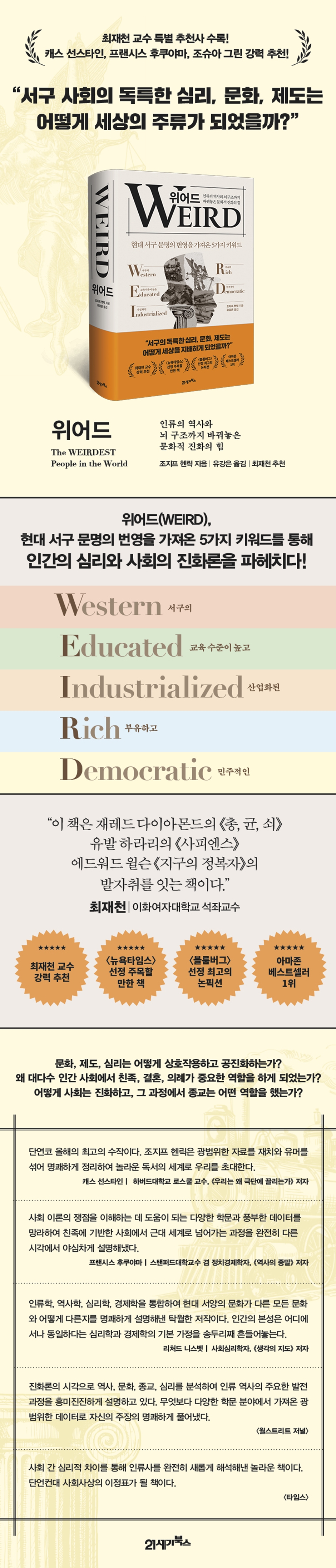
WEIRD: Five Keyword Keys to the Prosperity of Modern Western Civilization
Uncovering the evolution of human psychology and society through five keywords!
Western, educated, industrialized, rich, and democratic people.
Maybe you're WEIRD too.
If so, you may have some unique psychological characteristics.
Unlike many parts of the world today, and the vast majority of people who have ever lived, WEIRDs are highly individualistic, preoccupied with their own thoughts, control-oriented, unconventional, and analytical. They focus on themselves—their characteristics, accomplishments, and aspirations—rather than relationships and social roles. WEIRDs strive to be themselves in all situations, and they perceive inconsistencies in others as hypocrisy, not flexibility.
These are just a few examples of the areas of psychology the author mentions: perception, memory, attention, reasoning, motivation, decision-making, and moral judgment.
Anthropologist Clifford Geertz said:
“The Western concept of the individual sees a person as a cognitive universe, distinct from others, unique, with a certain degree of unified motivation, and a dynamic center of consciousness, emotion, judgment, and action, constituting his or her own unique world, distinct from other people and from the social and natural environment.
This may seem unchangeable to us, but it is a rather unique concept in the diverse cultural contexts of the world.”
Understanding how and why some Europeans developed such distinctive psychological patterns in the late Middle Ages also sheds light on another great mystery: the rise of the West.
Why were Western European nations able to conquer so much of the world starting around 1500? Why did Western Europe experience such explosive economic growth in the late 18th century, fueled by new technologies and the Industrial Revolution, that it sparked a wave of globalization that continues to sweep the globe today?
“What kind of animal is man?”
On human nature and social evolution
First, let's take a deeper look into human nature and social evolution.
What kind of animals are we? How should we understand the role of culture and cultural evolution? What are institutions, and where do they arise? How do culture, institutions, and psychology interact and coevolve? Why have kinship, marriage, and ritual played such important roles in most human societies? How and why did societies grow in size and complexity, and what role did religion play in this process?
One way to understand the centrality of culture in human nature is not to oppose 'evolutionary' or 'biological' explanations with explanations based on 'learning' or 'socialization'.
Instead, researchers have incorporated culture into this expanded evolutionary approach by asking how natural selection shaped our primate brains to best enable us to learn the thoughts, beliefs, values, motivations, and practices we need to survive and thrive in any ecological and social environment.
This means that we have genetically evolved to adapt to our surroundings by adjusting our minds and behaviors to suit the environments we encounter.
“Cultural evolution overpowers biological evolution!”
The power of cultural evolution that changed human history and even brain structure.
The author traces this riddle back to late antiquity, telling how one Christian sect affirmed a particular set of social norms and beliefs.
These social norms and beliefs dramatically changed the concepts of marriage, family, inheritance, and ownership in many parts of Europe over the centuries.
As family life changed fundamentally, a host of psychological shifts began to emerge, resulting in the rapid development of new forms of urbanization, the rise of impersonal commerce, and the proliferation of voluntary organizations, from merchant guilds and municipalities to universities and supraregional monasteries.
These organizations increasingly operated according to new, individualistic norms and laws.
If a team of alien anthropologists had observed humanity from orbit in 1000 or 1200 AD, they would never have guessed that Europeans would dominate the Earth in the latter half of the millennium.
If they had been betting, they would probably have put their money on China or the Islamic world instead of Europe.
What these aliens failed to see from their orbit was that a new psychology was quietly brewing in several European communities during the Middle Ages.
This developing archetypal WEIRD psychology gradually laid the foundation for the rise of impersonal markets, urbanization, constitutional government, democratic politics, individualistic religions, scientific societies, and relentless innovation.
In short, this psychological change became fertile ground for the sprouting of the modern world.
Thus, to understand the roots of modern society, it is necessary to explore how the psychology of WEIRDs has culturally adapted and coevolved with their most basic social institution: the family.
The birth of a masterpiece more specific than Sapiens!
There is a book that has recently been receiving a lot of praise from the publishing world and media around the world.
This book, which has received numerous recommendations from world-renowned scholars such as The Times, the Wall Street Journal, Cass Sunstein, Joshua Green, and Francis Fukuyama, has been ranked #1 on Amazon's bestseller list, among the best nonfiction books selected by Bloomberg, and among the notable books selected by the New York Times.
“A brilliant work that integrates anthropology, history, psychology, and economics to clearly explain how modern Western culture differs from all other cultures,” “A book that fundamentally challenges the assumptions of psychology and economics that human nature is universally the same,” “A book that ambitiously explains the transition from kinship-based societies to the modern world from a radically different perspective, drawing on a variety of disciplines and a wealth of data to help us understand key issues in social theory.” These are the praises heaped on Weird by Joseph Henrik, Professor of Human Evolutionary Biology at Harvard University.
Why has this book captured the world's attention and enthusiastic response? Numerous scholars have delved into the question, "Why did the West rise?"
In the author's bold and engaging answer to this question, we can clearly see how history changes human psychology and how human psychology drives history.
The author's writing, which is praised for adding depth to the book by combining interesting research from various fields such as evolutionary biology and cultural evolution, psychological research and field experiments, and cutting-edge economics, is mentioned along with Jared Diamond's "Guns, Germs, and Steel" and Yuval Harari's "Sapiens," and is considered a must-read for anyone interested in the origins of modern times.
WEIRD: Five Keyword Keys to the Prosperity of Modern Western Civilization
Uncovering the evolution of human psychology and society through five keywords!
Western, educated, industrialized, rich, and democratic people.
Maybe you're WEIRD too.
If so, you may have some unique psychological characteristics.
Unlike many parts of the world today, and the vast majority of people who have ever lived, WEIRDs are highly individualistic, preoccupied with their own thoughts, control-oriented, unconventional, and analytical. They focus on themselves—their characteristics, accomplishments, and aspirations—rather than relationships and social roles. WEIRDs strive to be themselves in all situations, and they perceive inconsistencies in others as hypocrisy, not flexibility.
These are just a few examples of the areas of psychology the author mentions: perception, memory, attention, reasoning, motivation, decision-making, and moral judgment.
Anthropologist Clifford Geertz said:
“The Western concept of the individual sees a person as a cognitive universe, distinct from others, unique, with a certain degree of unified motivation, and a dynamic center of consciousness, emotion, judgment, and action, constituting his or her own unique world, distinct from other people and from the social and natural environment.
This may seem unchangeable to us, but it is a rather unique concept in the diverse cultural contexts of the world.”
Understanding how and why some Europeans developed such distinctive psychological patterns in the late Middle Ages also sheds light on another great mystery: the rise of the West.
Why were Western European nations able to conquer so much of the world starting around 1500? Why did Western Europe experience such explosive economic growth in the late 18th century, fueled by new technologies and the Industrial Revolution, that it sparked a wave of globalization that continues to sweep the globe today?
“What kind of animal is man?”
On human nature and social evolution
First, let's take a deeper look into human nature and social evolution.
What kind of animals are we? How should we understand the role of culture and cultural evolution? What are institutions, and where do they arise? How do culture, institutions, and psychology interact and coevolve? Why have kinship, marriage, and ritual played such important roles in most human societies? How and why did societies grow in size and complexity, and what role did religion play in this process?
One way to understand the centrality of culture in human nature is not to oppose 'evolutionary' or 'biological' explanations with explanations based on 'learning' or 'socialization'.
Instead, researchers have incorporated culture into this expanded evolutionary approach by asking how natural selection shaped our primate brains to best enable us to learn the thoughts, beliefs, values, motivations, and practices we need to survive and thrive in any ecological and social environment.
This means that we have genetically evolved to adapt to our surroundings by adjusting our minds and behaviors to suit the environments we encounter.
“Cultural evolution overpowers biological evolution!”
The power of cultural evolution that changed human history and even brain structure.
The author traces this riddle back to late antiquity, telling how one Christian sect affirmed a particular set of social norms and beliefs.
These social norms and beliefs dramatically changed the concepts of marriage, family, inheritance, and ownership in many parts of Europe over the centuries.
As family life changed fundamentally, a host of psychological shifts began to emerge, resulting in the rapid development of new forms of urbanization, the rise of impersonal commerce, and the proliferation of voluntary organizations, from merchant guilds and municipalities to universities and supraregional monasteries.
These organizations increasingly operated according to new, individualistic norms and laws.
If a team of alien anthropologists had observed humanity from orbit in 1000 or 1200 AD, they would never have guessed that Europeans would dominate the Earth in the latter half of the millennium.
If they had been betting, they would probably have put their money on China or the Islamic world instead of Europe.
What these aliens failed to see from their orbit was that a new psychology was quietly brewing in several European communities during the Middle Ages.
This developing archetypal WEIRD psychology gradually laid the foundation for the rise of impersonal markets, urbanization, constitutional government, democratic politics, individualistic religions, scientific societies, and relentless innovation.
In short, this psychological change became fertile ground for the sprouting of the modern world.
Thus, to understand the roots of modern society, it is necessary to explore how the psychology of WEIRDs has culturally adapted and coevolved with their most basic social institution: the family.
GOODS SPECIFICS
- Publication date: October 19, 2022
- Format: Hardcover book binding method guide
- Page count, weight, size: 768 pages | 1,194g | 152*225*42mm
- ISBN13: 9788950941864
- ISBN10: 8950941864
You may also like
카테고리
korean


korean

![GQ KOREA Mark (Monthly): December [2025]](http://librairie.coreenne.fr/cdn/shop/files/8ef265dbbfbf186523ed75ba7319009d.jpg?v=1765340328&width=3840)


