

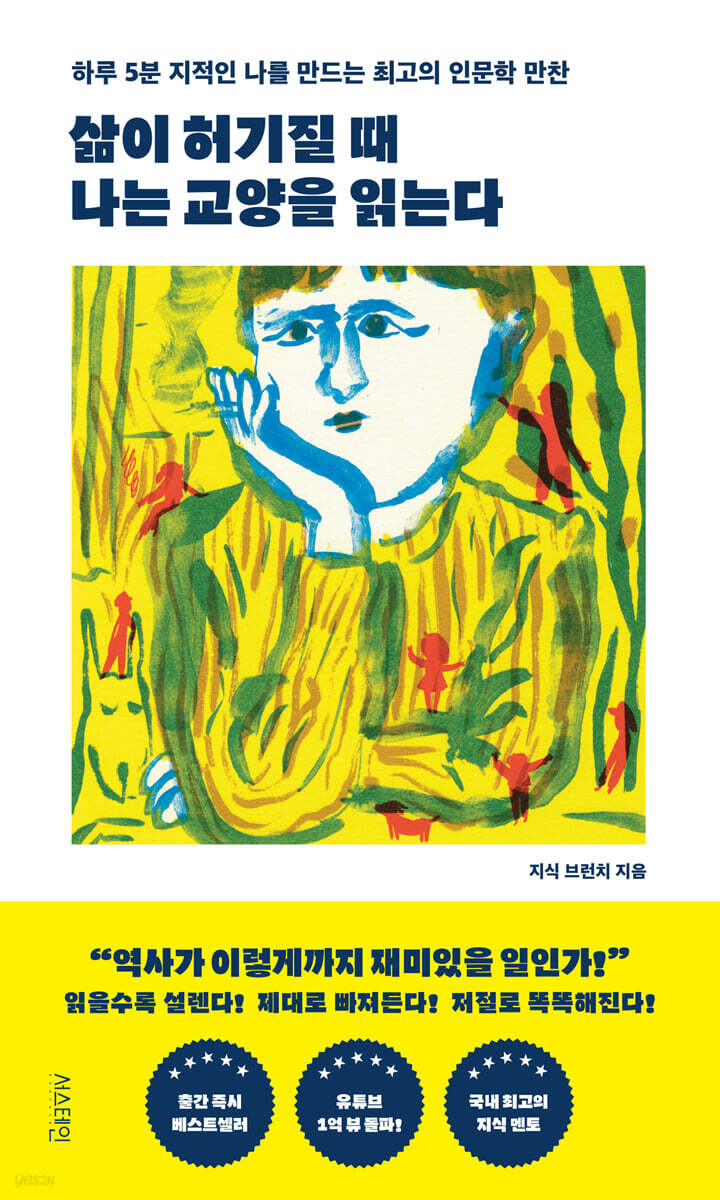
When life gets boring, I read liberal arts.
 |
Description
Book Introduction
“Once you start reading, you can’t stop!”
A perfect humanities textbook that will keep you hooked the more you read, proven by 30 million views!
Stories you've been curious about but couldn't find anywhere else, Korea's premier knowledge channel "Knowledge Brunch," which turns everything around us into knowledge with a fresh, unprecedented approach, is now available in book form! "Why did Buddhism disappear from India?", "Why did the Romans eat so uncomfortably while lying down?", "How did Britain become a nation of gentlemen?", "Why did foxes disappear only in Korea?", "The long-established restaurant culture created by Japan's philosophy of harmony"—from general knowledge that seems readily available everywhere to world history within food culture that enriches dinner conversations, to unexpected history filled with shocks and twists! Just reading will change your perspective on the world and make you more intelligent and sophisticated than yesterday, unfolding the most delicious and elegant humanities banquet!
A perfect humanities textbook that will keep you hooked the more you read, proven by 30 million views!
Stories you've been curious about but couldn't find anywhere else, Korea's premier knowledge channel "Knowledge Brunch," which turns everything around us into knowledge with a fresh, unprecedented approach, is now available in book form! "Why did Buddhism disappear from India?", "Why did the Romans eat so uncomfortably while lying down?", "How did Britain become a nation of gentlemen?", "Why did foxes disappear only in Korea?", "The long-established restaurant culture created by Japan's philosophy of harmony"—from general knowledge that seems readily available everywhere to world history within food culture that enriches dinner conversations, to unexpected history filled with shocks and twists! Just reading will change your perspective on the world and make you more intelligent and sophisticated than yesterday, unfolding the most delicious and elegant humanities banquet!
- You can preview some of the book's contents.
Preview
index
Introduction
Chapter 1: A Gentle Liberal Arts Class That Will Change Your Perception of the World
Why Buddhism Disappeared from India
Why did European nobles wear flour wigs?
Why do Indian films always have people dancing?
Why foxes have disappeared from Korea, the only country in the world where they are still extinct
Why do Europeans still carry around a bunch of keys?
Why can't America win wars anymore?
5 Reasons Why Luxury Goods Are So Expensive
Can Korea become a neutral country?
How did the Ganges River become the 'River of the Gods'?
How did the dollar become a reserve currency?
Why the Liberal Democratic Party Has Overwhelming Support in Japan
What are the five essential creatures on Earth?
Chapter 2: World History in Food Culture: Enriching Conversations Around the Table
Why did the Romans lie down so uncomfortably to eat?
The long-established culture created by Japan's ideology of harmony
When did humans begin to enjoy ‘taste’?
The impact of limestone water on Europe
Why oily foods developed in China
The Passion for Pepper Ushered in the Age of Exploration
From the Inquisition to Burning at the Stave: The Potato's Difficult European Settlement
Why are Japanese people so small in stature? (feat.
2 side effects)
Chapter 3: The Inconvenient Truth Every Cultured Person Must Know
What was life like for the convicts sent to Australia by Britain?
Why Jews Are Always Where Money Gathers
Why China Won't Abandon Tibet Despite International Criticism
The real problem blocking Myanmar's democratization
The Syrian Civil War: No matter who wins, there's no hope.
From the Jasmine Revolution to the Arab Spring: A Look Back at a Decade of Arab Democracy
The Valladolid Debate: The Worst Meeting in Human History
What did it mean to be excommunicated in the Middle Ages?
Ceausescu, the dictator who even monitored women's menstruation
Why did medieval Europe try so hard to prevent the succession of church power?
Chapter 4: An Unexpected History of Shock and Reversal
Iran is not Arab
The Secret to Switzerland's Transformation from Impoverished to the World's Richest Country
How did the Italian Mafia, once a country bumpkin, become synonymous with organized crime?
Five Reasons Why Monarchy Survived in Europe
How did Britain become a nation of gentlemen?
Prester John, the imaginary kingdom searched for 500 years
How did China and India come to have such overwhelming populations?
Geocentrism vs. Heliocentrism: Not a Conflict Between Religion and Science
Captives were a means of financial investment in the Middle Ages.
Chapter 5: The Real Story Behind the Characters That Will Fill the 1% Intellectual Hunger
Tama dancing in the square, who are they?
Why do Russians support Putin?
Was Pythagoras the leader of a religious group?
Somalia: Why They Became Pirates
The Story of Malinche, the Woman Who Overthrew the Aztecs
Gutenberg, who started a knowledge revolution, is there anyone else who made money with the printing press?
The Seven Language Learning Method of Shin Suk-ju, a Joseon Dynasty linguistic genius
253 wins in 253 battles, the elite African Kaknyu unit and the Korean War
Without Halley, there would have been no Newton.
Chapter 1: A Gentle Liberal Arts Class That Will Change Your Perception of the World
Why Buddhism Disappeared from India
Why did European nobles wear flour wigs?
Why do Indian films always have people dancing?
Why foxes have disappeared from Korea, the only country in the world where they are still extinct
Why do Europeans still carry around a bunch of keys?
Why can't America win wars anymore?
5 Reasons Why Luxury Goods Are So Expensive
Can Korea become a neutral country?
How did the Ganges River become the 'River of the Gods'?
How did the dollar become a reserve currency?
Why the Liberal Democratic Party Has Overwhelming Support in Japan
What are the five essential creatures on Earth?
Chapter 2: World History in Food Culture: Enriching Conversations Around the Table
Why did the Romans lie down so uncomfortably to eat?
The long-established culture created by Japan's ideology of harmony
When did humans begin to enjoy ‘taste’?
The impact of limestone water on Europe
Why oily foods developed in China
The Passion for Pepper Ushered in the Age of Exploration
From the Inquisition to Burning at the Stave: The Potato's Difficult European Settlement
Why are Japanese people so small in stature? (feat.
2 side effects)
Chapter 3: The Inconvenient Truth Every Cultured Person Must Know
What was life like for the convicts sent to Australia by Britain?
Why Jews Are Always Where Money Gathers
Why China Won't Abandon Tibet Despite International Criticism
The real problem blocking Myanmar's democratization
The Syrian Civil War: No matter who wins, there's no hope.
From the Jasmine Revolution to the Arab Spring: A Look Back at a Decade of Arab Democracy
The Valladolid Debate: The Worst Meeting in Human History
What did it mean to be excommunicated in the Middle Ages?
Ceausescu, the dictator who even monitored women's menstruation
Why did medieval Europe try so hard to prevent the succession of church power?
Chapter 4: An Unexpected History of Shock and Reversal
Iran is not Arab
The Secret to Switzerland's Transformation from Impoverished to the World's Richest Country
How did the Italian Mafia, once a country bumpkin, become synonymous with organized crime?
Five Reasons Why Monarchy Survived in Europe
How did Britain become a nation of gentlemen?
Prester John, the imaginary kingdom searched for 500 years
How did China and India come to have such overwhelming populations?
Geocentrism vs. Heliocentrism: Not a Conflict Between Religion and Science
Captives were a means of financial investment in the Middle Ages.
Chapter 5: The Real Story Behind the Characters That Will Fill the 1% Intellectual Hunger
Tama dancing in the square, who are they?
Why do Russians support Putin?
Was Pythagoras the leader of a religious group?
Somalia: Why They Became Pirates
The Story of Malinche, the Woman Who Overthrew the Aztecs
Gutenberg, who started a knowledge revolution, is there anyone else who made money with the printing press?
The Seven Language Learning Method of Shin Suk-ju, a Joseon Dynasty linguistic genius
253 wins in 253 battles, the elite African Kaknyu unit and the Korean War
Without Halley, there would have been no Newton.
Detailed image
.jpg)
Into the book
After the fall of the Western Roman Empire in the 5th century, wigs virtually disappeared from Europe.
This is because, as the Middle Ages began, the Church declared that wearing a wig was a sin greater than adultery.
Even the church said that wigs were a symbol of the devil, so no matter how much the church blessed them, they would not be able to receive grace because of the wig.
And from this time on, when attending mass in church, married women in particular had to cover their heads with a cloth.
Wigs were only able to make a comeback after the 1,000-year-long Middle Ages ended.
But there was syphilis in the background.
Europe in the 14th century was a time when the Black Death swept through humanity.
One in three people died.
Both the authority of God and the authority of the church have fallen to the ground.
The Middle Ages ended with the wavering belief that the Church could save humanity.
And history began a Renaissance that was more human-centered than God-centered.
---From "Why did European nobles wear flour wigs?"
So why are there so many incredibly old shops in Japan? And how is it possible for them to continue doing the same thing for generations? At its root lies the "harmony" (和), which has dominated Japan for 1,400 years.
Wa is the most important key to understanding not only old Japanese shops but also most Japanese culture.
The Chinese character for 'wa' is 'hwa', which means harmony, and is used in words like 'harmony' and 'harmony'.
Korean food is called Hansik (韓食), but what about Japanese food? Japanese food (日食)? No.
That's a phrase we only use in our country.
In Japan, it is called 'Washoku'.
Our clothes are called hanbok (Korean clothes), but Japanese clothes are called wafuku (Japanese clothes).
Korean sweets are called hangwa (韓菓), but Japanese sweets are called wagashi (和菓子).
As you can see from these words, Japan is harmonious.
The simplest way to interpret the Japanese word “wa” is to mean “to get along well.”
So how can we get along? It's about each person doing their own thing, in their own place.
---From "The Old-established Culture Created by Japan's Wa Thought"
Now, let's go back to the original question and find out why the Romans ate and drank in such an uncomfortable position.
First of all, eating while lying down was a symbol of status and power.
Basically, only the ruling class or wealthy class of Rome could afford to enjoy banquets of this scale, and they were the exclusive domain of men.
Women and children were also allowed to attend the wedding banquet at home, but they were required to sit upright at the table and eat the food.
It was not until the mid-Roman period that Roman women began attending banquets in the same oblique posture as men.
Even in the arrangement of the sofas, the upper and lower seats were strictly distinguished.
The middle seat is for the highest-ranking people among the banquet attendees.
The sofa on the left is the seat of the host who prepared the banquet.
And the seats on the right are occupied by those with the lowest status.
Roman banquets were so closely aligned with social status and power that they sometimes even served different foods according to class.
---From "Why did the Romans eat their food while lying down so uncomfortably?"
During this period, precision crafts such as jewellery making were developed in Switzerland.
Due to the religious reform atmosphere that emphasized frugality, many of them switched their business to the watch business.
They learned watchmaking techniques from Huguenot artisans, and when this was combined with the craftsmen's unique precision, high-quality watches began to pour out.
Switzerland had a very small population, so trade was the only way to survive.
In this respect, the watch was a product that fit Switzerland perfectly in many ways.
There are many narrow and rugged mountain paths, so if the product is bulky or heavy, it would be difficult to transport and sell it overseas.
However, the watch was small, light, and had high added value.
Swiss merchants made a fortune by selling watches in large bags over the Alps to France, Germany, Italy, and the Netherlands.
It was the first industry in Swiss history that could support many people, even if they were not mercenaries.
By the late 18th century, more than 20,000 people were working in the watch industry in Geneva alone, producing around 85,000 watches a year.
This is how Switzerland, the 'country of watches' that is now sweeping the world with ultra-expensive luxury watches, was created.
---From "The Secret of How Switzerland, Once Poor, Became the World's Richest Country"
Ships from Switzerland, Italy, France, the United Arab Emirates, Egypt and Qatar frequently came and dumped unidentified round barrels into the waters off Somalia.
In Europe, it cost $1,000 per ton to dispose of this waste, but in Somalia, the warlords only had to pay $3 per ton.
Afterwards, Somalis living along the coast began to suffer from an unknown illness.
At first, nausea, skin diseases, and bleeding from the mouth and abdomen appeared, and later, the number of birth defects increased sharply.
…and that wasn’t all.
The trash also contained a large amount of nuclear waste.
The sudden onset of bleeding, cancer, and birth defects among Somalis was all due to radiation.
The Somali coast, once the only safe haven for survival, has become a sea of death.
How should Somalis live now?
This is because, as the Middle Ages began, the Church declared that wearing a wig was a sin greater than adultery.
Even the church said that wigs were a symbol of the devil, so no matter how much the church blessed them, they would not be able to receive grace because of the wig.
And from this time on, when attending mass in church, married women in particular had to cover their heads with a cloth.
Wigs were only able to make a comeback after the 1,000-year-long Middle Ages ended.
But there was syphilis in the background.
Europe in the 14th century was a time when the Black Death swept through humanity.
One in three people died.
Both the authority of God and the authority of the church have fallen to the ground.
The Middle Ages ended with the wavering belief that the Church could save humanity.
And history began a Renaissance that was more human-centered than God-centered.
---From "Why did European nobles wear flour wigs?"
So why are there so many incredibly old shops in Japan? And how is it possible for them to continue doing the same thing for generations? At its root lies the "harmony" (和), which has dominated Japan for 1,400 years.
Wa is the most important key to understanding not only old Japanese shops but also most Japanese culture.
The Chinese character for 'wa' is 'hwa', which means harmony, and is used in words like 'harmony' and 'harmony'.
Korean food is called Hansik (韓食), but what about Japanese food? Japanese food (日食)? No.
That's a phrase we only use in our country.
In Japan, it is called 'Washoku'.
Our clothes are called hanbok (Korean clothes), but Japanese clothes are called wafuku (Japanese clothes).
Korean sweets are called hangwa (韓菓), but Japanese sweets are called wagashi (和菓子).
As you can see from these words, Japan is harmonious.
The simplest way to interpret the Japanese word “wa” is to mean “to get along well.”
So how can we get along? It's about each person doing their own thing, in their own place.
---From "The Old-established Culture Created by Japan's Wa Thought"
Now, let's go back to the original question and find out why the Romans ate and drank in such an uncomfortable position.
First of all, eating while lying down was a symbol of status and power.
Basically, only the ruling class or wealthy class of Rome could afford to enjoy banquets of this scale, and they were the exclusive domain of men.
Women and children were also allowed to attend the wedding banquet at home, but they were required to sit upright at the table and eat the food.
It was not until the mid-Roman period that Roman women began attending banquets in the same oblique posture as men.
Even in the arrangement of the sofas, the upper and lower seats were strictly distinguished.
The middle seat is for the highest-ranking people among the banquet attendees.
The sofa on the left is the seat of the host who prepared the banquet.
And the seats on the right are occupied by those with the lowest status.
Roman banquets were so closely aligned with social status and power that they sometimes even served different foods according to class.
---From "Why did the Romans eat their food while lying down so uncomfortably?"
During this period, precision crafts such as jewellery making were developed in Switzerland.
Due to the religious reform atmosphere that emphasized frugality, many of them switched their business to the watch business.
They learned watchmaking techniques from Huguenot artisans, and when this was combined with the craftsmen's unique precision, high-quality watches began to pour out.
Switzerland had a very small population, so trade was the only way to survive.
In this respect, the watch was a product that fit Switzerland perfectly in many ways.
There are many narrow and rugged mountain paths, so if the product is bulky or heavy, it would be difficult to transport and sell it overseas.
However, the watch was small, light, and had high added value.
Swiss merchants made a fortune by selling watches in large bags over the Alps to France, Germany, Italy, and the Netherlands.
It was the first industry in Swiss history that could support many people, even if they were not mercenaries.
By the late 18th century, more than 20,000 people were working in the watch industry in Geneva alone, producing around 85,000 watches a year.
This is how Switzerland, the 'country of watches' that is now sweeping the world with ultra-expensive luxury watches, was created.
---From "The Secret of How Switzerland, Once Poor, Became the World's Richest Country"
Ships from Switzerland, Italy, France, the United Arab Emirates, Egypt and Qatar frequently came and dumped unidentified round barrels into the waters off Somalia.
In Europe, it cost $1,000 per ton to dispose of this waste, but in Somalia, the warlords only had to pay $3 per ton.
Afterwards, Somalis living along the coast began to suffer from an unknown illness.
At first, nausea, skin diseases, and bleeding from the mouth and abdomen appeared, and later, the number of birth defects increased sharply.
…and that wasn’t all.
The trash also contained a large amount of nuclear waste.
The sudden onset of bleeding, cancer, and birth defects among Somalis was all due to radiation.
The Somali coast, once the only safe haven for survival, has become a sea of death.
How should Somalis live now?
---From "Somalia, Why They Became Pirates"
Publisher's Review
“If there was a Michelin Guide, it would definitely be five stars!”
The more you read, the more thrilling it gets! You'll be completely absorbed! You'll become smarter without even realizing it!
The ultimate knowledge feast that will satisfy your intellectual hunger in an instant the moment you open it!
“An amazing channel that changed my perspective on the world after turning it on out of boredom!”, “A true treasure for history buffs!”, “This is the best knowledge channel in Korea with fresh material, clear interpretations, and even a deep aftertaste!” These are the reviews of subscribers to ‘Knowledge Brunch’, which has established itself as the best knowledge tube channel with 340,000 subscribers and 33 million cumulative views in just one and a half years since its launch.
Why, among the countless knowledge channels, is "Knowledge Brunch" so captivating? The author explains that while traveling in Spain, he wondered, "Why do Europeans still carry around a bunch of keys?" While watching a movie set in Rome, he wondered, "Why did the Romans lie down so uncomfortably to eat?" While dining at a local Chinese restaurant, he wondered, "Why did China develop a preference for greasy food?"
In this way, the beginning of 'Knowledge Brunch' was the author's pure intellectual curiosity to resolve the questions that lingered like dregs in a corner of his mind.
This is the reason why we were able to produce fresh and clear content that we have never encountered before, by asking questions that no one has ever asked before and boldly addressing historical stories that may be somewhat uncomfortable.
The author, who manages to capture vast historical causal relationships in just five minutes of content with an exciting flow that starts off lighthearted but then draws you in deeply, has even earned the nickname "Professor B" with comments like "it's like taking a popular college liberal arts class."
The author, in the hopes of providing more people with food for thought and filling their inexplicably hungry hearts with intellectual pleasure, has compiled the most beloved content from the 'Knowledge Brunch' channel and reorganized the scattered topics into a new book for easy viewing at a glance.
"When Life Feels Hungry, I Read Culture" (published by Sustain) will be a meaningful book that will fill your empty day with fun and culture, completely resolve any questions you may have had, and help you live a more intellectual life than yesterday.
From common sense that can be found anywhere
A history of meaning that goes beyond shock and twist!
Become more intelligent and sophisticated than yesterday with a 5-minute knowledge brunch a day!
This book covers topics covering almost every field, including history, culture, society, and common sense.
The author clearly and concisely explains the key historical trends necessary to understand each topic, allowing readers to briefly satisfy their intellectual hunger whenever they have free time.
Furthermore, by presenting topics that we should think about at least once for each topic, it goes beyond simply imparting knowledge and provides time for deep reflection on the world.
This book consists of a total of 5 chapters, and in Chapter 1, [A Kind Liberal Arts Class That Changes Your Sense of the World], it covers various liberal arts common sense that can be found anywhere at any time, such as ‘Why Buddhism disappeared in India’ and ‘Why foxes disappeared only in Korea, the only country in the world.’
[Chapter 2: World History in Food Culture: Enriching Conversations Around the Table] covers historical stories centered around food culture, such as, "When did humans begin to enjoy 'taste'?" and "The impact of limestone water on Europe." After reading, you will experience the pleasure of enriching conversations at mealtimes.
[Chapter 3: The Inconvenient Truth Every Cultured Person Must Know] covers historical truths we might want to ignore but must nonetheless know, such as "Why China Doesn't Abandon Tibet Despite International Criticism" and "What Does It Mean to Be Excommunicated in the Middle Ages?"
[Chapter 4: Unexpected History, Bound by Shock and Twist] explores historical facts with unexpected twists and turns, such as "The Secret of How Poor Switzerland Became the World's Richest Country" and "How Did England Become a Nation of Gentlemen?", using interesting keywords to explore topics you've never considered before.
In the last chapter [Chapter 5: The Real Story Behind the Characters That Will Fill the 1% Intellectual Hunger], in addition to the previously known common knowledge such as 'Tama, Who Are They,' and 'The Story of Malinche, the Woman Who Destroyed the Aztecs,' the book tells the interesting story of key moments in world history contained in each character.
After reading this book, which is full of fascinating yet profound knowledge, you will have your curiosity completely satisfied, and at the same time, you will experience intellectual pleasure, a fulfillment that satisfies the hunger for life, and through this, you will have an amazing experience that will change your perspective on the world.
The more you read, the more thrilling it gets! You'll be completely absorbed! You'll become smarter without even realizing it!
The ultimate knowledge feast that will satisfy your intellectual hunger in an instant the moment you open it!
“An amazing channel that changed my perspective on the world after turning it on out of boredom!”, “A true treasure for history buffs!”, “This is the best knowledge channel in Korea with fresh material, clear interpretations, and even a deep aftertaste!” These are the reviews of subscribers to ‘Knowledge Brunch’, which has established itself as the best knowledge tube channel with 340,000 subscribers and 33 million cumulative views in just one and a half years since its launch.
Why, among the countless knowledge channels, is "Knowledge Brunch" so captivating? The author explains that while traveling in Spain, he wondered, "Why do Europeans still carry around a bunch of keys?" While watching a movie set in Rome, he wondered, "Why did the Romans lie down so uncomfortably to eat?" While dining at a local Chinese restaurant, he wondered, "Why did China develop a preference for greasy food?"
In this way, the beginning of 'Knowledge Brunch' was the author's pure intellectual curiosity to resolve the questions that lingered like dregs in a corner of his mind.
This is the reason why we were able to produce fresh and clear content that we have never encountered before, by asking questions that no one has ever asked before and boldly addressing historical stories that may be somewhat uncomfortable.
The author, who manages to capture vast historical causal relationships in just five minutes of content with an exciting flow that starts off lighthearted but then draws you in deeply, has even earned the nickname "Professor B" with comments like "it's like taking a popular college liberal arts class."
The author, in the hopes of providing more people with food for thought and filling their inexplicably hungry hearts with intellectual pleasure, has compiled the most beloved content from the 'Knowledge Brunch' channel and reorganized the scattered topics into a new book for easy viewing at a glance.
"When Life Feels Hungry, I Read Culture" (published by Sustain) will be a meaningful book that will fill your empty day with fun and culture, completely resolve any questions you may have had, and help you live a more intellectual life than yesterday.
From common sense that can be found anywhere
A history of meaning that goes beyond shock and twist!
Become more intelligent and sophisticated than yesterday with a 5-minute knowledge brunch a day!
This book covers topics covering almost every field, including history, culture, society, and common sense.
The author clearly and concisely explains the key historical trends necessary to understand each topic, allowing readers to briefly satisfy their intellectual hunger whenever they have free time.
Furthermore, by presenting topics that we should think about at least once for each topic, it goes beyond simply imparting knowledge and provides time for deep reflection on the world.
This book consists of a total of 5 chapters, and in Chapter 1, [A Kind Liberal Arts Class That Changes Your Sense of the World], it covers various liberal arts common sense that can be found anywhere at any time, such as ‘Why Buddhism disappeared in India’ and ‘Why foxes disappeared only in Korea, the only country in the world.’
[Chapter 2: World History in Food Culture: Enriching Conversations Around the Table] covers historical stories centered around food culture, such as, "When did humans begin to enjoy 'taste'?" and "The impact of limestone water on Europe." After reading, you will experience the pleasure of enriching conversations at mealtimes.
[Chapter 3: The Inconvenient Truth Every Cultured Person Must Know] covers historical truths we might want to ignore but must nonetheless know, such as "Why China Doesn't Abandon Tibet Despite International Criticism" and "What Does It Mean to Be Excommunicated in the Middle Ages?"
[Chapter 4: Unexpected History, Bound by Shock and Twist] explores historical facts with unexpected twists and turns, such as "The Secret of How Poor Switzerland Became the World's Richest Country" and "How Did England Become a Nation of Gentlemen?", using interesting keywords to explore topics you've never considered before.
In the last chapter [Chapter 5: The Real Story Behind the Characters That Will Fill the 1% Intellectual Hunger], in addition to the previously known common knowledge such as 'Tama, Who Are They,' and 'The Story of Malinche, the Woman Who Destroyed the Aztecs,' the book tells the interesting story of key moments in world history contained in each character.
After reading this book, which is full of fascinating yet profound knowledge, you will have your curiosity completely satisfied, and at the same time, you will experience intellectual pleasure, a fulfillment that satisfies the hunger for life, and through this, you will have an amazing experience that will change your perspective on the world.
GOODS SPECIFICS
- Date of issue: June 7, 2022
- Page count, weight, size: 360 pages | 372g | 120*200*30mm
- ISBN13: 9791197825903
- ISBN10: 1197825908
You may also like
카테고리
korean


korean

![GQ KOREA Mark (Monthly): December [2025]](http://librairie.coreenne.fr/cdn/shop/files/8ef265dbbfbf186523ed75ba7319009d.jpg?v=1765340328&width=3840)


