

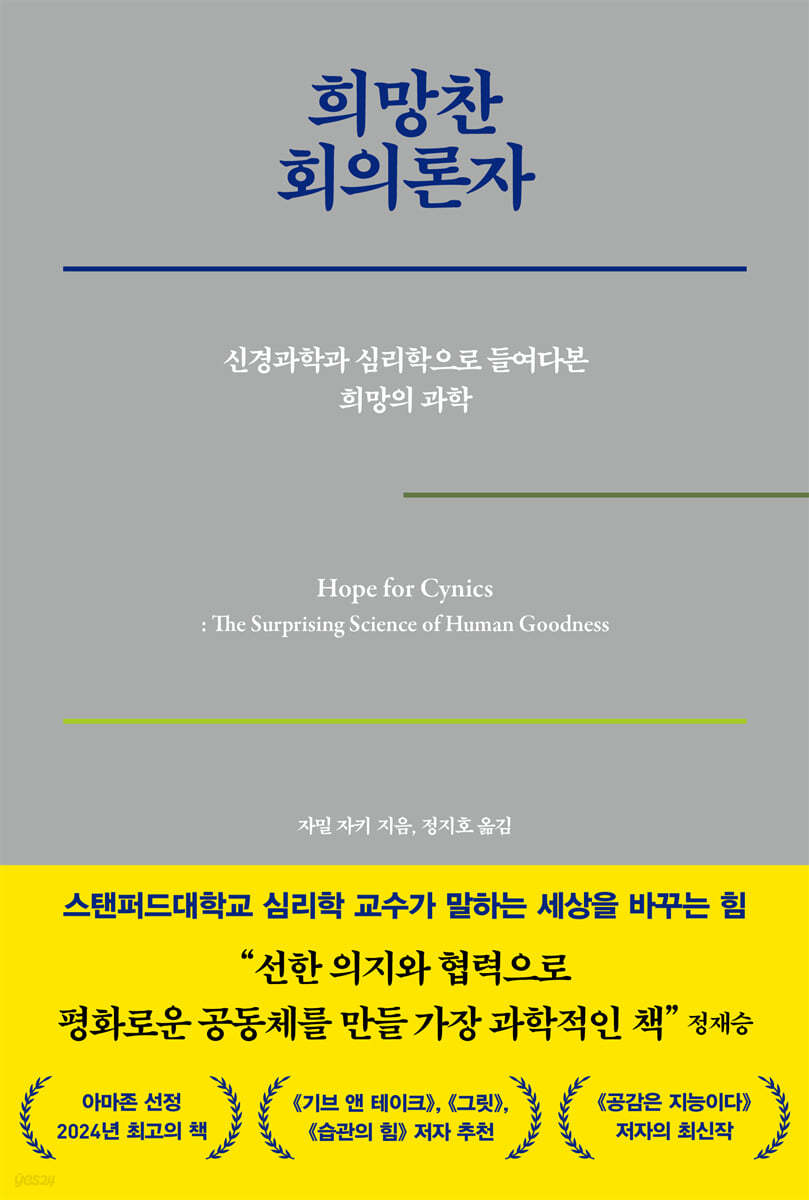
Hopeful Skeptic
 |
Description
Book Introduction
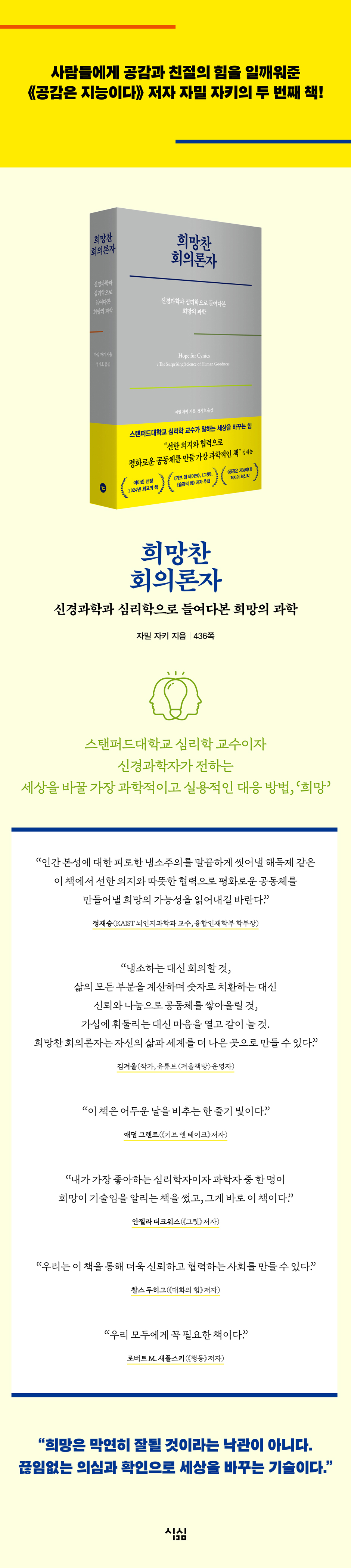
“A book filled with hope for positive change in our lives and society” _Jeong Jae-seung
“This book shatters cynicism” _Kim Gyul-wool
The Science of Hope from a Stanford University Psychology Professor and Neuroscientist
Jamil Zaki, who gained attention for his column on how kindness became a global trend during the COVID-19 pandemic and preached the power of empathy in “The War for Kindness” (Simsim, 2021), has published his second book.
This book, Hope for Cynics: The Surprising Science of Human Goodness, reframes and reframes our perspectives on hope, which we often misunderstand as optimism, and skepticism, which we often view as negative.
And it shows how human nature is good and how hope and skepticism can transform one's life, others, and the world.
"The Hopeful Skeptic" is a three-part book that explores the many lives of hopeful people and guides them through strategies and habits to overcome cynicism and become hopeful skeptics.
People who often ignore what others say or speak without emotion are often considered intelligent, and this is often considered a typical characteristic of cynicism.
However, in the famous detective novel Sherlock Holmes, the author shows us the true prototype of cynicism and the distorted modern cynicism through his older brother Mycroft Holmes.
And through stories such as the story of a principal who transformed a negative school atmosphere into a positive one by understanding the true nature of his students, the story of changing Microsoft's negative and fiercely competitive culture into a culture of cooperation and coexistence, and the story of how someone escaped conspiracy theories and found their own life through the love and support of their family, it suggests ways to awaken the hope and skepticism hidden in cynicism and take the path of a hopeful skeptic.
Things won't get better if you conform to cynicism and negativity or respond with anger.
As Professor Jaeseung Jeong said, “Human goodness is never a naive hope, but a shared resource that we can use to build stronger and more compassionate communities.” This book, based on good hope starting from small possibilities and skepticism that seeks evidence and certainty, will serve as a foundation for self-transformation and, going forward, changing the world around us.
“This book shatters cynicism” _Kim Gyul-wool
The Science of Hope from a Stanford University Psychology Professor and Neuroscientist
Jamil Zaki, who gained attention for his column on how kindness became a global trend during the COVID-19 pandemic and preached the power of empathy in “The War for Kindness” (Simsim, 2021), has published his second book.
This book, Hope for Cynics: The Surprising Science of Human Goodness, reframes and reframes our perspectives on hope, which we often misunderstand as optimism, and skepticism, which we often view as negative.
And it shows how human nature is good and how hope and skepticism can transform one's life, others, and the world.
"The Hopeful Skeptic" is a three-part book that explores the many lives of hopeful people and guides them through strategies and habits to overcome cynicism and become hopeful skeptics.
People who often ignore what others say or speak without emotion are often considered intelligent, and this is often considered a typical characteristic of cynicism.
However, in the famous detective novel Sherlock Holmes, the author shows us the true prototype of cynicism and the distorted modern cynicism through his older brother Mycroft Holmes.
And through stories such as the story of a principal who transformed a negative school atmosphere into a positive one by understanding the true nature of his students, the story of changing Microsoft's negative and fiercely competitive culture into a culture of cooperation and coexistence, and the story of how someone escaped conspiracy theories and found their own life through the love and support of their family, it suggests ways to awaken the hope and skepticism hidden in cynicism and take the path of a hopeful skeptic.
Things won't get better if you conform to cynicism and negativity or respond with anger.
As Professor Jaeseung Jeong said, “Human goodness is never a naive hope, but a shared resource that we can use to build stronger and more compassionate communities.” This book, based on good hope starting from small possibilities and skepticism that seeks evidence and certainty, will serve as a foundation for self-transformation and, going forward, changing the world around us.
index
Introductory Remarks: Hope is not an optimistic expectation, but a pragmatic response.
Part 1: The Key to Overcoming Cynicism
Chapter 1: Signs and Symptoms of Cynicism
The Archetype of Cynicism | A Transformed Cynicism | The Relationship Between Cynicism and Trust | The Resurrection of Ancient Cynicism | What Happens When You Trust Yourself
Chapter 2: The Reversal of Cynicism and Skepticism
A Mind of Constant Doubt and Belief│The Trap of Cynicism You Can Easily Fall Into│The Foundation for Eliminating Cynicism│How to Detoxify Cynicism
Chapter 3: Cynicism Created by the Environment
The Price of Inequality and Distrust│The Commodification of Human Relationships│A Small Seaside Town Built on Trust│Three Ways to Escape Cynicism
Chapter 4: Other People Are Not Hell
The Media's Gossip Megaphone│What We Believe About Human Nature
Chapter 5: Escaping the Trap of Cynicism
The Power That Cynicism Destroys│The Variables That Trust Creates│The Power That Brings Out the Best
Part 2: Awakening the Skepticism Within Cynicism
Chapter 6: The Invisible String of Cynicism
The Imaginary Social Shark Attack│What's More Valuable Than Self-Care│We Want to Connect│The Amazing Things That Happen When You Care for Others
Chapter 7: Building a Culture of Trust
The Society Created by Homo Economicus│The Price of Distrust is More Expensive than Trust│The Environment That Creates the Worst Cynics│Homo Collaboratus Leading Solidarity│The Change Revealed by Unconditional Faith
Chapter 8: Skepticism: Bridging the Gap
The Nonexistent Devil│The War No One Wants│Misunderstandings Sprung from Small Gaps│How to Wisely Coordinate Opinions│Beyond the Science of Peace
Part 3: The Path of the Hopeful Skeptic
Chapter 9: The Changes We Must Make
Ronald Reagan and the Welfare Queen│The law exists for the wicked│Trust for the few, distrust for the many│A chance to prove yourself
Chapter 10: The Hopeful Skeptic in Action
Democracy achieved in prison | The power of loud action | The small movements that changed the election | The courage to embrace change
Chapter 11: We Must All Be Hopeful Skeptics
How to Find Hope in Tragedy│People Become 'People' Through Others│Hope Is Not Borrowed, It Is Earned
A milestone of hope established by science
Acknowledgements
Appendix 1: A Practical Guide to Hopeful Skepticism
Appendix 2 Evidence Evaluation
Huzhou
Part 1: The Key to Overcoming Cynicism
Chapter 1: Signs and Symptoms of Cynicism
The Archetype of Cynicism | A Transformed Cynicism | The Relationship Between Cynicism and Trust | The Resurrection of Ancient Cynicism | What Happens When You Trust Yourself
Chapter 2: The Reversal of Cynicism and Skepticism
A Mind of Constant Doubt and Belief│The Trap of Cynicism You Can Easily Fall Into│The Foundation for Eliminating Cynicism│How to Detoxify Cynicism
Chapter 3: Cynicism Created by the Environment
The Price of Inequality and Distrust│The Commodification of Human Relationships│A Small Seaside Town Built on Trust│Three Ways to Escape Cynicism
Chapter 4: Other People Are Not Hell
The Media's Gossip Megaphone│What We Believe About Human Nature
Chapter 5: Escaping the Trap of Cynicism
The Power That Cynicism Destroys│The Variables That Trust Creates│The Power That Brings Out the Best
Part 2: Awakening the Skepticism Within Cynicism
Chapter 6: The Invisible String of Cynicism
The Imaginary Social Shark Attack│What's More Valuable Than Self-Care│We Want to Connect│The Amazing Things That Happen When You Care for Others
Chapter 7: Building a Culture of Trust
The Society Created by Homo Economicus│The Price of Distrust is More Expensive than Trust│The Environment That Creates the Worst Cynics│Homo Collaboratus Leading Solidarity│The Change Revealed by Unconditional Faith
Chapter 8: Skepticism: Bridging the Gap
The Nonexistent Devil│The War No One Wants│Misunderstandings Sprung from Small Gaps│How to Wisely Coordinate Opinions│Beyond the Science of Peace
Part 3: The Path of the Hopeful Skeptic
Chapter 9: The Changes We Must Make
Ronald Reagan and the Welfare Queen│The law exists for the wicked│Trust for the few, distrust for the many│A chance to prove yourself
Chapter 10: The Hopeful Skeptic in Action
Democracy achieved in prison | The power of loud action | The small movements that changed the election | The courage to embrace change
Chapter 11: We Must All Be Hopeful Skeptics
How to Find Hope in Tragedy│People Become 'People' Through Others│Hope Is Not Borrowed, It Is Earned
A milestone of hope established by science
Acknowledgements
Appendix 1: A Practical Guide to Hopeful Skepticism
Appendix 2 Evidence Evaluation
Huzhou
Detailed image
Into the book
As a cynic, I see the worst in people first.
I had this tendency early on and had a difficult time trusting people due to my turbulent family history.
But as I grew, I developed a stronger emotional foundation through new relationships and with the help of science.
In my lab, I've discovered that most people value compassion over selfishness, that donating money activates similar brain regions as eating chocolate, and that helping someone in need can actually be comforting.
The message of our research is simple.
We have goodness and that goodness helps us.
Scientists see hope differently.
Psychologist Richard Lazarus stated:
“Hope is the belief that something is positive.
This belief may not apply to that person's life right now, but it may come true someday." In other words, hope is not about avoiding problems, but about responding to them.
While optimism is the belief that things will definitely get better, hope tells us that things might get better.
Optimism is idealistic, hope is practical.
Hope gives people a glimpse of a better world and inspires them to fight for it.
If you're like most people, you won't hear the hopeful news: "People are probably better than we think."
But if you lean into skepticism, don't jump to conclusions, observe people carefully, and you might find pleasant surprises everywhere.
As research has clearly shown, hope is not a naive approach to the world.
Hope is an accurate response to the best available data.
This response offers a kind of hope that even cynics can embrace, and it offers an opportunity to escape the mental trap that has caught so many of us.
--- From "Introductory Remarks: Hope is not an optimistic expectation, but a practical response"
This social malnutrition worsens over time.
Studies have shown that cynical teenagers are more likely to be depressed as college students than non-cynical teenagers, and that cynical college students are more likely to drink excessively and get divorced in middle age.
While non-cynics consistently earn more money as their careers progress, cynics struggle financially.
Cynics are more likely to experience heartache and heart disease.
In one study, about 2,000 adults participated in a survey conducted by Cook and Medley.
Nine years later, 177 people had died, more than twice as many of whom were cynics as non-cynics.
Why do some people close their hearts when they face suffering, while others open theirs wide? Many factors are involved, but one of them is community.
In the highly trusted, ordinary town of Mano, the earthquake sparked cooperation.
But in Mikura, where trust is lower than this, everything is scattered.
In times of adversity, lonely people become lonelier, and trauma solidifies into premature disappointment.
But when someone like Emil supports you, you're more likely to thrive even in adversity.
Skepticism has been used as a therapeutic tool in cognitive behavioral therapy, or CBT, for over a century. CBT practitioners, like my psychologist, work with patients to challenge their thinking.
In reality testing, the patient identifies facts he or she believes and puts them into words.
A person who is very anxious may deep down believe that his or her friend really hates him or her.
At this time, the therapist and patient fact-check whether these feelings are correct.
Has anyone ever said they liked their patients? Have they ever been kind to them? Have they ever asked them to spend time with them? In almost every case, the actual evidence contradicts the patient's claims.
Most of us are tired of hearing that other people are hell.
A 2021 poll found that nearly 80 percent of consumers want news outlets to stop spreading bad news.
Tired of negative news, we've become clear about what we want.
It is an opportunity to witness the goodness of others.
Thankfully, this positive news is everywhere.
I'm not saying we should ignore our problems to open our eyes to the best in people.
It's just a matter of having a new mindset and being interested in a balanced way.
If there's one thing humans cannot avoid on a biological level, it's change.
The qualities we think of as eternal—our character, our intelligence, our values—evolve over time along with our brains.
This fact may be confusing, but it is also encouraging.
The ship of your life is now sailing.
We can't stop this ship, but we can steer it.
Cynics are preoccupied with stereotypes, judge others based on their worst behavior, and believe that those who cheat are always cheating.
If you look at the world this way, you're treating everyone you meet like a slot machine, trying to figure out who you should date to make a profit and who will steal your money.
But as we have experienced, people do not just change.
We change people through our own expectations and actions.
--- From "Part 1: The Key to Abandoning Cynicism"
People misjudge social relationships because they underestimate each other.
Similar to other forms of negativity bias, this error is accompanied by its own behavior: preemptive retreat rather than preemptive attack.
We avoid people because we fear deep down that they are not kind.
For Stanford University students, the less friendly they perceived other students to be, the less likely they were to confide in a friend about their struggles or engage in conversation with other students.
The less they try to do this, the less likely they are to see if their fears are actually true and to realize how many caring and open-minded people there are around them.
Anxiety, depression, eating disorders, and self-harm are on the rise among young people around the world.
One of the main culprits is isolation.
Isolation, in other words, is based on cynicism, the idea that others do not want or need us.
This experience had a surprising impact on me.
Over the past 12 years, our lab has conducted experiments on tens of thousands of people in the United States and around the world.
I know that the general public is kind and open-minded, and I teach this principle.
But deep down in my heart, I couldn't accept this.
In a culture obsessed with measuring absolutely everything, 'not being judged' can help us find peace of mind.
But as we go through life, there are things that deserve more attention and care, like positive moments spent with other people.
In such cases, continuing to collect these experiences helps us raise our level of consciousness and savor social relationships.
Young Americans grew up in the shadow of 9/11.
In elementary school, we practiced with our teachers to prepare for real-life shootings, and in high school, we learned that nature would wither away before we reached old age.
Israeli and Cypriot youth have no memory of ever living in a peaceful country.
In such a situation, nihilism is a natural reaction no matter what anyone says, but if nihilism becomes widespread, even the possibility of achieving something is blocked.
Nihilism is a characteristic of cynicism.
People who seem hopeless about politics seem intelligent and insightful, and the idea that nations can live in harmony begins to seem simplistic and dangerous.
Ironically, the cynical view of rivals is foolish in itself.
When political despair prevails, the most deceptive political power holders gain power.
As long as we believe that constructive communication between different groups is impossible, there is no need to make efforts in that direction.
As long as people continue to fight over party identities, the hardships we all share, like deepening inequality, will not disappear.
Emil and Casas didn't need to trick people to get rid of their fear and hatred.
They simply told the Colombians the truth about the other side.
“Our Colombia is on the verge of peace.
Through this study, we learned that the best way to achieve peace is to think well of others.” The same strategy has been proven effective in follow-up studies conducted in several other countries, including the United States.
When problems lurk beneath the surface, the best disinfectant is light.
But in our politics, festering and bursting areas are already being revealed here and there.
The hidden people are the peaceful and curious majority all around us, but their voices are often drowned out by the extreme voices.
The rift in our culture began with misunderstanding, and hopeful skepticism can be a powerful tool to bridge it.
When you shine a light on clear and simple information, it reveals a picture that closely resembles possibility.
--- From "Awakening Skepticism in Cynicism Part 2"
If these research results are surprising, that's a natural reaction.
Researchers who gave cash grants to homeless people in Vancouver asked more than 1,000 Canadians how they would spend the money.
Most of them were predicted to be used for drugs.
I don't think people make these assumptions because they hate homeless people.
If you also assumed that the poor would squander the cash they received, I don't think you're full of hate, because I, too, held this stereotype.
Before I read the study, I was worried that cash recipients would squander the money or work less.
I'm not proud of my past prejudices, but I've come to realize that they are also a side effect of our culture's cynicism.
We must arm ourselves with and internalize skepticism.
Where do our assumptions come from? What is their purpose, and to whom do they benefit? Cynical beliefs support the status quo.
If the poor are the villains, the rich have no reason to question the benefits they enjoy.
But programs like UpTogether and the Social Change Foundation have overturned this perspective.
Their hopeful experiment shows what happens when society blindly trusts the poor.
Many people are already angry about various things.
But it is becoming increasingly difficult to achieve efficacy.
How can we cultivate a sense of efficacy? It's about believing that others will step up.
In the 1960s, researchers asked black Americans whether they would be willing to participate in a sit-in protest against racial discrimination.
Black people who believed white people would support racial advancement were 20 percent more likely to participate in protests than those who believed white people would not support it.
White people who observed the sit-in also became more supportive of racial justice and more likely to participate in future protests.
This phenomenon has created a virtuous, self-fulfilling prophecy.
Black protesters who believed others would join them took action, and those who were influenced by this joined the protest.
Fatalism, like other forms of cynicism, drains our motivation to do anything.
Fatalism is obviously based on flawed assumptions about humanity.
Americans believe only a third of the population would support aggressive climate reform.
But the actual figure is closer to two-thirds.
If you want to advocate for environmental protection, that means there are a lot of people like that, and we just don't recognize them around us.
Most people want a sustainable future, and millions are taking action toward it through creative maladaptive initiatives.
More and more people are already living sustainably, providing guidance for us to follow.
I had this tendency early on and had a difficult time trusting people due to my turbulent family history.
But as I grew, I developed a stronger emotional foundation through new relationships and with the help of science.
In my lab, I've discovered that most people value compassion over selfishness, that donating money activates similar brain regions as eating chocolate, and that helping someone in need can actually be comforting.
The message of our research is simple.
We have goodness and that goodness helps us.
Scientists see hope differently.
Psychologist Richard Lazarus stated:
“Hope is the belief that something is positive.
This belief may not apply to that person's life right now, but it may come true someday." In other words, hope is not about avoiding problems, but about responding to them.
While optimism is the belief that things will definitely get better, hope tells us that things might get better.
Optimism is idealistic, hope is practical.
Hope gives people a glimpse of a better world and inspires them to fight for it.
If you're like most people, you won't hear the hopeful news: "People are probably better than we think."
But if you lean into skepticism, don't jump to conclusions, observe people carefully, and you might find pleasant surprises everywhere.
As research has clearly shown, hope is not a naive approach to the world.
Hope is an accurate response to the best available data.
This response offers a kind of hope that even cynics can embrace, and it offers an opportunity to escape the mental trap that has caught so many of us.
--- From "Introductory Remarks: Hope is not an optimistic expectation, but a practical response"
This social malnutrition worsens over time.
Studies have shown that cynical teenagers are more likely to be depressed as college students than non-cynical teenagers, and that cynical college students are more likely to drink excessively and get divorced in middle age.
While non-cynics consistently earn more money as their careers progress, cynics struggle financially.
Cynics are more likely to experience heartache and heart disease.
In one study, about 2,000 adults participated in a survey conducted by Cook and Medley.
Nine years later, 177 people had died, more than twice as many of whom were cynics as non-cynics.
Why do some people close their hearts when they face suffering, while others open theirs wide? Many factors are involved, but one of them is community.
In the highly trusted, ordinary town of Mano, the earthquake sparked cooperation.
But in Mikura, where trust is lower than this, everything is scattered.
In times of adversity, lonely people become lonelier, and trauma solidifies into premature disappointment.
But when someone like Emil supports you, you're more likely to thrive even in adversity.
Skepticism has been used as a therapeutic tool in cognitive behavioral therapy, or CBT, for over a century. CBT practitioners, like my psychologist, work with patients to challenge their thinking.
In reality testing, the patient identifies facts he or she believes and puts them into words.
A person who is very anxious may deep down believe that his or her friend really hates him or her.
At this time, the therapist and patient fact-check whether these feelings are correct.
Has anyone ever said they liked their patients? Have they ever been kind to them? Have they ever asked them to spend time with them? In almost every case, the actual evidence contradicts the patient's claims.
Most of us are tired of hearing that other people are hell.
A 2021 poll found that nearly 80 percent of consumers want news outlets to stop spreading bad news.
Tired of negative news, we've become clear about what we want.
It is an opportunity to witness the goodness of others.
Thankfully, this positive news is everywhere.
I'm not saying we should ignore our problems to open our eyes to the best in people.
It's just a matter of having a new mindset and being interested in a balanced way.
If there's one thing humans cannot avoid on a biological level, it's change.
The qualities we think of as eternal—our character, our intelligence, our values—evolve over time along with our brains.
This fact may be confusing, but it is also encouraging.
The ship of your life is now sailing.
We can't stop this ship, but we can steer it.
Cynics are preoccupied with stereotypes, judge others based on their worst behavior, and believe that those who cheat are always cheating.
If you look at the world this way, you're treating everyone you meet like a slot machine, trying to figure out who you should date to make a profit and who will steal your money.
But as we have experienced, people do not just change.
We change people through our own expectations and actions.
--- From "Part 1: The Key to Abandoning Cynicism"
People misjudge social relationships because they underestimate each other.
Similar to other forms of negativity bias, this error is accompanied by its own behavior: preemptive retreat rather than preemptive attack.
We avoid people because we fear deep down that they are not kind.
For Stanford University students, the less friendly they perceived other students to be, the less likely they were to confide in a friend about their struggles or engage in conversation with other students.
The less they try to do this, the less likely they are to see if their fears are actually true and to realize how many caring and open-minded people there are around them.
Anxiety, depression, eating disorders, and self-harm are on the rise among young people around the world.
One of the main culprits is isolation.
Isolation, in other words, is based on cynicism, the idea that others do not want or need us.
This experience had a surprising impact on me.
Over the past 12 years, our lab has conducted experiments on tens of thousands of people in the United States and around the world.
I know that the general public is kind and open-minded, and I teach this principle.
But deep down in my heart, I couldn't accept this.
In a culture obsessed with measuring absolutely everything, 'not being judged' can help us find peace of mind.
But as we go through life, there are things that deserve more attention and care, like positive moments spent with other people.
In such cases, continuing to collect these experiences helps us raise our level of consciousness and savor social relationships.
Young Americans grew up in the shadow of 9/11.
In elementary school, we practiced with our teachers to prepare for real-life shootings, and in high school, we learned that nature would wither away before we reached old age.
Israeli and Cypriot youth have no memory of ever living in a peaceful country.
In such a situation, nihilism is a natural reaction no matter what anyone says, but if nihilism becomes widespread, even the possibility of achieving something is blocked.
Nihilism is a characteristic of cynicism.
People who seem hopeless about politics seem intelligent and insightful, and the idea that nations can live in harmony begins to seem simplistic and dangerous.
Ironically, the cynical view of rivals is foolish in itself.
When political despair prevails, the most deceptive political power holders gain power.
As long as we believe that constructive communication between different groups is impossible, there is no need to make efforts in that direction.
As long as people continue to fight over party identities, the hardships we all share, like deepening inequality, will not disappear.
Emil and Casas didn't need to trick people to get rid of their fear and hatred.
They simply told the Colombians the truth about the other side.
“Our Colombia is on the verge of peace.
Through this study, we learned that the best way to achieve peace is to think well of others.” The same strategy has been proven effective in follow-up studies conducted in several other countries, including the United States.
When problems lurk beneath the surface, the best disinfectant is light.
But in our politics, festering and bursting areas are already being revealed here and there.
The hidden people are the peaceful and curious majority all around us, but their voices are often drowned out by the extreme voices.
The rift in our culture began with misunderstanding, and hopeful skepticism can be a powerful tool to bridge it.
When you shine a light on clear and simple information, it reveals a picture that closely resembles possibility.
--- From "Awakening Skepticism in Cynicism Part 2"
If these research results are surprising, that's a natural reaction.
Researchers who gave cash grants to homeless people in Vancouver asked more than 1,000 Canadians how they would spend the money.
Most of them were predicted to be used for drugs.
I don't think people make these assumptions because they hate homeless people.
If you also assumed that the poor would squander the cash they received, I don't think you're full of hate, because I, too, held this stereotype.
Before I read the study, I was worried that cash recipients would squander the money or work less.
I'm not proud of my past prejudices, but I've come to realize that they are also a side effect of our culture's cynicism.
We must arm ourselves with and internalize skepticism.
Where do our assumptions come from? What is their purpose, and to whom do they benefit? Cynical beliefs support the status quo.
If the poor are the villains, the rich have no reason to question the benefits they enjoy.
But programs like UpTogether and the Social Change Foundation have overturned this perspective.
Their hopeful experiment shows what happens when society blindly trusts the poor.
Many people are already angry about various things.
But it is becoming increasingly difficult to achieve efficacy.
How can we cultivate a sense of efficacy? It's about believing that others will step up.
In the 1960s, researchers asked black Americans whether they would be willing to participate in a sit-in protest against racial discrimination.
Black people who believed white people would support racial advancement were 20 percent more likely to participate in protests than those who believed white people would not support it.
White people who observed the sit-in also became more supportive of racial justice and more likely to participate in future protests.
This phenomenon has created a virtuous, self-fulfilling prophecy.
Black protesters who believed others would join them took action, and those who were influenced by this joined the protest.
Fatalism, like other forms of cynicism, drains our motivation to do anything.
Fatalism is obviously based on flawed assumptions about humanity.
Americans believe only a third of the population would support aggressive climate reform.
But the actual figure is closer to two-thirds.
If you want to advocate for environmental protection, that means there are a lot of people like that, and we just don't recognize them around us.
Most people want a sustainable future, and millions are taking action toward it through creative maladaptive initiatives.
More and more people are already living sustainably, providing guidance for us to follow.
--- From "Part 3: The Path of the Hopeful Skeptic"
Publisher's Review
“Are cynics smart and hopeful people foolish?”
Change begins with exposing the biases of cynicism and hope.
What image comes to mind when you think of a "cynical person"? Typically, you'd picture someone who's quick to point out and ridicule inaccuracies in others' stories, is quick to expose lies, and, while disinterested in social issues or politics, appears to have clear judgment and intelligence.
To conclude, this is a huge misunderstanding.
Cynics are not smart and cannot expose lies because they do not listen to anyone or believe anything without any evidence.
If we look at the archetypes of ancient cynicism, they are quite different from what we know today.
The true nature of cynicism can be seen in a person named Diogenes, who was born in Greece 2300 years ago.
Diogenes lived his life wandering the streets of Athens, enjoying delivering direct blows to society and people who valued decency.
He loved sarcasm and was sometimes rude, but he hated lying.
People who were unable to live a proper life due to laws and class systems found hope in Diogenes' actions and followed him, giving birth to cynicism that touched on the essence of life.
To combat the ills of society, Big C Cynic set rules to live by meaningfully.
The first element of the rule was autarkheia, or self-sufficiency.
The cynic could live his life in his own way, ignoring convention, money, and status.
He pursued his true value without relying on anyone.
The second element was cosmopolitanism, or globalism.
Cynics rejected identity politics and saw themselves as neither better nor worse than others.
When asked where he was from, Diogenes answered without hesitation, “I am a citizen of the world.”
The third element of the prescription was philanthropy, or love for humanity.
The cynic responded to suffering with what the so-called experts call "evangelistic fervor," helping others.
“Concern for the well-being of one’s fellows is the basis of all forms of cynicism,” Diogenes wrote.
(Page 36)
Cynicism, which was once based on helping others, has morphed over time into the form we know today.
People have become so selfish, greedy, and dishonest that they have lost faith or hope in themselves or in others.
But if you don't trust others, nothing will change.
The author is hopeful and uses a simple experiment to explain what happens to people who trust others and those who don't.
This experiment, also known as the trust game, involves participants acting as both investors and trustees, with the returns earned varying depending on how much the investors trust the trustees.
The results of the experiment showed that investors who trusted the trustee and entrusted a large amount of money made a profit by getting back about 80 percent of their investment, while investors who did not trust the trustee suffered losses by getting less than half of their investment back.
Cynics who engage in the trust game lose just that much money, but in reality they lose even more important resources: people and community.
Conversely, those who have hope and trust others gain not only money but also the trust of others and community cohesion.
High-trust communities outperform low-trust communities in many ways.
Members of communities with high levels of trust are happier.
In terms of happiness, living in a high-trust organization is said to be equivalent to a 40 percent increase in salary.
They are physically healthier and more tolerant of differences with others.
They donate a lot to charity, are actively involved in community activities, and have a low suicide rate.
They conduct business efficiently and are active in investment, contributing to the prosperity of trade.
Economists once measured trust levels in 41 countries and compared their gross domestic product over the years.
Countries with high trust saw their national treasuries grow, while those with low trust saw their wealth stagnate or decline.
(Pages 43-44)
To break free from cynicism, we must stop doubting others and defining ourselves through comparison.
Contrary to appearances, cynics tend to rely heavily on fame and status to boost their self-esteem, but breaking out of this trap requires exploring their own deepest values.
If you identify the qualities that are most important to you—social skills, interpersonal relationships, creativity, humor, etc.—and practice briefly writing down events related to them rather than just thinking about them, society will seem a little less scary and your trust in others will grow.
In this process of looking deeply into your own heart to confirm your own worth, cynicism can subside and hope can be found within.
"The Hopeful Skeptic" helps us question things we take for granted and believe will never change, and discover possibilities within them, through examples such as the culture of trust created through collaboration and the transformation of negative generalizations into positive ones.
In this book, the author presents another practical method for moving toward hopeful skepticism, along with examples, a method he has personally proven through experimentation.
Practice is not grand or difficult.
Simply confirming negative thoughts about others and society through clear evidence—asking a friend or colleague for a small favor, finding positive news coverage of the same event, sharing more positive stories about others, even if they are small—shows that modern cynicism can return to its original form and even lead to the path of hopeful skepticism.
“Hope is the most practical technology for changing the world.”
A world created by those who constantly doubt, seek evidence, and believe without compensation.
Through the story of Microsoft, "Hopeful Skeptic" shows how hopeful skepticism fosters collaboration and trust within companies.
The Microsoft we know today, with its outstanding employee collaboration and well-being, wasn't created out of thin air.
When Satya Nadella became the new CEO of Microsoft, there were still a lot of useless processes that required permission from superiors and their superiors for even the smallest things, and a policy of firing even the best employees if they didn't produce satisfactory results in a given quarter was maintained in the name of promotions and dismissals.
This led employees to choose individualism and distrust over cooperation and trust to avoid being laid off.
In this atmosphere, Microsoft's performance hit rock bottom and talented employees frequently left the company.
Satya Nadella introduced a new personnel system to eliminate the culture of competition among employees.
It was not just about reflecting individual performance, but also evaluating how much each person helped the other.
We also created an environment where teams can collaborate and generate new ideas through large-scale hackathons (a programming marathon where teams produce results within a given time frame, like a marathon).
Executives made every space in the company available to employees so they could work more closely together and comfortably, and they made an effort to understand their concerns.
As a result, a 2020 survey found that more than 90 percent of Microsoft employees trust their managers.
We also achieved the success of large-scale investment in OpenAI through large-scale hackathons.
The result was that the company trusted its employees first, and the employees also trusted the company.
Nadella even treated other companies like Homo collaboratorus.
He did something at a major industry event that would have been unthinkable a few years ago.
Nadella went up on stage, reached into his pocket, and took out his iPhone.
It was the first iPhone to come with Microsoft products, including Office and Outlook.
Nadella acknowledged the mobile technology race and set the stage for both companies to win by giving customers what they want.
“Too often, partnerships are seen as a zero-sum game,” Nadella said.
Nadella has sought opportunities to grow the pie both inside and outside Microsoft, tapping into his collaborative instincts.
/ (……) Early in the pandemic, Hogan began surveying his employees to understand them.
Employees were struggling with a whirlwind of worries, including unpredictable childcare issues and illness.
They needed work flexibility and support.
Microsoft announced that employees can work from home for extended periods, expanded mental health benefits, and added 12 weeks of parental leave.
(……) In 2020, more than 90 percent of Microsoft employees trusted their managers, and Hogan was named the best people officer in 2021.
(Pages 213-214)
The author also draws on his own experience as an assistant professor to illustrate how one person's hopeful skepticism can transform an entire group.
When he finally accepted an assistant professorship at Stanford University after a long period of study, he admitted to feeling under a lot of pressure.
Because I had to show new research results and have decent achievements to be able to apply for a tenured professorship.
Surrounded by anxiety and impatience, he became a living, breathing cynic, busy harassing and nagging the researchers he had hand-picked.
Whatever they did seemed inadequate, and they were quick to raise their voices if anything failed to meet their expectations.
It was one researcher who made me look back at him like this, and in fact, it was difficult to see him as either an optimist or a skeptic.
He simply made an honest confession that the working environment was too difficult and that he felt he could not work any longer unless this situation changed.
But his true confession came as a great shock to the author.
A sense of shame and shock washed over me that a scientist studying empathy had spread cynicism instead of kindness, and had failed to examine their hearts.
The author immediately changed the way the lab was run.
Since they were people I personally chose, I decided to see them and believe them as they were.
He didn't step forward to lead, but helped them when they needed him.
A manual on laboratory operations was also created and reviewed with researchers.
Then, the awareness that everyone was the owner of this laboratory, not swayed by the words of a single leader, was naturally instilled.
As shouting was replaced by communication, patience, and trust, the lab atmosphere changed and new and outstanding results were produced.
Any leader can learn anti-cynicism and soon find themselves establishing themselves as a good leader.
During the first two years of the pandemic, millions of people left their jobs in the face of the pandemic, and many more remained in their positions, shirking their duties and "secretly not working." Company leaders may be angry and confused by this state of affairs, but they shouldn't be.
The "Let's Go Loyalty" campaign began decades ago when managers suspected and exploited their employees.
The thigh pain is simply a phenomenon that has been belatedly manifested after employees' dissatisfaction has accumulated over a long period of time.
/ To rebuild a culture of trust, structural changes such as eliminating inequality in the workplace and restoring job security are necessary, but these changes must be accompanied by psychological reforms, that is, a culture in which those in power trust those with less power more.
(Page 221)
What we learn from Microsoft and the author's lab case is the power of collaboration created by trust and faith.
As one side began to trust the other, the stereotype of negativity bias was broken down and the situation changed for the better.
Cynicism arises from the negativity bias resulting from the fallacy and prejudice of polarization.
The perception of one another varies greatly depending on one's position and status: the wealthy and powerful class and the poor and marginalized class, the companies that provide jobs and the workers employed there, the teachers who teach students and the students who receive their teaching.
The wealthy believe that the relatively poor will cling to them, and companies believe that workers will not work as hard if they are given slightly more generous benefits.
Teachers may feel that if they don't push their students, they will go down the wrong path.
But this is a conviction without evidence.
Through this book, the author proves that the power to break free from the cynicism that pervades individuals and groups lies in the goodness of human nature and the hope that comes from believing in it.
"The Hopeful Skeptic" demonstrates through case studies that people value compassion over selfishness, that donating money activates similar brain regions as eating chocolate, and that helping those in need brings greater comfort to the individual, demonstrating that the goodness of an individual and the belief that goodness in others can be found in others are the most scientifically powerful forces that can change the world.
Change begins with exposing the biases of cynicism and hope.
What image comes to mind when you think of a "cynical person"? Typically, you'd picture someone who's quick to point out and ridicule inaccuracies in others' stories, is quick to expose lies, and, while disinterested in social issues or politics, appears to have clear judgment and intelligence.
To conclude, this is a huge misunderstanding.
Cynics are not smart and cannot expose lies because they do not listen to anyone or believe anything without any evidence.
If we look at the archetypes of ancient cynicism, they are quite different from what we know today.
The true nature of cynicism can be seen in a person named Diogenes, who was born in Greece 2300 years ago.
Diogenes lived his life wandering the streets of Athens, enjoying delivering direct blows to society and people who valued decency.
He loved sarcasm and was sometimes rude, but he hated lying.
People who were unable to live a proper life due to laws and class systems found hope in Diogenes' actions and followed him, giving birth to cynicism that touched on the essence of life.
To combat the ills of society, Big C Cynic set rules to live by meaningfully.
The first element of the rule was autarkheia, or self-sufficiency.
The cynic could live his life in his own way, ignoring convention, money, and status.
He pursued his true value without relying on anyone.
The second element was cosmopolitanism, or globalism.
Cynics rejected identity politics and saw themselves as neither better nor worse than others.
When asked where he was from, Diogenes answered without hesitation, “I am a citizen of the world.”
The third element of the prescription was philanthropy, or love for humanity.
The cynic responded to suffering with what the so-called experts call "evangelistic fervor," helping others.
“Concern for the well-being of one’s fellows is the basis of all forms of cynicism,” Diogenes wrote.
(Page 36)
Cynicism, which was once based on helping others, has morphed over time into the form we know today.
People have become so selfish, greedy, and dishonest that they have lost faith or hope in themselves or in others.
But if you don't trust others, nothing will change.
The author is hopeful and uses a simple experiment to explain what happens to people who trust others and those who don't.
This experiment, also known as the trust game, involves participants acting as both investors and trustees, with the returns earned varying depending on how much the investors trust the trustees.
The results of the experiment showed that investors who trusted the trustee and entrusted a large amount of money made a profit by getting back about 80 percent of their investment, while investors who did not trust the trustee suffered losses by getting less than half of their investment back.
Cynics who engage in the trust game lose just that much money, but in reality they lose even more important resources: people and community.
Conversely, those who have hope and trust others gain not only money but also the trust of others and community cohesion.
High-trust communities outperform low-trust communities in many ways.
Members of communities with high levels of trust are happier.
In terms of happiness, living in a high-trust organization is said to be equivalent to a 40 percent increase in salary.
They are physically healthier and more tolerant of differences with others.
They donate a lot to charity, are actively involved in community activities, and have a low suicide rate.
They conduct business efficiently and are active in investment, contributing to the prosperity of trade.
Economists once measured trust levels in 41 countries and compared their gross domestic product over the years.
Countries with high trust saw their national treasuries grow, while those with low trust saw their wealth stagnate or decline.
(Pages 43-44)
To break free from cynicism, we must stop doubting others and defining ourselves through comparison.
Contrary to appearances, cynics tend to rely heavily on fame and status to boost their self-esteem, but breaking out of this trap requires exploring their own deepest values.
If you identify the qualities that are most important to you—social skills, interpersonal relationships, creativity, humor, etc.—and practice briefly writing down events related to them rather than just thinking about them, society will seem a little less scary and your trust in others will grow.
In this process of looking deeply into your own heart to confirm your own worth, cynicism can subside and hope can be found within.
"The Hopeful Skeptic" helps us question things we take for granted and believe will never change, and discover possibilities within them, through examples such as the culture of trust created through collaboration and the transformation of negative generalizations into positive ones.
In this book, the author presents another practical method for moving toward hopeful skepticism, along with examples, a method he has personally proven through experimentation.
Practice is not grand or difficult.
Simply confirming negative thoughts about others and society through clear evidence—asking a friend or colleague for a small favor, finding positive news coverage of the same event, sharing more positive stories about others, even if they are small—shows that modern cynicism can return to its original form and even lead to the path of hopeful skepticism.
“Hope is the most practical technology for changing the world.”
A world created by those who constantly doubt, seek evidence, and believe without compensation.
Through the story of Microsoft, "Hopeful Skeptic" shows how hopeful skepticism fosters collaboration and trust within companies.
The Microsoft we know today, with its outstanding employee collaboration and well-being, wasn't created out of thin air.
When Satya Nadella became the new CEO of Microsoft, there were still a lot of useless processes that required permission from superiors and their superiors for even the smallest things, and a policy of firing even the best employees if they didn't produce satisfactory results in a given quarter was maintained in the name of promotions and dismissals.
This led employees to choose individualism and distrust over cooperation and trust to avoid being laid off.
In this atmosphere, Microsoft's performance hit rock bottom and talented employees frequently left the company.
Satya Nadella introduced a new personnel system to eliminate the culture of competition among employees.
It was not just about reflecting individual performance, but also evaluating how much each person helped the other.
We also created an environment where teams can collaborate and generate new ideas through large-scale hackathons (a programming marathon where teams produce results within a given time frame, like a marathon).
Executives made every space in the company available to employees so they could work more closely together and comfortably, and they made an effort to understand their concerns.
As a result, a 2020 survey found that more than 90 percent of Microsoft employees trust their managers.
We also achieved the success of large-scale investment in OpenAI through large-scale hackathons.
The result was that the company trusted its employees first, and the employees also trusted the company.
Nadella even treated other companies like Homo collaboratorus.
He did something at a major industry event that would have been unthinkable a few years ago.
Nadella went up on stage, reached into his pocket, and took out his iPhone.
It was the first iPhone to come with Microsoft products, including Office and Outlook.
Nadella acknowledged the mobile technology race and set the stage for both companies to win by giving customers what they want.
“Too often, partnerships are seen as a zero-sum game,” Nadella said.
Nadella has sought opportunities to grow the pie both inside and outside Microsoft, tapping into his collaborative instincts.
/ (……) Early in the pandemic, Hogan began surveying his employees to understand them.
Employees were struggling with a whirlwind of worries, including unpredictable childcare issues and illness.
They needed work flexibility and support.
Microsoft announced that employees can work from home for extended periods, expanded mental health benefits, and added 12 weeks of parental leave.
(……) In 2020, more than 90 percent of Microsoft employees trusted their managers, and Hogan was named the best people officer in 2021.
(Pages 213-214)
The author also draws on his own experience as an assistant professor to illustrate how one person's hopeful skepticism can transform an entire group.
When he finally accepted an assistant professorship at Stanford University after a long period of study, he admitted to feeling under a lot of pressure.
Because I had to show new research results and have decent achievements to be able to apply for a tenured professorship.
Surrounded by anxiety and impatience, he became a living, breathing cynic, busy harassing and nagging the researchers he had hand-picked.
Whatever they did seemed inadequate, and they were quick to raise their voices if anything failed to meet their expectations.
It was one researcher who made me look back at him like this, and in fact, it was difficult to see him as either an optimist or a skeptic.
He simply made an honest confession that the working environment was too difficult and that he felt he could not work any longer unless this situation changed.
But his true confession came as a great shock to the author.
A sense of shame and shock washed over me that a scientist studying empathy had spread cynicism instead of kindness, and had failed to examine their hearts.
The author immediately changed the way the lab was run.
Since they were people I personally chose, I decided to see them and believe them as they were.
He didn't step forward to lead, but helped them when they needed him.
A manual on laboratory operations was also created and reviewed with researchers.
Then, the awareness that everyone was the owner of this laboratory, not swayed by the words of a single leader, was naturally instilled.
As shouting was replaced by communication, patience, and trust, the lab atmosphere changed and new and outstanding results were produced.
Any leader can learn anti-cynicism and soon find themselves establishing themselves as a good leader.
During the first two years of the pandemic, millions of people left their jobs in the face of the pandemic, and many more remained in their positions, shirking their duties and "secretly not working." Company leaders may be angry and confused by this state of affairs, but they shouldn't be.
The "Let's Go Loyalty" campaign began decades ago when managers suspected and exploited their employees.
The thigh pain is simply a phenomenon that has been belatedly manifested after employees' dissatisfaction has accumulated over a long period of time.
/ To rebuild a culture of trust, structural changes such as eliminating inequality in the workplace and restoring job security are necessary, but these changes must be accompanied by psychological reforms, that is, a culture in which those in power trust those with less power more.
(Page 221)
What we learn from Microsoft and the author's lab case is the power of collaboration created by trust and faith.
As one side began to trust the other, the stereotype of negativity bias was broken down and the situation changed for the better.
Cynicism arises from the negativity bias resulting from the fallacy and prejudice of polarization.
The perception of one another varies greatly depending on one's position and status: the wealthy and powerful class and the poor and marginalized class, the companies that provide jobs and the workers employed there, the teachers who teach students and the students who receive their teaching.
The wealthy believe that the relatively poor will cling to them, and companies believe that workers will not work as hard if they are given slightly more generous benefits.
Teachers may feel that if they don't push their students, they will go down the wrong path.
But this is a conviction without evidence.
Through this book, the author proves that the power to break free from the cynicism that pervades individuals and groups lies in the goodness of human nature and the hope that comes from believing in it.
"The Hopeful Skeptic" demonstrates through case studies that people value compassion over selfishness, that donating money activates similar brain regions as eating chocolate, and that helping those in need brings greater comfort to the individual, demonstrating that the goodness of an individual and the belief that goodness in others can be found in others are the most scientifically powerful forces that can change the world.
GOODS SPECIFICS
- Date of issue: February 11, 2025
- Page count, weight, size: 436 pages | 662g | 145*215*31mm
- ISBN13: 9791172540463
You may also like
카테고리
korean


korean

![GQ KOREA Mark (Monthly): December [2025]](http://librairie.coreenne.fr/cdn/shop/files/8ef265dbbfbf186523ed75ba7319009d.jpg?v=1765340328&width=3840)


