

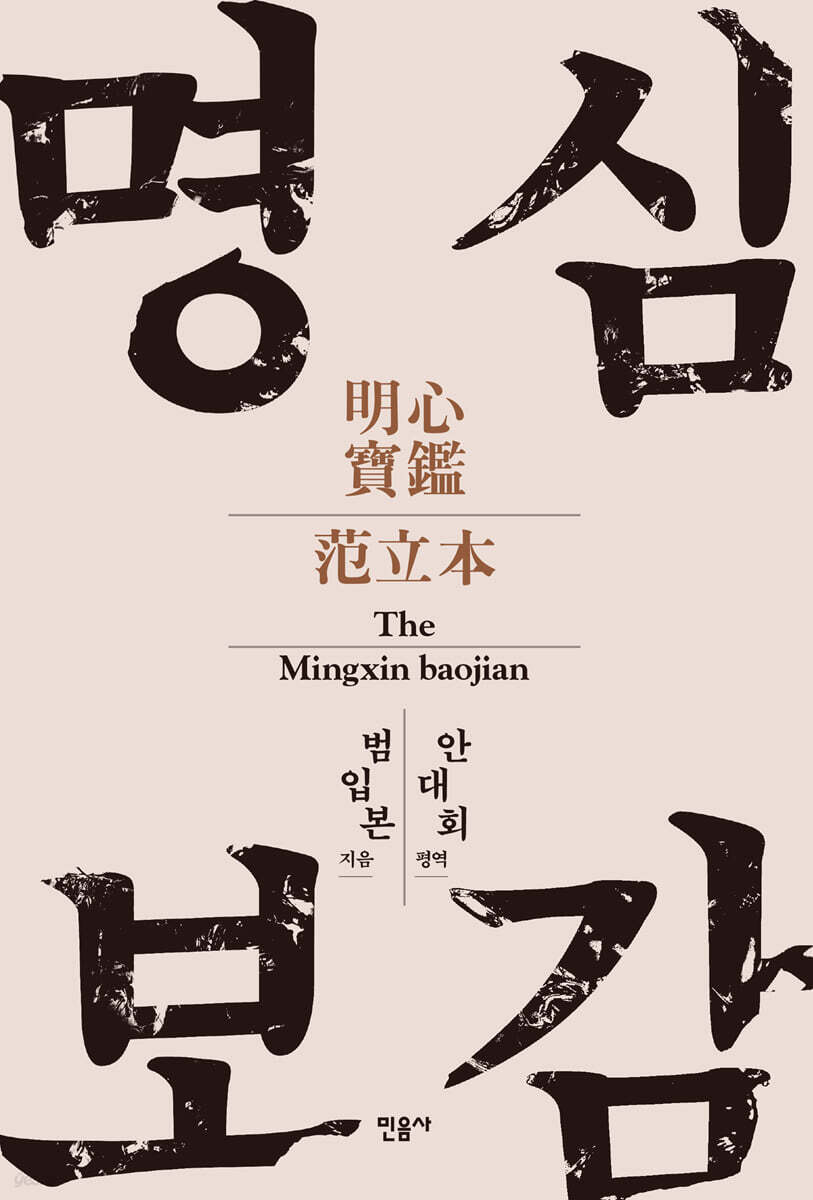
Myeongsimbogam
 |
Description
Book Introduction
A mirror that illuminates the mind, a treasure trove of philosophy on life.
The definitive translation of the 『Myeongsimbogam』 was published.
Chinese literature scholar Ahn Dae-hoe (professor of Chinese literature at Sungkyunkwan University) translates and publishes 『Myeongsimbogam (明心寶鑑)』.
This is a complete translation containing all 774 articles, not an abridged version that has been reduced to one-third.
He examined various versions, corrected errors, created a definitive version, and clearly stated the source of each text.
Additionally, we have refined the original author's intentions into powerful and readable sentences, and added clear commentary to help readers understand.
As a definitive translation that anyone can trust and read, it will serve as a guide for readers taking their first steps into the world of Eastern classics, and a rediscovery for those who have only encountered it in abbreviated versions.
The definitive translation of the 『Myeongsimbogam』 was published.
Chinese literature scholar Ahn Dae-hoe (professor of Chinese literature at Sungkyunkwan University) translates and publishes 『Myeongsimbogam (明心寶鑑)』.
This is a complete translation containing all 774 articles, not an abridged version that has been reduced to one-third.
He examined various versions, corrected errors, created a definitive version, and clearly stated the source of each text.
Additionally, we have refined the original author's intentions into powerful and readable sentences, and added clear commentary to help readers understand.
As a definitive translation that anyone can trust and read, it will serve as a guide for readers taking their first steps into the world of Eastern classics, and a rediscovery for those who have only encountered it in abbreviated versions.
- You can preview some of the book's contents.
Preview
index
introduction
commentary
Volume 1 of the commercial volume
1. Continuing Good Deeds _ Continuing Good Deeds
2 The Book of Heaven _ The Law of Heaven
3. Chapter 3: Obedience _ Fate and Compliance
4. Filial Piety Chapter _ Practicing Filial Piety
5. Correcting Oneself - Chapter 5: Correcting One's Conduct
6. Chapter 6: Keeping Your Duty
7. Preservation of the Original Mind
Chapter 8: Precepts for Nature _ Tempering one's temper
9 Diligent Learning Chapter _ Learning Diligently
Chapter 10: Teaching Children _ Child Education
Volume 2
11. The Heart of the Lord _ Reflection on the Heart
Chapter 12: Establishing a Teaching _ The Basics of Conduct
13. Chapter on Governance _ The Conduct of Officials
14 Chapter on Governing the Family _ Managing the Family
Chapter 15: The Basics of Humanity
16. Chapter 16: Etiquette and Lifestyle
17. Chapter on Preserving Faith _ Observing Faith
18 Language _ The Dignity of Language
19 Friendship Chapter _ Making Friends
20. The Chapter on Women's Conduct _ The Conduct of a Wife
Book of the Treasure of Mind
Myungsimbogam
Book of the Middle Mind and Heart
Yesterday's Jungjipmyeongsimbogam book
References
commentary
Volume 1 of the commercial volume
1. Continuing Good Deeds _ Continuing Good Deeds
2 The Book of Heaven _ The Law of Heaven
3. Chapter 3: Obedience _ Fate and Compliance
4. Filial Piety Chapter _ Practicing Filial Piety
5. Correcting Oneself - Chapter 5: Correcting One's Conduct
6. Chapter 6: Keeping Your Duty
7. Preservation of the Original Mind
Chapter 8: Precepts for Nature _ Tempering one's temper
9 Diligent Learning Chapter _ Learning Diligently
Chapter 10: Teaching Children _ Child Education
Volume 2
11. The Heart of the Lord _ Reflection on the Heart
Chapter 12: Establishing a Teaching _ The Basics of Conduct
13. Chapter on Governance _ The Conduct of Officials
14 Chapter on Governing the Family _ Managing the Family
Chapter 15: The Basics of Humanity
16. Chapter 16: Etiquette and Lifestyle
17. Chapter on Preserving Faith _ Observing Faith
18 Language _ The Dignity of Language
19 Friendship Chapter _ Making Friends
20. The Chapter on Women's Conduct _ The Conduct of a Wife
Book of the Treasure of Mind
Myungsimbogam
Book of the Middle Mind and Heart
Yesterday's Jungjipmyeongsimbogam book
References
Into the book
My place in the world has already been determined, yet I am busy with this fleeting life.
--- From “Chapter 3, Article 4”
When you hear about other people's faults, just listen to them as if you were hearing your parents' names, and don't say anything.
--- From “Chapter 5, Article 14”
A gentleman is calm and generous, while a mean man is always worried and fearful.
--- From “Chapter 7, Article 44”
It's okay if you learn it, but it's okay if you don't.
But a learned person is like a grain of rice, while an unlearned person is like mugwort and a weed.
--- From “Chapter 9, Article 13”
There is no greater pleasure than reading a book, and no work more important than teaching children.
--- From “Chapter 10, Article 7”
If you are suspicious of a person, don't use him. If you use a person, don't be suspicious of him.
--- From “Chapter 11, Article 32”
Gold is not expensive and health costs more.
--- From “Chapter 11, Article 90”
If you don't learn when you're young, you'll know nothing when you're old. If you don't plow the fields in the spring, you'll have nothing to hope for in the fall. If you don't wake up at dawn, you'll have accomplished nothing that day.
--- From “Chapter 12, Article 5”
When children are filial, their parents are happy, and when the family is harmonious, everything goes well.
--- From “Chapter 14, Article 10”
When you meet someone, say only three out of ten things and don't reveal everything that's on your mind.
Three tiger cubs are not scary, but two-hearted people are scary.
--- From “Chapter 3, Article 4”
When you hear about other people's faults, just listen to them as if you were hearing your parents' names, and don't say anything.
--- From “Chapter 5, Article 14”
A gentleman is calm and generous, while a mean man is always worried and fearful.
--- From “Chapter 7, Article 44”
It's okay if you learn it, but it's okay if you don't.
But a learned person is like a grain of rice, while an unlearned person is like mugwort and a weed.
--- From “Chapter 9, Article 13”
There is no greater pleasure than reading a book, and no work more important than teaching children.
--- From “Chapter 10, Article 7”
If you are suspicious of a person, don't use him. If you use a person, don't be suspicious of him.
--- From “Chapter 11, Article 32”
Gold is not expensive and health costs more.
--- From “Chapter 11, Article 90”
If you don't learn when you're young, you'll know nothing when you're old. If you don't plow the fields in the spring, you'll have nothing to hope for in the fall. If you don't wake up at dawn, you'll have accomplished nothing that day.
--- From “Chapter 12, Article 5”
When children are filial, their parents are happy, and when the family is harmonious, everything goes well.
--- From “Chapter 14, Article 10”
When you meet someone, say only three out of ten things and don't reveal everything that's on your mind.
Three tiger cubs are not scary, but two-hearted people are scary.
--- From “Chapter 18, Article 19”
Publisher's Review
Why 『Myeongsimbogam』?
A classic re-established through the original text and translation by the greatest scholar of Chinese literature
As the title suggests, 『Myeongsimbogam』 is a ‘mirror like a jewel that illuminates the mind.’
This book contains a selection of proverbs, sayings, sayings, and poems from over 160 different sources. Its purpose is to help you stay on track and not lose your way on the path of life, and to awaken a bright mind.
First published in 1393, the 『Myeongsimbogam』 enjoyed great popularity throughout East Asia.
In China, people of both the upper and lower classes read it, and even the emperor was so fascinated by it that Emperor Wanli ordered the compilation of the 『Mingxin Baojian』.
In the late 16th century, missionaries who recognized the value of this book translated it into Spanish and Latin, making it the first Chinese book to be translated into a Western language.
Korea is the country that best understands and popularly accepts the value of the 『Myeongsimbogam』.
During the Joseon Dynasty, it was used as an introductory book for education in private schools, along with books such as the Thousand Character Classic and the Elementary Learning.
Even today, phrases like “When a family is harmonious, everything goes well” and “Give the person you hate an extra rice cake” are a part of our daily lives.
However, most of the 『Myeongsimbogam』 you find in bookstores are abridged versions.
Abridged versions, which are about one-third the size of the original, have been popular since the reign of King Gwanghaegun, and are still popular today.
Moreover, there are many self-help books that have been disassembled to the point where it is difficult to recognize the original form, and there are even many 'Myeongsimbogams' that have been modified into self-help books.
As a reader, it is difficult to know which book is the true 『Myeongsimbogam』.
Among the editions of 『Myeongsimbogam』 that remain to this day, the one closest to the original, after the first edition published in 1393 disappeared early, is the 'Cheongju version (淸州本)'.
This is a woodblock print published in 1454 in Cheongju, Chungcheong Province, Joseon.
Translator Ahn Dae-hoe did not translate this Cheongju version as a text, but rather compared it with various versions, including the Heukgu version, the reprinted version, the royal version, and the Japanese engraved version, and re-established the 『Myeongsimbogam』 with 373 articles in 10 chapters in the first volume and 401 articles in 10 chapters in the second volume.
This is the second official edition and translation following 『Chaegeundam』, which was published in 2022.
Are you Korean or Chinese?
The problem of the original author of the 『Myeongsimbogam』
Many of the 『Myeongsimbogam』 books on the market do not properly indicate the author.
Either it was not written at all, or it was written incorrectly.
The original author of the 『Myeongsimbogam』 is Fan Liben (范立本), a scholar from the late Yuan Dynasty and early Ming Dynasty.
Even though he published a bestseller called "The Treasure of Mind," it was forgotten because he was unknown and the book was considered popular.
In the late 19th century, the claim that Chu-chuk (秋適), a civil servant during the reign of King Chungnyeol of Goryeo, was the author of Myeongsimbogam emerged in Korea, and it was confirmed as fact in the 20th century.
President Syngman Rhee, who visited Vietnam and received a gift of the 『Myeongsim Bogam』, gave instructions to have the 『National Translation and Augmented Myeongsim Bogam』 widely distributed throughout the country in 1959. In this book, Chuji was listed as the author, and later books accepted it uncritically, making the 'Chuji original theory' the mainstream.
The situation changed when the preface to the Beomip version was found in the Cheongju version discovered in the 1970s.
The research results confirmed that Beom Ip-bon was the author of 『Myeongsimbogam』.
However, even now, it is not easy to find a book that properly lists the author.
Perhaps to avoid controversy, some books introduce it as “a book compiled by Beomipbon, compiled by Chuji,” but the chronological order is incorrect.
The translator explains the cause and background of the spread of the theory of the original author, refutes the claim, and makes it clear that the original author is the original author.
Is the 'Taigong' in the 'Myeongsimbogam' Jiang Taigong?
Provide the correct translation
Of the 774 articles in the fully translated 『Myeongsimbogam』, 34 articles begin with “Taigong said.”
Most books translate it as “Taigong said,” but they also add a friendly explanation that “Taigong” is “Jiang Taigong.”
Translator Ahn Dae-hoe points out that there is no basis for viewing the Taigong in this section as Jiang Taigong, a figure from around the 11th century BC, and then explains that the source of the 34 articles is the children's education book "Taigong Jiao" written in the mid-Tang Dynasty, and explains that Taigong here refers to a rural teacher during the Tang Dynasty, similar to our schoolmaster.
In the original text of 『Myeongsimbogam』, 472 articles are cited and 302 articles are not.
The translator reviewed not only well-known Confucian, Buddhist, and Taoist scriptures such as the Analects, the Dhammapada, and the Laozi, but also literature excavated from the Dunhuang Grottoes, as well as collections of proverbs and sayings from earlier periods.
As a result, we were able to discover over 100 new sources and correct all errors as soon as they were discovered, providing an accurate translation.
This achievement was possible because the translator, an authority on Chinese literature, has been focusing on translating classics for the past several decades.
A light and popular book?
『Mindfulness-in-Mindfulness』, which pursues substance rather than form
Much of the 『Myeongsimbogam』 comes from Confucian literature.
Confucius's sayings amount to 90 articles.
This is natural considering that the author, Beom Ip-bon, was an intellectual who called himself a Confucian scholar.
However, the original text was compiled from Taoist and Buddhist texts with the insight of a knowledgeable and excellent editor, and the texts from various sources were arranged in an exquisite harmony.
Among them, there are texts that do not appear in the editions of 『Book of Changes』, 『Book of Documents』, and 『Zhuangzi』 that are handed down today.
The original text revealed that the quotes were taken from popular books that were easily accessible rather than serious and difficult books.
However, this does not mean that we should misunderstand 『Myeongsimbogam』 as a book that was pieced together by gleaning from various classics.
The original text was intended to capture the essence of Eastern thought and empirical thinking in 『Myeongsimbogam』.
Moreover, the quotes were not taken directly from the original text, but were modified to fit the 20 topics that make up each chapter.
The 『Myeongsimbogam』 can be considered a traditional teaching book in that it encourages good deeds, emphasizes ethics and morality, and emphasizes friendship and trust.
However, it is different from existing normative writings in that it proposes a practical philosophy of conduct rather than a formal reflection.
“When I drink and eat, I have a thousand brothers, but when times are tough, I have no friends” (Chapter 19, Article 18), which sharply captures an uncomfortable truth. On the other hand, it blatantly reveals a calculating way of thinking, saying, “Each of you should just sweep the snow in front of your own house and not worry about the frost on the roofs of other people’s houses” (Chapter 7, Article 47).
The translator translated and added commentary while taking into account the background of the creation of the 『Myeongsimbogam』 and the contemporary context at the time of its publication.
Taking advantage of its characteristics as a collection of aphorisms and proverbs, it was translated into powerful and easy-to-read sentences, and the commentary was made more in-depth by quoting not only Eastern classics but also Western classical authors such as Euripides, Horace, and Seneca.
Additionally, at the end of the book, a preface to each edition is included to help readers understand the significance of the book, “Myeongsimbogam,” in each era.
A classic re-established through the original text and translation by the greatest scholar of Chinese literature
As the title suggests, 『Myeongsimbogam』 is a ‘mirror like a jewel that illuminates the mind.’
This book contains a selection of proverbs, sayings, sayings, and poems from over 160 different sources. Its purpose is to help you stay on track and not lose your way on the path of life, and to awaken a bright mind.
First published in 1393, the 『Myeongsimbogam』 enjoyed great popularity throughout East Asia.
In China, people of both the upper and lower classes read it, and even the emperor was so fascinated by it that Emperor Wanli ordered the compilation of the 『Mingxin Baojian』.
In the late 16th century, missionaries who recognized the value of this book translated it into Spanish and Latin, making it the first Chinese book to be translated into a Western language.
Korea is the country that best understands and popularly accepts the value of the 『Myeongsimbogam』.
During the Joseon Dynasty, it was used as an introductory book for education in private schools, along with books such as the Thousand Character Classic and the Elementary Learning.
Even today, phrases like “When a family is harmonious, everything goes well” and “Give the person you hate an extra rice cake” are a part of our daily lives.
However, most of the 『Myeongsimbogam』 you find in bookstores are abridged versions.
Abridged versions, which are about one-third the size of the original, have been popular since the reign of King Gwanghaegun, and are still popular today.
Moreover, there are many self-help books that have been disassembled to the point where it is difficult to recognize the original form, and there are even many 'Myeongsimbogams' that have been modified into self-help books.
As a reader, it is difficult to know which book is the true 『Myeongsimbogam』.
Among the editions of 『Myeongsimbogam』 that remain to this day, the one closest to the original, after the first edition published in 1393 disappeared early, is the 'Cheongju version (淸州本)'.
This is a woodblock print published in 1454 in Cheongju, Chungcheong Province, Joseon.
Translator Ahn Dae-hoe did not translate this Cheongju version as a text, but rather compared it with various versions, including the Heukgu version, the reprinted version, the royal version, and the Japanese engraved version, and re-established the 『Myeongsimbogam』 with 373 articles in 10 chapters in the first volume and 401 articles in 10 chapters in the second volume.
This is the second official edition and translation following 『Chaegeundam』, which was published in 2022.
Are you Korean or Chinese?
The problem of the original author of the 『Myeongsimbogam』
Many of the 『Myeongsimbogam』 books on the market do not properly indicate the author.
Either it was not written at all, or it was written incorrectly.
The original author of the 『Myeongsimbogam』 is Fan Liben (范立本), a scholar from the late Yuan Dynasty and early Ming Dynasty.
Even though he published a bestseller called "The Treasure of Mind," it was forgotten because he was unknown and the book was considered popular.
In the late 19th century, the claim that Chu-chuk (秋適), a civil servant during the reign of King Chungnyeol of Goryeo, was the author of Myeongsimbogam emerged in Korea, and it was confirmed as fact in the 20th century.
President Syngman Rhee, who visited Vietnam and received a gift of the 『Myeongsim Bogam』, gave instructions to have the 『National Translation and Augmented Myeongsim Bogam』 widely distributed throughout the country in 1959. In this book, Chuji was listed as the author, and later books accepted it uncritically, making the 'Chuji original theory' the mainstream.
The situation changed when the preface to the Beomip version was found in the Cheongju version discovered in the 1970s.
The research results confirmed that Beom Ip-bon was the author of 『Myeongsimbogam』.
However, even now, it is not easy to find a book that properly lists the author.
Perhaps to avoid controversy, some books introduce it as “a book compiled by Beomipbon, compiled by Chuji,” but the chronological order is incorrect.
The translator explains the cause and background of the spread of the theory of the original author, refutes the claim, and makes it clear that the original author is the original author.
Is the 'Taigong' in the 'Myeongsimbogam' Jiang Taigong?
Provide the correct translation
Of the 774 articles in the fully translated 『Myeongsimbogam』, 34 articles begin with “Taigong said.”
Most books translate it as “Taigong said,” but they also add a friendly explanation that “Taigong” is “Jiang Taigong.”
Translator Ahn Dae-hoe points out that there is no basis for viewing the Taigong in this section as Jiang Taigong, a figure from around the 11th century BC, and then explains that the source of the 34 articles is the children's education book "Taigong Jiao" written in the mid-Tang Dynasty, and explains that Taigong here refers to a rural teacher during the Tang Dynasty, similar to our schoolmaster.
In the original text of 『Myeongsimbogam』, 472 articles are cited and 302 articles are not.
The translator reviewed not only well-known Confucian, Buddhist, and Taoist scriptures such as the Analects, the Dhammapada, and the Laozi, but also literature excavated from the Dunhuang Grottoes, as well as collections of proverbs and sayings from earlier periods.
As a result, we were able to discover over 100 new sources and correct all errors as soon as they were discovered, providing an accurate translation.
This achievement was possible because the translator, an authority on Chinese literature, has been focusing on translating classics for the past several decades.
A light and popular book?
『Mindfulness-in-Mindfulness』, which pursues substance rather than form
Much of the 『Myeongsimbogam』 comes from Confucian literature.
Confucius's sayings amount to 90 articles.
This is natural considering that the author, Beom Ip-bon, was an intellectual who called himself a Confucian scholar.
However, the original text was compiled from Taoist and Buddhist texts with the insight of a knowledgeable and excellent editor, and the texts from various sources were arranged in an exquisite harmony.
Among them, there are texts that do not appear in the editions of 『Book of Changes』, 『Book of Documents』, and 『Zhuangzi』 that are handed down today.
The original text revealed that the quotes were taken from popular books that were easily accessible rather than serious and difficult books.
However, this does not mean that we should misunderstand 『Myeongsimbogam』 as a book that was pieced together by gleaning from various classics.
The original text was intended to capture the essence of Eastern thought and empirical thinking in 『Myeongsimbogam』.
Moreover, the quotes were not taken directly from the original text, but were modified to fit the 20 topics that make up each chapter.
The 『Myeongsimbogam』 can be considered a traditional teaching book in that it encourages good deeds, emphasizes ethics and morality, and emphasizes friendship and trust.
However, it is different from existing normative writings in that it proposes a practical philosophy of conduct rather than a formal reflection.
“When I drink and eat, I have a thousand brothers, but when times are tough, I have no friends” (Chapter 19, Article 18), which sharply captures an uncomfortable truth. On the other hand, it blatantly reveals a calculating way of thinking, saying, “Each of you should just sweep the snow in front of your own house and not worry about the frost on the roofs of other people’s houses” (Chapter 7, Article 47).
The translator translated and added commentary while taking into account the background of the creation of the 『Myeongsimbogam』 and the contemporary context at the time of its publication.
Taking advantage of its characteristics as a collection of aphorisms and proverbs, it was translated into powerful and easy-to-read sentences, and the commentary was made more in-depth by quoting not only Eastern classics but also Western classical authors such as Euripides, Horace, and Seneca.
Additionally, at the end of the book, a preface to each edition is included to help readers understand the significance of the book, “Myeongsimbogam,” in each era.
GOODS SPECIFICS
- Date of issue: November 29, 2024
- Format: Hardcover book binding method guide
- Page count, weight, size: 664 pages | 136*200*35mm
- ISBN13: 9788937472435
- ISBN10: 8937472430
You may also like
카테고리
korean


korean

![GQ KOREA Mark (Monthly): December [2025]](http://librairie.coreenne.fr/cdn/shop/files/8ef265dbbfbf186523ed75ba7319009d.jpg?v=1765340328&width=3840)


