

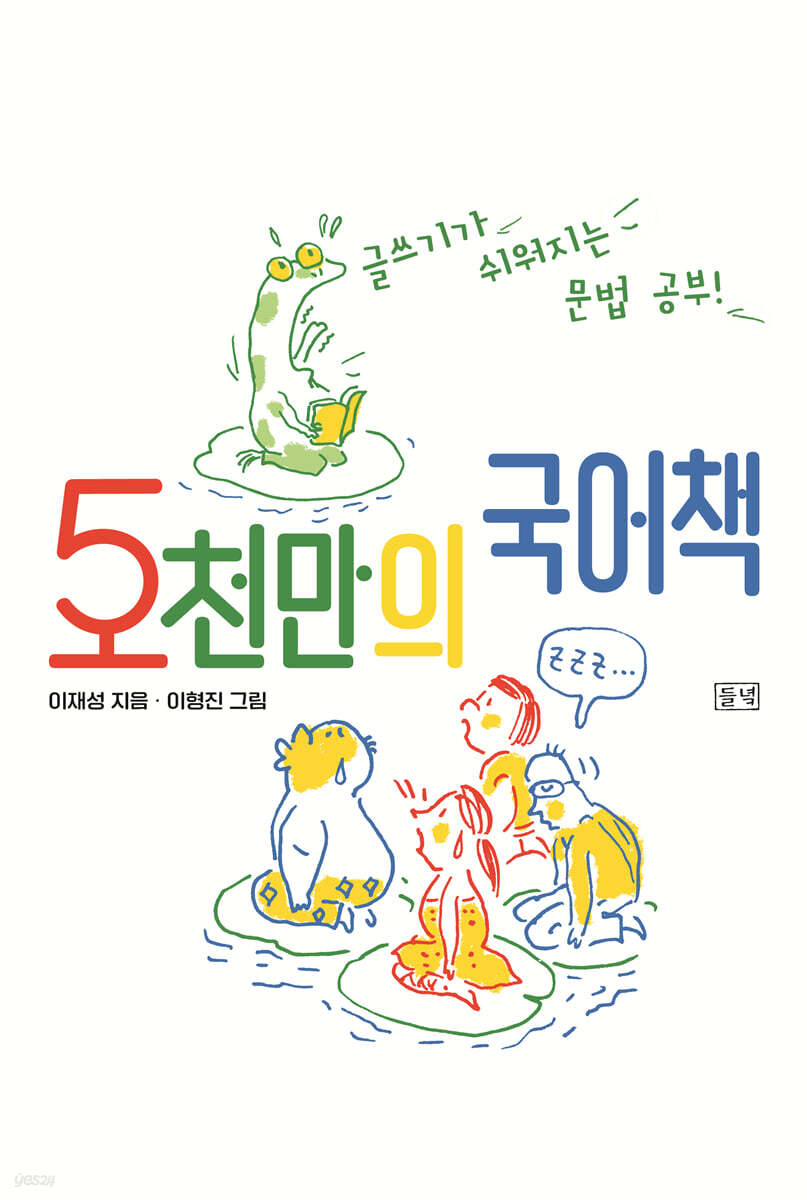
50 million Korean language books
 |
Description
Book Introduction
A revised edition published after 18 years by Professor Lee Jae-seong, Korea's leading writing education expert and linguist.
If you don't know the rules of speech, you can't write properly!
The 'grammar' we commonly refer to is 'grammar of speech'!
You need to learn grammar to be able to create sentences freely, and you need to be able to create sentences freely to be able to write well!
This is a completely revised edition of 『40 Million Korean Language Book』, which has established itself as the best Korean grammar book since its first edition was published in 2006.
I prepared this by looking back at the changes in Korean grammar rules, everyday expressions, and the sensibilities of a new generation of readers over time.
While preparing the revised edition, the author especially considered the growing popularity of K-culture and considered how to make teaching Korean to foreigners easier and more clear.
Therefore, this book will be of great help not only to Korean nationals studying Korean grammar and writing, but also to foreigners who wish to learn Korean.
To write well, you need to use correct sentences, and to write sentences correctly, you need to know grammar.
This is because in order to properly write sentences, which are the smallest vessels that contain thoughts, you need to know grammar, which is the rules of language.
This book, which teaches Korean grammar in an easy and fun way to those who want to write well, including college students and ordinary office workers, covers the rules of sentences in a dense and substantial way, and also looks at the rules of words and sounds for those who want to write more accurately.
Writing tips are included throughout the text to show how grammar can be applied to writing.
Most people want to write well, but when they hear the word grammar, they shake their heads.
I think I have to memorize it, and even if I do, I won't be able to use it.
This book breaks that preconception.
Grammar is not something to be memorized, but something to be understood, and it shows that understood grammar can be applied directly to writing.
Another attractive aspect of this book is that it uses familiar characters such as Chunhyang, Mongryong, Bangja, and Hyangdan as guides, making it even more fun to read.
I recommend this book to anyone who wants to learn how to write accurately, middle and high school students who want to master grammar easily, students who plan to major in Korean language in college, students who want to teach Korean to foreigners, and anyone who wants to write well but finds the mere mention of grammar a headache.
If you don't know the rules of speech, you can't write properly!
The 'grammar' we commonly refer to is 'grammar of speech'!
You need to learn grammar to be able to create sentences freely, and you need to be able to create sentences freely to be able to write well!
This is a completely revised edition of 『40 Million Korean Language Book』, which has established itself as the best Korean grammar book since its first edition was published in 2006.
I prepared this by looking back at the changes in Korean grammar rules, everyday expressions, and the sensibilities of a new generation of readers over time.
While preparing the revised edition, the author especially considered the growing popularity of K-culture and considered how to make teaching Korean to foreigners easier and more clear.
Therefore, this book will be of great help not only to Korean nationals studying Korean grammar and writing, but also to foreigners who wish to learn Korean.
To write well, you need to use correct sentences, and to write sentences correctly, you need to know grammar.
This is because in order to properly write sentences, which are the smallest vessels that contain thoughts, you need to know grammar, which is the rules of language.
This book, which teaches Korean grammar in an easy and fun way to those who want to write well, including college students and ordinary office workers, covers the rules of sentences in a dense and substantial way, and also looks at the rules of words and sounds for those who want to write more accurately.
Writing tips are included throughout the text to show how grammar can be applied to writing.
Most people want to write well, but when they hear the word grammar, they shake their heads.
I think I have to memorize it, and even if I do, I won't be able to use it.
This book breaks that preconception.
Grammar is not something to be memorized, but something to be understood, and it shows that understood grammar can be applied directly to writing.
Another attractive aspect of this book is that it uses familiar characters such as Chunhyang, Mongryong, Bangja, and Hyangdan as guides, making it even more fun to read.
I recommend this book to anyone who wants to learn how to write accurately, middle and high school students who want to master grammar easily, students who plan to major in Korean language in college, students who want to teach Korean to foreigners, and anyone who wants to write well but finds the mere mention of grammar a headache.
- You can preview some of the book's contents.
Preview
index
How to Use This Book_Sentences, a Vessel for Thoughts
Preparation 1 If you have to memorize, it's not grammar!
Syntax - Arranging word cards correctly / Morphology - What happens when you take a closer look at the shape of a word? / Phonology - What happens when sounds collide?
Preparation 2 Four Preconceptions to Discard Before Reading This Book
Is writing more important than speaking? / Is Hangul written in square boxes? / Sounds come together to form words, and words come together to form sentences? / Is the Korean grammar we learn in school true?
Preparation 3 Grammar is a game where you play with one set of sentences!
Syntax 1 What is the identity of a sentence?
A single sentence contains only one thought! / A short sentence is like an ID photo without a background scene, and a complex sentence is like a snapshot with a background scene.
Writing Tip: Should I write in two short sentences or one complex sentence?
Syntax 2 There are only seven types of sentences in Korean.
Do you want to go holding hands, or do you want to go on my back? Writing Tip What if the subject-predicate positions in a conjunction are reversed? / Five ways to be carried on my back / Chunhyang waits for Mongryong to return quickly. Chunhyang likes Mongryong because of his handsome back view. Chunhyang shed tears when she heard the sad sound of the flute. / Writing Tip How to use adverbial clause parts correctly / Writing Tip Tip Tips for using embedded adverbial clauses when writing / Chunhyang has long eyelashes. Mongryong said he liked Chunhyang. / Writing Tip Writing with 7 basic sentences
Syntax 3: Spacing is difficult?
Phrases are easy to see at a glance / Writing Tip Conditions for clear writing / Phrases, what are your roles? / Subject - I am the owner! / Writing Tip When do you use '-neun/-do/-man'? / Writing Tip There are times like this / Object - What do you want? / Predicate - I am the ruler! / Writing Tip Sentence patterns that express thoughts / Writing Tip Taste the predicate / Writing Tip Taste the predicate that is weak in the situation / Writing Tip The difference between subject/object omission and predicate omission / Writing Tip Our writing is different from English writing / Complement - I want to be perfect! / Adjective - I want to decorate! / Writing Tip The Korean '-ui' and the Japanese 'no' are different / Writing Tip Spacing of adjective clauses / Adverb - How, when, where! / Independent word - It's my mind, don't worry about it!
Syntax 4: Facts Everyone Already Knows
'What you want to say' and 'the perspective on what you want to say' / The perspective on what you want to say / Honorifics, tense, and modality / Writing Tip Three ways to express the past / Writing style / Writing Tip Incorrectly used adjectives / Subject verb / Writing Tip Active sentences are not always effective / Writing Tip Double-writing causative expressions / Negative verb / Writing Tip / Spacing negative adverbs / Writing Tip When the predicate is a verb, distinguish between '안' and '못'
Morphology 1 The smallest unit with meaning
Morphemes are the main players / How are morphemes distinguished? / Free morphemes vs.
Dependent morphemes/lexical morphemes vs.
Grammatical morphemes
Morphology 2 words
Words are the minimum self-contained form / Parts of speech / Standards for classifying parts of speech / Writing Tip Korean spacing method / Practice dividing parts of speech / Individuality of parts of speech / Call my name - noun / Do it for me - pronoun / One, two, three - numerals / Jjok jjok jjok - particles / Invariable - verbs and adjectives / Let's decorate - determiner / How - adverb / I can't stand it - exclamation / Writing Tip Abbreviated writing / Writing Tip Accurate writing of particles / Writing Tip There is no 'carrying Superman' / Writing Tip Korean decorates from front to back / Types of words / Writing Tip Create and use new words
Phonology Consonants and Vowels
Sounds that come from touching, sounds that come alone / Rules of consonants and vowels / Sounds of consonants and vowels / Writing Tip: If you pronounce it well, spelling is OK / Phonetic rules / Writing Tip: How to write final consonants in foreign words / Writing Tip: How to write the middle consonant
Writing Tip: Rows and Columns, Rates and Rates / Writing Tip: Vowel Harmony is Broken! / Writing Tip: Inserting a Middle Consonant / Writing Tip: When to Write a Consonant as a Voiced Sound in Spelling
Preparation 1 If you have to memorize, it's not grammar!
Syntax - Arranging word cards correctly / Morphology - What happens when you take a closer look at the shape of a word? / Phonology - What happens when sounds collide?
Preparation 2 Four Preconceptions to Discard Before Reading This Book
Is writing more important than speaking? / Is Hangul written in square boxes? / Sounds come together to form words, and words come together to form sentences? / Is the Korean grammar we learn in school true?
Preparation 3 Grammar is a game where you play with one set of sentences!
Syntax 1 What is the identity of a sentence?
A single sentence contains only one thought! / A short sentence is like an ID photo without a background scene, and a complex sentence is like a snapshot with a background scene.
Writing Tip: Should I write in two short sentences or one complex sentence?
Syntax 2 There are only seven types of sentences in Korean.
Do you want to go holding hands, or do you want to go on my back? Writing Tip What if the subject-predicate positions in a conjunction are reversed? / Five ways to be carried on my back / Chunhyang waits for Mongryong to return quickly. Chunhyang likes Mongryong because of his handsome back view. Chunhyang shed tears when she heard the sad sound of the flute. / Writing Tip How to use adverbial clause parts correctly / Writing Tip Tip Tips for using embedded adverbial clauses when writing / Chunhyang has long eyelashes. Mongryong said he liked Chunhyang. / Writing Tip Writing with 7 basic sentences
Syntax 3: Spacing is difficult?
Phrases are easy to see at a glance / Writing Tip Conditions for clear writing / Phrases, what are your roles? / Subject - I am the owner! / Writing Tip When do you use '-neun/-do/-man'? / Writing Tip There are times like this / Object - What do you want? / Predicate - I am the ruler! / Writing Tip Sentence patterns that express thoughts / Writing Tip Taste the predicate / Writing Tip Taste the predicate that is weak in the situation / Writing Tip The difference between subject/object omission and predicate omission / Writing Tip Our writing is different from English writing / Complement - I want to be perfect! / Adjective - I want to decorate! / Writing Tip The Korean '-ui' and the Japanese 'no' are different / Writing Tip Spacing of adjective clauses / Adverb - How, when, where! / Independent word - It's my mind, don't worry about it!
Syntax 4: Facts Everyone Already Knows
'What you want to say' and 'the perspective on what you want to say' / The perspective on what you want to say / Honorifics, tense, and modality / Writing Tip Three ways to express the past / Writing style / Writing Tip Incorrectly used adjectives / Subject verb / Writing Tip Active sentences are not always effective / Writing Tip Double-writing causative expressions / Negative verb / Writing Tip / Spacing negative adverbs / Writing Tip When the predicate is a verb, distinguish between '안' and '못'
Morphology 1 The smallest unit with meaning
Morphemes are the main players / How are morphemes distinguished? / Free morphemes vs.
Dependent morphemes/lexical morphemes vs.
Grammatical morphemes
Morphology 2 words
Words are the minimum self-contained form / Parts of speech / Standards for classifying parts of speech / Writing Tip Korean spacing method / Practice dividing parts of speech / Individuality of parts of speech / Call my name - noun / Do it for me - pronoun / One, two, three - numerals / Jjok jjok jjok - particles / Invariable - verbs and adjectives / Let's decorate - determiner / How - adverb / I can't stand it - exclamation / Writing Tip Abbreviated writing / Writing Tip Accurate writing of particles / Writing Tip There is no 'carrying Superman' / Writing Tip Korean decorates from front to back / Types of words / Writing Tip Create and use new words
Phonology Consonants and Vowels
Sounds that come from touching, sounds that come alone / Rules of consonants and vowels / Sounds of consonants and vowels / Writing Tip: If you pronounce it well, spelling is OK / Phonetic rules / Writing Tip: How to write final consonants in foreign words / Writing Tip: How to write the middle consonant
Writing Tip: Rows and Columns, Rates and Rates / Writing Tip: Vowel Harmony is Broken! / Writing Tip: Inserting a Middle Consonant / Writing Tip: When to Write a Consonant as a Voiced Sound in Spelling
Into the book
Syntax contains rules for organizing sentences.
It tells you how sentences are made, what types of sentences there are, and so on.
Sentences are made up of words, and it teaches you how to arrange these words in a certain order to make it understandable.
If you went to an old elementary school, that is, a first grade classroom, you would see flashcards hung on something like a clothesline across the classroom (this was a long time ago).
Learning to make sentences by arranging word cards in a way that makes sense is called syntax.
It's really nothing special, right? So, syntax tells us that the five words "Chunhyang, mirror, go, eul, see" should be arranged as "Chunhyang-ga-mirror-eul-see" or "mirror-eul-Chunhyang-ga-see."
The word "Tongsa" may sound a bit difficult, but it actually means lining up words (辭).
---From "Syntax (Arranging Word Cards Correctly)"
Morphology contains rules for organizing words.
It tells you how words are formed and what types of words there are.
For example, 'dogwood' is broken down into 'dog' and 'nari', and although 'dogwood' is a flower similar to 'nari', it is a different flower. Since it is a word created by attaching the word 'dog' to the word 'nari', it belongs to the category of derived words.
Here, 'form' refers to a certain shape (a shape made up of a group of letters) that has a meaning.
Why use the difficult term "morphology" when we're simply studying the collection of letters? When we examine morphology and syntax from the perspective of words, syntax examines how words interact with other words within the larger context of sentences, while morphology examines what the word itself is composed of, how it was formed, and what type it belongs to.
In other words, if we compare Chunhyang playing around in her room alone, trying on different clothes, to morphology, then syntax can be compared to Chunhyang going out and hanging out with people, and when she's with Hyangdan, Hyangdan becomes her friend, when she's with Mongryong, Mongryong becomes her lover, and when she's with Wolmae, he becomes her daughter.
---From "Morphology (If we take a closer look at the shape of a word)"
Phonology contains rules for organizing each sound, that is, consonants and vowels.
It's about looking at the relationship between sounds and what changes occur when sounds meet.
For example, 'Gudi' is pronounced as [guji].
In other words, the sound (letter) arrangement of /ㄱ/-/ㅜ/-/ㄷ/-/ㅣ/ changes to [ㄱ]-[ㅜ]-[ㅈ]-[ㅣ].
Phonology contains information about regular sound phenomena, such as how [ㄷ] changes into [ㅈ] when it meets [ㅣ].
Here, 'phoneme' is a word that combines 'phonemes' such as consonants and vowels and 'sounds' that indicate long, short, high, and low sounds.
---From "Phonology (What sound is made when two sounds collide?)"
Clear writing requires two conditions:
It should be clear what the writer is trying to convey in the text, and the sentences should be written so that they can be clearly interpreted in only one way.
To satisfy this second condition, the investigation must be written accurately.
-The new national soccer team coach said that the first quality that players must have is a strong and tireless mentality.
The above sentence sounds a bit awkward, doesn't it? Why? In this sentence, the new national soccer team coach points to "mental strength."
So, we need to add the objective particle '-eul' to indicate that it is the object of 'mental power'.
And for the 'first condition' that adds meaning to the sentence, we add the adverbial particle '-으로' that creates an adverbial word.
-The new national soccer team coach chose tireless, strong mental strength as the first condition that players must possess.
What do you think? I just changed the particle, but isn't the meaning clearer than in the first sentence?
---From "Conditions for Clear Writing"
Thoughts are conveyed through speech or writing.
At this time, words or writing are expressed within a sentence frame, but this sentence frame is not the only one.
It's not like there are countless of them either.
This type of sentence structure is called a sentence pattern.
We speak countless words, but these words can be divided into at most twenty or so sentence patterns.
To write good sentences, you need to know good sentence patterns.
If you read a lot of good books, you can internalize good sentence patterns.
And if you learn a lot of good sentence patterns, you don't need to study grammar separately.
Can you tell me how to learn good sentence structure?
First, go to a bookstore and buy a collection of short stories or essays by several authors (preferably famous authors) and read them all.
Find a piece of writing that is easy to read and doesn't get in the way, and check who wrote it.
Then, you just need to find the writings of that author and read them diligently.
You can read the same article multiple times, or you can take turns reading other articles by the same author.
Just read on and on.
Just read like this every day for 100 days without missing a single day, as much as you can spare, even if it's just a little bit.
Then you will be able to get used to the sentence patterns that the writer uses.
Of course, the sentence structure written by the author you choose may not necessarily be a good one.
But at least it's a universal sentence structure that allows you to convey your thoughts to others, right?
---From "Sentence Patterns that Express Thoughts"
In Korean, the predicate comes at the end of the sentence, but in English, the predicate comes after the subject.
Where the predicate is located in a sentence is a very important factor in reading comprehension.
Predicates occupy a large portion of a sentence because they carry important information.
In English, the predicate comes first, so important information is placed at the beginning of the sentence.
However, in Korean, the predicate comes at the end, so important information is placed at the end of the sentence.
-Article A: A notable fact is that Chunhyang is pretty.
-Article B: It is noteworthy that Chunhyang is pretty.
Both texts A and B contain two pieces of information: "It is noteworthy" and "Chunhyang is pretty."
However, when looking at text A, "Chunhyang is pretty" feels like important information, and when looking at text B, "It is noteworthy" feels like important information.
We feel that way because we use Korean as our native language.
So, objectively speaking, which piece of information is more important: "It's noteworthy" or "Chunhyang is pretty"? "Chunhyang is pretty" is one piece of information already known, and the author's decision to consider "Chunhyang is pretty" as "notable" is a novel idea.
The important information in a text is the writer's new idea.
Therefore, the information that 'it is noteworthy' is much more important than the information that 'Chunhyang is pretty.'
Therefore, in the preceding text, you should write it like text B, not like text A.
If you write like A, readers will misunderstand your writing.
Article A is an English translation of the expression.
---From "Our writing is different from English writing"
The writing style that can be expressed as a verb and the writing style that can be expressed as an adjective are different.
Verbs can express all moods: descriptive, interrogative, exhortative, and imperative, but adjectives can only express descriptive and interrogative moods.
-Chunhyang dances.
Chunhyang is pretty.
-Does Chunhyang dance? Is Chunhyang pretty?
-Chunhyang, let's dance! (X) Chunhyang, you're pretty!
-Chunhyang, dance! (X) Chunhyang, be pretty!
The reason verbs can be used in all four modalities is because they express movement.
Because verbs that indicate movement and imperative or imperative sentences that presuppose movement go well together.
On the other hand, adjectives only express the state of appearance and cannot express movement.
So, adjectives cannot make imperative or declarative sentences that presuppose movement.
When distinguishing between verbs and adjectives, you can see whether they make sense or not by adding '-ja' to create a request sentence or '-eo-ra' to create a command sentence.
If it makes sense, it's a verb, if it doesn't, it's an adjective, right?
---From "The Writing of Verbs and Adjectives"
I said words aren't necessarily divided into just nine parts of speech, right? Based on the divisions above, we can reduce or increase the number of parts of speech.
Let's reduce the nine parts of speech to six. The criterion for distinguishing between nouns, pronouns, and numerals is meaning.
I said meaning isn't relatively objective, right? What I mean is, there's no need to divide words by criteria that aren't objective.
So, nouns, pronouns, and numerals can be broadly grouped together as nouns, right? Verbs and adjectives can also be grouped together.
Because sometimes it is difficult to distinguish whether it is a verb or an adjective.
When something is difficult to distinguish, it's also a good idea to not distinguish the whole thing.
Some types of verbs appear to be inert, but are actually verbs.
For example, although it seems like an adjective because it doesn't have a movement, it is classified as a verb because it can make imperative or declarative sentences.
When there is no distinction between verbs and adjectives, the verb and adjective are grouped together and called a verb.
At this time, verbs can be further divided into action verbs and state verbs based on meaning.
When dividing the parts of speech into nine parts, action verbs are almost identical to verbs, and state verbs are almost identical to adjectives.
For example, when classifying the parts that do not match, "know" is classified as a verb when classifying it into the 9 parts of speech that distinguish between verbs and adjectives, but when classifying it as a verb, it is classified as a stative verb.
Because meaning is a state.
In this way, the nine parts of speech become six parts of speech: noun, verb, adverb, determiner, particle, and exclamation.
Let's expand the nine parts of speech to twelve. The word "ida" is classified as a particle in the nine parts of speech.
This has a dual nature.
It is attached after a noun.
The thing that comes after a noun is the characteristic of a particle.
However, because it has a suffix like a verb or adjective, the form of the word changes depending on how it is used.
In the classification of the 9 parts of speech, among these two characteristics of ida, the characteristic of being attached to the end of a noun was focused on and it was classified as a particle.
However, if we focus on the fact that the shape changes, we can classify the parts of speech separately.
By combining “ida” and “anita”, we determine the part of speech called a designator.
A designator is a part of speech that specifies what something is.
There's already one more part of speech added.
In the 9 parts of speech classification, the word "there" is classified as an adjective.
However, it does not necessarily have the characteristics of an adjective.
There are cases where it can be a request or an imperative, such as 'Let's stay at my house!' or 'You stay at home!', but there are also cases where it is not a request or imperative, such as 'Let's have money!' or 'You have money!'
So, by combining the words “there is” and “there is no”, which are related to “there is,” we can create a part of speech called “existential”.
The word ‘existential’ means a part of speech that indicates existence.
Meanwhile, words such as and and but are classified as adverbs in the 9th part of speech, but they can also be classified separately as conjunctions because they have the function of connecting sentences.
In this way, the 9 parts of speech (noun, pronoun, numeral, verb, adjective, adverb, determiner, particle, and exclamation) are supplemented with determiners, existentials, and conjunctions, making a total of 12 parts of speech.
---From "Number of Parts of Speech"
In Korean, there are two types of words that modify a word: adjectives and adverbs.
Both of them decorate in front of the horse that is being decorated.
Don't you think, "Why are you talking about something you already know?" You're right.
That's quite obvious.
However, because of this characteristic of our language, we sometimes use sentences that can lead to unintentional misunderstandings.
-Microorganisms such as viruses cannot usually be seen under a microscope.
The above sentence can be interpreted in two ways.
The first is interpreted to mean, "Viruses cannot be seen with an ordinary microscope, but only with a special microscope." The second is interpreted to mean, "Viruses cannot be seen with a general microscope."
This phenomenon usually occurs because it is both a noun and an adverb.
If it is a noun, it can be made into an adjective by adding '-의' next to it and modifying the noun that follows.
However, since the '-의' attached next to the noun can be omitted at this time, it can usually be used to modify the noun that follows, the microscope.
This is the first interpretation.
If the adverb is ordinary, it modifies the predicate that follows, 'can't see'.
The adverb is originally placed in front of the predicate, but since it can move freely within the sentence, it was moved to the front of the microscope.
This leads to a second interpretation.
To solve this problem, you just need to write it according to the principles.
If you want to write it like the first interpretation, you can usually write it as '보통의' by adding '-의' next to it.
If you do that, it will never be interpreted as an adverb.
Adverbs do not have '-의' attached to them.
-Microorganisms such as viruses cannot be seen with an ordinary microscope.
Next, to write it like the second interpretation, simply return the predicate to its original position in front of the predicate.
Usually, when it is placed in front of a predicate, it only modifies the predicate and cannot modify the noun before it, the microscope.
-Microorganisms such as viruses cannot usually be seen under a microscope.
Because the words that are being decorated must be decorated from front to back, and cannot be decorated from back to front.
It tells you how sentences are made, what types of sentences there are, and so on.
Sentences are made up of words, and it teaches you how to arrange these words in a certain order to make it understandable.
If you went to an old elementary school, that is, a first grade classroom, you would see flashcards hung on something like a clothesline across the classroom (this was a long time ago).
Learning to make sentences by arranging word cards in a way that makes sense is called syntax.
It's really nothing special, right? So, syntax tells us that the five words "Chunhyang, mirror, go, eul, see" should be arranged as "Chunhyang-ga-mirror-eul-see" or "mirror-eul-Chunhyang-ga-see."
The word "Tongsa" may sound a bit difficult, but it actually means lining up words (辭).
---From "Syntax (Arranging Word Cards Correctly)"
Morphology contains rules for organizing words.
It tells you how words are formed and what types of words there are.
For example, 'dogwood' is broken down into 'dog' and 'nari', and although 'dogwood' is a flower similar to 'nari', it is a different flower. Since it is a word created by attaching the word 'dog' to the word 'nari', it belongs to the category of derived words.
Here, 'form' refers to a certain shape (a shape made up of a group of letters) that has a meaning.
Why use the difficult term "morphology" when we're simply studying the collection of letters? When we examine morphology and syntax from the perspective of words, syntax examines how words interact with other words within the larger context of sentences, while morphology examines what the word itself is composed of, how it was formed, and what type it belongs to.
In other words, if we compare Chunhyang playing around in her room alone, trying on different clothes, to morphology, then syntax can be compared to Chunhyang going out and hanging out with people, and when she's with Hyangdan, Hyangdan becomes her friend, when she's with Mongryong, Mongryong becomes her lover, and when she's with Wolmae, he becomes her daughter.
---From "Morphology (If we take a closer look at the shape of a word)"
Phonology contains rules for organizing each sound, that is, consonants and vowels.
It's about looking at the relationship between sounds and what changes occur when sounds meet.
For example, 'Gudi' is pronounced as [guji].
In other words, the sound (letter) arrangement of /ㄱ/-/ㅜ/-/ㄷ/-/ㅣ/ changes to [ㄱ]-[ㅜ]-[ㅈ]-[ㅣ].
Phonology contains information about regular sound phenomena, such as how [ㄷ] changes into [ㅈ] when it meets [ㅣ].
Here, 'phoneme' is a word that combines 'phonemes' such as consonants and vowels and 'sounds' that indicate long, short, high, and low sounds.
---From "Phonology (What sound is made when two sounds collide?)"
Clear writing requires two conditions:
It should be clear what the writer is trying to convey in the text, and the sentences should be written so that they can be clearly interpreted in only one way.
To satisfy this second condition, the investigation must be written accurately.
-The new national soccer team coach said that the first quality that players must have is a strong and tireless mentality.
The above sentence sounds a bit awkward, doesn't it? Why? In this sentence, the new national soccer team coach points to "mental strength."
So, we need to add the objective particle '-eul' to indicate that it is the object of 'mental power'.
And for the 'first condition' that adds meaning to the sentence, we add the adverbial particle '-으로' that creates an adverbial word.
-The new national soccer team coach chose tireless, strong mental strength as the first condition that players must possess.
What do you think? I just changed the particle, but isn't the meaning clearer than in the first sentence?
---From "Conditions for Clear Writing"
Thoughts are conveyed through speech or writing.
At this time, words or writing are expressed within a sentence frame, but this sentence frame is not the only one.
It's not like there are countless of them either.
This type of sentence structure is called a sentence pattern.
We speak countless words, but these words can be divided into at most twenty or so sentence patterns.
To write good sentences, you need to know good sentence patterns.
If you read a lot of good books, you can internalize good sentence patterns.
And if you learn a lot of good sentence patterns, you don't need to study grammar separately.
Can you tell me how to learn good sentence structure?
First, go to a bookstore and buy a collection of short stories or essays by several authors (preferably famous authors) and read them all.
Find a piece of writing that is easy to read and doesn't get in the way, and check who wrote it.
Then, you just need to find the writings of that author and read them diligently.
You can read the same article multiple times, or you can take turns reading other articles by the same author.
Just read on and on.
Just read like this every day for 100 days without missing a single day, as much as you can spare, even if it's just a little bit.
Then you will be able to get used to the sentence patterns that the writer uses.
Of course, the sentence structure written by the author you choose may not necessarily be a good one.
But at least it's a universal sentence structure that allows you to convey your thoughts to others, right?
---From "Sentence Patterns that Express Thoughts"
In Korean, the predicate comes at the end of the sentence, but in English, the predicate comes after the subject.
Where the predicate is located in a sentence is a very important factor in reading comprehension.
Predicates occupy a large portion of a sentence because they carry important information.
In English, the predicate comes first, so important information is placed at the beginning of the sentence.
However, in Korean, the predicate comes at the end, so important information is placed at the end of the sentence.
-Article A: A notable fact is that Chunhyang is pretty.
-Article B: It is noteworthy that Chunhyang is pretty.
Both texts A and B contain two pieces of information: "It is noteworthy" and "Chunhyang is pretty."
However, when looking at text A, "Chunhyang is pretty" feels like important information, and when looking at text B, "It is noteworthy" feels like important information.
We feel that way because we use Korean as our native language.
So, objectively speaking, which piece of information is more important: "It's noteworthy" or "Chunhyang is pretty"? "Chunhyang is pretty" is one piece of information already known, and the author's decision to consider "Chunhyang is pretty" as "notable" is a novel idea.
The important information in a text is the writer's new idea.
Therefore, the information that 'it is noteworthy' is much more important than the information that 'Chunhyang is pretty.'
Therefore, in the preceding text, you should write it like text B, not like text A.
If you write like A, readers will misunderstand your writing.
Article A is an English translation of the expression.
---From "Our writing is different from English writing"
The writing style that can be expressed as a verb and the writing style that can be expressed as an adjective are different.
Verbs can express all moods: descriptive, interrogative, exhortative, and imperative, but adjectives can only express descriptive and interrogative moods.
-Chunhyang dances.
Chunhyang is pretty.
-Does Chunhyang dance? Is Chunhyang pretty?
-Chunhyang, let's dance! (X) Chunhyang, you're pretty!
-Chunhyang, dance! (X) Chunhyang, be pretty!
The reason verbs can be used in all four modalities is because they express movement.
Because verbs that indicate movement and imperative or imperative sentences that presuppose movement go well together.
On the other hand, adjectives only express the state of appearance and cannot express movement.
So, adjectives cannot make imperative or declarative sentences that presuppose movement.
When distinguishing between verbs and adjectives, you can see whether they make sense or not by adding '-ja' to create a request sentence or '-eo-ra' to create a command sentence.
If it makes sense, it's a verb, if it doesn't, it's an adjective, right?
---From "The Writing of Verbs and Adjectives"
I said words aren't necessarily divided into just nine parts of speech, right? Based on the divisions above, we can reduce or increase the number of parts of speech.
Let's reduce the nine parts of speech to six. The criterion for distinguishing between nouns, pronouns, and numerals is meaning.
I said meaning isn't relatively objective, right? What I mean is, there's no need to divide words by criteria that aren't objective.
So, nouns, pronouns, and numerals can be broadly grouped together as nouns, right? Verbs and adjectives can also be grouped together.
Because sometimes it is difficult to distinguish whether it is a verb or an adjective.
When something is difficult to distinguish, it's also a good idea to not distinguish the whole thing.
Some types of verbs appear to be inert, but are actually verbs.
For example, although it seems like an adjective because it doesn't have a movement, it is classified as a verb because it can make imperative or declarative sentences.
When there is no distinction between verbs and adjectives, the verb and adjective are grouped together and called a verb.
At this time, verbs can be further divided into action verbs and state verbs based on meaning.
When dividing the parts of speech into nine parts, action verbs are almost identical to verbs, and state verbs are almost identical to adjectives.
For example, when classifying the parts that do not match, "know" is classified as a verb when classifying it into the 9 parts of speech that distinguish between verbs and adjectives, but when classifying it as a verb, it is classified as a stative verb.
Because meaning is a state.
In this way, the nine parts of speech become six parts of speech: noun, verb, adverb, determiner, particle, and exclamation.
Let's expand the nine parts of speech to twelve. The word "ida" is classified as a particle in the nine parts of speech.
This has a dual nature.
It is attached after a noun.
The thing that comes after a noun is the characteristic of a particle.
However, because it has a suffix like a verb or adjective, the form of the word changes depending on how it is used.
In the classification of the 9 parts of speech, among these two characteristics of ida, the characteristic of being attached to the end of a noun was focused on and it was classified as a particle.
However, if we focus on the fact that the shape changes, we can classify the parts of speech separately.
By combining “ida” and “anita”, we determine the part of speech called a designator.
A designator is a part of speech that specifies what something is.
There's already one more part of speech added.
In the 9 parts of speech classification, the word "there" is classified as an adjective.
However, it does not necessarily have the characteristics of an adjective.
There are cases where it can be a request or an imperative, such as 'Let's stay at my house!' or 'You stay at home!', but there are also cases where it is not a request or imperative, such as 'Let's have money!' or 'You have money!'
So, by combining the words “there is” and “there is no”, which are related to “there is,” we can create a part of speech called “existential”.
The word ‘existential’ means a part of speech that indicates existence.
Meanwhile, words such as and and but are classified as adverbs in the 9th part of speech, but they can also be classified separately as conjunctions because they have the function of connecting sentences.
In this way, the 9 parts of speech (noun, pronoun, numeral, verb, adjective, adverb, determiner, particle, and exclamation) are supplemented with determiners, existentials, and conjunctions, making a total of 12 parts of speech.
---From "Number of Parts of Speech"
In Korean, there are two types of words that modify a word: adjectives and adverbs.
Both of them decorate in front of the horse that is being decorated.
Don't you think, "Why are you talking about something you already know?" You're right.
That's quite obvious.
However, because of this characteristic of our language, we sometimes use sentences that can lead to unintentional misunderstandings.
-Microorganisms such as viruses cannot usually be seen under a microscope.
The above sentence can be interpreted in two ways.
The first is interpreted to mean, "Viruses cannot be seen with an ordinary microscope, but only with a special microscope." The second is interpreted to mean, "Viruses cannot be seen with a general microscope."
This phenomenon usually occurs because it is both a noun and an adverb.
If it is a noun, it can be made into an adjective by adding '-의' next to it and modifying the noun that follows.
However, since the '-의' attached next to the noun can be omitted at this time, it can usually be used to modify the noun that follows, the microscope.
This is the first interpretation.
If the adverb is ordinary, it modifies the predicate that follows, 'can't see'.
The adverb is originally placed in front of the predicate, but since it can move freely within the sentence, it was moved to the front of the microscope.
This leads to a second interpretation.
To solve this problem, you just need to write it according to the principles.
If you want to write it like the first interpretation, you can usually write it as '보통의' by adding '-의' next to it.
If you do that, it will never be interpreted as an adverb.
Adverbs do not have '-의' attached to them.
-Microorganisms such as viruses cannot be seen with an ordinary microscope.
Next, to write it like the second interpretation, simply return the predicate to its original position in front of the predicate.
Usually, when it is placed in front of a predicate, it only modifies the predicate and cannot modify the noun before it, the microscope.
-Microorganisms such as viruses cannot usually be seen under a microscope.
Because the words that are being decorated must be decorated from front to back, and cannot be decorated from back to front.
---From "Our language is decorated from front to back"
Publisher's Review
Explain the rules of Korean sentence structure in an easy-to-understand way.
Most people communicate with each other verbally and in writing.
However, if you only use words you know, you can communicate to some extent, but you cannot freely exchange thoughts with each other.
In other words, when we communicate our thoughts through speech and writing, we use sentences, not words.
However, sentences are made by arranging words according to the laws of speech.
Therefore, if you know the rules of words and speech, you can convey your thoughts correctly.
So how can we write good sentences? First, we need to know what kind of sentence should contain our thoughts, and then we need to know how the words that make up that sentence should be arranged.
You also need to know how to create words and how to write them.
The rules of sentences like this are called 'grammar'.
The law is not something to be memorized, it is something to be understood.
Because the law is that if you know one, you can know ten.
Besides, there are only seven sentences in Korean.
If you can write just these seven sentences correctly, completing a piece of writing will be a piece of cake.
Since writing is made up of sentences, if you can write sentences well, you can write easily.
The softest Korean grammar book in our country
This book is a Korean grammar book that explains the rules of these sentences in an easy-to-understand way.
Professor Jaeseong Lee (Department of Korean Language, Seoul Women's University), co-author of the best-selling book "Writing Strategies," teaches Korean grammar in a very easy and fun way.
If the previous book presented a logical structure method for how to arrange sentences to compose a piece of writing, this book, "The Korean Language Book for 50 Million People," presents a method for properly writing sentences, the smallest vessels that contain thoughts.
Since this book is a grammar book for writing, it covers the rules for sentences (syntax) in the most dense and weighty way.
If you want to write well but have trouble with grammar, you can stop reading here.
However, if you want to write more accurately, you should also read about the rules for words and sounds (morphology and phonology).
The writing tips included throughout the text show how grammar applies to writing.
People often say that to write well, you need to read a lot (多讀), write a lot (多作), and think a lot (多商量).
But above all, writing each and every sentence that makes up an article properly is the most fundamental foundation for writing well.
This book, which teaches you how to write sentences correctly, is the most flexible Korean grammar book in Korea.
Most people communicate with each other verbally and in writing.
However, if you only use words you know, you can communicate to some extent, but you cannot freely exchange thoughts with each other.
In other words, when we communicate our thoughts through speech and writing, we use sentences, not words.
However, sentences are made by arranging words according to the laws of speech.
Therefore, if you know the rules of words and speech, you can convey your thoughts correctly.
So how can we write good sentences? First, we need to know what kind of sentence should contain our thoughts, and then we need to know how the words that make up that sentence should be arranged.
You also need to know how to create words and how to write them.
The rules of sentences like this are called 'grammar'.
The law is not something to be memorized, it is something to be understood.
Because the law is that if you know one, you can know ten.
Besides, there are only seven sentences in Korean.
If you can write just these seven sentences correctly, completing a piece of writing will be a piece of cake.
Since writing is made up of sentences, if you can write sentences well, you can write easily.
The softest Korean grammar book in our country
This book is a Korean grammar book that explains the rules of these sentences in an easy-to-understand way.
Professor Jaeseong Lee (Department of Korean Language, Seoul Women's University), co-author of the best-selling book "Writing Strategies," teaches Korean grammar in a very easy and fun way.
If the previous book presented a logical structure method for how to arrange sentences to compose a piece of writing, this book, "The Korean Language Book for 50 Million People," presents a method for properly writing sentences, the smallest vessels that contain thoughts.
Since this book is a grammar book for writing, it covers the rules for sentences (syntax) in the most dense and weighty way.
If you want to write well but have trouble with grammar, you can stop reading here.
However, if you want to write more accurately, you should also read about the rules for words and sounds (morphology and phonology).
The writing tips included throughout the text show how grammar applies to writing.
People often say that to write well, you need to read a lot (多讀), write a lot (多作), and think a lot (多商量).
But above all, writing each and every sentence that makes up an article properly is the most fundamental foundation for writing well.
This book, which teaches you how to write sentences correctly, is the most flexible Korean grammar book in Korea.
GOODS SPECIFICS
- Date of issue: February 23, 2024
- Format: Hardcover book binding method guide
- Page count, weight, size: 368 pages | 515g | 152*225*30mm
- ISBN13: 9791159258305
- ISBN10: 1159258309
You may also like
카테고리
korean


korean

![GQ KOREA Mark (Monthly): December [2025]](http://librairie.coreenne.fr/cdn/shop/files/8ef265dbbfbf186523ed75ba7319009d.jpg?v=1765340328&width=3840)


