

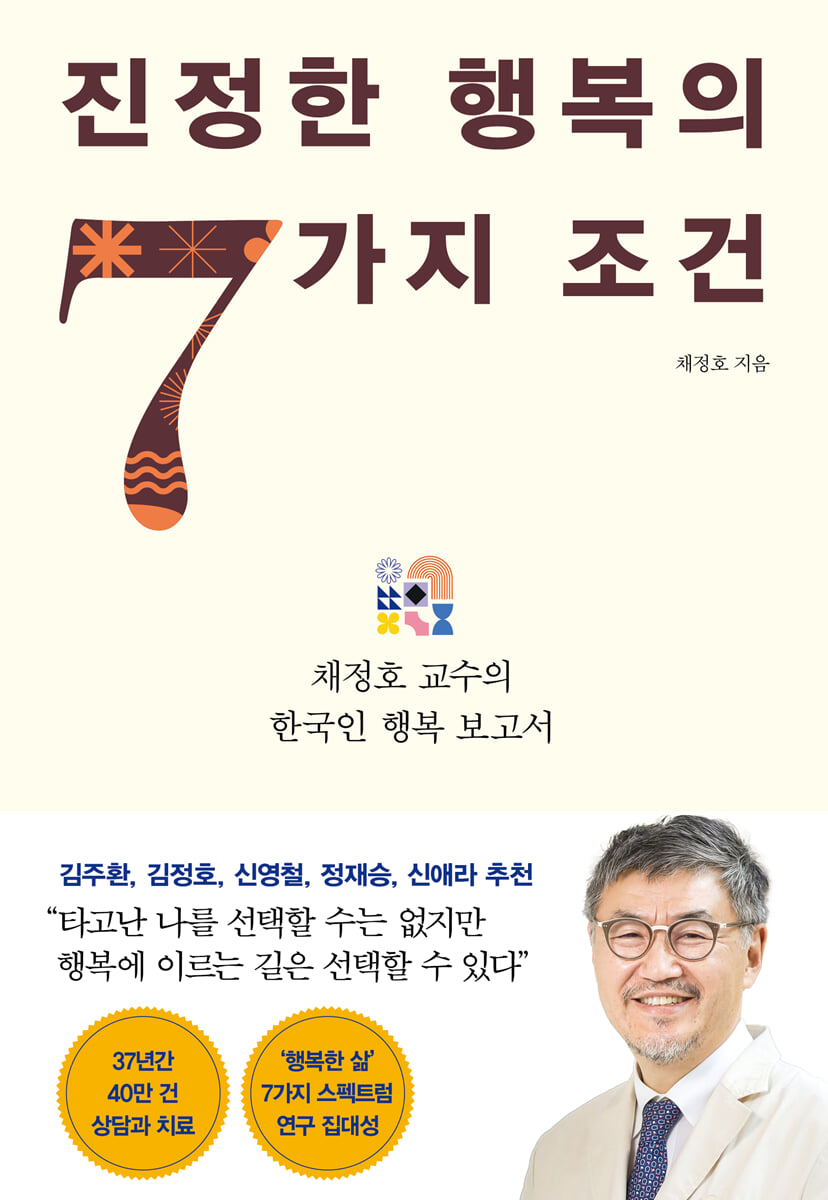
Seven Conditions for True Happiness
 |
Description
Book Introduction
“You can’t choose who you are, but you can choose the path to happiness.”
A compilation of 400,000 consultations and treatments, and 37 years of psychiatric research.
“Based on 37 years of experience treating people with heartache, I will clearly show you the path to true happiness!”
Kim Joo-hwan, Professor at Yonsei University and author of "Inner Communication"
“A book that talks about the ‘conditions for happiness’ that can be universally applied to all of us!”
Jaeseung Jeong | Decision-making neuroscientist, author of "Science Concert" and "Twelve Footsteps"
Since time immemorial, countless principles regarding happiness have existed in the world.
Also, each person has his or her own theory and pursues happiness.
If I'm not feeling happy enough right now, I need to question whether my values and methods for happiness are wrong.
Professor Jeong-ho Chae (Department of Psychiatry, Seoul St. Mary's Hospital), who has worked as a psychiatrist for 37 years and treated over 30,000 mentally ill people, points out our wrong prejudice that happiness is a 'good thing (福) that happens by chance (幸)' in this book, '7 Conditions for True Happiness', and introduces happiness that can be achieved through actual effort and the principles of happiness that can be universally applied to everyone.
The definition of happiness he presents is well-being, that is, 'existing well.'
Well-being, which has been misinformed in Korea and caused many misunderstandings (it is not a life of not working overtime, eating organic food, and traveling every weekend), means 'existing well' in one's own right, regardless of any external factors. Existing well as a human being means achieving self-realization by optimally utilizing the resources given to oneself without any deficiencies.
Ultimately, true well-being means a life in which both body and mind are healthy, a life that is optimal for oneself, and that is a happy life.
Through 400,000 interviews and treatments, and thousands of in-depth surveys of the general public, Professor Chae Jeong-ho has identified seven elements that lead to "well-being," or true happiness, in life.
The seven elements introduced in the book are research results that have already been published several times in academic papers, reconstructed from a popular perspective.
In particular, it supplemented existing positive psychology and other mental health theories to suit the characteristics of Koreans who are overly achievement-oriented and exposed to a lot of stressful situations.
Through the seven elements of a good life presented in this book, you will be able to find clues to what true happiness is and how to live a better today than yesterday.
A compilation of 400,000 consultations and treatments, and 37 years of psychiatric research.
“Based on 37 years of experience treating people with heartache, I will clearly show you the path to true happiness!”
Kim Joo-hwan, Professor at Yonsei University and author of "Inner Communication"
“A book that talks about the ‘conditions for happiness’ that can be universally applied to all of us!”
Jaeseung Jeong | Decision-making neuroscientist, author of "Science Concert" and "Twelve Footsteps"
Since time immemorial, countless principles regarding happiness have existed in the world.
Also, each person has his or her own theory and pursues happiness.
If I'm not feeling happy enough right now, I need to question whether my values and methods for happiness are wrong.
Professor Jeong-ho Chae (Department of Psychiatry, Seoul St. Mary's Hospital), who has worked as a psychiatrist for 37 years and treated over 30,000 mentally ill people, points out our wrong prejudice that happiness is a 'good thing (福) that happens by chance (幸)' in this book, '7 Conditions for True Happiness', and introduces happiness that can be achieved through actual effort and the principles of happiness that can be universally applied to everyone.
The definition of happiness he presents is well-being, that is, 'existing well.'
Well-being, which has been misinformed in Korea and caused many misunderstandings (it is not a life of not working overtime, eating organic food, and traveling every weekend), means 'existing well' in one's own right, regardless of any external factors. Existing well as a human being means achieving self-realization by optimally utilizing the resources given to oneself without any deficiencies.
Ultimately, true well-being means a life in which both body and mind are healthy, a life that is optimal for oneself, and that is a happy life.
Through 400,000 interviews and treatments, and thousands of in-depth surveys of the general public, Professor Chae Jeong-ho has identified seven elements that lead to "well-being," or true happiness, in life.
The seven elements introduced in the book are research results that have already been published several times in academic papers, reconstructed from a popular perspective.
In particular, it supplemented existing positive psychology and other mental health theories to suit the characteristics of Koreans who are overly achievement-oriented and exposed to a lot of stressful situations.
Through the seven elements of a good life presented in this book, you will be able to find clues to what true happiness is and how to live a better today than yesterday.
- You can preview some of the book's contents.
Preview
index
Preface: Why Are We Not Happy?
Prologue: Where Does True Happiness Come From?
What is a happy life?
Focus on myself, here and now.
To elevate an ordinary life to a happy life
Chapter 1 [Acceptance] Actively experience everything as it is.
Acceptance is active affirmation
Let's say "yes" to my life now unconditionally.
How to accept myself as I am
Accepting that anyone can do it - normalization
Affectionate and warm support for me - Validation
Believing that I am a good person - self-confidence
Mindfulness, the practice of staying present in the present moment
The driving force behind a better life: positive experiences
Be grateful for our very existence.
Savor the small joys and happiness of everyday life.
Chapter 2 [Change] Aim to be better than yesterday.
Change is something that gets better little by little every day
Let's make small, concrete changes to our daily lives.
How to Get on the 'Change' Train
Let's start by embodying small habits? Continuity
Spend time on things you enjoy and are good at? Preference
Find your own way to untangle the tangled threads? Method
Experience immersion through moderately challenging tasks.
Do your best every day, little by little.
Immersive experiences bring change.
Don't rush and just get closer to the life you want.
Chapter 3 [Connection] Don't Forget the Value of Living Together
People are happy when they are connected to each other.
The friendly ones survive
How are empathy and affinity formed?
The key to connection is intimacy and care.
True connection requires empathy.
A deep level of connection created by love and empathy
To be happy, first connect with yourself.
Chapter 4 [Strengths] Find your strengths and live your life true to yourself.
Strength is a life map that helps you find your true self.
Development of a strengths scale reflecting Korean characteristics
People are happy when they are good at what they do.
How to silence the intruders and move on
How to Leverage Your Strengths to Be Happy
Find your own light and turn on your strengths.
Chapter 5 [Wisdom] Develop the ability to cope with life's challenges.
Every choice in life requires wisdom.
Wisdom training method reflecting Korean characteristics
Wisdom Training Method 1: Accumulating Abundant Knowledge
Wisdom Training 2: Improving Your Contextual Ability
Wisdom Training Method 3: Raising Relativity
Wisdom Training 4: Tolerating Uncertainty
Wisdom Training Technique 5: Developing a Long-Term Perspective
Wisdom Training #6: Developing the Humility to Acknowledge Great Things
Wisdom Training 7: Empathize and Accept
Chapter 6: Get Out of Your Mind and Live with Your Body
Living well means moving well
If you use your body well and keep it healthy, your mind will be healed.
Good posture creates a good mind.
Know your body and do what makes it happy.
The principles of movement that revive the mind
Chapter 7: Look Beyond Reality to Find Meaning in Life
Spirituality is the ability to transcend myself.
The strength to hold on when life seems to be falling apart
In search of the meaning of existence and a reason to live
You can cultivate spirituality in your daily life even without religion.
Conclusion: A Journey to Find the Light in Our Lives
References
Recommendation
Prologue: Where Does True Happiness Come From?
What is a happy life?
Focus on myself, here and now.
To elevate an ordinary life to a happy life
Chapter 1 [Acceptance] Actively experience everything as it is.
Acceptance is active affirmation
Let's say "yes" to my life now unconditionally.
How to accept myself as I am
Accepting that anyone can do it - normalization
Affectionate and warm support for me - Validation
Believing that I am a good person - self-confidence
Mindfulness, the practice of staying present in the present moment
The driving force behind a better life: positive experiences
Be grateful for our very existence.
Savor the small joys and happiness of everyday life.
Chapter 2 [Change] Aim to be better than yesterday.
Change is something that gets better little by little every day
Let's make small, concrete changes to our daily lives.
How to Get on the 'Change' Train
Let's start by embodying small habits? Continuity
Spend time on things you enjoy and are good at? Preference
Find your own way to untangle the tangled threads? Method
Experience immersion through moderately challenging tasks.
Do your best every day, little by little.
Immersive experiences bring change.
Don't rush and just get closer to the life you want.
Chapter 3 [Connection] Don't Forget the Value of Living Together
People are happy when they are connected to each other.
The friendly ones survive
How are empathy and affinity formed?
The key to connection is intimacy and care.
True connection requires empathy.
A deep level of connection created by love and empathy
To be happy, first connect with yourself.
Chapter 4 [Strengths] Find your strengths and live your life true to yourself.
Strength is a life map that helps you find your true self.
Development of a strengths scale reflecting Korean characteristics
People are happy when they are good at what they do.
How to silence the intruders and move on
How to Leverage Your Strengths to Be Happy
Find your own light and turn on your strengths.
Chapter 5 [Wisdom] Develop the ability to cope with life's challenges.
Every choice in life requires wisdom.
Wisdom training method reflecting Korean characteristics
Wisdom Training Method 1: Accumulating Abundant Knowledge
Wisdom Training 2: Improving Your Contextual Ability
Wisdom Training Method 3: Raising Relativity
Wisdom Training 4: Tolerating Uncertainty
Wisdom Training Technique 5: Developing a Long-Term Perspective
Wisdom Training #6: Developing the Humility to Acknowledge Great Things
Wisdom Training 7: Empathize and Accept
Chapter 6: Get Out of Your Mind and Live with Your Body
Living well means moving well
If you use your body well and keep it healthy, your mind will be healed.
Good posture creates a good mind.
Know your body and do what makes it happy.
The principles of movement that revive the mind
Chapter 7: Look Beyond Reality to Find Meaning in Life
Spirituality is the ability to transcend myself.
The strength to hold on when life seems to be falling apart
In search of the meaning of existence and a reason to live
You can cultivate spirituality in your daily life even without religion.
Conclusion: A Journey to Find the Light in Our Lives
References
Recommendation
Detailed image

Into the book
Unfortunately, rather than focusing on the purpose of existence itself, we strive to have something more and are constantly doing something to achieve this.
It is a mistake to think that having is happiness and that you have to keep doing something to have it to live well.
It's because we've been trained to sacrifice the present too much for the future.
Preparing for the future is necessary, but if you go too far, you will end up neglecting your own existence.
We are bound to the future and live a life of constant action.
So I often say that to achieve true happiness, or in other words, to achieve 'well-being,' 'being' must come first.
It is about focusing on myself, who exists here and now, not in the past or the future.
Only when we discover the meaning and purpose of life centered on our own existence and are supported by the will to realize it, can we truly move forward toward a happy and healthy life.
--- From "Focus on Myself, Here and Now"
The most important thing in acceptance is to stop your mind from running.
To do that, you have to stop judging what is good and what is bad.
Likes and dislikes about something are actually instinctive emotions, and what follows these emotions is judgment.
So, to stop judging, I advise you to first look at what you are experiencing with interest and curiosity before deciding whether you like it or not.
--- From "How to Accept Myself as I Am"
To achieve healthy acceptance, it is important to accept pain without resistance, but it is also important to have many positive experiences to offset it.
In fact, our lives offer many opportunities for positive and happy experiences, from the smallest to the most significant.
It's just that we don't notice them.
--- From "The Power to Create a Better Life: Positive Experiences"
The reason we need to change is not to become better people or live better 'compared to' others.
No matter what you do, the most important competitor in your life is yourself.
That doesn't mean you should fight with yourself.
Rather than comparing ourselves to others, let's focus on making changes to live a better life that is true to ourselves.
The goal of change should be to become a better person this year than last year, this month than last month, and today than yesterday.
Therefore, there is no single, panacea-like answer to how to change.
The important thing is to find a method and pace that works for you.
--- From "Change is getting better little by little every day"
Neuroscientists define empathy as a type of 'intelligence'.
Many people think that empathy is the feeling of thinking about others, but in fact, that is not the case.
Empathy requires a 'cognitive process' of understanding the other person's emotions and situation.
Cognitive processes involve putting yourself in the other person's shoes and making a conscious effort to think about the reasons for their words or actions.
True empathy is only achieved when cognitive processes that utilize the brain are involved.
--- From "Empathy is necessary for true connection"
When we discover our own strengths and fully express them, we can find value in life and view the world through our own standards.
It also gives me grounds for self-confidence that I was already doing well enough.
If you are a working person, you can achieve your best performance in your current job and make your own choices at important turning points in your life.
So, I need to first develop my core strengths, and then fill in what I lack.
The problem is that most of us try to do it backwards.
If I try to fill in what I lack without fully developing my strengths, life will always be empty.
--- From "Strengths are a life map that helps you find your true self"
There are things in life that are minor, like buying orange juice, but there are also things that are irreparable, like a spouse's infidelity or a disability resulting from an accident.
Moreover, since human life is finite, separation from a loved one is one of the adversities we can never avoid.
Separation from family due to accident, illness, or old age happens to everyone.
(Omitted) Wisdom is necessary at every moment in every area of life, but it is ultimately the power that allows life to continue without stopping when faced with unavoidable adversities or difficult problems that are difficult to solve.
--- From "Every moment of life's choices requires wisdom"
One of the most common misconceptions is that wisdom is an innate ability.
Of course, just as each person has different strengths, it is true that some people are more talented at learning and acquiring wisdom.
However, anyone can develop wisdom through appropriate training and effort, such as cognitive training to change one's perspective on a problem or to create psychological distance, or mindfulness meditation to cultivate empathy, humility, and peace.
We also learn and acquire things through various experiences in life.
It's not necessarily true, but as you get older, you're more likely to become wiser.
--- From "Wisdom Training Methods Reflecting Korean Characteristics"
We are in motion at every moment and have the ability to perceive internal bodily sensations called 'proprioception'.
The ability to be internally aware of one's own physical movements is a uniquely human ability.
When I feel depressed, my posture inevitably becomes hunched.
Making an effort to maintain good posture will revitalize your body and give you energy.
It's a fact that everyone knows, but not many people actually put it into practice.
This is also the part that people who have lost the light in life miss the most.
Just by correcting your posture, depression and anxiety can be greatly improved, but you are only fighting the emotions themselves and cannot even think about moving your body.
--- From "If you use your body well and keep it healthy, your mind will be healed"
When we live ordinary lives, we may not feel the meaning and need for spirituality.
But when adversity comes that is so overwhelming that it feels like your entire life is crumbling, you need the strength of spirituality to endure.
Ultimately, the only thing a doctor can do for a cancer patient given six months to live is healing based on spirituality.
Even if it's not an extreme situation like a terminal diagnosis, there are times in our lives when we face adversity that is difficult to endure.
Even in such times, it is spirituality that sustains life and gives us the strength to endure.
It is a mistake to think that having is happiness and that you have to keep doing something to have it to live well.
It's because we've been trained to sacrifice the present too much for the future.
Preparing for the future is necessary, but if you go too far, you will end up neglecting your own existence.
We are bound to the future and live a life of constant action.
So I often say that to achieve true happiness, or in other words, to achieve 'well-being,' 'being' must come first.
It is about focusing on myself, who exists here and now, not in the past or the future.
Only when we discover the meaning and purpose of life centered on our own existence and are supported by the will to realize it, can we truly move forward toward a happy and healthy life.
--- From "Focus on Myself, Here and Now"
The most important thing in acceptance is to stop your mind from running.
To do that, you have to stop judging what is good and what is bad.
Likes and dislikes about something are actually instinctive emotions, and what follows these emotions is judgment.
So, to stop judging, I advise you to first look at what you are experiencing with interest and curiosity before deciding whether you like it or not.
--- From "How to Accept Myself as I Am"
To achieve healthy acceptance, it is important to accept pain without resistance, but it is also important to have many positive experiences to offset it.
In fact, our lives offer many opportunities for positive and happy experiences, from the smallest to the most significant.
It's just that we don't notice them.
--- From "The Power to Create a Better Life: Positive Experiences"
The reason we need to change is not to become better people or live better 'compared to' others.
No matter what you do, the most important competitor in your life is yourself.
That doesn't mean you should fight with yourself.
Rather than comparing ourselves to others, let's focus on making changes to live a better life that is true to ourselves.
The goal of change should be to become a better person this year than last year, this month than last month, and today than yesterday.
Therefore, there is no single, panacea-like answer to how to change.
The important thing is to find a method and pace that works for you.
--- From "Change is getting better little by little every day"
Neuroscientists define empathy as a type of 'intelligence'.
Many people think that empathy is the feeling of thinking about others, but in fact, that is not the case.
Empathy requires a 'cognitive process' of understanding the other person's emotions and situation.
Cognitive processes involve putting yourself in the other person's shoes and making a conscious effort to think about the reasons for their words or actions.
True empathy is only achieved when cognitive processes that utilize the brain are involved.
--- From "Empathy is necessary for true connection"
When we discover our own strengths and fully express them, we can find value in life and view the world through our own standards.
It also gives me grounds for self-confidence that I was already doing well enough.
If you are a working person, you can achieve your best performance in your current job and make your own choices at important turning points in your life.
So, I need to first develop my core strengths, and then fill in what I lack.
The problem is that most of us try to do it backwards.
If I try to fill in what I lack without fully developing my strengths, life will always be empty.
--- From "Strengths are a life map that helps you find your true self"
There are things in life that are minor, like buying orange juice, but there are also things that are irreparable, like a spouse's infidelity or a disability resulting from an accident.
Moreover, since human life is finite, separation from a loved one is one of the adversities we can never avoid.
Separation from family due to accident, illness, or old age happens to everyone.
(Omitted) Wisdom is necessary at every moment in every area of life, but it is ultimately the power that allows life to continue without stopping when faced with unavoidable adversities or difficult problems that are difficult to solve.
--- From "Every moment of life's choices requires wisdom"
One of the most common misconceptions is that wisdom is an innate ability.
Of course, just as each person has different strengths, it is true that some people are more talented at learning and acquiring wisdom.
However, anyone can develop wisdom through appropriate training and effort, such as cognitive training to change one's perspective on a problem or to create psychological distance, or mindfulness meditation to cultivate empathy, humility, and peace.
We also learn and acquire things through various experiences in life.
It's not necessarily true, but as you get older, you're more likely to become wiser.
--- From "Wisdom Training Methods Reflecting Korean Characteristics"
We are in motion at every moment and have the ability to perceive internal bodily sensations called 'proprioception'.
The ability to be internally aware of one's own physical movements is a uniquely human ability.
When I feel depressed, my posture inevitably becomes hunched.
Making an effort to maintain good posture will revitalize your body and give you energy.
It's a fact that everyone knows, but not many people actually put it into practice.
This is also the part that people who have lost the light in life miss the most.
Just by correcting your posture, depression and anxiety can be greatly improved, but you are only fighting the emotions themselves and cannot even think about moving your body.
--- From "If you use your body well and keep it healthy, your mind will be healed"
When we live ordinary lives, we may not feel the meaning and need for spirituality.
But when adversity comes that is so overwhelming that it feels like your entire life is crumbling, you need the strength of spirituality to endure.
Ultimately, the only thing a doctor can do for a cancer patient given six months to live is healing based on spirituality.
Even if it's not an extreme situation like a terminal diagnosis, there are times in our lives when we face adversity that is difficult to endure.
Even in such times, it is spirituality that sustains life and gives us the strength to endure.
--- From "The Strength That Holds You Back When Life Seems to Be Falling Apart"
Publisher's Review
“Why do we think happiness is far away?”
A New Law of Life for Those Who Think Happiness Isn't Theirs
In Chinese characters, happiness is 'a good thing (福) that happens by chance (幸).
The etymology of the English word 'happiness' is 'happen', which means 'to occur, to happen'.
Ultimately, the happiness we know can be interpreted as something like 'a good thing that happens by chance.'
The problem is that those happy moments are different for everyone.
This is why it is difficult to define happiness in a single word or measure it with objective indicators, and for this reason, ironically, the academic world has recently been seldom using the word "happiness" when studying happiness.
Professor Chae Jeong-ho of the Department of Psychiatry at Seoul St. Mary's Hospital says that instead of 'happiness', which varies from person to person in terms of conditions and states, 'well-being' should be considered as the goal of life.
Well-being is literally 'being well'.
A life of self-actualization, where one continuously grows by optimally utilizing the resources within oneself, is a life where both body and mind are healthy.
But most of us don't live a 'well-existing' life.
To be 'well-being', you must first 'be', but most Koreans are not good at 'being', that is, existing as they are, let alone achieving well-being.
Because I have never once in my life learned or thought about what it means to exist.
Professor Chae Jeong-ho adds that the achievement-oriented characteristics that are particularly prominent among Koreans are interfering with their lives.
If you live your life focused on the immediate goals and things you must achieve right away, you will never be able to realize the preciousness of existence, and therefore you will never be able to live a well-being life.
Professor Chae Jeong-ho has given lectures and workshops in over 300 companies, including clinical settings, and has spent extensive time researching the resources that are particularly needed by Koreans, who are achievement-oriented and often face stressful situations.
This book, "The Seven Conditions for True Happiness," is a new version of the research results, previously published as academic papers, reorganized into a popular perspective so that the general public can easily apply them.
If you implement the elements of well-being presented in this book, that is, the conditions for true happiness, one by one in your life, you will find yourself getting closer to a happy life, a life well-lived, even if it may not be right now.
To elevate an ordinary life to a happy life
7 Life Spectra That Lead to Happiness
Professor Chae Jeong-ho, who has spent his entire life meeting people who have lost the light in life, says, “People often think that meeting certain external conditions will make them happy, but in fact, those things have little to do with happiness.”
In particular, he observed for a long time countless people who were unable to escape from mental pain and discovered their common characteristics.
Among them, the characteristics that stand out are summarized as 'having difficulty accepting life', 'not changing appropriately', 'having weak connections with others or oneself', 'not being able to utilize one's strengths and positivity', 'not being wise and not being able to deal with stressful situations appropriately', 'not paying attention to one's body and living in one's thoughts', and 'being overly absorbed in a realistic life'.
Based on this, Professor Chae Jeong-ho derived seven elements of well-being that are especially essential for Koreans, namely, the conditions for happiness: acceptance, change, connection, strength, wisdom, body, and spirituality.
He calls these seven elements, which he has verified in clinical practice and published in a paper, the '7 Spectra of Life.'
Just as the seven colors of the spectrum come together to form bright white light, when these seven elements work well in life, we can achieve true well-being, or happiness.
"The Seven Conditions for True Happiness" is a compilation of these seven elements, which have already been verified in numerous organizations, including clinical settings and businesses, so that they can be more easily applied in everyday life.
In Chapter 1, 'Acceptance', we learn 'how to accept things as they are', which is the most important condition for happiness.
In Chapter 2, we learn about 'change' to create a different self from yesterday, rather than a better self by comparing ourselves to others, and we introduce specific methods to do so.
In Chapter 3, we explore the true meaning of 'connection', or 'relationship', a fundamental human need.
In Chapter 4, "Strengths," we will learn what true strengths are and how to realize and live according to our strengths.
But even if you live life to the fullest, there are bound to be difficult problems hidden everywhere in life that are difficult to solve.
In Chapter 5, "Wisdom," you learn how to deal with difficult problems that have no right answers.
Chapters 6 and 7 then explore ‘body’ and ‘spirituality’ respectively.
One thing that people who have lost the light of life often overlook is their body.
It goes without saying that you cannot expect peace of mind without physical stability.
Also, as we go through life, we come across things that we as humans can no longer do.
The ability to transcend those limits, the ability to transcend myself, is spirituality.
Professor Chae Jeong-ho asserts that these seven elements not only lead an unhappy life to an ordinary life, but are also the conditions for achieving ultimate happiness.
His explanation is that happiness is not about having certain external conditions that have been commonly known, but rather about having and utilizing these seven resources for well-being to achieve a truly happy life.
It's okay as it is now, if it's better than yesterday
What you see when you let go of the standards of perfection
“Instead of constantly trying to do something, you must first learn to stop.” This is what the author often says to people who ask him how to be happy.
Thanks to the social atmosphere that encourages us to believe that happiness comes from endless effort and achievement, we live our lives constantly striving to have something (having) and continuing to do something (doing) to achieve it.
In the book, the author, citing the words of American psychiatrist David Hawkins, points out that our vision of life develops into the dimensions of having, doing, and being according to the evolutionary stages of consciousness, and that Koreans, in particular, live lives filled with having and doing.
It is the illusion that you have to keep doing something to get it in order to be happy.
But he says that the more you try to achieve happiness, the further away it becomes from life.
The same applies when trying to implement the seven elements he presents in the book into your life.
Rather than being obsessed with the idea that you have to do something and pushing yourself, the most important thing is to let go and continue to make small efforts without stopping, 'just, just, happily'.
For example, he advises that when seeking change, one should not strive to be the 'best' but rather live with the goal of 'getting better and better every day'.
Let's break free from the misconception that change is a revolution that overturns everything at once, and the preconceived notion that it will be difficult and burdensome.
His explanation is that if you don't enjoy something, you can never do it consistently.
Also, you should not hold yourself to the standards of perfection.
Rather than blaming yourself by saying, “I tried so hard, but I’m still like this,” you need to have an attitude of acceptance in all aspects, thinking, “I tried hard, but I still need to try harder.”
What we need now is not the determination or effort to do everything perfectly, but to put at least one element of happiness into our lives, even if it is not perfect.
The author says that in itself, it is already well-being, that is, a life well-lived.
A New Law of Life for Those Who Think Happiness Isn't Theirs
In Chinese characters, happiness is 'a good thing (福) that happens by chance (幸).
The etymology of the English word 'happiness' is 'happen', which means 'to occur, to happen'.
Ultimately, the happiness we know can be interpreted as something like 'a good thing that happens by chance.'
The problem is that those happy moments are different for everyone.
This is why it is difficult to define happiness in a single word or measure it with objective indicators, and for this reason, ironically, the academic world has recently been seldom using the word "happiness" when studying happiness.
Professor Chae Jeong-ho of the Department of Psychiatry at Seoul St. Mary's Hospital says that instead of 'happiness', which varies from person to person in terms of conditions and states, 'well-being' should be considered as the goal of life.
Well-being is literally 'being well'.
A life of self-actualization, where one continuously grows by optimally utilizing the resources within oneself, is a life where both body and mind are healthy.
But most of us don't live a 'well-existing' life.
To be 'well-being', you must first 'be', but most Koreans are not good at 'being', that is, existing as they are, let alone achieving well-being.
Because I have never once in my life learned or thought about what it means to exist.
Professor Chae Jeong-ho adds that the achievement-oriented characteristics that are particularly prominent among Koreans are interfering with their lives.
If you live your life focused on the immediate goals and things you must achieve right away, you will never be able to realize the preciousness of existence, and therefore you will never be able to live a well-being life.
Professor Chae Jeong-ho has given lectures and workshops in over 300 companies, including clinical settings, and has spent extensive time researching the resources that are particularly needed by Koreans, who are achievement-oriented and often face stressful situations.
This book, "The Seven Conditions for True Happiness," is a new version of the research results, previously published as academic papers, reorganized into a popular perspective so that the general public can easily apply them.
If you implement the elements of well-being presented in this book, that is, the conditions for true happiness, one by one in your life, you will find yourself getting closer to a happy life, a life well-lived, even if it may not be right now.
To elevate an ordinary life to a happy life
7 Life Spectra That Lead to Happiness
Professor Chae Jeong-ho, who has spent his entire life meeting people who have lost the light in life, says, “People often think that meeting certain external conditions will make them happy, but in fact, those things have little to do with happiness.”
In particular, he observed for a long time countless people who were unable to escape from mental pain and discovered their common characteristics.
Among them, the characteristics that stand out are summarized as 'having difficulty accepting life', 'not changing appropriately', 'having weak connections with others or oneself', 'not being able to utilize one's strengths and positivity', 'not being wise and not being able to deal with stressful situations appropriately', 'not paying attention to one's body and living in one's thoughts', and 'being overly absorbed in a realistic life'.
Based on this, Professor Chae Jeong-ho derived seven elements of well-being that are especially essential for Koreans, namely, the conditions for happiness: acceptance, change, connection, strength, wisdom, body, and spirituality.
He calls these seven elements, which he has verified in clinical practice and published in a paper, the '7 Spectra of Life.'
Just as the seven colors of the spectrum come together to form bright white light, when these seven elements work well in life, we can achieve true well-being, or happiness.
"The Seven Conditions for True Happiness" is a compilation of these seven elements, which have already been verified in numerous organizations, including clinical settings and businesses, so that they can be more easily applied in everyday life.
In Chapter 1, 'Acceptance', we learn 'how to accept things as they are', which is the most important condition for happiness.
In Chapter 2, we learn about 'change' to create a different self from yesterday, rather than a better self by comparing ourselves to others, and we introduce specific methods to do so.
In Chapter 3, we explore the true meaning of 'connection', or 'relationship', a fundamental human need.
In Chapter 4, "Strengths," we will learn what true strengths are and how to realize and live according to our strengths.
But even if you live life to the fullest, there are bound to be difficult problems hidden everywhere in life that are difficult to solve.
In Chapter 5, "Wisdom," you learn how to deal with difficult problems that have no right answers.
Chapters 6 and 7 then explore ‘body’ and ‘spirituality’ respectively.
One thing that people who have lost the light of life often overlook is their body.
It goes without saying that you cannot expect peace of mind without physical stability.
Also, as we go through life, we come across things that we as humans can no longer do.
The ability to transcend those limits, the ability to transcend myself, is spirituality.
Professor Chae Jeong-ho asserts that these seven elements not only lead an unhappy life to an ordinary life, but are also the conditions for achieving ultimate happiness.
His explanation is that happiness is not about having certain external conditions that have been commonly known, but rather about having and utilizing these seven resources for well-being to achieve a truly happy life.
It's okay as it is now, if it's better than yesterday
What you see when you let go of the standards of perfection
“Instead of constantly trying to do something, you must first learn to stop.” This is what the author often says to people who ask him how to be happy.
Thanks to the social atmosphere that encourages us to believe that happiness comes from endless effort and achievement, we live our lives constantly striving to have something (having) and continuing to do something (doing) to achieve it.
In the book, the author, citing the words of American psychiatrist David Hawkins, points out that our vision of life develops into the dimensions of having, doing, and being according to the evolutionary stages of consciousness, and that Koreans, in particular, live lives filled with having and doing.
It is the illusion that you have to keep doing something to get it in order to be happy.
But he says that the more you try to achieve happiness, the further away it becomes from life.
The same applies when trying to implement the seven elements he presents in the book into your life.
Rather than being obsessed with the idea that you have to do something and pushing yourself, the most important thing is to let go and continue to make small efforts without stopping, 'just, just, happily'.
For example, he advises that when seeking change, one should not strive to be the 'best' but rather live with the goal of 'getting better and better every day'.
Let's break free from the misconception that change is a revolution that overturns everything at once, and the preconceived notion that it will be difficult and burdensome.
His explanation is that if you don't enjoy something, you can never do it consistently.
Also, you should not hold yourself to the standards of perfection.
Rather than blaming yourself by saying, “I tried so hard, but I’m still like this,” you need to have an attitude of acceptance in all aspects, thinking, “I tried hard, but I still need to try harder.”
What we need now is not the determination or effort to do everything perfectly, but to put at least one element of happiness into our lives, even if it is not perfect.
The author says that in itself, it is already well-being, that is, a life well-lived.
GOODS SPECIFICS
- Date of issue: October 25, 2023
- Page count, weight, size: 368 pages | 566g | 145*210*23mm
- ISBN13: 9791168341418
- ISBN10: 1168341418
You may also like
카테고리
korean


korean

![GQ KOREA Mark (Monthly): December [2025]](http://librairie.coreenne.fr/cdn/shop/files/8ef265dbbfbf186523ed75ba7319009d.jpg?v=1765340328&width=3840)


