

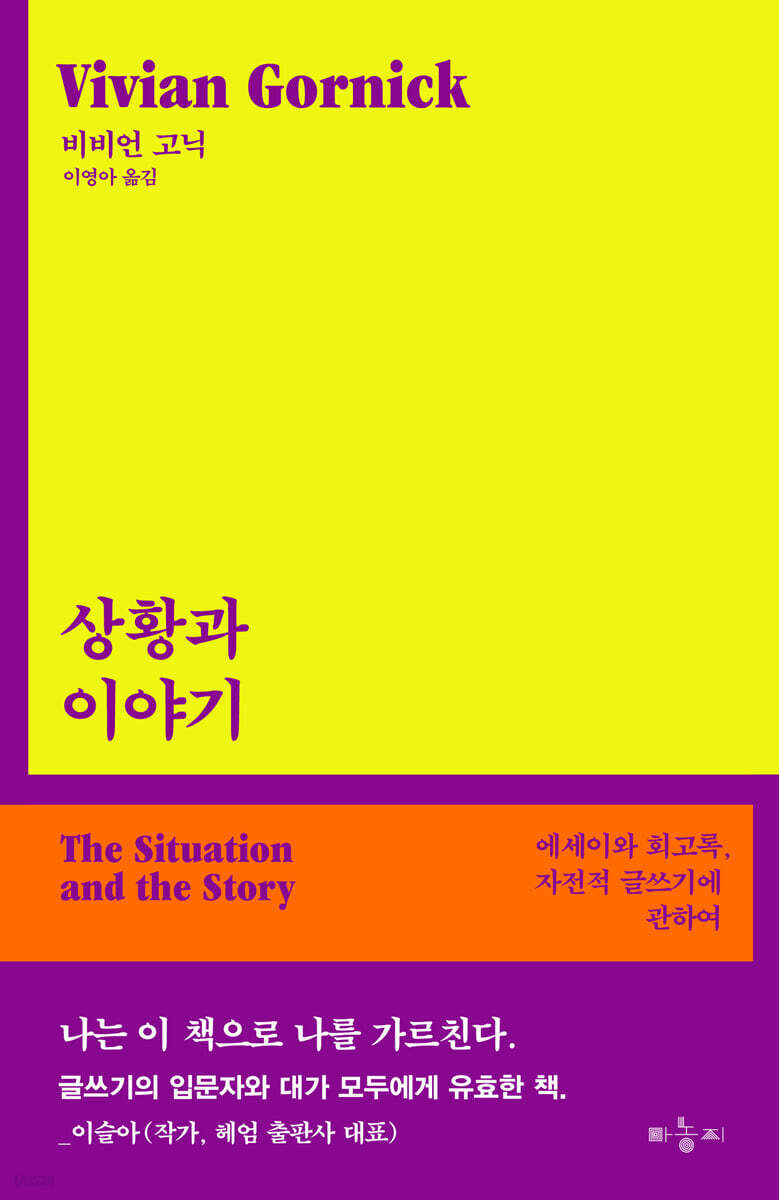
Situation and story
 |
Description
Book Introduction
Vivian Gornick's Autobiographical Writing Class
Recommended by Isul-ah and Maria Popova
It contains thoughts and insights on 'autobiographical writing' by Vivian Gonick, who is called a master of autobiography and a writer's writer.
Gonick is a writer who has created a unique world through essays, memoirs, and criticism, and is a long-time nonfiction writing teacher.
He says that teaching writing is next to impossible, but that he can teach you how to read, guide you on the path to understanding experience and discovering yourself.
What is especially important in this learning journey is the 'method' of asking "who is saying what, and what is the relationship between the two?"
To ask the right question, Gonick analyzes essays and memoirs by various authors with beautiful sentences and poignant thoughts.
This exploration leads to the core of what Gonick considers autobiographical writing.
The need to create a true narrator (persona) and separate the 'story' from the 'situation'.
If you want to write your story, you have to ask yourself this:
Does the narrator maintain sufficient distance? Is he credible? Does the author structure the story with key insights? Does the writing contain a compelling exploration? What aspects of himself does the narrator discover and reveal through his writing? This book, which asks these questions and seeks answers alongside the reader, alternates between a guide to autobiographical writing, a commentary illuminating the essence of self-narrative, and an elegant and incisive essay in literary criticism.
George Orwell, Joan Didion, Natalia Ginzburg, Jean Améry, Marguerite Duras, W.
G. Sebald… The brilliant writings of the authors who captivated Gonik are another gift.
Recommended by Isul-ah and Maria Popova
It contains thoughts and insights on 'autobiographical writing' by Vivian Gonick, who is called a master of autobiography and a writer's writer.
Gonick is a writer who has created a unique world through essays, memoirs, and criticism, and is a long-time nonfiction writing teacher.
He says that teaching writing is next to impossible, but that he can teach you how to read, guide you on the path to understanding experience and discovering yourself.
What is especially important in this learning journey is the 'method' of asking "who is saying what, and what is the relationship between the two?"
To ask the right question, Gonick analyzes essays and memoirs by various authors with beautiful sentences and poignant thoughts.
This exploration leads to the core of what Gonick considers autobiographical writing.
The need to create a true narrator (persona) and separate the 'story' from the 'situation'.
If you want to write your story, you have to ask yourself this:
Does the narrator maintain sufficient distance? Is he credible? Does the author structure the story with key insights? Does the writing contain a compelling exploration? What aspects of himself does the narrator discover and reveal through his writing? This book, which asks these questions and seeks answers alongside the reader, alternates between a guide to autobiographical writing, a commentary illuminating the essence of self-narrative, and an elegant and incisive essay in literary criticism.
George Orwell, Joan Didion, Natalia Ginzburg, Jean Améry, Marguerite Duras, W.
G. Sebald… The brilliant writings of the authors who captivated Gonik are another gift.
- You can preview some of the book's contents.
Preview
index
Entering
Essay
Memoir
In conclusion
A Guide for Writers, Educators, and Students
Essay
Memoir
In conclusion
A Guide for Writers, Educators, and Students
Detailed image

Into the book
The narrator, who is created from the raw material of the author's bare face, is an essential presence in the story.
This narrator becomes the persona.
His tone, his perspective, the rhythm of his sentences, what he observes or ignores, are chosen to suit the subject.
But what we need to see most is how the narrator or persona sees the world.
--- p.11
Every literary work has a situation and a story.
Situation refers to the context, surroundings, and (sometimes) plot, while story refers to the emotional experiences that fill the writer's head, or the insights and wisdom, or the message the writer wants to convey.
In her poem "In the Waiting Room," Elizabeth Bishop describes herself as a seven-year-old sitting in a dental office during World War I, flipping through National Geographic magazine and listening to her terrified aunt's muffled screams of pain.
This is the situation.
The story is about a child experiencing loneliness for the first time in his life.
Elizabeth's own loneliness, her aunt's loneliness, and the loneliness of the world.
--- p.18
The theme of autobiography is always self-awareness, but self-awareness cannot exist in a vacuum.
Like poets and novelists, memoirists must engage with the world.
Because exchange breeds experience, and experience breeds wisdom, and ultimately, what matters is this wisdom—or, more precisely, the striving toward wisdom… Whether poet, novelist, or memoirist, they must instill in their readers the conviction that they possess some wisdom, and they write with the utmost honesty to convey this wisdom.
In addition to this, the writer of an autobiographical story must also convince the reader of the narrator's credibility.
--- p.19
I had a narrator who would fight for me.
This narrator was the woman who could not leave his side because she had soon become like his mother. That woman was me.
A narrator who is not afraid of the situation of being “alone again.”
Come to think of it, he wasn't swayed much by me, a city walker, a divorced middle-aged feminist, or a financially unstable writer.
This narrator seemed to be just a solid, limited self, well-centered.
I knew what I had accomplished.
It created a persona.
--- p.30
A memoir in which the narrator is portrayed as an innocent person and the subject of the narrative as a monster is a failure because the situation remains static.
For a drama to deepen, the loneliness of the monster and the cunning of the innocent must be shown.
Above all, the narrator must be not simple in order to give life to the subject.
--- p.43
The truth in a memoir is not obtained by listing actual events.
Truth is achieved when the reader believes that the author is trying hard to confront the experiences he is facing.
It doesn't matter what happened to the writer.
What matters is whether the writer can understand the work in a big picture.
--- p.107
In a memoir, self-pity like “I’m alone again” never works.
Rather, the opposite strategy is needed.
If the loneliness of the self is the real theme, then better memoirs are generally written when they filter through topics far beyond the self.
Otherwise, it may end up as an investigative or abstract piece of writing.
--- p.158
From the beginning, I thought that teaching writing meant teaching people to read until they could clearly see what drives them.
When we read a text, we might ask ourselves:
What is the larger thought occupying the author's mind here? What is the true experience? What is the real theme? What matters to me isn't whether I can find the answer, but whether I can ask these questions.
This narrator becomes the persona.
His tone, his perspective, the rhythm of his sentences, what he observes or ignores, are chosen to suit the subject.
But what we need to see most is how the narrator or persona sees the world.
--- p.11
Every literary work has a situation and a story.
Situation refers to the context, surroundings, and (sometimes) plot, while story refers to the emotional experiences that fill the writer's head, or the insights and wisdom, or the message the writer wants to convey.
In her poem "In the Waiting Room," Elizabeth Bishop describes herself as a seven-year-old sitting in a dental office during World War I, flipping through National Geographic magazine and listening to her terrified aunt's muffled screams of pain.
This is the situation.
The story is about a child experiencing loneliness for the first time in his life.
Elizabeth's own loneliness, her aunt's loneliness, and the loneliness of the world.
--- p.18
The theme of autobiography is always self-awareness, but self-awareness cannot exist in a vacuum.
Like poets and novelists, memoirists must engage with the world.
Because exchange breeds experience, and experience breeds wisdom, and ultimately, what matters is this wisdom—or, more precisely, the striving toward wisdom… Whether poet, novelist, or memoirist, they must instill in their readers the conviction that they possess some wisdom, and they write with the utmost honesty to convey this wisdom.
In addition to this, the writer of an autobiographical story must also convince the reader of the narrator's credibility.
--- p.19
I had a narrator who would fight for me.
This narrator was the woman who could not leave his side because she had soon become like his mother. That woman was me.
A narrator who is not afraid of the situation of being “alone again.”
Come to think of it, he wasn't swayed much by me, a city walker, a divorced middle-aged feminist, or a financially unstable writer.
This narrator seemed to be just a solid, limited self, well-centered.
I knew what I had accomplished.
It created a persona.
--- p.30
A memoir in which the narrator is portrayed as an innocent person and the subject of the narrative as a monster is a failure because the situation remains static.
For a drama to deepen, the loneliness of the monster and the cunning of the innocent must be shown.
Above all, the narrator must be not simple in order to give life to the subject.
--- p.43
The truth in a memoir is not obtained by listing actual events.
Truth is achieved when the reader believes that the author is trying hard to confront the experiences he is facing.
It doesn't matter what happened to the writer.
What matters is whether the writer can understand the work in a big picture.
--- p.107
In a memoir, self-pity like “I’m alone again” never works.
Rather, the opposite strategy is needed.
If the loneliness of the self is the real theme, then better memoirs are generally written when they filter through topics far beyond the self.
Otherwise, it may end up as an investigative or abstract piece of writing.
--- p.158
From the beginning, I thought that teaching writing meant teaching people to read until they could clearly see what drives them.
When we read a text, we might ask ourselves:
What is the larger thought occupying the author's mind here? What is the true experience? What is the real theme? What matters to me isn't whether I can find the answer, but whether I can ask these questions.
--- p.184
Publisher's Review
“So, what’s your story?”
An autobiographical writing class by Vivian Gornick, a master of self-narrative writing.
Honest insights into writing and reading, self-exploration, or self-disclosure.
Recommended by Isul-ah and Maria Popova
“I teach myself with this book.
“A book that is useful for both beginners and experts in writing.” _Isul-ah (author)
“A classic for our time, a wonder to behold.” —Maria Popova, author of “Discovering Truth”
This book contains the thoughts and insights on 'autobiographical writing' by Vivian Gonick, who is called a master of autobiography and a writer's writer.
“30 years ago, people who had stories to tell wrote novels.
“People these days write memoirs.” In the 20 years since Gonick’s report, people are writing their stories with even greater fervor.
Countless self-narratives are emerging across various media, and countless writing books support this trend.
What does Gonick, author of "Ferocious Attachment," considered a model memoir, have to say about "autobiographical writing"?
“If there’s one thing I’ve learned over the years, it’s that teaching writing is impossible,” says Gonick, a writer who has built a unique world of essays, memoirs, and criticism, and a writing teacher who has taught nonfiction courses at universities for decades.
He says that teaching writing is next to impossible.
Instead, I can teach you how to read, guide you through understanding your experiences and discovering yourself.
What is especially important in this learning journey is the 'method' of asking "who is saying what, and what is the relationship between the two?"
To ask the right question, Gonick analyzes essays and memoirs by various authors with beautiful sentences and poignant thoughts.
This exploration reveals the core of what Gonick considers autobiographical writing.
The need to create a true narrator (persona) and separate the 'story' from the 'situation'.
If you want to write your story, you have to ask yourself this:
Is the narrator sufficiently detached? Is he credible? Does the author structure the story around a key insight? Is there an exploration that captivates the reader? What does the narrator discover and reveal about himself through his writing? ... So, what's your story?
By asking questions and finding answers alongside the reader, this book alternates between a guide to autobiographical writing, a commentary illuminating the nature of self-narrative, and an elegant and incisive essay in literary criticism.
George Orwell, Joan Didion, Natalia Ginzburg, Jean Améry, Marguerite Duras, W.
G. Sebald… The brilliant writings of the authors who captivated Gonik are another gift.
Separating the 'story' from the 'situation'
In her poem “In the Waiting Room,” Elizabeth Bishop describes herself as a seven-year-old sitting in a dental office during World War I… listening to her terrified aunt’s muffled screams of pain.
This is the situation.” It is an impressive scene that digs into the reader’s heart, but according to Gonick, autobiographical writing is not complete with ‘situation’ alone.
What is more important is what is contained in the situation and the 'story' that the writer wants to tell based on the situation.
“The story is about a child experiencing loneliness for the first time in his life.
Elizabeth's own loneliness, her aunt's loneliness, and the loneliness of the world.”
This is the story of Augustine's conversion to Christianity as told in his Confessions.
In this story, he moves “from an immature self-consciousness to a logical self-consciousness, from a state of ignorance to a state of truth,” and that is the story.
Stories of self-discovery and self-awareness resonate with us across time.
No matter how special our lives are, if we don't know why or what we want to say, our writing will remain circumstantial.
If we don't find what to say about the raw material of experience, the significant events, or even what we think of as plot, writing will stagnate at some point.
“A story is an emotional experience that fills the writer’s head, or an insight and wisdom, or a message the writer wants to convey.” Autobiographical writing can reach readers when the story can be separated from the context.
Creating a persona, understanding my fears and my cowardice
The person telling the story is the narrator.
The writer of an autobiographical story must create a narrator from the unstable, bare self who will interpret the situation and tell the truth.
Not the author's agent, but the other within me who is both me and not me, who tells stories I could not tell on my own.
He gives the story a free perspective by 'keeping a distance' from people and events.
This narrator is a persona.
“His tone, his perspective, the rhythm of his sentences, what he observes or ignores, are chosen to suit the subject.
But what we need to see most is the way the narrator or persona sees the world.”
The writer must convince the reader that the narrator is trustworthy.
Gonick emphasizes this point through George Orwell's "Shooting an Elephant."
The real Orwell is an imperfect human being, but the narrator he created as a writer is a real being.
Orwell's persona allows us to believe we know him, as he addresses contemporary politics without being swayed by emotion.
J., who left behind an interesting memoir titled “Father and I”.
It took R. Ackerley 30 years to “achieve distance, be honest with myself, and become a reliable narrator.”
But the narrator is not an innocent being.
According to Gonick, the work is constructed when the narrator is absorbed in self-study rather than self-confession.
The necessary element here is self-disclosure.
Understanding my fears, my cowardice, and my self-deception creates dynamism.
“For drama to be deep, it must show the loneliness of the monster and the cunning of the innocent.” Joan Didion’s essay “In Bed” is an example of how self-disclosure can create great nonfiction.
Didion creates a shaky persona, a shame-ridden one that reveals the truth about how mercilessly the anxieties of everyday life can eat us away, a shift in attitude that involves distancing, self-deception, and a reluctant poet.
Memoir: A Deeper Exploration of Self and Persona
“As we move from journalism to essays and memoirs, the exploration of nonfiction personas becomes deeper and more inward.” If an essay uses personas to explore a topic, a memoir is a piece of writing that uses that topic to explore myself.
The theme of the memoir is self-awareness, but in Gonick's view, self-awareness cannot exist in a vacuum.
It is also important for memoirists to interact with the world and gain experience and wisdom.
Gonick skillfully weaves together a variety of memoirs to trace the deepening exploration of self-concept and persona.
Edmund Gosse's Fathers and Sons shifts from peripheral events to the struggles of the inner self, while Agnes Smedley's The Earth's Daughter highlights the persona's self-loathing amidst the harsh conditions of life.
Geoffrey Wolff's The Duke of Deception explores my father, who is very similar to me, as a psychological counterpart.
The three authors' insight into their self-concepts makes their memoirs literature rather than testimony.
“In 1907, Goss felt that he had to leave his father to find his own identity.
Seventy years later, Wolf knows he cannot leave his father, for he is about to become one.
Smedley knows the wisdom of the 20th century.
We become what we are treated to be.
“The wait for freedom is precarious, and the effort to be liberated is itself precarious.”
Duras's Desire and Sebald's Serenity
To Gonnick, Marguerite Duras and W.
G. Sebald is a memoirist.
In Duras's The Lover and Sebald's The Rings of Saturn, the anxiety about loneliness becomes the authors' personas.
Duras's girl knows that desire is her weapon.
In it, we understand the essence of human relationships, but there is also a sense of shame mixed in with the desire for human relationships.
He is always alone, and is most lonely when he pursues pleasure, so he devotes himself to desire.
“But only after discovering the narrator within myself—the voice of a drug addict who has no moral compass and who embraces anomie as a living, breathing entity—was I able to articulate what I knew clearly and simply.”
According to Gonick, the voice that breathes life into Sebald's work is the author's own.
The narrator, the owner of the voice, writes to understand the situations people face in the world.
In The Rings of Saturn, the absence of humans is natural rather than ominous.
Even though the narrator is in an inner prison, Sebald's peaceful stay in his inner world creates a wonderful piece of writing.
The narrator simply concentrates on the vast silence that permeates solitude.
And it speaks of the broad and deep loneliness of human beings.
This is the beauty of this work that Gonick discovered.
“Memoirists step into the shoes of all of us and tell us the stories we need to hear right now.”
Smart and fresh.
-The New York Times Book Review
The logical consistency is amazing.
Going a step further than the autobiographical writing guide, it explores the thorny question of identity in this genre.
-The Boston Sunday Globe
An autobiographical writing class by Vivian Gornick, a master of self-narrative writing.
Honest insights into writing and reading, self-exploration, or self-disclosure.
Recommended by Isul-ah and Maria Popova
“I teach myself with this book.
“A book that is useful for both beginners and experts in writing.” _Isul-ah (author)
“A classic for our time, a wonder to behold.” —Maria Popova, author of “Discovering Truth”
This book contains the thoughts and insights on 'autobiographical writing' by Vivian Gonick, who is called a master of autobiography and a writer's writer.
“30 years ago, people who had stories to tell wrote novels.
“People these days write memoirs.” In the 20 years since Gonick’s report, people are writing their stories with even greater fervor.
Countless self-narratives are emerging across various media, and countless writing books support this trend.
What does Gonick, author of "Ferocious Attachment," considered a model memoir, have to say about "autobiographical writing"?
“If there’s one thing I’ve learned over the years, it’s that teaching writing is impossible,” says Gonick, a writer who has built a unique world of essays, memoirs, and criticism, and a writing teacher who has taught nonfiction courses at universities for decades.
He says that teaching writing is next to impossible.
Instead, I can teach you how to read, guide you through understanding your experiences and discovering yourself.
What is especially important in this learning journey is the 'method' of asking "who is saying what, and what is the relationship between the two?"
To ask the right question, Gonick analyzes essays and memoirs by various authors with beautiful sentences and poignant thoughts.
This exploration reveals the core of what Gonick considers autobiographical writing.
The need to create a true narrator (persona) and separate the 'story' from the 'situation'.
If you want to write your story, you have to ask yourself this:
Is the narrator sufficiently detached? Is he credible? Does the author structure the story around a key insight? Is there an exploration that captivates the reader? What does the narrator discover and reveal about himself through his writing? ... So, what's your story?
By asking questions and finding answers alongside the reader, this book alternates between a guide to autobiographical writing, a commentary illuminating the nature of self-narrative, and an elegant and incisive essay in literary criticism.
George Orwell, Joan Didion, Natalia Ginzburg, Jean Améry, Marguerite Duras, W.
G. Sebald… The brilliant writings of the authors who captivated Gonik are another gift.
Separating the 'story' from the 'situation'
In her poem “In the Waiting Room,” Elizabeth Bishop describes herself as a seven-year-old sitting in a dental office during World War I… listening to her terrified aunt’s muffled screams of pain.
This is the situation.” It is an impressive scene that digs into the reader’s heart, but according to Gonick, autobiographical writing is not complete with ‘situation’ alone.
What is more important is what is contained in the situation and the 'story' that the writer wants to tell based on the situation.
“The story is about a child experiencing loneliness for the first time in his life.
Elizabeth's own loneliness, her aunt's loneliness, and the loneliness of the world.”
This is the story of Augustine's conversion to Christianity as told in his Confessions.
In this story, he moves “from an immature self-consciousness to a logical self-consciousness, from a state of ignorance to a state of truth,” and that is the story.
Stories of self-discovery and self-awareness resonate with us across time.
No matter how special our lives are, if we don't know why or what we want to say, our writing will remain circumstantial.
If we don't find what to say about the raw material of experience, the significant events, or even what we think of as plot, writing will stagnate at some point.
“A story is an emotional experience that fills the writer’s head, or an insight and wisdom, or a message the writer wants to convey.” Autobiographical writing can reach readers when the story can be separated from the context.
Creating a persona, understanding my fears and my cowardice
The person telling the story is the narrator.
The writer of an autobiographical story must create a narrator from the unstable, bare self who will interpret the situation and tell the truth.
Not the author's agent, but the other within me who is both me and not me, who tells stories I could not tell on my own.
He gives the story a free perspective by 'keeping a distance' from people and events.
This narrator is a persona.
“His tone, his perspective, the rhythm of his sentences, what he observes or ignores, are chosen to suit the subject.
But what we need to see most is the way the narrator or persona sees the world.”
The writer must convince the reader that the narrator is trustworthy.
Gonick emphasizes this point through George Orwell's "Shooting an Elephant."
The real Orwell is an imperfect human being, but the narrator he created as a writer is a real being.
Orwell's persona allows us to believe we know him, as he addresses contemporary politics without being swayed by emotion.
J., who left behind an interesting memoir titled “Father and I”.
It took R. Ackerley 30 years to “achieve distance, be honest with myself, and become a reliable narrator.”
But the narrator is not an innocent being.
According to Gonick, the work is constructed when the narrator is absorbed in self-study rather than self-confession.
The necessary element here is self-disclosure.
Understanding my fears, my cowardice, and my self-deception creates dynamism.
“For drama to be deep, it must show the loneliness of the monster and the cunning of the innocent.” Joan Didion’s essay “In Bed” is an example of how self-disclosure can create great nonfiction.
Didion creates a shaky persona, a shame-ridden one that reveals the truth about how mercilessly the anxieties of everyday life can eat us away, a shift in attitude that involves distancing, self-deception, and a reluctant poet.
Memoir: A Deeper Exploration of Self and Persona
“As we move from journalism to essays and memoirs, the exploration of nonfiction personas becomes deeper and more inward.” If an essay uses personas to explore a topic, a memoir is a piece of writing that uses that topic to explore myself.
The theme of the memoir is self-awareness, but in Gonick's view, self-awareness cannot exist in a vacuum.
It is also important for memoirists to interact with the world and gain experience and wisdom.
Gonick skillfully weaves together a variety of memoirs to trace the deepening exploration of self-concept and persona.
Edmund Gosse's Fathers and Sons shifts from peripheral events to the struggles of the inner self, while Agnes Smedley's The Earth's Daughter highlights the persona's self-loathing amidst the harsh conditions of life.
Geoffrey Wolff's The Duke of Deception explores my father, who is very similar to me, as a psychological counterpart.
The three authors' insight into their self-concepts makes their memoirs literature rather than testimony.
“In 1907, Goss felt that he had to leave his father to find his own identity.
Seventy years later, Wolf knows he cannot leave his father, for he is about to become one.
Smedley knows the wisdom of the 20th century.
We become what we are treated to be.
“The wait for freedom is precarious, and the effort to be liberated is itself precarious.”
Duras's Desire and Sebald's Serenity
To Gonnick, Marguerite Duras and W.
G. Sebald is a memoirist.
In Duras's The Lover and Sebald's The Rings of Saturn, the anxiety about loneliness becomes the authors' personas.
Duras's girl knows that desire is her weapon.
In it, we understand the essence of human relationships, but there is also a sense of shame mixed in with the desire for human relationships.
He is always alone, and is most lonely when he pursues pleasure, so he devotes himself to desire.
“But only after discovering the narrator within myself—the voice of a drug addict who has no moral compass and who embraces anomie as a living, breathing entity—was I able to articulate what I knew clearly and simply.”
According to Gonick, the voice that breathes life into Sebald's work is the author's own.
The narrator, the owner of the voice, writes to understand the situations people face in the world.
In The Rings of Saturn, the absence of humans is natural rather than ominous.
Even though the narrator is in an inner prison, Sebald's peaceful stay in his inner world creates a wonderful piece of writing.
The narrator simply concentrates on the vast silence that permeates solitude.
And it speaks of the broad and deep loneliness of human beings.
This is the beauty of this work that Gonick discovered.
“Memoirists step into the shoes of all of us and tell us the stories we need to hear right now.”
Smart and fresh.
-The New York Times Book Review
The logical consistency is amazing.
Going a step further than the autobiographical writing guide, it explores the thorny question of identity in this genre.
-The Boston Sunday Globe
GOODS SPECIFICS
- Date of issue: September 5, 2023
- Page count, weight, size: 200 pages | 266g | 130*200*11mm
- ISBN13: 9791197870132
- ISBN10: 119787013X
You may also like
카테고리
korean


korean

![GQ KOREA Mark (Monthly): December [2025]](http://librairie.coreenne.fr/cdn/shop/files/8ef265dbbfbf186523ed75ba7319009d.jpg?v=1765340328&width=3840)


