

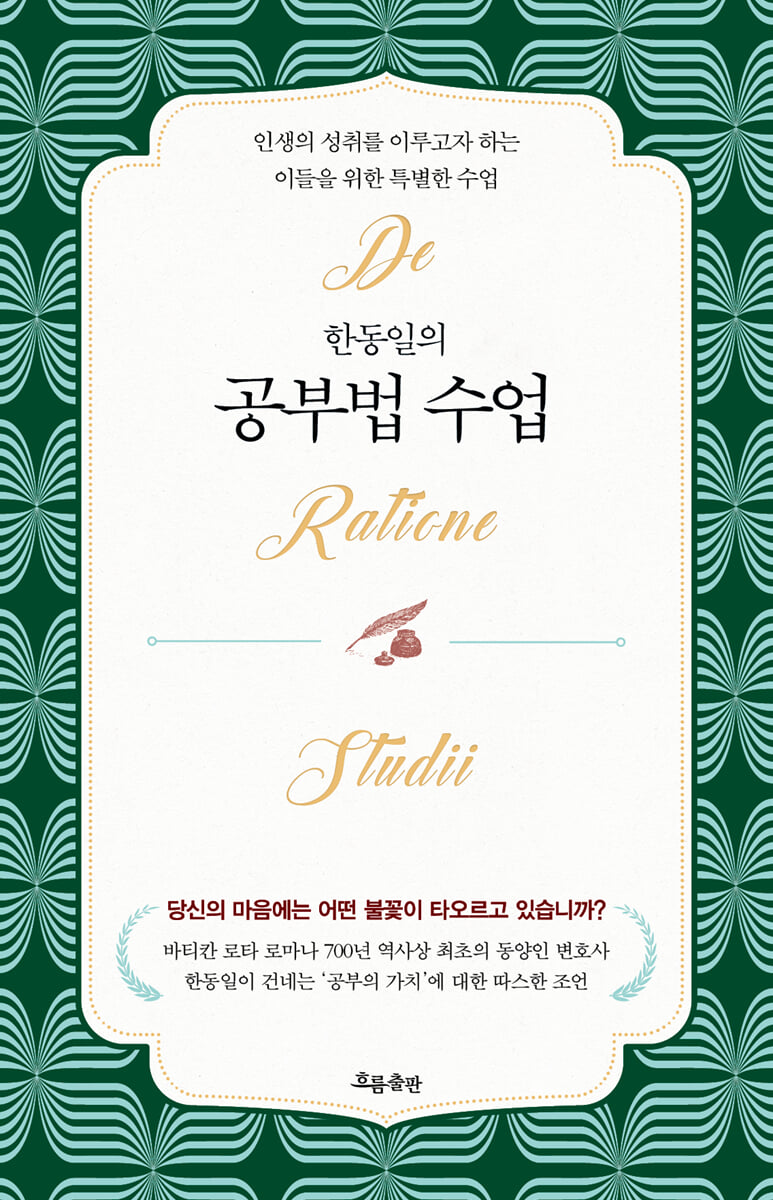
Han Dong-il's study method class
 |
Description
Book Introduction
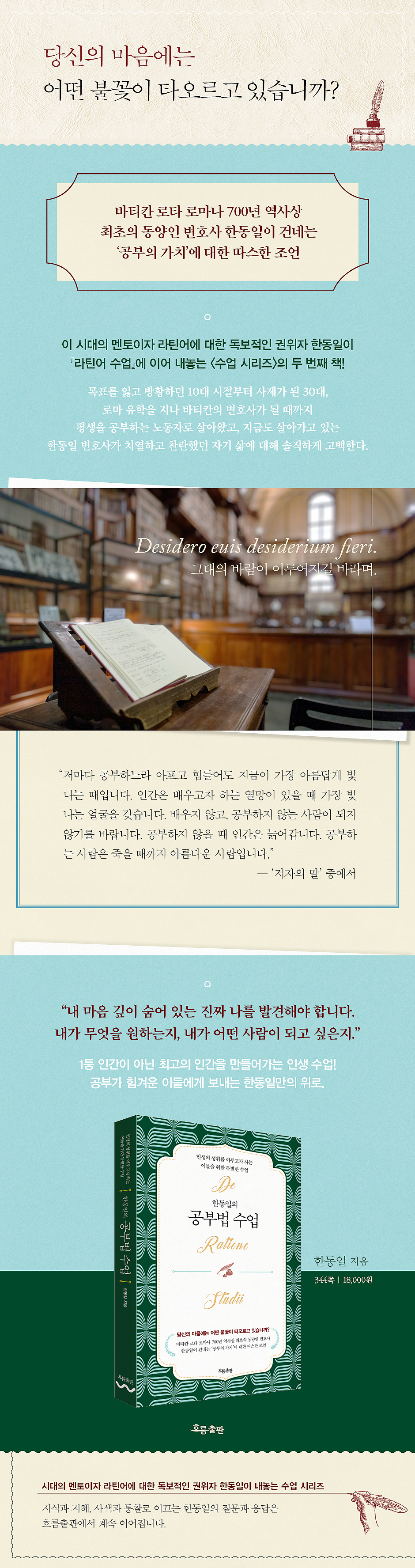
What fire is burning in your heart?
The first Asian lawyer in the 700-year history of the Vatican Rota Romana
Warm advice from Han Dong-il on the 'value of studying.'
From his lost and wandering teenage years, when he became a priest in his 30s, to his studies in Rome and becoming a lawyer at the Vatican, lawyer Dong-il Han has lived his entire life as a worker and student, and continues to do so today. He honestly confesses about his intense and brilliant life.
“Even though we are all sick and tired from studying, now is the time when we shine the most beautifully.
A person's face shines brightest when he has a desire to learn.
I hope you don't become someone who doesn't learn or study.
When people do not study, they grow old.
“A person who studies is a beautiful person until he dies.” - From the author’s words
The first Asian lawyer in the 700-year history of the Vatican Rota Romana
Warm advice from Han Dong-il on the 'value of studying.'
From his lost and wandering teenage years, when he became a priest in his 30s, to his studies in Rome and becoming a lawyer at the Vatican, lawyer Dong-il Han has lived his entire life as a worker and student, and continues to do so today. He honestly confesses about his intense and brilliant life.
“Even though we are all sick and tired from studying, now is the time when we shine the most beautifully.
A person's face shines brightest when he has a desire to learn.
I hope you don't become someone who doesn't learn or study.
When people do not study, they grow old.
“A person who studies is a beautiful person until he dies.” - From the author’s words
- You can preview some of the book's contents.
Preview
index
About your attitude toward studying
Beginning the Writing|I Study While I Breathe
Chapter 1 There is light at the end of the tunnel.
Chapter 2: A Study That Shakes the Ground
Chapter 3: Leave Your Parents
Chapter 4: Humble people study well.
Chapter 5: A Life of Consciousness, Not Will
Chapter 6: The Greatness of Just Doing
Chapter 7: Don't let the wolf into the sheepfold
Chapter 8: Rain that moistens the dry land
Chapter 9 We Are All Carpenters of Our Own Destiny
Chapter 10: Don't Make Easy Choices
Chapter 11: Purifying Memories, Letting Them Flow
Chapter 12: Exercise as if you were studying
Chapter 13: Study and Friendship
Chapter 14: Depth is not given by others.
Chapter 15: Explain as much as you know
Chapter 16: Studying is Tying a Knot
Chapter 17: People do not decorate places; places do not decorate people.
Chapter 18: Living in the Middle State
Chapter 19: Le Chedre, Today's Life, Thinking of the Day of Death
Chapter 20: I am still a working student
Beginning the Writing|I Study While I Breathe
Chapter 1 There is light at the end of the tunnel.
Chapter 2: A Study That Shakes the Ground
Chapter 3: Leave Your Parents
Chapter 4: Humble people study well.
Chapter 5: A Life of Consciousness, Not Will
Chapter 6: The Greatness of Just Doing
Chapter 7: Don't let the wolf into the sheepfold
Chapter 8: Rain that moistens the dry land
Chapter 9 We Are All Carpenters of Our Own Destiny
Chapter 10: Don't Make Easy Choices
Chapter 11: Purifying Memories, Letting Them Flow
Chapter 12: Exercise as if you were studying
Chapter 13: Study and Friendship
Chapter 14: Depth is not given by others.
Chapter 15: Explain as much as you know
Chapter 16: Studying is Tying a Knot
Chapter 17: People do not decorate places; places do not decorate people.
Chapter 18: Living in the Middle State
Chapter 19: Le Chedre, Today's Life, Thinking of the Day of Death
Chapter 20: I am still a working student
Detailed image
Into the book
I decided to talk about studying because of the pressure and stress Korean students face from a young age, as they are forced to study only to master the skills needed to do well on exams. They struggle to escape this burden.
Getting into the college of your choice is literally as difficult as reaching for the stars.
Even after entering college, the stress of studying remains, and even after graduation, you cannot let go of studying.
Because I wanted to share a little of my thoughts as an incompetent, blank-faced student for the countless students in this environment.
I, too, have been through a dark tunnel for a long time, and there are times when I just want to erase that time, but I still decided to think back to my student days.
If I don't recall my experiences from back then, I won't be able to empathize with the difficulties faced by students and students today, and I could end up hurting them.
Just because you've already experienced it, you shouldn't say, "You can buy hardships when you're young."
--- From "There is an end to the tunnel"
How wonderful would it be if people could change with just a thought? Or, if they could realize and transform something with just a single decision? But that's impossible.
Sometimes I wonder what humans could offer to God if He existed.
Is it the various offerings and donations that churches talk about? If there is a God, does he even need them? I wonder if what I can offer to God is "my inability to consistently put into practice the things I resolve to do every day."
What I, as a human, can show to God is not my achievements or abilities, but rather my inability to put my daily resolutions into practice as I have intended, leading to reflection.
This reflection is not an excuse for failure, but rather another self-reflection and resolution to think about how to avoid failure again tomorrow.
I think God would be more disappointed in humans who fail to learn anything from their failures than in humans who repeatedly fail.
--- From "A Life of Consciousness, Not Will"
'Summa cum laude' is an expression used in European university academic evaluations, meaning 'highest honors'.
It doesn't mean that it's the best you've ever done, but rather that it's the best you've ever done compared to others.
Studying is evaluated by others as grades, but ultimately, it is a yardstick that shows how much you have grown since yesterday.
Even if we haven't received 'Summa Cum Laude' yet, we who are studying should devote ourselves to our studies while thinking to ourselves, 'I am good, I am a genius.'
This is not to brag to others, but to encourage yourself to keep doing it.
If you do this, you will go beyond being a genius and become a ‘super genius’, and at some point you may even become an ‘ultra super genius’.
But when I go to bed at night, I must humbly examine my shortcomings.
Not to blame him for his shortcomings, but to discover the divinity within me through him.
What is the process of discovering the divinity within me? It is a humble, willing attitude of learning.
I believe that the process of a person studying, exploring the truth and finding what he or she should do within it, is a process by which a human being reveals the divinity he or she possesses.
--- From "Rain that Wets the Dry Land"
One day, a disciple talked about the things he wanted to do.
There was a list of five things, and I listened silently and then asked.
“Do you think you will be happy if you achieve all five of those things?”
At some point, I realized it too.
In my experience, achieving everything you want doesn't make you happy.
In Rome, I was so busy studying that I almost died, but when I look back on the small joys I had with my study friends, I feel happy.
I know I was happy because I had those times.
When you embark on a difficult and arduous journey with a clear goal in mind, it may be inevitable that you will be confined to an island for a while.
But how you decorate the island is entirely up to you.
Even amidst the difficulties and hardships of studying, even amidst the regular routine of each day, there are brief, small moments of peace and joy in everyday life.
I hope you don't live without knowing such things.
No matter how short the time may be, I hope you don't miss it and fully experience the happiness and life that it is, and gain the strength to study again.
Getting into the college of your choice is literally as difficult as reaching for the stars.
Even after entering college, the stress of studying remains, and even after graduation, you cannot let go of studying.
Because I wanted to share a little of my thoughts as an incompetent, blank-faced student for the countless students in this environment.
I, too, have been through a dark tunnel for a long time, and there are times when I just want to erase that time, but I still decided to think back to my student days.
If I don't recall my experiences from back then, I won't be able to empathize with the difficulties faced by students and students today, and I could end up hurting them.
Just because you've already experienced it, you shouldn't say, "You can buy hardships when you're young."
--- From "There is an end to the tunnel"
How wonderful would it be if people could change with just a thought? Or, if they could realize and transform something with just a single decision? But that's impossible.
Sometimes I wonder what humans could offer to God if He existed.
Is it the various offerings and donations that churches talk about? If there is a God, does he even need them? I wonder if what I can offer to God is "my inability to consistently put into practice the things I resolve to do every day."
What I, as a human, can show to God is not my achievements or abilities, but rather my inability to put my daily resolutions into practice as I have intended, leading to reflection.
This reflection is not an excuse for failure, but rather another self-reflection and resolution to think about how to avoid failure again tomorrow.
I think God would be more disappointed in humans who fail to learn anything from their failures than in humans who repeatedly fail.
--- From "A Life of Consciousness, Not Will"
'Summa cum laude' is an expression used in European university academic evaluations, meaning 'highest honors'.
It doesn't mean that it's the best you've ever done, but rather that it's the best you've ever done compared to others.
Studying is evaluated by others as grades, but ultimately, it is a yardstick that shows how much you have grown since yesterday.
Even if we haven't received 'Summa Cum Laude' yet, we who are studying should devote ourselves to our studies while thinking to ourselves, 'I am good, I am a genius.'
This is not to brag to others, but to encourage yourself to keep doing it.
If you do this, you will go beyond being a genius and become a ‘super genius’, and at some point you may even become an ‘ultra super genius’.
But when I go to bed at night, I must humbly examine my shortcomings.
Not to blame him for his shortcomings, but to discover the divinity within me through him.
What is the process of discovering the divinity within me? It is a humble, willing attitude of learning.
I believe that the process of a person studying, exploring the truth and finding what he or she should do within it, is a process by which a human being reveals the divinity he or she possesses.
--- From "Rain that Wets the Dry Land"
One day, a disciple talked about the things he wanted to do.
There was a list of five things, and I listened silently and then asked.
“Do you think you will be happy if you achieve all five of those things?”
At some point, I realized it too.
In my experience, achieving everything you want doesn't make you happy.
In Rome, I was so busy studying that I almost died, but when I look back on the small joys I had with my study friends, I feel happy.
I know I was happy because I had those times.
When you embark on a difficult and arduous journey with a clear goal in mind, it may be inevitable that you will be confined to an island for a while.
But how you decorate the island is entirely up to you.
Even amidst the difficulties and hardships of studying, even amidst the regular routine of each day, there are brief, small moments of peace and joy in everyday life.
I hope you don't live without knowing such things.
No matter how short the time may be, I hope you don't miss it and fully experience the happiness and life that it is, and gain the strength to study again.
--- From "I am still a worker who studies"
Publisher's Review
Han Dong-il, a mentor of this era and an unrivaled authority on Latin
The second book in the “Class Series” following “Latin Class”!
Warm advice on attitude and mindset toward studying.
The path to becoming a lawyer in the Vatican's Supreme Court, the Rota Romana, is renowned worldwide for its rigor.
They must be fluent in several European languages, including Latin, and after completing a three-year course at the Judicial Research and Training Institute, they must pass a qualifying examination, which has a pass rate of only 5 to 6 percent.
You can only take this final bar exam twice in your lifetime.
Han Dong-il became the first Korean lawyer in the 700-year history of the Vatican Rota Romana in 2010.
This book is the first confession in which Han Dong-il looks back on his life, filled with a brilliant career and fame, and opens up about the foundation of his life: “How I studied.”
From his lost and wandering teenage years, to his 30s when he became a priest, to his studies in Rome, to his becoming a lawyer at the Vatican, the life of Han Dong-il, who called himself a "studying worker," was more intense and brilliant than anyone else's.
He, like everyone else, had times when he felt despair and frustration, and moments when he wanted to give up everything.
So why does Han Dong-il still love studying and study as if he were breathing?
A life lesson that creates the best human being, not just the best human being!
Han Dong-il's comfort to those who find studying difficult.
“True study is discovering the joy of knowledge.”
As a child, Han Dong-il was born with a weak heart.
While climbing the mountain, I had difficulty breathing and had frequent nosebleeds.
His parents were poor, and his father, whose business failed, turned to alcohol.
Home never provided an environment conducive to focusing on my studies.
He had to spend his youth wandering without purpose or goals.
During those lonely, painful, and painful times, my only refuge and liberation was studying.
“I remember the first study that shook me to my core.
When I was in middle and high school, I worked hard but my grades were not good, so I was disappointed and became listless.
I didn't have any specific goals for my studies, I just wanted to escape from my poor family.
This kind of thinking always made me anxious and impatient, and sometimes even scared.
I wondered what could ultimately change the life of someone like me who grew up in poverty, but there was nothing I could do.
“It was just studying.” - From the Book
Since becoming a famous best-selling author with “Latin Lessons,” the question people have asked Han Dong-il the most is, “How did you study?”
These were questions about techniques or methods, such as 'how to get good test scores efficiently.'
In other words, people wondered if there was a shortcut that could get them to their goal the fastest.
Han Dong-il firmly states, “There is no such thing anywhere.”
The current reality, where getting good grades, going to a good university, and getting a good job are considered the top priorities in life, has turned studying into a mere means to an end.
For those who think of studying as a means, studying is an endlessly difficult and painful process.
That's because you're immersed in the method or technique of studying.
To teenagers struggling with college entrance exams, to those in their 20s preparing for various job tests, to middle-aged people who have put off studying or given up altogether after hitting a wall, to those who feel lost, as if they are stuck in the dark middle of a tunnel, Han Dong-il advises them to start "real studying" right now.
The 'real study' that Han Dong-il talks about means 'study that purifies the purpose.'
Only when you approach your studies with the desire to satisfy your intellectual curiosity and do good for the world can you truly begin to understand the essence and core of your studies.
Studying is not a skill to be acquired by filling the head, but a type of mental training that governs the body and mind.
Han Dong-il says that by encouraging yourself from the depths of your heart, not by force, and realizing the joy of knowledge one by one, you can reach the end of the tunnel by moving forward step by step.
In this book, Dong-il Han talks about eight different attitudes toward studying.
First, find and complete your own sheet music.
We must remember that studying is not a means to an end in life, but a companion, friend, and teacher in our lives.
Second, listen to your inner voice.
Studying is like training the mind, requiring self-examination and self-reflection.
If you ignore your own voice, at crucial moments you will return to the fundamental question, "What do I want to do?"
Third, we must break away from studying just for ourselves.
Studying for one's own benefit will not lead to any further progress beyond one's own growth.
It requires the will and action to utilize the achievements of one's studies for the benefit of society.
Only when you can study and give to others can your studies be filled with joy and delight.
Fourth, be humble.
The courage to not be discouraged comes from a humble attitude.
Humility is an attitude of knowing and accepting oneself accurately.
Therefore, a person with humility can think of other possibilities and get back up again even when faced with a crisis or failure.
Fifth, confine yourself.
You need to analyze your own lifestyle patterns and tendencies and study every day as a habit.
You have to make your body remember it.
Crash-style studying that aims to produce results in a short period of time may produce results, but it is not a successful study method.
You should sit down at your desk at the same time and work through your schedule step by step.
Sixth, just do it.
The more overwhelming the study is, the more you want to give up, but you must do it without calculating or imagining.
Seventh, relax your body.
Rest is as essential as studying.
It is not just a simple rest, but a rest that uses the body.
You need to move your body, like taking a walk or going for a walk, to move to the next step.
And finally, we must not forget the joy of life.
Don't get so caught up in your studies that you miss out on the things that are truly important in life.
Even if it is just a fleeting moment, you must realize that it is happiness and life, and through that moment, you must gain the strength to study again.
“I need to discover the real me hidden deep within my heart.
“What I want, what kind of person I want to be.”
Life is not a sprint.
It's not like it changes suddenly like running up stairs.
Human life is a long journey that must be climbed slowly, step by step, like a mountain with a gentle ridge.
Small steps, one by one, accumulate to complete the process called life.
Han Dong-il says that the closest friend you should have while going through that long journey is none other than study.
What is the most important thing in life? Each person has their own life, each with their own values, but the most important thing to establish first is, "What kind of person do I want to be?"
The results of study should be evaluated based on what is accumulated internally, not externally.
Failing an exam is only a superficial consequence.
The strength to stand up and start again without being frustrated or despairing over failure is built up within you.
This process of filling the inner self is the core of what Han Dong-il calls 'real study.'
Studying is a milestone in the mind that allows you to set your own goals, think hard, and find your own path, even if it means wandering.
This book is an invitation from Dong-il Han to all readers who wish to study happily.
The second book in the “Class Series” following “Latin Class”!
Warm advice on attitude and mindset toward studying.
The path to becoming a lawyer in the Vatican's Supreme Court, the Rota Romana, is renowned worldwide for its rigor.
They must be fluent in several European languages, including Latin, and after completing a three-year course at the Judicial Research and Training Institute, they must pass a qualifying examination, which has a pass rate of only 5 to 6 percent.
You can only take this final bar exam twice in your lifetime.
Han Dong-il became the first Korean lawyer in the 700-year history of the Vatican Rota Romana in 2010.
This book is the first confession in which Han Dong-il looks back on his life, filled with a brilliant career and fame, and opens up about the foundation of his life: “How I studied.”
From his lost and wandering teenage years, to his 30s when he became a priest, to his studies in Rome, to his becoming a lawyer at the Vatican, the life of Han Dong-il, who called himself a "studying worker," was more intense and brilliant than anyone else's.
He, like everyone else, had times when he felt despair and frustration, and moments when he wanted to give up everything.
So why does Han Dong-il still love studying and study as if he were breathing?
A life lesson that creates the best human being, not just the best human being!
Han Dong-il's comfort to those who find studying difficult.
“True study is discovering the joy of knowledge.”
As a child, Han Dong-il was born with a weak heart.
While climbing the mountain, I had difficulty breathing and had frequent nosebleeds.
His parents were poor, and his father, whose business failed, turned to alcohol.
Home never provided an environment conducive to focusing on my studies.
He had to spend his youth wandering without purpose or goals.
During those lonely, painful, and painful times, my only refuge and liberation was studying.
“I remember the first study that shook me to my core.
When I was in middle and high school, I worked hard but my grades were not good, so I was disappointed and became listless.
I didn't have any specific goals for my studies, I just wanted to escape from my poor family.
This kind of thinking always made me anxious and impatient, and sometimes even scared.
I wondered what could ultimately change the life of someone like me who grew up in poverty, but there was nothing I could do.
“It was just studying.” - From the Book
Since becoming a famous best-selling author with “Latin Lessons,” the question people have asked Han Dong-il the most is, “How did you study?”
These were questions about techniques or methods, such as 'how to get good test scores efficiently.'
In other words, people wondered if there was a shortcut that could get them to their goal the fastest.
Han Dong-il firmly states, “There is no such thing anywhere.”
The current reality, where getting good grades, going to a good university, and getting a good job are considered the top priorities in life, has turned studying into a mere means to an end.
For those who think of studying as a means, studying is an endlessly difficult and painful process.
That's because you're immersed in the method or technique of studying.
To teenagers struggling with college entrance exams, to those in their 20s preparing for various job tests, to middle-aged people who have put off studying or given up altogether after hitting a wall, to those who feel lost, as if they are stuck in the dark middle of a tunnel, Han Dong-il advises them to start "real studying" right now.
The 'real study' that Han Dong-il talks about means 'study that purifies the purpose.'
Only when you approach your studies with the desire to satisfy your intellectual curiosity and do good for the world can you truly begin to understand the essence and core of your studies.
Studying is not a skill to be acquired by filling the head, but a type of mental training that governs the body and mind.
Han Dong-il says that by encouraging yourself from the depths of your heart, not by force, and realizing the joy of knowledge one by one, you can reach the end of the tunnel by moving forward step by step.
In this book, Dong-il Han talks about eight different attitudes toward studying.
First, find and complete your own sheet music.
We must remember that studying is not a means to an end in life, but a companion, friend, and teacher in our lives.
Second, listen to your inner voice.
Studying is like training the mind, requiring self-examination and self-reflection.
If you ignore your own voice, at crucial moments you will return to the fundamental question, "What do I want to do?"
Third, we must break away from studying just for ourselves.
Studying for one's own benefit will not lead to any further progress beyond one's own growth.
It requires the will and action to utilize the achievements of one's studies for the benefit of society.
Only when you can study and give to others can your studies be filled with joy and delight.
Fourth, be humble.
The courage to not be discouraged comes from a humble attitude.
Humility is an attitude of knowing and accepting oneself accurately.
Therefore, a person with humility can think of other possibilities and get back up again even when faced with a crisis or failure.
Fifth, confine yourself.
You need to analyze your own lifestyle patterns and tendencies and study every day as a habit.
You have to make your body remember it.
Crash-style studying that aims to produce results in a short period of time may produce results, but it is not a successful study method.
You should sit down at your desk at the same time and work through your schedule step by step.
Sixth, just do it.
The more overwhelming the study is, the more you want to give up, but you must do it without calculating or imagining.
Seventh, relax your body.
Rest is as essential as studying.
It is not just a simple rest, but a rest that uses the body.
You need to move your body, like taking a walk or going for a walk, to move to the next step.
And finally, we must not forget the joy of life.
Don't get so caught up in your studies that you miss out on the things that are truly important in life.
Even if it is just a fleeting moment, you must realize that it is happiness and life, and through that moment, you must gain the strength to study again.
“I need to discover the real me hidden deep within my heart.
“What I want, what kind of person I want to be.”
Life is not a sprint.
It's not like it changes suddenly like running up stairs.
Human life is a long journey that must be climbed slowly, step by step, like a mountain with a gentle ridge.
Small steps, one by one, accumulate to complete the process called life.
Han Dong-il says that the closest friend you should have while going through that long journey is none other than study.
What is the most important thing in life? Each person has their own life, each with their own values, but the most important thing to establish first is, "What kind of person do I want to be?"
The results of study should be evaluated based on what is accumulated internally, not externally.
Failing an exam is only a superficial consequence.
The strength to stand up and start again without being frustrated or despairing over failure is built up within you.
This process of filling the inner self is the core of what Han Dong-il calls 'real study.'
Studying is a milestone in the mind that allows you to set your own goals, think hard, and find your own path, even if it means wandering.
This book is an invitation from Dong-il Han to all readers who wish to study happily.
GOODS SPECIFICS
- Date of issue: August 15, 2023
- Page count, weight, size: 344 pages | 594g | 145*225*20mm
- ISBN13: 9788965965886
- ISBN10: 8965965888
You may also like
카테고리
korean


korean

![GQ KOREA Mark (Monthly): December [2025]](http://librairie.coreenne.fr/cdn/shop/files/8ef265dbbfbf186523ed75ba7319009d.jpg?v=1765340328&width=3840)


