

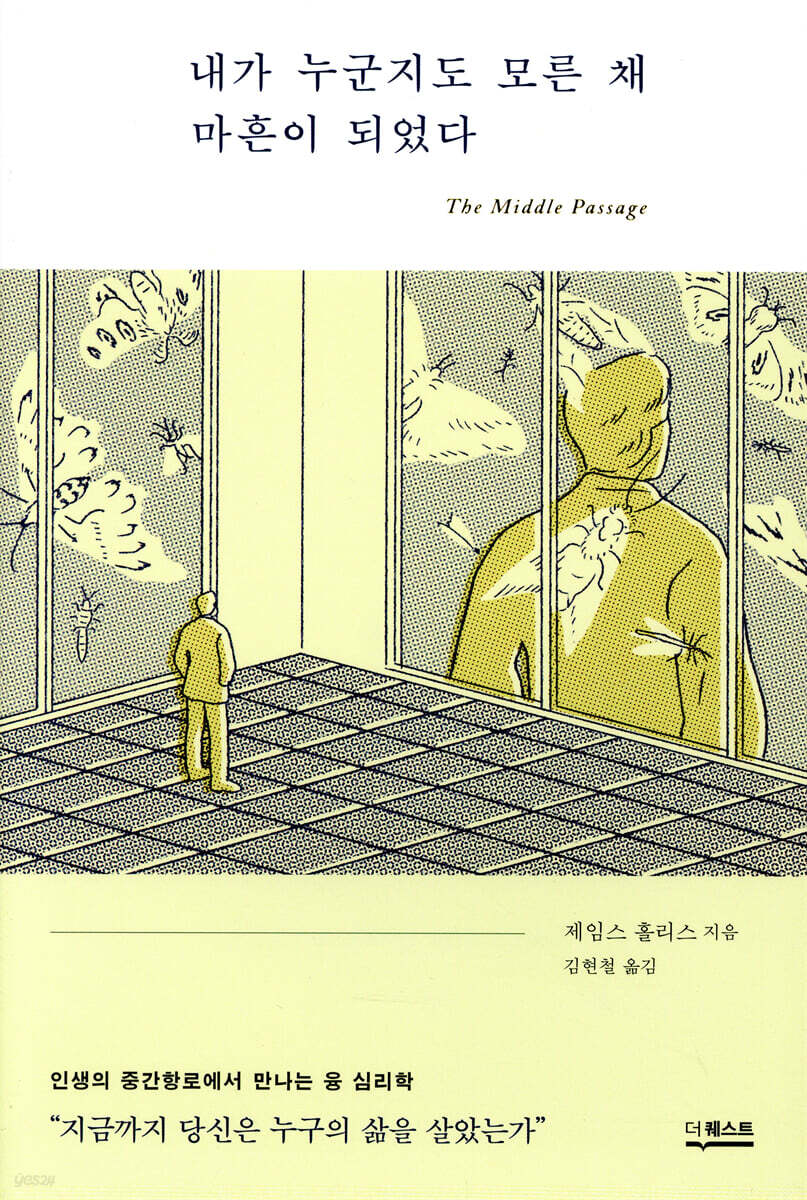
I turned forty without even knowing who I was.
 |
Description
Book Introduction
“Whose life have you lived so far?”
Now that you're forty, meet your true self instead of seeking momentary comfort.
Highly praised by Goodreads, the most demanding book review group in the United States!
“This book could change your life.”
When you turn forty, an earthquake occurs in your heart.
It's an inner signal to become your true self.
"I Turned Forty Without Knowing Who I Was" (original title: The Middle Passage) is a book based on Jungian psychology that provides guidance on how to live a meaningful life after forty.
Jung said, “When you turn forty, an earthquake occurs in your heart.
“It’s an inner signal to become your true self,” he said.
During this time, many people experience depression, loss of meaning in life, physical changes, infidelity, divorce, etc.
Why does turning forty feel like our entire lives are in turmoil? The book's author, Jungian psychoanalyst James Hollis, points out that the reason is that we have lived our lives far from our true selves.
Therefore, overcoming the crisis of forty is also a process of finding myself.
Now that you're forty, meet your true self instead of seeking momentary comfort.
Highly praised by Goodreads, the most demanding book review group in the United States!
“This book could change your life.”
When you turn forty, an earthquake occurs in your heart.
It's an inner signal to become your true self.
"I Turned Forty Without Knowing Who I Was" (original title: The Middle Passage) is a book based on Jungian psychology that provides guidance on how to live a meaningful life after forty.
Jung said, “When you turn forty, an earthquake occurs in your heart.
“It’s an inner signal to become your true self,” he said.
During this time, many people experience depression, loss of meaning in life, physical changes, infidelity, divorce, etc.
Why does turning forty feel like our entire lives are in turmoil? The book's author, Jungian psychoanalyst James Hollis, points out that the reason is that we have lived our lives far from our true selves.
Therefore, overcoming the crisis of forty is also a process of finding myself.
- You can preview some of the book's contents.
Preview
index
Introduction Who am I?
1.
A provisional personality is created
Personality inherited from parents, society, and culture
2.
Entering the middle passage
The beginning of a journey to a meaningful life
An earthquake occurs in my heart
Change your mindset
Kill the false self
Reap the fighters
The summer that seemed endless passes by
Reduce hope
suffer from depression, anxiety, and neurosis
3.
I want to be a complete human being
Now, it's time to look within
Dialogue between Persona and Shadow
Marriage in crisis
Why is middle-aged flirting a problem?
Beyond the parent complex
Work, a Career or a Calling?
Rediscovery of inferior functions
Embrace the Shadow
4.
Looking at it through literature
Faust, Madame Bovary, Notes from the Underground
5.
True healing is becoming yourself.
Individuation: Jung's Myth of Our Time
6.
Stand alone
No one can take responsibility for my life for me.
From loneliness to solitude
Meet the lost child within me
The key to loving life, passion
Finding meaning in the swamp of the soul
Conversations with me
We all die someday
A brief moment of shining stillness
1.
A provisional personality is created
Personality inherited from parents, society, and culture
2.
Entering the middle passage
The beginning of a journey to a meaningful life
An earthquake occurs in my heart
Change your mindset
Kill the false self
Reap the fighters
The summer that seemed endless passes by
Reduce hope
suffer from depression, anxiety, and neurosis
3.
I want to be a complete human being
Now, it's time to look within
Dialogue between Persona and Shadow
Marriage in crisis
Why is middle-aged flirting a problem?
Beyond the parent complex
Work, a Career or a Calling?
Rediscovery of inferior functions
Embrace the Shadow
4.
Looking at it through literature
Faust, Madame Bovary, Notes from the Underground
5.
True healing is becoming yourself.
Individuation: Jung's Myth of Our Time
6.
Stand alone
No one can take responsibility for my life for me.
From loneliness to solitude
Meet the lost child within me
The key to loving life, passion
Finding meaning in the swamp of the soul
Conversations with me
We all die someday
A brief moment of shining stillness
Detailed image
Into the book
The middle passage occurs when an individual is forced to ask anew the question of the meaning of life.
It's a question I used to imagine when I was young, but it's been forgotten as time goes by.
And this is also the case when we have to face problems that have been hidden until now.
As questions about identity resurface, responsibility can no longer be avoided.
Again, the middle passage begins when we ask ourselves, "What am I, apart from my life and my roles thus far?"
---「2.
From “Entering the Middle Passage”
The second major decline in expectations that occurs in midlife is facing the limits of relationships.
The perfect partner who meets all our needs, cares for us, and is always there for us is actually someone who is full of their own needs just like us and projects the same expectations onto us.
Marriages often break down in middle age.
One big reason is that the structure that binds two married people together is unstable, while placing excessively high childhood hopes on it.
(…) The person who claims to be our eternal companion and is ready to be so, is actually in our hearts, although we are not aware of it.
---「2.
From “Entering the Middle Passage”
Life is merciless in that it demands that we grow up and take responsibility for ourselves.
It may sound simple, but growth is truly an unavoidable requirement on the middle route.
This ultimately means having to face one's own dependencies, complexes, and fears without the mediation of others.
To do this, we must stop blaming others for our own burdens and take responsibility for our own physical, emotional, and mental well-being.
---「3.
From "I want to be a complete human being"
Even though we use personas to fit in with the outside world, we tend to mistake other people's personas for our inner truths, and likewise, we often believe that the roles we play are our own.
As I said before, when roles change, we experience a loss of self.
The persona masquerades as an individuality, but as Jung points out, it is fundamentally “untrue, but merely a compromise between the individual and society.”
(…) In the first half of life, most people are busy creating and maintaining a persona, so they easily neglect their inner reality.
Then what appears is the shadow, which refers to everything that is unrecognized or suppressed.
---「3.
From "I want to be a complete human being"
I've heard people say that psychotherapy is just about blaming your parents for all your current suffering.
In fact, it's the opposite.
The more we understand the fragility of the human spirit, the more likely we are to forgive our parents for the hurt they inflicted on us.
The worst thing you can do is keep all this buried in your unconscious, and the price you pay for that is high.
Wherever we find ourselves in our past, whether hurt or flawed, we must act as parents who embrace it.
---「3.
From "I want to be a complete human being"
I've often seen people become neurotic when they give inadequate or incorrect answers to life questions and become satisfied with those answers.
They pursue status, marriage, reputation, external success, money, etc., but even after they actually obtain them, they remain unhappy or neurotic.
These people are usually trapped in a very narrow spiritual horizon.
There is not enough substance or meaning in life.
As you expand your personality, neurosis will gradually disappear.
---「5.
From “True healing is becoming yourself”
The concept of individuation signifies Jung's myth of our time, in that it is a group of images that guide the energy of the soul.
Simply put, individuation is an essential element of personal development that allows us to become our complete selves within the limitations imposed by fate.
---「5.
From “True healing is becoming yourself”
We must live our present life most faithfully.
We must not face the weakness and death of our later years in hesitation and shame, complaining endlessly about the past.
The time when we must live most fully and faithfully is certainly now.
It's a question I used to imagine when I was young, but it's been forgotten as time goes by.
And this is also the case when we have to face problems that have been hidden until now.
As questions about identity resurface, responsibility can no longer be avoided.
Again, the middle passage begins when we ask ourselves, "What am I, apart from my life and my roles thus far?"
---「2.
From “Entering the Middle Passage”
The second major decline in expectations that occurs in midlife is facing the limits of relationships.
The perfect partner who meets all our needs, cares for us, and is always there for us is actually someone who is full of their own needs just like us and projects the same expectations onto us.
Marriages often break down in middle age.
One big reason is that the structure that binds two married people together is unstable, while placing excessively high childhood hopes on it.
(…) The person who claims to be our eternal companion and is ready to be so, is actually in our hearts, although we are not aware of it.
---「2.
From “Entering the Middle Passage”
Life is merciless in that it demands that we grow up and take responsibility for ourselves.
It may sound simple, but growth is truly an unavoidable requirement on the middle route.
This ultimately means having to face one's own dependencies, complexes, and fears without the mediation of others.
To do this, we must stop blaming others for our own burdens and take responsibility for our own physical, emotional, and mental well-being.
---「3.
From "I want to be a complete human being"
Even though we use personas to fit in with the outside world, we tend to mistake other people's personas for our inner truths, and likewise, we often believe that the roles we play are our own.
As I said before, when roles change, we experience a loss of self.
The persona masquerades as an individuality, but as Jung points out, it is fundamentally “untrue, but merely a compromise between the individual and society.”
(…) In the first half of life, most people are busy creating and maintaining a persona, so they easily neglect their inner reality.
Then what appears is the shadow, which refers to everything that is unrecognized or suppressed.
---「3.
From "I want to be a complete human being"
I've heard people say that psychotherapy is just about blaming your parents for all your current suffering.
In fact, it's the opposite.
The more we understand the fragility of the human spirit, the more likely we are to forgive our parents for the hurt they inflicted on us.
The worst thing you can do is keep all this buried in your unconscious, and the price you pay for that is high.
Wherever we find ourselves in our past, whether hurt or flawed, we must act as parents who embrace it.
---「3.
From "I want to be a complete human being"
I've often seen people become neurotic when they give inadequate or incorrect answers to life questions and become satisfied with those answers.
They pursue status, marriage, reputation, external success, money, etc., but even after they actually obtain them, they remain unhappy or neurotic.
These people are usually trapped in a very narrow spiritual horizon.
There is not enough substance or meaning in life.
As you expand your personality, neurosis will gradually disappear.
---「5.
From “True healing is becoming yourself”
The concept of individuation signifies Jung's myth of our time, in that it is a group of images that guide the energy of the soul.
Simply put, individuation is an essential element of personal development that allows us to become our complete selves within the limitations imposed by fate.
---「5.
From “True healing is becoming yourself”
We must live our present life most faithfully.
We must not face the weakness and death of our later years in hesitation and shame, complaining endlessly about the past.
The time when we must live most fully and faithfully is certainly now.
---「6.
From "Standing Alone"
From "Standing Alone"
Publisher's Review
“What am I, apart from my life and the roles I have played so far?”
James Hollis calls the 'forty-year crisis' the 'Middle Passage.'
The Middle Passage was a transatlantic route connecting the west coast of Africa and the West Indies, and was the sea route that carried African slaves to the Americas.
The reason middle age is given such a terrible name is because if you leave the voyage of life in someone else's hands and just go with the flow, you will end up in a destination you never wanted.
From the age of 12 to 40, which is the first stage of adulthood, we are socialized within our family and society as someone's son or daughter, someone's mother or father, or someone's team leader at a certain company.
As children, we imitate our parents' specific ways of relating to the world and develop various defense mechanisms to protect ourselves from the hurt we receive from them.
Cursors help to maintain and preserve certain values that society and culture deem right.
This is also meaningful, but unfortunately, it is closer to a life that is the result of being raised to think that life should be seen this way and choices should be made this way, rather than according to one's true nature.
“Whose life have I lived so far?” “Who am I, after taking away the roles I’ve played so far?” When we face these questions and realize that we’ve been building a “false self” up until now, we can move on to second adulthood, where we encounter our true self.
If you don't change, you will wither away in anger.
If you don't grow, you will rot and die inside.
If you feel like you've been wearing clothes that don't fit,
You should be suspicious of the projector
The greater the gap between your acquired personality and your inner self, the more unstable your life after forty becomes.
The man featured in this book had achieved everything he wanted—a PhD, a family, published books, and a stable professorial position—at the young age of 28, yet he suffered from boredom and a loss of energy.
At first, I tried to overcome it by working several times harder than others.
In 10 years, I have written more and gotten better teaching positions.
On the surface, he was a sincere and competent professor, but at the age of 37, depression struck, and he lost his energy and meaning in life. He quit his job, left his family, and opened an ice cream shop in another city.
This man's story is a classic example of suppressing one's inner voice and projecting one's identity onto one's career.
Besides this, we project our identity onto the parental role of controlling our children or onto the marriage we entered into with the vain expectation that it would save us.
“We inevitably make the mistake of projecting onto our children the lives we ourselves failed to live.
Jung said that the greatest burden a child must bear is the life his parents never lived.”
“Nothing causes more hurt and disappointment to middle-aged people than ‘marriage,’ a long-term, intimate relationship.
To sustain a marriage, you must bear the burden of your 'inner child'.
“Because you put so much hope and desire into your marriage, you are more likely to be disappointed.”
Through several poems and novels, this book shows how the projections of primary adulthood cause confusion in middle age.
Among them, in Gustave Flaubert's work Madame Bovary, the protagonist Emma Bovary tries to escape her miserable life through marriage.
Shortly after their marriage, Emma becomes pregnant and grows tired of her ordinary husband, but in Catholic-dominated 19th-century France, abortion, divorce, and even running away from home in rebellion were all but impossible.
Emma reads romance novels, dreams of finding a new lover who will save her, and has affairs with various men.
She projected her dream life onto her husband, but when she was disappointed, she met several men in the illusion of romantic salvation.
Eventually, Emma, abandoned by her lovers, driven to the brink of bankruptcy, and overcome with despair over not having met the love of her dreams, takes her own life.
True healing is becoming yourself.
Embrace the crying shadow inside me
The crisis of forty isn't solved by finding a new job or a new lover.
It is time to give up the belief that anyone or anything will solve your problems.
I must be conscious that I alone am responsible for my life and accept the truth that 'all the answers come from within me.'
Jung said, “I would rather be a complete person than a good person.”
For that to happen, the persona, which is the social personality, and the shadow that has been suppressed until now must have a conversation.
The shadow represents all the negative parts of ourselves that we want to hide, such as anger, selfishness, desire, and jealousy.
To heal the depression and anxiety of middle age, you must accept your shadow as a part of yourself rather than deny it.
Anyone who lives in the latter half of their life will have already suppressed a lot of their individuality.
The middle passage can be very painful as unacknowledged personalities and emotions constantly explode.
If we can be honest with ourselves, we can identify the selfishness, dependence, fear, jealousy, and destructive forces within us.
It may not be a good look, but it is a more complete form and more human than a persona that is only bright.
Since its publication in 1993, "I Turned Forty Without Knowing Who I Was" has resonated with many readers, receiving rave reviews from Goodreads, the most demanding book review group in the United States, for over 30 years.
James Hollis calls the 'forty-year crisis' the 'Middle Passage.'
The Middle Passage was a transatlantic route connecting the west coast of Africa and the West Indies, and was the sea route that carried African slaves to the Americas.
The reason middle age is given such a terrible name is because if you leave the voyage of life in someone else's hands and just go with the flow, you will end up in a destination you never wanted.
From the age of 12 to 40, which is the first stage of adulthood, we are socialized within our family and society as someone's son or daughter, someone's mother or father, or someone's team leader at a certain company.
As children, we imitate our parents' specific ways of relating to the world and develop various defense mechanisms to protect ourselves from the hurt we receive from them.
Cursors help to maintain and preserve certain values that society and culture deem right.
This is also meaningful, but unfortunately, it is closer to a life that is the result of being raised to think that life should be seen this way and choices should be made this way, rather than according to one's true nature.
“Whose life have I lived so far?” “Who am I, after taking away the roles I’ve played so far?” When we face these questions and realize that we’ve been building a “false self” up until now, we can move on to second adulthood, where we encounter our true self.
If you don't change, you will wither away in anger.
If you don't grow, you will rot and die inside.
If you feel like you've been wearing clothes that don't fit,
You should be suspicious of the projector
The greater the gap between your acquired personality and your inner self, the more unstable your life after forty becomes.
The man featured in this book had achieved everything he wanted—a PhD, a family, published books, and a stable professorial position—at the young age of 28, yet he suffered from boredom and a loss of energy.
At first, I tried to overcome it by working several times harder than others.
In 10 years, I have written more and gotten better teaching positions.
On the surface, he was a sincere and competent professor, but at the age of 37, depression struck, and he lost his energy and meaning in life. He quit his job, left his family, and opened an ice cream shop in another city.
This man's story is a classic example of suppressing one's inner voice and projecting one's identity onto one's career.
Besides this, we project our identity onto the parental role of controlling our children or onto the marriage we entered into with the vain expectation that it would save us.
“We inevitably make the mistake of projecting onto our children the lives we ourselves failed to live.
Jung said that the greatest burden a child must bear is the life his parents never lived.”
“Nothing causes more hurt and disappointment to middle-aged people than ‘marriage,’ a long-term, intimate relationship.
To sustain a marriage, you must bear the burden of your 'inner child'.
“Because you put so much hope and desire into your marriage, you are more likely to be disappointed.”
Through several poems and novels, this book shows how the projections of primary adulthood cause confusion in middle age.
Among them, in Gustave Flaubert's work Madame Bovary, the protagonist Emma Bovary tries to escape her miserable life through marriage.
Shortly after their marriage, Emma becomes pregnant and grows tired of her ordinary husband, but in Catholic-dominated 19th-century France, abortion, divorce, and even running away from home in rebellion were all but impossible.
Emma reads romance novels, dreams of finding a new lover who will save her, and has affairs with various men.
She projected her dream life onto her husband, but when she was disappointed, she met several men in the illusion of romantic salvation.
Eventually, Emma, abandoned by her lovers, driven to the brink of bankruptcy, and overcome with despair over not having met the love of her dreams, takes her own life.
True healing is becoming yourself.
Embrace the crying shadow inside me
The crisis of forty isn't solved by finding a new job or a new lover.
It is time to give up the belief that anyone or anything will solve your problems.
I must be conscious that I alone am responsible for my life and accept the truth that 'all the answers come from within me.'
Jung said, “I would rather be a complete person than a good person.”
For that to happen, the persona, which is the social personality, and the shadow that has been suppressed until now must have a conversation.
The shadow represents all the negative parts of ourselves that we want to hide, such as anger, selfishness, desire, and jealousy.
To heal the depression and anxiety of middle age, you must accept your shadow as a part of yourself rather than deny it.
Anyone who lives in the latter half of their life will have already suppressed a lot of their individuality.
The middle passage can be very painful as unacknowledged personalities and emotions constantly explode.
If we can be honest with ourselves, we can identify the selfishness, dependence, fear, jealousy, and destructive forces within us.
It may not be a good look, but it is a more complete form and more human than a persona that is only bright.
Since its publication in 1993, "I Turned Forty Without Knowing Who I Was" has resonated with many readers, receiving rave reviews from Goodreads, the most demanding book review group in the United States, for over 30 years.
GOODS SPECIFICS
- Date of issue: March 15, 2023
- Page count, weight, size: 280 pages | 318g | 128*188*17mm
- ISBN13: 9791140702909
You may also like
카테고리
korean


korean

![GQ KOREA Mark (Monthly): December [2025]](http://librairie.coreenne.fr/cdn/shop/files/8ef265dbbfbf186523ed75ba7319009d.jpg?v=1765340328&width=3840)


