

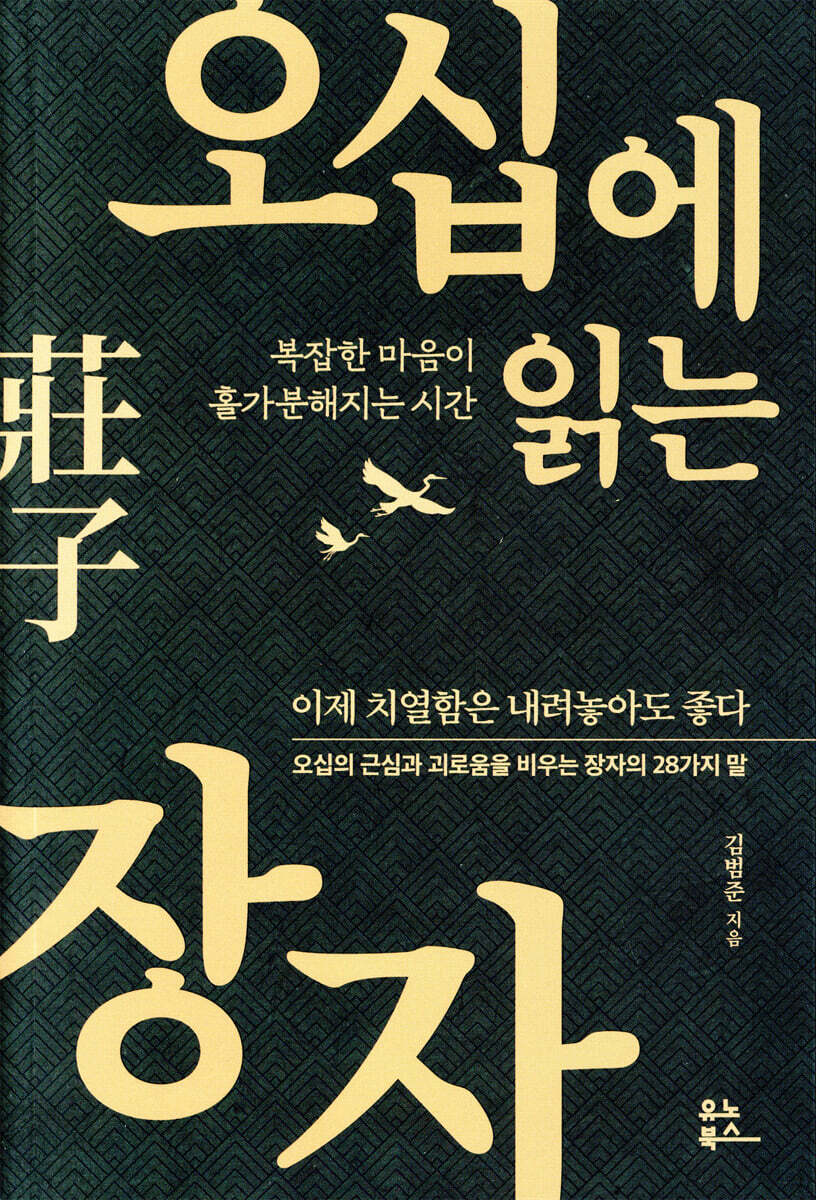
Reading Zhuangzi at Fifty
 |
Description
Book Introduction
- A word from MD
-
Wisdom imparted by Zhangzi in the middle of lifeIn an era where lifetime employment has disappeared, retiring in your 50s is no longer considered early retirement.
But that doesn't mean it's the end of life.
Your 50s are a great time to break away from your previous job and position and start anew.
From 『Zhuangzi』, who pursued freedom and peace, we learn wisdom on how to live the second half of life with ease.
May 6, 2022. Humanities PD Son Min-gyu
Now you can put down the intensity
28 sayings of Zhuangzi that will empty the worries and sufferings of fifty.
Fifty, halfway through my life, I've worked tirelessly for my family, money, and fame. But how well have I actually taken care of myself? My efforts to live well have only led to more worries and anxieties, so the depression and anxiety felt at fifty are only natural.
Jang-ja tells these fifty to put down their fierceness now.
Because if you realize the wisdom of 'emptiness', you can begin the second act of a comfortable and satisfying life.
If you read Zhuangzi, you can learn the secret to living a carefree life without being tied down by anything.
There was a tree named Hyeja that was large but so bumpy that even the carpenter did not pay attention to it.
Hyeja was worried that her tree was useless, but Jangja said that since the tree would not harm anyone and would not be cut down by an axe, why not just lie down in the shade of the tree and enjoy a nap?
What this story means is that there is no need to suffer because there is no pain and comfort because it is useless.
The same goes for our lives.
Rather than debating your own usefulness or obsessing over success, you can start a new life by finding meaning in life through the process.
《Reading Zhuangzi at Fifty》 is a book that contains 28 stories necessary for people in their fifties, carefully selected from the 'Naepyeon', which is said to have been written by Zhuangzi himself.
Thus, we can learn from Zhuangzi, the philosopher of life who transcended life and death 2,500 years ago, how to contemplate the great beauty of nature and enjoy freedom.
Jangja did not judge right and wrong, and accepted others and the world as they were.
This is an attitude that is especially guiding for those in their fifties, who are physically and mentally exhausted.
From now on, I must be able to look at myself as I am, accept myself, and enjoy each day.
The book presents five values that one must have to live a leisurely middle-aged life.
Freedom instead of greed, preparation instead of regret, reflection instead of loneliness, learning instead of emptiness, and vitality instead of giving up.
Therefore, if you keep these five values in mind when you feel negative emotions, your worries and concerns will disappear, and you can start the second half of your life with a comfortable and positive mind.
The story of Jangja will provide comfort to those in their fifties, saying, “You’ve come a long way.”
You yourself know best how difficult life has been, competing and struggling.
To those in their fifties who feel burdened and exhausted from sacrificing themselves due to excessive responsibility, I hope that while you read this book, you can empty your mind of the suffering that lingers in your heart and find peace in your life.
28 sayings of Zhuangzi that will empty the worries and sufferings of fifty.
Fifty, halfway through my life, I've worked tirelessly for my family, money, and fame. But how well have I actually taken care of myself? My efforts to live well have only led to more worries and anxieties, so the depression and anxiety felt at fifty are only natural.
Jang-ja tells these fifty to put down their fierceness now.
Because if you realize the wisdom of 'emptiness', you can begin the second act of a comfortable and satisfying life.
If you read Zhuangzi, you can learn the secret to living a carefree life without being tied down by anything.
There was a tree named Hyeja that was large but so bumpy that even the carpenter did not pay attention to it.
Hyeja was worried that her tree was useless, but Jangja said that since the tree would not harm anyone and would not be cut down by an axe, why not just lie down in the shade of the tree and enjoy a nap?
What this story means is that there is no need to suffer because there is no pain and comfort because it is useless.
The same goes for our lives.
Rather than debating your own usefulness or obsessing over success, you can start a new life by finding meaning in life through the process.
《Reading Zhuangzi at Fifty》 is a book that contains 28 stories necessary for people in their fifties, carefully selected from the 'Naepyeon', which is said to have been written by Zhuangzi himself.
Thus, we can learn from Zhuangzi, the philosopher of life who transcended life and death 2,500 years ago, how to contemplate the great beauty of nature and enjoy freedom.
Jangja did not judge right and wrong, and accepted others and the world as they were.
This is an attitude that is especially guiding for those in their fifties, who are physically and mentally exhausted.
From now on, I must be able to look at myself as I am, accept myself, and enjoy each day.
The book presents five values that one must have to live a leisurely middle-aged life.
Freedom instead of greed, preparation instead of regret, reflection instead of loneliness, learning instead of emptiness, and vitality instead of giving up.
Therefore, if you keep these five values in mind when you feel negative emotions, your worries and concerns will disappear, and you can start the second half of your life with a comfortable and positive mind.
The story of Jangja will provide comfort to those in their fifties, saying, “You’ve come a long way.”
You yourself know best how difficult life has been, competing and struggling.
To those in their fifties who feel burdened and exhausted from sacrificing themselves due to excessive responsibility, I hope that while you read this book, you can empty your mind of the suffering that lingers in your heart and find peace in your life.
- You can preview some of the book's contents.
Preview
index
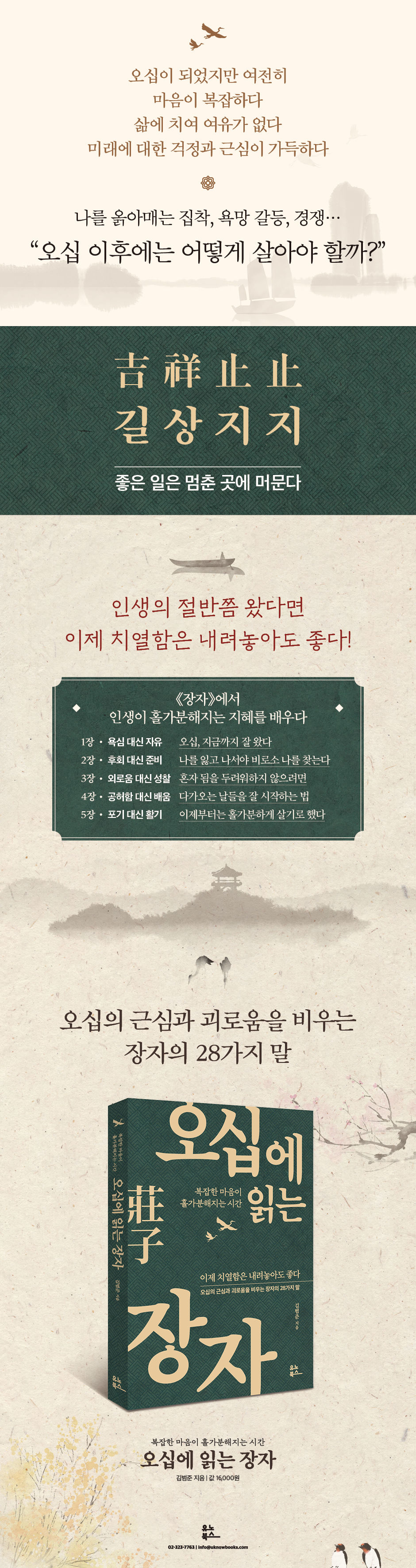
Entering | Reading Zhuangzi and Regaining the Leisure of Fifty
Chapter 1: Freedom Instead of Greed / Fifty, You've Come So Far
How long will you torment yourself by being tied down by your name?
The courage to let go of uselessness and responsibility
The trap of trivialities that turns an ordinary day into hell
If you just keep the middle ground, everything will be peaceful.
The mind must be clear and the spirit broad.
Chapter 2: Preparation Instead of Regret / Only After Losing Myself Can I Find Myself
From the age of fifty, you must let go of your past self.
Things you get naturally when you don't judge hastily
Don't see what you don't need to see
It is better to do nothing bad than to do something great.
Finding things to learn from juniors, the underprivileged, and children
He who can say he does not know is wise.
A catastrophe that occurred because we couldn't just leave it alone
Chapter 3: Reflection Instead of Loneliness / How to Stop Being Afraid of Being Alone
We can all become adults
Even a mature gentleman is nothing more than a nuisance to a fish.
When you reach the age of fifty, you must take responsibility for your own wisdom.
The desire to be known shakes virtue.
If you listen, talk, but if you don't listen, don't be upset.
Don't correct, don't advise, don't step forward
If you have a brilliant firework, you also need the courage to wither beautifully.
Chapter 4: Learning Instead of Emptiness / How to Start the Coming Days Well
There is a time for everything
Don't waste your energy judging right and wrong.
Good words become lies when taken to excess.
If you want to be a respected adult, just exist.
The first thing I do when I turn 50 is to cook for my loved ones.
Chapter 5: Vitality Instead of Giving Up / From Now On, I Decided to Live Carefreely
The work of life is something that begins when you turn fifty.
Empty to fill with better things
The courage to boldly break away from obsession
Don't get stuck in the past and live your life after 50.
Going Out | The Wisdom of Zhuangzi That Made Life More Comfortable
Appendix | A Line from Zhuangzi to Remember at Fifty
Chapter 1: Freedom Instead of Greed / Fifty, You've Come So Far
How long will you torment yourself by being tied down by your name?
The courage to let go of uselessness and responsibility
The trap of trivialities that turns an ordinary day into hell
If you just keep the middle ground, everything will be peaceful.
The mind must be clear and the spirit broad.
Chapter 2: Preparation Instead of Regret / Only After Losing Myself Can I Find Myself
From the age of fifty, you must let go of your past self.
Things you get naturally when you don't judge hastily
Don't see what you don't need to see
It is better to do nothing bad than to do something great.
Finding things to learn from juniors, the underprivileged, and children
He who can say he does not know is wise.
A catastrophe that occurred because we couldn't just leave it alone
Chapter 3: Reflection Instead of Loneliness / How to Stop Being Afraid of Being Alone
We can all become adults
Even a mature gentleman is nothing more than a nuisance to a fish.
When you reach the age of fifty, you must take responsibility for your own wisdom.
The desire to be known shakes virtue.
If you listen, talk, but if you don't listen, don't be upset.
Don't correct, don't advise, don't step forward
If you have a brilliant firework, you also need the courage to wither beautifully.
Chapter 4: Learning Instead of Emptiness / How to Start the Coming Days Well
There is a time for everything
Don't waste your energy judging right and wrong.
Good words become lies when taken to excess.
If you want to be a respected adult, just exist.
The first thing I do when I turn 50 is to cook for my loved ones.
Chapter 5: Vitality Instead of Giving Up / From Now On, I Decided to Live Carefreely
The work of life is something that begins when you turn fifty.
Empty to fill with better things
The courage to boldly break away from obsession
Don't get stuck in the past and live your life after 50.
Going Out | The Wisdom of Zhuangzi That Made Life More Comfortable
Appendix | A Line from Zhuangzi to Remember at Fifty
Detailed image
Into the book
If necessary, now actively affirm the uselessness and the boredom.
It may not solve the problem of making a living, but sometimes unproductive time is necessary.
I'm not saying that we should blindly admit that it's useless.
I just want to tell you that we absolutely need time to let go of our uselessness and responsibilities and look at ourselves as we are.
---From "The Courage to Let Go of Usefulness and Responsibility"
According to Zhuangzi, a sage, instead of judging right and wrong, sees and follows everything in the light of the laws of heaven.
I think the law of heaven is naturalness.
It is an attitude of acceptance that does not judge right and wrong, but accepts others, myself, and the world as they are.
This is the reason why you should break up with the cruelty of picking on the person you love.
---From "The Trap of Trivialities That Turn an Ordinary Day into Hell"
Only after I have emptied myself, only after I have lost myself, can I face the world.
We must empty ourselves of the stuffy, stifling, and extremely worldly thoughts of authority, fame, and money that we have accumulated so far.
Only then are we ready to meet someone else, and the sound created through such an encounter can be called a beautiful sound.
---From "From the age of fifty, you must abandon your past self"
What Zhang Zi considered most important was freedom and liberation in life.
Zhuangzi's idea was that freedom and liberation come when we transcend right and wrong and realize our existence as it is.
However, this does not mean that only individual freedom is emphasized.
Because Zhuangzi said that the reason we must be free is to relate to the world.
The heart of relationships is doing good to others.
The main point of content in the “Deokchungbu” section of the “Zhuangzi” is also about this.
---From "Don't See What You Don't Need to See"
Ignorance is not the pursuit of knowledge, but respect for ignorance.
However, this does not mean that left-wing is passive fatalism.
If fatalism is a passive acceptance of fate, one that does not change or take responsibility for oneself under the pretext of leaving everything to heaven, then Zhuangzi's sense of hope can be said to be an active and proactive acceptance of life.
Rather than blaming someone for what has already happened, it encompasses the meaning of recognizing it as the will of heaven, accepting what can be accepted, and learning what can be learned.
---From "Finding Things to Learn from Juniors, the Underprivileged, and Children"
Zhuangzi says that an attitude of learning with an open mind is far more important than the endless pursuit of knowledge.
The reason may lie in the finiteness of life.
The blind pursuit of knowledge in a world without end is a burdensome struggle for humans who live in the moment.
If you ignore what you really need to know and live with the narrow-minded mindset that you already know, your life will inevitably regress.
---From "When you reach the age of fifty, you must take responsibility for your own wisdom"
If you're in your fifties, you can go where the wind blows.
It's not a bad idea to live 'like those powerful salmon swimming upstream'.
But at fifty, you have to know how to ride the wind.
When the opportunity comes and the wind blows, you have to be able to surrender to it.
Rather than complaining about the wind being cold or hot, it is better to accept the wind as it is and be comfortable with it.
---From "There is a time for everything"
There is no right or wrong in this world, only differences in opinion.
Reconcile with me and the other party.
Accepting differences is a life tool that you need to equip yourself with right now, and it will help you fully enjoy life after fifty.
What is needed for this is zero base.
In the words of Zhangzi, it is called 'emptiness'.
---From "If you want to be a respected adult, just exist"
Happiness is ultimately about me.
To be precise, it's a question of what kind of relationship I have with the things that surround me.
That includes dealing with idle time.
We believe that we have never had a proper lazy time since we became iron-skinned.
So, even when I turn 50 and am given time, I am anxious and don't know what to do.
It is simply a matter of personal choice whether to be lazy or appropriately busy.
But what you do at this time is important.
If you're still only interested in other people's stories without telling your own, you're wasting your time.
---From "The first thing I do when I turn 50 is to cook for my loved ones"
Zhuangzi says, 'Good fortune stops when it's good.'
Good things stay where they are.
One could interpret this as saying that happiness resides in empty places.
If you are not satisfied, shameful things will happen, and if you do not stop, dangerous things will happen.
It means that only when you know how to be satisfied and stop can good things begin to pile up.
This is why ‘Jiji (止止)’, which is putting the stop into action, is as important as ‘Jiji (知止)’, which is knowing when to stop.
It may not solve the problem of making a living, but sometimes unproductive time is necessary.
I'm not saying that we should blindly admit that it's useless.
I just want to tell you that we absolutely need time to let go of our uselessness and responsibilities and look at ourselves as we are.
---From "The Courage to Let Go of Usefulness and Responsibility"
According to Zhuangzi, a sage, instead of judging right and wrong, sees and follows everything in the light of the laws of heaven.
I think the law of heaven is naturalness.
It is an attitude of acceptance that does not judge right and wrong, but accepts others, myself, and the world as they are.
This is the reason why you should break up with the cruelty of picking on the person you love.
---From "The Trap of Trivialities That Turn an Ordinary Day into Hell"
Only after I have emptied myself, only after I have lost myself, can I face the world.
We must empty ourselves of the stuffy, stifling, and extremely worldly thoughts of authority, fame, and money that we have accumulated so far.
Only then are we ready to meet someone else, and the sound created through such an encounter can be called a beautiful sound.
---From "From the age of fifty, you must abandon your past self"
What Zhang Zi considered most important was freedom and liberation in life.
Zhuangzi's idea was that freedom and liberation come when we transcend right and wrong and realize our existence as it is.
However, this does not mean that only individual freedom is emphasized.
Because Zhuangzi said that the reason we must be free is to relate to the world.
The heart of relationships is doing good to others.
The main point of content in the “Deokchungbu” section of the “Zhuangzi” is also about this.
---From "Don't See What You Don't Need to See"
Ignorance is not the pursuit of knowledge, but respect for ignorance.
However, this does not mean that left-wing is passive fatalism.
If fatalism is a passive acceptance of fate, one that does not change or take responsibility for oneself under the pretext of leaving everything to heaven, then Zhuangzi's sense of hope can be said to be an active and proactive acceptance of life.
Rather than blaming someone for what has already happened, it encompasses the meaning of recognizing it as the will of heaven, accepting what can be accepted, and learning what can be learned.
---From "Finding Things to Learn from Juniors, the Underprivileged, and Children"
Zhuangzi says that an attitude of learning with an open mind is far more important than the endless pursuit of knowledge.
The reason may lie in the finiteness of life.
The blind pursuit of knowledge in a world without end is a burdensome struggle for humans who live in the moment.
If you ignore what you really need to know and live with the narrow-minded mindset that you already know, your life will inevitably regress.
---From "When you reach the age of fifty, you must take responsibility for your own wisdom"
If you're in your fifties, you can go where the wind blows.
It's not a bad idea to live 'like those powerful salmon swimming upstream'.
But at fifty, you have to know how to ride the wind.
When the opportunity comes and the wind blows, you have to be able to surrender to it.
Rather than complaining about the wind being cold or hot, it is better to accept the wind as it is and be comfortable with it.
---From "There is a time for everything"
There is no right or wrong in this world, only differences in opinion.
Reconcile with me and the other party.
Accepting differences is a life tool that you need to equip yourself with right now, and it will help you fully enjoy life after fifty.
What is needed for this is zero base.
In the words of Zhangzi, it is called 'emptiness'.
---From "If you want to be a respected adult, just exist"
Happiness is ultimately about me.
To be precise, it's a question of what kind of relationship I have with the things that surround me.
That includes dealing with idle time.
We believe that we have never had a proper lazy time since we became iron-skinned.
So, even when I turn 50 and am given time, I am anxious and don't know what to do.
It is simply a matter of personal choice whether to be lazy or appropriately busy.
But what you do at this time is important.
If you're still only interested in other people's stories without telling your own, you're wasting your time.
---From "The first thing I do when I turn 50 is to cook for my loved ones"
Zhuangzi says, 'Good fortune stops when it's good.'
Good things stay where they are.
One could interpret this as saying that happiness resides in empty places.
If you are not satisfied, shameful things will happen, and if you do not stop, dangerous things will happen.
It means that only when you know how to be satisfied and stop can good things begin to pile up.
This is why ‘Jiji (止止)’, which is putting the stop into action, is as important as ‘Jiji (知止)’, which is knowing when to stop.
---From "Emptying to Fill with Better Things"
Publisher's Review
To the fifty-year-old who is full of worries
The wisdom of 'emptiness' as told by Jangja
It is said that when you reach the age of fifty, you will realize the will of heaven.
I really wish that were true, but in reality, life at fifty is difficult to even find meaning in.
My body aches here and there, and my mind is filled with worries about my family and old age.
The desire to live well has turned into greed and is now tormenting me.
Reading Zhuangzi at fifty is truly a necessary thing.
Zhuangzi is a philosopher who inherited the Taoist philosophy that emerged to overcome the chaos of the Spring and Autumn Period and the Warring States Period.
He valued freedom and liberation, and spread the message of living positively by accepting one's true self rather than obsessing over trivial matters.
This is a much-needed guideline for those in their fifties who have struggled for success and sacrificed themselves for their families and country.
Zhuangzi tells Fifty to look at the world as an 'empty boat'.
If you collide with an empty boat, you won't get angry, but if there are people on board, you will.
So if I live emptying myself, nothing in the world can harm me.
Jang-ja tells the fifty-year-old who has lived a fierce life that it is now time to look at himself rather than others and enjoy each day.
We are past the time when discipline, logic, wealth and fame were important, and now it is time to enjoy life freely.
Don't get stuck in the past
Living life after fifty
A pheasant living in a pond must walk quickly to get food and water.
On the other hand, a pheasant trapped in a cage can turn its head and find food and clean water all around it.
So, would a pheasant want to live in a cage? According to Zhuangzi, no pheasant wants to be raised in a cage, no matter how comfortable it may be.
Even though food may be easy to obtain, life is bound to become listless if we are not free.
Fifty, I've been running tirelessly to live well, but it's time to check how much I've taken care of myself.
Have I been confined not only by physical spaces like the workplace, but also by cages like wealth, fame, and the past? Especially if I waste time dwelling on regrets and regrets of the past, life after fifty will never be free.
Zhuangzi tells these fifty-year-olds that if they surrender themselves to the world and follow the changes, they can become one with heaven.
A truly good life is one in which you are free from the worries of the world and enjoy a life of leisure.
Now, rather than debating our own usefulness, we must realize the value of a life free from pain, and learn the wisdom of Zhuangzi, which enjoys quiet freedom rather than noisy success.
Fifty, put down the intensity
To a carefree life
It is more important to live with a carefree mind than to prove yourself through social status.
How empty would life be if, with half of my life remaining, I still had to refer to myself through business cards? "A name is merely a shadow of what truly exists, and only when we are free from attachment to names do we truly find freedom," said Zhuangzi.
This is the attitude needed for a person in their fifties to truly stand on their own two feet.
Zhuangzi warns against a life that cannot be stopped.
It is said that if you don't stop where you should, your mind will still be running even if your body is sitting.
This is called 'Zuochi', and Zhuangzi says to overcome Zuochi and live a carefree life by 'Zuo Mang'.
Zwamang means that if you do not listen with your ears, do not look with your eyes, but listen and look with your heart and empty yourself, you will become one with the great Tao.
The reason why we must put aside our fierceness and practice meditation is because we must empty our complicated minds.
The reason it needs to be emptied is to be filled with something better.
So, the story that Jangja tells seems to be a consolation to Fifty, who has been running without rest, telling him that it is now okay to live happily.
After fifty, why not read the story of Zhuangzi and enjoy life with a carefree mind, free from the obsessions, desires, conflicts, and competition that bind you?
The wisdom of 'emptiness' as told by Jangja
It is said that when you reach the age of fifty, you will realize the will of heaven.
I really wish that were true, but in reality, life at fifty is difficult to even find meaning in.
My body aches here and there, and my mind is filled with worries about my family and old age.
The desire to live well has turned into greed and is now tormenting me.
Reading Zhuangzi at fifty is truly a necessary thing.
Zhuangzi is a philosopher who inherited the Taoist philosophy that emerged to overcome the chaos of the Spring and Autumn Period and the Warring States Period.
He valued freedom and liberation, and spread the message of living positively by accepting one's true self rather than obsessing over trivial matters.
This is a much-needed guideline for those in their fifties who have struggled for success and sacrificed themselves for their families and country.
Zhuangzi tells Fifty to look at the world as an 'empty boat'.
If you collide with an empty boat, you won't get angry, but if there are people on board, you will.
So if I live emptying myself, nothing in the world can harm me.
Jang-ja tells the fifty-year-old who has lived a fierce life that it is now time to look at himself rather than others and enjoy each day.
We are past the time when discipline, logic, wealth and fame were important, and now it is time to enjoy life freely.
Don't get stuck in the past
Living life after fifty
A pheasant living in a pond must walk quickly to get food and water.
On the other hand, a pheasant trapped in a cage can turn its head and find food and clean water all around it.
So, would a pheasant want to live in a cage? According to Zhuangzi, no pheasant wants to be raised in a cage, no matter how comfortable it may be.
Even though food may be easy to obtain, life is bound to become listless if we are not free.
Fifty, I've been running tirelessly to live well, but it's time to check how much I've taken care of myself.
Have I been confined not only by physical spaces like the workplace, but also by cages like wealth, fame, and the past? Especially if I waste time dwelling on regrets and regrets of the past, life after fifty will never be free.
Zhuangzi tells these fifty-year-olds that if they surrender themselves to the world and follow the changes, they can become one with heaven.
A truly good life is one in which you are free from the worries of the world and enjoy a life of leisure.
Now, rather than debating our own usefulness, we must realize the value of a life free from pain, and learn the wisdom of Zhuangzi, which enjoys quiet freedom rather than noisy success.
Fifty, put down the intensity
To a carefree life
It is more important to live with a carefree mind than to prove yourself through social status.
How empty would life be if, with half of my life remaining, I still had to refer to myself through business cards? "A name is merely a shadow of what truly exists, and only when we are free from attachment to names do we truly find freedom," said Zhuangzi.
This is the attitude needed for a person in their fifties to truly stand on their own two feet.
Zhuangzi warns against a life that cannot be stopped.
It is said that if you don't stop where you should, your mind will still be running even if your body is sitting.
This is called 'Zuochi', and Zhuangzi says to overcome Zuochi and live a carefree life by 'Zuo Mang'.
Zwamang means that if you do not listen with your ears, do not look with your eyes, but listen and look with your heart and empty yourself, you will become one with the great Tao.
The reason why we must put aside our fierceness and practice meditation is because we must empty our complicated minds.
The reason it needs to be emptied is to be filled with something better.
So, the story that Jangja tells seems to be a consolation to Fifty, who has been running without rest, telling him that it is now okay to live happily.
After fifty, why not read the story of Zhuangzi and enjoy life with a carefree mind, free from the obsessions, desires, conflicts, and competition that bind you?
GOODS SPECIFICS
- Publication date: April 28, 2022
- Page count, weight, size: 288 pages | 414g | 142*210*20mm
- ISBN13: 9791192300092
- ISBN10: 1192300092
You may also like
카테고리
korean


korean

![GQ KOREA Mark (Monthly): December [2025]](http://librairie.coreenne.fr/cdn/shop/files/8ef265dbbfbf186523ed75ba7319009d.jpg?v=1765340328&width=3840)


