

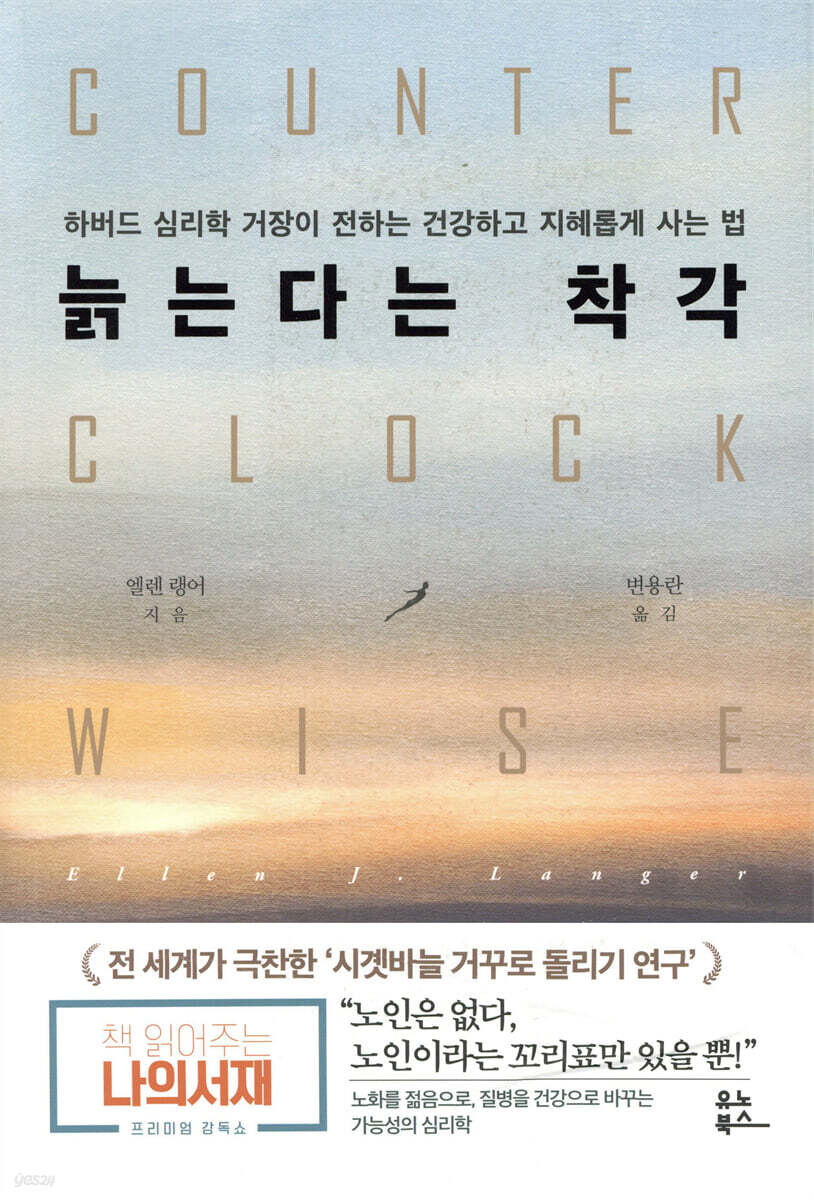
The illusion of growing old
 |
Description
Book Introduction
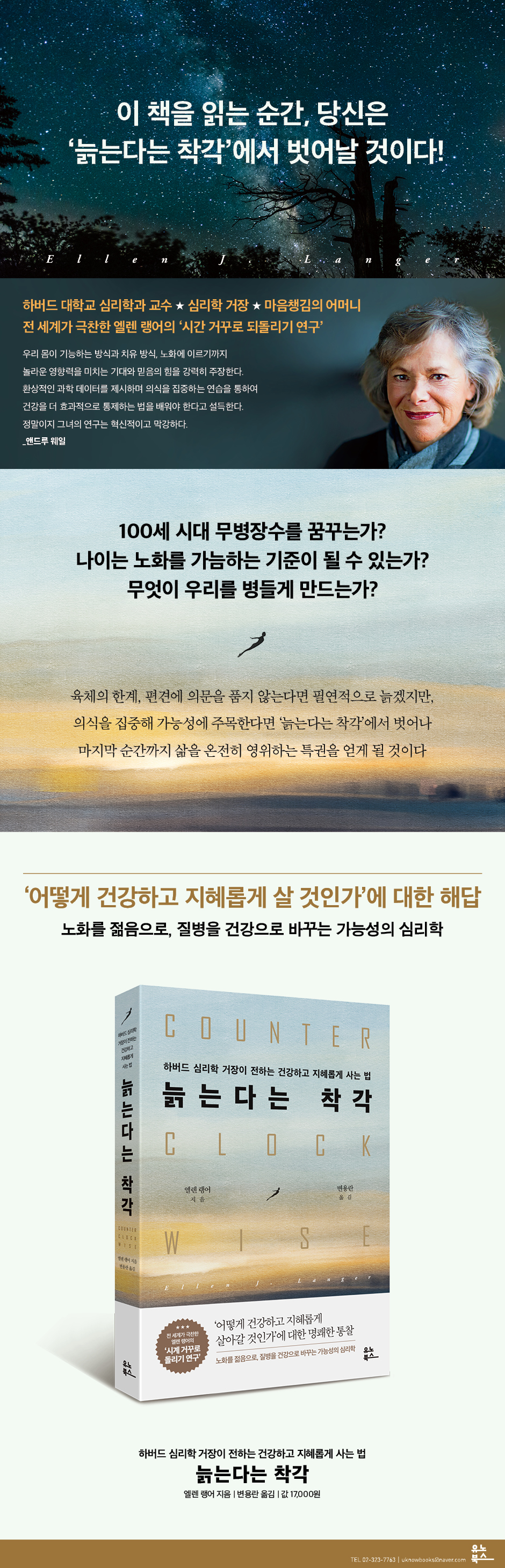
On a life focused on possibilities, not aging The psychology of the possibility of turning aging into youth and disease into health. There are many elderly people who are healthy and well regardless of their age. There are people who look like they are in their 20s but are actually in their 30s or 40s. There is a gap between the commonly perceived concept of age and its actual appearance. Some people live younger than their age, while others live older than their age. Where does this difference come from? We can find the answer in Dr. Ellen Langer's 'Clock Turning Back' study, which has been praised worldwide. Langer, a professor of psychology at Harvard University, focused on the psychology of possibility by asking people, "How can we live healthy and wise lives?" They brought in a group of elderly people in their late 70s and early 80s to a secluded monastery where the surroundings had been turned back 20 years and asked them to act as young as they had 20 years ago for a week. Surprisingly, the elderly people who had difficulty carrying their own luggage showed a noticeable improvement in their vitality after a week, and their physical functions also clearly improved. This book questions the connection between body, mind, and aging, and emphasizes 'focusing consciousness.' Rather than accepting the situation as it is, I encourage you to focus your consciousness and ask, "Why can't it be?" rather than "How is that possible?" and to live proactively, recognizing that change is possible with determination, rather than accepting the limitations of aging and the body. Uncertainty exists everywhere. The medical community bases many decisions on science, but scientific research is not a definitive truth; it is a constant search for a better truth. Therefore, we must take responsibility for ourselves and continue to observe our body's changes and communicate with our healthcare providers in a non-confrontational manner. Prejudice against older people is unconscious and social. Old people are often thought to be forgetful, slow-moving, and stubborn, but humans only remember what they want to remember, and slow-moving people exist in all age groups, and stubbornness is common in children, young adults, and middle-aged people. There is a saying that the 100-year lifespan is not a blessing but a curse. This is because of the idea that aging is a disease. But if the idea that we grow old over time is merely an illusion, then we might as well stake our lives on the possibility. Dr. Langer's delightful practical experiments into possibility will take you back in time 10 or 20 years. |
- You can preview some of the book's contents.
Preview
index
Author's Note
Chapter 1: People Who Got 20 Years Younger | Turning Back the Clock
A natural thing that happens as you get older
Best guesses for the 'majority'
The Psychology of Possibility Where Impossibility Doesn't Matter
Chapter 2: On Healthy Living | Regaining Control
'Social Clock' and 'The Right Age'
Everyone can take control of their health
Why doesn't anyone question the doctor's diagnosis?
Observe your body's changes and diagnose yourself.
Chapter 3: Everything Changes | Paying Attention to Change
Knowing the conditions allows you to recognize change.
A journey of a thousand miles begins with a single step
A human being who thinks as he wants to believe
Just by paying attention to variability,
The illusion of stability
We must fight and win against instability.
Chapter 4: What Makes Us Sick | Letting Go of Stereotypes
Is it all because of age?
Things that make us fat
Humans are too complex to be neatly categorized.
Why don't you delude yourself into thinking things will get better?
If you keep getting closer to the average,
Several symptoms that provide clues to the disease
The 'hidden decisions' of doctors unknown to others
A name tag attached without thinking and a decision made with concentrated consciousness
Are you healthy or sick?
Chapter 5: The Right to Live Fully, Even if It's Just One Day | Redesigning Your Environment
The need to reorganize medical principles
Are you living in an overly protected environment?
Paying attention beyond one's role
Chapter 6: Words Rule the Mind | Using Proper Language
It doesn't have to be conveyed in clear words.
The priming effect and the placebo effect
With minimal consciousness and movement
Chapter 7: How Much Should We Accept as Fact? | Beware of Name Tags and Numbers
Is it 'alleviated' or 'cured'?
The lethality of name tags on life
Numbers are just tools
Signals that are conveyed without speaking
Chapter 8: Perhaps the Most Irresponsible People | Recognizing the Limitations of Experts
Problems arise even without obvious mistakes.
Keep asking questions in a non-confrontational way
Chapter 9: The Illusion of Growing Old | How to Age Wisely
Unconscious biases about aging
Meaningless and meaningful memories
Aging or degeneration?
Unconscious life in a shelter
To avoid being overwhelmed by negative stereotypes
The past and present cannot be compared.
Pay attention to the world and your surroundings
How to deal with 'them' now
Chapter 10: A Healthy Person Until the End | Learning About Health
A life free from illusions
Look to life, not death
Living with focused consciousness
Personal relationships heal us.
Open mind toward possibility
Acknowledgements
annotation
Recommended Reading
Translator's Note
Chapter 1: People Who Got 20 Years Younger | Turning Back the Clock
A natural thing that happens as you get older
Best guesses for the 'majority'
The Psychology of Possibility Where Impossibility Doesn't Matter
Chapter 2: On Healthy Living | Regaining Control
'Social Clock' and 'The Right Age'
Everyone can take control of their health
Why doesn't anyone question the doctor's diagnosis?
Observe your body's changes and diagnose yourself.
Chapter 3: Everything Changes | Paying Attention to Change
Knowing the conditions allows you to recognize change.
A journey of a thousand miles begins with a single step
A human being who thinks as he wants to believe
Just by paying attention to variability,
The illusion of stability
We must fight and win against instability.
Chapter 4: What Makes Us Sick | Letting Go of Stereotypes
Is it all because of age?
Things that make us fat
Humans are too complex to be neatly categorized.
Why don't you delude yourself into thinking things will get better?
If you keep getting closer to the average,
Several symptoms that provide clues to the disease
The 'hidden decisions' of doctors unknown to others
A name tag attached without thinking and a decision made with concentrated consciousness
Are you healthy or sick?
Chapter 5: The Right to Live Fully, Even if It's Just One Day | Redesigning Your Environment
The need to reorganize medical principles
Are you living in an overly protected environment?
Paying attention beyond one's role
Chapter 6: Words Rule the Mind | Using Proper Language
It doesn't have to be conveyed in clear words.
The priming effect and the placebo effect
With minimal consciousness and movement
Chapter 7: How Much Should We Accept as Fact? | Beware of Name Tags and Numbers
Is it 'alleviated' or 'cured'?
The lethality of name tags on life
Numbers are just tools
Signals that are conveyed without speaking
Chapter 8: Perhaps the Most Irresponsible People | Recognizing the Limitations of Experts
Problems arise even without obvious mistakes.
Keep asking questions in a non-confrontational way
Chapter 9: The Illusion of Growing Old | How to Age Wisely
Unconscious biases about aging
Meaningless and meaningful memories
Aging or degeneration?
Unconscious life in a shelter
To avoid being overwhelmed by negative stereotypes
The past and present cannot be compared.
Pay attention to the world and your surroundings
How to deal with 'them' now
Chapter 10: A Healthy Person Until the End | Learning About Health
A life free from illusions
Look to life, not death
Living with focused consciousness
Personal relationships heal us.
Open mind toward possibility
Acknowledgements
annotation
Recommended Reading
Translator's Note
Detailed image
Into the book
There is no way to turn back time.
As time goes by and we age, the vitality of youth gradually becomes a memory.
When chronic illness eats away at our health and energy, the best we can do is to accept our fate gracefully.
When illness strikes, we rely on modern medicine and try to hold onto hope until the very end, but we cannot stop the march of time.
No, but is it really impossible?
---From "Natural Things That Happen When You Get Old"
If I had not questioned what was possible, I would never have attempted to turn back the clock and witnessed the transformative power of the human mind.
---From "The Psychology of Possibility Without Impossibility"
If everything is certain, then choice is impossible.
Because if there is no doubt, there is no choice.
When you are confident, you cannot see the uncertainty of the world, whether you are aware of it or not.
But if we care about our health, we must be willing to embrace uncertainty.
Then you are rewarded with the opportunity to choose and take control of your life.
---From "Everyone Can Control Their Health"
People tend to assume that the present state is inevitable, but if there is always a tiny step we can take toward our goal, the limitations we often assume are merely self-created or culturally constructed.
---From "A journey of a thousand miles begins with a single step"
Are you tempted to blindly follow medical advice? Realizing the incompleteness of the data it relies on will make it less tempting.
All health assessment tools are man-made.
Of course it's not perfect.
Additionally, the science used to evaluate tools is probability-based.
While such diagnostic tools may successfully predict the health of a given population, none of us are "us."
---From "Things That Make Us Fat"
If we learn to 'cope' with the changes associated with aging, we will be better able to adapt to our own aging.
Conversely, if we assume that many problems are inevitable consequences of aging and that nothing can be done about them, we won't invest time or energy in finding ways to reduce or reverse them.
---From "Are you living in an overprotected state?"
But we must choose our language very carefully, because we can understand the context.
Especially when our health is at stake.
We can choose whether to view our condition as amelioration or a cure, and whether to call alcohol dependence an allergy or a disease.
We can label the situations we find ourselves in.
---From "Is it 'alleviated' or 'cured'?"
Studying our bodies with an eye to variability can provide us with even more useful information about our health.
By recognizing the limitations of a physician's knowledge, we become more convinced of the importance of information sharing.
We act as health learners, fully taking stock of our own health so we can better collaborate with professionals.
As we become experts in our own health, doctors will become our advisors.
---From "Continue to Ask Questions in a Non-Confrontational Way"
Because of the societal environment and the mindless internalization of prejudice, the 80-year-old tennis player has learned that his game is not developing and he is aging, so the idea of playing with new techniques never even crosses his mind.
Because we perceive the differences between young and old as a decline, we are unlikely to find a way for older people to 'change the game'.
---From "Aging or Degeneration?"
This book describes the journey we can each choose, and attempts to convey how far we have fallen from the better life we should have lived, and how we can safely and consciously return to it.
We also suggest that you collect and respect personal information that only you have access to, and that medical information be used as a guideline rather than as absolute truth.
As time goes by and we age, the vitality of youth gradually becomes a memory.
When chronic illness eats away at our health and energy, the best we can do is to accept our fate gracefully.
When illness strikes, we rely on modern medicine and try to hold onto hope until the very end, but we cannot stop the march of time.
No, but is it really impossible?
---From "Natural Things That Happen When You Get Old"
If I had not questioned what was possible, I would never have attempted to turn back the clock and witnessed the transformative power of the human mind.
---From "The Psychology of Possibility Without Impossibility"
If everything is certain, then choice is impossible.
Because if there is no doubt, there is no choice.
When you are confident, you cannot see the uncertainty of the world, whether you are aware of it or not.
But if we care about our health, we must be willing to embrace uncertainty.
Then you are rewarded with the opportunity to choose and take control of your life.
---From "Everyone Can Control Their Health"
People tend to assume that the present state is inevitable, but if there is always a tiny step we can take toward our goal, the limitations we often assume are merely self-created or culturally constructed.
---From "A journey of a thousand miles begins with a single step"
Are you tempted to blindly follow medical advice? Realizing the incompleteness of the data it relies on will make it less tempting.
All health assessment tools are man-made.
Of course it's not perfect.
Additionally, the science used to evaluate tools is probability-based.
While such diagnostic tools may successfully predict the health of a given population, none of us are "us."
---From "Things That Make Us Fat"
If we learn to 'cope' with the changes associated with aging, we will be better able to adapt to our own aging.
Conversely, if we assume that many problems are inevitable consequences of aging and that nothing can be done about them, we won't invest time or energy in finding ways to reduce or reverse them.
---From "Are you living in an overprotected state?"
But we must choose our language very carefully, because we can understand the context.
Especially when our health is at stake.
We can choose whether to view our condition as amelioration or a cure, and whether to call alcohol dependence an allergy or a disease.
We can label the situations we find ourselves in.
---From "Is it 'alleviated' or 'cured'?"
Studying our bodies with an eye to variability can provide us with even more useful information about our health.
By recognizing the limitations of a physician's knowledge, we become more convinced of the importance of information sharing.
We act as health learners, fully taking stock of our own health so we can better collaborate with professionals.
As we become experts in our own health, doctors will become our advisors.
---From "Continue to Ask Questions in a Non-Confrontational Way"
Because of the societal environment and the mindless internalization of prejudice, the 80-year-old tennis player has learned that his game is not developing and he is aging, so the idea of playing with new techniques never even crosses his mind.
Because we perceive the differences between young and old as a decline, we are unlikely to find a way for older people to 'change the game'.
---From "Aging or Degeneration?"
This book describes the journey we can each choose, and attempts to convey how far we have fallen from the better life we should have lived, and how we can safely and consciously return to it.
We also suggest that you collect and respect personal information that only you have access to, and that medical information be used as a guideline rather than as absolute truth.
---From "An Open Mind Towards Possibilities"
Publisher's Review
Clear insights on 'How to live healthy and wisely'!
The desire to live a long and healthy life is a lifelong wish of every human being.
If you can maintain your youth, that would be great.
But contrary to expectations, each year we grow a year older, and we face a life where aging and disease are accepted as our fate.
We try to keep hope alive by relying on modern medicine, but there is no way to stop the march of time.
But is it really impossible?
Psychology guru and Harvard professor Ellen Langer questions this stereotype.
In fact, you can't turn back time.
But Langer says that if we understand the psychology of possibility, we can easily turn disease into health and aging into youth.
It means that there are endless opportunities to live independently and break free from the illusion of growing old.
The 'time-turning-back' study, which has received rave reviews worldwide, proves this.
Before the experiment, elderly people in their 70s and 80s gave up reading because they couldn't see the letters even with glasses, didn't play golf because they felt embarrassed about walking slowly, and even when choosing a meal, they only chose foods that were easy to digest.
But after spending a week independently, as if they'd been transported back 20 years in time, the older adults showed marked improvements in hearing, memory, and grip strength, and numerous other measurements, including height, weight, gait, and posture, showed a markedly "younger" appearance. It wasn't their bodies that held them back, but their mindset, which relied on their physical limitations.
A delightful psychological experiment that challenges aging and the limits of the body.
Dr. Langer questioned the connection between body and mind.
Do people who have cosmetic surgery to make themselves look younger age more slowly? Who lives longer: an older spouse or a younger spouse? Are those who become bald due to premature baldness at a higher risk of aging and disease than those who aren't bald? Who has a longer life expectancy: a woman who has children late or one who has them early? Studies have shown that women who have children later have a longer life expectancy.
This was a result of being surrounded by relatively young and healthy signals because of the children.
The same was true for spouses with younger spouses.
Human life can certainly vary depending on how much exposure to certain factors and stimuli one has and how much one focuses one's consciousness on the environment.
This is why we need to focus our consciousness on not only our way of thinking but also the environment in which we want to live.
Langer says we need to take back control of our health.
When we lose control, we perceive ourselves as incompetent, regardless of our actual abilities. However, when we increase our control by focusing on variability, we can live proactively in a way that allows us to cope with change rather than being passive.
Maybe aging and disease aren't the problem.
Things that can only be seen when you focus your consciousness on possibilities
Death cannot be avoided, but we can influence our lives before death.
Langer says we need to be mindful of the medical profession's diagnoses and the uncertainty surrounding them.
Medicine is not a collection of answers.
Human health is a very complex issue, and problems can arise even without obvious mistakes.
Therefore, we must continue to ask questions to the medical staff in a non-confrontational manner.
This is not to say that the medical community cannot be trusted.
By recognizing changes in your body, you can focus your consciousness and observe your body before they lead to bigger problems.
Concentration of consciousness and alertness are different.
It is with flexible awareness that we can get closer to a solution simply by putting in the effort.
This book describes the journey each of us can choose, showing how far we have fallen from the better life we should have lived, and how we can find our way back to it.
Everything we discover today was impossible yesterday.
When we recognize that even the 'facts' we currently accept can change, possibilities will reveal themselves.
Langer points out the limitations of stereotypes, social conventions, labels, numbers, and medical common sense that prevent us from seeing possibilities, and uses concepts such as the priming effect, the placebo effect, and private stimulation, as well as examples from psychological research, to remind us of how we live without doubt in the midst of uncertainty.
Therefore, if we live without thinking, we will inevitably grow old, but if we focus our consciousness on possibilities, we can free ourselves from the illusion of growing old.
I hope that you will not lose your right to live a full life until the very end.
I recommend this book to anyone who wants to approach old age with a proactive and wise attitude.
This book will guide you to a healthy and wise life.
The desire to live a long and healthy life is a lifelong wish of every human being.
If you can maintain your youth, that would be great.
But contrary to expectations, each year we grow a year older, and we face a life where aging and disease are accepted as our fate.
We try to keep hope alive by relying on modern medicine, but there is no way to stop the march of time.
But is it really impossible?
Psychology guru and Harvard professor Ellen Langer questions this stereotype.
In fact, you can't turn back time.
But Langer says that if we understand the psychology of possibility, we can easily turn disease into health and aging into youth.
It means that there are endless opportunities to live independently and break free from the illusion of growing old.
The 'time-turning-back' study, which has received rave reviews worldwide, proves this.
Before the experiment, elderly people in their 70s and 80s gave up reading because they couldn't see the letters even with glasses, didn't play golf because they felt embarrassed about walking slowly, and even when choosing a meal, they only chose foods that were easy to digest.
But after spending a week independently, as if they'd been transported back 20 years in time, the older adults showed marked improvements in hearing, memory, and grip strength, and numerous other measurements, including height, weight, gait, and posture, showed a markedly "younger" appearance. It wasn't their bodies that held them back, but their mindset, which relied on their physical limitations.
A delightful psychological experiment that challenges aging and the limits of the body.
Dr. Langer questioned the connection between body and mind.
Do people who have cosmetic surgery to make themselves look younger age more slowly? Who lives longer: an older spouse or a younger spouse? Are those who become bald due to premature baldness at a higher risk of aging and disease than those who aren't bald? Who has a longer life expectancy: a woman who has children late or one who has them early? Studies have shown that women who have children later have a longer life expectancy.
This was a result of being surrounded by relatively young and healthy signals because of the children.
The same was true for spouses with younger spouses.
Human life can certainly vary depending on how much exposure to certain factors and stimuli one has and how much one focuses one's consciousness on the environment.
This is why we need to focus our consciousness on not only our way of thinking but also the environment in which we want to live.
Langer says we need to take back control of our health.
When we lose control, we perceive ourselves as incompetent, regardless of our actual abilities. However, when we increase our control by focusing on variability, we can live proactively in a way that allows us to cope with change rather than being passive.
Maybe aging and disease aren't the problem.
Things that can only be seen when you focus your consciousness on possibilities
Death cannot be avoided, but we can influence our lives before death.
Langer says we need to be mindful of the medical profession's diagnoses and the uncertainty surrounding them.
Medicine is not a collection of answers.
Human health is a very complex issue, and problems can arise even without obvious mistakes.
Therefore, we must continue to ask questions to the medical staff in a non-confrontational manner.
This is not to say that the medical community cannot be trusted.
By recognizing changes in your body, you can focus your consciousness and observe your body before they lead to bigger problems.
Concentration of consciousness and alertness are different.
It is with flexible awareness that we can get closer to a solution simply by putting in the effort.
This book describes the journey each of us can choose, showing how far we have fallen from the better life we should have lived, and how we can find our way back to it.
Everything we discover today was impossible yesterday.
When we recognize that even the 'facts' we currently accept can change, possibilities will reveal themselves.
Langer points out the limitations of stereotypes, social conventions, labels, numbers, and medical common sense that prevent us from seeing possibilities, and uses concepts such as the priming effect, the placebo effect, and private stimulation, as well as examples from psychological research, to remind us of how we live without doubt in the midst of uncertainty.
Therefore, if we live without thinking, we will inevitably grow old, but if we focus our consciousness on possibilities, we can free ourselves from the illusion of growing old.
I hope that you will not lose your right to live a full life until the very end.
I recommend this book to anyone who wants to approach old age with a proactive and wise attitude.
This book will guide you to a healthy and wise life.
GOODS SPECIFICS
- Date of issue: February 4, 2022
- Page count, weight, size: 356 pages | 614g | 152*224*30mm
- ISBN13: 9791190826976
- ISBN10: 1190826976
You may also like
카테고리
korean


korean

![GQ KOREA Mark (Monthly): December [2025]](http://librairie.coreenne.fr/cdn/shop/files/8ef265dbbfbf186523ed75ba7319009d.jpg?v=1765340328&width=3840)


