

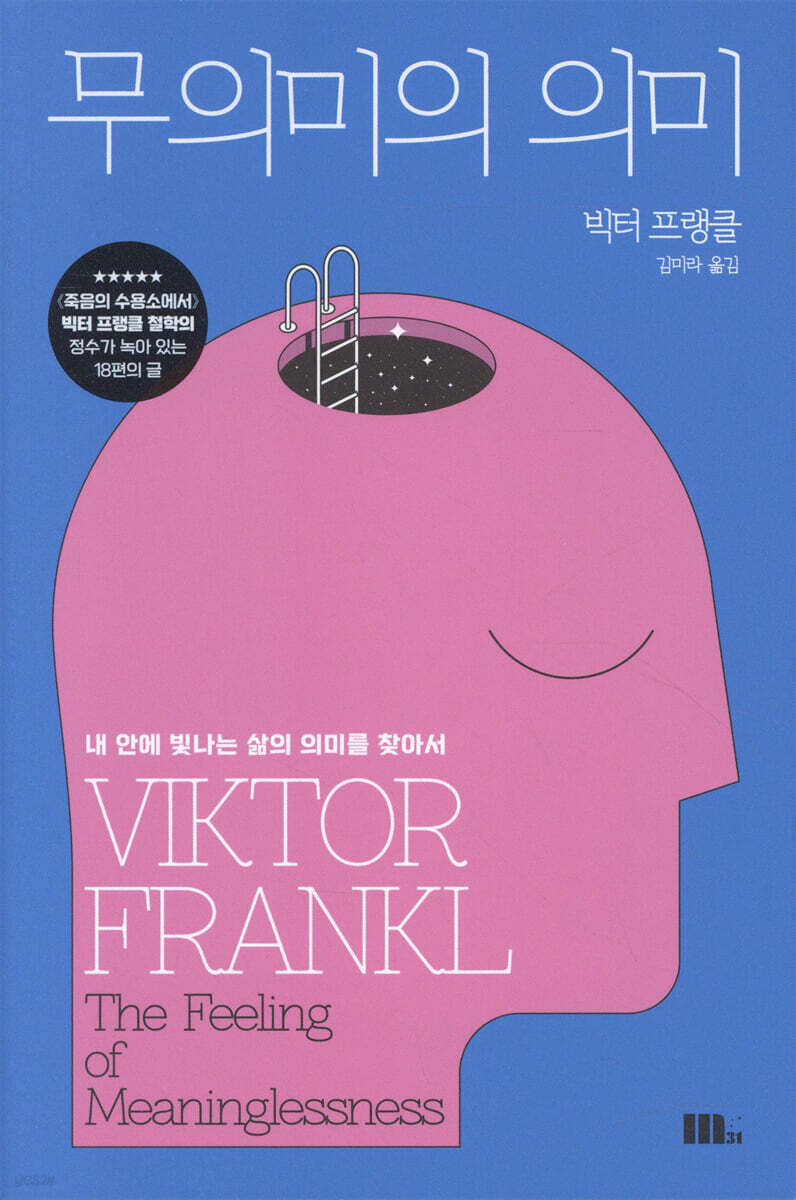
The meaning of meaninglessness
 |
Description
Book Introduction
A collection of 18 essays that represent the philosophy of Viktor Frankl, author of "Man's Search for Meaning"!
What do the feelings of meaninglessness, emptiness, and futility that sometimes come to us tell us?
This book is a collection of 18 essays and lecture manuscripts that contain the essence of Viktor Frankl, the author of the world-famous bestseller "Man's Search for Meaning" and the psychiatrist who founded logotherapy.
Viktor Frankl was imprisoned in a Nazi concentration camp and encountered various types of people, which led him to develop his insight into humanity and develop it into a psychotherapy theory called logotherapy.
Logotherapy is called one of Vienna's three major psychotherapy theories, following Freud's psychoanalytic theory and Adler's individual psychology.
Viktor Frankl, who established the theory of logotherapy after a persistent exploration of humanity and proved it through his own life, explains the philosophical background and concepts of logotherapy in detail in this book, focusing in particular on 'meaninglessness' to reveal its true meaning and implications.
This book will reveal why we can still find a shining light of hope even in the face of the worst circumstances and suffering: it is because we are human, and that light remains intact within us.
What do the feelings of meaninglessness, emptiness, and futility that sometimes come to us tell us?
This book is a collection of 18 essays and lecture manuscripts that contain the essence of Viktor Frankl, the author of the world-famous bestseller "Man's Search for Meaning" and the psychiatrist who founded logotherapy.
Viktor Frankl was imprisoned in a Nazi concentration camp and encountered various types of people, which led him to develop his insight into humanity and develop it into a psychotherapy theory called logotherapy.
Logotherapy is called one of Vienna's three major psychotherapy theories, following Freud's psychoanalytic theory and Adler's individual psychology.
Viktor Frankl, who established the theory of logotherapy after a persistent exploration of humanity and proved it through his own life, explains the philosophical background and concepts of logotherapy in detail in this book, focusing in particular on 'meaninglessness' to reveal its true meaning and implications.
This book will reveal why we can still find a shining light of hope even in the face of the worst circumstances and suffering: it is because we are human, and that light remains intact within us.
- You can preview some of the book's contents.
Preview
index
Translator's Preface
Part 1: The Meaning of Meaninglessness
Chapter 1: Meaninglessness: Challenging the Limits of Psychotherapy
Chapter 2: Humans are Meaning-Seeking Beings
Chapter 3: Logotherapy: Opening the Path to Restoring Humanity
Chapter 4: Humans Are Spiritual Beings Who Choose and Decide: Dimensional Ontology
Chapter 5 What is Existence?
Chapter 6: Beyond Self-Actualization and Self-Expression: Humans Are Self-Transcendent Beings
Chapter 7: Three Basic Assumptions of Logotherapy
Part 2: The Meaning of Meaning
Chapter 1: Logotherapy, a Psychotherapy Based on Existentialism
Chapter 2: What is True Psychotherapy?
Chapter 3: Logotherapy: Drawing a True Picture of Humanity
Chapter 4: On Human Freedom
Chapter 5: Human Existential Responsibility for Time
Chapter 6: The Unique and Objective Meaning of Life
Part 3: A Journey from Existence to Meaning
Chapter 1: The Ultimate Question of Human Existence
Chapter 2: The Role of Logotherapy in Psychotherapy
Chapter 3: On the Shoulders of Giants
Chapter 4 From the Classroom to the Camp
Chapter 5: Responding to Modern Collective Neurosis
Appendix: Viktor Frankl and the Path of Logotherapy_Alexander Burtyany
References
Part 1: The Meaning of Meaninglessness
Chapter 1: Meaninglessness: Challenging the Limits of Psychotherapy
Chapter 2: Humans are Meaning-Seeking Beings
Chapter 3: Logotherapy: Opening the Path to Restoring Humanity
Chapter 4: Humans Are Spiritual Beings Who Choose and Decide: Dimensional Ontology
Chapter 5 What is Existence?
Chapter 6: Beyond Self-Actualization and Self-Expression: Humans Are Self-Transcendent Beings
Chapter 7: Three Basic Assumptions of Logotherapy
Part 2: The Meaning of Meaning
Chapter 1: Logotherapy, a Psychotherapy Based on Existentialism
Chapter 2: What is True Psychotherapy?
Chapter 3: Logotherapy: Drawing a True Picture of Humanity
Chapter 4: On Human Freedom
Chapter 5: Human Existential Responsibility for Time
Chapter 6: The Unique and Objective Meaning of Life
Part 3: A Journey from Existence to Meaning
Chapter 1: The Ultimate Question of Human Existence
Chapter 2: The Role of Logotherapy in Psychotherapy
Chapter 3: On the Shoulders of Giants
Chapter 4 From the Classroom to the Camp
Chapter 5: Responding to Modern Collective Neurosis
Appendix: Viktor Frankl and the Path of Logotherapy_Alexander Burtyany
References
Into the book
Above all, through this book, I wanted to convey to you the most essential message that Dr. Viktor Frankl so desperately wanted to convey: that life is unconditionally meaningful, that feeling that life is meaningless is not a pathological thing but a sign of health, and that I really wanted to convey to you the words of conviction that give me strength to understand the true meaning of meaninglessness, that is, how human I am.
--- p.8
So how can we explain existential emptiness? Unlike animals, humans don't rely on instinct when deciding what to do.
And in contrast to the past, we no longer follow the voices of tradition or values when it comes to what we are responsible for and what we should do.
Nowadays, humans do not know what they should do or what they are responsible for, and sometimes they do not even know what they want to do.
Instead, they try to do what others do (conformity) or do what others expect of them (totalitarianism).
--- p.16~17
Even negative and tragic things like suffering, guilt, and death—the so-called three great tragedies of life—can be transformed into positive and creative things.
Even when trapped as helpless victims in desperate situations and faced with an unchangeable fate, humans can still transform such difficulties into human achievements as complete human beings.
By doing so, you will be able to recognize the potential you possess.
Humans can turn life's tragedies into triumphs.
--- p.24
This can be likened to a reef exposed during low tide.
Reefs appear because of the tide, but no one thinks that reefs cause the tide.
Likewise, guilt is not a cause of psychotic depression, such as endogenous depression.
Rather, it is the emotional ebb of depression that exposes the reef of guilt.
However, if a patient suffering from psychotic symptoms of physiological origin interprets his or her depressive symptoms as spiritual or even moral in terms of 'existential guilt', it is quite possible to predict the potential impact of such an interpretation on the patient.
This would add another pathological factor to the pathological tendency to self-accusation, which may ultimately lead the patient to choose suicide.
--- p.32~33
People's answers were like this.
“He was captured by the Russians and held in solitary confinement in the Steinhof Hospital.
But the next day the door to the cell he was in was left open, and no one ever saw him again.” I assumed he had fled to South America with the help of Nazis like many others.
Recently I had the opportunity to treat a former Austrian diplomat who had been imprisoned for several years, first in Siberia and then in the infamous Ljubljana prison in Moscow.
While I was being examined for neurological abnormalities, he suddenly asked me a question.
The question was whether I knew anyone named Dr. Jay.
When I answered that I knew, he continued talking.
“I got to know him in Lublin.
There he died of bladder cancer at the age of 40.
But until his death, he was truly the best colleague I had.
He comforted everyone who was there.
He seems to have lived by the highest moral standards imaginable.
“Of all the people I met during my long time in prison, he was truly the best friend I ever had.” This is the story of Dr. Jay, who was called the “Steinhoff Mass Murderer.”
--- p.57
As a generation that lived through World War II, we are coming to a very real and experiential realization of what it means to be human.
Humans are the ones who invented the gas chambers of Auschwitz.
But there are also those who go into the gas chamber with their backs straight and their heads held high while praying the Lord's Prayer.
--- p.62
If we project Dostoevsky from a psychiatric perspective, he is nothing more than an epileptic.
Bernadetta is nothing more than a hysterical patient with hallucinations.
From a psychiatric perspective, it is impossible to distinguish between Dostoevsky as a 'human being' and an epileptic patient as a 'disease'.
Moreover, from a psychiatric perspective, it is impossible to distinguish between Saint Bernadetta as a 'human being' and a hysterical patient as a 'disease'.
Psychiatry cannot separate Dostoevsky as a human being from his epileptic condition, nor can it separate Saint Bernadette as a human being from her hysterical symptoms.
Artistic achievements and accomplishments, as well as religious encounters and experiences, transcend the conceptual framework of psychiatric categories.
Their place goes beyond psychiatry.
Psychiatrists do not know what is hidden behind the pathology.
--- p.8
So how can we explain existential emptiness? Unlike animals, humans don't rely on instinct when deciding what to do.
And in contrast to the past, we no longer follow the voices of tradition or values when it comes to what we are responsible for and what we should do.
Nowadays, humans do not know what they should do or what they are responsible for, and sometimes they do not even know what they want to do.
Instead, they try to do what others do (conformity) or do what others expect of them (totalitarianism).
--- p.16~17
Even negative and tragic things like suffering, guilt, and death—the so-called three great tragedies of life—can be transformed into positive and creative things.
Even when trapped as helpless victims in desperate situations and faced with an unchangeable fate, humans can still transform such difficulties into human achievements as complete human beings.
By doing so, you will be able to recognize the potential you possess.
Humans can turn life's tragedies into triumphs.
--- p.24
This can be likened to a reef exposed during low tide.
Reefs appear because of the tide, but no one thinks that reefs cause the tide.
Likewise, guilt is not a cause of psychotic depression, such as endogenous depression.
Rather, it is the emotional ebb of depression that exposes the reef of guilt.
However, if a patient suffering from psychotic symptoms of physiological origin interprets his or her depressive symptoms as spiritual or even moral in terms of 'existential guilt', it is quite possible to predict the potential impact of such an interpretation on the patient.
This would add another pathological factor to the pathological tendency to self-accusation, which may ultimately lead the patient to choose suicide.
--- p.32~33
People's answers were like this.
“He was captured by the Russians and held in solitary confinement in the Steinhof Hospital.
But the next day the door to the cell he was in was left open, and no one ever saw him again.” I assumed he had fled to South America with the help of Nazis like many others.
Recently I had the opportunity to treat a former Austrian diplomat who had been imprisoned for several years, first in Siberia and then in the infamous Ljubljana prison in Moscow.
While I was being examined for neurological abnormalities, he suddenly asked me a question.
The question was whether I knew anyone named Dr. Jay.
When I answered that I knew, he continued talking.
“I got to know him in Lublin.
There he died of bladder cancer at the age of 40.
But until his death, he was truly the best colleague I had.
He comforted everyone who was there.
He seems to have lived by the highest moral standards imaginable.
“Of all the people I met during my long time in prison, he was truly the best friend I ever had.” This is the story of Dr. Jay, who was called the “Steinhoff Mass Murderer.”
--- p.57
As a generation that lived through World War II, we are coming to a very real and experiential realization of what it means to be human.
Humans are the ones who invented the gas chambers of Auschwitz.
But there are also those who go into the gas chamber with their backs straight and their heads held high while praying the Lord's Prayer.
--- p.62
If we project Dostoevsky from a psychiatric perspective, he is nothing more than an epileptic.
Bernadetta is nothing more than a hysterical patient with hallucinations.
From a psychiatric perspective, it is impossible to distinguish between Dostoevsky as a 'human being' and an epileptic patient as a 'disease'.
Moreover, from a psychiatric perspective, it is impossible to distinguish between Saint Bernadetta as a 'human being' and a hysterical patient as a 'disease'.
Psychiatry cannot separate Dostoevsky as a human being from his epileptic condition, nor can it separate Saint Bernadette as a human being from her hysterical symptoms.
Artistic achievements and accomplishments, as well as religious encounters and experiences, transcend the conceptual framework of psychiatric categories.
Their place goes beyond psychiatry.
Psychiatrists do not know what is hidden behind the pathology.
--- p.73
Publisher's Review
The most accurate interpretation of the concepts and basic philosophy of logotherapy!
A book that will give you profound insights into yourself and your true humanity.
The feeling that one's existence and life are meaningless, a feeling of emptiness and futility is something that every human being feels.
As long as we are human, this kind of 'existential emptiness' is a perfectly normal phenomenon.
However, if this feeling persists for a long time, it can develop into severe lethargy or neurosis, which is different from the psychiatric neurosis that is commonly referred to.
Viktor Frankl called this a "spiritual neurosis" in the sense that it is a neurosis that originates from the "spirit," the dimension unique to humans.
However, the core concepts of logotherapy, including the concept of 'spirit,' are often not properly conveyed during translation or interpretation.
Dr. Mira Kim, the only Korean internationally certified logotherapy expert, paid particular attention to these points when translating this book, and she also annotated every expression that could be misunderstood, striving to make logotherapy theory easier and more accurate to understand.
Logotherapy, which is called one of Vienna's three major psychotherapy theories following Freud's psychoanalysis and Adler's individual psychology, focuses on the meaning of human existence and the human will to pursue meaning.
Unlike Freud and Adler, who viewed humans from a two-dimensional perspective of body and mind, Viktor Frankl viewed humans from a three-dimensional perspective of body, mind, and spirit.
Here, ‘spirit’ is a unique dimension that only humans possess, and can be said to be the core of human existence.
Through his theory of logotherapy, Viktor Frankl repeatedly confirms that humans are inherently meaning-seeking beings and are unique beings who can exercise freedom of choice at any moment.
This book also focuses specifically on 'meaninglessness', and explains in detail what meaninglessness suggests to us and our attitudes toward it.
A book that will give you profound insights into yourself and your true humanity.
The feeling that one's existence and life are meaningless, a feeling of emptiness and futility is something that every human being feels.
As long as we are human, this kind of 'existential emptiness' is a perfectly normal phenomenon.
However, if this feeling persists for a long time, it can develop into severe lethargy or neurosis, which is different from the psychiatric neurosis that is commonly referred to.
Viktor Frankl called this a "spiritual neurosis" in the sense that it is a neurosis that originates from the "spirit," the dimension unique to humans.
However, the core concepts of logotherapy, including the concept of 'spirit,' are often not properly conveyed during translation or interpretation.
Dr. Mira Kim, the only Korean internationally certified logotherapy expert, paid particular attention to these points when translating this book, and she also annotated every expression that could be misunderstood, striving to make logotherapy theory easier and more accurate to understand.
Logotherapy, which is called one of Vienna's three major psychotherapy theories following Freud's psychoanalysis and Adler's individual psychology, focuses on the meaning of human existence and the human will to pursue meaning.
Unlike Freud and Adler, who viewed humans from a two-dimensional perspective of body and mind, Viktor Frankl viewed humans from a three-dimensional perspective of body, mind, and spirit.
Here, ‘spirit’ is a unique dimension that only humans possess, and can be said to be the core of human existence.
Through his theory of logotherapy, Viktor Frankl repeatedly confirms that humans are inherently meaning-seeking beings and are unique beings who can exercise freedom of choice at any moment.
This book also focuses specifically on 'meaninglessness', and explains in detail what meaninglessness suggests to us and our attitudes toward it.
GOODS SPECIFICS
- Publication date: December 22, 2021
- Page count, weight, size: 408 pages | 524g | 140*210*30mm
- ISBN13: 9791191095036
- ISBN10: 1191095037
You may also like
카테고리
korean


korean

![GQ KOREA Mark (Monthly): December [2025]](http://librairie.coreenne.fr/cdn/shop/files/8ef265dbbfbf186523ed75ba7319009d.jpg?v=1765340328&width=3840)


