

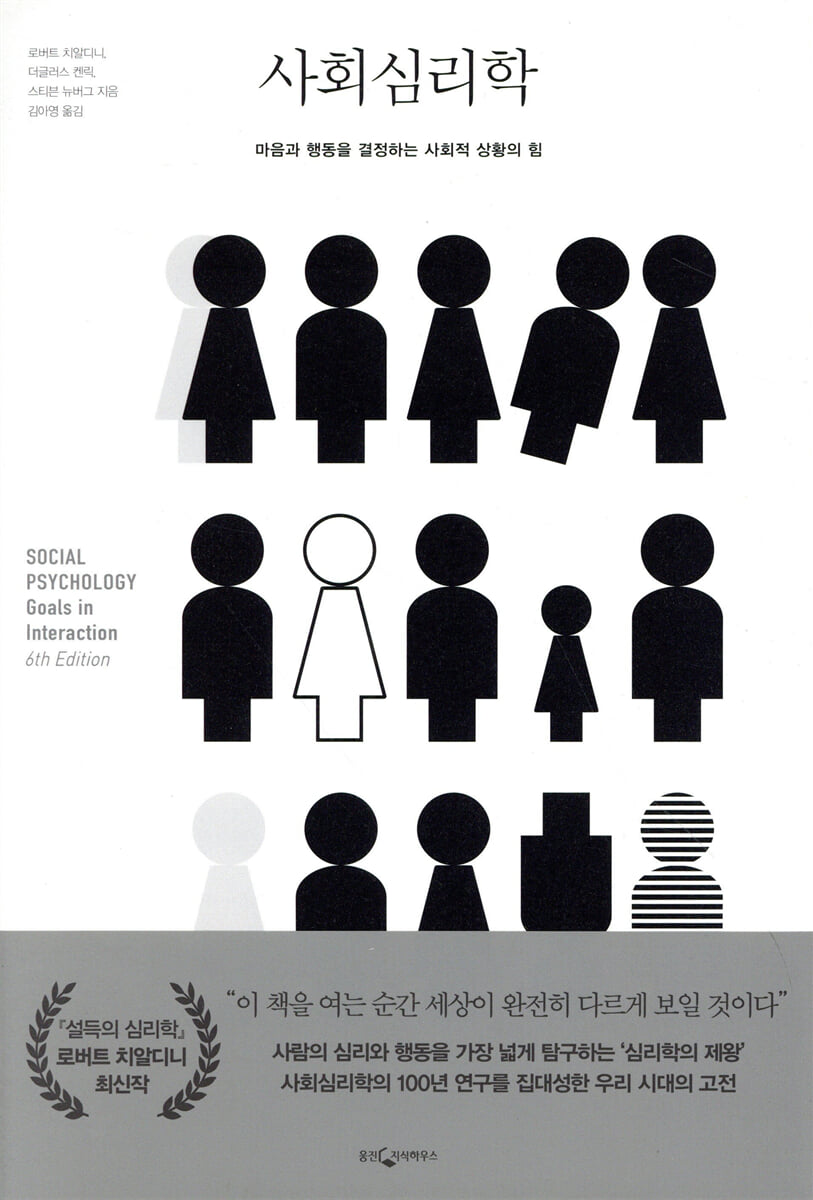
social psychology
 |
Description
Book Introduction
Robert Cialdini, the 4 million-selling author of "The Psychology of Persuasion"
The world of social psychology guided by world-renowned scholars Douglas Kenrick and Steven Newberg.
Uncovering the secrets of human relationships that govern our thoughts, emotions, and actions.
Human behavior is a mystery in itself.
There are grandmothers who collect waste paper and donate all their wealth, and there are also people who make sacrifices to save strangers.
A person who was once meticulous in everything becomes obsessed with a strange religion, and a person who trembles at the sight of a bug commits a brutal murder.
How should we interpret this behavior, which is difficult to understand simply based on a person's personality or temperament?
World-renowned psychologists Robert Cialdini, Douglas Kenrick, and Steven Newberg answer nearly every question and curiosity about humans and the societies they create in their new book, Social Psychology.
Social psychology is the scientific study of how a person's thoughts, feelings, and behavior are influenced by others.
From self-image management to relationship building, persuasion, agreement and obedience, altruistic behavior, discrimination and violence, and group living, the topics covered in each chapter are all directly related to our real lives.
As a result of the combined efforts of leading figures in social psychology with a combined research experience of 130 years, this book covers everything from classic research you may have heard of to the latest trends in academia.
Solomon Ashi's Conformity Experiment, which revealed that an individual's thoughts and actions can be completely reversed by the thoughts and actions of those around them; Philip Zimbardo's Aggression Experiment, which proved that humans can become unimaginably cruel when given power; and Stanley Milgram's Obedience Experiment, which revealed that humans can become infinitely ruthless in the face of authority, have all provided opportunities for us to reflect on humans as social beings.
Since its original publication in 2014, this book has been used as a textbook, introductory text, and reference book at universities in the United States and Europe.
Professor Kim Kyung-il of the Department of Psychology at Ajou University praised this book, saying, “I can’t count how many times I underlined and read it.” It is a rare work of theory that combines both popular interest and academic perfection.
If philosophy has been asking the question, "What is a human being?" for the past 3,000 years, social psychology, the "king of psychology," offers the most promising answers to that question.
This book, a culmination of over a century of social psychology research, will offer readers a "classic of our time," offering brilliant insights into humanity and society and clues to a better world.
The world of social psychology guided by world-renowned scholars Douglas Kenrick and Steven Newberg.
Uncovering the secrets of human relationships that govern our thoughts, emotions, and actions.
Human behavior is a mystery in itself.
There are grandmothers who collect waste paper and donate all their wealth, and there are also people who make sacrifices to save strangers.
A person who was once meticulous in everything becomes obsessed with a strange religion, and a person who trembles at the sight of a bug commits a brutal murder.
How should we interpret this behavior, which is difficult to understand simply based on a person's personality or temperament?
World-renowned psychologists Robert Cialdini, Douglas Kenrick, and Steven Newberg answer nearly every question and curiosity about humans and the societies they create in their new book, Social Psychology.
Social psychology is the scientific study of how a person's thoughts, feelings, and behavior are influenced by others.
From self-image management to relationship building, persuasion, agreement and obedience, altruistic behavior, discrimination and violence, and group living, the topics covered in each chapter are all directly related to our real lives.
As a result of the combined efforts of leading figures in social psychology with a combined research experience of 130 years, this book covers everything from classic research you may have heard of to the latest trends in academia.
Solomon Ashi's Conformity Experiment, which revealed that an individual's thoughts and actions can be completely reversed by the thoughts and actions of those around them; Philip Zimbardo's Aggression Experiment, which proved that humans can become unimaginably cruel when given power; and Stanley Milgram's Obedience Experiment, which revealed that humans can become infinitely ruthless in the face of authority, have all provided opportunities for us to reflect on humans as social beings.
Since its original publication in 2014, this book has been used as a textbook, introductory text, and reference book at universities in the United States and Europe.
Professor Kim Kyung-il of the Department of Psychology at Ajou University praised this book, saying, “I can’t count how many times I underlined and read it.” It is a rare work of theory that combines both popular interest and academic perfection.
If philosophy has been asking the question, "What is a human being?" for the past 3,000 years, social psychology, the "king of psychology," offers the most promising answers to that question.
This book, a culmination of over a century of social psychology research, will offer readers a "classic of our time," offering brilliant insights into humanity and society and clues to a better world.
- You can preview some of the book's contents.
Preview
index
A letter of recommendation.
From individual psychology to social psychology
introduction.
The greatest story on earth about humans and society
Chapter 1.
The key to solving everyday mysteries
-Why a poor single mom became a charity angel: J.
K. Rowling
-On social psychology
-Major theoretical perspectives
-Basic principles of social behavior
-Research methods for social behavior
-Links with other disciplines
-summation
Chapter 2.
Two axes that determine behavior: people and situations
-What made the ordinary man extraordinary?: Martin Luther King
-What kind of person am I: Person
-What kind of environment are you in? : Situation
-Interaction between people and situations
-summation
Chapter 3.
Understanding yourself and others
Hillary Clinton: Next-Generation Leader or Greedy Power-Government Activist?
-The black box in my head, social cognition
-Quickly take only the important things
-How to protect and elevate yourself
-How to read the world properly, the noble inference
-summation
Chapter 4.
How to present yourself
The Secret of the Conman Who Stole the Hearts of Many: Fred Demara
-The first step to a good impression: self-presentation
-How to make someone like me
-How can I appear competent?
- Revealing status and power
-summation
Chapter 5.
persuasion mechanism
The Man Who Confessed to a Murder He Didn't Commit: Peter Riley
-Attributes of attitude
-What is persuasion?
-An accurate view of the world
-Consistency in attitude and behavior
- Gain social approval
-summation
Chapter 6.
social influence
Why People Fall Into Cults: Steve Hassan
-Social influence: conformity, obedience, and submission
-Clues for making the right choice
- Gaining people's favor
-Maintain consistency in self-image
-summation
Chapter 7.
Relationships and Friendship
The Fugitive Who Became Friends with the Dalai Lama: Heinrich Harrer
-What is a friend?
-Having a shoulder to lean on: social support
-Find more information
-Aspiration for high places, status
-Exchange of material benefits
-summation
Chapter 8.
Love and romantic relationships
-The war-like love of an elephant and a pigeon: Frida Kahlo and Diego Rivera
-Definition of love and romantic attraction
-The primary purpose of sharing love is sexual satisfaction.
-The path to becoming a family, a sense of unity
- Obtaining resources and social status
-Maintaining and breaking up relationships
-summation
Chapter 9.
prosocial behavior
-The Great Sacrifice of a Japanese Man Who Saved the Jews: Chiune Sugihara
Why People Help Others: The Goals of Prosocial Behavior
-Promoting basic happiness: Gaining genetic and material benefits
- Gaining social status and recognition
-Maintain consistency in self-image
-Emotion and mood management
-Does pure altruism exist?
-summation
Chapter 10.
Aggression
-What Made Them Infamous Murderers: The Manson Family
-What is aggression?
- Responding to irritation
- Pursuit of material and social rewards
-Acquisition and maintenance of social status
-How to protect yourself and others
-How to reduce violence
-summation
Chapter 11.
prejudice, stereotypes, discrimination
-The surprising twist between a KKK member and a civil rights activist: C.
P. Ellis and Ann Atwater
-A world full of prejudice
- Support and protection for the group
- Gain social recognition
-Maintain consistency in self-image
- Pursuit of mental efficiency
-How to reduce prejudice, stereotypes, and discrimination
-summation
Chapter 12.
Groups and Leadership
The End of the Whistleblowers Who Expose the Corruption of Organizations: FBI, Enron, WorldCom
-Attributes of groups
-Getting things done
-Making accurate decisions
-Leading a group
-summation
Chapter 13.
social dilemma
-The Contrasting Futures of Italy and Bangladesh
-Definition of social dilemma
-The pursuit of instant gratification
-Protecting 'my people'
-summation
Chapter 14.
Synthesis of Social Psychology
-The Strange Conspiracy Behind the Speech of the Century
What Social Psychology Tells Us
-Social psychology from a major theoretical perspective
-Combination of diverse perspectives
-How to study social behavior
-The study of integration, social psychology
-The Future of Social Psychology
References
Search
From individual psychology to social psychology
introduction.
The greatest story on earth about humans and society
Chapter 1.
The key to solving everyday mysteries
-Why a poor single mom became a charity angel: J.
K. Rowling
-On social psychology
-Major theoretical perspectives
-Basic principles of social behavior
-Research methods for social behavior
-Links with other disciplines
-summation
Chapter 2.
Two axes that determine behavior: people and situations
-What made the ordinary man extraordinary?: Martin Luther King
-What kind of person am I: Person
-What kind of environment are you in? : Situation
-Interaction between people and situations
-summation
Chapter 3.
Understanding yourself and others
Hillary Clinton: Next-Generation Leader or Greedy Power-Government Activist?
-The black box in my head, social cognition
-Quickly take only the important things
-How to protect and elevate yourself
-How to read the world properly, the noble inference
-summation
Chapter 4.
How to present yourself
The Secret of the Conman Who Stole the Hearts of Many: Fred Demara
-The first step to a good impression: self-presentation
-How to make someone like me
-How can I appear competent?
- Revealing status and power
-summation
Chapter 5.
persuasion mechanism
The Man Who Confessed to a Murder He Didn't Commit: Peter Riley
-Attributes of attitude
-What is persuasion?
-An accurate view of the world
-Consistency in attitude and behavior
- Gain social approval
-summation
Chapter 6.
social influence
Why People Fall Into Cults: Steve Hassan
-Social influence: conformity, obedience, and submission
-Clues for making the right choice
- Gaining people's favor
-Maintain consistency in self-image
-summation
Chapter 7.
Relationships and Friendship
The Fugitive Who Became Friends with the Dalai Lama: Heinrich Harrer
-What is a friend?
-Having a shoulder to lean on: social support
-Find more information
-Aspiration for high places, status
-Exchange of material benefits
-summation
Chapter 8.
Love and romantic relationships
-The war-like love of an elephant and a pigeon: Frida Kahlo and Diego Rivera
-Definition of love and romantic attraction
-The primary purpose of sharing love is sexual satisfaction.
-The path to becoming a family, a sense of unity
- Obtaining resources and social status
-Maintaining and breaking up relationships
-summation
Chapter 9.
prosocial behavior
-The Great Sacrifice of a Japanese Man Who Saved the Jews: Chiune Sugihara
Why People Help Others: The Goals of Prosocial Behavior
-Promoting basic happiness: Gaining genetic and material benefits
- Gaining social status and recognition
-Maintain consistency in self-image
-Emotion and mood management
-Does pure altruism exist?
-summation
Chapter 10.
Aggression
-What Made Them Infamous Murderers: The Manson Family
-What is aggression?
- Responding to irritation
- Pursuit of material and social rewards
-Acquisition and maintenance of social status
-How to protect yourself and others
-How to reduce violence
-summation
Chapter 11.
prejudice, stereotypes, discrimination
-The surprising twist between a KKK member and a civil rights activist: C.
P. Ellis and Ann Atwater
-A world full of prejudice
- Support and protection for the group
- Gain social recognition
-Maintain consistency in self-image
- Pursuit of mental efficiency
-How to reduce prejudice, stereotypes, and discrimination
-summation
Chapter 12.
Groups and Leadership
The End of the Whistleblowers Who Expose the Corruption of Organizations: FBI, Enron, WorldCom
-Attributes of groups
-Getting things done
-Making accurate decisions
-Leading a group
-summation
Chapter 13.
social dilemma
-The Contrasting Futures of Italy and Bangladesh
-Definition of social dilemma
-The pursuit of instant gratification
-Protecting 'my people'
-summation
Chapter 14.
Synthesis of Social Psychology
-The Strange Conspiracy Behind the Speech of the Century
What Social Psychology Tells Us
-Social psychology from a major theoretical perspective
-Combination of diverse perspectives
-How to study social behavior
-The study of integration, social psychology
-The Future of Social Psychology
References
Search
Detailed image
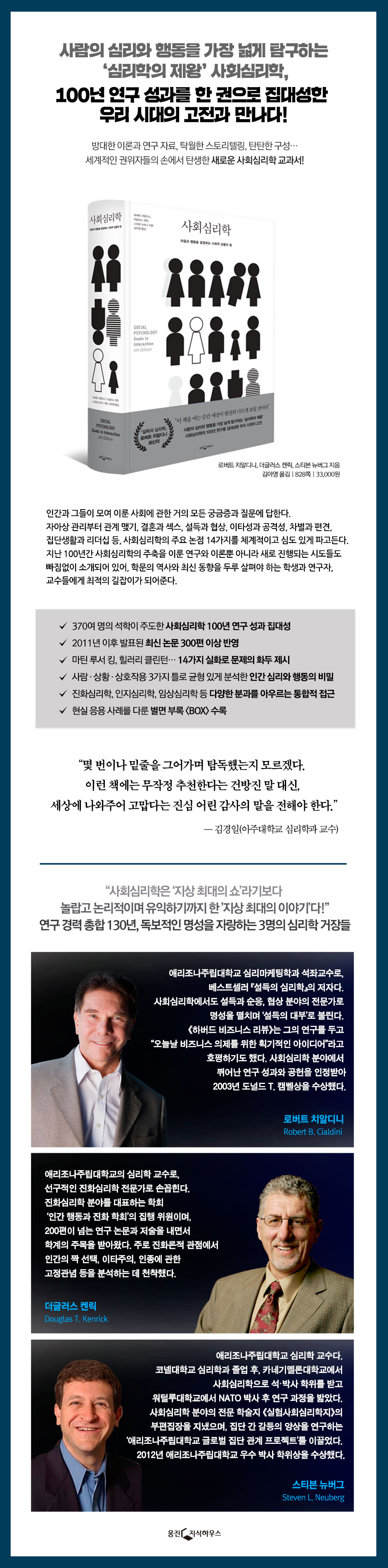
Into the book
Social psychology can be said to be a consistent and fascinating chronicle.
Of course, the form is colorful and very complex, but if you look closely, you will find that it contains recurring characters, scenes, and themes related to each element.
By providing a framework for an integrated approach to the field of social psychology, this book offers readers the intellectual pleasure of discovering order in chaos and the insight to read society.
--- p.10~11, 「Preface.
From "The Greatest Story on Earth About Humans and Society"
We often underestimate the power of the situation because we assume that the other person's behavior matches their temperament.
Social psychologists call the tendency to attribute behavior solely to temperament the fundamental attribution error.
(……) The impact of a situation on an action is often ‘invisible’ to the observer.
For example, let's say you see your new roommate yelling at your father.
If you didn't know that your friend's father had been unfairly picking on her boyfriend, it would be easy to blame her for her behavior on her spoiled personality.
--- p.128, from “Is it because of personality, whether you do well or not?: The fundamental attribution error”
Lottery winning numbers are chosen randomly, so any combination has an equally slim chance of winning.
But when you pick numbers on a computer, the outcome of a hugely important case with a stake of $1.1 million is safely out of your control.
What do we do then? Just as we roll the dice at a gambling table or wear a lucky T-shirt before an important game, we create the perception of control by choosing the winning lottery numbers ourselves, believing we are in control of the events and circumstances surrounding us.
(……)
Because self-control is so important, people who are deprived of it show distinct reactions.
For example, if you receive a material reward for doing something you like, you may lose interest in that activity.
Because the reward is seen as an attempt to control oneself.
The same goes for school-age children.
Most children will enjoy being rewarded for their learning, but it turns out that such rewards actually discourage children from independent learning.
--- p.142~143, from “Self-Improvement Strategies”
There is a saying that goes, “Flattery is useless.”
But the reality is different.
When done well, compliments can be an effective technique for gaining favor with others.
Another successful form of flattery is to subtly tell your boss through a coworker how much you respect him or her.
If you hear it through a third party, your boss is less likely to feel that the compliment is a tactic.
Asking for advice often works because it shows that you respect the person's expertise and knowledge.
Flattery as a technique of ingratiation begins in preschool age and is often quite successful.
We tend to readily accept compliments we receive while quickly interpreting the flattery of others as empty words.
Why wouldn't they? After all, I'm sure everyone deserves praise when it comes to their own work.
--- p.180, from “How to Make People Like Me”
In the fall of 1973, Robert Cialdini and colleagues discovered that American football fans wore more clothing with their team's logo after a victory.
Fans used the word "we" more when their team won ("We won!") than when their team lost ("They lost!").
By basking in the reflected glory of the winning team, that is, associating themselves with the team known as the winner, fans strengthen their public image.
Conversely, people sometimes exhibit cutting off reflected failure.
This is an act of distancing oneself from known 'losers' for fear of tarnishing one's reputation.
For example, residents of Flanders, Belgium, expressed their political preferences by pasting posters on the front windows of their houses.
After the election, 60% of residents who supported the winning party left their posters in place, while only 19% of residents who supported the losing party left their posters in place.
In this way, networking, which involves associating oneself with winners and distancing oneself from losers, also becomes a means of self-presentation.
--- p.205, from “4 Ways to Demonstrate Influence”
Think of a celebrity you've always liked.
Let's say that person takes a politically opposite stance to you.
According to Fritz Heider's balance theory, having a different opinion from someone you like disrupts the balance of your cognitive system.
How can we relax and restore our cognitive systems to a state of balance? The first way is to change our feelings about celebrities.
Then you will be having a different opinion from someone you don't like.
The second way is to change your attitude toward the subject.
Then you will have the same opinion as the person you like.
(……)
Typically, people change their perspectives to maintain a harmonious connection between the communicator (the subject of persuasion), themselves, and the subject.
This is why advertisers pay huge amounts of money to celebrities or sponsor positive events.
For example, it is said that when a store displays a Visa card sign with an Olympic symbol, the frequency of Visa card purchases increases by 15 to 25 percent.
Tsingtao Beer also reported that its profits jumped 32% during the Olympic period after sponsoring the Beijing Olympics.
--- p.250, from “Why do we want to empower people we like: Balance theory”
Let's recall Solomon Ashi's sympathy experiment.
Participants chose the wrong answer in a line-matching experiment even though they knew it was wrong simply because all their group members had chosen it.
In a situation like this where everyone's opinions are perfectly aligned, people will trust the group's choices more than their own.
(……) But what if someone breaks the consensus by choosing the expected answer before the answer is chosen? In that case, the likelihood of majority agreement becomes much lower.
Because diverse perspectives have the power to suppress consensus, almost all cults suppress communication with external sources of information, including family and friends.
Margaret Singer, who devoted her life to studying cults, would ask victims why they persevered despite the abuse they must have endured within the group.
The most common answers are:
“I look around and think,
'Well, there's still some Joe.
Mary is still holding on.
I was wrong.
“I just don’t understand,” he said.
--- p.288~289, from “Agreement and Similarity”
Car salespeople often "throw the ball low."
They offer certain models at lower prices to entice buyers to choose a specific car.
Then, they escalate their involvement by having the buyer drive the car to their house and spend the night there, or by having them prepare the purchase price, and then, before the final contract is signed, they make all sorts of excuses to make it impossible to sign the contract at that price.
However, by this point, most buyers have experienced a strong psychological involvement with the car, so they often pay a premium to purchase it.
Once people actively choose something, they view it more positively and are less likely to give up.
Once you 'mentally own' an important object, it becomes part of your self-concept.
So, the behavior of car buyers who fall for low-ball tactics makes sense psychologically, even if it makes no economic sense.
--- p.310, from “Personal Intervention and Four Obedience Strategies”
We are drawn to our neighbors partly because the cost of interaction is lower, but also because they are simply more familiar.
At first, the Tibetans regarded Heinrich Harrer as a strange-looking foreigner, but after he had spent seven years in Tibet, they considered him a close friend.
This tendency to think positively about people, places, and things that we see frequently is called the mere exposure effect.
The link between familiarity and preference is so powerful that it also works in reverse.
When you like someone, you become more familiar with that person.
One study found that people not only like people with the same initials as their own (Douglas Kenrick likes Dave Kenney), but also like cities whose names sound similar to theirs (a person named Louis is more likely to live in St. Louis), and even like occupations that sound similar to theirs (a person named Dennis is more likely to be a dentist).
--- p.354, from “When the eyes are close, the heart also becomes close”
In Israel's collective farms, kibbutzim, several children born to different families are raised in groups.
As adults, they remained friends with the opposite sex who grew up in the same group, but they did not marry each other.
This result is contrary to common sense, which states that people tend to marry the person they see often.
First of all, why was this so, when there was no norm within the kibbutz that prohibited sexual attraction?
Joseph Schaeffer attributed this to the interaction of the characteristics of the kibbutz environment and the internal systems that prevented siblings from being sexually attracted to each other.
Mating between siblings, which is more likely to express recessive genes, was a challenge that had to be solved during the evolutionary process.
A typical way to prevent this is for people who grow up under the same roof to develop an aversion to each other's sexual relations.
(……) These findings suggest that it is wrong to ask whether sexual behavior is an evolved genetic system, a sociocultural norm, or a learned experience.
Rather, it is more productive to ask how biological influences interact with culture to influence learning and how that process affects thinking and motivation.
--- p.379~380, from “Why Siblings Don’t See Each Other as the Opposite Sex: A Kibbutz Study”
Governments and citizens of countries that receive foreign aid often respond with resentment and hostility rather than gratitude toward the countries that provided the aid.
How should we interpret the tendency to criticize the actions and intentions of helpers, thereby risking future failures? The answer to this question is complex, but a phrase from French anthropologist Marcel Mauss explains much of it.
“Charity hurts the recipient.”
Research by social psychologists Jeffrey Fisher, Eri Nadler, and Bella DePaulo has clarified the nature and mechanisms of 'wounds'.
Among the self-concepts, the area that gets hurt is self-esteem.
In the process of solving the problem at hand, in some cases, the help itself can threaten self-esteem.
Because being helped can mean that the person is incompetent, inadequate, or dependent.
In such situations, we may refuse or downplay the value of help needed to maintain a positive self-concept.
--- p.442~443, from 「BOX 9.3 “Charity Hurts the Recipient” - Refusal of Help」
Not all aggressive kids are cold-blooded little psychopaths.
In fact, they are afraid of being attacked.
These young attackers generally have two characteristics.
One is being overly emotional, and the other is a tendency to believe that others are threatening them.
Kenneth Dodge and his colleagues developed a social information processing model of child aggression, as shown in Table 10.3, based on their research on aggression in school playgrounds.
--- p.496~497, from “The Self-Defense Man”
There are several reasons why cooperation among members of different groups is effective in reducing hostility.
Cooperation not only provides a means of obtaining economic and social resources in place of competition, but also reduces the tendency for competing groups to view each other in a simplistic way and motivates them to understand outgroup members more accurately.
When you collaborate with people from different groups, you may be less likely to assume that the group only contains similar people, and thus less likely to impose stereotypes and prejudices on others.
Also, we tend to put them in the category of 'us' and consider them as part of it.
As a result, when we cooperate, we develop the mindset that “we are all in this together” and begin to see other groups as we see ourselves, breaking down intergroup prejudices and stereotypes.
--- p.561~562, from “The Power of Contact”
When considering what abilities a leader needs, there are tasks that are more effective with leadership tendencies that are predominantly male, and tasks that are more effective with leadership tendencies that are predominantly female.
However, women may be seen as having a slightly greater advantage in becoming effective leaders because they tend to exhibit transformational leadership more.
The key here is that the most effective leaders, regardless of gender, are those who can adapt their strategies to the environment.
In short, just as leadership emerges, leadership effectiveness is determined by the interaction between people (potential leaders) and situations (groups).
--- p.612~613, from “Conditions for Demonstrating Competence”
In the 1980s, Soviet leader Mikhail Gorbachev used a strategy very similar to GRIT to bring US President Ronald Reagan to the negotiating table.
Gorbachev first offered to suspend nuclear weapons testing in the Soviet Union, then said he would resume it if the United States did not do the same.
His first outstretched hand swayed public opinion in the United States, and Gorbachev extended his hand again the following year, offering to have American investigators verify Soviet arms reductions.
That's how the nuclear arms reduction treaty between the two countries was concluded.
Gorbachev's policy of mutual concessions, which led to a truly fortunate conclusion, is remembered as the key to the end of the Cold War.
--- p.656~657, from 「BOX 13.2 GRIT Strategy that Led to the End of the Cold War」
One science writer recently argued that scientists will soon run out of questions to answer.
This author clearly doesn't know much about social psychology.
The frontier of social psychology is a vast continent, and so far researchers have only sketched the jagged edges of its coastline.
(……) The move to integrate the science of mind and social behavior is not simply a matter of philosophical concern.
There is also significant real potential here.
Social psychology has begun to offer insights into how people can be happier in their social relationships and what factors promote heroism, kindness, and love.
At the same time, by scientifically understanding the forces that motivate negative social behaviors such as aggression, prejudice, and narcissistic selfishness, we provide the key to solving some of the world's most pressing problems today.
Of course, the form is colorful and very complex, but if you look closely, you will find that it contains recurring characters, scenes, and themes related to each element.
By providing a framework for an integrated approach to the field of social psychology, this book offers readers the intellectual pleasure of discovering order in chaos and the insight to read society.
--- p.10~11, 「Preface.
From "The Greatest Story on Earth About Humans and Society"
We often underestimate the power of the situation because we assume that the other person's behavior matches their temperament.
Social psychologists call the tendency to attribute behavior solely to temperament the fundamental attribution error.
(……) The impact of a situation on an action is often ‘invisible’ to the observer.
For example, let's say you see your new roommate yelling at your father.
If you didn't know that your friend's father had been unfairly picking on her boyfriend, it would be easy to blame her for her behavior on her spoiled personality.
--- p.128, from “Is it because of personality, whether you do well or not?: The fundamental attribution error”
Lottery winning numbers are chosen randomly, so any combination has an equally slim chance of winning.
But when you pick numbers on a computer, the outcome of a hugely important case with a stake of $1.1 million is safely out of your control.
What do we do then? Just as we roll the dice at a gambling table or wear a lucky T-shirt before an important game, we create the perception of control by choosing the winning lottery numbers ourselves, believing we are in control of the events and circumstances surrounding us.
(……)
Because self-control is so important, people who are deprived of it show distinct reactions.
For example, if you receive a material reward for doing something you like, you may lose interest in that activity.
Because the reward is seen as an attempt to control oneself.
The same goes for school-age children.
Most children will enjoy being rewarded for their learning, but it turns out that such rewards actually discourage children from independent learning.
--- p.142~143, from “Self-Improvement Strategies”
There is a saying that goes, “Flattery is useless.”
But the reality is different.
When done well, compliments can be an effective technique for gaining favor with others.
Another successful form of flattery is to subtly tell your boss through a coworker how much you respect him or her.
If you hear it through a third party, your boss is less likely to feel that the compliment is a tactic.
Asking for advice often works because it shows that you respect the person's expertise and knowledge.
Flattery as a technique of ingratiation begins in preschool age and is often quite successful.
We tend to readily accept compliments we receive while quickly interpreting the flattery of others as empty words.
Why wouldn't they? After all, I'm sure everyone deserves praise when it comes to their own work.
--- p.180, from “How to Make People Like Me”
In the fall of 1973, Robert Cialdini and colleagues discovered that American football fans wore more clothing with their team's logo after a victory.
Fans used the word "we" more when their team won ("We won!") than when their team lost ("They lost!").
By basking in the reflected glory of the winning team, that is, associating themselves with the team known as the winner, fans strengthen their public image.
Conversely, people sometimes exhibit cutting off reflected failure.
This is an act of distancing oneself from known 'losers' for fear of tarnishing one's reputation.
For example, residents of Flanders, Belgium, expressed their political preferences by pasting posters on the front windows of their houses.
After the election, 60% of residents who supported the winning party left their posters in place, while only 19% of residents who supported the losing party left their posters in place.
In this way, networking, which involves associating oneself with winners and distancing oneself from losers, also becomes a means of self-presentation.
--- p.205, from “4 Ways to Demonstrate Influence”
Think of a celebrity you've always liked.
Let's say that person takes a politically opposite stance to you.
According to Fritz Heider's balance theory, having a different opinion from someone you like disrupts the balance of your cognitive system.
How can we relax and restore our cognitive systems to a state of balance? The first way is to change our feelings about celebrities.
Then you will be having a different opinion from someone you don't like.
The second way is to change your attitude toward the subject.
Then you will have the same opinion as the person you like.
(……)
Typically, people change their perspectives to maintain a harmonious connection between the communicator (the subject of persuasion), themselves, and the subject.
This is why advertisers pay huge amounts of money to celebrities or sponsor positive events.
For example, it is said that when a store displays a Visa card sign with an Olympic symbol, the frequency of Visa card purchases increases by 15 to 25 percent.
Tsingtao Beer also reported that its profits jumped 32% during the Olympic period after sponsoring the Beijing Olympics.
--- p.250, from “Why do we want to empower people we like: Balance theory”
Let's recall Solomon Ashi's sympathy experiment.
Participants chose the wrong answer in a line-matching experiment even though they knew it was wrong simply because all their group members had chosen it.
In a situation like this where everyone's opinions are perfectly aligned, people will trust the group's choices more than their own.
(……) But what if someone breaks the consensus by choosing the expected answer before the answer is chosen? In that case, the likelihood of majority agreement becomes much lower.
Because diverse perspectives have the power to suppress consensus, almost all cults suppress communication with external sources of information, including family and friends.
Margaret Singer, who devoted her life to studying cults, would ask victims why they persevered despite the abuse they must have endured within the group.
The most common answers are:
“I look around and think,
'Well, there's still some Joe.
Mary is still holding on.
I was wrong.
“I just don’t understand,” he said.
--- p.288~289, from “Agreement and Similarity”
Car salespeople often "throw the ball low."
They offer certain models at lower prices to entice buyers to choose a specific car.
Then, they escalate their involvement by having the buyer drive the car to their house and spend the night there, or by having them prepare the purchase price, and then, before the final contract is signed, they make all sorts of excuses to make it impossible to sign the contract at that price.
However, by this point, most buyers have experienced a strong psychological involvement with the car, so they often pay a premium to purchase it.
Once people actively choose something, they view it more positively and are less likely to give up.
Once you 'mentally own' an important object, it becomes part of your self-concept.
So, the behavior of car buyers who fall for low-ball tactics makes sense psychologically, even if it makes no economic sense.
--- p.310, from “Personal Intervention and Four Obedience Strategies”
We are drawn to our neighbors partly because the cost of interaction is lower, but also because they are simply more familiar.
At first, the Tibetans regarded Heinrich Harrer as a strange-looking foreigner, but after he had spent seven years in Tibet, they considered him a close friend.
This tendency to think positively about people, places, and things that we see frequently is called the mere exposure effect.
The link between familiarity and preference is so powerful that it also works in reverse.
When you like someone, you become more familiar with that person.
One study found that people not only like people with the same initials as their own (Douglas Kenrick likes Dave Kenney), but also like cities whose names sound similar to theirs (a person named Louis is more likely to live in St. Louis), and even like occupations that sound similar to theirs (a person named Dennis is more likely to be a dentist).
--- p.354, from “When the eyes are close, the heart also becomes close”
In Israel's collective farms, kibbutzim, several children born to different families are raised in groups.
As adults, they remained friends with the opposite sex who grew up in the same group, but they did not marry each other.
This result is contrary to common sense, which states that people tend to marry the person they see often.
First of all, why was this so, when there was no norm within the kibbutz that prohibited sexual attraction?
Joseph Schaeffer attributed this to the interaction of the characteristics of the kibbutz environment and the internal systems that prevented siblings from being sexually attracted to each other.
Mating between siblings, which is more likely to express recessive genes, was a challenge that had to be solved during the evolutionary process.
A typical way to prevent this is for people who grow up under the same roof to develop an aversion to each other's sexual relations.
(……) These findings suggest that it is wrong to ask whether sexual behavior is an evolved genetic system, a sociocultural norm, or a learned experience.
Rather, it is more productive to ask how biological influences interact with culture to influence learning and how that process affects thinking and motivation.
--- p.379~380, from “Why Siblings Don’t See Each Other as the Opposite Sex: A Kibbutz Study”
Governments and citizens of countries that receive foreign aid often respond with resentment and hostility rather than gratitude toward the countries that provided the aid.
How should we interpret the tendency to criticize the actions and intentions of helpers, thereby risking future failures? The answer to this question is complex, but a phrase from French anthropologist Marcel Mauss explains much of it.
“Charity hurts the recipient.”
Research by social psychologists Jeffrey Fisher, Eri Nadler, and Bella DePaulo has clarified the nature and mechanisms of 'wounds'.
Among the self-concepts, the area that gets hurt is self-esteem.
In the process of solving the problem at hand, in some cases, the help itself can threaten self-esteem.
Because being helped can mean that the person is incompetent, inadequate, or dependent.
In such situations, we may refuse or downplay the value of help needed to maintain a positive self-concept.
--- p.442~443, from 「BOX 9.3 “Charity Hurts the Recipient” - Refusal of Help」
Not all aggressive kids are cold-blooded little psychopaths.
In fact, they are afraid of being attacked.
These young attackers generally have two characteristics.
One is being overly emotional, and the other is a tendency to believe that others are threatening them.
Kenneth Dodge and his colleagues developed a social information processing model of child aggression, as shown in Table 10.3, based on their research on aggression in school playgrounds.
--- p.496~497, from “The Self-Defense Man”
There are several reasons why cooperation among members of different groups is effective in reducing hostility.
Cooperation not only provides a means of obtaining economic and social resources in place of competition, but also reduces the tendency for competing groups to view each other in a simplistic way and motivates them to understand outgroup members more accurately.
When you collaborate with people from different groups, you may be less likely to assume that the group only contains similar people, and thus less likely to impose stereotypes and prejudices on others.
Also, we tend to put them in the category of 'us' and consider them as part of it.
As a result, when we cooperate, we develop the mindset that “we are all in this together” and begin to see other groups as we see ourselves, breaking down intergroup prejudices and stereotypes.
--- p.561~562, from “The Power of Contact”
When considering what abilities a leader needs, there are tasks that are more effective with leadership tendencies that are predominantly male, and tasks that are more effective with leadership tendencies that are predominantly female.
However, women may be seen as having a slightly greater advantage in becoming effective leaders because they tend to exhibit transformational leadership more.
The key here is that the most effective leaders, regardless of gender, are those who can adapt their strategies to the environment.
In short, just as leadership emerges, leadership effectiveness is determined by the interaction between people (potential leaders) and situations (groups).
--- p.612~613, from “Conditions for Demonstrating Competence”
In the 1980s, Soviet leader Mikhail Gorbachev used a strategy very similar to GRIT to bring US President Ronald Reagan to the negotiating table.
Gorbachev first offered to suspend nuclear weapons testing in the Soviet Union, then said he would resume it if the United States did not do the same.
His first outstretched hand swayed public opinion in the United States, and Gorbachev extended his hand again the following year, offering to have American investigators verify Soviet arms reductions.
That's how the nuclear arms reduction treaty between the two countries was concluded.
Gorbachev's policy of mutual concessions, which led to a truly fortunate conclusion, is remembered as the key to the end of the Cold War.
--- p.656~657, from 「BOX 13.2 GRIT Strategy that Led to the End of the Cold War」
One science writer recently argued that scientists will soon run out of questions to answer.
This author clearly doesn't know much about social psychology.
The frontier of social psychology is a vast continent, and so far researchers have only sketched the jagged edges of its coastline.
(……) The move to integrate the science of mind and social behavior is not simply a matter of philosophical concern.
There is also significant real potential here.
Social psychology has begun to offer insights into how people can be happier in their social relationships and what factors promote heroism, kindness, and love.
At the same time, by scientifically understanding the forces that motivate negative social behaviors such as aggression, prejudice, and narcissistic selfishness, we provide the key to solving some of the world's most pressing problems today.
--- p.696~697, from “The Future of Social Psychology”
Publisher's Review
Robert Cialdini, the 4 million-selling author of "The Psychology of Persuasion"
Everything You Need to Know About Social Psychology from World-Renowned Scholars Douglas Kenrick and Steven Newberg
World-renowned psychologists Robert Cialdini, Douglas Kenrick, and Steven Newberg answer fundamental and important questions about humanity and society in their new book, Social Psychology.
Based on extensive theory and research, this book scientifically reveals how one person's thoughts, feelings, and actions are influenced by others.
This book is noteworthy because it was written by leading psychologists with a combined research experience of 130 years.
Robert Cialdini, author of the 4 million-selling book "The Psychology of Persuasion," is the "godfather of persuasion" who has been focusing on persuasion, compliance, and negotiation for over 50 years.
He is considered an expert with both outstanding skills and a keen sense of reality, as evidenced by the Harvard Business Review's praise for him as "a researcher who provides groundbreaking ideas optimized for today's management issues."
The other two authors also boast unrivaled fame.
Douglas Kenrick has been a prolific writer, publishing over 200 research papers, and is called "the next evolutionary psychology darling, following in the footsteps of David Buss."
Steven Newberg is also a leading figure who has earned the trust of psychologists for his unique experimental design.
As a result of the combined efforts of leading experts who have long focused on social psychology, this book covers everything from the history of social psychology to core theories and research, and a variety of case studies centered on individuals.
Furthermore, it encompasses not only fields of psychology such as cognitive psychology and evolutionary psychology, but also fields outside of psychology such as economics, political science, and management, thereby solidifying the position of social psychology as an interdisciplinary discipline that connects various fields of study.
Since the original publication (5th edition) in 2009, 『Social Psychology』 has been reprinted and is used as a textbook, introductory book, and reference book in universities in the United States and Europe.
In publishing the revised and expanded edition (6th edition) in 2014, we additionally referenced 300 research papers, most of which were published after 2011, making it an ideal resource for examining the latest trends and current status of social psychology.
Professor Kim Kyung-il of the Department of Psychology at Ajou University praised this book highly, saying in his recommendation, “I can’t count how many times I underlined and read it.” This is a rare example of a theoretical book that combines both popular interest and academic perfection.
This book, which culminates 100 years of research in social psychology with concrete and rigorous knowledge, excellent storytelling, and a solid structure, will provide both psychology majors and beginners with insights that will allow them to deeply and broadly understand the psychology and behavior of humans as "social beings."
"There is no action that is 100% the fault of the person or the situation."
How to break free from black-and-white logic and read the world accurately
In the summer of 1940, about 200 Jews flocked to the Japanese consulate in Lithuania.
They requested asylum from Japan, which was in alliance with the Nazis who had trampled them.
Surprisingly, a Japanese diplomat issued visas to them day and night, ignoring the authorities' orders.
He is Chiune Sugihara, who is called the ‘Japanese Schindler’.
Can we simply dismiss his decision, risking his career, his life, and his family's livelihood, as simply being "good"? Rather, his seemingly enigmatic actions become fully understandable when supported by the "circumstances" of his upbringing—his parents were proactive in helping the starving, and he happened to befriend a Jewish boy.
In this way, human behavior is a product of an exquisite combination of personal and situational factors.
"Social Psychology" reveals the secrets of social behavior from the perspective of "the interaction between people and situations," allowing us to view the world more accurately and in a balanced way.
This is a point of difference from other introductory social psychology books, which heavily rely on external factors such as upbringing, group norms, and culture when judging specific attitudes or behaviors.
For example, Charles Manson, who grew up without love from his biological mother, and Martin Luther King, who grew up in a wealthy Baptist pastor's family, had such different upbringings that they took such different paths that they became notorious murderers and heroes of the civil rights movement.
However, not all children who grow up neglected become brutal criminals, and not all children who grow up happily become great social activists.
To achieve a deep and broad understanding of human psychology and behavior, this book analyzes various topics in social psychology from various perspectives: person, situation, and interaction.
The relevant sections are marked with symbols such as [People], [Situation], and [Interaction], which serve as landmarks to help readers avoid getting lost on their long reading journey.
"Why delve so deeply into the complex interactions between people and situations? Simple explanations are often inaccurate.
To conserve cognitive resources, we often settle for simple, black-and-white answers, but the truth lies in a swirl of shades of gray that provoke far more thought.
“The more carefully we navigate these complexities, the more we can avoid placing too much responsibility on individuals or, conversely, viewing them as passive pawns in a situation.” (p. 687)
Martin Luther King, Frida Kahlo, Hillary Clinton…
The world of social psychology opened up through 14 fascinating true stories.
From relationships to marriage and sex, to persuasion and negotiation, to leadership.
Scientifically Uncovering the Secrets of Human Psychology and Behavior We Never Knew
This book consists of a total of 14 chapters.
Chapter 1 introduces social psychology, and Chapter 2 examines individuals and social situations.
Chapters 3-13 examine the main issues of social psychology.
For example, how to win the favor of others (Chapter 4), persuasion mechanisms that bring about a change in one's position (Chapter 5), factors influencing sexual appeal and mate selection (Chapter 8), reasons for the appearance of helpful and aggressive behavior (Chapters 9-10), and the characteristics of groups and the conditions for a competent leader (Chapter 12).
From relationships to marriage and sex, persuasion and negotiation, altruism and aggression, discrimination and prejudice, group living and leadership, the 14 topics covered in each chapter are all directly related to our real lives.
In addition, [BOX] placed throughout the text shows how various experimental results can be applied to reality.
For example, we explore how insights gained from research can be used to create less unequal classroom environments, help couples maintain relationships, and reduce violence.
In addition, it examines the connections between key issues within social psychology and fields such as health, education, management, and politics, suggesting that the principles of social psychology are inevitably connected to our ordinary daily lives.
As it covers a wide range of topics, the theories and research data supporting it are also solid.
Solomon Asch's conformity experiment (page 270), which revealed that an individual's thoughts and actions can be completely opposite to those of those around them; Philip Zimbardo's aggression experiment (page 56), which proved that humans can become unimaginably cruel when given power; and Stanley Milgram's obedience experiment (page 276), which revealed that humans can become infinitely ruthless in the face of authority, clearly show how humans, as social beings, are influenced by others.
In addition, surprising theories that have brought about changes in our lives are introduced, such as the fundamental attribution error (p. 128), which proved that the saying, “If I do it, it’s romance, but if others do it, it’s an affair” is cognitively valid; the balance theory (p. 249), which explains the principle of buying products advertised by your favorite celebrity; and the labeling strategy (p. 312), which increased voter turnout simply by mentioning someone as an “above-average citizen.”
This series of studies contains the trial and error and achievements of social psychologists over a period of over 100 years, making it highly significant from a research perspective.
Although it contains extensive theoretical and research material, this book is designed to be accessible and enjoyable for the general reader.
The case studies of real people placed at the beginning of each chapter allow even beginners to enter the world of social psychology without difficulty.
How did Martin Luther King, who was so ordinary that he even had an affair, become a hero representing the weak? How did Frida Kahlo fall in love with Diego Rivera, who was 20 years her senior? Why are there conflicting opinions about Hillary Clinton?
As you search for clues to the problem centered around a controversial topic, the seemingly complex mysteries of human psychology and behavior are quickly unraveled.
A better world is possible for us.
Social psychology: the key to uncovering inconvenient truths and solving real-world problems.
Social psychology, which established itself as an independent discipline in the early 20th century, has provided clues to solving the problems of modern society, surviving turbulent times marked by war, economic hardship, and international conflict.
It has been scientifically proven to have the power to motivate negative social behaviors such as aggression, prejudice, and narcissistic selfishness.
In 『Social Psychology』, based on various research results, it reveals the uncomfortable truths that were hidden, such as the Holocaust perpetrated by Nazi Germany, the brutal lynching of black people by the KKK, and the indiscriminate exploitation of resources by various countries.
These issues offer important insights for modern people living today, as they resurface in various forms even a century later and constantly challenge us.
However, this does not mean that social psychology is a dark discipline that exposes human weaknesses and rationalizes pathological behaviors.
As the authors note in the text, social psychology also has "substantial potential to positively change the world." It's about scientifically exploring how people become happier in their social relationships and what factors foster the emergence of heroic behavior, kindness, and love.
C. proved that when empathy and sympathetic concern are secured, anyone will help others with pure intentions.
Daniel Batson's study of helping behavior (p. 452) is one example.
"Social Psychology," which delves into the dark side of humanity and society from a multifaceted perspective, will serve as an excellent guide for untangling long-standing conflicts and moving toward a better world.
Everything You Need to Know About Social Psychology from World-Renowned Scholars Douglas Kenrick and Steven Newberg
World-renowned psychologists Robert Cialdini, Douglas Kenrick, and Steven Newberg answer fundamental and important questions about humanity and society in their new book, Social Psychology.
Based on extensive theory and research, this book scientifically reveals how one person's thoughts, feelings, and actions are influenced by others.
This book is noteworthy because it was written by leading psychologists with a combined research experience of 130 years.
Robert Cialdini, author of the 4 million-selling book "The Psychology of Persuasion," is the "godfather of persuasion" who has been focusing on persuasion, compliance, and negotiation for over 50 years.
He is considered an expert with both outstanding skills and a keen sense of reality, as evidenced by the Harvard Business Review's praise for him as "a researcher who provides groundbreaking ideas optimized for today's management issues."
The other two authors also boast unrivaled fame.
Douglas Kenrick has been a prolific writer, publishing over 200 research papers, and is called "the next evolutionary psychology darling, following in the footsteps of David Buss."
Steven Newberg is also a leading figure who has earned the trust of psychologists for his unique experimental design.
As a result of the combined efforts of leading experts who have long focused on social psychology, this book covers everything from the history of social psychology to core theories and research, and a variety of case studies centered on individuals.
Furthermore, it encompasses not only fields of psychology such as cognitive psychology and evolutionary psychology, but also fields outside of psychology such as economics, political science, and management, thereby solidifying the position of social psychology as an interdisciplinary discipline that connects various fields of study.
Since the original publication (5th edition) in 2009, 『Social Psychology』 has been reprinted and is used as a textbook, introductory book, and reference book in universities in the United States and Europe.
In publishing the revised and expanded edition (6th edition) in 2014, we additionally referenced 300 research papers, most of which were published after 2011, making it an ideal resource for examining the latest trends and current status of social psychology.
Professor Kim Kyung-il of the Department of Psychology at Ajou University praised this book highly, saying in his recommendation, “I can’t count how many times I underlined and read it.” This is a rare example of a theoretical book that combines both popular interest and academic perfection.
This book, which culminates 100 years of research in social psychology with concrete and rigorous knowledge, excellent storytelling, and a solid structure, will provide both psychology majors and beginners with insights that will allow them to deeply and broadly understand the psychology and behavior of humans as "social beings."
"There is no action that is 100% the fault of the person or the situation."
How to break free from black-and-white logic and read the world accurately
In the summer of 1940, about 200 Jews flocked to the Japanese consulate in Lithuania.
They requested asylum from Japan, which was in alliance with the Nazis who had trampled them.
Surprisingly, a Japanese diplomat issued visas to them day and night, ignoring the authorities' orders.
He is Chiune Sugihara, who is called the ‘Japanese Schindler’.
Can we simply dismiss his decision, risking his career, his life, and his family's livelihood, as simply being "good"? Rather, his seemingly enigmatic actions become fully understandable when supported by the "circumstances" of his upbringing—his parents were proactive in helping the starving, and he happened to befriend a Jewish boy.
In this way, human behavior is a product of an exquisite combination of personal and situational factors.
"Social Psychology" reveals the secrets of social behavior from the perspective of "the interaction between people and situations," allowing us to view the world more accurately and in a balanced way.
This is a point of difference from other introductory social psychology books, which heavily rely on external factors such as upbringing, group norms, and culture when judging specific attitudes or behaviors.
For example, Charles Manson, who grew up without love from his biological mother, and Martin Luther King, who grew up in a wealthy Baptist pastor's family, had such different upbringings that they took such different paths that they became notorious murderers and heroes of the civil rights movement.
However, not all children who grow up neglected become brutal criminals, and not all children who grow up happily become great social activists.
To achieve a deep and broad understanding of human psychology and behavior, this book analyzes various topics in social psychology from various perspectives: person, situation, and interaction.
The relevant sections are marked with symbols such as [People], [Situation], and [Interaction], which serve as landmarks to help readers avoid getting lost on their long reading journey.
"Why delve so deeply into the complex interactions between people and situations? Simple explanations are often inaccurate.
To conserve cognitive resources, we often settle for simple, black-and-white answers, but the truth lies in a swirl of shades of gray that provoke far more thought.
“The more carefully we navigate these complexities, the more we can avoid placing too much responsibility on individuals or, conversely, viewing them as passive pawns in a situation.” (p. 687)
Martin Luther King, Frida Kahlo, Hillary Clinton…
The world of social psychology opened up through 14 fascinating true stories.
From relationships to marriage and sex, to persuasion and negotiation, to leadership.
Scientifically Uncovering the Secrets of Human Psychology and Behavior We Never Knew
This book consists of a total of 14 chapters.
Chapter 1 introduces social psychology, and Chapter 2 examines individuals and social situations.
Chapters 3-13 examine the main issues of social psychology.
For example, how to win the favor of others (Chapter 4), persuasion mechanisms that bring about a change in one's position (Chapter 5), factors influencing sexual appeal and mate selection (Chapter 8), reasons for the appearance of helpful and aggressive behavior (Chapters 9-10), and the characteristics of groups and the conditions for a competent leader (Chapter 12).
From relationships to marriage and sex, persuasion and negotiation, altruism and aggression, discrimination and prejudice, group living and leadership, the 14 topics covered in each chapter are all directly related to our real lives.
In addition, [BOX] placed throughout the text shows how various experimental results can be applied to reality.
For example, we explore how insights gained from research can be used to create less unequal classroom environments, help couples maintain relationships, and reduce violence.
In addition, it examines the connections between key issues within social psychology and fields such as health, education, management, and politics, suggesting that the principles of social psychology are inevitably connected to our ordinary daily lives.
As it covers a wide range of topics, the theories and research data supporting it are also solid.
Solomon Asch's conformity experiment (page 270), which revealed that an individual's thoughts and actions can be completely opposite to those of those around them; Philip Zimbardo's aggression experiment (page 56), which proved that humans can become unimaginably cruel when given power; and Stanley Milgram's obedience experiment (page 276), which revealed that humans can become infinitely ruthless in the face of authority, clearly show how humans, as social beings, are influenced by others.
In addition, surprising theories that have brought about changes in our lives are introduced, such as the fundamental attribution error (p. 128), which proved that the saying, “If I do it, it’s romance, but if others do it, it’s an affair” is cognitively valid; the balance theory (p. 249), which explains the principle of buying products advertised by your favorite celebrity; and the labeling strategy (p. 312), which increased voter turnout simply by mentioning someone as an “above-average citizen.”
This series of studies contains the trial and error and achievements of social psychologists over a period of over 100 years, making it highly significant from a research perspective.
Although it contains extensive theoretical and research material, this book is designed to be accessible and enjoyable for the general reader.
The case studies of real people placed at the beginning of each chapter allow even beginners to enter the world of social psychology without difficulty.
How did Martin Luther King, who was so ordinary that he even had an affair, become a hero representing the weak? How did Frida Kahlo fall in love with Diego Rivera, who was 20 years her senior? Why are there conflicting opinions about Hillary Clinton?
As you search for clues to the problem centered around a controversial topic, the seemingly complex mysteries of human psychology and behavior are quickly unraveled.
A better world is possible for us.
Social psychology: the key to uncovering inconvenient truths and solving real-world problems.
Social psychology, which established itself as an independent discipline in the early 20th century, has provided clues to solving the problems of modern society, surviving turbulent times marked by war, economic hardship, and international conflict.
It has been scientifically proven to have the power to motivate negative social behaviors such as aggression, prejudice, and narcissistic selfishness.
In 『Social Psychology』, based on various research results, it reveals the uncomfortable truths that were hidden, such as the Holocaust perpetrated by Nazi Germany, the brutal lynching of black people by the KKK, and the indiscriminate exploitation of resources by various countries.
These issues offer important insights for modern people living today, as they resurface in various forms even a century later and constantly challenge us.
However, this does not mean that social psychology is a dark discipline that exposes human weaknesses and rationalizes pathological behaviors.
As the authors note in the text, social psychology also has "substantial potential to positively change the world." It's about scientifically exploring how people become happier in their social relationships and what factors foster the emergence of heroic behavior, kindness, and love.
C. proved that when empathy and sympathetic concern are secured, anyone will help others with pure intentions.
Daniel Batson's study of helping behavior (p. 452) is one example.
"Social Psychology," which delves into the dark side of humanity and society from a multifaceted perspective, will serve as an excellent guide for untangling long-standing conflicts and moving toward a better world.
GOODS SPECIFICS
- Date of issue: January 10, 2020
- Format: Hardcover book binding method guide
- Page count, weight, size: 828 pages | 1,419g | 160*235*48mm
- ISBN13: 9788901238210
- ISBN10: 8901238217
You may also like
카테고리
korean


korean

![GQ KOREA Mark (Monthly): December [2025]](http://librairie.coreenne.fr/cdn/shop/files/8ef265dbbfbf186523ed75ba7319009d.jpg?v=1765340328&width=3840)


