

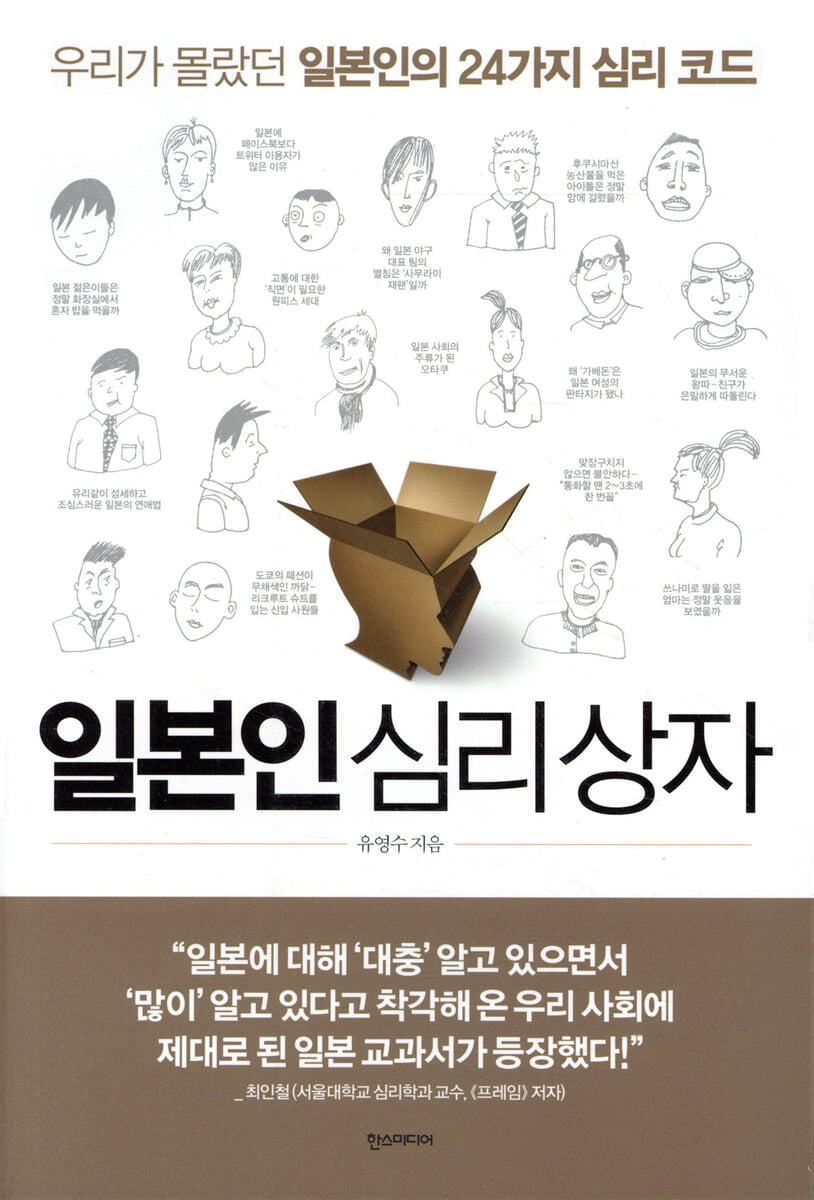
Japanese psychological box
 |
Description
Book Introduction
The 'real' Japanese people, full of things we're curious about but not quite sure about.
A Japanese correspondent specializing in psychology deciphers 24 psychological codes.
"Japanese Psychology Box" is a cultural book that approaches 24 topics that people are curious about regarding the unique behavior and culture of the Japanese people from a psychological perspective.
There have been many books on Japan and the Japanese people, but none have approached the subject in such an interesting and entertaining way.
This perspective on Japanese people through 24 psychological codes, including romantic relationships, mediocrity, ongaeshi, nuisance, and the right-wing shift of the younger generation, provides a fresh perspective on interpretation and is even beneficial as it helps us delve deeper into Japanese culture.
The book is also quite enjoyable to read, as it uses the current affairs program format to present cases first, followed by interpretations and evidence.
If you get immersed in it and read it, you will find yourself nodding your head and saying, "Ah, so that's why it was like that."
A Japanese correspondent specializing in psychology deciphers 24 psychological codes.
"Japanese Psychology Box" is a cultural book that approaches 24 topics that people are curious about regarding the unique behavior and culture of the Japanese people from a psychological perspective.
There have been many books on Japan and the Japanese people, but none have approached the subject in such an interesting and entertaining way.
This perspective on Japanese people through 24 psychological codes, including romantic relationships, mediocrity, ongaeshi, nuisance, and the right-wing shift of the younger generation, provides a fresh perspective on interpretation and is even beneficial as it helps us delve deeper into Japanese culture.
The book is also quite enjoyable to read, as it uses the current affairs program format to present cases first, followed by interpretations and evidence.
If you get immersed in it and read it, you will find yourself nodding your head and saying, "Ah, so that's why it was like that."
- You can preview some of the book's contents.
Preview
index
Part 1.
Psychological code of the younger generation
1.
Have you heard of the Friend Rental Service? [Interpersonal Relationships]
2.
Young People Falling into 'Friend Hell' [Worldview]
3.
Against the Conspiracy of Romance Capitalism! [Otaku]
4.
Japanese version of "The Man Who Never Got It Until He Was Forty" [Male Views on Love]
5.
Why Has "Gabedon" Become a Female Fantasy? [Women's Views on Love]
6.
Is Korea a plastic surgery powerhouse? Is Japan a procedure powerhouse? [Plastic Surgery and Makeup]
Part 2.
Communication Psychology Code
1.
"Why aren't there any interviews with the distressed refugees?" The Tokyo correspondent is furious! [Expression of emotion]
2.
The scene in the musical "Laundry" that the Japanese actors found most difficult to understand [Privacy]
3.
Why Do Japanese People Prefer "President" to "CEO"? (Moderate)
4.
Why the members of national group SMAP had no choice but to declare surrender [Trust]
5.
Why did they sweat for 20 minutes over 50 yen in a restaurant? [Ongaeshi]
6.
Why Japanese People Clap Every 2-3 Seconds [Communication]
Part 3.
Psychological Codes of Home and Everyday Life
1.
Japan's version of the "peanut rage incident" [Solo Parenting]
2.
Why Are Japanese Children So Delayed in Developing Empathy? [Home Education]
3.
Stroller Riding: Worse Than Leaving Littering on Subways [Public Nuisance]
4.
In Japan, do they really divide kindergarten classes by blood type? [Blood Type Personality Theory]
5.
Why Bhutan's King Buddha's Visit to Japan Created a Syndrome [Happiness]
6.
Why is Japan's national baseball team nicknamed "Samurai Japan"? [Sports]
Part 4.
The Psychological Code of Earthquakes and Anxiety
1.
Did the idol who ate Fukushima produce really get cancer? [Radiation Anxiety]
2.
Why did the 10 million-viewer film "Haeundae" fail so badly in Japan? [Fear of a major earthquake]
3.
Are Japan's "Net Right" and Korea's "Ilbe" Siamese Twins? [Net Right and Anti-Korea]
4.
Are Japan's Young Right-Wingers "One Piece Conservatives"? [The Rightward Shift of the Young Generation]
5.
Where Have All the Hallyu Fans Gone? [The Rise and Fall of the Hallyu Wave]
6.
Why didn't top star Namie Amuro sing Kimigayo? [Okinawa]
Psychological code of the younger generation
1.
Have you heard of the Friend Rental Service? [Interpersonal Relationships]
2.
Young People Falling into 'Friend Hell' [Worldview]
3.
Against the Conspiracy of Romance Capitalism! [Otaku]
4.
Japanese version of "The Man Who Never Got It Until He Was Forty" [Male Views on Love]
5.
Why Has "Gabedon" Become a Female Fantasy? [Women's Views on Love]
6.
Is Korea a plastic surgery powerhouse? Is Japan a procedure powerhouse? [Plastic Surgery and Makeup]
Part 2.
Communication Psychology Code
1.
"Why aren't there any interviews with the distressed refugees?" The Tokyo correspondent is furious! [Expression of emotion]
2.
The scene in the musical "Laundry" that the Japanese actors found most difficult to understand [Privacy]
3.
Why Do Japanese People Prefer "President" to "CEO"? (Moderate)
4.
Why the members of national group SMAP had no choice but to declare surrender [Trust]
5.
Why did they sweat for 20 minutes over 50 yen in a restaurant? [Ongaeshi]
6.
Why Japanese People Clap Every 2-3 Seconds [Communication]
Part 3.
Psychological Codes of Home and Everyday Life
1.
Japan's version of the "peanut rage incident" [Solo Parenting]
2.
Why Are Japanese Children So Delayed in Developing Empathy? [Home Education]
3.
Stroller Riding: Worse Than Leaving Littering on Subways [Public Nuisance]
4.
In Japan, do they really divide kindergarten classes by blood type? [Blood Type Personality Theory]
5.
Why Bhutan's King Buddha's Visit to Japan Created a Syndrome [Happiness]
6.
Why is Japan's national baseball team nicknamed "Samurai Japan"? [Sports]
Part 4.
The Psychological Code of Earthquakes and Anxiety
1.
Did the idol who ate Fukushima produce really get cancer? [Radiation Anxiety]
2.
Why did the 10 million-viewer film "Haeundae" fail so badly in Japan? [Fear of a major earthquake]
3.
Are Japan's "Net Right" and Korea's "Ilbe" Siamese Twins? [Net Right and Anti-Korea]
4.
Are Japan's Young Right-Wingers "One Piece Conservatives"? [The Rightward Shift of the Young Generation]
5.
Where Have All the Hallyu Fans Gone? [The Rise and Fall of the Hallyu Wave]
6.
Why didn't top star Namie Amuro sing Kimigayo? [Okinawa]
Into the book
The face of Japan I saw was different each time.
How should we understand their ever-changing nature? I wanted to understand the minds of "ordinary Japanese."
I wanted to study systematically, not just make arbitrary interpretations based on simple experiences.
I have read hundreds of papers and books from Japan and Korea.
As I studied, phenomena that I had previously considered completely separate became gradually connected and integrated into one.
There were times when I hit my knees in amazement, saying, "Aha~" at the realization.
--- pp.11-12
The reason Japanese people are so self-deprecating is because they have a very strong norm against publicly praising themselves.
Social psychologist Hiroshi Azuma pointed out that Japanese people tend to avoid positive things when talking about themselves and talk negatively, and they avoid boasting and showing off because they have an aggressive nature that threatens others.
Other studies have shown that Japanese people not only strongly dislike people who brag about themselves, but even view them as lacking in ability.
Japanese people often think, "He's an idiot for bragging about himself," and avoid meeting him. --- p.31
Nakama, a keyword for the younger generation in Japan, is a broader concept than the Korean word peer.
It could be a friend, it could be a comrade.
Sometimes it is used in a negative sense, such as 'gang', and is similar to the slang term 'partner' used in Korean society.
Above all, there is a strong sense of belonging to the group, a strong bond like camaraderie. In Journey to the West, the Sun Wukong, Tripitaka, Pigsy, and Sandy are typical examples of nakama relationships, as they journey together through all kinds of hardships.
(syncopation)
Columnist Suzuki analyzes that the younger generation of Japanese people dream of overcoming the difficulties of the world together with their close-knit group of friends, like those in the manga "One Piece."
And he cheers them on, saying that in an era where the myth of lifetime employment has collapsed and the Gundam generation's values of relying on organizational hierarchy are no longer valid, the rebellion of the One Piece generation, which aims for an equal and horizontal society, must succeed for Japan's bleak future to change.
--- pp.37-38
Japanese scholars explain this psychology as the so-called 'creditor personality.'
Social psychologists Greenberg and Westcott classified people into "creditor personality" and "qualifier personality" based on their reciprocal tendencies, and it was found that many Japanese people have the creditor personality type.
This type of person finds it burdensome to receive help, so it would be more comfortable for them to become a helping creditor.
They believe in the reciprocal norm of giving back as much as they receive, and are sensitive to being indebted, so they feel a great sense of psychological debt.
So when they receive help, they want to pay off the psychological debt as quickly as possible because of the feeling of indebtedness.
Scholars point out that a kind of maternal myth that places the responsibility for childcare on mothers is strongly entrenched in Japanese society.
This is a typical example of so-called "single-parenting," where the mother alone bears infinite responsibility and is criticized. Eiko Tabusa, author of "Moms Are Human Too" (not published in Korea), likened Japanese mothers to "marionette" puppets.
As soon as they are born, they are inseparable from their newborn and are considered “inorganic creatures without desires, thoughts, or individuality.”
Because patience and perseverance are the ideal of a 'good mother', you have to sacrifice and give up everything.
He criticizes it as “a human rights issue.”
While such perceptions still remain strong in our society, they feel much more entrenched and deeply rooted in Japanese society.
--- pp.190-191
Since the Great East Japan Earthquake, the declaration "It's not post-war, it's post-disaster" has become a fad in Japan. In a 2014 NHK survey titled "Japanese People's Views of the 70 Years of Postwar Life," the Great East Japan Earthquake was cited most frequently as the event that had the greatest impact on post-war Japanese society.
(syncopation)
Aggression also increased to relieve anxiety.
One study found an increase in the use of derogatory or dismissive words online, as well as a significant increase in comments and blog posts containing emotional anger or arguments.
He also points out that there has been a significant increase in the number of Japanese people filing complaints, or "claims," with various public institutions such as TV stations and government agencies.
This was not a typical Japanese behavior of suppressing discontent, and was interpreted as an aggression never seen before.
--- pp.287-288
How should we understand their ever-changing nature? I wanted to understand the minds of "ordinary Japanese."
I wanted to study systematically, not just make arbitrary interpretations based on simple experiences.
I have read hundreds of papers and books from Japan and Korea.
As I studied, phenomena that I had previously considered completely separate became gradually connected and integrated into one.
There were times when I hit my knees in amazement, saying, "Aha~" at the realization.
--- pp.11-12
The reason Japanese people are so self-deprecating is because they have a very strong norm against publicly praising themselves.
Social psychologist Hiroshi Azuma pointed out that Japanese people tend to avoid positive things when talking about themselves and talk negatively, and they avoid boasting and showing off because they have an aggressive nature that threatens others.
Other studies have shown that Japanese people not only strongly dislike people who brag about themselves, but even view them as lacking in ability.
Japanese people often think, "He's an idiot for bragging about himself," and avoid meeting him. --- p.31
Nakama, a keyword for the younger generation in Japan, is a broader concept than the Korean word peer.
It could be a friend, it could be a comrade.
Sometimes it is used in a negative sense, such as 'gang', and is similar to the slang term 'partner' used in Korean society.
Above all, there is a strong sense of belonging to the group, a strong bond like camaraderie. In Journey to the West, the Sun Wukong, Tripitaka, Pigsy, and Sandy are typical examples of nakama relationships, as they journey together through all kinds of hardships.
(syncopation)
Columnist Suzuki analyzes that the younger generation of Japanese people dream of overcoming the difficulties of the world together with their close-knit group of friends, like those in the manga "One Piece."
And he cheers them on, saying that in an era where the myth of lifetime employment has collapsed and the Gundam generation's values of relying on organizational hierarchy are no longer valid, the rebellion of the One Piece generation, which aims for an equal and horizontal society, must succeed for Japan's bleak future to change.
--- pp.37-38
Japanese scholars explain this psychology as the so-called 'creditor personality.'
Social psychologists Greenberg and Westcott classified people into "creditor personality" and "qualifier personality" based on their reciprocal tendencies, and it was found that many Japanese people have the creditor personality type.
This type of person finds it burdensome to receive help, so it would be more comfortable for them to become a helping creditor.
They believe in the reciprocal norm of giving back as much as they receive, and are sensitive to being indebted, so they feel a great sense of psychological debt.
So when they receive help, they want to pay off the psychological debt as quickly as possible because of the feeling of indebtedness.
Scholars point out that a kind of maternal myth that places the responsibility for childcare on mothers is strongly entrenched in Japanese society.
This is a typical example of so-called "single-parenting," where the mother alone bears infinite responsibility and is criticized. Eiko Tabusa, author of "Moms Are Human Too" (not published in Korea), likened Japanese mothers to "marionette" puppets.
As soon as they are born, they are inseparable from their newborn and are considered “inorganic creatures without desires, thoughts, or individuality.”
Because patience and perseverance are the ideal of a 'good mother', you have to sacrifice and give up everything.
He criticizes it as “a human rights issue.”
While such perceptions still remain strong in our society, they feel much more entrenched and deeply rooted in Japanese society.
--- pp.190-191
Since the Great East Japan Earthquake, the declaration "It's not post-war, it's post-disaster" has become a fad in Japan. In a 2014 NHK survey titled "Japanese People's Views of the 70 Years of Postwar Life," the Great East Japan Earthquake was cited most frequently as the event that had the greatest impact on post-war Japanese society.
(syncopation)
Aggression also increased to relieve anxiety.
One study found an increase in the use of derogatory or dismissive words online, as well as a significant increase in comments and blog posts containing emotional anger or arguments.
He also points out that there has been a significant increase in the number of Japanese people filing complaints, or "claims," with various public institutions such as TV stations and government agencies.
This was not a typical Japanese behavior of suppressing discontent, and was interpreted as an aggression never seen before.
--- pp.287-288
--- p.161
Publisher's Review
One of the major causes of the Korea-Japan conflict is "misunderstandings arising from the mistaken belief that one knows everything."
Most people think they know something about Japan.
Especially when it comes to Japanese people, we often mistakenly think we know them well.
However, there are not many people who have a proper understanding of Japanese culture and the nature of the Japanese people.
Because of the nature of the Japanese, their true nature can only be known by looking closely and for a long time.
The author of this book, as a Japanese correspondent, was able to truly understand the Japanese only after living among them.
Through direct encounters and experiences, I was able to 'clearly' feel the differences between us, and through the process of misunderstanding and being misunderstood, I came to believe that 'misunderstandings arising from the illusion of knowing each other well' are one of the major causes of the conflict between Korea and Japan.
So, instead of stopping at "That's just how Japanese people are," I've spent several years focusing on the questions, "Why are they like that? Is that really true?" and working to find the answers.
With the keen eye of a reporter with 22 years of experience, he keenly captured the phenomenon, and with the earnestness and experience of a psychology student and the wealth of data he painstakingly collected, he finally psychologically summarized the "true face of the Japanese."
Based on a total of 24 keywords, this interesting article wittily contains answers to many things we have been mistaken about or unaware of.
Japanese people are people you hate but also like, look down on but also admire.
If we must coexist with them until the end, we must reduce misunderstandings by forcing ourselves to know and understand them.
After reading this book, at least some useless misunderstandings will disappear.
High praise from Professor Choi In-cheol of the Department of Psychology at Seoul National University!
“A proper ‘Japanese textbook’ has appeared in our society!”
Professor Choi In-cheol of Seoul National University's Department of Psychology, author of the best-selling book "Frame," praised the book, saying, "A proper Japanese textbook has appeared in our society, which has been deluded into thinking it knows 'a lot' about Japan while only knowing 'a little' about it."
It was also evaluated that it was not only fun but also intellectually enjoyable.
It is said that it is well-written without being biased towards either popular or academic books.
SBS announcer Kim So-won praised the enigmatic Japanese people, saying they were starting to look a little clearer.
The comment, "With the attitude of a passionate reporter and an ageless psychology student, I ran to find and gather answers," truly describes the conclusion of the entire book.
It seems to have all the elements necessary to properly know and understand the Japanese people.
This is a must-read for anyone with even the slightest connection to Japan, including those who are interested in Japan but still have a vague understanding of it, office workers who have to deal with Japanese people, and students preparing to study abroad in Japan.
It will allow us to look at Japan and the Japanese people from a more balanced perspective.
Most people think they know something about Japan.
Especially when it comes to Japanese people, we often mistakenly think we know them well.
However, there are not many people who have a proper understanding of Japanese culture and the nature of the Japanese people.
Because of the nature of the Japanese, their true nature can only be known by looking closely and for a long time.
The author of this book, as a Japanese correspondent, was able to truly understand the Japanese only after living among them.
Through direct encounters and experiences, I was able to 'clearly' feel the differences between us, and through the process of misunderstanding and being misunderstood, I came to believe that 'misunderstandings arising from the illusion of knowing each other well' are one of the major causes of the conflict between Korea and Japan.
So, instead of stopping at "That's just how Japanese people are," I've spent several years focusing on the questions, "Why are they like that? Is that really true?" and working to find the answers.
With the keen eye of a reporter with 22 years of experience, he keenly captured the phenomenon, and with the earnestness and experience of a psychology student and the wealth of data he painstakingly collected, he finally psychologically summarized the "true face of the Japanese."
Based on a total of 24 keywords, this interesting article wittily contains answers to many things we have been mistaken about or unaware of.
Japanese people are people you hate but also like, look down on but also admire.
If we must coexist with them until the end, we must reduce misunderstandings by forcing ourselves to know and understand them.
After reading this book, at least some useless misunderstandings will disappear.
High praise from Professor Choi In-cheol of the Department of Psychology at Seoul National University!
“A proper ‘Japanese textbook’ has appeared in our society!”
Professor Choi In-cheol of Seoul National University's Department of Psychology, author of the best-selling book "Frame," praised the book, saying, "A proper Japanese textbook has appeared in our society, which has been deluded into thinking it knows 'a lot' about Japan while only knowing 'a little' about it."
It was also evaluated that it was not only fun but also intellectually enjoyable.
It is said that it is well-written without being biased towards either popular or academic books.
SBS announcer Kim So-won praised the enigmatic Japanese people, saying they were starting to look a little clearer.
The comment, "With the attitude of a passionate reporter and an ageless psychology student, I ran to find and gather answers," truly describes the conclusion of the entire book.
It seems to have all the elements necessary to properly know and understand the Japanese people.
This is a must-read for anyone with even the slightest connection to Japan, including those who are interested in Japan but still have a vague understanding of it, office workers who have to deal with Japanese people, and students preparing to study abroad in Japan.
It will allow us to look at Japan and the Japanese people from a more balanced perspective.
GOODS SPECIFICS
- Date of issue: August 22, 2016
- Page count, weight, size: 372 pages | 670g | 152*224*30mm
- ISBN13: 9791160070231
- ISBN10: 1160070237
You may also like
카테고리
korean


korean

![GQ KOREA Mark (Monthly): December [2025]](http://librairie.coreenne.fr/cdn/shop/files/8ef265dbbfbf186523ed75ba7319009d.jpg?v=1765340328&width=3840)


