

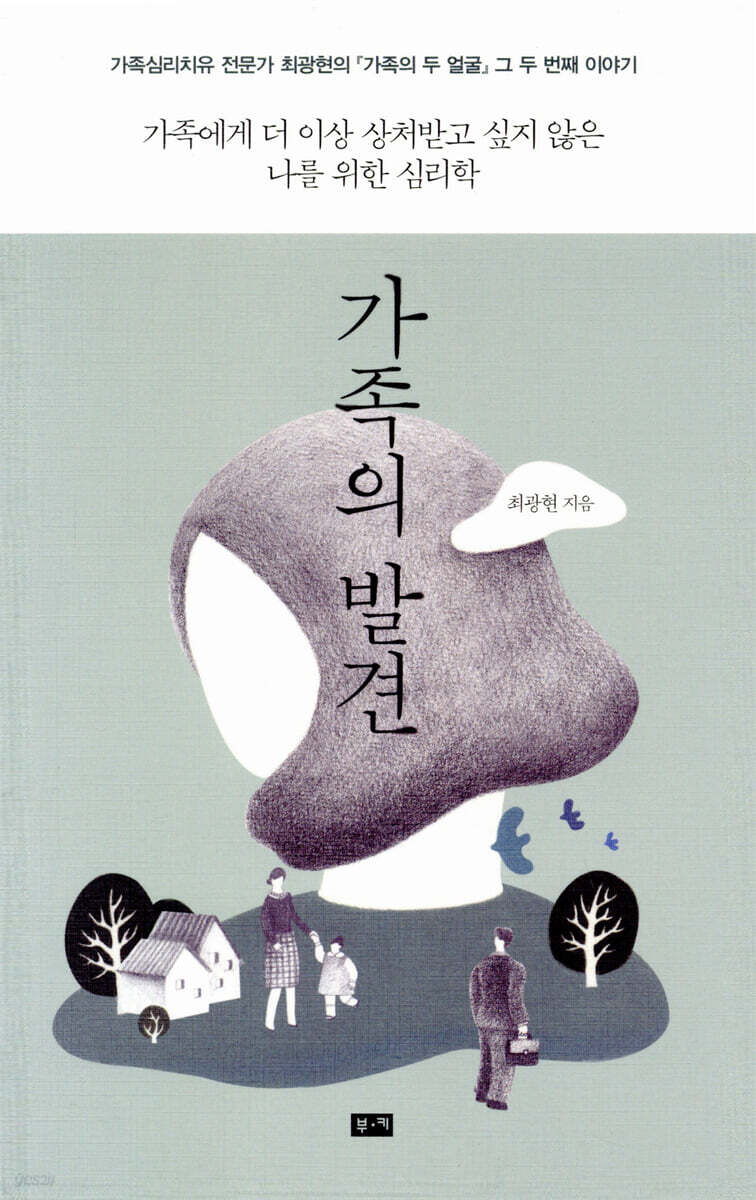
Family Discovery
 |
Description
Book Introduction
Why do we get hurt and suffer from our most beloved family?
Finding my true happiness through the lens of psychology
"The Discovery of Family" is the second family story published by Professor Choi Gwang-hyun, a family psychology specialist and author of "The Two Faces of Family," which has been a bestseller in the humanities for years, soothing the wounds of countless families.
This book provides refreshing answers to the questions, "Why do we get hurt and suffer from our families?", "What kind of pain do the wounds we receive from our families bring us, and what do they look like?", "How can we heal those wounds?", and "How can we embrace ourselves and our families without being hurt by them anymore?", and through these answers, it allows us to reflect on ourselves and our families.
Through this book, I will be able to discover and embrace the wounds of my family and myself that I never knew existed, just because they were always there, just like that, and empathize with them, and finally find a way to be happy.
Finding my true happiness through the lens of psychology
"The Discovery of Family" is the second family story published by Professor Choi Gwang-hyun, a family psychology specialist and author of "The Two Faces of Family," which has been a bestseller in the humanities for years, soothing the wounds of countless families.
This book provides refreshing answers to the questions, "Why do we get hurt and suffer from our families?", "What kind of pain do the wounds we receive from our families bring us, and what do they look like?", "How can we heal those wounds?", and "How can we embrace ourselves and our families without being hurt by them anymore?", and through these answers, it allows us to reflect on ourselves and our families.
Through this book, I will be able to discover and embrace the wounds of my family and myself that I never knew existed, just because they were always there, just like that, and empathize with them, and finally find a way to be happy.
- You can preview some of the book's contents.
Preview
index
Family Discovery
Introduction: Change begins when we look directly at our wounds.
Part 1: Good People
Why can't good people be happy?
Dr. Jekyll and Mr. Hyde live inside me.
Another face of ordinary life: boredom
The man who locked himself in his home for 10 years
Am I the master of my life?
Everyone lives with pain in their heart.
Do I want to die? Do I want to be loved?
“Just stop thinking about it now.”
Part 2: The Wounded Family
The inheritance of misfortune is more frightening than debt.
A set of three that bring misfortune to the family
Even fathers have to cry sometimes.
A child who is burdened with family problems
A couple who fights just by looking at each other's faces. Is it because of their personality differences?
A man who tried to protect his family but was kicked out
A caring father? He's actually a very anxious father.
“Be independent.
But don't leave my arms!”
Part 3: Discovery of the Family
Family projects shadows onto family
A son imitates his father, a daughter imitates her mother
Why everyone gets depressed when they hear their father sigh
The family is a living organism.
Finding a clear place for myself within the family
The fate of a family entangled like a spider's web
Carrying my family's misfortune within me
Part 4: Caring for My Family and Me
Men and women who are lonelier together than alone
The family's unhappiness brought about by a lack of empathy
Empathize with your family and make changes
Why My Son's Happiness Becomes My Happiness
Creating a new story for me and my family
From a vicious cycle of conflict to a virtuous cycle of happiness
Yet, family is our last refuge.
A Message to Those Who Know the Hardships and Pain of Life [Sehando]
Introduction: Change begins when we look directly at our wounds.
Part 1: Good People
Why can't good people be happy?
Dr. Jekyll and Mr. Hyde live inside me.
Another face of ordinary life: boredom
The man who locked himself in his home for 10 years
Am I the master of my life?
Everyone lives with pain in their heart.
Do I want to die? Do I want to be loved?
“Just stop thinking about it now.”
Part 2: The Wounded Family
The inheritance of misfortune is more frightening than debt.
A set of three that bring misfortune to the family
Even fathers have to cry sometimes.
A child who is burdened with family problems
A couple who fights just by looking at each other's faces. Is it because of their personality differences?
A man who tried to protect his family but was kicked out
A caring father? He's actually a very anxious father.
“Be independent.
But don't leave my arms!”
Part 3: Discovery of the Family
Family projects shadows onto family
A son imitates his father, a daughter imitates her mother
Why everyone gets depressed when they hear their father sigh
The family is a living organism.
Finding a clear place for myself within the family
The fate of a family entangled like a spider's web
Carrying my family's misfortune within me
Part 4: Caring for My Family and Me
Men and women who are lonelier together than alone
The family's unhappiness brought about by a lack of empathy
Empathize with your family and make changes
Why My Son's Happiness Becomes My Happiness
Creating a new story for me and my family
From a vicious cycle of conflict to a virtuous cycle of happiness
Yet, family is our last refuge.
A Message to Those Who Know the Hardships and Pain of Life [Sehando]
Into the book
One day, Mr. Yeonggwang, a professional man in his early forties, came for counseling.
He had built a family that everyone envied, but he appealed that he could no longer continue his marriage with his wife.
Mr. Yeonggwang's wife was a professional woman, so conscientious that she was thorough and without a single flaw.
She was perfect in every way while balancing work and housework.
(…) Mr. Yeonggwang’s anger at his wife’s perfect appearance actually stemmed from his anger at himself for living a life not much different from his wife’s.
The desire to deviate from his role as a good worker, good friend, good son, good husband, and good father was expressed as criticism of his wife.
--- p.37-38
'Relationship problems' often seem to be when the other person is in control, but in reality, it's often when you're in control and it's your problem.
When we think that the other person holds the 'key to the solution', we feel frustrated, impatient, and sometimes even despair.
But once you realize that you have the key, the burden is much lessened.
This is because we humans feel more helpless from the fact that we have no initiative to solve the problems and conflicts we experience in life than from the problems and conflicts themselves.
--- p.53
More than ten years ago, the man broke up with his first love due to his parents' opposition.
Although he tried his best to protect his girlfriend, he could not break his parents' stubborn will and they ended up having a painful breakup.
But I recently discovered a photo of her.
He felt a deep pain in his chest.
(…) Sometimes I meet people who can’t forget their first love.
They are talking about something completely different, and then suddenly they remember a past lover they had buried deep in their hearts.
I thought it was a thing of the past and a love that had already passed, but I still couldn't let it go in my heart and tried to ignore the pain and live on.
But it is not love for an ex-lover, but rather regret, guilt, and even shame about oneself.
This shame becomes a powerful bond to the past that prevents us from forgetting our ex-lovers.
--- p.62-63
It is said that the most common reason for divorce among couples in our country is personality differences.
When you say that you broke up due to personality differences, people around you comfort you and understand you, saying, “I guess you couldn’t help it.”
But was it really because of their personality differences that they broke up?
If you look closely at couples who say that their conflicts arise because of their different personalities, you will find that their personality differences are not that great.
Rather, there are many similar parts.
Although our outward personalities may be different, what's hidden inside can be surprisingly similar.
--- p.121-122
“Live the life you want.
Prepare hard for the future, pioneer your own life, get married, and become independent.
But I will not allow you to become independent.
“You must remain emotionally dependent on me and not leave my embrace.”
Every parent wants their children to succeed.
There is no parent who does not want to see their child become independent and carve out his or her own life.
However, they are not ready to accept their child's emotional independence.
You want your children to be as close to you and dependent on you as they were when they were young.
Children are conflicted about whether to choose verbal messages to become independent or nonverbal messages to stay.
--- p.150-151
As I counseled these young men, I discovered a common problem they had.
It was the absence of the father.
Their fathers were socially successful or at least recognized by those around them as having lived hard lives.
There were many cases where they were 'good' fathers, both in society and at home.
But their son actually had an absent father.
Then, one day on my way home from work, the thought suddenly occurred to me, 'Am I a father who talks to my son and empathizes with him?'
That night, I asked my wife quietly, and she nagged me, “Stop just going out and sympathizing with other people’s children. Try doing it at home too!”
--- p.230-231
A woman I counseled once asked, “Why should I be the only one to endure and forgive?”
I told her, “It’s not because you have more problems.
“We need to do that to resolve this situation,” he replied.
To get out of the flow of conflict, someone has to get out first.
This is like a pump that used to be in the countryside.
There is a lot of cool groundwater under the pump, but to drink it, you need a bucket of water, or mae-mi (water to prepare).
By pouring water into the pump and pumping it, you can draw up cool water to your heart's content.
He had built a family that everyone envied, but he appealed that he could no longer continue his marriage with his wife.
Mr. Yeonggwang's wife was a professional woman, so conscientious that she was thorough and without a single flaw.
She was perfect in every way while balancing work and housework.
(…) Mr. Yeonggwang’s anger at his wife’s perfect appearance actually stemmed from his anger at himself for living a life not much different from his wife’s.
The desire to deviate from his role as a good worker, good friend, good son, good husband, and good father was expressed as criticism of his wife.
--- p.37-38
'Relationship problems' often seem to be when the other person is in control, but in reality, it's often when you're in control and it's your problem.
When we think that the other person holds the 'key to the solution', we feel frustrated, impatient, and sometimes even despair.
But once you realize that you have the key, the burden is much lessened.
This is because we humans feel more helpless from the fact that we have no initiative to solve the problems and conflicts we experience in life than from the problems and conflicts themselves.
--- p.53
More than ten years ago, the man broke up with his first love due to his parents' opposition.
Although he tried his best to protect his girlfriend, he could not break his parents' stubborn will and they ended up having a painful breakup.
But I recently discovered a photo of her.
He felt a deep pain in his chest.
(…) Sometimes I meet people who can’t forget their first love.
They are talking about something completely different, and then suddenly they remember a past lover they had buried deep in their hearts.
I thought it was a thing of the past and a love that had already passed, but I still couldn't let it go in my heart and tried to ignore the pain and live on.
But it is not love for an ex-lover, but rather regret, guilt, and even shame about oneself.
This shame becomes a powerful bond to the past that prevents us from forgetting our ex-lovers.
--- p.62-63
It is said that the most common reason for divorce among couples in our country is personality differences.
When you say that you broke up due to personality differences, people around you comfort you and understand you, saying, “I guess you couldn’t help it.”
But was it really because of their personality differences that they broke up?
If you look closely at couples who say that their conflicts arise because of their different personalities, you will find that their personality differences are not that great.
Rather, there are many similar parts.
Although our outward personalities may be different, what's hidden inside can be surprisingly similar.
--- p.121-122
“Live the life you want.
Prepare hard for the future, pioneer your own life, get married, and become independent.
But I will not allow you to become independent.
“You must remain emotionally dependent on me and not leave my embrace.”
Every parent wants their children to succeed.
There is no parent who does not want to see their child become independent and carve out his or her own life.
However, they are not ready to accept their child's emotional independence.
You want your children to be as close to you and dependent on you as they were when they were young.
Children are conflicted about whether to choose verbal messages to become independent or nonverbal messages to stay.
--- p.150-151
As I counseled these young men, I discovered a common problem they had.
It was the absence of the father.
Their fathers were socially successful or at least recognized by those around them as having lived hard lives.
There were many cases where they were 'good' fathers, both in society and at home.
But their son actually had an absent father.
Then, one day on my way home from work, the thought suddenly occurred to me, 'Am I a father who talks to my son and empathizes with him?'
That night, I asked my wife quietly, and she nagged me, “Stop just going out and sympathizing with other people’s children. Try doing it at home too!”
--- p.230-231
A woman I counseled once asked, “Why should I be the only one to endure and forgive?”
I told her, “It’s not because you have more problems.
“We need to do that to resolve this situation,” he replied.
To get out of the flow of conflict, someone has to get out first.
This is like a pump that used to be in the countryside.
There is a lot of cool groundwater under the pump, but to drink it, you need a bucket of water, or mae-mi (water to prepare).
By pouring water into the pump and pumping it, you can draw up cool water to your heart's content.
--- p.268-267
Publisher's Review
“My mom told me not to play with you! You can’t come to my house to play anymore!”
A third-grade boy was cut off from his close friend because his father lost his job.
This incident left a deep scar on the child for a long time afterward.
This child grew up to become a family psychology specialist and a professor of family counseling.
Now able to talk about his childhood without any hesitation, he said, “My intense study during my time studying abroad was possible because I had a strong desire not to pass on the shame of ‘poverty’ to my family.”
He added, “It was that experience that gave me the strength to choose counseling as a career and to study family wounds.”
He is Professor Choi Gwang-hyeon, the author of “The Two Faces of Family,” which has been a bestseller in the humanities for years, soothing the wounds of countless families.
He published his second family story, "The Discovery of Family."
Through countless family counseling sessions, the author pondered the following questions: "Why do we get hurt and suffer from our families?" "What kind of pain do the wounds we receive from our families cause us, and what do they look like?" "How can we heal those wounds?" "How can we no longer be hurt by our families and embrace ourselves and our families?" and included his own answers in this book.
Even though we fought to the death and were enemies until yesterday, on a sad day when we are beaten outside, the only place we can rely on is our family.
Let's discover, embrace, and empathize with the wounds of my family and myself that I never knew existed, always there, just like that, and finally find the way to become happy through this book, "Discovery of Family."
Why do we get hurt and suffer from our most beloved family?
The author says that most of the people who come to the counseling office are “people I would like or at least not feel uncomfortable with if I met them in society.”
They were people who did not want to harm others and lived honestly with good character.
Why do these people come to the counseling room?
They have a delicate and gentle personality, and most of them love their family more than themselves and spend excessive energy protecting their family.
In particular, I felt that I had to take responsibility for the conflicts and tensions that occurred within the family.
“I was driving.
It was an ordinary day, with no difference in body or mind.
But then suddenly, all the people crossing the crosswalk looked like bowling pins.
I felt an overwhelming desire to just hit and pass.
I don't know how to accept that desire.
“I’m honestly afraid that there might be a conflicting personality like Dr. Jekyll and Mr. Hyde inside me.” - From “Dr. Jekyll and Mr. Hyde Live Inside Me”
This man, who revealed his inner dark impulses, was also a professor respected by his students for his usual sincere and responsible behavior.
But why does this happen? It's because our inner self and shadow want to find balance.
The European proverb, “Every fireman has a desire to be an arsonist,” illustrates the need for balance between the ego and the shadow.
And this applies equally to family matters.
Families that are in conflict and tension are usually families that have tried to resolve the problems.
The more you try to create a happy family, the more conflict you will face.
Why the wounds experienced within the family are more painful
In an imbalanced family, the husband unconsciously hurts his wife, the wife unconsciously hurts her husband, the parents unconsciously hurts their children, and the children unconsciously hurts their parents.
What would a family in such conflict look like?
▶ “Why doesn’t my husband understand my heart?”
A newlywed couple who had just celebrated their first holiday after marriage came to a counseling center because they were on the verge of divorce.
The newlywed, who was celebrating her first holiday after marriage, was quite unfamiliar with things, but did her best to help prepare for the holiday.
On the day she was going up to Seoul after the holiday celebrations were over, the new bride happened to overhear her mother-in-law and sister-in-law talking.
“Why is he so bad at his job?” “Well, that’s okay, Mom.” At that moment, the bride’s face turned pale.
On the way to Seoul, the newlywed couldn't hold back the sadness that was washing over her and burst into tears.
Then the husband turned up the volume on the radio.
The wife could not forgive her husband for turning up the radio volume when she was crying, saying he did not want to hear her cry, let alone comfort her.
He yelled at me to get a divorce right away.
-From "A Couple Who Fight Just by Looking at Their Faces, Is It Because of Their Different Personalities?"
Is the husband behaving this way because he doesn't love his wife and doesn't want to hear her cry?
He just didn't know how to react when his wife exploded emotionally and cried.
He had always been a person who suppressed or avoided his emotions, so he assumed his wife would be the same.
But the wife just wanted her husband to understand her suffering.
“It was hard, wasn’t it?” This one sentence would have been enough.
▶ “I don’t want to live like my mom!”
Jeong-eun, in her late twenties, always invested her savings in travel.
I even quit my hard-earned job to go on a long trip.
She felt alive only when she traveled, and that's why she became obsessed with traveling.
Her mother married an only son of a single mother and lived quietly, taking care of her mother-in-law and husband.
She lived a life of patience and sacrifice, caring for her picky mother-in-law and patriarchal husband.
One time, I told my daughter, who lives alone in Seoul, that I was going to visit her house for a few days, and I got scolded by both of them.
The question was, why would a woman go to her daughter's house without preparing a meal?
-From “A son imitates his father, a daughter imitates her mother”
Growing up in a family that constantly demanded sacrifices from her mother, she secretly felt guilty about her mother.
The desire for freedom was actually her mother's desire rather than her own.
The will to not live like my mother and the guilt of fulfilling her wishes were happening at the same time.
People who live this way, fulfilling their parents' desires, have a love-hate relationship with their parents.
I love my mother, but I find her behavior annoying and frustrating, and I rebel against and reject my father, but at the same time, I feel deep compassion for her.
Parents and children, entangled in such complex emotions, know each other better than anyone else and are close, but they are also prone to hurting each other and falling into conflict.
On the other hand, there are various types of problems within the family and the resulting wounds to the family, such as a son who developed anorexia from trying too hard to please his parents who treated each other like strangers, a daughter who lived as if she was atonement for her mother because she resembled her grandfather who gave her a hard time, and a husband who wants to divorce because he is miserable living with a wife who is too perfect.
Discovering a family you never knew existed because they were always by your side
Because they are family, because they are family, it is a ‘characteristic’ that only appears in family.
What are the things we have unconditionally accepted or taken for granted?
▶ “Honey, is this why you’ve been like this all along?”
A new family doesn't start from scratch.
Couples bring their own family culture and that of previous generations to their new family.
Because no one can be free from the family in which they are rooted.
Jihyun said she keeps getting angry at her husband for no reason, and she thinks it's too much.
She said that she would get angry at her husband for nothing and then feel better and her anxiety would subside when he backed down and paid attention.
The reason she did this was actually to manage her anxiety.
But she also knew that this relationship could not last long and that her husband's patience would soon run out.
The more this happened, the more anxious she became and the more she repeated this behavior.
-From "Inheritance is more frightening than debt"
Why on earth does she act like this? Her father abused her family when she was young.
When I came home from work and saw my family looking at me and not knowing what to do, I felt comforted.
And she felt fear and dread along with anger towards such a father.
Her father was also a man who harbored anger and fear toward his own father, who had abused his family.
In the end, the grandfather was repeating to the father the fear he felt, and the father was repeating to the daughter.
▶ “I had a hard time because of my father, but now I’m doing the same thing as him…”
Behind these recurring family problems lies ‘projection.’
Projection is like projecting our unconscious desires, emotions, etc. onto others through a projector.
'Family projection' occurs when parents project their anger or anxiety onto other family members, or project marital conflict onto their children, drawing them into the conflict.
And when these projected children grow up and get married, they deal with family conflicts in the same way as their parents.
Mr. Cheolsu's father was a self-made man who achieved financial success and stability through wholesale business.
At the same time, he was also a person with a very high level of anxiety.
When business wasn't going well, I couldn't sleep and was anxious.
When he came home from work, he would get irritated with his wife and children and react sensitively to even the smallest mistakes, which always made his family members tense.
However, as an adult, Cheolsu also projected his anger onto his family just like his father.
He dumped his negative emotions on his wife and children without permission, just like he would throw away his own trash at someone else's house instead of taking care of it himself.
-From "Even Fathers Need to Cry Sometimes"
When family projection occurs, someone becomes the victim of that projection.
The scapegoat ends up being the rest of the family, and the conflict and hurt are repeated within them.
In addition to this, there are also 'family homeostasis', which seeks to maintain a certain balance as if it were a single organism, a hierarchy established within the family, and identification with the pain of family members.
This characteristic is also the basis for the sacrifice and loyalty that one can show to one's family, which can never be seen in other groups.
Healing the wounds of myself and my family
Rather than trying to forget or ignore the wounds you received from your family, you can naturally find your way to healing by changing your perspective on the wounds and trauma.
There was a woman who became so angry and depressed whenever she thought about her father who was so cruel to his children.
This woman continued to suffer as an adult from the wounds she received from her father as a child.
Then a change came into her life.
My father was a victim of war trauma.
The greater the trauma, the narrower the field of vision.
Because they cannot see the bigger picture, they become more anxious, tense, think more negatively, and judge more negatively than the average person.
And all of these things, regardless of one's will, become factors that make people around them suffer.
Every day was like a battlefield for my father, so he trained his children to survive there.
?From the introduction, “Change begins when we look directly at the wounds of ourselves and our families.”
Through counseling, she learned about her father's cold-hearted intentions toward his children.
It was a change that came about not by erasing or ignoring the memories and wounds of my childhood, but simply by looking at them from a different angle.
In this process of change and healing, warm communication and empathy with family can be of great help.
Family is a source of pain and suffering for us, and we want to escape from it, but it is also our last refuge and shelter.
Communication and empathy are not big or great things.
Just a warm word or a hug is enough.
This happened last year.
I had just published a new book and was excitedly watching readers' reactions. I was watching the TV news when they introduced me to that week's bestsellers in the humanities.
My book wasn't on the list.
I thought it would be like that, but I was still disappointed.
But at that moment, my son came up to me quietly, hugged me, and said, “I know how you feel, Dad.
“When I lost the class president election, I did the same thing.” - From “Empathizing with Your Family and Changing Things”
The author was able to laugh off a potentially disappointing and depressing situation with just one word from his son.
At that moment, she felt that her son had comforted her heart, and she loved him even more.
A single word from the son created empathy and communication between the two.
As the first sentence of Anna Karenina says, “Happy families are all alike; every unhappy family is unhappy in its own way.”, the wounds we receive from our families may all be different, but doesn’t recovery all begin with “a kind word”?
A third-grade boy was cut off from his close friend because his father lost his job.
This incident left a deep scar on the child for a long time afterward.
This child grew up to become a family psychology specialist and a professor of family counseling.
Now able to talk about his childhood without any hesitation, he said, “My intense study during my time studying abroad was possible because I had a strong desire not to pass on the shame of ‘poverty’ to my family.”
He added, “It was that experience that gave me the strength to choose counseling as a career and to study family wounds.”
He is Professor Choi Gwang-hyeon, the author of “The Two Faces of Family,” which has been a bestseller in the humanities for years, soothing the wounds of countless families.
He published his second family story, "The Discovery of Family."
Through countless family counseling sessions, the author pondered the following questions: "Why do we get hurt and suffer from our families?" "What kind of pain do the wounds we receive from our families cause us, and what do they look like?" "How can we heal those wounds?" "How can we no longer be hurt by our families and embrace ourselves and our families?" and included his own answers in this book.
Even though we fought to the death and were enemies until yesterday, on a sad day when we are beaten outside, the only place we can rely on is our family.
Let's discover, embrace, and empathize with the wounds of my family and myself that I never knew existed, always there, just like that, and finally find the way to become happy through this book, "Discovery of Family."
Why do we get hurt and suffer from our most beloved family?
The author says that most of the people who come to the counseling office are “people I would like or at least not feel uncomfortable with if I met them in society.”
They were people who did not want to harm others and lived honestly with good character.
Why do these people come to the counseling room?
They have a delicate and gentle personality, and most of them love their family more than themselves and spend excessive energy protecting their family.
In particular, I felt that I had to take responsibility for the conflicts and tensions that occurred within the family.
“I was driving.
It was an ordinary day, with no difference in body or mind.
But then suddenly, all the people crossing the crosswalk looked like bowling pins.
I felt an overwhelming desire to just hit and pass.
I don't know how to accept that desire.
“I’m honestly afraid that there might be a conflicting personality like Dr. Jekyll and Mr. Hyde inside me.” - From “Dr. Jekyll and Mr. Hyde Live Inside Me”
This man, who revealed his inner dark impulses, was also a professor respected by his students for his usual sincere and responsible behavior.
But why does this happen? It's because our inner self and shadow want to find balance.
The European proverb, “Every fireman has a desire to be an arsonist,” illustrates the need for balance between the ego and the shadow.
And this applies equally to family matters.
Families that are in conflict and tension are usually families that have tried to resolve the problems.
The more you try to create a happy family, the more conflict you will face.
Why the wounds experienced within the family are more painful
In an imbalanced family, the husband unconsciously hurts his wife, the wife unconsciously hurts her husband, the parents unconsciously hurts their children, and the children unconsciously hurts their parents.
What would a family in such conflict look like?
▶ “Why doesn’t my husband understand my heart?”
A newlywed couple who had just celebrated their first holiday after marriage came to a counseling center because they were on the verge of divorce.
The newlywed, who was celebrating her first holiday after marriage, was quite unfamiliar with things, but did her best to help prepare for the holiday.
On the day she was going up to Seoul after the holiday celebrations were over, the new bride happened to overhear her mother-in-law and sister-in-law talking.
“Why is he so bad at his job?” “Well, that’s okay, Mom.” At that moment, the bride’s face turned pale.
On the way to Seoul, the newlywed couldn't hold back the sadness that was washing over her and burst into tears.
Then the husband turned up the volume on the radio.
The wife could not forgive her husband for turning up the radio volume when she was crying, saying he did not want to hear her cry, let alone comfort her.
He yelled at me to get a divorce right away.
-From "A Couple Who Fight Just by Looking at Their Faces, Is It Because of Their Different Personalities?"
Is the husband behaving this way because he doesn't love his wife and doesn't want to hear her cry?
He just didn't know how to react when his wife exploded emotionally and cried.
He had always been a person who suppressed or avoided his emotions, so he assumed his wife would be the same.
But the wife just wanted her husband to understand her suffering.
“It was hard, wasn’t it?” This one sentence would have been enough.
▶ “I don’t want to live like my mom!”
Jeong-eun, in her late twenties, always invested her savings in travel.
I even quit my hard-earned job to go on a long trip.
She felt alive only when she traveled, and that's why she became obsessed with traveling.
Her mother married an only son of a single mother and lived quietly, taking care of her mother-in-law and husband.
She lived a life of patience and sacrifice, caring for her picky mother-in-law and patriarchal husband.
One time, I told my daughter, who lives alone in Seoul, that I was going to visit her house for a few days, and I got scolded by both of them.
The question was, why would a woman go to her daughter's house without preparing a meal?
-From “A son imitates his father, a daughter imitates her mother”
Growing up in a family that constantly demanded sacrifices from her mother, she secretly felt guilty about her mother.
The desire for freedom was actually her mother's desire rather than her own.
The will to not live like my mother and the guilt of fulfilling her wishes were happening at the same time.
People who live this way, fulfilling their parents' desires, have a love-hate relationship with their parents.
I love my mother, but I find her behavior annoying and frustrating, and I rebel against and reject my father, but at the same time, I feel deep compassion for her.
Parents and children, entangled in such complex emotions, know each other better than anyone else and are close, but they are also prone to hurting each other and falling into conflict.
On the other hand, there are various types of problems within the family and the resulting wounds to the family, such as a son who developed anorexia from trying too hard to please his parents who treated each other like strangers, a daughter who lived as if she was atonement for her mother because she resembled her grandfather who gave her a hard time, and a husband who wants to divorce because he is miserable living with a wife who is too perfect.
Discovering a family you never knew existed because they were always by your side
Because they are family, because they are family, it is a ‘characteristic’ that only appears in family.
What are the things we have unconditionally accepted or taken for granted?
▶ “Honey, is this why you’ve been like this all along?”
A new family doesn't start from scratch.
Couples bring their own family culture and that of previous generations to their new family.
Because no one can be free from the family in which they are rooted.
Jihyun said she keeps getting angry at her husband for no reason, and she thinks it's too much.
She said that she would get angry at her husband for nothing and then feel better and her anxiety would subside when he backed down and paid attention.
The reason she did this was actually to manage her anxiety.
But she also knew that this relationship could not last long and that her husband's patience would soon run out.
The more this happened, the more anxious she became and the more she repeated this behavior.
-From "Inheritance is more frightening than debt"
Why on earth does she act like this? Her father abused her family when she was young.
When I came home from work and saw my family looking at me and not knowing what to do, I felt comforted.
And she felt fear and dread along with anger towards such a father.
Her father was also a man who harbored anger and fear toward his own father, who had abused his family.
In the end, the grandfather was repeating to the father the fear he felt, and the father was repeating to the daughter.
▶ “I had a hard time because of my father, but now I’m doing the same thing as him…”
Behind these recurring family problems lies ‘projection.’
Projection is like projecting our unconscious desires, emotions, etc. onto others through a projector.
'Family projection' occurs when parents project their anger or anxiety onto other family members, or project marital conflict onto their children, drawing them into the conflict.
And when these projected children grow up and get married, they deal with family conflicts in the same way as their parents.
Mr. Cheolsu's father was a self-made man who achieved financial success and stability through wholesale business.
At the same time, he was also a person with a very high level of anxiety.
When business wasn't going well, I couldn't sleep and was anxious.
When he came home from work, he would get irritated with his wife and children and react sensitively to even the smallest mistakes, which always made his family members tense.
However, as an adult, Cheolsu also projected his anger onto his family just like his father.
He dumped his negative emotions on his wife and children without permission, just like he would throw away his own trash at someone else's house instead of taking care of it himself.
-From "Even Fathers Need to Cry Sometimes"
When family projection occurs, someone becomes the victim of that projection.
The scapegoat ends up being the rest of the family, and the conflict and hurt are repeated within them.
In addition to this, there are also 'family homeostasis', which seeks to maintain a certain balance as if it were a single organism, a hierarchy established within the family, and identification with the pain of family members.
This characteristic is also the basis for the sacrifice and loyalty that one can show to one's family, which can never be seen in other groups.
Healing the wounds of myself and my family
Rather than trying to forget or ignore the wounds you received from your family, you can naturally find your way to healing by changing your perspective on the wounds and trauma.
There was a woman who became so angry and depressed whenever she thought about her father who was so cruel to his children.
This woman continued to suffer as an adult from the wounds she received from her father as a child.
Then a change came into her life.
My father was a victim of war trauma.
The greater the trauma, the narrower the field of vision.
Because they cannot see the bigger picture, they become more anxious, tense, think more negatively, and judge more negatively than the average person.
And all of these things, regardless of one's will, become factors that make people around them suffer.
Every day was like a battlefield for my father, so he trained his children to survive there.
?From the introduction, “Change begins when we look directly at the wounds of ourselves and our families.”
Through counseling, she learned about her father's cold-hearted intentions toward his children.
It was a change that came about not by erasing or ignoring the memories and wounds of my childhood, but simply by looking at them from a different angle.
In this process of change and healing, warm communication and empathy with family can be of great help.
Family is a source of pain and suffering for us, and we want to escape from it, but it is also our last refuge and shelter.
Communication and empathy are not big or great things.
Just a warm word or a hug is enough.
This happened last year.
I had just published a new book and was excitedly watching readers' reactions. I was watching the TV news when they introduced me to that week's bestsellers in the humanities.
My book wasn't on the list.
I thought it would be like that, but I was still disappointed.
But at that moment, my son came up to me quietly, hugged me, and said, “I know how you feel, Dad.
“When I lost the class president election, I did the same thing.” - From “Empathizing with Your Family and Changing Things”
The author was able to laugh off a potentially disappointing and depressing situation with just one word from his son.
At that moment, she felt that her son had comforted her heart, and she loved him even more.
A single word from the son created empathy and communication between the two.
As the first sentence of Anna Karenina says, “Happy families are all alike; every unhappy family is unhappy in its own way.”, the wounds we receive from our families may all be different, but doesn’t recovery all begin with “a kind word”?
GOODS SPECIFICS
- Date of publication: December 19, 2014
- Page count, weight, size: 287 pages | 488g | 140*225*15mm
- ISBN13: 9788960514485
- ISBN10: 8960514489
You may also like
카테고리
korean


korean

![GQ KOREA Mark (Monthly): December [2025]](http://librairie.coreenne.fr/cdn/shop/files/8ef265dbbfbf186523ed75ba7319009d.jpg?v=1765340328&width=3840)


