

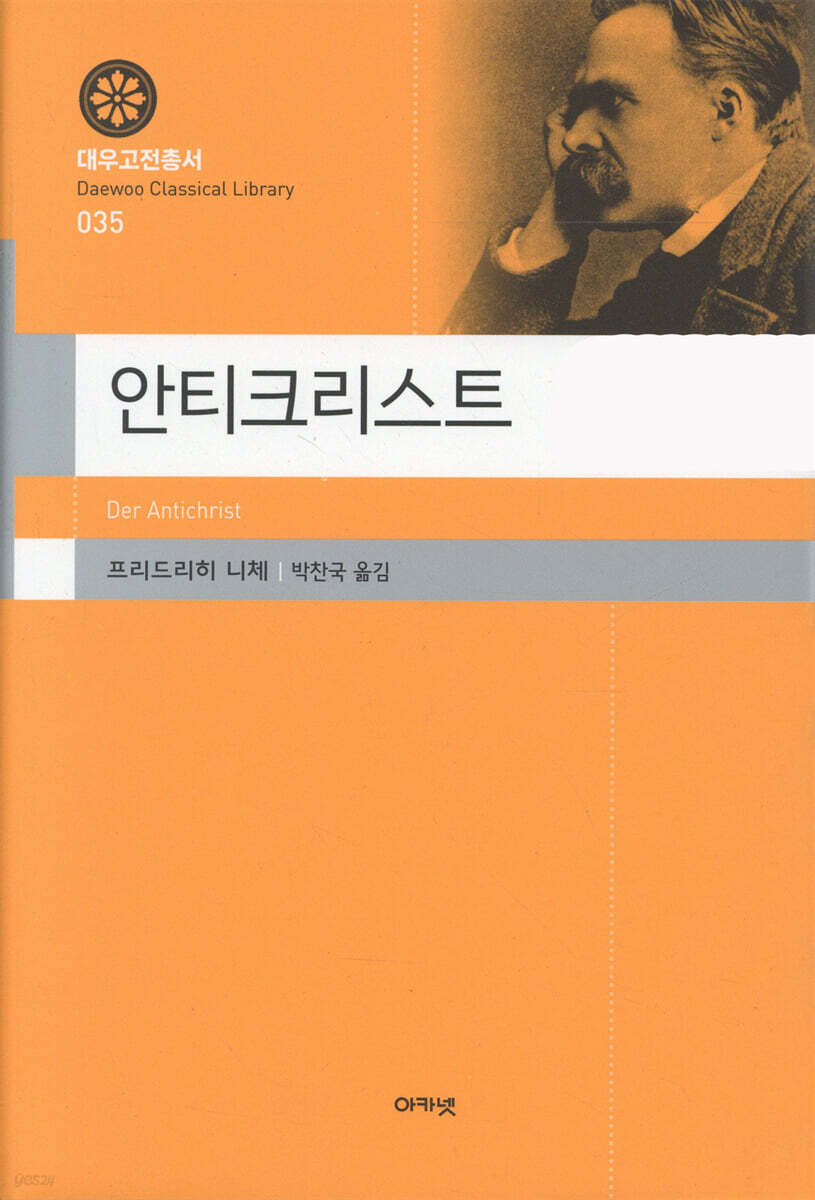
Antichrist
 |
Description
index
Translator's Preface
introduction
Antichrist
Christian persecution laws
Translator's Note
Search
introduction
Antichrist
Christian persecution laws
Translator's Note
Search
Publisher's Review
"The Antichrist," the culmination of Nietzsche's lifelong attempts at a shift in values.
-Evaluated as the culmination of Nietzsche's ultimate thoughts
Nietzsche completed his final writings, which would fully unfold his ideas, in the late summer and fall of 1888, twelve years before his death.
At the same time, Nietzsche thought that the grand finale of his lifelong attempt at a transformation of values had been achieved, to the point that he himself once gave it the subtitle, “The Transformation of All Values.”
Nietzsche planned to translate the book into major European languages and publish it in large numbers within two years.
However, it was published with four parts deleted by his younger sister.
The deleted part was restored in the 1955 Nietzsche Complete Works, and the 1969 revised edition was published with the addition of 'The Law of Persecution of Christianity'.
This Korean translation is based on this authenticated version.
A sharp yet nuanced critique of Western Christian thought and Western philosophy.
- Accurate translation and friendly, rich annotations make it accessible even to beginners of Nietzsche's thought.
Nietzsche, who believed that he was carrying out the final accounting of the transformation of values in 'Antichrist', subjected not only Christianity but also Western philosophy related to it, from Plato to Hegel and Schopenhauer, and to trends such as socialism and anarchism, to the subject of sharp criticism.
For Nietzsche, Christianity was not a special phenomenon separate from the entire history of Western philosophy.
There have been many books criticizing Christianity in the West, but none can match Nietzsche's critique of Christianity in terms of the breadth, thoroughness, sharpness, and intensity of its criticism.
However, in this book, Nietzsche goes beyond the critique of Christianity and criticizes the entire so-called Christian way of thinking, from Plato to Kant and German idealism, through democracy, socialism, and anarchism.
According to the prominent Catholic theologian Hans Küng, Nietzsche's critique is far more extensive and thorough than the critiques of Christianity by Feuerbach or Marx.
Nevertheless, the translator points out that it is necessary to note how Nietzsche's criticism and analysis are based on delicate logic.
In particular, Nietzsche's sense of smell for the differences between Buddhism and Christianity, the difference between the true ideology of Jesus and the institutionalized Christian doctrine, and the difference in the physiological and psychological foundations that can be said to be the ultimate foundation from which each of the ideologies of Buddhism, Jesus, and Christian doctrines originates, is extremely sensitive.
Through the introduction, the translator helps readers understand the nature and significance of 'Antichrist', the background and composition of its publication, and the differences between Buddhism and Christianity as seen by Nietzsche, as well as the comparison between Judaism and Christianity.
-Evaluated as the culmination of Nietzsche's ultimate thoughts
Nietzsche completed his final writings, which would fully unfold his ideas, in the late summer and fall of 1888, twelve years before his death.
At the same time, Nietzsche thought that the grand finale of his lifelong attempt at a transformation of values had been achieved, to the point that he himself once gave it the subtitle, “The Transformation of All Values.”
Nietzsche planned to translate the book into major European languages and publish it in large numbers within two years.
However, it was published with four parts deleted by his younger sister.
The deleted part was restored in the 1955 Nietzsche Complete Works, and the 1969 revised edition was published with the addition of 'The Law of Persecution of Christianity'.
This Korean translation is based on this authenticated version.
A sharp yet nuanced critique of Western Christian thought and Western philosophy.
- Accurate translation and friendly, rich annotations make it accessible even to beginners of Nietzsche's thought.
Nietzsche, who believed that he was carrying out the final accounting of the transformation of values in 'Antichrist', subjected not only Christianity but also Western philosophy related to it, from Plato to Hegel and Schopenhauer, and to trends such as socialism and anarchism, to the subject of sharp criticism.
For Nietzsche, Christianity was not a special phenomenon separate from the entire history of Western philosophy.
There have been many books criticizing Christianity in the West, but none can match Nietzsche's critique of Christianity in terms of the breadth, thoroughness, sharpness, and intensity of its criticism.
However, in this book, Nietzsche goes beyond the critique of Christianity and criticizes the entire so-called Christian way of thinking, from Plato to Kant and German idealism, through democracy, socialism, and anarchism.
According to the prominent Catholic theologian Hans Küng, Nietzsche's critique is far more extensive and thorough than the critiques of Christianity by Feuerbach or Marx.
Nevertheless, the translator points out that it is necessary to note how Nietzsche's criticism and analysis are based on delicate logic.
In particular, Nietzsche's sense of smell for the differences between Buddhism and Christianity, the difference between the true ideology of Jesus and the institutionalized Christian doctrine, and the difference in the physiological and psychological foundations that can be said to be the ultimate foundation from which each of the ideologies of Buddhism, Jesus, and Christian doctrines originates, is extremely sensitive.
Through the introduction, the translator helps readers understand the nature and significance of 'Antichrist', the background and composition of its publication, and the differences between Buddhism and Christianity as seen by Nietzsche, as well as the comparison between Judaism and Christianity.
GOODS SPECIFICS
- Date of issue: December 30, 2013
- Format: Hardcover book binding method guide
- Page count, weight, size: 216 pages | 373g | 128*188*20mm
- ISBN13: 9788957333440
- ISBN10: 8957333444
You may also like
카테고리
korean


korean

![GQ KOREA Mark (Monthly): December [2025]](http://librairie.coreenne.fr/cdn/shop/files/8ef265dbbfbf186523ed75ba7319009d.jpg?v=1765340328&width=3840)


