

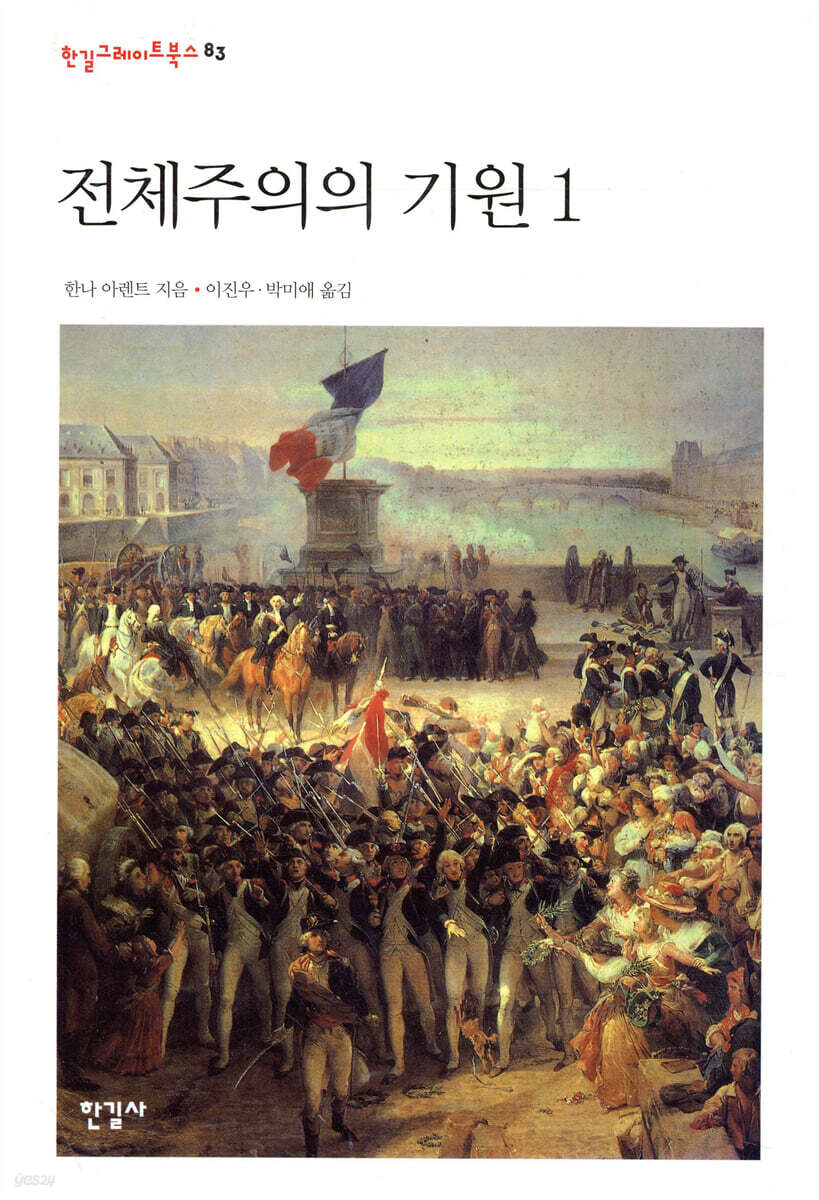
The Origins of Totalitarianism 1
 |
Description
Book Introduction
Hannah Arendt's first book, published in 1951, demonstrates her unique political ideological foundation.
In this book, Arendt meticulously researches the origins of totalitarianism through extensive historical data.
Like the author's life, which actively lived in reality, "The Origins of Totalitarianism" is a living work of thought. Rather than describing historical facts in a causal manner, it consistently emphasizes the author's deep-seated theme of political freedom under the title of "The Origins of Totalitarianism."
Understanding the background of totalitarianism and the possibility of this absolute evil recurring is the way to preserve 'freedom', the condition that makes humans human.
In this book, Arendt meticulously researches the origins of totalitarianism through extensive historical data.
Like the author's life, which actively lived in reality, "The Origins of Totalitarianism" is a living work of thought. Rather than describing historical facts in a causal manner, it consistently emphasizes the author's deep-seated theme of political freedom under the title of "The Origins of Totalitarianism."
Understanding the background of totalitarianism and the possibility of this absolute evil recurring is the way to preserve 'freedom', the condition that makes humans human.
- You can preview some of the book's contents.
Preview
index
Part 1: Anti-Semitism
An atrocity against common sense
Jews, the Nation-State, and the Rise of Anti-Semitism
Jews and Society
Dreyfus Affair
Part 2 Imperialism
political emancipation of the bourgeoisie
racial thought before racism
Race and Bureaucracy
Imperialism on the Continent: Pan-National Movement
The Fall of the Nation-State and the End of Human Rights
An atrocity against common sense
Jews, the Nation-State, and the Rise of Anti-Semitism
Jews and Society
Dreyfus Affair
Part 2 Imperialism
political emancipation of the bourgeoisie
racial thought before racism
Race and Bureaucracy
Imperialism on the Continent: Pan-National Movement
The Fall of the Nation-State and the End of Human Rights
Publisher's Review
Totalitarianism, a shadow that will never disappear
The translator refers to Arendt as a ‘Jewish political thinker.’
His innate Jewishness is closely linked to his ideological world.
『The Origins of Totalitarianism』 also begins with the heinous tragedy of the Holocaust.
Arendt attempts to explain totalitarianism in order to 'understand' the causes that led to this tragedy, which can only be seen as an absolute evil.
“The problem is that good and evil in our time are so strangely intertwined.
Without imperialism's "expansion for expansion's sake," the world would never have become one, and without the bourgeois class's apparatus of power, "power for power's sake," the extent of human power would never have been discovered.
And were it not for the fictional world of totalitarian movements, which so clearly demonstrate the uncertainty of our times, we would be hurtling towards destruction without even realizing what was happening.
If it is true that absolute evil emerged in the final stages of totalitarianism, it is equally true that without this absolute evil we would never have known the true fundamental nature of evil.” Just as good and evil are strangely intertwined, absolute evil did not arise independently of itself.
The birth of everything has its seed.
Arendt traces the origins of totalitarianism to the historical currents that led to anti-Semitism and imperialism, and logically describes, using only facts, how human dignity is being destroyed along these currents.
In the final part of the book, "Totalitarianism," he distinguishes totalitarianism from other dictatorships, stating that only Nazism and Stalinism are political systems that fully display totalitarian characteristics.
And we must face the fact that these systems could re-emerge at any time.
This argument is persuasive because he consistently views totalitarianism through the lens of 'freedom'.
Totalitarian movements that started from the belief that “everything is possible” have only shown that “everything can be destroyed.”
This is the point that demands a fundamental reflection on freedom.
Since the universal human value of freedom is at the heart of the problem, totalitarianism can never be confined to the specific history of Germany and Russia.
The Rise and Alienation of the Masses, and the Origins of Totalitarianism
Arendt sees the emergence of the 'masses' resulting from the collapse of class society as the real background of totalitarianism.
A totalitarian movement cannot arise without the masses, and a totalitarian state cannot be formed without a totalitarian movement.
“The unorganized and unstructured masses, the masses of desperate and hateful individuals” look to their leaders for salvation.
A totalitarian regime rules over the masses and relies on their support to the end.
Therefore, the core goal of totalitarianism is to constantly maintain the movement of the masses, and totalitarian regimes mass-produce the masses by using political tools that reduce individuals to useless 'surplus beings'.
To explain this phenomenon, Arendt uses the concept of 'mob', meaning a large, unorganized, violent crowd.
The mob is an unorganized surplus group that does not belong to any class, nation, or community.
Totalitarian regimes render each individual useless, erasing their individuality.
The people have become nothing more than a single group.
This is why the threat of totalitarianism remains relevant half a century after the writing of The Origins of Totalitarianism.
As the members of society become more atomized, a blind mass of people are constantly being produced.
Arendt, in the final part of the book, distinguishes between isolation, loneliness, and solitude, and warns against the potential seeds of totalitarianism that lie within the lonely crowd.
When humans are not recognized as 'creators' who act, but are treated as 'animals' who work, the isolation that all humans feel to some extent becomes loneliness.
Loneliness is based on the experience of not belonging to the world, and this experience is the most extreme and most desperate state a human being can have.
“Loneliness is closely related to the phenomenon of modern masses being uprooted and rendered unnecessary.
This phenomenon has been the curse of the modern masses since the beginning of the Industrial Revolution, and has been exacerbated with the rise of imperialism in the 19th century and with the breakdown of political institutions and social traditions in our own time.”
Man was created to have a beginning.
To borrow Arendt's words, the crisis of that time and its central experiences gave rise to an entirely new form of government, one that will exist as both a potential and an ever-present danger.
What we must not forget is to protect the 'freedom' that makes humans human, and this begins with recognizing the virtues of pluralism and democracy.
Arendt says that totalitarianism has only reduced and destroyed the space in which humans can move in the name of movement, but it has never erased the love of freedom from the human heart.
“Freedom is identical with the fact that man is reborn, and thus each is a new beginning, and in a sense the world is a new beginning.” Understanding totalitarianism is ultimately a hopeful attempt at true freedom.
The translator refers to Arendt as a ‘Jewish political thinker.’
His innate Jewishness is closely linked to his ideological world.
『The Origins of Totalitarianism』 also begins with the heinous tragedy of the Holocaust.
Arendt attempts to explain totalitarianism in order to 'understand' the causes that led to this tragedy, which can only be seen as an absolute evil.
“The problem is that good and evil in our time are so strangely intertwined.
Without imperialism's "expansion for expansion's sake," the world would never have become one, and without the bourgeois class's apparatus of power, "power for power's sake," the extent of human power would never have been discovered.
And were it not for the fictional world of totalitarian movements, which so clearly demonstrate the uncertainty of our times, we would be hurtling towards destruction without even realizing what was happening.
If it is true that absolute evil emerged in the final stages of totalitarianism, it is equally true that without this absolute evil we would never have known the true fundamental nature of evil.” Just as good and evil are strangely intertwined, absolute evil did not arise independently of itself.
The birth of everything has its seed.
Arendt traces the origins of totalitarianism to the historical currents that led to anti-Semitism and imperialism, and logically describes, using only facts, how human dignity is being destroyed along these currents.
In the final part of the book, "Totalitarianism," he distinguishes totalitarianism from other dictatorships, stating that only Nazism and Stalinism are political systems that fully display totalitarian characteristics.
And we must face the fact that these systems could re-emerge at any time.
This argument is persuasive because he consistently views totalitarianism through the lens of 'freedom'.
Totalitarian movements that started from the belief that “everything is possible” have only shown that “everything can be destroyed.”
This is the point that demands a fundamental reflection on freedom.
Since the universal human value of freedom is at the heart of the problem, totalitarianism can never be confined to the specific history of Germany and Russia.
The Rise and Alienation of the Masses, and the Origins of Totalitarianism
Arendt sees the emergence of the 'masses' resulting from the collapse of class society as the real background of totalitarianism.
A totalitarian movement cannot arise without the masses, and a totalitarian state cannot be formed without a totalitarian movement.
“The unorganized and unstructured masses, the masses of desperate and hateful individuals” look to their leaders for salvation.
A totalitarian regime rules over the masses and relies on their support to the end.
Therefore, the core goal of totalitarianism is to constantly maintain the movement of the masses, and totalitarian regimes mass-produce the masses by using political tools that reduce individuals to useless 'surplus beings'.
To explain this phenomenon, Arendt uses the concept of 'mob', meaning a large, unorganized, violent crowd.
The mob is an unorganized surplus group that does not belong to any class, nation, or community.
Totalitarian regimes render each individual useless, erasing their individuality.
The people have become nothing more than a single group.
This is why the threat of totalitarianism remains relevant half a century after the writing of The Origins of Totalitarianism.
As the members of society become more atomized, a blind mass of people are constantly being produced.
Arendt, in the final part of the book, distinguishes between isolation, loneliness, and solitude, and warns against the potential seeds of totalitarianism that lie within the lonely crowd.
When humans are not recognized as 'creators' who act, but are treated as 'animals' who work, the isolation that all humans feel to some extent becomes loneliness.
Loneliness is based on the experience of not belonging to the world, and this experience is the most extreme and most desperate state a human being can have.
“Loneliness is closely related to the phenomenon of modern masses being uprooted and rendered unnecessary.
This phenomenon has been the curse of the modern masses since the beginning of the Industrial Revolution, and has been exacerbated with the rise of imperialism in the 19th century and with the breakdown of political institutions and social traditions in our own time.”
Man was created to have a beginning.
To borrow Arendt's words, the crisis of that time and its central experiences gave rise to an entirely new form of government, one that will exist as both a potential and an ever-present danger.
What we must not forget is to protect the 'freedom' that makes humans human, and this begins with recognizing the virtues of pluralism and democracy.
Arendt says that totalitarianism has only reduced and destroyed the space in which humans can move in the name of movement, but it has never erased the love of freedom from the human heart.
“Freedom is identical with the fact that man is reborn, and thus each is a new beginning, and in a sense the world is a new beginning.” Understanding totalitarianism is ultimately a hopeful attempt at true freedom.
GOODS SPECIFICS
- Date of issue: December 10, 2006
- Format: Hardcover book binding method guide
- Page count, weight, size: 550 pages | 876g | 160*232*35mm
- ISBN13: 9788935656639
- ISBN10: 8935656631
You may also like
카테고리
korean


korean

![GQ KOREA Mark (Monthly): December [2025]](http://librairie.coreenne.fr/cdn/shop/files/8ef265dbbfbf186523ed75ba7319009d.jpg?v=1765340328&width=3840)


