

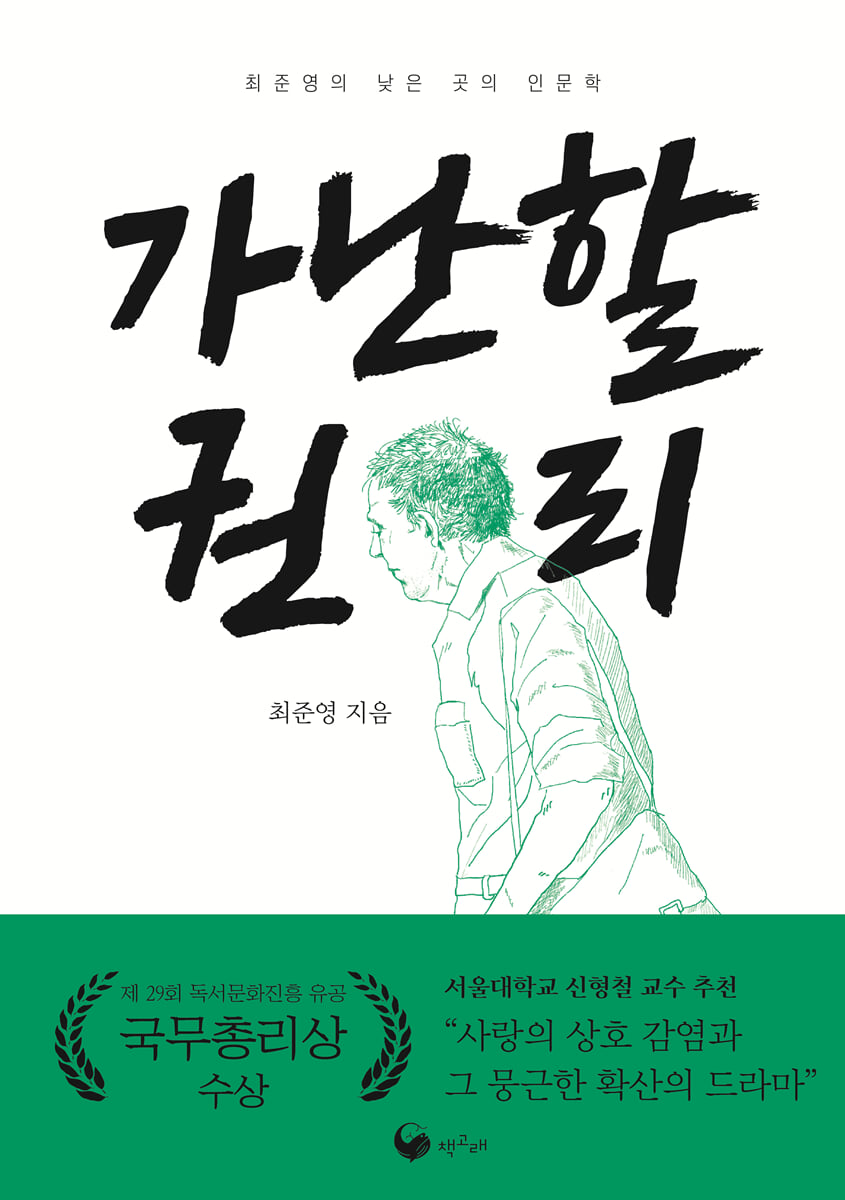
right to be poor
 |
Description
Book Introduction
Street humanist Choi Jun-young tells us
Stories of the Poor and the Not-Poor
"The Right to Be Poor" is a book that contains the life of author Choi Jun-young, who spent over 20 years working with the homeless as a street humanist.
It's nonfiction that's more fictional than fiction.
These are stories of people I met on the street for a long time or at a self-reliance center or shelter.
Most of them are those who have stumbled at some point in life and lost their way or are left lost and alone.
Author Choi Jun-young, who knows this sense of despair better than anyone else, did not approach them with the grand theme of "humanities," but simply stayed by their side, offered a shoulder to lean on, and listened to their stories, recording their difficult but vivid lives.
The traces of green make even those who study literature reflect on themselves.
All the characters appearing in 'The Right to Be Poor' are poor.
It's a cliché, but reading their stories reminds me of the saying, "Just because you're poor doesn't mean you're poor at heart."
I can't help but shed tears at the sight of the 1.3 million won that people who came to the funeral of Mr. Kim, who lived a life on the streets and met his death, left behind.
It is easy to guess that it was money that he had kept sewn inside his pants, lest someone on the street steal it, and that it was money that he had hidden in the deepest part of his body, or rather, the world, vowing never to take it out until the very end of his life.
The dictionary definition of the adjective poor is “a state of suffering in body and mind due to insufficient living conditions.”
It is undeniable that material poverty causes physical suffering, but isn't the emotional suffering a relative feeling?
That's why their stories are never poor.
Stories of the Poor and the Not-Poor
"The Right to Be Poor" is a book that contains the life of author Choi Jun-young, who spent over 20 years working with the homeless as a street humanist.
It's nonfiction that's more fictional than fiction.
These are stories of people I met on the street for a long time or at a self-reliance center or shelter.
Most of them are those who have stumbled at some point in life and lost their way or are left lost and alone.
Author Choi Jun-young, who knows this sense of despair better than anyone else, did not approach them with the grand theme of "humanities," but simply stayed by their side, offered a shoulder to lean on, and listened to their stories, recording their difficult but vivid lives.
The traces of green make even those who study literature reflect on themselves.
All the characters appearing in 'The Right to Be Poor' are poor.
It's a cliché, but reading their stories reminds me of the saying, "Just because you're poor doesn't mean you're poor at heart."
I can't help but shed tears at the sight of the 1.3 million won that people who came to the funeral of Mr. Kim, who lived a life on the streets and met his death, left behind.
It is easy to guess that it was money that he had kept sewn inside his pants, lest someone on the street steal it, and that it was money that he had hidden in the deepest part of his body, or rather, the world, vowing never to take it out until the very end of his life.
The dictionary definition of the adjective poor is “a state of suffering in body and mind due to insufficient living conditions.”
It is undeniable that material poverty causes physical suffering, but isn't the emotional suffering a relative feeling?
That's why their stories are never poor.
- You can preview some of the book's contents.
Preview
index
Prologue If you don't know where to go, just go.
Recommendation
Part 1: The Right to Be Poor
It's a person
50,000 won
Shall we have a go?
right to be poor
A reason to live
The "inheritance of poverty" is more heartbreaking than poverty itself.
Part 2: Humanities of Hope
Confess your love after 16 years
That winter was warm
I want to try living like a human being for once.
Sister, Sister, Mother Sister
Dreaming of a Korean-style prison university
Attitudes toward poverty
Humanities for Seniors: Our Happy Times
Humanists of the Third Street
From a life of deprivation and frustration to a life of study
Humanities for the Homeless: Taking the First Step
From beggar professor to street humanist
How far has street humanities come?
The third of a certain minority
promise
Lost in thought at Sajijae
I am broken, therefore I go forward.
Recommendation
Part 1: The Right to Be Poor
It's a person
50,000 won
Shall we have a go?
right to be poor
A reason to live
The "inheritance of poverty" is more heartbreaking than poverty itself.
Part 2: Humanities of Hope
Confess your love after 16 years
That winter was warm
I want to try living like a human being for once.
Sister, Sister, Mother Sister
Dreaming of a Korean-style prison university
Attitudes toward poverty
Humanities for Seniors: Our Happy Times
Humanists of the Third Street
From a life of deprivation and frustration to a life of study
Humanities for the Homeless: Taking the First Step
From beggar professor to street humanist
How far has street humanities come?
The third of a certain minority
promise
Lost in thought at Sajijae
I am broken, therefore I go forward.
Detailed image
Publisher's Review
“Who is by your side right now?”
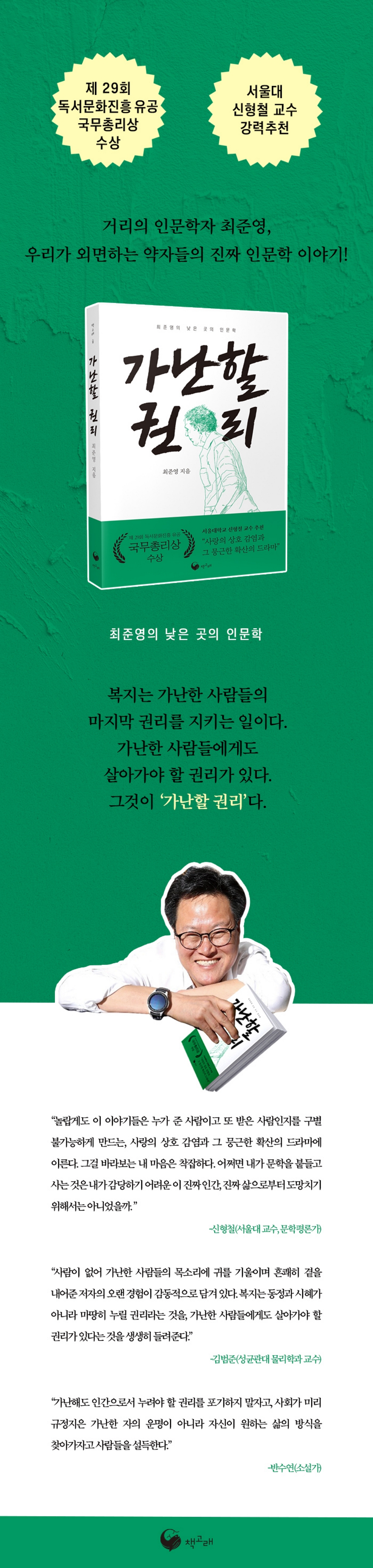
Our rightful rights as poor people
right to be poor
For some, the humanities may broaden their horizons of knowledge and wisdom.
For others, it may be a profound study that explores the very roots of humanity.
But, as novelist Ban Su-yeon said, is the humanities suitable for poor people who have to fight for survival every day?
To them, the humanities were considered a luxury, an unattainable realm, without needing to be taught.
So, humanities lectures have always been held in fancy places for fancy people.
To break that stereotype, author Choi Jun-young approached the lower levels.
That's why he was nicknamed the beggar professor and the street humanist.
I went to the self-reliance center to see teenagers who were branded as problem children, single mothers who were afraid of being criticized for raising their children alone at a young age and who were constantly cowering and hiding, each with their own stories.
He stayed by their side for 20 years without flinching, despite countless failures and frustrations.
Let's not give up, saying that even though we are poor, we too have the right to live like human beings, that it is our right as poor people.
If you don't know where to go, just go.
Last September, author Choi Jun-young received the 29th Prime Minister's Award for Merit in the Promotion of Reading Culture.
This is the second time I have been nominated for the Presidential Award, and I won the Prime Minister's Award.
This year, 20 years after I started Street Humanities, I finally got to teach humanities classes for the homeless simultaneously at 12 facilities across the country.
Although slow, a small change in perception is taking place.
There may be a chance of falling back again, but thanks to constantly breaking and being broken, writer Choi Jun-young has developed a stronger foundation than anyone else.
Even if he gets lost and wanders, or wherever he goes, writer Choi Jun-young will always keep moving forward.
I am certain that the mountain he has built silently and foolishly is approaching me step by step.
Our rightful rights as poor people
right to be poor
For some, the humanities may broaden their horizons of knowledge and wisdom.
For others, it may be a profound study that explores the very roots of humanity.
But, as novelist Ban Su-yeon said, is the humanities suitable for poor people who have to fight for survival every day?
To them, the humanities were considered a luxury, an unattainable realm, without needing to be taught.
So, humanities lectures have always been held in fancy places for fancy people.
To break that stereotype, author Choi Jun-young approached the lower levels.
That's why he was nicknamed the beggar professor and the street humanist.
I went to the self-reliance center to see teenagers who were branded as problem children, single mothers who were afraid of being criticized for raising their children alone at a young age and who were constantly cowering and hiding, each with their own stories.
He stayed by their side for 20 years without flinching, despite countless failures and frustrations.
Let's not give up, saying that even though we are poor, we too have the right to live like human beings, that it is our right as poor people.
If you don't know where to go, just go.
Last September, author Choi Jun-young received the 29th Prime Minister's Award for Merit in the Promotion of Reading Culture.
This is the second time I have been nominated for the Presidential Award, and I won the Prime Minister's Award.
This year, 20 years after I started Street Humanities, I finally got to teach humanities classes for the homeless simultaneously at 12 facilities across the country.
Although slow, a small change in perception is taking place.
There may be a chance of falling back again, but thanks to constantly breaking and being broken, writer Choi Jun-young has developed a stronger foundation than anyone else.
Even if he gets lost and wanders, or wherever he goes, writer Choi Jun-young will always keep moving forward.
I am certain that the mountain he has built silently and foolishly is approaching me step by step.
GOODS SPECIFICS
- Date of issue: September 25, 2023
- Page count, weight, size: 236 pages | 148*210*20mm
- ISBN13: 9791165021535
- ISBN10: 1165021536
- KC Certification: Certification Type: Conformity Confirmation
You may also like
카테고리
korean


korean

![GQ KOREA Mark (Monthly): December [2025]](http://librairie.coreenne.fr/cdn/shop/files/8ef265dbbfbf186523ed75ba7319009d.jpg?v=1765340328&width=3840)


