

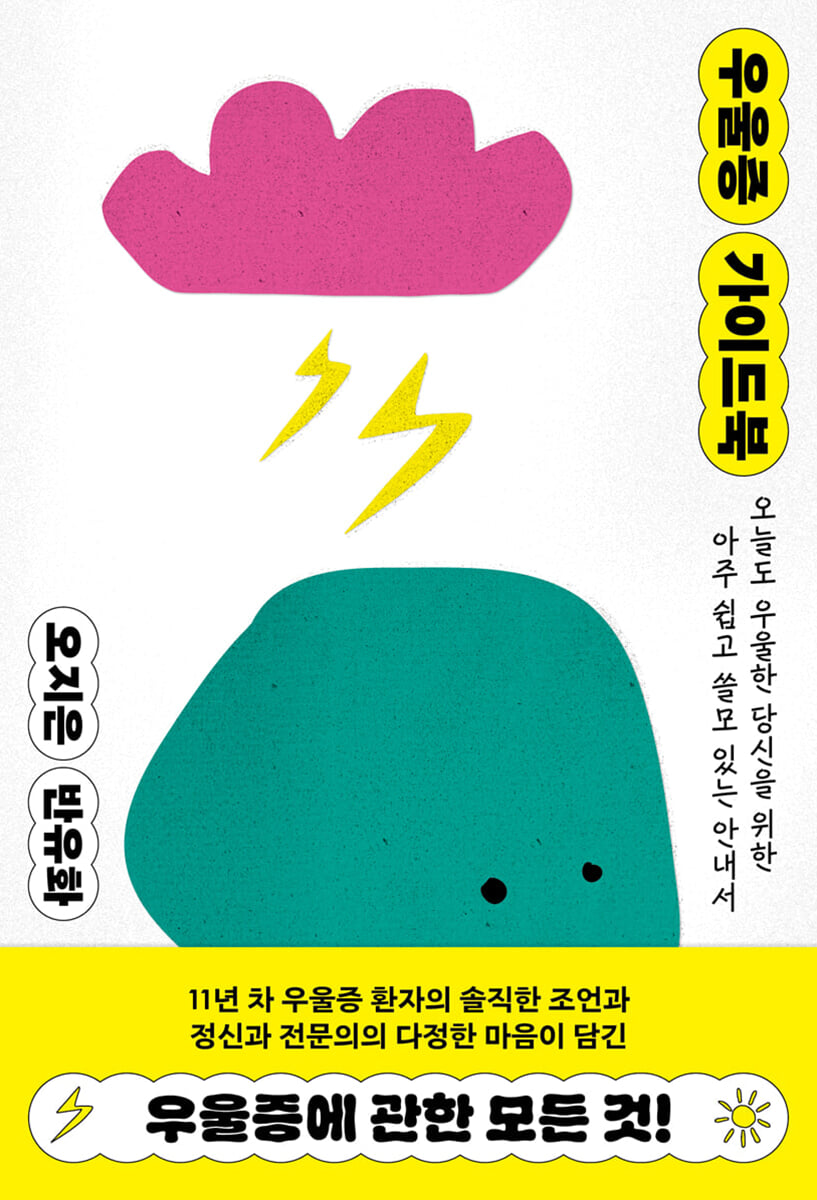
Depression Guidebook
 |
Description
Book Introduction
Ji-eun Oh, a patient with depression for 11 years who has been conveying her dark feelings through writing and music, and Yu-hwa Ban, a psychiatrist with 16 years of experience who has been listening to the hearts of her patients both inside and outside the clinic, have put together a book that covers everything about depression, from diagnosis to medication and counseling treatment and how to accept yourself.
The "Depression Guidebook" began when Ji-eun Oh, who realized that many people repeatedly give up in the process of accepting and treating their illness, started serializing her own illness diary online, containing tips for patients during the visits, diagnosis, treatment, and recovery process.
In the process of publishing this book, Dr. Ban Yu-hwa joined the medical review process, and based on the intimate stories of the patients, it was decided to include not only practical information needed right now but also medical information in one book.
One morning, about ten years ago, after spending seven hours in bed thinking nothing but 'I have to get up,' Oh Ji-eun realized that her condition was serious and went to a psychiatrist, where she was diagnosed with depression.
Since then, I have been receiving treatment for a long time, and I have been understanding the difficulties that only patients face, and I have been able to overcome them and build up my own know-how.
Based on these experiences, Oh Ji-eun shares detailed and practical information about her depression experience and treatment process in “The Depression Guidebook,” using her characteristic wit and honesty.
Furthermore, Dr. Ban Yu-hwa, who has come to realize this while seeing patients in the clinic, has written a book in the form of kind advice about depression that would be good for patients to know during the treatment process, in an attempt to lower the threshold for depression and psychiatry.
This book will serve as a light yet weighty guide for those who hesitate in the face of depression.
The "Depression Guidebook" began when Ji-eun Oh, who realized that many people repeatedly give up in the process of accepting and treating their illness, started serializing her own illness diary online, containing tips for patients during the visits, diagnosis, treatment, and recovery process.
In the process of publishing this book, Dr. Ban Yu-hwa joined the medical review process, and based on the intimate stories of the patients, it was decided to include not only practical information needed right now but also medical information in one book.
One morning, about ten years ago, after spending seven hours in bed thinking nothing but 'I have to get up,' Oh Ji-eun realized that her condition was serious and went to a psychiatrist, where she was diagnosed with depression.
Since then, I have been receiving treatment for a long time, and I have been understanding the difficulties that only patients face, and I have been able to overcome them and build up my own know-how.
Based on these experiences, Oh Ji-eun shares detailed and practical information about her depression experience and treatment process in “The Depression Guidebook,” using her characteristic wit and honesty.
Furthermore, Dr. Ban Yu-hwa, who has come to realize this while seeing patients in the clinic, has written a book in the form of kind advice about depression that would be good for patients to know during the treatment process, in an attempt to lower the threshold for depression and psychiatry.
This book will serve as a light yet weighty guide for those who hesitate in the face of depression.
- You can preview some of the book's contents.
Preview
index
prolog
Ten years of wandering through the hills of depression
Chapter 1: If you have symptoms, go to the hospital.
Am I Depressed? | Depression Denial | When Should I See a Doctor? | What to Say When You Go to the Hospital | My Journey to Find the Right Doctor for Me | [Dr. Ban Yu-hwa's Prescription] If your depression persists, get your pain checked at the hospital.
Chapter 2: Getting a Proper Diagnosis, Getting a Proper Treatment, and Dealing with It
How much does it honestly cost? | Will strengthening the brain help with chronic illness? | The trap of pills | Accepting reduced abilities | I will never take medication because it makes me fat | The world of narcotics and zolpidem | [Professor Ban Yu-hwa's prescription] Drug treatment is a cost-effective shield for my life.
Chapter 3: Let's get treated in various ways
Beginning Counseling | The Light and Darkness of the Word to Exercise (and the Light) | Breaking Bad Moods | Xanax Moods | [Prescription from Professor Ban Yu-hwa] Let's Understand and Take Care of Myself More Specifically
Chapter 4: Let's continue our daily lives
I'm depressed, but don't call me a psychopath | How to get along with people you care about | Teacher, why can't I graduate | Accepting the present and moving forward | [Professor Ban Yu-hwa's prescription] I am already sufficient as I am.
Epilogue
supplement
A candid conversation between a patient and a psychiatrist in their 11th year of practice.
Ten years of wandering through the hills of depression
Chapter 1: If you have symptoms, go to the hospital.
Am I Depressed? | Depression Denial | When Should I See a Doctor? | What to Say When You Go to the Hospital | My Journey to Find the Right Doctor for Me | [Dr. Ban Yu-hwa's Prescription] If your depression persists, get your pain checked at the hospital.
Chapter 2: Getting a Proper Diagnosis, Getting a Proper Treatment, and Dealing with It
How much does it honestly cost? | Will strengthening the brain help with chronic illness? | The trap of pills | Accepting reduced abilities | I will never take medication because it makes me fat | The world of narcotics and zolpidem | [Professor Ban Yu-hwa's prescription] Drug treatment is a cost-effective shield for my life.
Chapter 3: Let's get treated in various ways
Beginning Counseling | The Light and Darkness of the Word to Exercise (and the Light) | Breaking Bad Moods | Xanax Moods | [Prescription from Professor Ban Yu-hwa] Let's Understand and Take Care of Myself More Specifically
Chapter 4: Let's continue our daily lives
I'm depressed, but don't call me a psychopath | How to get along with people you care about | Teacher, why can't I graduate | Accepting the present and moving forward | [Professor Ban Yu-hwa's prescription] I am already sufficient as I am.
Epilogue
supplement
A candid conversation between a patient and a psychiatrist in their 11th year of practice.
Detailed image

Into the book
Even now, some people are probably wondering, 'Could it be that I have depression?'
Or, some people might dismiss the signs of depression, thinking, "Oh, no way! It can't be!"
Then, some people will naturally get better, and sadly, some will get worse.
I see people who are at a loss, now for the first time, with questions that I have had for a long time.
I see it on the internet and from my friends.
They are climbing the hill I climbed alone.
--- p.7 From “Prologue, 10 Years of Wandering on the Hill of Depression”
So I started writing this.
I am neither a specialist nor a doctor, but I am just a patient, and I decided to write down everything I have experienced and thought about so far in this book.
I thought that the story of a local person who had been going to the hospital for about 10 years might be useful.
Since it will focus on my own experiences, the field of view will not be very broad.
But since I did it, maybe you can too, and maybe your loved one can too, so I'll risk my foolishness and write down various stories.
I tried to write it as lightly as possible, like a guidebook that can be easily read.
--- p.10 From "Prologue, 10 Years of Wandering on the Hill of Depression"
It was over 10 years ago.
I was preparing a new book.
I woke up in the morning and tried to write a manuscript.
It was nothing new since that was my job and my work.
Preparation for writing is simple.
Just go to your desk, sit down, open your laptop, open your document program, and get started.
Even if it is natural that the work is difficult, it is difficult to say that the beginning of the process itself is difficult.
Because after taking a few steps, you just need to move your arms and fingers a little.
But that didn't work.
I couldn't just go to my desk.
Oh, I have to go.
Oh, that's weird.
Oh, I have to get up… .
I just lay on the bed like that, muttering and staring at the laptop on the desk.
I looked at my watch and saw that seven hours had passed.
Oh, I have to go to the hospital
You're doing it.
It was the first time I had that thought.
--- p.18 From “Chapter 1, Am I Depressed?”
The act of changing one's mind is not easy.
Because doctors are the people to whom patients can express their most difficult feelings.
Once treatment begins, patients develop a bond with their doctors.
Rapport, or connection, plays an important role in therapy.
It's a long way to go to change a doctor with whom you've barely established a rapport.
But change isn't all bad.
Perhaps it might be a little easier to think of the journey to finding a doctor as less about finding a kind and understanding friend and more about finding someone who can help you prescribe the right medicine.
Feeling like this doctor isn't on my side, that he's cold, that he's upset—those are the most important things to our goals.
It would be a good idea to think rationally about whether this doctor is a good fit for your treatment process.
If you determine that is not the case, you can transfer to a different hospital.
Just like my case.
The first doctor is not a bad doctor.
I was embarrassed, but I wasn't hurt by him.
It just didn't suit me at the time.
It's dizzying to think that at that time I gave up on psychiatric treatment because I was disappointed with the psychiatric treatment itself.
--- pp.44-4 From "Chapter 1, The Adventure of Finding the Right Doctor for Me"
So, the medication should be adjusted together with the doctor.
Whether it's increasing your dose, gradually reducing it, or switching to a different medication if it doesn't seem to be working for you, these are all things your doctor will be happy to work with you on.
Of course, medication is not a panacea, so it is also important to receive cognitive therapy or change ingrained lifestyle habits.
However, if you are someone who cannot get out of bed and cannot go about your daily life, it would be good to be able to build up your mental muscles with minimal help from medication.
--- pp.76-77 From "Chapter 2, The Trap of the Pill"
Prescribing zolpidem is quite tricky.
To prevent misuse, the number of rides possible at one time is strictly limited.
Side effects can occur and can be dangerous if taken incorrectly.
So, patients should not continue taking the medication because they cannot sleep, but should be careful about the dosage.
It is a drug that is difficult to handle as it is very effective.
So, it must have become so notorious that it was covered in “I Want to Know That.”
But what's bad is the crime that abuses the drug, not the drug itself.
--- p.93 From Chapter 2, “The World of Narcotics and Zolpidem”
Of course, medication only reduces daily pain and discomfort, but it cannot replace self-understanding and growth.
That is, it focuses on controlling the final outcome of pain.
Whatever is making me depressed, the depression itself is reduced through antidepressants.
Sometimes it can indirectly control symptoms.
In cases of insomnia, it can sometimes be a symptom of depression, so if it is not too painful right away, you can expect improvement by using only antidepressants instead of sleeping pills that directly help with sleep.
--- p.97 From “Chapter 2, Professor Ban Yu-hwa’s Prescription: Drug Therapy, a Cost-Effective Protection Shield for My Life”
All medicines have side effects.
If there are no side effects, then it can certainly not be called a drug.
However, I can tell you with certainty that the medications currently prescribed in psychiatry are definitely much safer than the previous image of psychiatric medication.
As I mentioned earlier, most of the drugs are suitable for long-term use, and this is also because remarkable progress has been made over the past several decades.
Of course, this doesn't mean you can take it as much as you want without worrying about side effects. However, most side effects are less severe than you might expect, are reversible, and can be controlled by changing or reducing the dose. So, even if you need drug treatment, I hope you don't stop yourself from taking it because of concerns about side effects.
--- pp.102-103 From "Chapter 2, Professor Ban Yu-hwa's Prescription: Drug Therapy, a Cost-Effective Protection Shield for My Life"
That's why I had to leave home late in the afternoon to observe the sky.
The sky-tari flower, which seemed to be spewing white petals from the darkness, was so strange that it was difficult to tell whether it was a plant or a small animal.
The next day, when I looked for the sky tari again, the petals were drooping as if nothing had happened the night before.
So why do these plants bloom in the dark of night? The most likely reason is that the insects that help pollinate them are nocturnal.
The reason for seeking the help of nocturnal insects may have been that it was judged that it would be more advantageous to be chosen by insects that are active at night than to participate in the competition to be chosen by insects that are active during the day.
The same reason is the choice of winter flowers, such as forsythia and snowdrops, which bloom during the cold winter rather than the warm spring and summer.
--- p.143 From “Flowers that Bloom in the Morning, Flowers that Bloom at Night”
That's how I got my first consultation.
I thought I wouldn't have much to say, but I talked so much that I was worried about the teacher's wrist as he took notes of my story.
Even in the second, third, and fourth rounds! I paused every now and then while speaking.
Because the teacher spoke so much that it was difficult to keep up with the typing.
Surprisingly, I didn't feel embarrassed or regretful.
I didn't even do any self-harm.
It was strange how I often started to dislike myself after talking too much.
The teacher started connecting the dots one by one from the 5th time.
My childhood, my relationship with my parents, my current depression, my lifestyle, my relationships, my work, my perspective on the world—these were all things that existed independently within me.
That's that, this is this.
But the teacher helped me build a small bridge between them.
As life is connected, the dots are also connected.
--- p.109 From “Chapter 3, Starting Counseling Therapy”
My first consultation was thankfully supported by the Korea Arts and Culture Education Service’s Artist Psychological Counseling Support Program.
The second consultation was with the help of the National Mindfulness Project.
Surprisingly(?) the country is helping us.
I thought it was time for the government to step in because the Korean people were in a state of great crisis, so I am very glad.
Additionally, many local governments provide psychological counseling, so those who would like to receive help are encouraged to actively search for it.
I was fortunate enough to find a teacher who was very helpful in both sessions, but that doesn't always work out.
In the case of the psychological counseling I received, compared to psychiatry, there was a lot of conversation, so I felt that the connection with the counselor was more important.
If you feel that you are not a good fit for the counselor, you can boldly change centers.
The counselor in Jeonju said this during our first meeting.
“If you feel uncomfortable, it’s okay to go somewhere else.
“Don’t worry, I won’t make you feel bad.” This is because the client must feel at ease in order to safely go deeper.
--- pp.114-115 From “Chapter 3, Starting Counseling Therapy”
Counseling therapy can take many forms, but if there's one thing they all have in common, it's that it alleviates suffering and fosters growth through self-understanding.
Even the expert who enters the basement of the mind with you in counseling therapy does not know what is inside that basement.
However, he only has a very small flashlight, not very bright, but dim.
He invites us to look around together, shining a light here and there.
--- p.132 From “Chapter 3, Teacher Ban Yu-hwa’s Prescription: Let’s understand and take care of myself more specifically”
Exercise increases the secretion of brain-derived neurotrophic factor (BDNF), as well as serotonin, dopamine, norepinephrine, and endorphins.
That's why exercise also has the function of promoting neuroplasticity, which is the effect of antidepressants that I mentioned earlier.
Of course, I hope you understand that exercising doesn't mean you don't need to take antidepressants.
Let's try it little by little from the time we have the energy to exercise and make it a daily habit.
It may take some time.
--- pp.135-136 From “Chapter 3, Professor Ban Yu-hwa’s Prescription: Let’s understand and take care of myself more specifically”
As a person with depression, I have several symptoms (this may seem new to you), and lethargy is one of them.
When this symptom occurs, even simple tasks become incredibly difficult, as if gravity has become ten times stronger.
Even something as simple as putting toilet paper in the trash can next to the bed is incredibly difficult.
I feel a little embarrassed after writing this, but I will continue to write.
Anyway, if you do that, the room will become a mess.
Clothes are left anywhere, and three or four cups of water are piled up on the desk.
It can be done in 10 minutes, but those 10 minutes feel like 100 minutes.
“Okay, let’s get started!” That’s because the energy that pushes my back doesn’t really sink in.
In such a situation, I think it is a good thing to recognize yourself as a patient.
It is about looking at yourself with the identity of a patient, thinking, ‘Oh, I have lethargy’, ‘This is what a depressed person is like.’
'It's just me being lazy.
I'm screwed.
Because it's much better than thinking, 'I'm sick of this...'
If you recognize the situation and say, 'I'm feeling lethargic right now!' and accept your condition, you will start to see a clue from then on.
My mind also feels a little better.
Because we found the cause.
If there is a cause, there is a solution.
--- pp.141-142 From “Chapter 4, I am depressed, but don’t call me a psychopath”
But what I think is most important when talking about the present is that the present is not eternal.
The present will soon become the past.
And a new present comes.
That 'new present' could look quite different.
It could be that I've seen four movies this season alone, or that I've accomplished a pretty impressive amount of work.
Anyway, the present is located a little further away.
It might get worse, but it might still be a pretty good guy next time.
So, acknowledging the present moment is not giving up or defeat, but rather growth.
It springs from such a solid truth.
It is a rehabilitation that takes place step by step.
--- p.155 From “Chapter 4, Accepting the Present and Taking a Step Forward”
If you know someone who is undergoing ongoing treatment, whether medication or counseling, rather than worrying about what to do, just remember what not to do.
'Do no harm' is better.
If you're unsure of how to react when you hear stories about hardship or treatment, try letting go of the "I have to solve it myself" mentality and simply expressing that you're willing to help whenever needed.
Some people are born with incredible sensitivity and are able to provide the care that their partner needs precisely and without overwhelming them, but far more often than not, this is not the case.
The very idea that we need to provide perfect empathy, understanding, and care is an excessive expectation of ourselves.
We can't and don't need to all have perfect responses.
So, simply trying not to cause obvious harm can be a huge help to someone suffering from depression.
Or, some people might dismiss the signs of depression, thinking, "Oh, no way! It can't be!"
Then, some people will naturally get better, and sadly, some will get worse.
I see people who are at a loss, now for the first time, with questions that I have had for a long time.
I see it on the internet and from my friends.
They are climbing the hill I climbed alone.
--- p.7 From “Prologue, 10 Years of Wandering on the Hill of Depression”
So I started writing this.
I am neither a specialist nor a doctor, but I am just a patient, and I decided to write down everything I have experienced and thought about so far in this book.
I thought that the story of a local person who had been going to the hospital for about 10 years might be useful.
Since it will focus on my own experiences, the field of view will not be very broad.
But since I did it, maybe you can too, and maybe your loved one can too, so I'll risk my foolishness and write down various stories.
I tried to write it as lightly as possible, like a guidebook that can be easily read.
--- p.10 From "Prologue, 10 Years of Wandering on the Hill of Depression"
It was over 10 years ago.
I was preparing a new book.
I woke up in the morning and tried to write a manuscript.
It was nothing new since that was my job and my work.
Preparation for writing is simple.
Just go to your desk, sit down, open your laptop, open your document program, and get started.
Even if it is natural that the work is difficult, it is difficult to say that the beginning of the process itself is difficult.
Because after taking a few steps, you just need to move your arms and fingers a little.
But that didn't work.
I couldn't just go to my desk.
Oh, I have to go.
Oh, that's weird.
Oh, I have to get up… .
I just lay on the bed like that, muttering and staring at the laptop on the desk.
I looked at my watch and saw that seven hours had passed.
Oh, I have to go to the hospital
You're doing it.
It was the first time I had that thought.
--- p.18 From “Chapter 1, Am I Depressed?”
The act of changing one's mind is not easy.
Because doctors are the people to whom patients can express their most difficult feelings.
Once treatment begins, patients develop a bond with their doctors.
Rapport, or connection, plays an important role in therapy.
It's a long way to go to change a doctor with whom you've barely established a rapport.
But change isn't all bad.
Perhaps it might be a little easier to think of the journey to finding a doctor as less about finding a kind and understanding friend and more about finding someone who can help you prescribe the right medicine.
Feeling like this doctor isn't on my side, that he's cold, that he's upset—those are the most important things to our goals.
It would be a good idea to think rationally about whether this doctor is a good fit for your treatment process.
If you determine that is not the case, you can transfer to a different hospital.
Just like my case.
The first doctor is not a bad doctor.
I was embarrassed, but I wasn't hurt by him.
It just didn't suit me at the time.
It's dizzying to think that at that time I gave up on psychiatric treatment because I was disappointed with the psychiatric treatment itself.
--- pp.44-4 From "Chapter 1, The Adventure of Finding the Right Doctor for Me"
So, the medication should be adjusted together with the doctor.
Whether it's increasing your dose, gradually reducing it, or switching to a different medication if it doesn't seem to be working for you, these are all things your doctor will be happy to work with you on.
Of course, medication is not a panacea, so it is also important to receive cognitive therapy or change ingrained lifestyle habits.
However, if you are someone who cannot get out of bed and cannot go about your daily life, it would be good to be able to build up your mental muscles with minimal help from medication.
--- pp.76-77 From "Chapter 2, The Trap of the Pill"
Prescribing zolpidem is quite tricky.
To prevent misuse, the number of rides possible at one time is strictly limited.
Side effects can occur and can be dangerous if taken incorrectly.
So, patients should not continue taking the medication because they cannot sleep, but should be careful about the dosage.
It is a drug that is difficult to handle as it is very effective.
So, it must have become so notorious that it was covered in “I Want to Know That.”
But what's bad is the crime that abuses the drug, not the drug itself.
--- p.93 From Chapter 2, “The World of Narcotics and Zolpidem”
Of course, medication only reduces daily pain and discomfort, but it cannot replace self-understanding and growth.
That is, it focuses on controlling the final outcome of pain.
Whatever is making me depressed, the depression itself is reduced through antidepressants.
Sometimes it can indirectly control symptoms.
In cases of insomnia, it can sometimes be a symptom of depression, so if it is not too painful right away, you can expect improvement by using only antidepressants instead of sleeping pills that directly help with sleep.
--- p.97 From “Chapter 2, Professor Ban Yu-hwa’s Prescription: Drug Therapy, a Cost-Effective Protection Shield for My Life”
All medicines have side effects.
If there are no side effects, then it can certainly not be called a drug.
However, I can tell you with certainty that the medications currently prescribed in psychiatry are definitely much safer than the previous image of psychiatric medication.
As I mentioned earlier, most of the drugs are suitable for long-term use, and this is also because remarkable progress has been made over the past several decades.
Of course, this doesn't mean you can take it as much as you want without worrying about side effects. However, most side effects are less severe than you might expect, are reversible, and can be controlled by changing or reducing the dose. So, even if you need drug treatment, I hope you don't stop yourself from taking it because of concerns about side effects.
--- pp.102-103 From "Chapter 2, Professor Ban Yu-hwa's Prescription: Drug Therapy, a Cost-Effective Protection Shield for My Life"
That's why I had to leave home late in the afternoon to observe the sky.
The sky-tari flower, which seemed to be spewing white petals from the darkness, was so strange that it was difficult to tell whether it was a plant or a small animal.
The next day, when I looked for the sky tari again, the petals were drooping as if nothing had happened the night before.
So why do these plants bloom in the dark of night? The most likely reason is that the insects that help pollinate them are nocturnal.
The reason for seeking the help of nocturnal insects may have been that it was judged that it would be more advantageous to be chosen by insects that are active at night than to participate in the competition to be chosen by insects that are active during the day.
The same reason is the choice of winter flowers, such as forsythia and snowdrops, which bloom during the cold winter rather than the warm spring and summer.
--- p.143 From “Flowers that Bloom in the Morning, Flowers that Bloom at Night”
That's how I got my first consultation.
I thought I wouldn't have much to say, but I talked so much that I was worried about the teacher's wrist as he took notes of my story.
Even in the second, third, and fourth rounds! I paused every now and then while speaking.
Because the teacher spoke so much that it was difficult to keep up with the typing.
Surprisingly, I didn't feel embarrassed or regretful.
I didn't even do any self-harm.
It was strange how I often started to dislike myself after talking too much.
The teacher started connecting the dots one by one from the 5th time.
My childhood, my relationship with my parents, my current depression, my lifestyle, my relationships, my work, my perspective on the world—these were all things that existed independently within me.
That's that, this is this.
But the teacher helped me build a small bridge between them.
As life is connected, the dots are also connected.
--- p.109 From “Chapter 3, Starting Counseling Therapy”
My first consultation was thankfully supported by the Korea Arts and Culture Education Service’s Artist Psychological Counseling Support Program.
The second consultation was with the help of the National Mindfulness Project.
Surprisingly(?) the country is helping us.
I thought it was time for the government to step in because the Korean people were in a state of great crisis, so I am very glad.
Additionally, many local governments provide psychological counseling, so those who would like to receive help are encouraged to actively search for it.
I was fortunate enough to find a teacher who was very helpful in both sessions, but that doesn't always work out.
In the case of the psychological counseling I received, compared to psychiatry, there was a lot of conversation, so I felt that the connection with the counselor was more important.
If you feel that you are not a good fit for the counselor, you can boldly change centers.
The counselor in Jeonju said this during our first meeting.
“If you feel uncomfortable, it’s okay to go somewhere else.
“Don’t worry, I won’t make you feel bad.” This is because the client must feel at ease in order to safely go deeper.
--- pp.114-115 From “Chapter 3, Starting Counseling Therapy”
Counseling therapy can take many forms, but if there's one thing they all have in common, it's that it alleviates suffering and fosters growth through self-understanding.
Even the expert who enters the basement of the mind with you in counseling therapy does not know what is inside that basement.
However, he only has a very small flashlight, not very bright, but dim.
He invites us to look around together, shining a light here and there.
--- p.132 From “Chapter 3, Teacher Ban Yu-hwa’s Prescription: Let’s understand and take care of myself more specifically”
Exercise increases the secretion of brain-derived neurotrophic factor (BDNF), as well as serotonin, dopamine, norepinephrine, and endorphins.
That's why exercise also has the function of promoting neuroplasticity, which is the effect of antidepressants that I mentioned earlier.
Of course, I hope you understand that exercising doesn't mean you don't need to take antidepressants.
Let's try it little by little from the time we have the energy to exercise and make it a daily habit.
It may take some time.
--- pp.135-136 From “Chapter 3, Professor Ban Yu-hwa’s Prescription: Let’s understand and take care of myself more specifically”
As a person with depression, I have several symptoms (this may seem new to you), and lethargy is one of them.
When this symptom occurs, even simple tasks become incredibly difficult, as if gravity has become ten times stronger.
Even something as simple as putting toilet paper in the trash can next to the bed is incredibly difficult.
I feel a little embarrassed after writing this, but I will continue to write.
Anyway, if you do that, the room will become a mess.
Clothes are left anywhere, and three or four cups of water are piled up on the desk.
It can be done in 10 minutes, but those 10 minutes feel like 100 minutes.
“Okay, let’s get started!” That’s because the energy that pushes my back doesn’t really sink in.
In such a situation, I think it is a good thing to recognize yourself as a patient.
It is about looking at yourself with the identity of a patient, thinking, ‘Oh, I have lethargy’, ‘This is what a depressed person is like.’
'It's just me being lazy.
I'm screwed.
Because it's much better than thinking, 'I'm sick of this...'
If you recognize the situation and say, 'I'm feeling lethargic right now!' and accept your condition, you will start to see a clue from then on.
My mind also feels a little better.
Because we found the cause.
If there is a cause, there is a solution.
--- pp.141-142 From “Chapter 4, I am depressed, but don’t call me a psychopath”
But what I think is most important when talking about the present is that the present is not eternal.
The present will soon become the past.
And a new present comes.
That 'new present' could look quite different.
It could be that I've seen four movies this season alone, or that I've accomplished a pretty impressive amount of work.
Anyway, the present is located a little further away.
It might get worse, but it might still be a pretty good guy next time.
So, acknowledging the present moment is not giving up or defeat, but rather growth.
It springs from such a solid truth.
It is a rehabilitation that takes place step by step.
--- p.155 From “Chapter 4, Accepting the Present and Taking a Step Forward”
If you know someone who is undergoing ongoing treatment, whether medication or counseling, rather than worrying about what to do, just remember what not to do.
'Do no harm' is better.
If you're unsure of how to react when you hear stories about hardship or treatment, try letting go of the "I have to solve it myself" mentality and simply expressing that you're willing to help whenever needed.
Some people are born with incredible sensitivity and are able to provide the care that their partner needs precisely and without overwhelming them, but far more often than not, this is not the case.
The very idea that we need to provide perfect empathy, understanding, and care is an excessive expectation of ourselves.
We can't and don't need to all have perfect responses.
So, simply trying not to cause obvious harm can be a huge help to someone suffering from depression.
--- p.160 From “Chapter 4, Professor Ban Yu-hwa’s Prescription: I am already sufficient in myself”
Publisher's Review
I'm depressed today too, but if I focus on my brain
Do you believe this will get better too?
“Depression is something beyond the will.
I found out a little late.”
From the visit to diagnosis, medication and counseling treatment, and how to accept myself
A guide to depression from a psychiatrist and a patient with depression for 11 years!
The author of this book, Ji-eun Oh, tried to get up one morning about ten years ago, but was unable to do so. After spending seven hours in bed, she realized, "I need to go to the hospital."
After having difficulty finding a place to visit a psychiatrist and being diagnosed with depression and burnout syndrome, I have been receiving treatment for 11 years.
Looking back, the signs were clearly there before, but I didn't want to "link my mind to the illness." I thought of myself as pathetic and lazy, and believed that I could solve this with willpower and effort.
After realizing belatedly that I had depression, that depression could only be cured with treatment, and that going to the hospital was the biggest step toward recovery, I was able to begin the process of treating my depression.
Ji-eun Oh, who has been receiving hospital treatment for a long time, encounters questions from people around her and posts on social media and the internet, asking questions about whether she has depression, whether she should go to the hospital, whether she should continue taking medication, how to deal with the side effects of medication, and whether she should also receive counseling.
I discovered that many people are climbing the hill of depression that I had climbed alone.
He met Ban Yu-hwa, who had been working as a psychiatrist for 16 years, understanding patients' difficulties both inside and outside the clinic and publishing several psychological books to promote mental health, and decided to write an easy and enjoyable 'Depression Guidebook' based on his treatment experience.
Author Oh Ji-eun and Dr. Ban Yu-hwa wrote this book for people who want to understand their depression, patients who want to continue treatment for depression, and readers who want to understand depression.
It tells the patient's perspective on how to recover from daily life and accept oneself as one is with the illness, as well as the process of visiting a hospital after discovering symptoms of depression, receiving a diagnosis, and receiving medication and counseling, and adds the doctor's medical opinion.
This book deeply empathizes with the sense of hopelessness felt by patients, suggests ways to resolve it, and provides answers to questions that patients were unable to ask doctors in the examination room. Through this book, readers will be able to find answers to their concerns about depression that no one has been able to tell them or ask about.
Do you believe this will get better too?
“Depression is something beyond the will.
I found out a little late.”
From the visit to diagnosis, medication and counseling treatment, and how to accept myself
A guide to depression from a psychiatrist and a patient with depression for 11 years!
The author of this book, Ji-eun Oh, tried to get up one morning about ten years ago, but was unable to do so. After spending seven hours in bed, she realized, "I need to go to the hospital."
After having difficulty finding a place to visit a psychiatrist and being diagnosed with depression and burnout syndrome, I have been receiving treatment for 11 years.
Looking back, the signs were clearly there before, but I didn't want to "link my mind to the illness." I thought of myself as pathetic and lazy, and believed that I could solve this with willpower and effort.
After realizing belatedly that I had depression, that depression could only be cured with treatment, and that going to the hospital was the biggest step toward recovery, I was able to begin the process of treating my depression.
Ji-eun Oh, who has been receiving hospital treatment for a long time, encounters questions from people around her and posts on social media and the internet, asking questions about whether she has depression, whether she should go to the hospital, whether she should continue taking medication, how to deal with the side effects of medication, and whether she should also receive counseling.
I discovered that many people are climbing the hill of depression that I had climbed alone.
He met Ban Yu-hwa, who had been working as a psychiatrist for 16 years, understanding patients' difficulties both inside and outside the clinic and publishing several psychological books to promote mental health, and decided to write an easy and enjoyable 'Depression Guidebook' based on his treatment experience.
Author Oh Ji-eun and Dr. Ban Yu-hwa wrote this book for people who want to understand their depression, patients who want to continue treatment for depression, and readers who want to understand depression.
It tells the patient's perspective on how to recover from daily life and accept oneself as one is with the illness, as well as the process of visiting a hospital after discovering symptoms of depression, receiving a diagnosis, and receiving medication and counseling, and adds the doctor's medical opinion.
This book deeply empathizes with the sense of hopelessness felt by patients, suggests ways to resolve it, and provides answers to questions that patients were unable to ask doctors in the examination room. Through this book, readers will be able to find answers to their concerns about depression that no one has been able to tell them or ask about.
GOODS SPECIFICS
- Date of issue: April 23, 2025
- Format: Guide to book binding methods for four-sided binding
- Page count, weight, size: 264 pages | 406g | 128*188*18mm
- ISBN13: 9791171713561
- ISBN10: 1171713568
You may also like
카테고리
korean


korean

![GQ KOREA Mark (Monthly): December [2025]](http://librairie.coreenne.fr/cdn/shop/files/8ef265dbbfbf186523ed75ba7319009d.jpg?v=1765340328&width=3840)


