

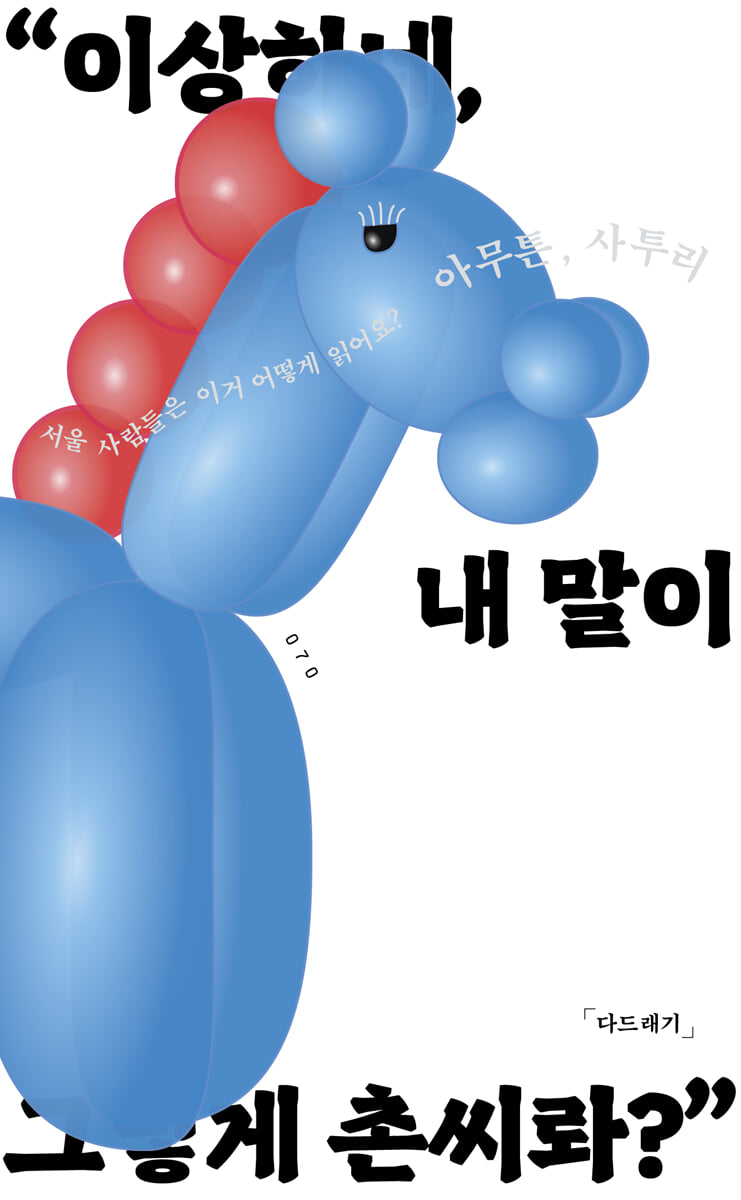
Anyway, dialect
 |
Description
Book Introduction
“How do people in Seoul read this?”
A Never-ending Dialect Rhapsody for Korean-speaking Korean speakers across the eight provinces
Cartoonist Dadraegi has extraordinary language skills.
His true value is revealed when he uses foreign languages such as Seoul dialect, Busan dialect, Daegu dialect, and Jeju dialect, rather than foreign languages such as English, Japanese, or French (in fact, there are even characters in his comics who speak the Gaeseong dialect).
When I see people speaking in dialects from various regions as if they were really there, I am amazed by the variety of language variations and the skill with which they vividly reproduce the sounds of speech in writing.
First of all, if it's not too much trouble, I really want to ask.
Excuse me, but… where are you from?
"Anyway, Dialect" is the first collection of essays by cartoonist Dadraegi, who was born and raised in Busan, then moved to Suncheon and settled in Gwangju.
The author left for Suncheon, Jeolla Province, around the age of twenty with the dream of becoming a cartoonist.
Because at the time, the only national university with a cartoon department was located there.
Perhaps due to Suncheon's geographical location between Jeolla-do and Gyeongsang-do, people from various regions of Yeongnam and Honam gathered at the university.
The novel and unusual dialects heard here and there were unfamiliar for a moment, but then the 'Hwagae Market dialect' sprouted, with old words from Jeolla-do and other regions infiltrating here and there based on the Gyeongsang-do dialect.
The author says that even now, when passing through the old toll gate on the way from Jeolla Province to Busan, an unidentified dialect that had been deeply dormant bursts out.
A single word that arouses the listener's endless curiosity begins like this.
“Oh my, it’s been a while since I’ve been here. Busan has changed so much, I can’t even recognize it! It’s really changed a lot, don’t you think?”
A Never-ending Dialect Rhapsody for Korean-speaking Korean speakers across the eight provinces
Cartoonist Dadraegi has extraordinary language skills.
His true value is revealed when he uses foreign languages such as Seoul dialect, Busan dialect, Daegu dialect, and Jeju dialect, rather than foreign languages such as English, Japanese, or French (in fact, there are even characters in his comics who speak the Gaeseong dialect).
When I see people speaking in dialects from various regions as if they were really there, I am amazed by the variety of language variations and the skill with which they vividly reproduce the sounds of speech in writing.
First of all, if it's not too much trouble, I really want to ask.
Excuse me, but… where are you from?
"Anyway, Dialect" is the first collection of essays by cartoonist Dadraegi, who was born and raised in Busan, then moved to Suncheon and settled in Gwangju.
The author left for Suncheon, Jeolla Province, around the age of twenty with the dream of becoming a cartoonist.
Because at the time, the only national university with a cartoon department was located there.
Perhaps due to Suncheon's geographical location between Jeolla-do and Gyeongsang-do, people from various regions of Yeongnam and Honam gathered at the university.
The novel and unusual dialects heard here and there were unfamiliar for a moment, but then the 'Hwagae Market dialect' sprouted, with old words from Jeolla-do and other regions infiltrating here and there based on the Gyeongsang-do dialect.
The author says that even now, when passing through the old toll gate on the way from Jeolla Province to Busan, an unidentified dialect that had been deeply dormant bursts out.
A single word that arouses the listener's endless curiosity begins like this.
“Oh my, it’s been a while since I’ve been here. Busan has changed so much, I can’t even recognize it! It’s really changed a lot, don’t you think?”
- You can preview some of the book's contents.
Preview
index
storyteller
Where is your house?
A word that breaks taboos
Rhapsody Inn Call Center 1
Rhapsody in Call Center 2
Mother's last words
Japanese grandmother and tea
I only have one sister
A defense against the unfair dialect
How do people in Seoul read this?
With incredible care
Fluently and deliciously
As you say
Epilogue
Where is your house?
A word that breaks taboos
Rhapsody Inn Call Center 1
Rhapsody in Call Center 2
Mother's last words
Japanese grandmother and tea
I only have one sister
A defense against the unfair dialect
How do people in Seoul read this?
With incredible care
Fluently and deliciously
As you say
Epilogue
Detailed image
Into the book
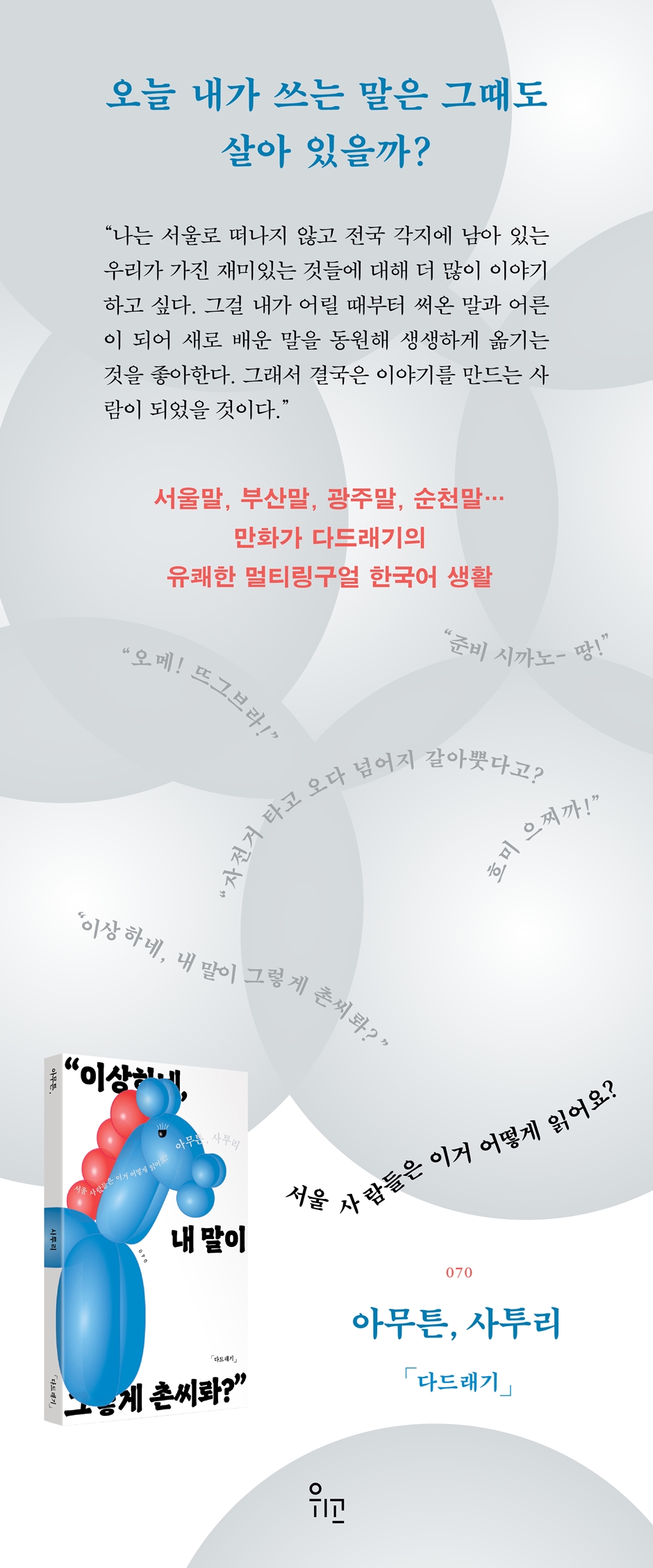
“Oh my! T-ttugbra!”
“You fell off your bike and you want to change it? What the heck!”
Can you feel this natural collaboration between Gyeongsang-do and Jeolla-do?
Words that can never be said on purpose.
These are not words I learned by deliberately following them or being scolded, but words that have been absorbed and taken root within me.
The Gyeongsang dialect, which was further strengthened by the influence of the Gyeongsangnam-do friends I met in Suncheon for five years, and the Jeolla dialect, which was internalized after living in Jeolla-do for nearly 20 years, were mixed together, resulting in my own way of speaking that is much more distant from Busan.
--- p.16
“Customer, if you look at the bottom right corner of the largest text that says ‘Bill,’ you will see a black box inside a blue box.
Can you see it?”
“Huh? That’s it.
“There it is.”
“In that table, the bottom box will say ‘Current Monthly Fee’ and the amount will appear next to it.
“Aren’t you positive?”
"Aren't you positive?" The sudden question, "Aren't you positive?", thrown in after a clear and concise explanation, is a question that can only come from a Jeolla-do native who has perfectly mastered the dialect.
An unintentional “Pfft!” burst out of my mouth.
At that time, all the eyes of the twenty-five superintendents and the education team leader were focused on me.
But it wasn't a look of reproach for laughing.
It was a look of genuine curiosity.
I realized it the moment my seatmate next to me mouthed 'Why?'
No one is saying that this situation is funny or strange right now.
What the heck, am I the only one laughing?
--- pp.28-29
As we grew up, my sister and I lived in different places, and our speech evolved to suit our respective backgrounds.
My sister, who has been teaching in Gyeonggi-do for over 20 years, speaks with a really neat upper-class accent.
It is a sophistication on a different level from mine, which evolved while rolling around the Hwagae market.
I should be used to it by now, but I still get goosebumps when I hear my sister's Gyeonggi dialect when I occasionally run into her on the phone or while shopping with her.
My sister's shameless attitude, as if she were speaking two languages, is still disgusting to see, but she has now reached a point where she doesn't even notice my glare.
Is this the power of salary?
But if it's just the two of us, my sister's seal will inevitably be broken.
When words that are close to instinct come out without going through consciousness, I realize anew how much dialect I have forgotten over the years.
--- pp.47-48
Similar to "unnie", "oppa" is also a word that is used comfortably between close siblings or those who speak informally.
As a female student from Gyeongsang Province who can't even say the word "oppa" to others because it makes her cringe, let alone call me "oppa," when I hear a touching comment that I can't tell if it's out of curiosity or flirting, "I think it's really cute when you call me "oppa," I can't help but think this.
Since when did you know me, Yaga?
--- p.67
You can also use 'hey' to threaten your opponent.
Compared to the Jeolla dialect, which puts a lot of effort into the content and description of even one curse, the Gyeongsang dialect is short and simple, so you just need to say a title loudly and strongly.
The moment the opponent says “Oppa!!!!!!” instead of “Oppa~”, a battle may begin.
So, those who ask for Oppa at first sight, be prepared for all kinds of variations of the past questions.
--- p.68
Incorporating now-forgotten or little-used words into my work serves as a way to connect characters across generations as a family unit, and also to show how dramatically different people can come together.
And the reason I try to include as many everyday phrases as possible in my comics is because I hope that as more people get together, more interesting phrases will be born.
Isn't it fun to search Google and ask AI speakers questions to find out what I'm talking about?
“You fell off your bike and you want to change it? What the heck!”
Can you feel this natural collaboration between Gyeongsang-do and Jeolla-do?
Words that can never be said on purpose.
These are not words I learned by deliberately following them or being scolded, but words that have been absorbed and taken root within me.
The Gyeongsang dialect, which was further strengthened by the influence of the Gyeongsangnam-do friends I met in Suncheon for five years, and the Jeolla dialect, which was internalized after living in Jeolla-do for nearly 20 years, were mixed together, resulting in my own way of speaking that is much more distant from Busan.
--- p.16
“Customer, if you look at the bottom right corner of the largest text that says ‘Bill,’ you will see a black box inside a blue box.
Can you see it?”
“Huh? That’s it.
“There it is.”
“In that table, the bottom box will say ‘Current Monthly Fee’ and the amount will appear next to it.
“Aren’t you positive?”
"Aren't you positive?" The sudden question, "Aren't you positive?", thrown in after a clear and concise explanation, is a question that can only come from a Jeolla-do native who has perfectly mastered the dialect.
An unintentional “Pfft!” burst out of my mouth.
At that time, all the eyes of the twenty-five superintendents and the education team leader were focused on me.
But it wasn't a look of reproach for laughing.
It was a look of genuine curiosity.
I realized it the moment my seatmate next to me mouthed 'Why?'
No one is saying that this situation is funny or strange right now.
What the heck, am I the only one laughing?
--- pp.28-29
As we grew up, my sister and I lived in different places, and our speech evolved to suit our respective backgrounds.
My sister, who has been teaching in Gyeonggi-do for over 20 years, speaks with a really neat upper-class accent.
It is a sophistication on a different level from mine, which evolved while rolling around the Hwagae market.
I should be used to it by now, but I still get goosebumps when I hear my sister's Gyeonggi dialect when I occasionally run into her on the phone or while shopping with her.
My sister's shameless attitude, as if she were speaking two languages, is still disgusting to see, but she has now reached a point where she doesn't even notice my glare.
Is this the power of salary?
But if it's just the two of us, my sister's seal will inevitably be broken.
When words that are close to instinct come out without going through consciousness, I realize anew how much dialect I have forgotten over the years.
--- pp.47-48
Similar to "unnie", "oppa" is also a word that is used comfortably between close siblings or those who speak informally.
As a female student from Gyeongsang Province who can't even say the word "oppa" to others because it makes her cringe, let alone call me "oppa," when I hear a touching comment that I can't tell if it's out of curiosity or flirting, "I think it's really cute when you call me "oppa," I can't help but think this.
Since when did you know me, Yaga?
--- p.67
You can also use 'hey' to threaten your opponent.
Compared to the Jeolla dialect, which puts a lot of effort into the content and description of even one curse, the Gyeongsang dialect is short and simple, so you just need to say a title loudly and strongly.
The moment the opponent says “Oppa!!!!!!” instead of “Oppa~”, a battle may begin.
So, those who ask for Oppa at first sight, be prepared for all kinds of variations of the past questions.
--- p.68
Incorporating now-forgotten or little-used words into my work serves as a way to connect characters across generations as a family unit, and also to show how dramatically different people can come together.
And the reason I try to include as many everyday phrases as possible in my comics is because I hope that as more people get together, more interesting phrases will be born.
Isn't it fun to search Google and ask AI speakers questions to find out what I'm talking about?
--- pp.123-124
Publisher's Review
“You never know when or where those words will pop up and dominate your life.”
Before becoming a full-time cartoonist, Dadraegi worked as a counselor at a local call center for seven years.
Call centers, where the use of standard language is the basic guideline for customer service regardless of industry or region, are places that make you realize “how many different people there are in the world and how many different words the world needs.”
Aren't there some people who can't hide their dialect no matter how hard they try?
In local call centers where middle-aged and older customers speak with a strong dialect, there are bound to be blind spots in conversation that cannot be reached with standard language and technical terms.
“Stop using difficult words and speak properly.” When the customer’s frustration and the counselor’s embarrassment reach their peak, it is time to put aside the standard language that is widely used by educated people in Seoul and release the seal of the dialect.
“Even counselors don’t think that the standard language they force themselves to speak after going through a rigorous performance evaluation will resonate well with all customers.
Those are just rules and principles, and skills always shine in applied problems.
Once you've properly figured out whether your opponent's words are a sign of irritation or a magical spell to summon a dialect, it's time to show off your mature skills.
“Customer, do you see the square box on the right side of the bill?
There is a fee of 2300 won under the sign there.
“Aren’t you positive?” (Page 34)
“I love all the words people have to say.”
The author wrote all the words in this book starting from a few words that people blurt out without thinking.
Just as a fleeting expression and a burst of laughter can clearly reveal one's true feelings, words that burst out without one's knowledge reveal a person's hidden side.
There is a sister who worked hard to correct her dialect to get a foothold in a new land, a mother who spoke in a soft voice because she was particularly bad at making audible sounds, and a young child whose heart fluttered when she was called by her full name without her last name for the first time in her life.
K, the youngest call center employee who had been struggling to hide her dialect, adapted to her job with determination and continued working, and the author's older sister, who took up teaching in Gyeonggi Province, now speaks with a clean, upscale accent.
Words that have now disappeared and people who are no longer the same.
The reason why 『Anyway, Dialect』 keeps making readers feel nostalgic is because it touches on childhood memories that they will never experience again.
The child who cried and said, "What I said was so unsophisticated?" has now grown up to be an adult who speaks the dialects of the eight provinces fluently.
The author, who wanted to talk more about the interesting things we have in our local communities without leaving for Seoul, hopes that people will come together today and create new, interesting words.
What could be a more exciting topic than this?
Before becoming a full-time cartoonist, Dadraegi worked as a counselor at a local call center for seven years.
Call centers, where the use of standard language is the basic guideline for customer service regardless of industry or region, are places that make you realize “how many different people there are in the world and how many different words the world needs.”
Aren't there some people who can't hide their dialect no matter how hard they try?
In local call centers where middle-aged and older customers speak with a strong dialect, there are bound to be blind spots in conversation that cannot be reached with standard language and technical terms.
“Stop using difficult words and speak properly.” When the customer’s frustration and the counselor’s embarrassment reach their peak, it is time to put aside the standard language that is widely used by educated people in Seoul and release the seal of the dialect.
“Even counselors don’t think that the standard language they force themselves to speak after going through a rigorous performance evaluation will resonate well with all customers.
Those are just rules and principles, and skills always shine in applied problems.
Once you've properly figured out whether your opponent's words are a sign of irritation or a magical spell to summon a dialect, it's time to show off your mature skills.
“Customer, do you see the square box on the right side of the bill?
There is a fee of 2300 won under the sign there.
“Aren’t you positive?” (Page 34)
“I love all the words people have to say.”
The author wrote all the words in this book starting from a few words that people blurt out without thinking.
Just as a fleeting expression and a burst of laughter can clearly reveal one's true feelings, words that burst out without one's knowledge reveal a person's hidden side.
There is a sister who worked hard to correct her dialect to get a foothold in a new land, a mother who spoke in a soft voice because she was particularly bad at making audible sounds, and a young child whose heart fluttered when she was called by her full name without her last name for the first time in her life.
K, the youngest call center employee who had been struggling to hide her dialect, adapted to her job with determination and continued working, and the author's older sister, who took up teaching in Gyeonggi Province, now speaks with a clean, upscale accent.
Words that have now disappeared and people who are no longer the same.
The reason why 『Anyway, Dialect』 keeps making readers feel nostalgic is because it touches on childhood memories that they will never experience again.
The child who cried and said, "What I said was so unsophisticated?" has now grown up to be an adult who speaks the dialects of the eight provinces fluently.
The author, who wanted to talk more about the interesting things we have in our local communities without leaving for Seoul, hopes that people will come together today and create new, interesting words.
What could be a more exciting topic than this?
GOODS SPECIFICS
- Date of issue: September 20, 2024
- Page count, weight, size: 132 pages | 154g | 110*178*10mm
- ISBN13: 9791193044209
- ISBN10: 1193044200
You may also like
카테고리
korean


korean

![GQ KOREA Mark (Monthly): December [2025]](http://librairie.coreenne.fr/cdn/shop/files/8ef265dbbfbf186523ed75ba7319009d.jpg?v=1765340328&width=3840)


