

Death Stitch Club
 |
Description
Book Introduction
There is a workshop that has stirred up the Mangwon-dong and Seongsan-dong areas of Mapo-gu, Seoul.
It's the 'Death Sewing Club' where no one leaves their seat until the target task is completed, and the workshop notice is posted and it closes in an instant.
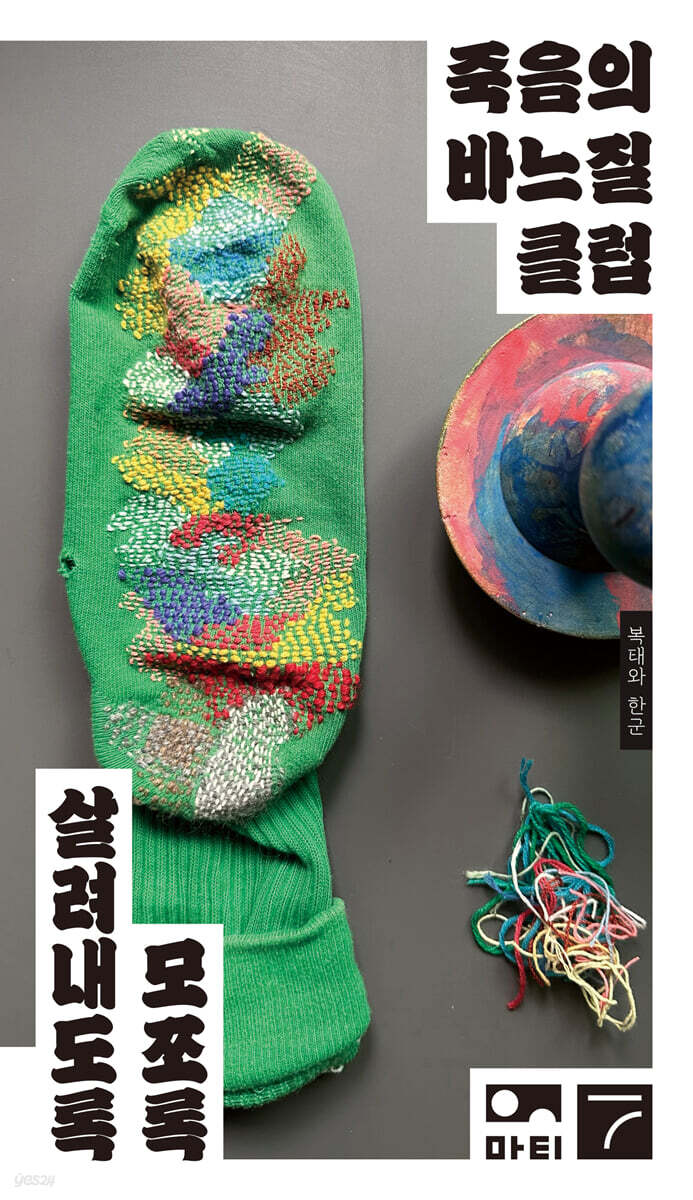
This is a collection of stories about Bok-tae and Han-gun, the operators of the Death Sewing Club, who are famous for sewing together all kinds of things, including socks with holes, torn sleeves, torn plastic bags, and broken bricks, into unique and beautiful pieces.
It's the 'Death Sewing Club' where no one leaves their seat until the target task is completed, and the workshop notice is posted and it closes in an instant.
This is a collection of stories about Bok-tae and Han-gun, the operators of the Death Sewing Club, who are famous for sewing together all kinds of things, including socks with holes, torn sleeves, torn plastic bags, and broken bricks, into unique and beautiful pieces.
- You can preview some of the book's contents.
Preview
index
1.
The tools we use: needles and thread… …and mushrooms
needle
Needle people
line
scissors
Threader
Sketching pen
Dinning Mushroom
thimble
Head Lantern
The Birth of a Mushroom That Replaced Lightbulbs
Madness Sewing Party
2.
Sewing Techniques: Either way is fine
Single knot / Double knot
Homemaking (=skewering fish cakes)
sewing
darning
Blanket Stitch
Woven embroidery
3.
A life of repair: saving lives if possible
Socks with thumbs sticking out (voice.
Korean Army)
12-year-old friend Vans' hole repair
Sneakers that have holes and give you a boost of stamina
A village child's jeans with torn knees
From a slightly worn-out Mustang to a vintage Mustang
A jacket that burned while being 'fired'
Gloves that can't stand calluses
A musician's cardigan bitten by a cat (voice.
Korean Army)
One day, a guitar case handle fell off
Cheonso-pa prescribed by a Korean medicine doctor
Mother-in-law's black bag (voice.
Korean Army)
An incredibly strong and incredibly tough backpack
small ark, umbrella
Like the teacher's jacket
A repairing heart
Death Stitch Club
Chiang Mai Spirit
4.
Weaving Life: In Chiang Mai
The Lanten people with purple hands
Chiang Mai Craft Week Entry Story
All sewn up
Satomi's Karen Village Entry Period
Paperspoon Family
Puens at the night market
Coming out
Appendix Death Stitch Club Playlist
The tools we use: needles and thread… …and mushrooms
needle
Needle people
line
scissors
Threader
Sketching pen
Dinning Mushroom
thimble
Head Lantern
The Birth of a Mushroom That Replaced Lightbulbs
Madness Sewing Party
2.
Sewing Techniques: Either way is fine
Single knot / Double knot
Homemaking (=skewering fish cakes)
sewing
darning
Blanket Stitch
Woven embroidery
3.
A life of repair: saving lives if possible
Socks with thumbs sticking out (voice.
Korean Army)
12-year-old friend Vans' hole repair
Sneakers that have holes and give you a boost of stamina
A village child's jeans with torn knees
From a slightly worn-out Mustang to a vintage Mustang
A jacket that burned while being 'fired'
Gloves that can't stand calluses
A musician's cardigan bitten by a cat (voice.
Korean Army)
One day, a guitar case handle fell off
Cheonso-pa prescribed by a Korean medicine doctor
Mother-in-law's black bag (voice.
Korean Army)
An incredibly strong and incredibly tough backpack
small ark, umbrella
Like the teacher's jacket
A repairing heart
Death Stitch Club
Chiang Mai Spirit
4.
Weaving Life: In Chiang Mai
The Lanten people with purple hands
Chiang Mai Craft Week Entry Story
All sewn up
Satomi's Karen Village Entry Period
Paperspoon Family
Puens at the night market
Coming out
Appendix Death Stitch Club Playlist
Publisher's Review
Marty On series volume 7
The publication of "The Death Sewing Club"
People sewing on plastic bags
There is a workshop that has been stirring up the Mangwon-dong and Seongsan-dong areas of Mapo-gu, Seoul since 2018.
It is the 'Death Sewing Club' (hereafter referred to as 'Death Sewing Club') where no one leaves their seat until the target task is completed, the workshop notice is posted and it is filled in an instant, and there is no one who has not been there before but has come only once.
Boktae and Hangun, who run Jukbakle together and are famous for sewing together various objects like socks with holes, torn sleeves, torn plastic bags, and broken bricks to create unique and beautiful new life through sewing on their Instagram account (@da_jojin_da), have published their essay, “Death Sewing Club.”
Living like a needle and thread
Living with a needle and thread
Bok-tae loves summer when he can wear light, flowing clothes, and he never stops trying to finish something he starts.
He's the type of person who rarely rushes around, and he walks around with worn-out sneakers with blue tape all over the heels.
At first glance, these two people seem like polar opposites, but they are companions who raise three children and a dog together and are musicians who make music under the name 'Seon and Young'.
Since 2010, I have lived a busy and hectic life, spending every moment of every day like a needle and thread, raising my children and composing songs.
Winter was especially difficult for the musician couple.
For those who made a living by doing small performances and teaching music at alternative schools, winter was like a slack season.
In the winter of 2016, someone recommended a trip to Chiang Mai, saying, "Boktae and Chiang Mai go well together." They boarded a plane with the hope that they might be able to save money while living in a warm country.
And then, in a cafe in Chiang Mai, he happens to run into a sewing machine. (pp. 10-19) Fascinated by her extraordinary hand movements and beautiful stitches, Bok-tae musters up the courage to speak to her in broken English.
Soon they become friends and the Thai woman teaches sewing to her Korean friend Bok-tae and Han-gun.
This chance encounter may have been fate.
Two people who lived together like a needle and thread began to live like a needle and thread.
Chiang Mai Spirit
No hard and take relax
There are three things missing from the sewing of the liquid that I bought in Chiang Mai.
Perfection, passion, speed.
Instead, there is pause, leisure, and beauty.
You don't need any special tools.
You don't have to measure the dimensions exactly.
Place the fabric on the body, cut it to the desired length, and sew it with a needle and thread.
This is Chiang Mai style sewing.
But what they learned wasn't just manual dexterity.
“Sewing is a genre specialized in ‘stopping.’
If it gets difficult, stop.
Because you can continue later.
Do it in moderation and stop.
Quitting when you want to do more.
We call this the 'Chiang Mai Spirit'.
Our sewing master, Aek, is the very spirit of Chiang Mai.
If the stitches are off, do it again.
If you're tired, take a rest.
“If you feel like you’ve rested too much, just move.” (pp. 167-168)
Bok-tae and Han-gun decide to spread the body and mind skills they have learned far and wide.
If possible, make it stand out
Does it mean I should sew until I die, that it's so hard I'll die, or that I should push myself to the limit.
There is much speculation about the name of the 'Death Stitching Club', which means 'be born again'.
Sewing allows you to escape from your current life, experience another world, and connect to another time and space. (p. 161) You can focus solely on your hands and mind.
That's why Boktae and Han-gun sew, and why people join the 'Death Sewing Club'.
It is not only you who is reborn.
Their sewing began with making clothes and bags, and soon moved on to repairing old and worn-out clothes.
I sew up socks with holes that I couldn't bring myself to throw away, I sew a guitar case with a loose strap, and I embroider torn sleeves.
It is not a matter of 'restoring' it back to its previous state.
Rather, the method they chose was 'visible mending', which involves making noticeable repairs.
Visible mending has long been emerging as a new art genre among trend-setting cities and artists like New York, Berlin, and Paris.
Boktae and Han-gun are spreading their unique experience and know-how in their repair method all over the country, calling it "Chiang Mai-style sewing" instead of the common noun "visible mending."
This is because Chiang Mai is where they first learned and practiced sewing, and some of the sewing techniques they use have been passed down for a long time by Chiang Mai's ethnic minorities.
What are you doing saving so much money for?
As the 'Death Sewing Club' became a hot topic, workshop proposals poured in from all over.
The two of them went wherever their feet took them.
I moved with all my heart, as if I were a sewing evangelist.
To Jeju, to Gwangju, to Daegu, to Busan.
There were people who came from far away to learn sewing.
In Gyeonggi-do, Gangwon-do, and even New York.
Sometimes people ask.
Isn't it a waste of time to spend two hours mending a pair of 20,000 won pants? What are you trying to do by saving so much?
The two people say.
A heart that repairs and a heart that cherishes are precious.
You don't have to save so much to do anything.
Repairing is a joyful and happy movement, just like drawing or singing.
I'm looking forward to the day when every nook and cranny will burst, tear, and have holes in it.
Sewing is a process of weaving together time by stitch.
『Death Sewing Club』 contains the sewing tools, sewing techniques and how to use them, and work notes that Boktae and Hangun use when sewing.
But the authors say it's okay not to have all the tools or master all the techniques.
Anyone can start sewing with just a needle and thread, and just sew in any way that catches their fancy.
In the spirit of Chiang Mai.
They fix the DJ's friend's backpack (page 64) and patch a hole in a village boy's pants (page 106).
He puts a new pattern on a worn-out Mustang (page 110) and revives an umbrella abandoned on the side of the road (page 140).
Sometimes, when a child asks me to mend a torn bag pocket, I subtly hand him a needle and suggest that he try to mend it himself (page 58).
Their sewing goes beyond mending torn sleeves and reattaching fallen buttons.
Repair is a job that takes time, stitch by stitch.
It is an act of retracing the traces of the past contained in the gift.
The story of repairs in the book is the trajectory of two people's lives, and a story that adds new meaning to the past times.
Warm, intense, fun, and whimsical.
We can't live without being entangled with each other.
Since meeting their sewing teacher, Ak, on their first trip to Chiang Mai in 2016, Bok-tae and Han-gun have been going to Chiang Mai to learn sewing, meet friends, and spend the winter.
The relationships woven with thread and needle have become more diverse, deeper, and wider as the years go by.
By chance, I participated in Chiang Mai Craft Week (page 196), created a new family (page 244), crossed the border to meet the Lan Ten, an ethnic minority in Laos (page 178), met the Karen people living in the highlands and learned natural dyeing (page 230), and learned weaving in a Karen village where a Japanese friend had immigrated (page 234).
Now I have a regular restaurant and the number of words I know increases every year (page 263).
As your affection grows, there are things you come to know.
Thailand's political and economic situation is unstable, and discrimination against ethnic minorities remains entrenched.
The threads and naturally dyed fabrics that ethnic minorities make with time and care are an absolute means of livelihood for them, but unlike the authors' family, who can easily cross the borders of Thailand and Laos with just a passport, ethnic minorities do not have passports (p. 195).
Southeast Asia, including Thailand, is a much closer neighbor than the United States or Europe.
Bok-tae and Han-gun believe that knowing their neighbors' stories well is the way to live well, and they resolve to live by getting closer to them.
Please save me
Bok-tae and Han-gun are clearly talking about sewing clothes, patching holes in sneakers, and mending torn sofas, but as you turn the pages, you realize that the things they fixed and revived weren't just objects.
As you follow the needles that stretch here and there, your mind will be mended and your soul will be aligned.
The authors say:
You have to thread to live, you have to weave to survive.
All you need is thread, a needle, and music.
At the end of this book, there is a playlist carefully selected by Boktae and Hangun.
It's music to listen to while sewing.
The authors, who emphasize that the true taste is in the hands, recommend “searching for music while typing each letter, like sewing stitch by stitch.”
Now that you have the 『Death Sewing Club』, your needles, thread, and music, let's get into the Chiang Mai spirit and start sewing.
Whatever you sew, please try to save it.
The publication of "The Death Sewing Club"
People sewing on plastic bags
There is a workshop that has been stirring up the Mangwon-dong and Seongsan-dong areas of Mapo-gu, Seoul since 2018.
It is the 'Death Sewing Club' (hereafter referred to as 'Death Sewing Club') where no one leaves their seat until the target task is completed, the workshop notice is posted and it is filled in an instant, and there is no one who has not been there before but has come only once.
Boktae and Hangun, who run Jukbakle together and are famous for sewing together various objects like socks with holes, torn sleeves, torn plastic bags, and broken bricks to create unique and beautiful new life through sewing on their Instagram account (@da_jojin_da), have published their essay, “Death Sewing Club.”
Living like a needle and thread
Living with a needle and thread
Bok-tae loves summer when he can wear light, flowing clothes, and he never stops trying to finish something he starts.
He's the type of person who rarely rushes around, and he walks around with worn-out sneakers with blue tape all over the heels.
At first glance, these two people seem like polar opposites, but they are companions who raise three children and a dog together and are musicians who make music under the name 'Seon and Young'.
Since 2010, I have lived a busy and hectic life, spending every moment of every day like a needle and thread, raising my children and composing songs.
Winter was especially difficult for the musician couple.
For those who made a living by doing small performances and teaching music at alternative schools, winter was like a slack season.
In the winter of 2016, someone recommended a trip to Chiang Mai, saying, "Boktae and Chiang Mai go well together." They boarded a plane with the hope that they might be able to save money while living in a warm country.
And then, in a cafe in Chiang Mai, he happens to run into a sewing machine. (pp. 10-19) Fascinated by her extraordinary hand movements and beautiful stitches, Bok-tae musters up the courage to speak to her in broken English.
Soon they become friends and the Thai woman teaches sewing to her Korean friend Bok-tae and Han-gun.
This chance encounter may have been fate.
Two people who lived together like a needle and thread began to live like a needle and thread.
Chiang Mai Spirit
No hard and take relax
There are three things missing from the sewing of the liquid that I bought in Chiang Mai.
Perfection, passion, speed.
Instead, there is pause, leisure, and beauty.
You don't need any special tools.
You don't have to measure the dimensions exactly.
Place the fabric on the body, cut it to the desired length, and sew it with a needle and thread.
This is Chiang Mai style sewing.
But what they learned wasn't just manual dexterity.
“Sewing is a genre specialized in ‘stopping.’
If it gets difficult, stop.
Because you can continue later.
Do it in moderation and stop.
Quitting when you want to do more.
We call this the 'Chiang Mai Spirit'.
Our sewing master, Aek, is the very spirit of Chiang Mai.
If the stitches are off, do it again.
If you're tired, take a rest.
“If you feel like you’ve rested too much, just move.” (pp. 167-168)
Bok-tae and Han-gun decide to spread the body and mind skills they have learned far and wide.
If possible, make it stand out
Does it mean I should sew until I die, that it's so hard I'll die, or that I should push myself to the limit.
There is much speculation about the name of the 'Death Stitching Club', which means 'be born again'.
Sewing allows you to escape from your current life, experience another world, and connect to another time and space. (p. 161) You can focus solely on your hands and mind.
That's why Boktae and Han-gun sew, and why people join the 'Death Sewing Club'.
It is not only you who is reborn.
Their sewing began with making clothes and bags, and soon moved on to repairing old and worn-out clothes.
I sew up socks with holes that I couldn't bring myself to throw away, I sew a guitar case with a loose strap, and I embroider torn sleeves.
It is not a matter of 'restoring' it back to its previous state.
Rather, the method they chose was 'visible mending', which involves making noticeable repairs.
Visible mending has long been emerging as a new art genre among trend-setting cities and artists like New York, Berlin, and Paris.
Boktae and Han-gun are spreading their unique experience and know-how in their repair method all over the country, calling it "Chiang Mai-style sewing" instead of the common noun "visible mending."
This is because Chiang Mai is where they first learned and practiced sewing, and some of the sewing techniques they use have been passed down for a long time by Chiang Mai's ethnic minorities.
What are you doing saving so much money for?
As the 'Death Sewing Club' became a hot topic, workshop proposals poured in from all over.
The two of them went wherever their feet took them.
I moved with all my heart, as if I were a sewing evangelist.
To Jeju, to Gwangju, to Daegu, to Busan.
There were people who came from far away to learn sewing.
In Gyeonggi-do, Gangwon-do, and even New York.
Sometimes people ask.
Isn't it a waste of time to spend two hours mending a pair of 20,000 won pants? What are you trying to do by saving so much?
The two people say.
A heart that repairs and a heart that cherishes are precious.
You don't have to save so much to do anything.
Repairing is a joyful and happy movement, just like drawing or singing.
I'm looking forward to the day when every nook and cranny will burst, tear, and have holes in it.
Sewing is a process of weaving together time by stitch.
『Death Sewing Club』 contains the sewing tools, sewing techniques and how to use them, and work notes that Boktae and Hangun use when sewing.
But the authors say it's okay not to have all the tools or master all the techniques.
Anyone can start sewing with just a needle and thread, and just sew in any way that catches their fancy.
In the spirit of Chiang Mai.
They fix the DJ's friend's backpack (page 64) and patch a hole in a village boy's pants (page 106).
He puts a new pattern on a worn-out Mustang (page 110) and revives an umbrella abandoned on the side of the road (page 140).
Sometimes, when a child asks me to mend a torn bag pocket, I subtly hand him a needle and suggest that he try to mend it himself (page 58).
Their sewing goes beyond mending torn sleeves and reattaching fallen buttons.
Repair is a job that takes time, stitch by stitch.
It is an act of retracing the traces of the past contained in the gift.
The story of repairs in the book is the trajectory of two people's lives, and a story that adds new meaning to the past times.
Warm, intense, fun, and whimsical.
We can't live without being entangled with each other.
Since meeting their sewing teacher, Ak, on their first trip to Chiang Mai in 2016, Bok-tae and Han-gun have been going to Chiang Mai to learn sewing, meet friends, and spend the winter.
The relationships woven with thread and needle have become more diverse, deeper, and wider as the years go by.
By chance, I participated in Chiang Mai Craft Week (page 196), created a new family (page 244), crossed the border to meet the Lan Ten, an ethnic minority in Laos (page 178), met the Karen people living in the highlands and learned natural dyeing (page 230), and learned weaving in a Karen village where a Japanese friend had immigrated (page 234).
Now I have a regular restaurant and the number of words I know increases every year (page 263).
As your affection grows, there are things you come to know.
Thailand's political and economic situation is unstable, and discrimination against ethnic minorities remains entrenched.
The threads and naturally dyed fabrics that ethnic minorities make with time and care are an absolute means of livelihood for them, but unlike the authors' family, who can easily cross the borders of Thailand and Laos with just a passport, ethnic minorities do not have passports (p. 195).
Southeast Asia, including Thailand, is a much closer neighbor than the United States or Europe.
Bok-tae and Han-gun believe that knowing their neighbors' stories well is the way to live well, and they resolve to live by getting closer to them.
Please save me
Bok-tae and Han-gun are clearly talking about sewing clothes, patching holes in sneakers, and mending torn sofas, but as you turn the pages, you realize that the things they fixed and revived weren't just objects.
As you follow the needles that stretch here and there, your mind will be mended and your soul will be aligned.
The authors say:
You have to thread to live, you have to weave to survive.
All you need is thread, a needle, and music.
At the end of this book, there is a playlist carefully selected by Boktae and Hangun.
It's music to listen to while sewing.
The authors, who emphasize that the true taste is in the hands, recommend “searching for music while typing each letter, like sewing stitch by stitch.”
Now that you have the 『Death Sewing Club』, your needles, thread, and music, let's get into the Chiang Mai spirit and start sewing.
Whatever you sew, please try to save it.
GOODS SPECIFICS
- Date of issue: June 26, 2024
- Page count, weight, size: 304 pages | 130*225*30mm
- ISBN13: 9791190853569
- ISBN10: 1190853566
You may also like
카테고리
korean


korean

![GQ KOREA Mark (Monthly): December [2025]](http://librairie.coreenne.fr/cdn/shop/files/8ef265dbbfbf186523ed75ba7319009d.jpg?v=1765340328&width=3840)


