

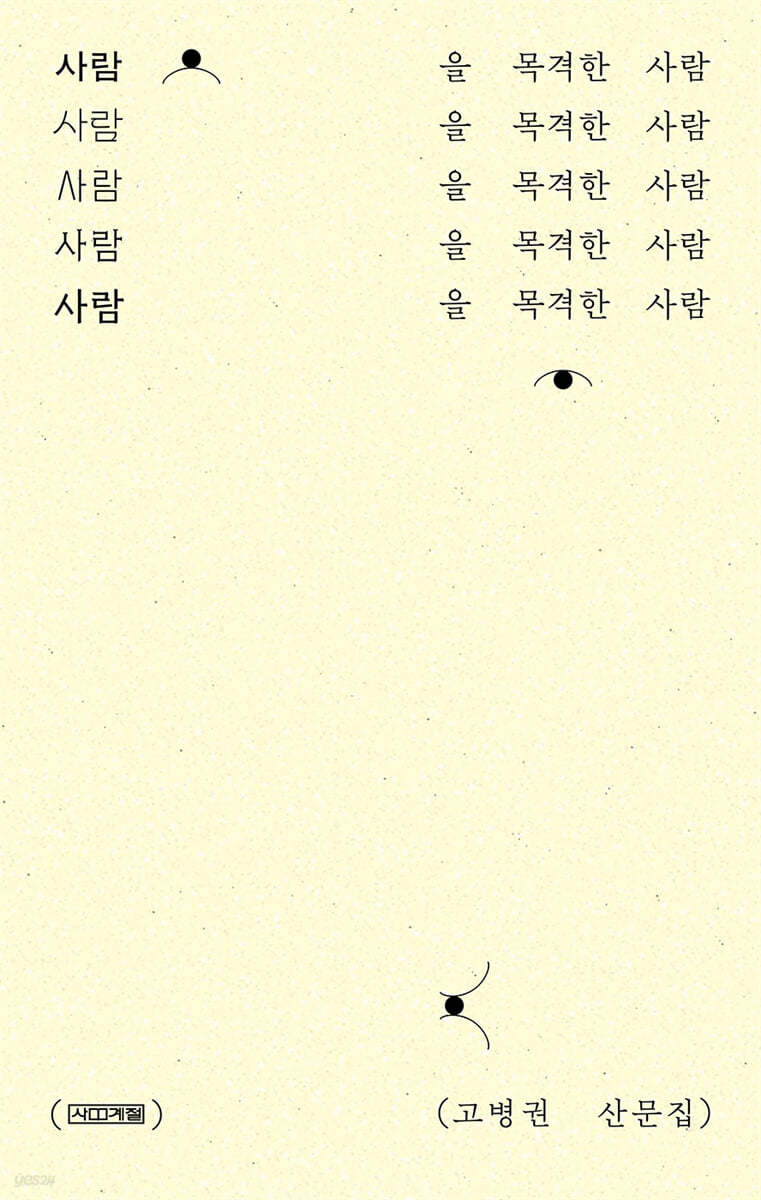
A person who witnessed a person
 |
Description
Book Introduction
Go Byeong-gwon, a philosophy teacher at the Noddle Night School for the Disabled and a person who has been striving to align knowledge and life for over twenty years. "The Man Who Witnessed People" is a collection of essays that collects his writings and solidarity statements made at sites of struggle from 2018 to 2023. When you tie it all together, it's a story about 'all people'. To be precise, it is a story about people who are not treated as human: the disabled, immigrants, the sick, and non-human animals. In this society where severely disabled people are confined to facilities, illegal immigrants are hunted down and driven out, parents kill their children and attempt suicide, and people are made to feel sorry for their sick bodies and make excuses, Go Byeong-gwon constantly asks himself what is wrong, “Am I really that stupid?” This book is a story about those who have been excluded or pushed to the margins by oppression, discrimination, prejudice, and ignorance, but it is also a story about 'knowing' and 'asking questions.' |
- You can preview some of the book's contents.
Preview
index
Prologue - Remembering the Dance of That Day
Part 1 Second Person
Zarathustra's First Companion
The second person, Hong Eun-jeon
David Graeber's Breakfast
Studying mindset
Service to the poor
appeal
Part 2: A Sick and Sorry Person
The language of miserable suffering
Asking for forgiveness
Human score instead of human grade
Fasting and cans
141-day head-shaving ceremony
“Are you human?”
"It only caused trouble"
Part 3: The Invisible Man
A person who worked invisibly and disappeared
Good Spectator
Life depends on administrative capacity
Preachers of Death
Enact a law to support deinstitutionalization.
Part 4: The Captured
Organs left behind by illegal immigrants
Memories of Torture
The other side of torture
Guantanamo on Mars
Season of Capture
Indigenous dance commemorating immigrants
Lee Heung-seop, a forced laborer
Minu, please take care
Part 5: Those Left Behind
We have to live together
Activists who volunteered for communal quarantine
This winter's defense posture
The reason he remained in the facility
Max saw my naked body
Nest of false birds
Reading Communism for the Sick - On a Certain 'Solitude' and 'Friendship'
Part 6: The Fighter
The immortal words of a dead man
The poor, the miserable, the dangerous
Are innocent citizens without sin?
Drop out of the weak
“We are crazy”
In front of the window of a sealed building
Author Lee Kyu-sik
"Once is Nothing" - A Revolutionary's Childhood Story
Part 7: People in Solidarity
Where did the struggles of Korean disabled people come from? - On the poverty, ignorance, and undignified wills of disabled liberation martyrs (Nodul Night School, 2023.
9. 6.)
Solidarity Statement - Where Will We Live? (Gyeongbokgung Station, 2022)
4. 14.)
Solidarity statement - We are the people who have waited for too long in front of a train that does not stop (Samgakji, 2022.
12.
26.)
Solidarity Statement - We have spent 400 days in a place that does not welcome us (National Assembly Station, 2023.
8. 3.)
Epilogue - Save the People!
Materials mentioned or quoted in the book
Part 1 Second Person
Zarathustra's First Companion
The second person, Hong Eun-jeon
David Graeber's Breakfast
Studying mindset
Service to the poor
appeal
Part 2: A Sick and Sorry Person
The language of miserable suffering
Asking for forgiveness
Human score instead of human grade
Fasting and cans
141-day head-shaving ceremony
“Are you human?”
"It only caused trouble"
Part 3: The Invisible Man
A person who worked invisibly and disappeared
Good Spectator
Life depends on administrative capacity
Preachers of Death
Enact a law to support deinstitutionalization.
Part 4: The Captured
Organs left behind by illegal immigrants
Memories of Torture
The other side of torture
Guantanamo on Mars
Season of Capture
Indigenous dance commemorating immigrants
Lee Heung-seop, a forced laborer
Minu, please take care
Part 5: Those Left Behind
We have to live together
Activists who volunteered for communal quarantine
This winter's defense posture
The reason he remained in the facility
Max saw my naked body
Nest of false birds
Reading Communism for the Sick - On a Certain 'Solitude' and 'Friendship'
Part 6: The Fighter
The immortal words of a dead man
The poor, the miserable, the dangerous
Are innocent citizens without sin?
Drop out of the weak
“We are crazy”
In front of the window of a sealed building
Author Lee Kyu-sik
"Once is Nothing" - A Revolutionary's Childhood Story
Part 7: People in Solidarity
Where did the struggles of Korean disabled people come from? - On the poverty, ignorance, and undignified wills of disabled liberation martyrs (Nodul Night School, 2023.
9. 6.)
Solidarity Statement - Where Will We Live? (Gyeongbokgung Station, 2022)
4. 14.)
Solidarity statement - We are the people who have waited for too long in front of a train that does not stop (Samgakji, 2022.
12.
26.)
Solidarity Statement - We have spent 400 days in a place that does not welcome us (National Assembly Station, 2023.
8. 3.)
Epilogue - Save the People!
Materials mentioned or quoted in the book
Into the book
The first seat is full of people, and the third and fourth seats are also full of people, but the second seat is not.
The third person hears that the first person is sad or angry, but the second person hears the first person's wailing and sees his bloodshot eyes.
Above all, the second person's position is the one where the first person's sleeve is grabbed when the first person reaches out for help.
Knowing that, I stand on the third, and when I'm scared, I run away until the fourth or fifth.
And because there are many people like me, most of the people in the world who cry cry alone.
--- From "The Second Person, Hong Eun-jeon"
At some point, I began to think that studying isn't just about curiosity.
There is something that holds my heart more than curiosity, although it doesn't captivate me as much as curiosity.
The reason we are drawn to a certain topic may be because it is interesting, but it may also be because it is sad, worrisome, or makes us sad and angry.
I can't stand myself being still.
So, there is also something called the mindset of studying.
--- From "The Mind of Studying"
In fact, people often look at their appeals with skepticism.
I wonder if it is because you are that kind of being that you caused such violence.
Aren't you feeling too distressed over trivial things?
This is what makes people miserable.
--- From "The Language of Pain"
Sometimes a society fails surprisingly quietly and significantly.
Important failures go unnoticed because of the lack of noise or other disturbances.
This makes this failure an even bigger failure.
A failure that may or may not have failed, a failure that may or may not have been attempted before, a failure that had no interest in what came before, so it did not matter what happened.
--- From ""I only caused trouble""
As a spectator, he looks upon suffering, but as an authority, he turns a blind eye to it.
They feel compassion and do good deeds for the poor, but they enforce laws and principles on those who claim their rights and hold them accountable.
As a spectator, he is a philanthropist, and as an authority, he is a public security ruler.
--- From "The Good Spectator"
From the beginning, undocumented immigrants were in a situation of human rights deprivation.
When I was working, I was like water from a reservoir that could be used at any time, when the police raided, I was like a rabbit that ran into the mountains out of breath, and after being captured, I was like a shrimp that had its back broken in a place called a shelter for foreigners.
It's like a system of exploitation that is intertwined with each other.
This crackdown on illegality seems to me to be part of a larger crime committed by man against man, by life against life.
--- From "Season of Capture"
‘Author Lee Kyu-sik’ is a question in itself.
It raises questions about the myth of the author as composed of independence, autonomy, and individuality.
At checkpoints around the world, he has been asked countless times whether he can do it alone.
Whether you can eat by yourself, whether you can dress by yourself.
As if living without dependence is a qualification for living in this world.
Did you make this story up by yourself?
Is this life something you live alone?
No, it isn't.
--- From "Author Lee Kyu-sik"
He was insulting people.
It is not known whether he received instructions from above or was overcome by some kind of self-inflicted error or impulse.
However, that was not the right thing to do when faced with the desperate voice of someone who had been silenced in this society for decades.
When I felt my eyes meet his, I waved my hand with a look that said, "Please don't do that."
Because I felt sorry for him.
He seemed like a man who didn't know what he was doing to himself.
--- From “Are You Human?”
Those who believed in the progress of the world often compared history to a train.
We thought that humanity would progress like a train passing through Samgakji Station, Sookmyung Women's University Station, and then Seoul Station.
In the previous station of history, only men's rights were guaranteed, but in the next station, women's rights will be guaranteed, and in the previous station, human rights were in fact only white people's rights, but in the next station, they will also be rights for people of color.
We have always believed that our history will move forward in a way that guarantees the rights of people with disabilities.
But I think we had the wrong image about trains.
--- From "We are the people who have waited for too long in front of a train that does not stop"
"Please save me!" I saw "Save Me" desperately clinging to the spot where I had lectured on "Save Me."
My eyes just turned red and I couldn't say anything.
No philosophy, no literature, no spiritual triumph was possible.
Were all the beautiful words of the past just empty talk?
Because of 'saving people', I woke up, my dream failed, and I was speechless.
I don't know what to say.
Even as I write this, even as I conclude this, I am searching for words.
The third person hears that the first person is sad or angry, but the second person hears the first person's wailing and sees his bloodshot eyes.
Above all, the second person's position is the one where the first person's sleeve is grabbed when the first person reaches out for help.
Knowing that, I stand on the third, and when I'm scared, I run away until the fourth or fifth.
And because there are many people like me, most of the people in the world who cry cry alone.
--- From "The Second Person, Hong Eun-jeon"
At some point, I began to think that studying isn't just about curiosity.
There is something that holds my heart more than curiosity, although it doesn't captivate me as much as curiosity.
The reason we are drawn to a certain topic may be because it is interesting, but it may also be because it is sad, worrisome, or makes us sad and angry.
I can't stand myself being still.
So, there is also something called the mindset of studying.
--- From "The Mind of Studying"
In fact, people often look at their appeals with skepticism.
I wonder if it is because you are that kind of being that you caused such violence.
Aren't you feeling too distressed over trivial things?
This is what makes people miserable.
--- From "The Language of Pain"
Sometimes a society fails surprisingly quietly and significantly.
Important failures go unnoticed because of the lack of noise or other disturbances.
This makes this failure an even bigger failure.
A failure that may or may not have failed, a failure that may or may not have been attempted before, a failure that had no interest in what came before, so it did not matter what happened.
--- From ""I only caused trouble""
As a spectator, he looks upon suffering, but as an authority, he turns a blind eye to it.
They feel compassion and do good deeds for the poor, but they enforce laws and principles on those who claim their rights and hold them accountable.
As a spectator, he is a philanthropist, and as an authority, he is a public security ruler.
--- From "The Good Spectator"
From the beginning, undocumented immigrants were in a situation of human rights deprivation.
When I was working, I was like water from a reservoir that could be used at any time, when the police raided, I was like a rabbit that ran into the mountains out of breath, and after being captured, I was like a shrimp that had its back broken in a place called a shelter for foreigners.
It's like a system of exploitation that is intertwined with each other.
This crackdown on illegality seems to me to be part of a larger crime committed by man against man, by life against life.
--- From "Season of Capture"
‘Author Lee Kyu-sik’ is a question in itself.
It raises questions about the myth of the author as composed of independence, autonomy, and individuality.
At checkpoints around the world, he has been asked countless times whether he can do it alone.
Whether you can eat by yourself, whether you can dress by yourself.
As if living without dependence is a qualification for living in this world.
Did you make this story up by yourself?
Is this life something you live alone?
No, it isn't.
--- From "Author Lee Kyu-sik"
He was insulting people.
It is not known whether he received instructions from above or was overcome by some kind of self-inflicted error or impulse.
However, that was not the right thing to do when faced with the desperate voice of someone who had been silenced in this society for decades.
When I felt my eyes meet his, I waved my hand with a look that said, "Please don't do that."
Because I felt sorry for him.
He seemed like a man who didn't know what he was doing to himself.
--- From “Are You Human?”
Those who believed in the progress of the world often compared history to a train.
We thought that humanity would progress like a train passing through Samgakji Station, Sookmyung Women's University Station, and then Seoul Station.
In the previous station of history, only men's rights were guaranteed, but in the next station, women's rights will be guaranteed, and in the previous station, human rights were in fact only white people's rights, but in the next station, they will also be rights for people of color.
We have always believed that our history will move forward in a way that guarantees the rights of people with disabilities.
But I think we had the wrong image about trains.
--- From "We are the people who have waited for too long in front of a train that does not stop"
"Please save me!" I saw "Save Me" desperately clinging to the spot where I had lectured on "Save Me."
My eyes just turned red and I couldn't say anything.
No philosophy, no literature, no spiritual triumph was possible.
Were all the beautiful words of the past just empty talk?
Because of 'saving people', I woke up, my dream failed, and I was speechless.
I don't know what to say.
Even as I write this, even as I conclude this, I am searching for words.
--- From "Epilogue - Save the People!"
Publisher's Review
“Cheap amp, this is my pride”
A humanities researcher who stands by the sick, the sad, and the fighting.
A solid name that amplifies voices from the field: Go Byeong-gwon
I don't have much to say to the world.
Most of these are stories that can be kept to oneself, stories that only a few people know about.
But the sounds coming from outside really boost my writing voltage.
When a voice so important is heard so small, the vacuum tubes of the mind heat up.
― Appeal
Since publishing his first book in 2001, Go Byeong-gwon has been an indispensable researcher when discussing the humanities in Korean society.
He is the man who gave me stories about Nietzsche, Marx, Spinoza, and Lu Xun, and whose very name gives me a sense of comfort and strength.
He calls himself a 'cheap amp' in 'The Man Who Witnessed People'.
Why is it called a 'cheap amp'?
One day, Go Byeong-gwon sees an old amplifier covered in blue tape in a protest site set up underground in Gwanghwamun.
At the moment when the amp was malfunctioning and the people there were looking for a replacement, he truly wished he could be that amp.
Since the most important sounds in the world are not easily heard in inverse proportion to their importance, I wanted to create an amplifier that anyone could easily use.
He sometimes went to the parties and asked them what topics they should write about, studied the topics they told him about or requested first, and wrote about them.
With a feeling of concern and regret, saying, ‘Please listen to what these people say’ and ‘Please look at what these people are like.’
The 'cheap amplifier' that amplifies the cries of the sad is his pride and the identity of this book.
Who is a person, what is witnessing?
The Writer's Duty: "I saw it, so I wrote it."
Who is 'person'?
The commonly used expression 'human person' is limited to humans, especially to a certain typical and ideological biological human species.
The people in this book are not like that.
A being condemned as unfit for this world, a being who is ignored and invisible.
They are located on the margins of society, and in a desolate environment, they ask the question, "What is life?" with their very lives.
They are the noble beings who make us fundamentally rethink the social structure and form of life.
What is 'witnessing'?
Witnessing is more than a glance or a glance.
This is more like a witness.
A person who witnessed a person being burned to death shouted, “There is a person here!” and a portrait of a worker who was killed while working unseen, holding a picket sign, said, “Can you see us?”
When it is said that writing is a testimony in some context, this book is imbued with the author's heart: "I have seen something, and I cannot go back to not having seen it, so I write."
When you look through the eyes of Go Byeong-gwon, you see things differently.
So that those who want to live and resist will not be lonely, he writes about the ripples that the people he witnessed caused within him.
The world brought to you by Go Byeong-gwon
A world where the "same" has disappeared from "I'm about to die"
Where does Go Byeong-gwon take his readers?
He leads readers to the illegal immigrant crackdown where they are conducting a ‘rabbit hunt’, to the Sura mudflats where a baby black-headed gull walks pitifully, to a room where a person is found with his eyes rolled back from heatstroke, to a subway station where people are crawling on the floor and struggling, to a detention center where people cry out “Please save me” from inside iron bars, to a place where the disabled, the poor, and women struggle to their deaths… …
The world we are sucked into by his dense sentences is different from the world we knew before.
It is a world where the 'same' has disappeared from 'likely to die', a place where 'metaphors and symbols' have disappeared.
Here, readers are forced to reexamine their vague ideas about the so-called 'minorities' and 'socially disadvantaged', and their attitudes toward them.
Above all, as readers encounter the quiet anger and despair, repentance and shame, and admiration and support for those fighting, which are contained throughout Go Byeong-gwon's writing, they naturally find themselves in the shoes of the people involved.
Before I can even begin to understand it with my head, I am struck by emotions that come before logic, and my heart aches.
This is the power of this book, which is both philosophy and the most beautiful literature.
“We suffer together”
May we respond to each other
The words “pain,” “togetherness,” and “dependence” appear frequently in this book.
Go Byeong-gwon's words, "We are suffering together," embrace the "first people" who are in pain and feel sorry.
He says that no one can survive without the help of others, and the only difference is between those who can easily choose and use the services they need and those who cannot.
I realize that the 'daily life' I enjoy is not everyday life for some people, and that although we all thought we lived together in this society, there are actually people who have 'left out' of 'us'.
If you follow Go Byeong-gwon's gesture of 'Look here', you will be startled and wonder 'What did I just see?' and at times, like him, you will be overcome with 'the feeling of wanting to run away to the fourth or fifth seat for fear of being grabbed by the sleeve by the person asking for help.'
But please take just a moment to listen to Go Byeong-gwon's appeal in response.
We ask that you respond to each other so that the first person can become the 'second person', and so that more third people can come to the second place.
“I wish people who have never heard a story like this would read it.
For example, there are people who were surprised when a disabled person suddenly appeared on the subway on their way to work, or even got angry, or had no idea about it at all.
Secondly, there are those who were unaware of their own suffering or discrimination, and who suffered alone.
We all suffer from our own pain.
Even in times like these, we want to let you know that we are suffering together.
I want to tell you that you are not alone.
Finally, there are some people I would like to read this book to.
These are the parties that appear in the book.
Because this is something I heard before I said it.
I want to tell them, 'This is how I heard your voice.'
“You could say it’s my way of responding.” ― From an interview with Go Byeong-gwon
A humanities researcher who stands by the sick, the sad, and the fighting.
A solid name that amplifies voices from the field: Go Byeong-gwon
I don't have much to say to the world.
Most of these are stories that can be kept to oneself, stories that only a few people know about.
But the sounds coming from outside really boost my writing voltage.
When a voice so important is heard so small, the vacuum tubes of the mind heat up.
― Appeal
Since publishing his first book in 2001, Go Byeong-gwon has been an indispensable researcher when discussing the humanities in Korean society.
He is the man who gave me stories about Nietzsche, Marx, Spinoza, and Lu Xun, and whose very name gives me a sense of comfort and strength.
He calls himself a 'cheap amp' in 'The Man Who Witnessed People'.
Why is it called a 'cheap amp'?
One day, Go Byeong-gwon sees an old amplifier covered in blue tape in a protest site set up underground in Gwanghwamun.
At the moment when the amp was malfunctioning and the people there were looking for a replacement, he truly wished he could be that amp.
Since the most important sounds in the world are not easily heard in inverse proportion to their importance, I wanted to create an amplifier that anyone could easily use.
He sometimes went to the parties and asked them what topics they should write about, studied the topics they told him about or requested first, and wrote about them.
With a feeling of concern and regret, saying, ‘Please listen to what these people say’ and ‘Please look at what these people are like.’
The 'cheap amplifier' that amplifies the cries of the sad is his pride and the identity of this book.
Who is a person, what is witnessing?
The Writer's Duty: "I saw it, so I wrote it."
Who is 'person'?
The commonly used expression 'human person' is limited to humans, especially to a certain typical and ideological biological human species.
The people in this book are not like that.
A being condemned as unfit for this world, a being who is ignored and invisible.
They are located on the margins of society, and in a desolate environment, they ask the question, "What is life?" with their very lives.
They are the noble beings who make us fundamentally rethink the social structure and form of life.
What is 'witnessing'?
Witnessing is more than a glance or a glance.
This is more like a witness.
A person who witnessed a person being burned to death shouted, “There is a person here!” and a portrait of a worker who was killed while working unseen, holding a picket sign, said, “Can you see us?”
When it is said that writing is a testimony in some context, this book is imbued with the author's heart: "I have seen something, and I cannot go back to not having seen it, so I write."
When you look through the eyes of Go Byeong-gwon, you see things differently.
So that those who want to live and resist will not be lonely, he writes about the ripples that the people he witnessed caused within him.
The world brought to you by Go Byeong-gwon
A world where the "same" has disappeared from "I'm about to die"
Where does Go Byeong-gwon take his readers?
He leads readers to the illegal immigrant crackdown where they are conducting a ‘rabbit hunt’, to the Sura mudflats where a baby black-headed gull walks pitifully, to a room where a person is found with his eyes rolled back from heatstroke, to a subway station where people are crawling on the floor and struggling, to a detention center where people cry out “Please save me” from inside iron bars, to a place where the disabled, the poor, and women struggle to their deaths… …
The world we are sucked into by his dense sentences is different from the world we knew before.
It is a world where the 'same' has disappeared from 'likely to die', a place where 'metaphors and symbols' have disappeared.
Here, readers are forced to reexamine their vague ideas about the so-called 'minorities' and 'socially disadvantaged', and their attitudes toward them.
Above all, as readers encounter the quiet anger and despair, repentance and shame, and admiration and support for those fighting, which are contained throughout Go Byeong-gwon's writing, they naturally find themselves in the shoes of the people involved.
Before I can even begin to understand it with my head, I am struck by emotions that come before logic, and my heart aches.
This is the power of this book, which is both philosophy and the most beautiful literature.
“We suffer together”
May we respond to each other
The words “pain,” “togetherness,” and “dependence” appear frequently in this book.
Go Byeong-gwon's words, "We are suffering together," embrace the "first people" who are in pain and feel sorry.
He says that no one can survive without the help of others, and the only difference is between those who can easily choose and use the services they need and those who cannot.
I realize that the 'daily life' I enjoy is not everyday life for some people, and that although we all thought we lived together in this society, there are actually people who have 'left out' of 'us'.
If you follow Go Byeong-gwon's gesture of 'Look here', you will be startled and wonder 'What did I just see?' and at times, like him, you will be overcome with 'the feeling of wanting to run away to the fourth or fifth seat for fear of being grabbed by the sleeve by the person asking for help.'
But please take just a moment to listen to Go Byeong-gwon's appeal in response.
We ask that you respond to each other so that the first person can become the 'second person', and so that more third people can come to the second place.
“I wish people who have never heard a story like this would read it.
For example, there are people who were surprised when a disabled person suddenly appeared on the subway on their way to work, or even got angry, or had no idea about it at all.
Secondly, there are those who were unaware of their own suffering or discrimination, and who suffered alone.
We all suffer from our own pain.
Even in times like these, we want to let you know that we are suffering together.
I want to tell you that you are not alone.
Finally, there are some people I would like to read this book to.
These are the parties that appear in the book.
Because this is something I heard before I said it.
I want to tell them, 'This is how I heard your voice.'
“You could say it’s my way of responding.” ― From an interview with Go Byeong-gwon
GOODS SPECIFICS
- Date of issue: December 7, 2023
- Page count, weight, size: 328 pages | 470g | 130*205*22mm
- ISBN13: 9791169811750
You may also like
카테고리
korean


korean

![GQ KOREA Mark (Monthly): December [2025]](http://librairie.coreenne.fr/cdn/shop/files/8ef265dbbfbf186523ed75ba7319009d.jpg?v=1765340328&width=3840)


