

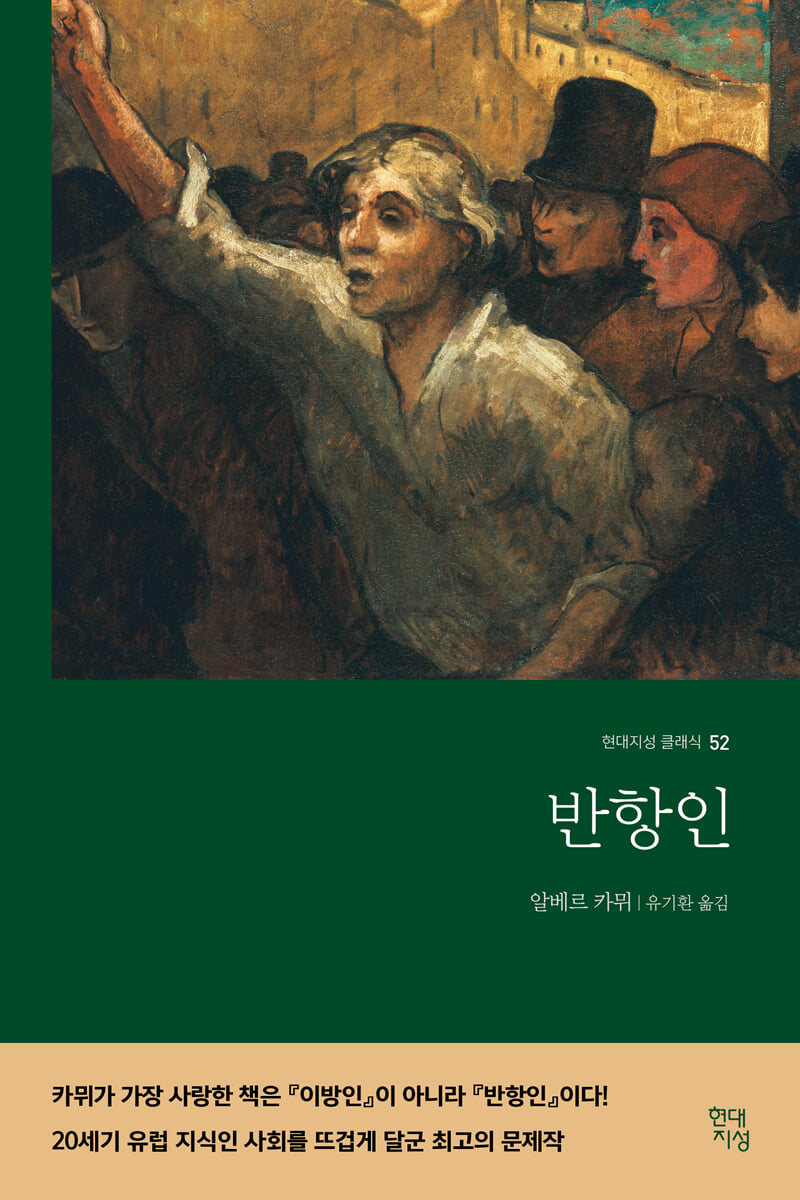
rebel
 |
Description
Book Introduction
“I rebel, therefore we exist.”
From Cain's murder to the French Revolution, Marxism, and Nazism
A History of Western Resistance: Responding to the Fateful Absurdity of Humanity with Rebellion
Wherever there is absurdity, there is rebellion.
“How should we live in the face of the absurdity that has been given us by fate?” ‘Rebellion’ is the answer to this question.
The rebel, as Albert Camus says, is someone who says "no" to unbearable constraints and "yes" to the essential value of human dignity.
This essential value shared by all human beings moves from the personal to the universal level through the ‘identification of fate.’
So Camus says:
“I rebel, therefore we exist.”
"The Rebel" provides a comprehensive overview of the "history of rebellion" that runs through Western history, from Cain's murder to Hitler's Nazism.
As in The Stranger, in The Rebel, Camus is dominated by the Mediterranean sun, that is, by Hellenistic thought.
Camus emphasizes the so-called 'noon thought', which places limits on rebellion and emphasizes balance and moderation.
However, for leftist intellectuals living in the post-war Cold War era, the idea of the Doctrine of the Mean only made Camus appear as a “weak moralist” and an “ambiguous humanist.”
But from today's perspective, where reality overwhelms ideology, it is not difficult to guess why Camus so strongly advocated balance and moderation.
Our world is once again in turmoil due to the absolute hegemony struggle between the two superpowers, the United States and China.
In this reality, the book “The Rebel,” which was ahead of its time, asks us:
“When and in what form will the rebels of our time appear?”
Professor Yoo Ki-hwan, who revived the modern intellectual classic “The Stranger” in a style most reminiscent of Camus, has taken on the translation of “The Rebel.”
In an age when everyone was reluctant to speak the dark truth, Camus's conscientious cry, "The emperor has no clothes," will serve as a good guide for today's readers on what to choose and how to act in this absurd era.
From Cain's murder to the French Revolution, Marxism, and Nazism
A History of Western Resistance: Responding to the Fateful Absurdity of Humanity with Rebellion
Wherever there is absurdity, there is rebellion.
“How should we live in the face of the absurdity that has been given us by fate?” ‘Rebellion’ is the answer to this question.
The rebel, as Albert Camus says, is someone who says "no" to unbearable constraints and "yes" to the essential value of human dignity.
This essential value shared by all human beings moves from the personal to the universal level through the ‘identification of fate.’
So Camus says:
“I rebel, therefore we exist.”
"The Rebel" provides a comprehensive overview of the "history of rebellion" that runs through Western history, from Cain's murder to Hitler's Nazism.
As in The Stranger, in The Rebel, Camus is dominated by the Mediterranean sun, that is, by Hellenistic thought.
Camus emphasizes the so-called 'noon thought', which places limits on rebellion and emphasizes balance and moderation.
However, for leftist intellectuals living in the post-war Cold War era, the idea of the Doctrine of the Mean only made Camus appear as a “weak moralist” and an “ambiguous humanist.”
But from today's perspective, where reality overwhelms ideology, it is not difficult to guess why Camus so strongly advocated balance and moderation.
Our world is once again in turmoil due to the absolute hegemony struggle between the two superpowers, the United States and China.
In this reality, the book “The Rebel,” which was ahead of its time, asks us:
“When and in what form will the rebels of our time appear?”
Professor Yoo Ki-hwan, who revived the modern intellectual classic “The Stranger” in a style most reminiscent of Camus, has taken on the translation of “The Rebel.”
In an age when everyone was reluctant to speak the dark truth, Camus's conscientious cry, "The emperor has no clothes," will serve as a good guide for today's readers on what to choose and how to act in this absurd era.
- You can preview some of the book's contents.
Preview
index
Chapter 1: The Rebel
Chapter 2: Metaphysical Rebellion
descendants of Cain
absolute denial
refusal of salvation
Absolute affirmation
Rebellious poetry
Nihilism and History
Chapter 3: Historical Rebellion
The King's Servants
God's servants
individual terrorism
State terrorism and irrational fear politics
State terrorism and rational fear politics
Rebellion and Revolution
Chapter 4: Rebellion and Art
Chapter 5: Thoughts at Noon
Rebellion and Murder
Theft and excess
Beyond nihilism
Camus Interview 1
- “No, I am not an existentialist.”
Camus Interview 2
- Interview with the São Paulo newspaper Diario
Release | Yoo Ki-hwan
Camus's social and political thought and rebellion
Camus Chronology
Chapter 2: Metaphysical Rebellion
descendants of Cain
absolute denial
refusal of salvation
Absolute affirmation
Rebellious poetry
Nihilism and History
Chapter 3: Historical Rebellion
The King's Servants
God's servants
individual terrorism
State terrorism and irrational fear politics
State terrorism and rational fear politics
Rebellion and Revolution
Chapter 4: Rebellion and Art
Chapter 5: Thoughts at Noon
Rebellion and Murder
Theft and excess
Beyond nihilism
Camus Interview 1
- “No, I am not an existentialist.”
Camus Interview 2
- Interview with the São Paulo newspaper Diario
Release | Yoo Ki-hwan
Camus's social and political thought and rebellion
Camus Chronology
Detailed image

Into the book
Who is a rebel? Someone who says 'No.'
To him, rejection means not giving up.
Therefore, he is also a person who says 'yeoui' from the beginning of the rebellion.
A slave who has been given orders his entire life suddenly decides he cannot accept new orders.
What does this 'no' mean?
For example, it could be, “This has been going on for too long,” or “That’s good enough.
But it can mean “but not more than that”, “this is too much”, or “there is a line you shouldn’t cross”.
In short, 'no' affirms the existence of a certain boundary.
The very idea of limitation is found in the rebel's feeling that the other side is encroaching beyond the boundary line where two rights confront each other and limit each other, the rebel's feeling that 'this is a bit too much.'
The rebellious movement is based on an absolute rejection of an infringement that is judged intolerable, and on a vague conviction of a legitimate right, or more precisely, on the feeling that the rebel has that he 'has the right to…'.
Rebellion never happens in any way, anywhere, without a sense of self-righteousness.
It is in this sense that the rebellious slave says 'no' and 'yes' at the same time.
He acknowledges the borderline, while at the same time affirming everything that he wants to maintain on this side of the borderline.
He stubbornly tries to prove that there is something in him that is 'worth doing', something that people should pay attention to.
In a sense, he is opposing the commandments that persecute him with his right not to be persecuted beyond what he can accept.
--- p.35
In the experience of the absurd, suffering is personal.
With the rebellion, suffering becomes collective and a universal adventure.
The first step forward taken by humans, caught up in a sense of alienation, was to recognize that this sense of alienation is shared by all, that human reality as a whole is shadowed by a sense of distance between the self and the world.
A disease that afflicted just one person becomes a mass plague.
In our daily trials, rebellion plays a role similar to the 'cogito' in the sequence of thought.
Rebellion is the first clear-cut fact, and this clear-cut fact pulls the individual out of solitude.
In short, rebellion is the common foundation that establishes the first value for all people.
I rebel, therefore we exist.
--- p.47
Rebellion can be said to be illogical when it leads to destruction.
The rebellion that demands the unity of the human condition is a force of life, not a force of death.
The profound logic of rebellion is not the logic of destruction.
That is the logic of creation.
For a rebellious movement to be authentic, it must not abandon any of the contradictions that sustain it.
The rebellious movement must be faithful to both the 'yes' it implies and the 'no' that the nihilistic interpretation separates from the rebellion.
The logic of the rebel is to strive not to add further injustice to the injustice of the human condition, to use clear language so as not to aggravate the falsehoods so prevalent in the world, and to fight for happiness in the face of human suffering.
Nihilistic passion destroys its old demands in its frenzy by multiplying injustice and falsehood, and thus loses the clearest reason for its rebellion.
Nihilistic passions lead to murder in a state of madness, believing the world to be abandoned to death.
On the other hand, the conclusion of the rebellion rejects the legitimacy of murder.
Because, in principle, rebellion is a protest against death.
--- p.412
If rebellion could establish a philosophy, it would be a philosophy of limits, a philosophy of precisely calculated ignorance, a philosophy of danger.
He who does not know everything cannot kill everything.
Far from making history absolute, the rebel rejects history and challenges it in the name of ideas that stem from his own nature.
He rejects his own terms, which are mostly historical.
Injustice, futility, and death appear throughout history.
By rejecting them, humans are rejecting history itself.
Of course, the rebel does not deny the history that surrounds him.
He tries to affirm himself within that very history.
But he stands before history as an artist stands before reality.
He rejects history without escaping from it.
He does not absolutize history for even a moment.
Even if he is forced to participate in a historical crime due to unavoidable circumstances, he does not justify that crime.
A rational crime is not only unacceptable in terms of rebellion, but it goes one step further and means the death of rebellion.
To make this obvious point even clearer, rational crimes are primarily committed against rebels.
Because they challenge the history that will later be deified.
--- p.419
Even after reading all of "The Rebel" and closing the book, it is not easy to clearly distinguish between rebellion and revolution.
However, the conscientious voice that tried to rightfully criticize Stalinism, the 'living power' of the time and the Stalinism that ruled half the world, remains vivid in my ears.
For Camus, Stalinism was barbarism in the guise of revolution.
According to British historian Robert Conquest, approximately 30 million people died in Soviet prison camps between 1936 and 1950.
Camus cannot distinguish these Soviet camps from Auschwitz.
If there is an absolute, it is not history but humanity.
If Raymond Aron's "Opium of the Intellectuals" criticized communism from a right-wing perspective, Camus's "The Rebel" criticized communism from a left-wing perspective.
In an era when everyone was reluctant to speak the dark truth, it wasn't easy for the left to criticize the left.
In short, the courage of the boy who cried out, “The Emperor is naked,” is perhaps Camus’ greatest virtue.
As the Cold War came to a close, another absolute, another extreme, was imposed on the world: the "globalization of America" or the "Americanization of the world."
And now, at this very moment, the United States and China are fiercely competing for absolute hegemony.
When and in what form will the rebels of our time come to us?
To him, rejection means not giving up.
Therefore, he is also a person who says 'yeoui' from the beginning of the rebellion.
A slave who has been given orders his entire life suddenly decides he cannot accept new orders.
What does this 'no' mean?
For example, it could be, “This has been going on for too long,” or “That’s good enough.
But it can mean “but not more than that”, “this is too much”, or “there is a line you shouldn’t cross”.
In short, 'no' affirms the existence of a certain boundary.
The very idea of limitation is found in the rebel's feeling that the other side is encroaching beyond the boundary line where two rights confront each other and limit each other, the rebel's feeling that 'this is a bit too much.'
The rebellious movement is based on an absolute rejection of an infringement that is judged intolerable, and on a vague conviction of a legitimate right, or more precisely, on the feeling that the rebel has that he 'has the right to…'.
Rebellion never happens in any way, anywhere, without a sense of self-righteousness.
It is in this sense that the rebellious slave says 'no' and 'yes' at the same time.
He acknowledges the borderline, while at the same time affirming everything that he wants to maintain on this side of the borderline.
He stubbornly tries to prove that there is something in him that is 'worth doing', something that people should pay attention to.
In a sense, he is opposing the commandments that persecute him with his right not to be persecuted beyond what he can accept.
--- p.35
In the experience of the absurd, suffering is personal.
With the rebellion, suffering becomes collective and a universal adventure.
The first step forward taken by humans, caught up in a sense of alienation, was to recognize that this sense of alienation is shared by all, that human reality as a whole is shadowed by a sense of distance between the self and the world.
A disease that afflicted just one person becomes a mass plague.
In our daily trials, rebellion plays a role similar to the 'cogito' in the sequence of thought.
Rebellion is the first clear-cut fact, and this clear-cut fact pulls the individual out of solitude.
In short, rebellion is the common foundation that establishes the first value for all people.
I rebel, therefore we exist.
--- p.47
Rebellion can be said to be illogical when it leads to destruction.
The rebellion that demands the unity of the human condition is a force of life, not a force of death.
The profound logic of rebellion is not the logic of destruction.
That is the logic of creation.
For a rebellious movement to be authentic, it must not abandon any of the contradictions that sustain it.
The rebellious movement must be faithful to both the 'yes' it implies and the 'no' that the nihilistic interpretation separates from the rebellion.
The logic of the rebel is to strive not to add further injustice to the injustice of the human condition, to use clear language so as not to aggravate the falsehoods so prevalent in the world, and to fight for happiness in the face of human suffering.
Nihilistic passion destroys its old demands in its frenzy by multiplying injustice and falsehood, and thus loses the clearest reason for its rebellion.
Nihilistic passions lead to murder in a state of madness, believing the world to be abandoned to death.
On the other hand, the conclusion of the rebellion rejects the legitimacy of murder.
Because, in principle, rebellion is a protest against death.
--- p.412
If rebellion could establish a philosophy, it would be a philosophy of limits, a philosophy of precisely calculated ignorance, a philosophy of danger.
He who does not know everything cannot kill everything.
Far from making history absolute, the rebel rejects history and challenges it in the name of ideas that stem from his own nature.
He rejects his own terms, which are mostly historical.
Injustice, futility, and death appear throughout history.
By rejecting them, humans are rejecting history itself.
Of course, the rebel does not deny the history that surrounds him.
He tries to affirm himself within that very history.
But he stands before history as an artist stands before reality.
He rejects history without escaping from it.
He does not absolutize history for even a moment.
Even if he is forced to participate in a historical crime due to unavoidable circumstances, he does not justify that crime.
A rational crime is not only unacceptable in terms of rebellion, but it goes one step further and means the death of rebellion.
To make this obvious point even clearer, rational crimes are primarily committed against rebels.
Because they challenge the history that will later be deified.
--- p.419
Even after reading all of "The Rebel" and closing the book, it is not easy to clearly distinguish between rebellion and revolution.
However, the conscientious voice that tried to rightfully criticize Stalinism, the 'living power' of the time and the Stalinism that ruled half the world, remains vivid in my ears.
For Camus, Stalinism was barbarism in the guise of revolution.
According to British historian Robert Conquest, approximately 30 million people died in Soviet prison camps between 1936 and 1950.
Camus cannot distinguish these Soviet camps from Auschwitz.
If there is an absolute, it is not history but humanity.
If Raymond Aron's "Opium of the Intellectuals" criticized communism from a right-wing perspective, Camus's "The Rebel" criticized communism from a left-wing perspective.
In an era when everyone was reluctant to speak the dark truth, it wasn't easy for the left to criticize the left.
In short, the courage of the boy who cried out, “The Emperor is naked,” is perhaps Camus’ greatest virtue.
As the Cold War came to a close, another absolute, another extreme, was imposed on the world: the "globalization of America" or the "Americanization of the world."
And now, at this very moment, the United States and China are fiercely competing for absolute hegemony.
When and in what form will the rebels of our time come to us?
--- p.460
Publisher's Review
The Rebel, the most beloved work of Albert Camus, the greatest French writer of the 20th century
A must-read to understand Camus's social and political thought.
“The Rebel” is a book that made me more enemies than friends.
… but if I had to write it again, I would write it exactly the same way.”
In 1942, at the age of 29, Albert Camus published his absurd novel, The Stranger, and instantly rose to stardom in the French literary world.
Even after decades, Camus still ranks high on the list of French people's favorite authors.
"The Stranger" is also considered the best-selling book by Gallimard, France's largest publishing house.
However, Camus did not always have a smooth life.
In particular, after the publication of 『The Rebel』, it went through many twists and turns, receiving numerous criticisms.
As soon as 『The Rebel』 was published in 1951, it became a hot topic of debate in European intellectual circles.
At the time of the publication of "The Stranger," left-wing intellectuals, including Jean-Paul Sartre, who had praised Camus, began to criticize him.
In the end, the friendship with Sartre that lasted for 10 years also collapsed.
Nevertheless, Camus shows his unchanging affection for The Rebel, saying that it is his favorite book and the most important book to him.
What exactly was "The Rebel" that drove Camus into such a predicament? And why did he love it so much?
Three Key Themes for Understanding Camus: Absurdity, Rebellion, and Love
True rebellion is "to confront the absurd and become complete in your own right."
Camus's world of work can be summarized into three core themes: absurdity, rebellion, and love.
These three themes are each reimagined in novels, essays, and plays.
Absurdist works include the novel “The Stranger,” the essay “The Myth of Sisyphus,” and the plays “Caligula” and “Misunderstanding.” Rebellious works include the novel “The Plague,” the essay “The Rebel,” and the plays “The Just” and “Martial Law.”
Among his works in the love series is the novel "The First Man", which was left unfinished due to his death.
Therefore, without 『The Rebel』, it is impossible to fully understand the theme of 'rebellion', or even Camus's world of works.
Rebellion is born from absurdity.
The feeling of bewilderment and absurdity that arises when a person who has been living by habit and routine suddenly thinks about death, life, the universe, existence, and nothingness. That is the 'absurd feeling.'
According to Camus, absurdity is the fate of human beings.
So then, “How should we live in the face of the absurdity that has been given us by fate?” ‘Rebellion’ is the answer to this question.
Wherever there is absurdity, there is rebellion.
Camus's rebel is someone who says "no" to unbearable constraints and "yes" to the essential value of human dignity.
This essential value shared by all human beings moves from the personal to the universal level through the ‘identification of fate.’
So Camus says:
“I rebel, therefore we exist.”
In The Rebel, Camus devotes a particularly large amount of space to “metaphysical rebellion” and “historical rebellion.”
Metaphysical rebellion is the rebellion of man against God, and the rebellion of slaves against their masters is a historical rebellion.
Camus again distinguishes between revolution and rebellion in terms of historical rebellion.
Camus criticizes revolutions that begin with a theoretical framework and seek to overturn history and change the world, unlike rebellions that begin with a kind of protest and seek gradual liberation.
Instead, it emphasizes the idea of limits and moderation, faithful to the Hellenistic tradition, called the 'idea of noon'.
“Humans have actions and thoughts that are possible at an intermediate level suitable for humans.” In this book, Camus struggles with tolerance and balance in the face of all kinds of transcendence and negation.
To Camus, the true meaning of rebellion was to live a worthwhile life on this earth, not to overthrow the world, to confront the absurd and become complete in one's true self.
Professor Yoo Ki-hwan's revised translation, which revives the most Camus-like style.
Includes a collection of Camus interviews and a summary of the translator's thesis to aid readers' understanding.
Professor Yoo Ki-hwan, who revived the modern intellectual classic “The Stranger” in a style most reminiscent of Camus, has taken on the translation of “The Rebel.”
The modern intellectual classic, 『The Rebel』, has been revised and supplemented from the original translation published in 1987 and the revised translation published in 1993.
To illuminate the true meaning of "The Rebel" and help readers understand it, I've added two interviews with Camus.
One is an interview titled “No, I am not an existentialist,” included in the commentary on “The Myth of Sisyphus” in Volume 2 of “The Complete Works of Camus.”
In this essay, Camus explains the relationship between absurdity and rebellion, emphasizing the differences between himself and Sartre.
The other is an interview piece from the newspaper Diario, included in the commentary on “The Rebel” in Volume 2 of “The Complete Works of Camus.”
This article gives readers a glimpse into Camus's thoughts on the necessity of rebellion.
Finally, the translator's thesis, "Camus's Political Thought and Communism," is summarized and revised, introducing the core themes of "The Rebel."
These three essays will greatly help readers understand Camus' Mediterranean philosophy of 'resistance with limits and balance.'
"The Rebel" is by no means an easy read, as it is the longest and most profound of Camus's works.
However, no other book reveals Camus's social and political thought as well as this one.
In an age when everyone was reluctant to speak the dark truth, I hope that Camus's conscientious cry of "The Emperor has no clothes" will provide an opportunity for today's readers to consider what choices they should make and how they should act in this absurd era.
A must-read to understand Camus's social and political thought.
“The Rebel” is a book that made me more enemies than friends.
… but if I had to write it again, I would write it exactly the same way.”
In 1942, at the age of 29, Albert Camus published his absurd novel, The Stranger, and instantly rose to stardom in the French literary world.
Even after decades, Camus still ranks high on the list of French people's favorite authors.
"The Stranger" is also considered the best-selling book by Gallimard, France's largest publishing house.
However, Camus did not always have a smooth life.
In particular, after the publication of 『The Rebel』, it went through many twists and turns, receiving numerous criticisms.
As soon as 『The Rebel』 was published in 1951, it became a hot topic of debate in European intellectual circles.
At the time of the publication of "The Stranger," left-wing intellectuals, including Jean-Paul Sartre, who had praised Camus, began to criticize him.
In the end, the friendship with Sartre that lasted for 10 years also collapsed.
Nevertheless, Camus shows his unchanging affection for The Rebel, saying that it is his favorite book and the most important book to him.
What exactly was "The Rebel" that drove Camus into such a predicament? And why did he love it so much?
Three Key Themes for Understanding Camus: Absurdity, Rebellion, and Love
True rebellion is "to confront the absurd and become complete in your own right."
Camus's world of work can be summarized into three core themes: absurdity, rebellion, and love.
These three themes are each reimagined in novels, essays, and plays.
Absurdist works include the novel “The Stranger,” the essay “The Myth of Sisyphus,” and the plays “Caligula” and “Misunderstanding.” Rebellious works include the novel “The Plague,” the essay “The Rebel,” and the plays “The Just” and “Martial Law.”
Among his works in the love series is the novel "The First Man", which was left unfinished due to his death.
Therefore, without 『The Rebel』, it is impossible to fully understand the theme of 'rebellion', or even Camus's world of works.
Rebellion is born from absurdity.
The feeling of bewilderment and absurdity that arises when a person who has been living by habit and routine suddenly thinks about death, life, the universe, existence, and nothingness. That is the 'absurd feeling.'
According to Camus, absurdity is the fate of human beings.
So then, “How should we live in the face of the absurdity that has been given us by fate?” ‘Rebellion’ is the answer to this question.
Wherever there is absurdity, there is rebellion.
Camus's rebel is someone who says "no" to unbearable constraints and "yes" to the essential value of human dignity.
This essential value shared by all human beings moves from the personal to the universal level through the ‘identification of fate.’
So Camus says:
“I rebel, therefore we exist.”
In The Rebel, Camus devotes a particularly large amount of space to “metaphysical rebellion” and “historical rebellion.”
Metaphysical rebellion is the rebellion of man against God, and the rebellion of slaves against their masters is a historical rebellion.
Camus again distinguishes between revolution and rebellion in terms of historical rebellion.
Camus criticizes revolutions that begin with a theoretical framework and seek to overturn history and change the world, unlike rebellions that begin with a kind of protest and seek gradual liberation.
Instead, it emphasizes the idea of limits and moderation, faithful to the Hellenistic tradition, called the 'idea of noon'.
“Humans have actions and thoughts that are possible at an intermediate level suitable for humans.” In this book, Camus struggles with tolerance and balance in the face of all kinds of transcendence and negation.
To Camus, the true meaning of rebellion was to live a worthwhile life on this earth, not to overthrow the world, to confront the absurd and become complete in one's true self.
Professor Yoo Ki-hwan's revised translation, which revives the most Camus-like style.
Includes a collection of Camus interviews and a summary of the translator's thesis to aid readers' understanding.
Professor Yoo Ki-hwan, who revived the modern intellectual classic “The Stranger” in a style most reminiscent of Camus, has taken on the translation of “The Rebel.”
The modern intellectual classic, 『The Rebel』, has been revised and supplemented from the original translation published in 1987 and the revised translation published in 1993.
To illuminate the true meaning of "The Rebel" and help readers understand it, I've added two interviews with Camus.
One is an interview titled “No, I am not an existentialist,” included in the commentary on “The Myth of Sisyphus” in Volume 2 of “The Complete Works of Camus.”
In this essay, Camus explains the relationship between absurdity and rebellion, emphasizing the differences between himself and Sartre.
The other is an interview piece from the newspaper Diario, included in the commentary on “The Rebel” in Volume 2 of “The Complete Works of Camus.”
This article gives readers a glimpse into Camus's thoughts on the necessity of rebellion.
Finally, the translator's thesis, "Camus's Political Thought and Communism," is summarized and revised, introducing the core themes of "The Rebel."
These three essays will greatly help readers understand Camus' Mediterranean philosophy of 'resistance with limits and balance.'
"The Rebel" is by no means an easy read, as it is the longest and most profound of Camus's works.
However, no other book reveals Camus's social and political thought as well as this one.
In an age when everyone was reluctant to speak the dark truth, I hope that Camus's conscientious cry of "The Emperor has no clothes" will provide an opportunity for today's readers to consider what choices they should make and how they should act in this absurd era.
GOODS SPECIFICS
- Date of issue: September 1, 2023
- Page count, weight, size: 472 pages | 150*225*30mm
- ISBN13: 9791139716030
- ISBN10: 1139716034
You may also like
카테고리
korean


korean

![GQ KOREA Mark (Monthly): December [2025]](http://librairie.coreenne.fr/cdn/shop/files/8ef265dbbfbf186523ed75ba7319009d.jpg?v=1765340328&width=3840)


