

My schizophrenic uncle
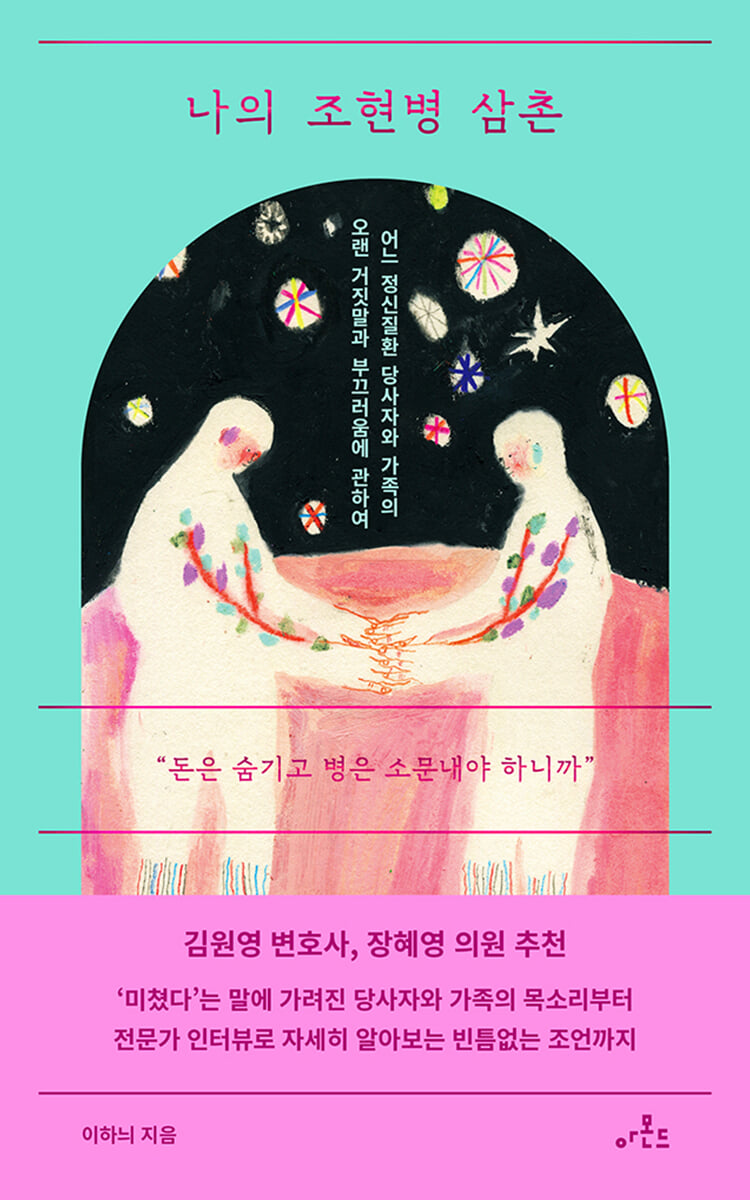 |
Description
Book Introduction
Reporter Lee Ha-nui has long been listening to the voices of people with mental illness and disabilities.
His uncle, now 65, has suffered from schizophrenia for 40 years.
My uncle's illness is a story that he "hid with all his might" from his family.
The biggest reason he decided to reveal the story of his uncle, which he had kept hidden for so long, was because he wanted to put an end to the long shame and lies that had been passed down from his grandmother to his mother and then to them.
Also, I thought that my uncle's life should not be remembered as "he spent his whole life in and out of mental hospitals and died a pitiful death."
I am not writing only as a member of the family of the person involved.
The identity of ‘reporter’ was added.
His reporting skills particularly shine in this book.
To include more diverse voices, we met with Sheila and Jaguar, who are living with schizophrenia, their peer supporter Yooyoung, the person living with schizophrenia's younger sister Heesu, and the person living with schizophrenia's mother Eunyoung.
We interviewed three psychiatrists and social workers, among other experts, to provide advice and practical information essential to the person and their family.
The author believes that “the stigma will fade as more people open up about their own illnesses and disabilities and those of their families.”
He says.
“If the stories of my uncle, my mother, and others come together, won’t there come a day when people with various mental illnesses can share their stories without fear of stigma?” This book will be the catalyst for that.
His uncle, now 65, has suffered from schizophrenia for 40 years.
My uncle's illness is a story that he "hid with all his might" from his family.
The biggest reason he decided to reveal the story of his uncle, which he had kept hidden for so long, was because he wanted to put an end to the long shame and lies that had been passed down from his grandmother to his mother and then to them.
Also, I thought that my uncle's life should not be remembered as "he spent his whole life in and out of mental hospitals and died a pitiful death."
I am not writing only as a member of the family of the person involved.
The identity of ‘reporter’ was added.
His reporting skills particularly shine in this book.
To include more diverse voices, we met with Sheila and Jaguar, who are living with schizophrenia, their peer supporter Yooyoung, the person living with schizophrenia's younger sister Heesu, and the person living with schizophrenia's mother Eunyoung.
We interviewed three psychiatrists and social workers, among other experts, to provide advice and practical information essential to the person and their family.
The author believes that “the stigma will fade as more people open up about their own illnesses and disabilities and those of their families.”
He says.
“If the stories of my uncle, my mother, and others come together, won’t there come a day when people with various mental illnesses can share their stories without fear of stigma?” This book will be the catalyst for that.
- You can preview some of the book's contents.
Preview
index
Preface I Have No Uncle
Chapter 1: My Uncle Has Schizophrenia
“Please take me to the hospital.”
The first outbreak, the beginning of a long journey
Relapse without reason
Tip 1: Why does schizophrenia occur and relapse?
Tip 2: Why the Diagnosis Changes
Is trauma-free hospitalization possible?
Tip 3: Everything About Hospitalization
Auditory hallucinations, the most common hallucination symptom
Delusions, the most difficult symptom to cure
Tip 4: How Should Families Respond to Symptoms?
Chapter 2: Family, the people who support you
Whenever my uncle was sick, my mother did her best.
A heart that has not been liberated for 40 years
Tip 5: Where can your family lean on you?
Because you have to hide the money and spread rumors about the disease.
Dad draws a line
How can you abandon your family?
Chapter 3: Uncle's Daily Life
The difficulty of acknowledging illness
Coffee, cigarettes, and sleep
Are people with schizophrenia really dangerous?
Tip 6: Misconceptions and Truths About Mental Weakness
My uncle's struggle to find a job
Tip 7 For those preparing for employment
Chapter 4: Living with Schizophrenia
Live long and stay healthy - Sheila
To fight Taewoongs - Jaguar, the party in question
"I have no intention of hiding my illness" - Peer Supporter Yoo Young
But he's my brother - Heesu, the younger brother of the person involved
A relief after 13 years - Eunyoung, the mother of the person involved
Chapter 5: Schizophrenia for 40 Years
Why You Should Be Careful About Parkinson's Disease
Tip 8: Drug Actions and Side Effects
How urgently do you need to be admitted?
Independence first, what's lacking later
Tip 9: What You Need to Live in the Community
“Do you have dementia, sir?”
When does a disability become a disability?
Tip 10: Living with Chronic Schizophrenia
A story that should not be remembered as "a pitiful death"
References
Americas
Chapter 1: My Uncle Has Schizophrenia
“Please take me to the hospital.”
The first outbreak, the beginning of a long journey
Relapse without reason
Tip 1: Why does schizophrenia occur and relapse?
Tip 2: Why the Diagnosis Changes
Is trauma-free hospitalization possible?
Tip 3: Everything About Hospitalization
Auditory hallucinations, the most common hallucination symptom
Delusions, the most difficult symptom to cure
Tip 4: How Should Families Respond to Symptoms?
Chapter 2: Family, the people who support you
Whenever my uncle was sick, my mother did her best.
A heart that has not been liberated for 40 years
Tip 5: Where can your family lean on you?
Because you have to hide the money and spread rumors about the disease.
Dad draws a line
How can you abandon your family?
Chapter 3: Uncle's Daily Life
The difficulty of acknowledging illness
Coffee, cigarettes, and sleep
Are people with schizophrenia really dangerous?
Tip 6: Misconceptions and Truths About Mental Weakness
My uncle's struggle to find a job
Tip 7 For those preparing for employment
Chapter 4: Living with Schizophrenia
Live long and stay healthy - Sheila
To fight Taewoongs - Jaguar, the party in question
"I have no intention of hiding my illness" - Peer Supporter Yoo Young
But he's my brother - Heesu, the younger brother of the person involved
A relief after 13 years - Eunyoung, the mother of the person involved
Chapter 5: Schizophrenia for 40 Years
Why You Should Be Careful About Parkinson's Disease
Tip 8: Drug Actions and Side Effects
How urgently do you need to be admitted?
Independence first, what's lacking later
Tip 9: What You Need to Live in the Community
“Do you have dementia, sir?”
When does a disability become a disability?
Tip 10: Living with Chronic Schizophrenia
A story that should not be remembered as "a pitiful death"
References
Americas
Detailed image

Into the book
I think I was reluctant to talk about my uncle from the time I started to get a rough idea of the ways of the world.
When I was young, I wondered why my uncle didn't work.
After I noticed something different about my uncle, I couldn't put my finger on it, but I knew it was something stranger and more embarrassing than being unemployed.
After I found out about the disease, I couldn't even open my mouth.
--- p.6
When we talk about hallucinations or delusions, it's easy to think of them as stories without any context, but in most cases, they have their own realistic context.
My uncle's uncle went missing during the National Press Union incident in 1950.
Afterwards, all we heard was that it had sunk into the nearby sea.
For decades, my maternal grandparents lived hoping the rumor wasn't true.
At the same time, I was afraid of being branded a 'commie'.
These fears and desires were reflected in my uncle's hallucinations.
--- p.25
Hani: Do you talk to hallucinations?
Uncle: If I ask you anything, you answer.
Sometimes hallucinations are right.
Men have men's voices, women have women's voices.
It actually sounds like a person speaking.
Just like the real thing.
Hani: Wow, Uncle won't be bored.
Because we can talk anytime.
Uncle: (Laughs) But I feel more at ease when I don't hear auditory hallucinations.
--- p.57
Asking us not to agree with or refute delusions does not mean ignoring them.
It is closer to the meaning that the content of the delusion is important to the person involved and therefore must be heard and accepted.
Dr. Cha Seung-min said, “Furthermore, delusions are too strong to be broken,” and “Arguing only creates hostility between the two parties, so it is better to focus on maintaining daily life rather than trying to break down delusions.”
--- p.69
One day, when I went to visit my uncle, the hospital recommended that I seek parental counseling.
“I’m not mentally ill,” said the mother, who didn’t know what parental counseling was.
The counselor said that it wasn't like that and that I should just talk comfortably.
It was the first and last time my mother received counseling related to her uncle.
Hani: What did you talk about in the consultation?
Mom: I answered all sorts of questions.
The counselor held me and cried.
That was the first time I realized my situation.
I always thought it was natural, but after talking about it, I realized I was so pathetic.
From that young age until now… …I was in my mid-40s at the time.
That day, for the first time, he cried for me.
--- p.83
I've been lying for a long time too, but I feel like I don't want to do it anymore.
I'm tired of and hate the feeling of being anxious about who might notice my uncle's existence.
Now I want to break that vicious cycle.
If my uncle's and my mother's stories, along with those of other parties involved, come together, won't there come a day when people with various mental illnesses can share their stories without fear of stigma?
Because you have to hide the money and spread rumors about the illness.
--- p.98
There were voices here and there calling for people with mental illness, including schizophrenia, to be sent to isolation facilities.
Related articles were frequently filled with comments like, “Permanent isolation is the answer,” and “People like that should not be allowed to roam around,” and one morning radio news anchor ended with, “Shouldn’t the government strongly manage people with mental disabilities, even if it means some human rights violations?”
In a situation where a group is treated as a potential perpetrator and their human rights are being "slightly" violated, what can the parties and their families do?
There is no other way than to hide more tightly.
--- p.128
It is important for everyone to work at a level that is appropriate for their body.
This is especially true for people who are sick or disabled.
In Korean society, where people with disabilities have no place to live, they need a connection called 'work' to build relationships with others.
Moreover, a sick body costs more in medical expenses, etc.
--- p.141
Hani: It's been a long time since I've heard the words "live a long and healthy life."
Sheila: Really.
I feel like these days are the most relaxed times in my life.
Both economically and relationally.
I work in the morning and go to a support group or draw in the afternoon.
We are also preparing a group painting exhibition in the fall.
In the long term, I also want to hold individual exhibitions.
Come see it when you have time.
--- p.156~157
He asked if he could include a poem he had written in the interview.
He mainly writes poems using people's names or nicknames.
It's nice to see people enjoying the poems they've created with their own names.
The name of Yooyoung's blog is 'Let's be with poetry'.
In the poem below, Bamtol is Yuyeong's nickname.
One night when the night sky was sparkling
On the way to meet you, who gets closer every time I pass the tollgate
--- p.169
Heesu maintained a dry tone throughout the interview.
He was also indifferent when he told me about his brother's crime, his giving up on being a doctor, his family having three disabled children, and his older sister's early death from cancer.
During the nearly four-hour interview, his voice wavered and his eyes turned red just once.
It was when I was talking about my childhood with my older brother.
This is what makes family difficult.
When you think that only resentment remains, but then you realize that the memories of love are still vivid.
--- p.177
I wonder if my uncle can live well on his own.
I wonder if the symptoms are getting worse.
What if I were to be locked in my room, unable to move due to Parkinson's symptoms? My worries grew and grew.
My mother and I, who were very worried, said that it was not yet time and delayed it for nearly half a year.
The younger brother, who couldn't stand to watch, stepped forward.
“There will never be a time when you are perfectly prepared.
“Let’s first become independent and then solve any shortcomings.”
--- p.206
Treatment does not mean immediate recovery.
Even if symptoms improve, if you cannot carry out your daily life, recovery is far away.
To recover, we must live together in the region.
This includes many activities such as working, connecting with people, spending leisure time, and taking care of one's health.
If these things are not organically linked together, the body will be outside the facility.
--- p.214
The boss looked at me with pity in his eyes and asked, “Are you suffering from dementia?”
Ah… … I see that my uncle is getting older and may be showing signs of dementia.
It was rather fortunate.
There was no need to mention mental illness or explain anything.
Symptoms of dementia include hallucinations and delusions.
I looked embarrassed and neither confirmed nor denied.
Dementia is a sad thing, but schizophrenia is an object of disgust.
--- p.216
If there were more people who would listen to my uncle's story silently, if the social atmosphere wasn't such that his thoughts were flattened with the single word "crazy," if there were more options besides hospitalization, if his family had a place to seek help, if there were more jobs available for those with schizophrenia to open up about... my uncle's impairment wouldn't have been as severe a disability as it is now.
When I was young, I wondered why my uncle didn't work.
After I noticed something different about my uncle, I couldn't put my finger on it, but I knew it was something stranger and more embarrassing than being unemployed.
After I found out about the disease, I couldn't even open my mouth.
--- p.6
When we talk about hallucinations or delusions, it's easy to think of them as stories without any context, but in most cases, they have their own realistic context.
My uncle's uncle went missing during the National Press Union incident in 1950.
Afterwards, all we heard was that it had sunk into the nearby sea.
For decades, my maternal grandparents lived hoping the rumor wasn't true.
At the same time, I was afraid of being branded a 'commie'.
These fears and desires were reflected in my uncle's hallucinations.
--- p.25
Hani: Do you talk to hallucinations?
Uncle: If I ask you anything, you answer.
Sometimes hallucinations are right.
Men have men's voices, women have women's voices.
It actually sounds like a person speaking.
Just like the real thing.
Hani: Wow, Uncle won't be bored.
Because we can talk anytime.
Uncle: (Laughs) But I feel more at ease when I don't hear auditory hallucinations.
--- p.57
Asking us not to agree with or refute delusions does not mean ignoring them.
It is closer to the meaning that the content of the delusion is important to the person involved and therefore must be heard and accepted.
Dr. Cha Seung-min said, “Furthermore, delusions are too strong to be broken,” and “Arguing only creates hostility between the two parties, so it is better to focus on maintaining daily life rather than trying to break down delusions.”
--- p.69
One day, when I went to visit my uncle, the hospital recommended that I seek parental counseling.
“I’m not mentally ill,” said the mother, who didn’t know what parental counseling was.
The counselor said that it wasn't like that and that I should just talk comfortably.
It was the first and last time my mother received counseling related to her uncle.
Hani: What did you talk about in the consultation?
Mom: I answered all sorts of questions.
The counselor held me and cried.
That was the first time I realized my situation.
I always thought it was natural, but after talking about it, I realized I was so pathetic.
From that young age until now… …I was in my mid-40s at the time.
That day, for the first time, he cried for me.
--- p.83
I've been lying for a long time too, but I feel like I don't want to do it anymore.
I'm tired of and hate the feeling of being anxious about who might notice my uncle's existence.
Now I want to break that vicious cycle.
If my uncle's and my mother's stories, along with those of other parties involved, come together, won't there come a day when people with various mental illnesses can share their stories without fear of stigma?
Because you have to hide the money and spread rumors about the illness.
--- p.98
There were voices here and there calling for people with mental illness, including schizophrenia, to be sent to isolation facilities.
Related articles were frequently filled with comments like, “Permanent isolation is the answer,” and “People like that should not be allowed to roam around,” and one morning radio news anchor ended with, “Shouldn’t the government strongly manage people with mental disabilities, even if it means some human rights violations?”
In a situation where a group is treated as a potential perpetrator and their human rights are being "slightly" violated, what can the parties and their families do?
There is no other way than to hide more tightly.
--- p.128
It is important for everyone to work at a level that is appropriate for their body.
This is especially true for people who are sick or disabled.
In Korean society, where people with disabilities have no place to live, they need a connection called 'work' to build relationships with others.
Moreover, a sick body costs more in medical expenses, etc.
--- p.141
Hani: It's been a long time since I've heard the words "live a long and healthy life."
Sheila: Really.
I feel like these days are the most relaxed times in my life.
Both economically and relationally.
I work in the morning and go to a support group or draw in the afternoon.
We are also preparing a group painting exhibition in the fall.
In the long term, I also want to hold individual exhibitions.
Come see it when you have time.
--- p.156~157
He asked if he could include a poem he had written in the interview.
He mainly writes poems using people's names or nicknames.
It's nice to see people enjoying the poems they've created with their own names.
The name of Yooyoung's blog is 'Let's be with poetry'.
In the poem below, Bamtol is Yuyeong's nickname.
One night when the night sky was sparkling
On the way to meet you, who gets closer every time I pass the tollgate
--- p.169
Heesu maintained a dry tone throughout the interview.
He was also indifferent when he told me about his brother's crime, his giving up on being a doctor, his family having three disabled children, and his older sister's early death from cancer.
During the nearly four-hour interview, his voice wavered and his eyes turned red just once.
It was when I was talking about my childhood with my older brother.
This is what makes family difficult.
When you think that only resentment remains, but then you realize that the memories of love are still vivid.
--- p.177
I wonder if my uncle can live well on his own.
I wonder if the symptoms are getting worse.
What if I were to be locked in my room, unable to move due to Parkinson's symptoms? My worries grew and grew.
My mother and I, who were very worried, said that it was not yet time and delayed it for nearly half a year.
The younger brother, who couldn't stand to watch, stepped forward.
“There will never be a time when you are perfectly prepared.
“Let’s first become independent and then solve any shortcomings.”
--- p.206
Treatment does not mean immediate recovery.
Even if symptoms improve, if you cannot carry out your daily life, recovery is far away.
To recover, we must live together in the region.
This includes many activities such as working, connecting with people, spending leisure time, and taking care of one's health.
If these things are not organically linked together, the body will be outside the facility.
--- p.214
The boss looked at me with pity in his eyes and asked, “Are you suffering from dementia?”
Ah… … I see that my uncle is getting older and may be showing signs of dementia.
It was rather fortunate.
There was no need to mention mental illness or explain anything.
Symptoms of dementia include hallucinations and delusions.
I looked embarrassed and neither confirmed nor denied.
Dementia is a sad thing, but schizophrenia is an object of disgust.
--- p.216
If there were more people who would listen to my uncle's story silently, if the social atmosphere wasn't such that his thoughts were flattened with the single word "crazy," if there were more options besides hospitalization, if his family had a place to seek help, if there were more jobs available for those with schizophrenia to open up about... my uncle's impairment wouldn't have been as severe a disability as it is now.
--- p.225
Publisher's Review
“Because you have to hide the money and spread rumors about the illness.”
A person with mental illness and his/her family
A story about long lies and shame
Schizophrenia is a mental illness with a very high prevalence, occurring in 1 in 100 people regardless of gender, country, or race.
Assuming that the population of our country is 50 million, this means that approximately 500,000 people are suffering from schizophrenia.
Considering the families of those affected, the number of people directly or indirectly related to schizophrenia is estimated to exceed 2 million.
Where have all the people with schizophrenia and their families gone?
“My Schizophrenic Uncle (Almond Publishing),” which tells the story of a person with schizophrenia and their family, has been published.
Author Lee Ha-nui has worked as a journalist for the past 10 years, listening to the voices of people with mental illness and disabilities.
His uncle, who is 65 years old this year, suffered from schizophrenia for 40 years.
My uncle's illness is a story that he "hid with all his might" from his family (page 9).
As my uncle's only sibling and the de facto guardian of my family, my mother has been suffering all her life from the lies she has told to hide her illness.
The main reason the author decided to reveal the story of his uncle, whom he had been “reluctant to talk about since he first began to understand the ways of the world” and “treated as if he did not exist (p. 6),” is that he wanted to put an end to the long-standing shame and lies that had been passed down from his grandmother to his mother and then to them.
I also thought that my uncle's life should not be remembered as "a life spent in and out of a mental hospital and then died a pitiful death (page 233)."
I decided that I had to record the voices of my uncle and family before it was too late.
I interviewed the family whenever I had time.
I also looked through my mother's old diary and letters my siblings wrote to each other.
The sealed story came out into the world like that.
“Because you have to hide the money and spread rumors about the illness.” (p. 93)
From the vivid voice of the person involved, hidden by the word 'crazy'
From expert interviews to thorough advice
I am not writing only as a member of the family of the person involved.
The identity of ‘reporter’ was added.
The feature articles he wrote with his co-workers won awards such as the Citizens' Coalition for Democratic Media's Good Report of the Month Award and the Journalist of the Month Award from the Korea Press Association, and were also published in the book "We Didn't Do Any Work Without Business Cards."
His reporting skills particularly shine in this book.
To include more diverse voices, we interviewed Sheila and Jaguar, who are living with schizophrenia, their peer supporter Yooyoung, the person living with schizophrenia's younger sister Heesu, and the person living with schizophrenia's mother Eunyoung.
Thanks to this, their voices, which the world had not yet heard but clearly existed, were captured clearly and vividly.
We interviewed experts, including three psychiatrists and a social worker who supports the movement of those involved, and carefully included essential advice and practical information for those involved and their families.
This is why I was able to broaden this extremely personal record into a universal and political story.
The reason the author is so interested in mental illness and disability is because he himself is a person involved in it.
His previous work, “My F-Code Story,” is a book about his struggle with depression.
The author personally experienced the social discrimination and prejudice against mental illness and confirmed that hiding does not solve anything and only reinforces the stigma.
The author believes that “as more people open up about their own and their families’ illnesses and disabilities, the stigma will fade” (p. 234).
I decided to look forward to the research results that “in a society where stigma and hatred are rampant, one of the effective ways to eliminate them is to show the target ‘as is’ (p. 97).”
He says.
“If the stories of my uncle and my mother, and those of other parties, come together, won’t there come a day when people with various mental illnesses can tell their stories without fear of stigma (p. 97)?”
The author hopes that more parties and families will break the silence and speak out.
This book will be the starting point.
“Hallucinations are the most common symptom,
“Delusion is the most difficult symptom to cure.”
Is there a place for the family to lean on?
Chapter 1, 'My Uncle Has Schizophrenia', focuses on accurately conveying the nature of the illness.
It contains the onset, relapse, hospitalization process, and main symptoms of schizophrenia patients.
My uncle first developed the disease at the age of 24 and had relapses every 1-2 years, or as long as 4-5 years.
According to the book, auditory hallucinations are the most common symptom and delusions are the most difficult to treat.
Although the story is generally told in a calm manner, the part where he and his younger brother “hugged each other and cried (page 22)” after forcibly hospitalizing his uncle who came to Seoul in the spring of 2016 brings tears to his eyes.
Chapter 2 contains the voices of the family.
My mother did her best to take care of my younger brother, my uncle, whenever he was sick, but she never once said out loud that he had a mental illness.
I hid it not only from my friends and colleagues, but also from my relatives, husband, and children.
Not only could I not let people treat my brother like he was crazy, but I also believed that he would be cured someday.
But that 'someday' kept getting postponed, and the lie continued throughout his life.
According to the book, he lived in “a mind that had never been liberated for 40 years (page 81).”
This situation is not just the story of the author's uncle and mother.
We can also glimpse a cross-section of the hardships faced by families through the interviews with Heesu and Eunyoung, the families of people with schizophrenia, included in Chapter 4.
Heesu (page 171) graduated from a medical school in Seoul, but gave up on taking the national exam.
It was to 'protect' his brother, who had become violent due to schizophrenia, from hitting people or committing other crimes.
According to Heesu's expression, if the author's uncle was coffee, his older brother was 'Tiopi'.
Eunyoung (page 178) has been in and out of the hospital for a whole year due to her son's negative symptoms of schizophrenia (symptoms in which things that should be there, such as emotional expression, speech, motivation, and a sense of cleanliness, disappear).
Eunyoung's son once lost his appetite and stopped sleeping, causing his weight to drop from 74 kilograms to 47 kilograms.
Eunyoung's only wish is for her son to take his medicine on his own.
The author adds that sufficient material and emotional support from family or caregivers "improves the quality of life of the person involved (p. 80)" and that it is easy to overlook that even family members who provide such one-sided care need emotional support.
This is why families need more realistic and systematic support they can rely on.
I want to live a long and healthy life, working hard
What does a day like for someone with schizophrenia?
What is the daily life of someone with schizophrenia like? We imagine them being "mad" 24/7, constantly plagued by hallucinations and delusions, but reality isn't like that.
For example, the author's uncle, when symptoms such as delusions or hallucinations become severe enough to require hospitalization, is obsessed with the symptoms, but generally lives a normal life.
Chapter 3, 'Uncle's Daily Life', honestly shows the life of the person involved.
My uncle likes drinking coffee at a cafe.
When he was hospitalized, he loved cigarettes so much that anyone who gave him a cigarette was his 'favorite'.
I wake up around 10 to 12, eat breakfast, and then sleep again for a while before waking up.
After a walk, I arrive at the library and read poetry, novels, or history books.
It also includes my experience of getting my 'first' job as a parking attendant a few years ago.
The whole family thought that he wouldn't last long and would just quit, but my uncle did better than expected.
According to the book, research has shown that 'work' improves the symptoms of people with mental illness and reduces the likelihood of relapse and hospitalization.
My uncle simply expressed this difficult saying as “a feeling of a person becoming upright (p. 137).”
There is nothing unusual about the stories of other parties included in Chapter 4.
Sheila (p. 151), who studied French literature and psychology at university, expresses her stories through drawings and plays.
Schizophrenia has changed a lot of things for me, but I don't think it's unfortunate.
Jaguar (page 158) suffers from both schizophrenia and intellectual disability.
She works as a cleaner with her mother and fights against the '1000 Taewoongs (hallucinations)' in her head.
After defeating Taewoong, the thing I want to do is also 'cleaning'.
When asked what he would like to do other than work, he said, "I want to go to the Han River again with my friends."
It's a small and beautiful dream that anyone can have.
Yoo Young (page 164), who is working as a peer support worker to help the person in question, has no intention of hiding her illness.
He provides emotional support to the person involved (“I know how you feel,
“You are not alone”) Ask the hospital what the person wants or find out about facilities to go to after discharge.
Ultimately, what I want to do is be a 'poet'.
My goal was to become a famous poet by the age of 60, but I want to become a poet sooner.
The hidden stories of the parties involved, which have been flatly expressed as 'crazy', shine like jewels in the book.
When does a disability become a disability?
Living with Chronic Mental Illness
Diabetes and high blood pressure are usually classified as chronic diseases.
It is a disease that requires lifelong medication and management.
Mental illness also has chronicity.
The author's uncle is like that.
Chapter 5 shows what it's like to live with a chronic mental illness, while also highlighting some things to keep in mind and what's needed.
The author's uncle was recently diagnosed with Parkinson's disease (p. 187).
In cases of chronic schizophrenia, Parkinson's disease should be watched out for.
Long-term use of dopamine-related medications to alleviate schizophrenia symptoms often results in muscle stiffness or cognitive decline, as both schizophrenia and Parkinson's disease are related to the 'action of dopamine.'
This is why you need to carefully consider the short-term and long-term side effects of the drug before taking it.
We need to reconsider the idea of families just living together.
I understand the desire to take care of everything from a family perspective, but that is a double-edged sword that makes the person involved feel 'incompetent.'
If you interfere and control everything, you become a person who cannot do anything on your own.
That's why I'm glad to hear the story of my uncle successfully separating from home and becoming independent.
My uncle was doing better than I expected, and he also improved the quality of life for my mother and grandmother.
The author actively recommends, “Because the time to be perfectly prepared will never come, start with independence first (p. 206).”
Finally, the author questions the concept of ‘disability’ by quoting a comment from someone he met at a family support group: “If we don’t say that believing in the existence of God is a delusion, why is the belief of a person with schizophrenia a delusion (p. 224)?”
The question arises whether the fact that my uncle's 'damage' became a serious 'disability' is not only my uncle's fault, but also a social atmosphere that does not recognize diversity, an environment with limited options, and the stigma and prejudice against schizophrenia.
The author's problem awareness seems obvious and not new.
But it is not an old question, as it has not yet been overcome.
A person with mental illness and his/her family
A story about long lies and shame
Schizophrenia is a mental illness with a very high prevalence, occurring in 1 in 100 people regardless of gender, country, or race.
Assuming that the population of our country is 50 million, this means that approximately 500,000 people are suffering from schizophrenia.
Considering the families of those affected, the number of people directly or indirectly related to schizophrenia is estimated to exceed 2 million.
Where have all the people with schizophrenia and their families gone?
“My Schizophrenic Uncle (Almond Publishing),” which tells the story of a person with schizophrenia and their family, has been published.
Author Lee Ha-nui has worked as a journalist for the past 10 years, listening to the voices of people with mental illness and disabilities.
His uncle, who is 65 years old this year, suffered from schizophrenia for 40 years.
My uncle's illness is a story that he "hid with all his might" from his family (page 9).
As my uncle's only sibling and the de facto guardian of my family, my mother has been suffering all her life from the lies she has told to hide her illness.
The main reason the author decided to reveal the story of his uncle, whom he had been “reluctant to talk about since he first began to understand the ways of the world” and “treated as if he did not exist (p. 6),” is that he wanted to put an end to the long-standing shame and lies that had been passed down from his grandmother to his mother and then to them.
I also thought that my uncle's life should not be remembered as "a life spent in and out of a mental hospital and then died a pitiful death (page 233)."
I decided that I had to record the voices of my uncle and family before it was too late.
I interviewed the family whenever I had time.
I also looked through my mother's old diary and letters my siblings wrote to each other.
The sealed story came out into the world like that.
“Because you have to hide the money and spread rumors about the illness.” (p. 93)
From the vivid voice of the person involved, hidden by the word 'crazy'
From expert interviews to thorough advice
I am not writing only as a member of the family of the person involved.
The identity of ‘reporter’ was added.
The feature articles he wrote with his co-workers won awards such as the Citizens' Coalition for Democratic Media's Good Report of the Month Award and the Journalist of the Month Award from the Korea Press Association, and were also published in the book "We Didn't Do Any Work Without Business Cards."
His reporting skills particularly shine in this book.
To include more diverse voices, we interviewed Sheila and Jaguar, who are living with schizophrenia, their peer supporter Yooyoung, the person living with schizophrenia's younger sister Heesu, and the person living with schizophrenia's mother Eunyoung.
Thanks to this, their voices, which the world had not yet heard but clearly existed, were captured clearly and vividly.
We interviewed experts, including three psychiatrists and a social worker who supports the movement of those involved, and carefully included essential advice and practical information for those involved and their families.
This is why I was able to broaden this extremely personal record into a universal and political story.
The reason the author is so interested in mental illness and disability is because he himself is a person involved in it.
His previous work, “My F-Code Story,” is a book about his struggle with depression.
The author personally experienced the social discrimination and prejudice against mental illness and confirmed that hiding does not solve anything and only reinforces the stigma.
The author believes that “as more people open up about their own and their families’ illnesses and disabilities, the stigma will fade” (p. 234).
I decided to look forward to the research results that “in a society where stigma and hatred are rampant, one of the effective ways to eliminate them is to show the target ‘as is’ (p. 97).”
He says.
“If the stories of my uncle and my mother, and those of other parties, come together, won’t there come a day when people with various mental illnesses can tell their stories without fear of stigma (p. 97)?”
The author hopes that more parties and families will break the silence and speak out.
This book will be the starting point.
“Hallucinations are the most common symptom,
“Delusion is the most difficult symptom to cure.”
Is there a place for the family to lean on?
Chapter 1, 'My Uncle Has Schizophrenia', focuses on accurately conveying the nature of the illness.
It contains the onset, relapse, hospitalization process, and main symptoms of schizophrenia patients.
My uncle first developed the disease at the age of 24 and had relapses every 1-2 years, or as long as 4-5 years.
According to the book, auditory hallucinations are the most common symptom and delusions are the most difficult to treat.
Although the story is generally told in a calm manner, the part where he and his younger brother “hugged each other and cried (page 22)” after forcibly hospitalizing his uncle who came to Seoul in the spring of 2016 brings tears to his eyes.
Chapter 2 contains the voices of the family.
My mother did her best to take care of my younger brother, my uncle, whenever he was sick, but she never once said out loud that he had a mental illness.
I hid it not only from my friends and colleagues, but also from my relatives, husband, and children.
Not only could I not let people treat my brother like he was crazy, but I also believed that he would be cured someday.
But that 'someday' kept getting postponed, and the lie continued throughout his life.
According to the book, he lived in “a mind that had never been liberated for 40 years (page 81).”
This situation is not just the story of the author's uncle and mother.
We can also glimpse a cross-section of the hardships faced by families through the interviews with Heesu and Eunyoung, the families of people with schizophrenia, included in Chapter 4.
Heesu (page 171) graduated from a medical school in Seoul, but gave up on taking the national exam.
It was to 'protect' his brother, who had become violent due to schizophrenia, from hitting people or committing other crimes.
According to Heesu's expression, if the author's uncle was coffee, his older brother was 'Tiopi'.
Eunyoung (page 178) has been in and out of the hospital for a whole year due to her son's negative symptoms of schizophrenia (symptoms in which things that should be there, such as emotional expression, speech, motivation, and a sense of cleanliness, disappear).
Eunyoung's son once lost his appetite and stopped sleeping, causing his weight to drop from 74 kilograms to 47 kilograms.
Eunyoung's only wish is for her son to take his medicine on his own.
The author adds that sufficient material and emotional support from family or caregivers "improves the quality of life of the person involved (p. 80)" and that it is easy to overlook that even family members who provide such one-sided care need emotional support.
This is why families need more realistic and systematic support they can rely on.
I want to live a long and healthy life, working hard
What does a day like for someone with schizophrenia?
What is the daily life of someone with schizophrenia like? We imagine them being "mad" 24/7, constantly plagued by hallucinations and delusions, but reality isn't like that.
For example, the author's uncle, when symptoms such as delusions or hallucinations become severe enough to require hospitalization, is obsessed with the symptoms, but generally lives a normal life.
Chapter 3, 'Uncle's Daily Life', honestly shows the life of the person involved.
My uncle likes drinking coffee at a cafe.
When he was hospitalized, he loved cigarettes so much that anyone who gave him a cigarette was his 'favorite'.
I wake up around 10 to 12, eat breakfast, and then sleep again for a while before waking up.
After a walk, I arrive at the library and read poetry, novels, or history books.
It also includes my experience of getting my 'first' job as a parking attendant a few years ago.
The whole family thought that he wouldn't last long and would just quit, but my uncle did better than expected.
According to the book, research has shown that 'work' improves the symptoms of people with mental illness and reduces the likelihood of relapse and hospitalization.
My uncle simply expressed this difficult saying as “a feeling of a person becoming upright (p. 137).”
There is nothing unusual about the stories of other parties included in Chapter 4.
Sheila (p. 151), who studied French literature and psychology at university, expresses her stories through drawings and plays.
Schizophrenia has changed a lot of things for me, but I don't think it's unfortunate.
Jaguar (page 158) suffers from both schizophrenia and intellectual disability.
She works as a cleaner with her mother and fights against the '1000 Taewoongs (hallucinations)' in her head.
After defeating Taewoong, the thing I want to do is also 'cleaning'.
When asked what he would like to do other than work, he said, "I want to go to the Han River again with my friends."
It's a small and beautiful dream that anyone can have.
Yoo Young (page 164), who is working as a peer support worker to help the person in question, has no intention of hiding her illness.
He provides emotional support to the person involved (“I know how you feel,
“You are not alone”) Ask the hospital what the person wants or find out about facilities to go to after discharge.
Ultimately, what I want to do is be a 'poet'.
My goal was to become a famous poet by the age of 60, but I want to become a poet sooner.
The hidden stories of the parties involved, which have been flatly expressed as 'crazy', shine like jewels in the book.
When does a disability become a disability?
Living with Chronic Mental Illness
Diabetes and high blood pressure are usually classified as chronic diseases.
It is a disease that requires lifelong medication and management.
Mental illness also has chronicity.
The author's uncle is like that.
Chapter 5 shows what it's like to live with a chronic mental illness, while also highlighting some things to keep in mind and what's needed.
The author's uncle was recently diagnosed with Parkinson's disease (p. 187).
In cases of chronic schizophrenia, Parkinson's disease should be watched out for.
Long-term use of dopamine-related medications to alleviate schizophrenia symptoms often results in muscle stiffness or cognitive decline, as both schizophrenia and Parkinson's disease are related to the 'action of dopamine.'
This is why you need to carefully consider the short-term and long-term side effects of the drug before taking it.
We need to reconsider the idea of families just living together.
I understand the desire to take care of everything from a family perspective, but that is a double-edged sword that makes the person involved feel 'incompetent.'
If you interfere and control everything, you become a person who cannot do anything on your own.
That's why I'm glad to hear the story of my uncle successfully separating from home and becoming independent.
My uncle was doing better than I expected, and he also improved the quality of life for my mother and grandmother.
The author actively recommends, “Because the time to be perfectly prepared will never come, start with independence first (p. 206).”
Finally, the author questions the concept of ‘disability’ by quoting a comment from someone he met at a family support group: “If we don’t say that believing in the existence of God is a delusion, why is the belief of a person with schizophrenia a delusion (p. 224)?”
The question arises whether the fact that my uncle's 'damage' became a serious 'disability' is not only my uncle's fault, but also a social atmosphere that does not recognize diversity, an environment with limited options, and the stigma and prejudice against schizophrenia.
The author's problem awareness seems obvious and not new.
But it is not an old question, as it has not yet been overcome.
GOODS SPECIFICS
- Date of issue: July 17, 2023
- Pages, weight, size: 242 pages | 290g | 125*200*15mm
- ISBN13: 9791192465081
- ISBN10: 1192465083
You may also like
카테고리
korean


korean

![GQ KOREA Mark (Monthly): December [2025]](http://librairie.coreenne.fr/cdn/shop/files/8ef265dbbfbf186523ed75ba7319009d.jpg?v=1765340328&width=3840)


