

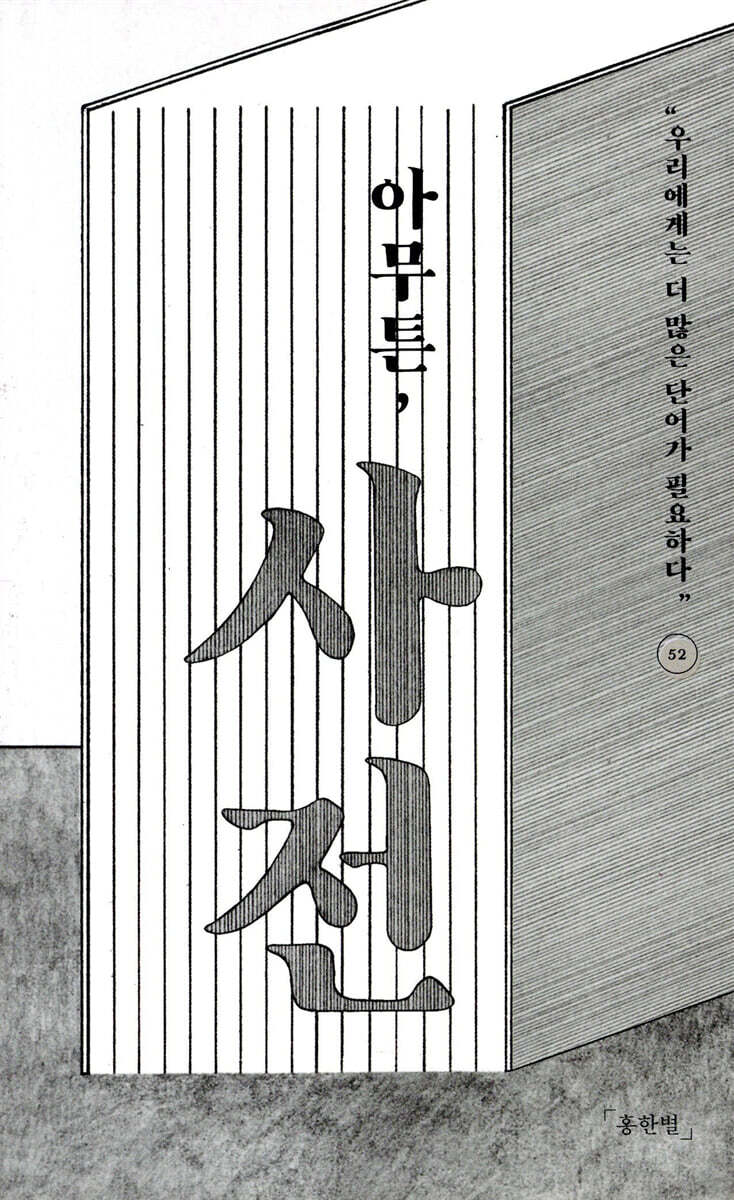
Anyway, dictionary
 |
Description
Book Introduction
We have books that contain small pieces of truth, such as dictionaries.
Author Hong Han-byeol loves dictionaries.
Not only dictionaries and encyclopedias, but I also tend to collect books with the word 'dictionary' or 'encyclopedia' in the title.
For a translator who must constantly select and use words, a dictionary is an essential tool. Furthermore, while relying on the dictionary for translation work, I quickly realized the greatness of compiling something into a single volume, of collecting, organizing, and organizing data.
Moreover, author Hong Han-byeol also likes to create lists of small pieces of information, although they cannot be called 'dictionaries'.
When translating a book in a specific field, I sometimes search for all relevant glossaries on the Internet and combine them into one to create my own glossary.
For author Hong Han-byeol, a dictionary is not just a ‘search tool.’
A dictionary is a book to be 'read' and a place to 'play'.
It also creates interesting new stories using only the examples and examples provided with each word.
Above all, a dictionary is a guide that helps us find order in a very confusing universe.
“We cannot perceive or understand the vastness of the universe, but we have dictionaries, encyclopedias, and books containing small fragments of truth.
“These books allow us to understand and perceive the unknown world.” “Anyway, Dictionary,” which delicately caresses the world of dictionaries built up with a list of words that is close to infinite, is the 52nd book in the “Anyway” series and the first solo essay by Hong Han-byeol, a publishing translator with 20 years of experience.
Author Hong Han-byeol loves dictionaries.
Not only dictionaries and encyclopedias, but I also tend to collect books with the word 'dictionary' or 'encyclopedia' in the title.
For a translator who must constantly select and use words, a dictionary is an essential tool. Furthermore, while relying on the dictionary for translation work, I quickly realized the greatness of compiling something into a single volume, of collecting, organizing, and organizing data.
Moreover, author Hong Han-byeol also likes to create lists of small pieces of information, although they cannot be called 'dictionaries'.
When translating a book in a specific field, I sometimes search for all relevant glossaries on the Internet and combine them into one to create my own glossary.
For author Hong Han-byeol, a dictionary is not just a ‘search tool.’
A dictionary is a book to be 'read' and a place to 'play'.
It also creates interesting new stories using only the examples and examples provided with each word.
Above all, a dictionary is a guide that helps us find order in a very confusing universe.
“We cannot perceive or understand the vastness of the universe, but we have dictionaries, encyclopedias, and books containing small fragments of truth.
“These books allow us to understand and perceive the unknown world.” “Anyway, Dictionary,” which delicately caresses the world of dictionaries built up with a list of words that is close to infinite, is the 52nd book in the “Anyway” series and the first solo essay by Hong Han-byeol, a publishing translator with 20 years of experience.
- You can preview some of the book's contents.
Preview
index
Thoughts on the stairs
The power of words
Collect words in your pocket
Don't trust your dictionary
The dictionary is a cat
Father's Dictionary
From a to zyxt
Scrabble and the Internet
Reclaiming words
Newly created words
Creating a world with dictionaries
A word that is in the dictionary but not in the world,
A word that exists in the world but is not in the dictionary
Dictionary in my mind
The power of words
Collect words in your pocket
Don't trust your dictionary
The dictionary is a cat
Father's Dictionary
From a to zyxt
Scrabble and the Internet
Reclaiming words
Newly created words
Creating a world with dictionaries
A word that is in the dictionary but not in the world,
A word that exists in the world but is not in the dictionary
Dictionary in my mind
Detailed image
Into the book
Without the vocabulary we need, we are at risk of being unable to fend off advanced language attacks from others, understand the world, or express our thoughts.
The problem is, we can't know what words we need without knowing the words themselves.
As if I didn't know that the word I needed was 'strict' until I was hit with that word.
So we have a dictionary.
---From "The Power of Words"
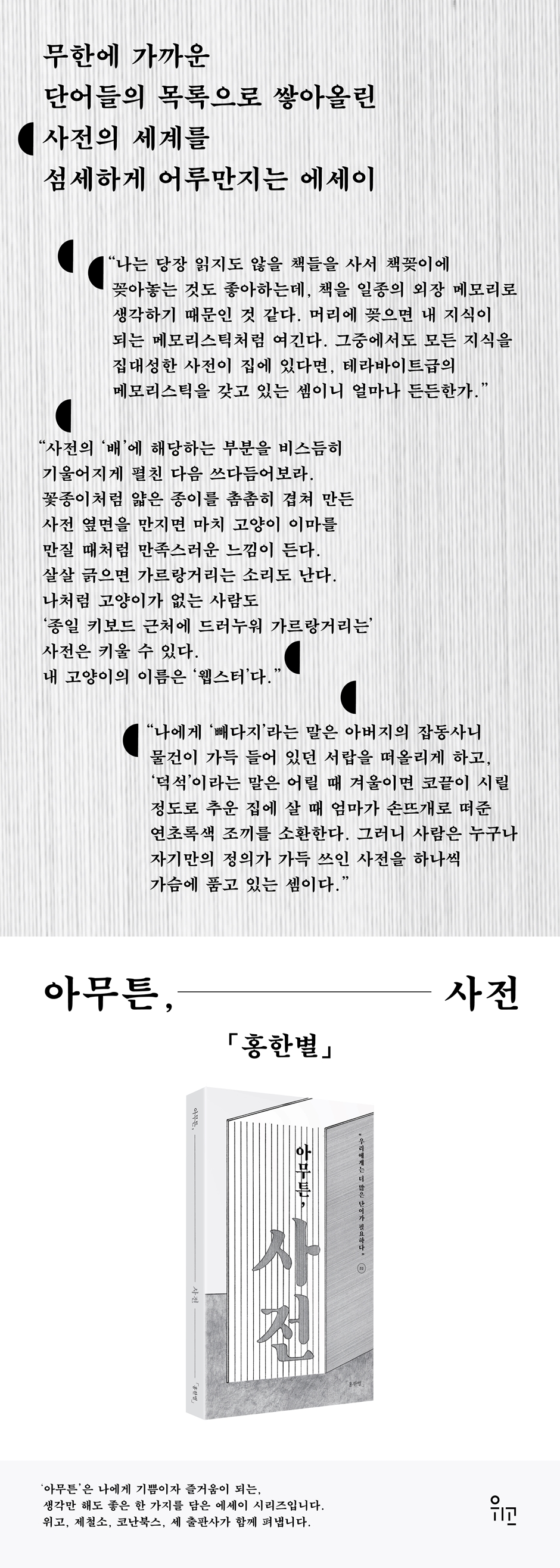
I also like to buy books that I won't read right away and put them on my bookshelf, I guess because I think of books as a kind of external memory.
I think of it as a memory stick that becomes my knowledge when I put it in my head.
If you have a dictionary containing all your knowledge at home, it's like having a terabyte-sized memory stick, so how secure is that (although you never know when you'll have to put it in your head).
---From "The Power of Words"
With a dictionary, we can play Scrabble, create short stories with example sentences, and even create a book code to send to a friend.
And there's a secret to the dictionary: open the dictionary at an angle and stroke the part that corresponds to the word 'pear'.
Touching the side of the dictionary, which is made up of tightly folded, thin paper like flower paper, gives a satisfying feeling, like touching a cat's forehead.
If you scratch it gently, it makes a rustling sound.
Even people like me who don't have cats can keep a dictionary that "lies around the keyboard all day and purrs."
My cat's name is 'Webster'.
---From "The Dictionary is a Cat"
My father, who was losing his logic, memory, and language skills, began studying Greek in a truly odd way.
My father was a devout Christian, and he wanted to learn Koine Greek, the language in which the Apostles' Gospel was first recorded, so that he could read the Bible in its original language, uncorrupted by translation.
He said he wanted to find the original meaning, the primordial meaning.
My father copied the strangely shaped Greek alphabet into a notebook and memorized it every day.
My father, who suffered from a language-losing disease, tried to learn a new language every day, losing words and thoughts.
---From "Father's Dictionary"
Dictionary compilation strives for perfect rigor, but by definition it can never achieve perfection.
Dictionary compilers are people who climb mountains, knowing that they will roll back down, knowing that the mountain keeps growing.
Perhaps the impossibility of reaching perfection is the common fate of all human endeavors, not just dictionaries.
Perfect sculptures decline and perfect theories are refuted.
Nothing can withstand the passage of time.
Yet, civilization would not be possible without people striving for impossible perfection through futile efforts.
---From "a to zyxt"
The definitions in the dictionary are written as dry as possible, drained of all oil, and with great care to avoid containing any traces of the writer's soul, existence, or life.
However, some words may have slightly different meanings for different people, and they may feel emotions when they see those words that are not recorded in the dictionary.
There are some words whose meanings we only know superficially, but then at some point in our lives we experience them for the first time and they come to mind with a completely new feeling.
Love, loneliness, aging, cramps in your legs.
These are things you wouldn't know until you experience them.
---From "The Dictionary in My Heart"
When we encounter words in a specific place as children, the context, feeling, and atmosphere of when we first see them come to mind.
Words like "new rice merchant," "neunggeum," "agawi," "aggyo," "amapo," and "gramophone" were things I saw in storybooks when I was young, but I had never encountered them in real life, so they were already fossilized words even when I was young.
There must have been many more words than what I wrote here, but they were lost and now I can never find them again, which is such a shame.
There are words that I used to use a lot when I was young, but I don't use anymore.
Words such as Yangokjip, Hwaseong, Jinamcheol, Sodokjeo, Camera, Bokdeokbang, Washbasin, and Hole-in-the-wall store have disappeared and are no longer used, have become inappropriate, or have been replaced by other words.
Dead words.
Meanwhile, the word 'ppaedaji' reminds me of the drawer full of my father's odds and ends, and the word 'deokseok' brings to mind the light green vest my mother knitted for me when I was young and we lived in a house so cold that my nose would freeze in the winter.
Words that evoke emotional memories and nostalgia.
So, it's like everyone has a dictionary filled with their own definitions, a dictionary filled with words that are used these days, words that we know but don't use anymore, words that seem to be known only to them, words that they like and words that they hate.
---From "The Dictionary in My Heart"
So we need more words.
For example, I wish there was a more encouraging word to celebrate the invisible labor required to maintain homeostasis in the home: refilling the toilet, stocking up on necessities, taking out the trash, wiping the dust from every corner.
I also wish there was a word that could pinpoint the emotions that are always floating around in my mind.
The burden that remains in my heart when I want to help someone in a difficult situation but lack the courage to do so; the phenomenon of feeling happier and more affectionate when I meet someone in a dream than when I meet them in real life; the fact that a mistake I made in the past cannot be forgotten no matter how much time passes and always comes to mind as if it were happening now, etc.
If there are words to describe such feelings, and if other people use them too, it would be reassuring to think that I am not the only one who feels this way.
The problem is, we can't know what words we need without knowing the words themselves.
As if I didn't know that the word I needed was 'strict' until I was hit with that word.
So we have a dictionary.
---From "The Power of Words"
I also like to buy books that I won't read right away and put them on my bookshelf, I guess because I think of books as a kind of external memory.
I think of it as a memory stick that becomes my knowledge when I put it in my head.
If you have a dictionary containing all your knowledge at home, it's like having a terabyte-sized memory stick, so how secure is that (although you never know when you'll have to put it in your head).
---From "The Power of Words"
With a dictionary, we can play Scrabble, create short stories with example sentences, and even create a book code to send to a friend.
And there's a secret to the dictionary: open the dictionary at an angle and stroke the part that corresponds to the word 'pear'.
Touching the side of the dictionary, which is made up of tightly folded, thin paper like flower paper, gives a satisfying feeling, like touching a cat's forehead.
If you scratch it gently, it makes a rustling sound.
Even people like me who don't have cats can keep a dictionary that "lies around the keyboard all day and purrs."
My cat's name is 'Webster'.
---From "The Dictionary is a Cat"
My father, who was losing his logic, memory, and language skills, began studying Greek in a truly odd way.
My father was a devout Christian, and he wanted to learn Koine Greek, the language in which the Apostles' Gospel was first recorded, so that he could read the Bible in its original language, uncorrupted by translation.
He said he wanted to find the original meaning, the primordial meaning.
My father copied the strangely shaped Greek alphabet into a notebook and memorized it every day.
My father, who suffered from a language-losing disease, tried to learn a new language every day, losing words and thoughts.
---From "Father's Dictionary"
Dictionary compilation strives for perfect rigor, but by definition it can never achieve perfection.
Dictionary compilers are people who climb mountains, knowing that they will roll back down, knowing that the mountain keeps growing.
Perhaps the impossibility of reaching perfection is the common fate of all human endeavors, not just dictionaries.
Perfect sculptures decline and perfect theories are refuted.
Nothing can withstand the passage of time.
Yet, civilization would not be possible without people striving for impossible perfection through futile efforts.
---From "a to zyxt"
The definitions in the dictionary are written as dry as possible, drained of all oil, and with great care to avoid containing any traces of the writer's soul, existence, or life.
However, some words may have slightly different meanings for different people, and they may feel emotions when they see those words that are not recorded in the dictionary.
There are some words whose meanings we only know superficially, but then at some point in our lives we experience them for the first time and they come to mind with a completely new feeling.
Love, loneliness, aging, cramps in your legs.
These are things you wouldn't know until you experience them.
---From "The Dictionary in My Heart"
When we encounter words in a specific place as children, the context, feeling, and atmosphere of when we first see them come to mind.
Words like "new rice merchant," "neunggeum," "agawi," "aggyo," "amapo," and "gramophone" were things I saw in storybooks when I was young, but I had never encountered them in real life, so they were already fossilized words even when I was young.
There must have been many more words than what I wrote here, but they were lost and now I can never find them again, which is such a shame.
There are words that I used to use a lot when I was young, but I don't use anymore.
Words such as Yangokjip, Hwaseong, Jinamcheol, Sodokjeo, Camera, Bokdeokbang, Washbasin, and Hole-in-the-wall store have disappeared and are no longer used, have become inappropriate, or have been replaced by other words.
Dead words.
Meanwhile, the word 'ppaedaji' reminds me of the drawer full of my father's odds and ends, and the word 'deokseok' brings to mind the light green vest my mother knitted for me when I was young and we lived in a house so cold that my nose would freeze in the winter.
Words that evoke emotional memories and nostalgia.
So, it's like everyone has a dictionary filled with their own definitions, a dictionary filled with words that are used these days, words that we know but don't use anymore, words that seem to be known only to them, words that they like and words that they hate.
---From "The Dictionary in My Heart"
So we need more words.
For example, I wish there was a more encouraging word to celebrate the invisible labor required to maintain homeostasis in the home: refilling the toilet, stocking up on necessities, taking out the trash, wiping the dust from every corner.
I also wish there was a word that could pinpoint the emotions that are always floating around in my mind.
The burden that remains in my heart when I want to help someone in a difficult situation but lack the courage to do so; the phenomenon of feeling happier and more affectionate when I meet someone in a dream than when I meet them in real life; the fact that a mistake I made in the past cannot be forgotten no matter how much time passes and always comes to mind as if it were happening now, etc.
If there are words to describe such feelings, and if other people use them too, it would be reassuring to think that I am not the only one who feels this way.
---From "The Dictionary in My Heart"
Publisher's Review
Don't trust your dictionary
Author Hong Han-byeol visits the English-Korean dictionary website dozens or hundreds of times a day.
Look up words you don't know, look up words you know again, and look up words you don't know whether you know them or not.
When translating, I usually have ten search boxes open on my monitor, including an English-Korean dictionary.
Half of the job of translating is word searching.
But at the same time, I often think of the saying, 'don't trust the dictionary.'
Dictionaries offer the illusion of 'completeness,' but in reality they are an impossible project that somehow attempts to capture and fix a constantly changing language.
No matter how extensive the dictionary is, it cannot contain every word that exists in the world.
Because words are constantly being created.
No matter how much we try to confine ourselves to a dictionary, we cannot hold on to the language we use.
『Anyway, Dictionary』 contains author Hong Han-byeol's attempts as a writer and translator to expand the scope of language as far as possible, using the dictionary as an anchor.
This book contains an effort to understand the nature of 'words', which amplify their meaning as they are actually used and create new meanings each time they are placed in a new context.
Yet, people dedicate their lives and passion to advance.
The story that begins with the words contained in a paper dictionary, a square, hard, thick, and heavy object, gradually leads to the story of people who have devoted their passion and lives to it.
We trace the hands of the "authorities of words" who first defined a word and selected and defined the words to be included in the dictionary, and the hands of the anonymous workers who "manually" collected and classified all the examples in the world to support their work and made a list.
Also interesting are the stories of the compilers of the Oxford English Dictionary, who diligently updated the constantly disappearing and emerging 'English words' and even faithfully recorded the history of the English language, the two giants of Japanese dictionary compilation who expanded the world of the Japanese language with completely different approaches to words and definitions despite being active at the same time, and the British conman who started a lie to attract people's attention and ended up creating an entire imaginary country, including a language.
Above all, through the story of the author's father, who collected all kinds of dictionaries out of curiosity and a desire to learn, and his mother, who made her own dictionary by collecting Jeolla dialect words in a notebook so as not to miss out on the words of her old hometown, we finally come to deeply understand the thoughts and heart of author Hong Han-byeol, who built a beloved world with dictionaries that some might consider stiff and boring.
We need more words
"Anyway, Dictionary" shows the power of words and the power of the dictionary to relieve the feeling of loneliness.
If there's a word that describes a feeling or emotion that only I feel, if other people use that word, or if that word is even in the dictionary, I can feel reassured that I'm not alone.
And we all often experience the wondrous phenomenon of a single word giving form to an obscure thought or making it possible to say something we could not say.
Words that express unclear thoughts, explain confusing experiences, and stabilize wavering emotions.
It's like the experience of my heart being pierced by the addition of new words like gaslighting and mansplaining to our vocabulary these days.
So, “we need more words,” says author Hong Han-byeol.
More words, more dictionaries, make us less lonely, more thoughtful, and better.
Author Hong Han-byeol visits the English-Korean dictionary website dozens or hundreds of times a day.
Look up words you don't know, look up words you know again, and look up words you don't know whether you know them or not.
When translating, I usually have ten search boxes open on my monitor, including an English-Korean dictionary.
Half of the job of translating is word searching.
But at the same time, I often think of the saying, 'don't trust the dictionary.'
Dictionaries offer the illusion of 'completeness,' but in reality they are an impossible project that somehow attempts to capture and fix a constantly changing language.
No matter how extensive the dictionary is, it cannot contain every word that exists in the world.
Because words are constantly being created.
No matter how much we try to confine ourselves to a dictionary, we cannot hold on to the language we use.
『Anyway, Dictionary』 contains author Hong Han-byeol's attempts as a writer and translator to expand the scope of language as far as possible, using the dictionary as an anchor.
This book contains an effort to understand the nature of 'words', which amplify their meaning as they are actually used and create new meanings each time they are placed in a new context.
Yet, people dedicate their lives and passion to advance.
The story that begins with the words contained in a paper dictionary, a square, hard, thick, and heavy object, gradually leads to the story of people who have devoted their passion and lives to it.
We trace the hands of the "authorities of words" who first defined a word and selected and defined the words to be included in the dictionary, and the hands of the anonymous workers who "manually" collected and classified all the examples in the world to support their work and made a list.
Also interesting are the stories of the compilers of the Oxford English Dictionary, who diligently updated the constantly disappearing and emerging 'English words' and even faithfully recorded the history of the English language, the two giants of Japanese dictionary compilation who expanded the world of the Japanese language with completely different approaches to words and definitions despite being active at the same time, and the British conman who started a lie to attract people's attention and ended up creating an entire imaginary country, including a language.
Above all, through the story of the author's father, who collected all kinds of dictionaries out of curiosity and a desire to learn, and his mother, who made her own dictionary by collecting Jeolla dialect words in a notebook so as not to miss out on the words of her old hometown, we finally come to deeply understand the thoughts and heart of author Hong Han-byeol, who built a beloved world with dictionaries that some might consider stiff and boring.
We need more words
"Anyway, Dictionary" shows the power of words and the power of the dictionary to relieve the feeling of loneliness.
If there's a word that describes a feeling or emotion that only I feel, if other people use that word, or if that word is even in the dictionary, I can feel reassured that I'm not alone.
And we all often experience the wondrous phenomenon of a single word giving form to an obscure thought or making it possible to say something we could not say.
Words that express unclear thoughts, explain confusing experiences, and stabilize wavering emotions.
It's like the experience of my heart being pierced by the addition of new words like gaslighting and mansplaining to our vocabulary these days.
So, “we need more words,” says author Hong Han-byeol.
More words, more dictionaries, make us less lonely, more thoughtful, and better.
GOODS SPECIFICS
- Publication date: October 10, 2022
- Page count, weight, size: 156 pages | 174g | 110*178*20mm
- ISBN13: 9791186602898
- ISBN10: 1186602899
You may also like
카테고리
korean


korean

![GQ KOREA Mark (Monthly): December [2025]](http://librairie.coreenne.fr/cdn/shop/files/8ef265dbbfbf186523ed75ba7319009d.jpg?v=1765340328&width=3840)


