

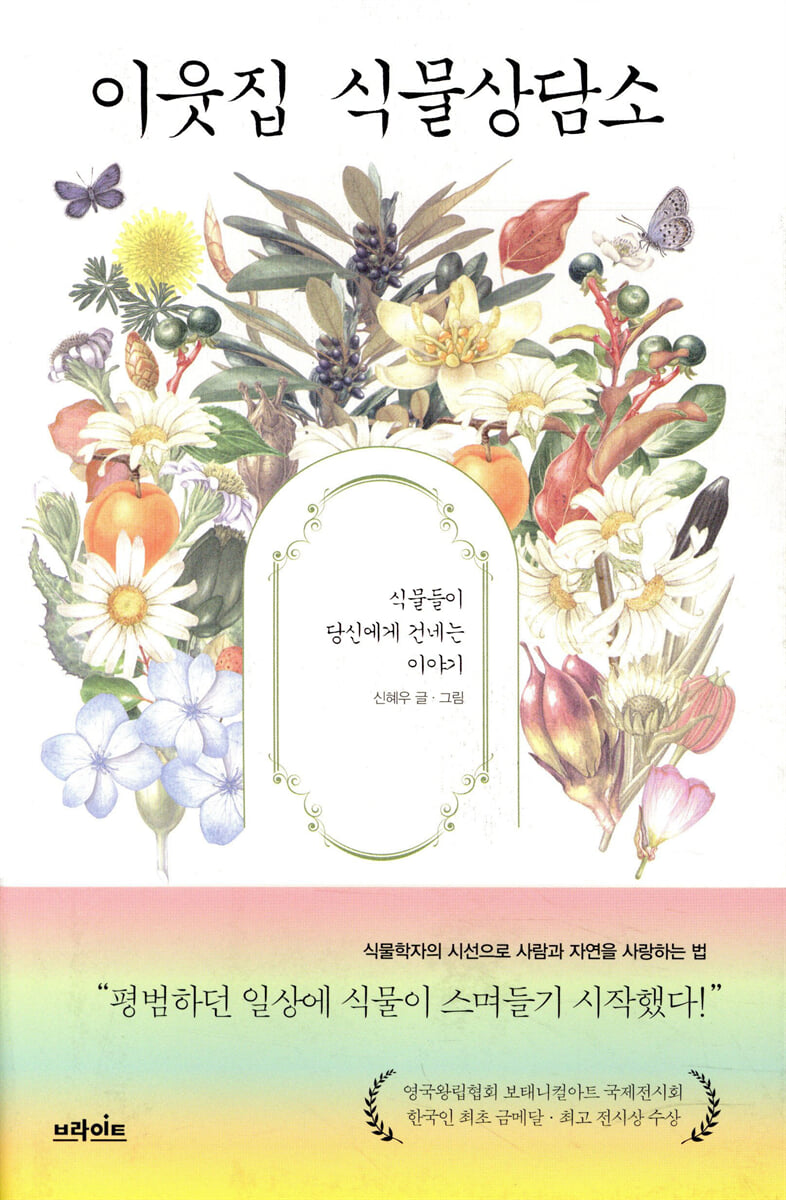
Neighborhood Plant Consultation Center
 |
Description
Book Introduction
“I thought the answer to life was far away. “We were talking so close together.” Shin Hye-woo, a botanist who draws pictures, first collection of essays First Korean to win gold medal and best exhibition award at the Royal Society of Botanical Art International Exhibition The first collection of essays by botanist Shin Hye-woo, who drew much attention and received praise for “learning how to discover the world from a single blade of grass on the roadside,” has been published. This is the story of the 'Plant Consultation Center' that the author, a botanist who conducts cutting-edge research and conveys easy and fun knowledge to the public, and the first Korean to win a gold medal and the best exhibition award at the Royal Society of Botanical Art International Exhibition in the UK, has run for over two years while meeting people. This book tells the story of people who, tired of their daily lives, came to find knowledge and wisdom from plants and discovered life's enlightenment. The book, "Neighborhood Plant Counseling Center," has finally been published, featuring the author's delicate and dense illustrations, and offers a warm invitation to those in need of affection. |
- You can preview some of the book's contents.
Preview
index
introduction.
An invitation to those who want to talk to plants
Part 1.
The dazzling joy found in the greenery around us
Where did my companion plant come from?
I thought the world had abandoned me
Have you ever thought about the role of weeds?
See you in hell
If you love, try loving less
"Is it okay to live like this?" The plant's answer
Part 2.
A place to go when your heart is cold
Instead of asking, “Are you good?”, I want to ask, “Do you like it?”
A folded dream is looking for me
What you see when you let go of your romanticism toward plants
Mysterious secrets not even found in plant encyclopedias
Lonely Child Plant Lover
Because it is diverse, it can become deeper
Learning from the centuries-old zelkova tree
Part 3.
What Plants Teach Us About Preparing for Tomorrow
Like a flower that blooms after preparing all winter
A vegetarian who still wants to try
How to express love without trying too hard
Are you sure it's okay if I raise it?
A botanist who likes plants but hates hiking
Courtesy of old trees
Part 4.
A story that protects precious moments
A story I want to tell you as you begin to like plants
Why should I become a specialist in just one thing?
Plants have no borders
Walking Plant Guide
Because when a plant dies, its secret friend disappears.
You don't have to be great
Hesitant moss researcher
Our Warm Plant Counseling Center Story
I buried a dead baby fish and it sprouted! | What will come out of this bean? | I couldn't see it until yesterday, but I will tomorrow. | This is a strength and this is a weakness on my arm. | How I wish I had known this sooner. | You say you made a fortune by growing flowers? | A lament for plants that were kicked out of the house.
An invitation to those who want to talk to plants
Part 1.
The dazzling joy found in the greenery around us
Where did my companion plant come from?
I thought the world had abandoned me
Have you ever thought about the role of weeds?
See you in hell
If you love, try loving less
"Is it okay to live like this?" The plant's answer
Part 2.
A place to go when your heart is cold
Instead of asking, “Are you good?”, I want to ask, “Do you like it?”
A folded dream is looking for me
What you see when you let go of your romanticism toward plants
Mysterious secrets not even found in plant encyclopedias
Lonely Child Plant Lover
Because it is diverse, it can become deeper
Learning from the centuries-old zelkova tree
Part 3.
What Plants Teach Us About Preparing for Tomorrow
Like a flower that blooms after preparing all winter
A vegetarian who still wants to try
How to express love without trying too hard
Are you sure it's okay if I raise it?
A botanist who likes plants but hates hiking
Courtesy of old trees
Part 4.
A story that protects precious moments
A story I want to tell you as you begin to like plants
Why should I become a specialist in just one thing?
Plants have no borders
Walking Plant Guide
Because when a plant dies, its secret friend disappears.
You don't have to be great
Hesitant moss researcher
Our Warm Plant Counseling Center Story
I buried a dead baby fish and it sprouted! | What will come out of this bean? | I couldn't see it until yesterday, but I will tomorrow. | This is a strength and this is a weakness on my arm. | How I wish I had known this sooner. | You say you made a fortune by growing flowers? | A lament for plants that were kicked out of the house.
Detailed image
.jpg)
Into the book
People who don't know much about plant consultation centers wondered why they were consulting about plants for so long.
It was a place to share knowledge about plants as well as anything related to plants.
After talking for an hour, we became quite close and the conversation went in unexpected directions, such as stories about life, living, and even jokes.
We shared knowledge through flowing conversations and sought answers to our concerns.
The counselor taught me about plants, and I feel like I've learned life lessons through various counselors.
Sometimes, on days when we didn't take reservations, people who had no connection to plants or interest in them would pass by and sit down by chance.
As we talked, each of us was surprised and moved, and I felt it was too precious to let our story disappear and be known only to the counselor and me.
---From the "Preface"
Sad things often happen when you don't have a basic knowledge of the plants you are growing.
For example, acquaintances send a flower pot as a congratulatory gift to a newly opened store.
When the owner runs the store and is very busy, the plants in the corner of the store wither.
One day, the owner finds a withered plant and, worried, places it in front of the store.
I thought the problem was that it was kept indoors where it didn't get any sunlight.
Then, when winter comes, these tropical plants cannot survive the winter and freeze to death, leaving behind only the colorful celebratory ribbons.
---From "Where did my companion plant come from?"
Counselor: I am currently on leave from school for health reasons.
I was diagnosed with breast cancer last year.
Teacher: Are you in good health now?
Counselor: I feel much better now.
Hair grows back like this too.
Last summer, I felt like, "The world has abandoned me." But when I looked at the situation from a different perspective, my thoughts changed, strangely enough.
I lost one heart, but I gained much more.
Teacher: I also had major surgery when I was young and had to stay in the hospital for a long time.
It was painful at the time, but now that I think about it, if I hadn't been sick then, I might not have lived so diligently.
Thanks to that, I think I've developed a set of values that allow me to choose what I like without hesitation.
---From "I Thought the World Had Abandoned Me"
The first time I thought it would be interesting to publish the stories I shared at the Plant Counseling Center in a book was when I met a scientist who was studying nanoparticles.
The day I met the scientist was when I opened a plant consultation center as a related program to an art exhibition related to plants.
I wanted to open a plant consultation center where anyone could come and talk, but since it was connected to a plant-related exhibition, most of the visitors were those who liked plants or art.
As the counseling session was ending, a person came in hesitantly.
The man introduced himself as a nanoparticle researcher.
The scientist was just a local resident who happened to be passing by without knowing anything about it.
Then he talked about the continuity and discontinuity of particles.
---From "Have you ever thought about the role of weeds?"
When you look at cut flowers, that is, flowers that are cut and sold at flower shops, it is actually sad when you think about the entire form of the plant.
People often only see the flowers sold at flower shops and do not know what is underneath.
Many people remember the gerbera flower, but few people know the shape of its leaves and roots.
In fact, from the flower to the root tip, it is one plant and alive.
---From "See You in Hell"
If the plant you are currently growing is not growing well, I recommend that you reduce the amount of love you give it.
Will we finally see the beautiful flowers we've been waiting for? I wonder if the same holds true for many things we experience in life.
There are many cases where we say we love someone but end up eating away at ourselves and hurting the person we love in the name of love.
If we reduce love a little, the long-awaited flower may bloom in our lives and relationships.
---From "If you love, try to love less"
Talking to the counselor helped me resolve one of the concerns I had been having.
It is a realization that it is more important to tell children “I like you” than “You are good.”
I often hear that praise is important for children, so I often say, “Good job.”
I thought it was definitely a good thing, but it made me think about it again.
When I meet with a counselor at a plant counseling center, there are many times when I gain insight rather than just providing counseling.
The enjoyable synergy that comes from each other's strengths is fun.
This kind of joy is one of the reasons why I continue to run the Plant Consultation Center.
---From "Instead of "Are you good?", I'd like to ask "Do you like it?"
There are many people who have dreams that they have folded by their own judgment or by others.
And it's really sad to hear about that process.
There was a time when I had to give up studying plants, which I loved so much.
At first, I was so exhausted both physically and mentally that I couldn't leave the house for three months.
I was frustrated and wandered around for about two years.
It's something I only realized after it happened, but I wonder why it was so hard.
Even if you have put your dreams on hold for a while due to unfavorable circumstances, you can always pursue them again someday.
What if it's folded?
Who knows what else could be cool if we made something else with the folded shape?
---From "The folded dream is looking for me"
It may be a blessing to have something that only you like.
You may feel lonely right now because you don't have anyone to like, but if you keep going down that path, you will meet someone like you somewhere.
As time goes by and I gain more experience and knowledge in what I love, I can become someone who shares it.
The people we meet at such times are another form of great joy and pleasure.
Wouldn't holding on to what you love be a shortcut to achieving your special dream?
---From "The Lonely Child Plant Lover"
The best way to engage someone who isn't particularly familiar with plants is to talk about them.
I study wild plants and would like to share their hidden stories, but it may not be very meaningful to someone who has never seen a wild plant.
So, let's talk about plants using crops that everyone knows, such as grains, vegetables, and fruits that we eat every day.
There are many interesting stories just by looking at crops.
It examines the origins of crops, the wild species from which they originated, the agricultural techniques used to make them tastier and more abundant, and the history of human transformation through plants.
Also, people usually only know certain parts of the crops that are sold as products, so I like to impart the botanical knowledge behind them.
For example, even though we eat rice every day, few people have seen rice flowers.
---From "Like a flower that blooms after preparing all winter"
There are many reasons for plant death.
This may be due to the plant's inherent characteristics or as a strategy to sell the plant as a product.
I hope plant owners don't blame themselves for the death of their plants and grieve over it, as plants can pass away in an unhealthy state that prevents them from growing as healthy as they would in their natural state.
It's a shame to worry about a plant dying without knowing its natural death, and then declare that you will never grow a plant again.
If you love plants, I encourage you to bravely continue loving them even if the plants you worked so hard to grow die.
---From "Are you sure it's okay if I raise it?"
Teacher: Do plants cry a lot when they die?
Child: When a plant dies, it doesn't cry.
It's really frustrating when a plant dies and you have to throw it away.
Then at night, it appears in my dreams.
Plants keep appearing in my dreams.
That's when I cry.
Teacher: Why do you like it so much? Because it's cute?
Child: Life is truly precious and cute.
And it really is like I have a secret friend.
It was a place to share knowledge about plants as well as anything related to plants.
After talking for an hour, we became quite close and the conversation went in unexpected directions, such as stories about life, living, and even jokes.
We shared knowledge through flowing conversations and sought answers to our concerns.
The counselor taught me about plants, and I feel like I've learned life lessons through various counselors.
Sometimes, on days when we didn't take reservations, people who had no connection to plants or interest in them would pass by and sit down by chance.
As we talked, each of us was surprised and moved, and I felt it was too precious to let our story disappear and be known only to the counselor and me.
---From the "Preface"
Sad things often happen when you don't have a basic knowledge of the plants you are growing.
For example, acquaintances send a flower pot as a congratulatory gift to a newly opened store.
When the owner runs the store and is very busy, the plants in the corner of the store wither.
One day, the owner finds a withered plant and, worried, places it in front of the store.
I thought the problem was that it was kept indoors where it didn't get any sunlight.
Then, when winter comes, these tropical plants cannot survive the winter and freeze to death, leaving behind only the colorful celebratory ribbons.
---From "Where did my companion plant come from?"
Counselor: I am currently on leave from school for health reasons.
I was diagnosed with breast cancer last year.
Teacher: Are you in good health now?
Counselor: I feel much better now.
Hair grows back like this too.
Last summer, I felt like, "The world has abandoned me." But when I looked at the situation from a different perspective, my thoughts changed, strangely enough.
I lost one heart, but I gained much more.
Teacher: I also had major surgery when I was young and had to stay in the hospital for a long time.
It was painful at the time, but now that I think about it, if I hadn't been sick then, I might not have lived so diligently.
Thanks to that, I think I've developed a set of values that allow me to choose what I like without hesitation.
---From "I Thought the World Had Abandoned Me"
The first time I thought it would be interesting to publish the stories I shared at the Plant Counseling Center in a book was when I met a scientist who was studying nanoparticles.
The day I met the scientist was when I opened a plant consultation center as a related program to an art exhibition related to plants.
I wanted to open a plant consultation center where anyone could come and talk, but since it was connected to a plant-related exhibition, most of the visitors were those who liked plants or art.
As the counseling session was ending, a person came in hesitantly.
The man introduced himself as a nanoparticle researcher.
The scientist was just a local resident who happened to be passing by without knowing anything about it.
Then he talked about the continuity and discontinuity of particles.
---From "Have you ever thought about the role of weeds?"
When you look at cut flowers, that is, flowers that are cut and sold at flower shops, it is actually sad when you think about the entire form of the plant.
People often only see the flowers sold at flower shops and do not know what is underneath.
Many people remember the gerbera flower, but few people know the shape of its leaves and roots.
In fact, from the flower to the root tip, it is one plant and alive.
---From "See You in Hell"
If the plant you are currently growing is not growing well, I recommend that you reduce the amount of love you give it.
Will we finally see the beautiful flowers we've been waiting for? I wonder if the same holds true for many things we experience in life.
There are many cases where we say we love someone but end up eating away at ourselves and hurting the person we love in the name of love.
If we reduce love a little, the long-awaited flower may bloom in our lives and relationships.
---From "If you love, try to love less"
Talking to the counselor helped me resolve one of the concerns I had been having.
It is a realization that it is more important to tell children “I like you” than “You are good.”
I often hear that praise is important for children, so I often say, “Good job.”
I thought it was definitely a good thing, but it made me think about it again.
When I meet with a counselor at a plant counseling center, there are many times when I gain insight rather than just providing counseling.
The enjoyable synergy that comes from each other's strengths is fun.
This kind of joy is one of the reasons why I continue to run the Plant Consultation Center.
---From "Instead of "Are you good?", I'd like to ask "Do you like it?"
There are many people who have dreams that they have folded by their own judgment or by others.
And it's really sad to hear about that process.
There was a time when I had to give up studying plants, which I loved so much.
At first, I was so exhausted both physically and mentally that I couldn't leave the house for three months.
I was frustrated and wandered around for about two years.
It's something I only realized after it happened, but I wonder why it was so hard.
Even if you have put your dreams on hold for a while due to unfavorable circumstances, you can always pursue them again someday.
What if it's folded?
Who knows what else could be cool if we made something else with the folded shape?
---From "The folded dream is looking for me"
It may be a blessing to have something that only you like.
You may feel lonely right now because you don't have anyone to like, but if you keep going down that path, you will meet someone like you somewhere.
As time goes by and I gain more experience and knowledge in what I love, I can become someone who shares it.
The people we meet at such times are another form of great joy and pleasure.
Wouldn't holding on to what you love be a shortcut to achieving your special dream?
---From "The Lonely Child Plant Lover"
The best way to engage someone who isn't particularly familiar with plants is to talk about them.
I study wild plants and would like to share their hidden stories, but it may not be very meaningful to someone who has never seen a wild plant.
So, let's talk about plants using crops that everyone knows, such as grains, vegetables, and fruits that we eat every day.
There are many interesting stories just by looking at crops.
It examines the origins of crops, the wild species from which they originated, the agricultural techniques used to make them tastier and more abundant, and the history of human transformation through plants.
Also, people usually only know certain parts of the crops that are sold as products, so I like to impart the botanical knowledge behind them.
For example, even though we eat rice every day, few people have seen rice flowers.
---From "Like a flower that blooms after preparing all winter"
There are many reasons for plant death.
This may be due to the plant's inherent characteristics or as a strategy to sell the plant as a product.
I hope plant owners don't blame themselves for the death of their plants and grieve over it, as plants can pass away in an unhealthy state that prevents them from growing as healthy as they would in their natural state.
It's a shame to worry about a plant dying without knowing its natural death, and then declare that you will never grow a plant again.
If you love plants, I encourage you to bravely continue loving them even if the plants you worked so hard to grow die.
---From "Are you sure it's okay if I raise it?"
Teacher: Do plants cry a lot when they die?
Child: When a plant dies, it doesn't cry.
It's really frustrating when a plant dies and you have to throw it away.
Then at night, it appears in my dreams.
Plants keep appearing in my dreams.
That's when I cry.
Teacher: Why do you like it so much? Because it's cute?
Child: Life is truly precious and cute.
And it really is like I have a secret friend.
---From "When a plant dies, its secret friend disappears"
Publisher's Review
When the door to the plant consultation center opens
People's stories begin!
A time to discover dazzling joy in the plants around us.
“Contained in a single blade of grass blooming on the roadside
“Now I understand the joys and sorrows of life.”
A place where people tired of everyday life come to heal their empty hearts with the wisdom of plants.
A place where you can meet a botanist who will reveal the mysterious secrets held by plants.
Surprisingly, places that seem like they only exist in novels actually exist.
This is the story of the plant consultation center that Shin Hye-woo, a botanist who draws pictures, has been running for over two years, meeting people and sharing stories.
"Neighborhood Plant Counseling Center" is a true story, like a novel, about people who come to talk about plants, gain knowledge about plants, discover enlightenment about life, and experience "time to fill my exhausted self" through honest and deep conversations about life stories, living stories, worries and concerns, dreams and career paths.
The story of the Plant Counseling Center, which received praise such as “I gained the courage to stand up again like a flower blooming in spring” and “I learned how to discover the world from a single blade of grass on the roadside,” has finally been published as a book, along with the delicate and dense illustrations of the author, the first Korean to receive a gold medal and the highest exhibition award for botanical art from the Royal Society of London.
Is it because of the comfort that plants provide, or is it because of the author's kindness, who dreams of becoming a neighborhood botanist that everyone can easily visit?
People who came to the plant counseling center told stories they wanted someone to listen to but couldn't tell anyone.
As people talked, they were surprised and moved, and they discovered the answers to life that they thought were far away in the plants right next to them.
Only then did I notice the countless footsteps of people that the small, blooming plant on the side of the road held, the stories that the plant in the pot in the living room saw and heard that no one could tell, and the unknown joys and sorrows that the plant on the office desk held.
Just as a counselor who visited a plant counseling center confessed, “I now understand the joys and sorrows of life contained in a single roadside plant,” “Neighborhood Plant Counseling Center” conveys that the plants we easily encounter contain stories of human life.
Like countless others who have visited the Plant Counseling Center, the moment you open its doors, you too will experience yourself looking at your daily life with different eyes.
I have a story that I wish someone would listen to, but I can't tell anyone.
People who confide in affectionate plants
A physicist who glimpses the transformation of life in plants,
A child who feels lonely because he has no friends to share his feelings with,
Office workers who work hard but have an uncertain future,
A late bloomer student recovering his health and studying nature,
A woman pours out her empty heart while consulting a seed plant…
The Plant Consultation Center opened its doors for the first time at the Boan Inn, a complex cultural space in Seochon.
The author, a new researcher whose research scope extends from plant morphological classification to plant genome research, realized one day while studying plants and drawing for research in the lab that studying plants is something that benefits people.
I thought it would be fun to meet people as a neighborhood botanist who could come and ask about plants while sitting in the playground on weekends or holidays.
That's how the plant counseling center for people began.
Now that more people are looking for it, we are taking reservations in advance, but at first, we just happened to meet people passing by and sitting down.
The results exceeded expectations.
People you wouldn't expect to find at the Plant Counseling Center.
A physicist who glimpses the changes in life through plants, a child who feels lonely because he has no friends to share his feelings with, an office worker who works hard but is uncertain about the future, a woman who pours out her empty heart while consulting a dying plant…
In the flowing conversation, we shared our knowledge about plants and sought answers to our concerns.
The people who visited the counseling center and the author shared their hearts through heartwarming conversations, becoming a warm shelter for each other during these hectic days.
Counselor: I am currently on leave from school for health reasons.
I was diagnosed with breast cancer last year.
Teacher: Are you in good health now?
Counselor: I feel much better now.
Hair grows back like this too.
Last summer, I felt like, "The world has abandoned me." But when I looked at the situation from a different perspective, my thoughts changed, strangely enough.
I lost one heart, but I gained much more.
Teacher: I also had major surgery when I was young and had to stay in the hospital for a long time.
It was painful at the time, but now that I think about it, if I hadn't been sick then, I might not have lived so diligently.
Thanks to that, I think I've developed a set of values that allow me to choose what I like without hesitation.
_From pages 29-30, “I Thought the World Had Abandoned Me”
“Is it okay to live like this?”
The answers plants offer and the profound world they contain.
Do weeds have a role to play?
I feel guilty every time I eat avocado. What should I do?
Why should you become a specialist in just one thing?
My old tree is dying because of the new building being built in front of my house. Is there any way to do this?
I want to study more deeply, but I'm starting to doubt whether it's just my greed.
The story begins with an interesting question asked by people who visit the plant consultation center.
It is full of unspoken concerns and stories, from questions surrounding plants that we had never thought of before, such as “Do weeds have a role to play?” and “What should I do when I feel guilty every time I eat an avocado?” to “Is it okay to live like this?” and “Why do I have to be an expert at only one thing?”
The author tells the story of plants, and through the deep world contained within, we discover another side of ordinary life and find wisdom in life.
The author skillfully navigates between scientific knowledge-based insights, rich experience, and intimate psychology as a botanist, guiding readers to experience the healing of body and mind that nature provides, from the stories contained in weeds that can be easily found around us, to wild plants that are difficult for the general public to encounter, to the secrets of crops that we eat every day but are not aware of, to the sadness of cut flowers sold at flower shops, to the inner workings of tropical plants that remain stunted on apartment balconies.
If the plant you are currently growing is not growing well, I recommend that you reduce the amount of love you give it.
Will we finally see the beautiful flowers we've been waiting for? I wonder if the same holds true for many things we experience in life.
There are many times when we say we love someone and eat away at ourselves, and in the name of love, we hurt the person we love.
If we reduce love a little, the flowers we have been waiting for may bloom in our lives and relationships.
_From pages 58-59 of “If You Love, Try to Love Less”
The author, who excels at both being a botanist and a painter, also faces many concerns about work, the future, dreams, and aptitude.
Each time, he shared his experiences with his counselors openly, like a neighborhood botanist or a friendly advisor.
The numerous lectures and drawing classes he gives to the public, and the warm solidarity he builds with those who visit his plant consultation center, all highlight his understanding and consideration for others found in his relationships with others.
When I hear from the counselor the secrets of plants that I had not discovered despite observing and recording for years, when I see the childlike innocence in the eyes of adults observing plants, and when I see the author sharing his pain without reservation with a counselor who is anxious about an uncertain future despite studying hard, I can see his deep concern and affection for people.
Nature is always there, but the time when we open our eyes to its natural beauty varies from person to person.
When I didn't pay attention to the explanation and didn't know it was pretty, but then suddenly realized that the nature next to me was so perfectly beautiful, I wanted to be by that person's side.
_From pages 64-65, “Is it okay to live like this?” The answer given by plants
For the first time in the history of the Royal Society of Great Britain
Won the Gold Medal and Best Exhibition Award for 4 consecutive years!
A collection of paintings filled with deep emotions that cannot be expressed simply by the word "beautiful."
The illustrations skillfully placed on each page of the book, along with the delicate sentences, allow the reader to fully enjoy the nature the author saw and felt through the book.
Looking at the picture, you can feel how much love the author put into observing and expressing plants.
The record of going to a remote area where no one has set foot in search of plants and observing and accurately depicting the plants for a year evokes a deep emotion that cannot be expressed simply with the word 'beautiful'.
In the author's paintings, we feel with our whole body the amazing changes that occur in our body and mind when we spend time in nature.
Plants hold a precious and profound world that we miss out on in our busy lives.
This book is filled with stories of people around us that we have forgotten in these hectic days.
Let's shake off the painful memories of yesterday, the worries and concerns we want to tell someone but lack the courage to, and discover in the plants around us the courage to embrace and face the exciting anticipation of tomorrow and the fearful present.
The Plant Counseling Center, which started at a security hotel, is preparing to meet diverse people in more diverse places.
Just like the countless people who have found a different story in life through comfort and comforting laughter at the Plant Counseling Center, the moment you step into the Plant Counseling Center that opens before you, a completely different life will unfold before your eyes.
People's stories begin!
A time to discover dazzling joy in the plants around us.
“Contained in a single blade of grass blooming on the roadside
“Now I understand the joys and sorrows of life.”
A place where people tired of everyday life come to heal their empty hearts with the wisdom of plants.
A place where you can meet a botanist who will reveal the mysterious secrets held by plants.
Surprisingly, places that seem like they only exist in novels actually exist.
This is the story of the plant consultation center that Shin Hye-woo, a botanist who draws pictures, has been running for over two years, meeting people and sharing stories.
"Neighborhood Plant Counseling Center" is a true story, like a novel, about people who come to talk about plants, gain knowledge about plants, discover enlightenment about life, and experience "time to fill my exhausted self" through honest and deep conversations about life stories, living stories, worries and concerns, dreams and career paths.
The story of the Plant Counseling Center, which received praise such as “I gained the courage to stand up again like a flower blooming in spring” and “I learned how to discover the world from a single blade of grass on the roadside,” has finally been published as a book, along with the delicate and dense illustrations of the author, the first Korean to receive a gold medal and the highest exhibition award for botanical art from the Royal Society of London.
Is it because of the comfort that plants provide, or is it because of the author's kindness, who dreams of becoming a neighborhood botanist that everyone can easily visit?
People who came to the plant counseling center told stories they wanted someone to listen to but couldn't tell anyone.
As people talked, they were surprised and moved, and they discovered the answers to life that they thought were far away in the plants right next to them.
Only then did I notice the countless footsteps of people that the small, blooming plant on the side of the road held, the stories that the plant in the pot in the living room saw and heard that no one could tell, and the unknown joys and sorrows that the plant on the office desk held.
Just as a counselor who visited a plant counseling center confessed, “I now understand the joys and sorrows of life contained in a single roadside plant,” “Neighborhood Plant Counseling Center” conveys that the plants we easily encounter contain stories of human life.
Like countless others who have visited the Plant Counseling Center, the moment you open its doors, you too will experience yourself looking at your daily life with different eyes.
I have a story that I wish someone would listen to, but I can't tell anyone.
People who confide in affectionate plants
A physicist who glimpses the transformation of life in plants,
A child who feels lonely because he has no friends to share his feelings with,
Office workers who work hard but have an uncertain future,
A late bloomer student recovering his health and studying nature,
A woman pours out her empty heart while consulting a seed plant…
The Plant Consultation Center opened its doors for the first time at the Boan Inn, a complex cultural space in Seochon.
The author, a new researcher whose research scope extends from plant morphological classification to plant genome research, realized one day while studying plants and drawing for research in the lab that studying plants is something that benefits people.
I thought it would be fun to meet people as a neighborhood botanist who could come and ask about plants while sitting in the playground on weekends or holidays.
That's how the plant counseling center for people began.
Now that more people are looking for it, we are taking reservations in advance, but at first, we just happened to meet people passing by and sitting down.
The results exceeded expectations.
People you wouldn't expect to find at the Plant Counseling Center.
A physicist who glimpses the changes in life through plants, a child who feels lonely because he has no friends to share his feelings with, an office worker who works hard but is uncertain about the future, a woman who pours out her empty heart while consulting a dying plant…
In the flowing conversation, we shared our knowledge about plants and sought answers to our concerns.
The people who visited the counseling center and the author shared their hearts through heartwarming conversations, becoming a warm shelter for each other during these hectic days.
Counselor: I am currently on leave from school for health reasons.
I was diagnosed with breast cancer last year.
Teacher: Are you in good health now?
Counselor: I feel much better now.
Hair grows back like this too.
Last summer, I felt like, "The world has abandoned me." But when I looked at the situation from a different perspective, my thoughts changed, strangely enough.
I lost one heart, but I gained much more.
Teacher: I also had major surgery when I was young and had to stay in the hospital for a long time.
It was painful at the time, but now that I think about it, if I hadn't been sick then, I might not have lived so diligently.
Thanks to that, I think I've developed a set of values that allow me to choose what I like without hesitation.
_From pages 29-30, “I Thought the World Had Abandoned Me”
“Is it okay to live like this?”
The answers plants offer and the profound world they contain.
Do weeds have a role to play?
I feel guilty every time I eat avocado. What should I do?
Why should you become a specialist in just one thing?
My old tree is dying because of the new building being built in front of my house. Is there any way to do this?
I want to study more deeply, but I'm starting to doubt whether it's just my greed.
The story begins with an interesting question asked by people who visit the plant consultation center.
It is full of unspoken concerns and stories, from questions surrounding plants that we had never thought of before, such as “Do weeds have a role to play?” and “What should I do when I feel guilty every time I eat an avocado?” to “Is it okay to live like this?” and “Why do I have to be an expert at only one thing?”
The author tells the story of plants, and through the deep world contained within, we discover another side of ordinary life and find wisdom in life.
The author skillfully navigates between scientific knowledge-based insights, rich experience, and intimate psychology as a botanist, guiding readers to experience the healing of body and mind that nature provides, from the stories contained in weeds that can be easily found around us, to wild plants that are difficult for the general public to encounter, to the secrets of crops that we eat every day but are not aware of, to the sadness of cut flowers sold at flower shops, to the inner workings of tropical plants that remain stunted on apartment balconies.
If the plant you are currently growing is not growing well, I recommend that you reduce the amount of love you give it.
Will we finally see the beautiful flowers we've been waiting for? I wonder if the same holds true for many things we experience in life.
There are many times when we say we love someone and eat away at ourselves, and in the name of love, we hurt the person we love.
If we reduce love a little, the flowers we have been waiting for may bloom in our lives and relationships.
_From pages 58-59 of “If You Love, Try to Love Less”
The author, who excels at both being a botanist and a painter, also faces many concerns about work, the future, dreams, and aptitude.
Each time, he shared his experiences with his counselors openly, like a neighborhood botanist or a friendly advisor.
The numerous lectures and drawing classes he gives to the public, and the warm solidarity he builds with those who visit his plant consultation center, all highlight his understanding and consideration for others found in his relationships with others.
When I hear from the counselor the secrets of plants that I had not discovered despite observing and recording for years, when I see the childlike innocence in the eyes of adults observing plants, and when I see the author sharing his pain without reservation with a counselor who is anxious about an uncertain future despite studying hard, I can see his deep concern and affection for people.
Nature is always there, but the time when we open our eyes to its natural beauty varies from person to person.
When I didn't pay attention to the explanation and didn't know it was pretty, but then suddenly realized that the nature next to me was so perfectly beautiful, I wanted to be by that person's side.
_From pages 64-65, “Is it okay to live like this?” The answer given by plants
For the first time in the history of the Royal Society of Great Britain
Won the Gold Medal and Best Exhibition Award for 4 consecutive years!
A collection of paintings filled with deep emotions that cannot be expressed simply by the word "beautiful."
The illustrations skillfully placed on each page of the book, along with the delicate sentences, allow the reader to fully enjoy the nature the author saw and felt through the book.
Looking at the picture, you can feel how much love the author put into observing and expressing plants.
The record of going to a remote area where no one has set foot in search of plants and observing and accurately depicting the plants for a year evokes a deep emotion that cannot be expressed simply with the word 'beautiful'.
In the author's paintings, we feel with our whole body the amazing changes that occur in our body and mind when we spend time in nature.
Plants hold a precious and profound world that we miss out on in our busy lives.
This book is filled with stories of people around us that we have forgotten in these hectic days.
Let's shake off the painful memories of yesterday, the worries and concerns we want to tell someone but lack the courage to, and discover in the plants around us the courage to embrace and face the exciting anticipation of tomorrow and the fearful present.
The Plant Counseling Center, which started at a security hotel, is preparing to meet diverse people in more diverse places.
Just like the countless people who have found a different story in life through comfort and comforting laughter at the Plant Counseling Center, the moment you step into the Plant Counseling Center that opens before you, a completely different life will unfold before your eyes.
GOODS SPECIFICS
- Publication date: May 19, 2022
- Page count, weight, size: 288 pages | 436g | 135*210*18mm
- ISBN13: 9791130690827
- ISBN10: 1130690822
You may also like
카테고리
korean


korean

![GQ KOREA Mark (Monthly): December [2025]](http://librairie.coreenne.fr/cdn/shop/files/8ef265dbbfbf186523ed75ba7319009d.jpg?v=1765340328&width=3840)


