

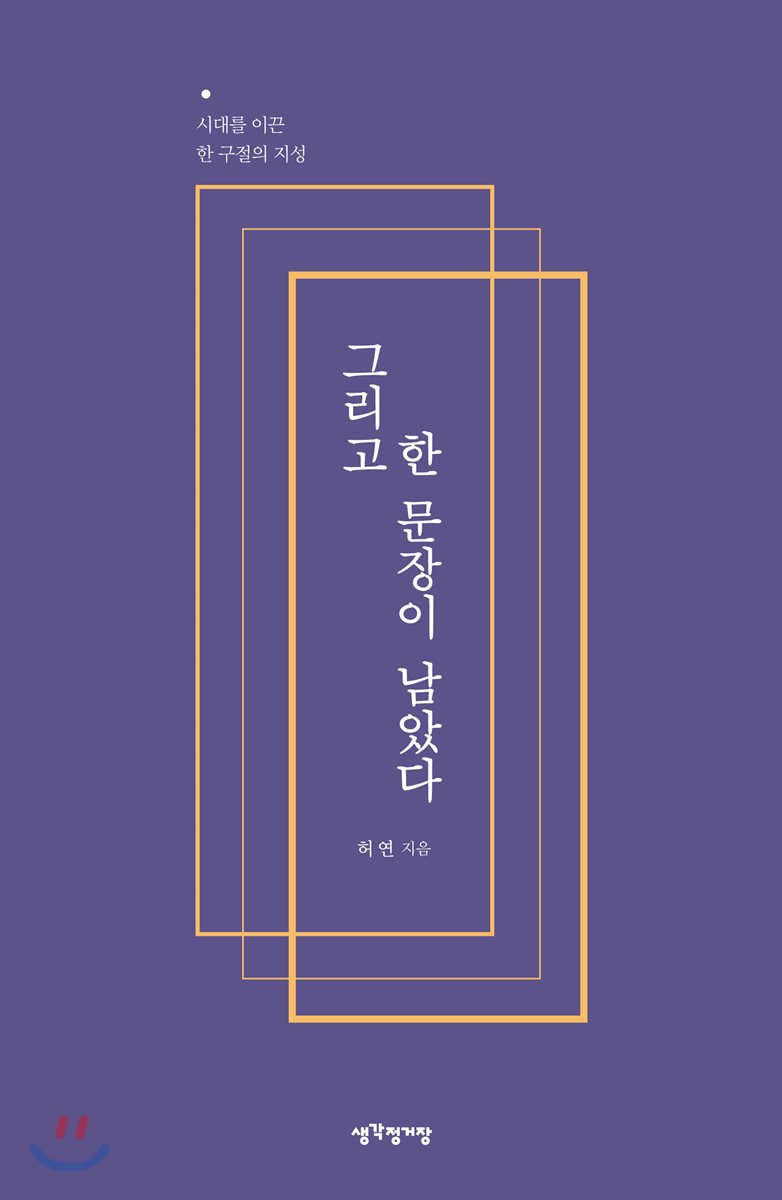
And one sentence remains
 |
Description
Book Introduction
A great record of the book and author that shook the world.
On the wisdom of a phrase that led the times
As the majority of humanity began to learn to read, barbarism began to decline.
The world changed when humans learned to read and write.
Reading a book is an act of providing standards and motivation for certain words and actions.
These standards and motivations have come together to drive the progress of mankind.
The writings in this book are a memory and a great record of a book and its author that caused a stir in the world.
As people read books, their egos and perspectives changed, and these changed egos came together to change the world.
The author leaves behind a meaningful record that connects today's readers with sentences that were themselves intellectuals of an era.
The hidden stories of those who willingly went ahead become an opportunity for readers to truly think and have eyes to see the world.
The world must become better in the future.
A solid 'one sentence' that shows what a conscious, living life is will make it possible.
On the wisdom of a phrase that led the times
As the majority of humanity began to learn to read, barbarism began to decline.
The world changed when humans learned to read and write.
Reading a book is an act of providing standards and motivation for certain words and actions.
These standards and motivations have come together to drive the progress of mankind.
The writings in this book are a memory and a great record of a book and its author that caused a stir in the world.
As people read books, their egos and perspectives changed, and these changed egos came together to change the world.
The author leaves behind a meaningful record that connects today's readers with sentences that were themselves intellectuals of an era.
The hidden stories of those who willingly went ahead become an opportunity for readers to truly think and have eyes to see the world.
The world must become better in the future.
A solid 'one sentence' that shows what a conscious, living life is will make it possible.
- You can preview some of the book's contents.
Preview
index
Author's Note
Part 1: The Inner Solitude
A great writer who tightroped between conflicting images
The Catcher in the Rye, the most-borrowed novel ever written and then lived in seclusion
The heretic of British literature who designed the concept of the outsider
The father of the play [Long Day's Journey into Night]
A master of epigraphy who perfected Chusa script amidst political misfortune
Where Am I Going?, Humanistic Storyteller
Part 2: The Nobility of Unhidden Emotions
The fool of God who was faithful to his desires
Most of what I believe to be my own thoughts are borrowed from others.
The author who transformed the kitchen into a feminist space
Introduction to the Study of Love, which shook Europe 170 years ago
Those who do not dream will never see the light.
Emotions can also be the basis for public judgment.
Part 3: On the Aesthetics of Resistance
A sailor-turned-author who delved into the dark side of civilization
The kamikaze pilots weren't brave.
Activist theologian and pastor who resisted the Nazis
A writer who challenged caste, male superiority, and religious discrimination
A street philosopher who unearthed the madness of collectivism
Power dynamics, not ethics, drive groups.
The "dignity of conservatism" that values careful change based on experience.
Authoritarianism should not change science.
The way we mourn is also a product of ideology.
The more you believe you can do anything, the more helpless you become.
Wealth is not bestowed by heaven, but is created by the people.
A humanist who cried out that humans are unbreakable
Nobel Prize-winning author who criticized concentration camps with beautiful prose
Part 4: Finite Time and Infinite Self
A writer who documented both the affluence and decline of 20th-century Europe.
Albert Camus' spiritual mentor, mystical prose writer
A writer respected by writers for his unfamiliar and powerful sentences.
A transcendent poet who discovered the meaning of life in exile
There are mysteries that cannot be explained by logic alone.
A poet is a seer who sees through the hidden essence.
A poet who brought purity from barbarism
A giant in Japanese literature who broke down the wall of religious novels
A weighty question and a sublime teaching about existence
The essence of life depicted in detail, a representative writer of pure literature
Pointing out the dark side of a hyper-connected society
Part 5: Going Ahead of Others
A pioneer who introduced the alphabet, dictionaries, and revolutions to Joseon
Desire is the beginning of wisdom, says Islamic scholar who sketched the Renaissance.
A bookseller who led the Paris literary world in the early 20th century
The epic of Korean literature exchanged for 'Han'
A master of black comedy who elevated cynicism to literature.
The father of the English language, who compiled the Oxford English Dictionary
Marquez, the Continental writer of the original film [Red Sorghum]
A master of modern literature who embodies a sense of place in his novels
An intellectual is someone who fights against the clichés that have already been established.
Viewing the universe from the attic
Part 6: For a New Intelligence
Without doubt, science cannot progress.
A mathematician and thinker who despised reason without action
The Internet, the king of science fiction that predicted the moon landing
A great writer of the early 20th century who overcame the contradictions of reality with wit
The world improves only as humans improve.
Humanity ultimately finds salvation through memory.
The less you know, the less you love.
Evolution is not about progress, but about diversification.
Scientific thinking made humanity moral.
The Harvard saint who called for the neutralization of opportunity
Part 1: The Inner Solitude
A great writer who tightroped between conflicting images
The Catcher in the Rye, the most-borrowed novel ever written and then lived in seclusion
The heretic of British literature who designed the concept of the outsider
The father of the play [Long Day's Journey into Night]
A master of epigraphy who perfected Chusa script amidst political misfortune
Where Am I Going?, Humanistic Storyteller
Part 2: The Nobility of Unhidden Emotions
The fool of God who was faithful to his desires
Most of what I believe to be my own thoughts are borrowed from others.
The author who transformed the kitchen into a feminist space
Introduction to the Study of Love, which shook Europe 170 years ago
Those who do not dream will never see the light.
Emotions can also be the basis for public judgment.
Part 3: On the Aesthetics of Resistance
A sailor-turned-author who delved into the dark side of civilization
The kamikaze pilots weren't brave.
Activist theologian and pastor who resisted the Nazis
A writer who challenged caste, male superiority, and religious discrimination
A street philosopher who unearthed the madness of collectivism
Power dynamics, not ethics, drive groups.
The "dignity of conservatism" that values careful change based on experience.
Authoritarianism should not change science.
The way we mourn is also a product of ideology.
The more you believe you can do anything, the more helpless you become.
Wealth is not bestowed by heaven, but is created by the people.
A humanist who cried out that humans are unbreakable
Nobel Prize-winning author who criticized concentration camps with beautiful prose
Part 4: Finite Time and Infinite Self
A writer who documented both the affluence and decline of 20th-century Europe.
Albert Camus' spiritual mentor, mystical prose writer
A writer respected by writers for his unfamiliar and powerful sentences.
A transcendent poet who discovered the meaning of life in exile
There are mysteries that cannot be explained by logic alone.
A poet is a seer who sees through the hidden essence.
A poet who brought purity from barbarism
A giant in Japanese literature who broke down the wall of religious novels
A weighty question and a sublime teaching about existence
The essence of life depicted in detail, a representative writer of pure literature
Pointing out the dark side of a hyper-connected society
Part 5: Going Ahead of Others
A pioneer who introduced the alphabet, dictionaries, and revolutions to Joseon
Desire is the beginning of wisdom, says Islamic scholar who sketched the Renaissance.
A bookseller who led the Paris literary world in the early 20th century
The epic of Korean literature exchanged for 'Han'
A master of black comedy who elevated cynicism to literature.
The father of the English language, who compiled the Oxford English Dictionary
Marquez, the Continental writer of the original film [Red Sorghum]
A master of modern literature who embodies a sense of place in his novels
An intellectual is someone who fights against the clichés that have already been established.
Viewing the universe from the attic
Part 6: For a New Intelligence
Without doubt, science cannot progress.
A mathematician and thinker who despised reason without action
The Internet, the king of science fiction that predicted the moon landing
A great writer of the early 20th century who overcame the contradictions of reality with wit
The world improves only as humans improve.
Humanity ultimately finds salvation through memory.
The less you know, the less you love.
Evolution is not about progress, but about diversification.
Scientific thinking made humanity moral.
The Harvard saint who called for the neutralization of opportunity
Into the book
“Have you ever wanted to read Plato’s Republic? I am Plato’s Republic.
Or maybe you want to read Marcus Aurelius.
Then go see Simmons.
He is Marcus Aurelius.”
It's a really interesting setup.
Anyone who reads Plato is soon an alter ego of Plato, and anyone who reads Aurelius is soon an alter ego of Aurelius.
In fact, this fictional exaggeration is a very well-founded story.
Reading a book, empathizing with it, and remembering it means becoming an alter ego of that book.
The book that comes into contact with me soon becomes my alter ego.
_From the Author's Note --- p.5
“Being better than others does not make you noble.
“He who is superior to his past self ultimately becomes a noble person.” _Hemingway --- p.14
“They abandon the right path and seek the Way only in mysterious places.
“I climbed up to the ridge, stepping on the empty space, and tried to find the leak in the lower room by looking at the light from the window and the shadows from the attic, but I couldn’t find it.”
Chusa's point that one cannot find water leaking from the room below by climbing up to the roof of the building reveals his academic style that valued poetry over public opinion.
--- p.32
“There is no need to try to be great or simple, wise or foolish.
“Just do whatever comes to mind.” _Henry Miller --- p.40
“Thinking that sees the world only through utilitarian calculations is blind.
This attitude blinds us to the qualitative richness, the individuality and inner depth of human existence, and things like hope, love, and fear.” _Martha Nussbaum --- p.60
『Heart of Darkness』 is actually a 'novel to think about' rather than a 'novel to read'.
It is that deep and difficult.
This is because it relies on symbolism and allusion rather than description or plot progression.
“Behind the curtain of jungle, the sound of drums hung in the air, circling above our heads.
We could not even guess whether the sound of the drum meant war, peace, or prayer.” --- p.69
“There is no way the military was unaware of the situation.
Their delay in surrender was due to their biological instinct to preserve their own lives.
So I have the right to hate them.” _Shohei Ooka --- p.70
This is the essence of the Pacific War.
It was the politicians who used the common people as cannon fodder and talked about the Greater East Asia Co-Prosperity Sphere and Long Live the Emperor.
They went one step further and even instilled in us the deceptive idea of an afterlife where we would be reborn as gods after we died.
In fact, all wars are fought by blackmailing ordinary people with similar attributes into becoming warriors.
--- p.73
“The weaker the basis for one’s own superiority, the more likely one is to become a blind believer in the cause one supports, whether it be a nation, an ideology, a race, or a religion.” _Eric Hoffer --- p.82
Herta Müller's "Breathing", which won the 2009 Nobel Prize, is a unique work.
Above all, the symbols and descriptions that appear in the novel are very poetic and beautiful.
It makes me wonder if it is possible for concentration camp literature to be written in such poetic sentences.
She was the one who sublimated the most disgusting ugliness into aesthetics.
“I couldn’t dare to put my longing first.
“The same scenes keep replaying in my head, and when I become accustomed to being isolated from the world, the longing has already become a memory.” --- p.116
Jean Grenier said, “Beasts die of pleasure, men die of wonder.”
He was a man born with a natural ability to see wonders.
Yes, that's right.
Wonder is not only found in big and great things.
How wonderful is a single blade of grass poking its head out between the pavement blocks.
How much does it make us want to live?
--- p.127
Life is about looking at the invisible.
For what is seen is temporary, but what is unseen is eternal.
_Christopher Merrill --- p.136
By synthesizing various experiences, eliminating exaggerations and revering what is realistic, complete the unified learning.
_Hye-gang Choi Han-gi --- p.166
Ibn Sina was a great intellectual who divided the world into before and after him.
In his book, The Book of Healing, there is a profound and enlightening sentence: "The body is a beast that must be let go when the purpose of the journey is achieved."
This passage allows us to guess how far ahead he was of the Europeans of his time, who practiced alchemy.
--- p.173
“Every experience is a morning.
Through it, the unknown world becomes brighter.
“He who has gained experience knows more than a fortuneteller.” _Leonardo da Vinci
Or maybe you want to read Marcus Aurelius.
Then go see Simmons.
He is Marcus Aurelius.”
It's a really interesting setup.
Anyone who reads Plato is soon an alter ego of Plato, and anyone who reads Aurelius is soon an alter ego of Aurelius.
In fact, this fictional exaggeration is a very well-founded story.
Reading a book, empathizing with it, and remembering it means becoming an alter ego of that book.
The book that comes into contact with me soon becomes my alter ego.
_From the Author's Note --- p.5
“Being better than others does not make you noble.
“He who is superior to his past self ultimately becomes a noble person.” _Hemingway --- p.14
“They abandon the right path and seek the Way only in mysterious places.
“I climbed up to the ridge, stepping on the empty space, and tried to find the leak in the lower room by looking at the light from the window and the shadows from the attic, but I couldn’t find it.”
Chusa's point that one cannot find water leaking from the room below by climbing up to the roof of the building reveals his academic style that valued poetry over public opinion.
--- p.32
“There is no need to try to be great or simple, wise or foolish.
“Just do whatever comes to mind.” _Henry Miller --- p.40
“Thinking that sees the world only through utilitarian calculations is blind.
This attitude blinds us to the qualitative richness, the individuality and inner depth of human existence, and things like hope, love, and fear.” _Martha Nussbaum --- p.60
『Heart of Darkness』 is actually a 'novel to think about' rather than a 'novel to read'.
It is that deep and difficult.
This is because it relies on symbolism and allusion rather than description or plot progression.
“Behind the curtain of jungle, the sound of drums hung in the air, circling above our heads.
We could not even guess whether the sound of the drum meant war, peace, or prayer.” --- p.69
“There is no way the military was unaware of the situation.
Their delay in surrender was due to their biological instinct to preserve their own lives.
So I have the right to hate them.” _Shohei Ooka --- p.70
This is the essence of the Pacific War.
It was the politicians who used the common people as cannon fodder and talked about the Greater East Asia Co-Prosperity Sphere and Long Live the Emperor.
They went one step further and even instilled in us the deceptive idea of an afterlife where we would be reborn as gods after we died.
In fact, all wars are fought by blackmailing ordinary people with similar attributes into becoming warriors.
--- p.73
“The weaker the basis for one’s own superiority, the more likely one is to become a blind believer in the cause one supports, whether it be a nation, an ideology, a race, or a religion.” _Eric Hoffer --- p.82
Herta Müller's "Breathing", which won the 2009 Nobel Prize, is a unique work.
Above all, the symbols and descriptions that appear in the novel are very poetic and beautiful.
It makes me wonder if it is possible for concentration camp literature to be written in such poetic sentences.
She was the one who sublimated the most disgusting ugliness into aesthetics.
“I couldn’t dare to put my longing first.
“The same scenes keep replaying in my head, and when I become accustomed to being isolated from the world, the longing has already become a memory.” --- p.116
Jean Grenier said, “Beasts die of pleasure, men die of wonder.”
He was a man born with a natural ability to see wonders.
Yes, that's right.
Wonder is not only found in big and great things.
How wonderful is a single blade of grass poking its head out between the pavement blocks.
How much does it make us want to live?
--- p.127
Life is about looking at the invisible.
For what is seen is temporary, but what is unseen is eternal.
_Christopher Merrill --- p.136
By synthesizing various experiences, eliminating exaggerations and revering what is realistic, complete the unified learning.
_Hye-gang Choi Han-gi --- p.166
Ibn Sina was a great intellectual who divided the world into before and after him.
In his book, The Book of Healing, there is a profound and enlightening sentence: "The body is a beast that must be let go when the purpose of the journey is achieved."
This passage allows us to guess how far ahead he was of the Europeans of his time, who practiced alchemy.
--- p.173
“Every experience is a morning.
Through it, the unknown world becomes brighter.
“He who has gained experience knows more than a fortuneteller.” _Leonardo da Vinci
--- p.232
Publisher's Review
The sentence that became everyone's wisdom continues
I will guide the world on the path to progress.
All these human-centered achievements we enjoy were created by books.
The most significant characteristic of an era in which absurd atrocities such as slavery and discrimination against women were committed was illiteracy.
A time when only a few people had access to books, that time soon made barbarism possible.
Before books opened the window, humans never lived like humans.
As the majority of humanity began to learn to read, barbarism began to decline.
Witch hunts did not disappear because those who opposed them won the battle against those who perpetrated them.
Witch hunts disappeared because people with scientific and rational knowledge discovered that witch hunts were wrong.
There are those who led the times with advanced perception and writing.
The author, who has deeply engraved in his heart the words of those who have thrown much-needed waves into the world, says:
“As long as there is someone who memorizes a single sentence from the book, humanity will not give up the fight against evil.”
The essence of life and the spirit of resistance realized by those who went ahead of others were left in one sentence.
Their hidden story, which we encounter again through reading the book, raises another great question and makes us ponder the answer.
This includes a sentence by Eric Hoffer that exposes the madness of collectivism, Richard Feynman's self-reflection that points out the illusory authority, and Maxim Gorky's work that brings the suffering of the people to the surface.
A conscious life is like the life of a philosopher who has made true thought his friend.
Readers who look into just one sentence will be able to look deeper into their inner selves and also develop eyes to see the world.
This is the second book compiled from the column 『Heo Yeon's Books and Intelligence』 serialized in the Maeil Business Newspaper.
The stories of books and authors that led the times, and the great sentences that have become the intellect of all, will continue to guide the world on the path toward progress.
I will guide the world on the path to progress.
All these human-centered achievements we enjoy were created by books.
The most significant characteristic of an era in which absurd atrocities such as slavery and discrimination against women were committed was illiteracy.
A time when only a few people had access to books, that time soon made barbarism possible.
Before books opened the window, humans never lived like humans.
As the majority of humanity began to learn to read, barbarism began to decline.
Witch hunts did not disappear because those who opposed them won the battle against those who perpetrated them.
Witch hunts disappeared because people with scientific and rational knowledge discovered that witch hunts were wrong.
There are those who led the times with advanced perception and writing.
The author, who has deeply engraved in his heart the words of those who have thrown much-needed waves into the world, says:
“As long as there is someone who memorizes a single sentence from the book, humanity will not give up the fight against evil.”
The essence of life and the spirit of resistance realized by those who went ahead of others were left in one sentence.
Their hidden story, which we encounter again through reading the book, raises another great question and makes us ponder the answer.
This includes a sentence by Eric Hoffer that exposes the madness of collectivism, Richard Feynman's self-reflection that points out the illusory authority, and Maxim Gorky's work that brings the suffering of the people to the surface.
A conscious life is like the life of a philosopher who has made true thought his friend.
Readers who look into just one sentence will be able to look deeper into their inner selves and also develop eyes to see the world.
This is the second book compiled from the column 『Heo Yeon's Books and Intelligence』 serialized in the Maeil Business Newspaper.
The stories of books and authors that led the times, and the great sentences that have become the intellect of all, will continue to guide the world on the path toward progress.
GOODS SPECIFICS
- Date of issue: March 30, 2019
- Page count, weight, size: 248 pages | 388g | 137*210*20mm
- ISBN13: 9791155426791
- ISBN10: 1155426797
You may also like
카테고리
korean


korean

![GQ KOREA Mark (Monthly): December [2025]](http://librairie.coreenne.fr/cdn/shop/files/8ef265dbbfbf186523ed75ba7319009d.jpg?v=1765340328&width=3840)


