

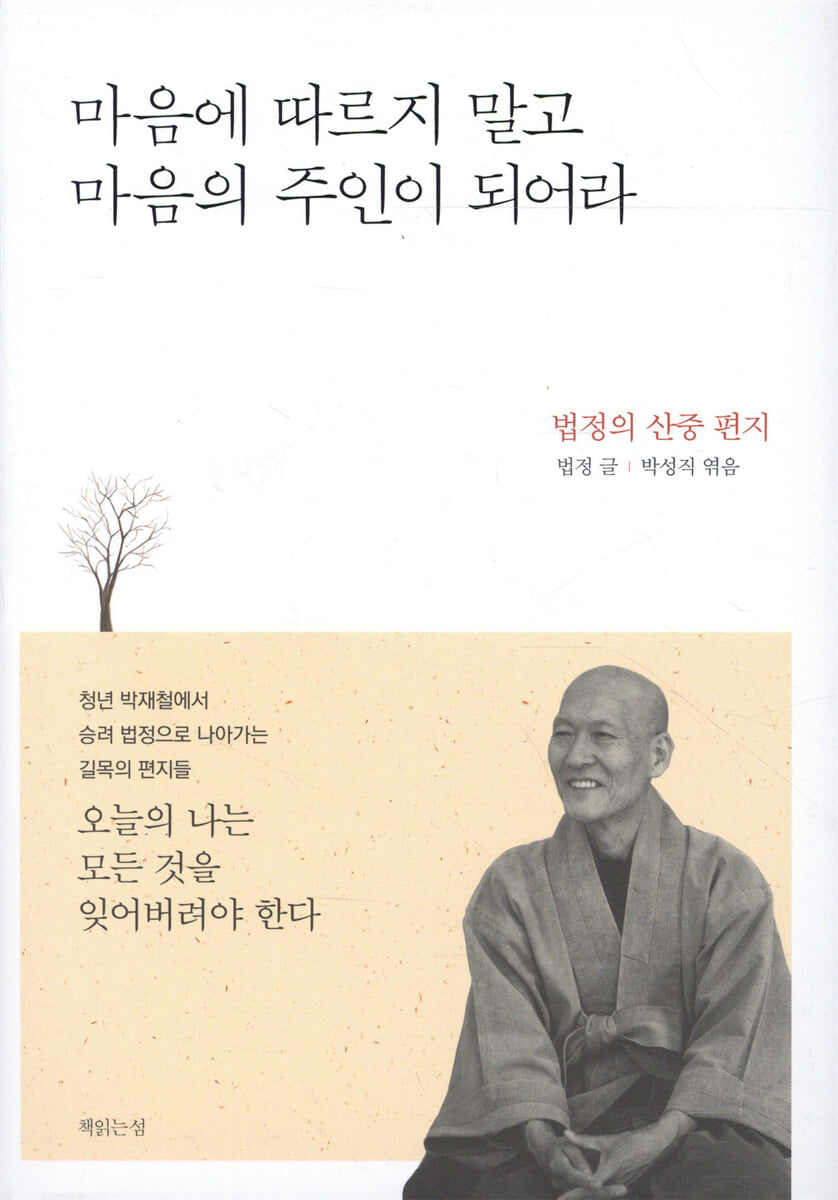
Don't follow your heart, be the master of your heart.
 |
Description
Book Introduction
“You take on the role of our poor mother’s son.”
The experience that young Park Jae-cheol had to go through to be reborn as a monk court
Traces of pain and agony, joy and enlightenment
The Korean War is over.
Some never returned, some slowly went mad, some dreamed of smuggling, and some took their own lives.
Park Jae-cheol, a third-year university student who witnessed the worst atrocity a human can commit, spent several nights awake, asking questions without answers, and then suddenly disappeared.
And then a letter arrived the following year.
“You take on the role of our poor mother’s son.”
And he became a monk court.
This book is a compilation of approximately 50 letters sent by the monk Beopjeong to his cousin, Park Seong-jik, from 1955 to 1970.
Park Jae-cheol, a young man, was berating himself for his cruelty in cutting off ties with his blood relatives, including his single mother.
His process of being reborn as a monk by relying on great nature and truth continues as an inner monologue.
His letters were traces of the agony and enlightenment faced by someone who had embarked on the path of asceticism.
The experience that young Park Jae-cheol had to go through to be reborn as a monk court
Traces of pain and agony, joy and enlightenment
The Korean War is over.
Some never returned, some slowly went mad, some dreamed of smuggling, and some took their own lives.
Park Jae-cheol, a third-year university student who witnessed the worst atrocity a human can commit, spent several nights awake, asking questions without answers, and then suddenly disappeared.
And then a letter arrived the following year.
“You take on the role of our poor mother’s son.”
And he became a monk court.
This book is a compilation of approximately 50 letters sent by the monk Beopjeong to his cousin, Park Seong-jik, from 1955 to 1970.
Park Jae-cheol, a young man, was berating himself for his cruelty in cutting off ties with his blood relatives, including his single mother.
His process of being reborn as a monk by relying on great nature and truth continues as an inner monologue.
His letters were traces of the agony and enlightenment faced by someone who had embarked on the path of asceticism.
- You can preview some of the book's contents.
Preview
index
Today I Must Forget Everything: 1955-1956
I miss that room | Don't follow your heart, but be the master of your heart | Until now, I've been a sinner | Everything here is joyful | Take my place and be my son | A place the world doesn't know | Autumn is coming | See the greatness in the repetitive daily life | The whole world is my home | Don't write to me for the time being | Be careful with your friends and books
We Will Meet Someday: 1957-1958
I will soon leave this place|All the worldly affairs are but a dream|I could smell the scent of my room in your writing|Only you read it|Autumn is fading away|Worry and think|Literature is your teacher|Pain is a trial for perfection|Send my regards to the sea|Do not drink alcohol|Blind faith is worse than superstition|An empty branch stands lonely in the air|Do not cry, do not cry
Isn't the whole universe our school?: 1959-1960
I will save my neighbor who is wandering in the sea of suffering|School of life|I will send you a book|I will study hard|I must raise myself|How mature we are|In fact, it is shameful|I keep tormenting you|I dream of a quiet hermitage overlooking the East Sea|Our spring is what we prepare|The meaning of being alive
The past is fading away, but I'm still living my own life: 1961–1964
Don't reveal the whereabouts of the mountain monk|I am alive while I read, think, and write|Just living honestly and without shame|In fact, I even forgot the address of my old house|An autumn day when your face suddenly comes to mind|The face of our naked personality|Wait|The space created by time|After returning from my hometown|If there is a connection with the world, we will meet again
I went into the temple today and cried a lot _ Letter from 1970
I miss that room | Don't follow your heart, but be the master of your heart | Until now, I've been a sinner | Everything here is joyful | Take my place and be my son | A place the world doesn't know | Autumn is coming | See the greatness in the repetitive daily life | The whole world is my home | Don't write to me for the time being | Be careful with your friends and books
We Will Meet Someday: 1957-1958
I will soon leave this place|All the worldly affairs are but a dream|I could smell the scent of my room in your writing|Only you read it|Autumn is fading away|Worry and think|Literature is your teacher|Pain is a trial for perfection|Send my regards to the sea|Do not drink alcohol|Blind faith is worse than superstition|An empty branch stands lonely in the air|Do not cry, do not cry
Isn't the whole universe our school?: 1959-1960
I will save my neighbor who is wandering in the sea of suffering|School of life|I will send you a book|I will study hard|I must raise myself|How mature we are|In fact, it is shameful|I keep tormenting you|I dream of a quiet hermitage overlooking the East Sea|Our spring is what we prepare|The meaning of being alive
The past is fading away, but I'm still living my own life: 1961–1964
Don't reveal the whereabouts of the mountain monk|I am alive while I read, think, and write|Just living honestly and without shame|In fact, I even forgot the address of my old house|An autumn day when your face suddenly comes to mind|The face of our naked personality|Wait|The space created by time|After returning from my hometown|If there is a connection with the world, we will meet again
I went into the temple today and cried a lot _ Letter from 1970
Into the book
I wanted to go there.
When I came down, I didn't even look back because the city's summer customs were so unpleasant, but now I miss that room? That quiet space? That room where my breath had seeped in.
---From "I Miss That Room"
Priest, those who experience hardship have much more experience in life than those who live happily, and this gives them confidence and also increases their resilience to life.
It means experiencing life more seriously than anyone else.
I guess I'll have to live like this, masturbating.
I have so much to say, but I'll keep it short.
Always be healthy in body and mind.
“Don’t follow your heart, be the master of your heart.”
---From "Don't follow your heart, be the master of your heart"
I'm sorry, I feel guilty.
He left without even looking at your admission status.
They say the world is but a dream, and it feels just like a dream.
I have become the most unforgivable sinner in the world.
I betrayed my grandmother, uncle, mother and you all.
For me, becoming a monk, no matter what the reason, cannot but be a betrayal of my family.
---From "I am a sinner until now"
I have been silent until now, entrusting my mind to the sound of the stream flowing through the valley and the wind, and remaining as quiet as the moonlight.
Isn't it a beautiful heart that loves and misses each other from such a distance?
If I were to stay away like this forever, it would be a long time, but I think that living like this for a while will actually help me cultivate beautiful hearts.
Now when I come back to your house, I won't be the 'older brother' I used to be.
My bad temper must have gone away a lot.
---From "Autumn is Coming"
You will have to discover something great in your repetitive life.
Even though it is a daily routine, we should not neglect it even a little.
Today must be newer than yesterday, and tomorrow must be one step ahead of today.
Herein lies the great reward of life and human growth.
Look at the sun in the sky.
Even on cloudy days, I see that great figure steadily going his own way!
---From "See the greatness in the repetitive everyday life"
And think of the country as something that just died in the distant past.
In fact, it's as good as dead and nonexistent.
It is best to write letters as infrequently as possible.
Not only do many monks here dislike it, but it also interferes with their studies… … .
---From "The World is a Dream"
The world, in a word, is a sea of suffering.
That is why, three thousand years ago, an Indian prince left his luxurious palace, left home, and entered the mountains, becoming a ‘free man’ free from all obstacles.
The monk is not a passive practitioner who just sits still, strikes the moktak, and chants Buddhist chants.
Asceticism is the practice of practice.
It is about escaping (being liberated) from this suffering of life and death through the power of practice.
When I came down, I didn't even look back because the city's summer customs were so unpleasant, but now I miss that room? That quiet space? That room where my breath had seeped in.
---From "I Miss That Room"
Priest, those who experience hardship have much more experience in life than those who live happily, and this gives them confidence and also increases their resilience to life.
It means experiencing life more seriously than anyone else.
I guess I'll have to live like this, masturbating.
I have so much to say, but I'll keep it short.
Always be healthy in body and mind.
“Don’t follow your heart, be the master of your heart.”
---From "Don't follow your heart, be the master of your heart"
I'm sorry, I feel guilty.
He left without even looking at your admission status.
They say the world is but a dream, and it feels just like a dream.
I have become the most unforgivable sinner in the world.
I betrayed my grandmother, uncle, mother and you all.
For me, becoming a monk, no matter what the reason, cannot but be a betrayal of my family.
---From "I am a sinner until now"
I have been silent until now, entrusting my mind to the sound of the stream flowing through the valley and the wind, and remaining as quiet as the moonlight.
Isn't it a beautiful heart that loves and misses each other from such a distance?
If I were to stay away like this forever, it would be a long time, but I think that living like this for a while will actually help me cultivate beautiful hearts.
Now when I come back to your house, I won't be the 'older brother' I used to be.
My bad temper must have gone away a lot.
---From "Autumn is Coming"
You will have to discover something great in your repetitive life.
Even though it is a daily routine, we should not neglect it even a little.
Today must be newer than yesterday, and tomorrow must be one step ahead of today.
Herein lies the great reward of life and human growth.
Look at the sun in the sky.
Even on cloudy days, I see that great figure steadily going his own way!
---From "See the greatness in the repetitive everyday life"
And think of the country as something that just died in the distant past.
In fact, it's as good as dead and nonexistent.
It is best to write letters as infrequently as possible.
Not only do many monks here dislike it, but it also interferes with their studies… … .
---From "The World is a Dream"
The world, in a word, is a sea of suffering.
That is why, three thousand years ago, an Indian prince left his luxurious palace, left home, and entered the mountains, becoming a ‘free man’ free from all obstacles.
The monk is not a passive practitioner who just sits still, strikes the moktak, and chants Buddhist chants.
Asceticism is the practice of practice.
It is about escaping (being liberated) from this suffering of life and death through the power of practice.
---From "Think and Think"
Publisher's Review
“I have become the most unforgivable sinner in the world.”
A young man who was the pillar of his family left home
Park Jae-cheol, who lost his father at an early age, grew up studying at his uncle's house.
Although liberation had occurred, the nation was in a state of chaos, divided into North and South. Life in the countryside was difficult during the war, and life was bleak and desolate.
However, his uncle sent Park Jae-cheol, who was bright and mature from a young age, to college.
Considering that he sent Park Jae-cheol to college despite being his own son during difficult times, it seems that to his uncle, Park Jae-cheol was not a nephew but his 'eldest son'.
The war was over, but Park Jae-cheol was fighting another war.
I spent countless nights in agony over human existence and the endless stream of questions.
Then, he suddenly left home without telling any of his family.
It must have been a huge shock to the family who had believed that he would become the mainstay of the household.
Park Seong-jik, the cousin who had shared a room with Park Jae-cheol since childhood, waited for a long time for his older brother to return.
In the room my brother left behind, only the books he left behind remained.
But my brother didn't come.
Instead, a letter arrived.
Although the letter didn't contain any detailed information, even a middle school student could understand it to some extent.
The fact that my cousin Park Jae-cheol, who I grew up with, would never return home again.
“After building up some capital, I will go out into the world again.”
Leaving home and the path of a monk
Park Jae-cheol was not a Buddhist.
But why did he decide to become a monk? This book's editor, Park Seong-jik, shares a meaningful anecdote.
During his time in college, he had the opportunity to try on the monk's robes. He was so pleased with the gray robe that he felt like he had found the perfect fit for his body and mind.
Although he never encountered Buddha, he may have been born with a natural talent for becoming a monk.
Letters from Park Jae-cheol began to arrive in 1955, a year before he received novice precepts and began his Buddhist path.
Among the family members, he was the only one who sent letters to Park Seong-jik, and he earnestly requested that his whereabouts not be revealed.
If his family asks, he wrote in a letter that he had gone far away to a place like Japan, and that they should think of him as dead.
Even so, he checked on his family members' well-being one by one.
In the letters he sent recently, there is a mixture of a strong desire to sever ties with his blood relatives and a longing that is welling up in his heart.
However, there is a passage that particularly stands out in the letter sent by the young man, Jae-cheol Park.
That doesn't mean you'll be a slave for the rest of your life.
After accumulating some capital, I will go out into the world again and live.
For now, you are a sinner.
_ From the letter dated March 21, 1956, “I am a sinner until now.”
There are two things we can infer from this passage.
One is that he chose to become a monk to escape the agony that weighed on his head and heart and to find answers to the questions that endlessly arose, but at the time, for Park Jae-cheol, becoming a monk was perhaps a kind of training with the intention of going down the mountain.
And another thing is that he might have said something he didn't mean to reassure his younger sibling who was eighteen years younger than him.
There is another passage that gives us a glimpse into this state of mind.
If I were to stay away like this forever, it would be a long time, but I think that living like this for a while will actually help me cultivate beautiful hearts.
Now when I come back to your house, I won't be the 'older brother' I used to be.
My bad temper must have gone away a lot.
_ From a letter dated September 6, 1956, “Autumn is Coming”
Since this letter was written for the first time using the Buddhist name ‘Beopjeong’, it is assumed that he had already received the novice precepts.
However, he wrote a letter expressing his hope that by the time he finished his studies and returned home, he would be a different person.
There is no way to know his thoughts when he wrote this, but this passage remains as the last record of a time when he was closer to the 'young Park Jae-cheol' than the 'monk court'.
“I will rescue my neighbor who is lost in the sea of trouble.”
Reborn as a monk's court
The content of the letter from the court changes significantly after this.
In addition to caring for his brothers and family, he praises the greatness and beauty of nature and conveys the enlightenment gleaned from the daily routine of a monk.
It also tells us what kind of conduct and attitude a monk who has taken refuge in Buddhism should have.
His letters may have also been a pledge to himself.
And in a letter dated March 10, 1959, he states:
I will tell you the truth.
My brother will become a monk not only in this life but also in future lives, and will achieve the supreme path of liberation from birth and death.
So I will rescue my neighbor who is lost in the sea of suffering.
_ From a letter dated March 10, 1959, “I will save my neighbor who is lost in the sea of suffering”
What does it mean to 'speak without lies'?
Could it be that he was confessing that his earlier letter about possibly returning was a pretense to give his younger brother a glimmer of hope?
In any case, in this letter, the court declared that Buddhism, which had been a training ground for overcoming suffering, had finally become his complete home.
The five years of spring, summer, fall, and winter he faced while leaving his hometown and family behind must have helped him to make this decision. The mountains, trees, flowers, grass, water, sky, and birds must have encouraged him, and his role models must have opened the way.
After that, the letters from the court addressed to Park Seong-jik continued.
Meanwhile, Park Seong-jik, who was a middle school student, became a soldier, and Beop Jeong became a Buddhist monk (a Buddhist term for a monk with a long history) who was needed in various places of Buddhism due to his outstanding tolerance.
Then, on January 14, 1964, in a letter to Park Seong-jik, Beop Jeong expressed his intention to enter a remote mountain area and practice asceticism.
Just like the first time I left home, I took another leap of faith without telling anyone at the temple.
Leaving behind the words that if there is a connection, we will meet again.
“I went into the temple today and cried a lot.”
_ The last letter from the court sent from the mountains
It was in 1970 that the court sent another letter.
It was after I received the late news that my uncle had passed away.
'Uncle' was the father of Park Seong-jik, the editor of this book, and the benefactor who opened his eyes and helped him study law through college.
The court felt sorry for being an outsider and unable to be filial, and said that it would pray for the repose of the deceased's soul in the Buddhist temple for forty-nine days.
The court's letter to Park Seong-jik ends here.
“Our spring will come from what we prepare ourselves.”
_ Letters from the young Park Jae-cheol on his way to the monk court
The letters sent to the monk Beopjeong from 1955 to 1970 are a complete account of the young Park Jae-cheol's transformation into a monk Beopjeong.
It is also filled with the stories and enlightenment that became the subject of the masterpiece 『No Possession』 published in 1976.
This book is a re-publication of 『Mindful Aouya』, published in 2011.
However, unlike the first edition, the content was enriched by adding essays containing the court's reflections on the time when he became a monk, and essays written in remembrance of people whose names were only briefly mentioned in the letters.
Readers will be able to delve deeper into the stories and meaning contained in the letters by reading them together with the essays cited in this book.
Perhaps the greatest hardship that Beopjeong had to endure in his early days as a monk was 'cutting off'.
That painful time when I had to cut off my family, my youth, and furthermore, Park Jae-cheol.
Although the letter is filled with a sense of steadfastness, as it is written to a younger brother who is worried about him, the letter also contains the sorrow of someone who has turned his back on his long-time hometown by choosing his own path.
His sad voice can be heard saying, 'I even forgot the address of my old house.'
He had to give up what he cherished most for such a greater love.
“Don’t follow your heart, be the master of your heart.”
_ A letter from the court to us today
The letters the court sent to Park Seong-jik always included a request.
Study hard, don't drink, be selective with your books and friends, find shining, jewel-like moments in the midst of the repetitive daily routine, that times of suffering enrich our hearts, worry and reflect, learn from nature... ... and don't cry, don't cry.
Six years after the court sent its last letter to Park Seong-jik, 『No Possession』 was published.
As mentioned earlier, there are some essays in 『No Possession』 that use the letters sent by the court to Park Seong-jik as their original source.
I think about this.
Were the essays the court had written so far not letters to an unknown recipient?
As his tolerance grew, and he lost all distinction between his blood relatives and strangers, wasn't it possible that he was constantly writing letters to someone?
These letters, sent by the court to his younger brother decades ago, are also sent to us today by someone who deeply cherished and loved someone, stored in a time capsule of memories.
A young man who was the pillar of his family left home
Park Jae-cheol, who lost his father at an early age, grew up studying at his uncle's house.
Although liberation had occurred, the nation was in a state of chaos, divided into North and South. Life in the countryside was difficult during the war, and life was bleak and desolate.
However, his uncle sent Park Jae-cheol, who was bright and mature from a young age, to college.
Considering that he sent Park Jae-cheol to college despite being his own son during difficult times, it seems that to his uncle, Park Jae-cheol was not a nephew but his 'eldest son'.
The war was over, but Park Jae-cheol was fighting another war.
I spent countless nights in agony over human existence and the endless stream of questions.
Then, he suddenly left home without telling any of his family.
It must have been a huge shock to the family who had believed that he would become the mainstay of the household.
Park Seong-jik, the cousin who had shared a room with Park Jae-cheol since childhood, waited for a long time for his older brother to return.
In the room my brother left behind, only the books he left behind remained.
But my brother didn't come.
Instead, a letter arrived.
Although the letter didn't contain any detailed information, even a middle school student could understand it to some extent.
The fact that my cousin Park Jae-cheol, who I grew up with, would never return home again.
“After building up some capital, I will go out into the world again.”
Leaving home and the path of a monk
Park Jae-cheol was not a Buddhist.
But why did he decide to become a monk? This book's editor, Park Seong-jik, shares a meaningful anecdote.
During his time in college, he had the opportunity to try on the monk's robes. He was so pleased with the gray robe that he felt like he had found the perfect fit for his body and mind.
Although he never encountered Buddha, he may have been born with a natural talent for becoming a monk.
Letters from Park Jae-cheol began to arrive in 1955, a year before he received novice precepts and began his Buddhist path.
Among the family members, he was the only one who sent letters to Park Seong-jik, and he earnestly requested that his whereabouts not be revealed.
If his family asks, he wrote in a letter that he had gone far away to a place like Japan, and that they should think of him as dead.
Even so, he checked on his family members' well-being one by one.
In the letters he sent recently, there is a mixture of a strong desire to sever ties with his blood relatives and a longing that is welling up in his heart.
However, there is a passage that particularly stands out in the letter sent by the young man, Jae-cheol Park.
That doesn't mean you'll be a slave for the rest of your life.
After accumulating some capital, I will go out into the world again and live.
For now, you are a sinner.
_ From the letter dated March 21, 1956, “I am a sinner until now.”
There are two things we can infer from this passage.
One is that he chose to become a monk to escape the agony that weighed on his head and heart and to find answers to the questions that endlessly arose, but at the time, for Park Jae-cheol, becoming a monk was perhaps a kind of training with the intention of going down the mountain.
And another thing is that he might have said something he didn't mean to reassure his younger sibling who was eighteen years younger than him.
There is another passage that gives us a glimpse into this state of mind.
If I were to stay away like this forever, it would be a long time, but I think that living like this for a while will actually help me cultivate beautiful hearts.
Now when I come back to your house, I won't be the 'older brother' I used to be.
My bad temper must have gone away a lot.
_ From a letter dated September 6, 1956, “Autumn is Coming”
Since this letter was written for the first time using the Buddhist name ‘Beopjeong’, it is assumed that he had already received the novice precepts.
However, he wrote a letter expressing his hope that by the time he finished his studies and returned home, he would be a different person.
There is no way to know his thoughts when he wrote this, but this passage remains as the last record of a time when he was closer to the 'young Park Jae-cheol' than the 'monk court'.
“I will rescue my neighbor who is lost in the sea of trouble.”
Reborn as a monk's court
The content of the letter from the court changes significantly after this.
In addition to caring for his brothers and family, he praises the greatness and beauty of nature and conveys the enlightenment gleaned from the daily routine of a monk.
It also tells us what kind of conduct and attitude a monk who has taken refuge in Buddhism should have.
His letters may have also been a pledge to himself.
And in a letter dated March 10, 1959, he states:
I will tell you the truth.
My brother will become a monk not only in this life but also in future lives, and will achieve the supreme path of liberation from birth and death.
So I will rescue my neighbor who is lost in the sea of suffering.
_ From a letter dated March 10, 1959, “I will save my neighbor who is lost in the sea of suffering”
What does it mean to 'speak without lies'?
Could it be that he was confessing that his earlier letter about possibly returning was a pretense to give his younger brother a glimmer of hope?
In any case, in this letter, the court declared that Buddhism, which had been a training ground for overcoming suffering, had finally become his complete home.
The five years of spring, summer, fall, and winter he faced while leaving his hometown and family behind must have helped him to make this decision. The mountains, trees, flowers, grass, water, sky, and birds must have encouraged him, and his role models must have opened the way.
After that, the letters from the court addressed to Park Seong-jik continued.
Meanwhile, Park Seong-jik, who was a middle school student, became a soldier, and Beop Jeong became a Buddhist monk (a Buddhist term for a monk with a long history) who was needed in various places of Buddhism due to his outstanding tolerance.
Then, on January 14, 1964, in a letter to Park Seong-jik, Beop Jeong expressed his intention to enter a remote mountain area and practice asceticism.
Just like the first time I left home, I took another leap of faith without telling anyone at the temple.
Leaving behind the words that if there is a connection, we will meet again.
“I went into the temple today and cried a lot.”
_ The last letter from the court sent from the mountains
It was in 1970 that the court sent another letter.
It was after I received the late news that my uncle had passed away.
'Uncle' was the father of Park Seong-jik, the editor of this book, and the benefactor who opened his eyes and helped him study law through college.
The court felt sorry for being an outsider and unable to be filial, and said that it would pray for the repose of the deceased's soul in the Buddhist temple for forty-nine days.
The court's letter to Park Seong-jik ends here.
“Our spring will come from what we prepare ourselves.”
_ Letters from the young Park Jae-cheol on his way to the monk court
The letters sent to the monk Beopjeong from 1955 to 1970 are a complete account of the young Park Jae-cheol's transformation into a monk Beopjeong.
It is also filled with the stories and enlightenment that became the subject of the masterpiece 『No Possession』 published in 1976.
This book is a re-publication of 『Mindful Aouya』, published in 2011.
However, unlike the first edition, the content was enriched by adding essays containing the court's reflections on the time when he became a monk, and essays written in remembrance of people whose names were only briefly mentioned in the letters.
Readers will be able to delve deeper into the stories and meaning contained in the letters by reading them together with the essays cited in this book.
Perhaps the greatest hardship that Beopjeong had to endure in his early days as a monk was 'cutting off'.
That painful time when I had to cut off my family, my youth, and furthermore, Park Jae-cheol.
Although the letter is filled with a sense of steadfastness, as it is written to a younger brother who is worried about him, the letter also contains the sorrow of someone who has turned his back on his long-time hometown by choosing his own path.
His sad voice can be heard saying, 'I even forgot the address of my old house.'
He had to give up what he cherished most for such a greater love.
“Don’t follow your heart, be the master of your heart.”
_ A letter from the court to us today
The letters the court sent to Park Seong-jik always included a request.
Study hard, don't drink, be selective with your books and friends, find shining, jewel-like moments in the midst of the repetitive daily routine, that times of suffering enrich our hearts, worry and reflect, learn from nature... ... and don't cry, don't cry.
Six years after the court sent its last letter to Park Seong-jik, 『No Possession』 was published.
As mentioned earlier, there are some essays in 『No Possession』 that use the letters sent by the court to Park Seong-jik as their original source.
I think about this.
Were the essays the court had written so far not letters to an unknown recipient?
As his tolerance grew, and he lost all distinction between his blood relatives and strangers, wasn't it possible that he was constantly writing letters to someone?
These letters, sent by the court to his younger brother decades ago, are also sent to us today by someone who deeply cherished and loved someone, stored in a time capsule of memories.
GOODS SPECIFICS
- Date of issue: March 9, 2018
- Format: Hardcover book binding method guide
- Page count, weight, size: 176 pages | 428g | 140*200*20mm
- ISBN13: 9791188047352
- ISBN10: 1188047353
You may also like
카테고리
korean


korean

![GQ KOREA Mark (Monthly): December [2025]](http://librairie.coreenne.fr/cdn/shop/files/8ef265dbbfbf186523ed75ba7319009d.jpg?v=1765340328&width=3840)


