

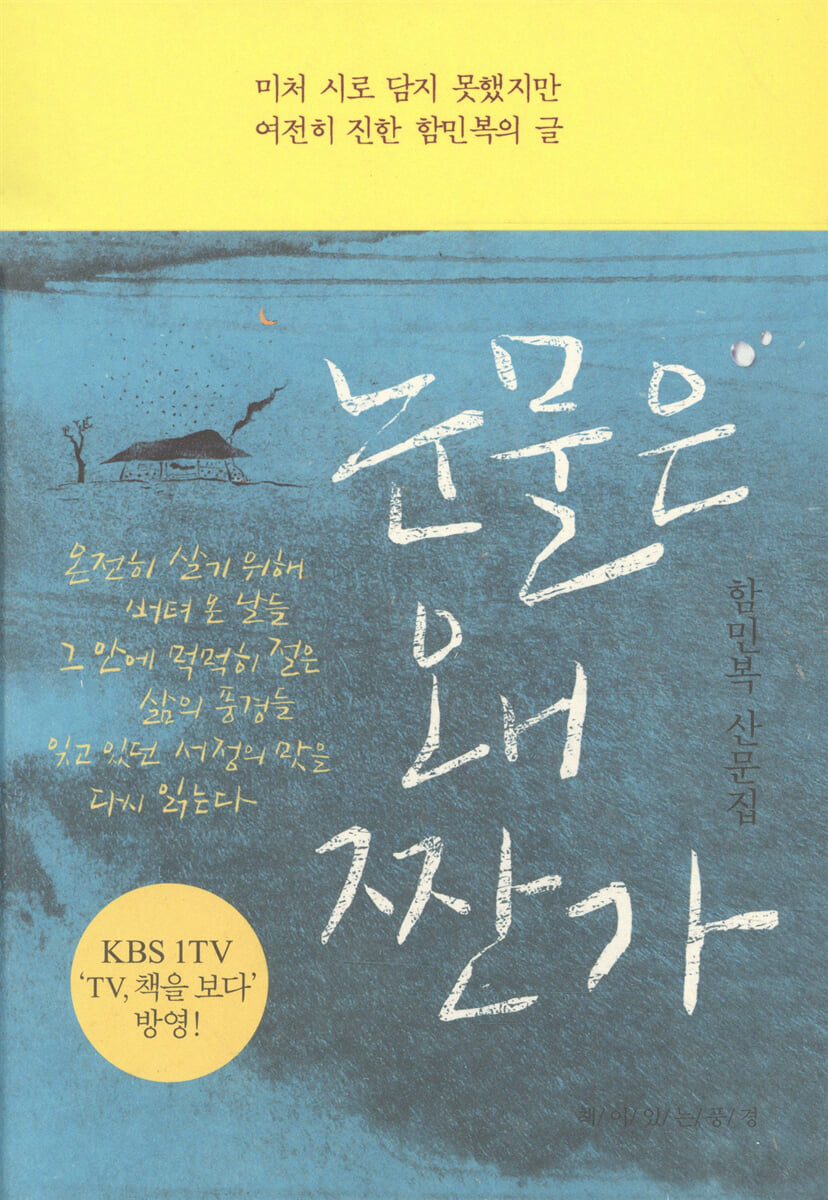
Why are tears salty?
 |
Description
Book Introduction
Poet Ham Min-bok's newly published collection of essays, "Why Are Tears Salty?"
Poet Ham Min-bok's first collection of prose, and the most widely known of his collections, "Why Are Tears Salty?" has been republished.
In his various prose collections, poet Ham Min-bok has reminisced about his difficult past while also embracing reality, and has endlessly asked readers the question of what it means to truly live.
In particular, his life story and literary roots are fully contained in “Why Are Tears Salty” published in 2003.
This collection of essays continues to be loved, allowing readers to appreciate his writing skills even after ten years.
However, due to circumstances at the publisher, this collection of essays went out of print, which had been a source of regret for a long time. We have restored it in the Book Landscape, and added new essays carefully selected by poet Ham Min-bok.
Novelist Kim Hoon said this about the book:
“His poverty is not asking ‘Why am I poor?’ but rather, it is a poverty that asks what this poverty is and what content it has.
He speaks of the hope and joy that spring from the primal condition of being alive.
I treasure his prose sentences that reach this point.”
This collection of essays contains widely read works such as “Why Are Tears Salty,” “Cold Rice and Mother,” and “In a Factory Making Milking Machines,” as well as “Bouquet of Wild Chrysanthemums,” “Walking the Yellow Soil Road Barefoot,” and “A Clumsy yet Beautiful Dance,” as well as the preciousness of the land that he realized through his own body while settling down on Ganghwa Island and the salty stories he shared with people.
In this newly published collection of essays, the poet says that poverty was miserable, but he dared to say that he was full.
Reading his prose, we come to realize that poetry was the force that sustained him, and that the people who accompanied him were tears.
Yet, they were milestones that helped him stand firm, a room on earth that welcomed his life as he wandered in search of a resting place.
Through this collection of essays, we encounter the poet Ham Min-bok's arduous life, which became the literary foundation of his career, and we are reminded of what true life is, something we have forgotten.
Poet Ham Min-bok's first collection of prose, and the most widely known of his collections, "Why Are Tears Salty?" has been republished.
In his various prose collections, poet Ham Min-bok has reminisced about his difficult past while also embracing reality, and has endlessly asked readers the question of what it means to truly live.
In particular, his life story and literary roots are fully contained in “Why Are Tears Salty” published in 2003.
This collection of essays continues to be loved, allowing readers to appreciate his writing skills even after ten years.
However, due to circumstances at the publisher, this collection of essays went out of print, which had been a source of regret for a long time. We have restored it in the Book Landscape, and added new essays carefully selected by poet Ham Min-bok.
Novelist Kim Hoon said this about the book:
“His poverty is not asking ‘Why am I poor?’ but rather, it is a poverty that asks what this poverty is and what content it has.
He speaks of the hope and joy that spring from the primal condition of being alive.
I treasure his prose sentences that reach this point.”
This collection of essays contains widely read works such as “Why Are Tears Salty,” “Cold Rice and Mother,” and “In a Factory Making Milking Machines,” as well as “Bouquet of Wild Chrysanthemums,” “Walking the Yellow Soil Road Barefoot,” and “A Clumsy yet Beautiful Dance,” as well as the preciousness of the land that he realized through his own body while settling down on Ganghwa Island and the salty stories he shared with people.
In this newly published collection of essays, the poet says that poverty was miserable, but he dared to say that he was full.
Reading his prose, we come to realize that poetry was the force that sustained him, and that the people who accompanied him were tears.
Yet, they were milestones that helped him stand firm, a room on earth that welcomed his life as he wandered in search of a resting place.
Through this collection of essays, we encounter the poet Ham Min-bok's arduous life, which became the literary foundation of his career, and we are reminded of what true life is, something we have forgotten.
- You can preview some of the book's contents.
Preview
index
Chapter 1: You Are Right, Swallow
Innate longing
One more step towards the sea
thunder
Mother's medical skills
Puduk carrying a load of mullet on his back
family photo
Swallow, you are right
Chapter 2: Why Are Tears Salty?
Why are tears salty?
Cold rice and mother
In a factory that makes milking machines
Living in a three-room apartment
One spring, a year with a clear beginning and a cloudy end
Janghang Line
About dogs
Zelkova
depart
Chapter 3: Shadows Are Just Shadows
A night when my body hurts a lot
apricot
One day, I went out with my shadow and the sound of birds.
A full moon spent at Dongunam
An alleyway with a house full of fruit hanging on the road
Wake up to the sound of the early morning bus
Chapter 4 That Day, I Was Filled with Sorrow
That day, I was full of sorrow
mouse
Cousin and the newspaper
Good luck, Seonggu!
The Moon in Supervision
Name engraved on a pencil
A day in the autumn mudflats of Dongmakri
Thoughts of a raccoon in the middle of winter
Chapter 5: Nature's Hearing
Thoughts from the hospital bed
Longing bee
sprinkler
Geese and Poetry
Wild chrysanthemum bouquet
butterfly
Walking barefoot on the dirt road
Eyes are the buttons of life
Thoughts on the window
sad gift
A dance that is beautiful because it is clumsy
Mengmu is wronged
Walking through the autumn fields
Innate longing
One more step towards the sea
thunder
Mother's medical skills
Puduk carrying a load of mullet on his back
family photo
Swallow, you are right
Chapter 2: Why Are Tears Salty?
Why are tears salty?
Cold rice and mother
In a factory that makes milking machines
Living in a three-room apartment
One spring, a year with a clear beginning and a cloudy end
Janghang Line
About dogs
Zelkova
depart
Chapter 3: Shadows Are Just Shadows
A night when my body hurts a lot
apricot
One day, I went out with my shadow and the sound of birds.
A full moon spent at Dongunam
An alleyway with a house full of fruit hanging on the road
Wake up to the sound of the early morning bus
Chapter 4 That Day, I Was Filled with Sorrow
That day, I was full of sorrow
mouse
Cousin and the newspaper
Good luck, Seonggu!
The Moon in Supervision
Name engraved on a pencil
A day in the autumn mudflats of Dongmakri
Thoughts of a raccoon in the middle of winter
Chapter 5: Nature's Hearing
Thoughts from the hospital bed
Longing bee
sprinkler
Geese and Poetry
Wild chrysanthemum bouquet
butterfly
Walking barefoot on the dirt road
Eyes are the buttons of life
Thoughts on the window
sad gift
A dance that is beautiful because it is clumsy
Mengmu is wronged
Walking through the autumn fields
Into the book
Then, the owner approached us carefully so that we wouldn't feel sorry, placed a plate of kimchi the size of a matchbox, and turned away. In an instant, I burst into tears that I had been holding back. I quickly wiped the sweat from my forehead, pretending that the tears were sweat, and then very slowly wiped the sweat from my eyes with a wet towel. As I did so, I muttered to myself, "Why are tears salty?" --- p. 51
The food on the table my mother had prepared was cold.
I made some soybean paste stew that had cooled down after being reheated several times.
The mother had been worried since the two rich men who had gone to the mountains had not returned even after the moon had risen, so she had come out to meet them a long time ago.
As long as the rice had been cold, my mother waited for my father and me, bathed in moonlight.
The mother looked at the father and son, who were wearing sweat-soaked clothes, eating cold soybean paste soup and pickled vegetables with rice mixed in water, with eyes filled with relief.
The table filled with cold rice that day was filled with anticipation.
One night, as I ate the salty soybean paste stew, the moonlight was shining brightly in the yard of our low-roofed house, and the porch where our family of three sat was filled with the scent of chrysanthemums and deodeok. ---p.55
When I handed over the knitwear, saying I was sad to part ways, the factory manager gave me a gift he had prepared in advance.
“I bought a fountain pen and a pencil along with this article.
“Write a lot of good poems.”
I walked with heavy steps, looking back at the factory manager, this article, and the factory building.
'You have already written all the good poems in my heart.
Poets write poems on paper and publish them in a book, but you write poems in the poet's heart, so aren't you the true poets?
The milking machines you've created will milk clean cows and make the world healthy.'---p.62
The squirrel or the chipmunk is in charge of the pebaek, the elm tree is in charge of the guard, the arrow tree is in charge of the security, the goro tree that has a pain in water is in charge of the drinking, never ask the birch tree to take charge of the drinks, leave that to the pine tree, the bartender is a jan-dae, and for music, go to the traditional Korean music, the gong is a gardenia tree, the flute is a willow tree, the drum is a drum tree, the speaker is a gwang-gwang tree, and for singing, the osori is the right choice.
Society would be better with a juniper tree, food stamps with a poplar tree, wedding gifts with a ginkgo tree, and bathroom directions with a mulberry tree and a holly tree.
The bride's makeup was like azalea, the lighting was like fireflies, and the clapping was like maple trees until the palms of the hands turned red... ... No matter how much I thought about who should officiate the wedding, I couldn't come up with an idea.
The food on the table my mother had prepared was cold.
I made some soybean paste stew that had cooled down after being reheated several times.
The mother had been worried since the two rich men who had gone to the mountains had not returned even after the moon had risen, so she had come out to meet them a long time ago.
As long as the rice had been cold, my mother waited for my father and me, bathed in moonlight.
The mother looked at the father and son, who were wearing sweat-soaked clothes, eating cold soybean paste soup and pickled vegetables with rice mixed in water, with eyes filled with relief.
The table filled with cold rice that day was filled with anticipation.
One night, as I ate the salty soybean paste stew, the moonlight was shining brightly in the yard of our low-roofed house, and the porch where our family of three sat was filled with the scent of chrysanthemums and deodeok. ---p.55
When I handed over the knitwear, saying I was sad to part ways, the factory manager gave me a gift he had prepared in advance.
“I bought a fountain pen and a pencil along with this article.
“Write a lot of good poems.”
I walked with heavy steps, looking back at the factory manager, this article, and the factory building.
'You have already written all the good poems in my heart.
Poets write poems on paper and publish them in a book, but you write poems in the poet's heart, so aren't you the true poets?
The milking machines you've created will milk clean cows and make the world healthy.'---p.62
The squirrel or the chipmunk is in charge of the pebaek, the elm tree is in charge of the guard, the arrow tree is in charge of the security, the goro tree that has a pain in water is in charge of the drinking, never ask the birch tree to take charge of the drinks, leave that to the pine tree, the bartender is a jan-dae, and for music, go to the traditional Korean music, the gong is a gardenia tree, the flute is a willow tree, the drum is a drum tree, the speaker is a gwang-gwang tree, and for singing, the osori is the right choice.
Society would be better with a juniper tree, food stamps with a poplar tree, wedding gifts with a ginkgo tree, and bathroom directions with a mulberry tree and a holly tree.
The bride's makeup was like azalea, the lighting was like fireflies, and the clapping was like maple trees until the palms of the hands turned red... ... No matter how much I thought about who should officiate the wedding, I couldn't come up with an idea.
--- From the text
Publisher's Review
Editor's Note
In this age where people are busy trying to show off their skills, a person who only wrote poetry and was therefore awkward in life.
A person who still conveys the resonance of poetry even in an age when poetry has lost its meaning.
Ham Min-bok, who had no choice but to write poetry, still lives as a poet on Ganghwa Island.
Even in the prose he wrote from time to time, his literary depth and warmth in his view of the world can be read.
As I was putting together his collection of prose, I realized that prose can be truly weighty, that prose can also become poetry.
Wouldn't it be a blessing for us to be able to meet 'Ham Min-bok' even if it's not poetry?
His prose tells us that in an age that has lost its poetry, our lives can become poetry, and that the people and everything around us can become lyrical.
We look back, word by word, on why this collection of essays still resonates with so many and why his writings will continue to resonate with us in the future.
In this age where people are busy trying to show off their skills, a person who only wrote poetry and was therefore awkward in life.
A person who still conveys the resonance of poetry even in an age when poetry has lost its meaning.
Ham Min-bok, who had no choice but to write poetry, still lives as a poet on Ganghwa Island.
Even in the prose he wrote from time to time, his literary depth and warmth in his view of the world can be read.
As I was putting together his collection of prose, I realized that prose can be truly weighty, that prose can also become poetry.
Wouldn't it be a blessing for us to be able to meet 'Ham Min-bok' even if it's not poetry?
His prose tells us that in an age that has lost its poetry, our lives can become poetry, and that the people and everything around us can become lyrical.
We look back, word by word, on why this collection of essays still resonates with so many and why his writings will continue to resonate with us in the future.
GOODS SPECIFICS
- Date of issue: February 13, 2014
- Format: Hardcover book binding method guide
- Page count, weight, size: 272 pages | 354g | 128*188*20mm
- ISBN13: 9788993616354
- ISBN10: 8993616353
You may also like
카테고리
korean


korean

![GQ KOREA Mark (Monthly): December [2025]](http://librairie.coreenne.fr/cdn/shop/files/8ef265dbbfbf186523ed75ba7319009d.jpg?v=1765340328&width=3840)


