

pilgrim
 |
Description
Book Introduction
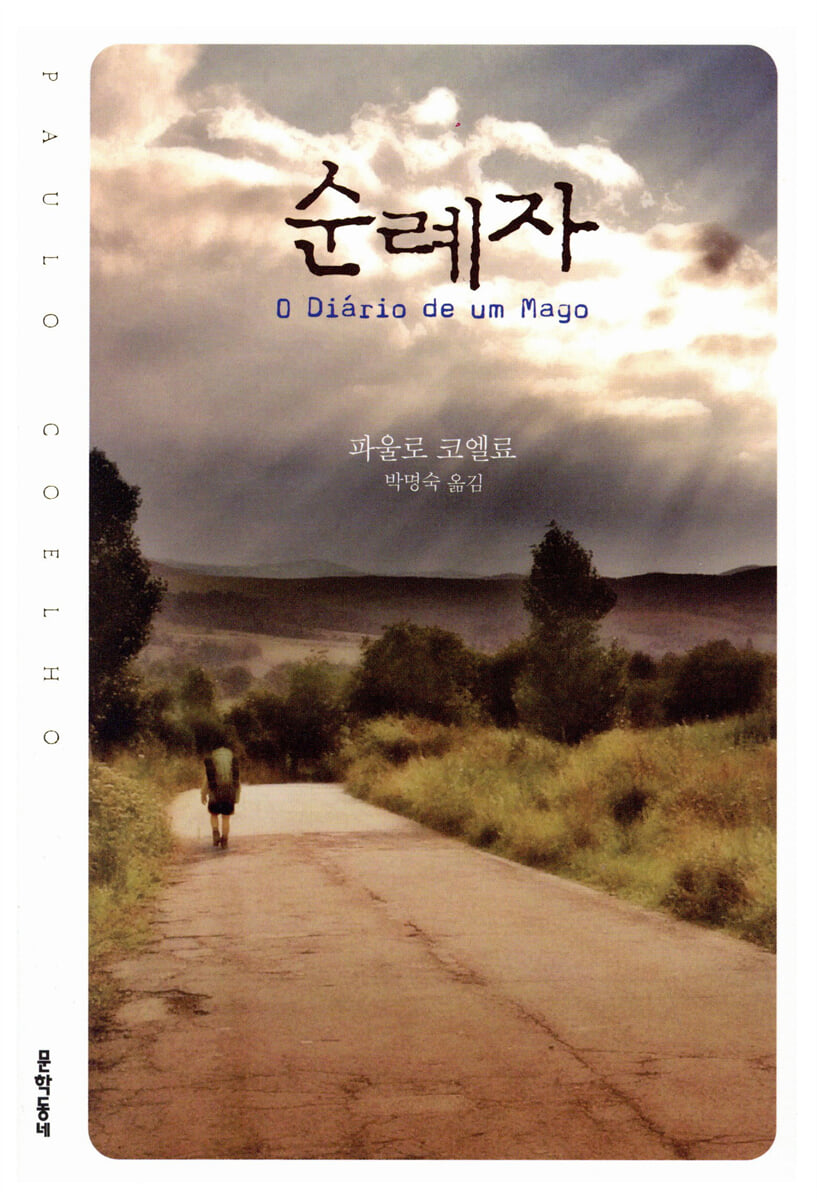
This is Paulo Coelho's debut work and the work that served as the basis for 'The Alchemist', which put him in the ranks of world-class authors.
It contains the journey of a wandering man who goes through a miraculous process of transformation and reaches enlightenment.
There is a man.
A man who was in and out of mental hospitals several times during his adolescence, became engrossed in hippie culture as a young man, and was imprisoned and tortured by the military government.
And as time passes, he becomes an executive of a company and becomes an 'adult' living a comfortable and wealthy life.
But the moment he thought the truth was within his grasp, he experienced the frustration of being sent back to square one.
The teacher recommends that he go on a pilgrimage along the 'Camino de Santiago'.
He must walk the entire seven hundred kilometer route that begins in Saint-Jean-de-Pied-de-Port in southern France and ends in Santiago de Compostela in Galicia, Spain.
The book contains Paulo Coelho's personal experiences and spiritual explorations as he walked the seven hundred kilometer 'Camino de Santiago'.
In this way, "The Pilgrim" can be said to be a book that condenses the message that all of his works seek to convey, revealing with bare face the depth of humanity and reflection embedded in Paulo Coelho's philosophy.
In 2006, Paulo Coelho embarked on the pilgrimage again to mark the 20th anniversary of his Camino de Santiago pilgrimage.
This journey, which began as a pilgrimage on the 'Camino de Santiago' and continued across Siberia, was recorded in real time on his personal blog (www.paulocoelhoblog.com) and made available to readers around the world.
It contains the journey of a wandering man who goes through a miraculous process of transformation and reaches enlightenment.
There is a man.
A man who was in and out of mental hospitals several times during his adolescence, became engrossed in hippie culture as a young man, and was imprisoned and tortured by the military government.
And as time passes, he becomes an executive of a company and becomes an 'adult' living a comfortable and wealthy life.
But the moment he thought the truth was within his grasp, he experienced the frustration of being sent back to square one.
The teacher recommends that he go on a pilgrimage along the 'Camino de Santiago'.
He must walk the entire seven hundred kilometer route that begins in Saint-Jean-de-Pied-de-Port in southern France and ends in Santiago de Compostela in Galicia, Spain.
The book contains Paulo Coelho's personal experiences and spiritual explorations as he walked the seven hundred kilometer 'Camino de Santiago'.
In this way, "The Pilgrim" can be said to be a book that condenses the message that all of his works seek to convey, revealing with bare face the depth of humanity and reflection embedded in Paulo Coelho's philosophy.
In 2006, Paulo Coelho embarked on the pilgrimage again to mark the 20th anniversary of his Camino de Santiago pilgrimage.
This journey, which began as a pilgrimage on the 'Camino de Santiago' and continued across Siberia, was recorded in real time on his personal blog (www.paulocoelhoblog.com) and made available to readers around the world.
- You can preview some of the book's contents.
Preview
index
tribute
prolog
Saint-Jean-Pied-de-Port
Creator and Creation
cruelty
lion
love
marriage
passion
death
personal vices
conquest
madness
Command and Obedience
sanctuary
El Cebreiro
Author's Note
Publisher's Review
Paulo Coelho, the "Alchemist of the Soul," the starting point of his great literary journey.
“Extraordinary lives always follow the path of ordinary people.”
Coelho achieved great success with every work he published and reached the pinnacle of his career.
At some point, he realized that he was facing a serious inner crisis and in 2006 he went on a pilgrimage to start everything over again, an experience that was captured in the book "Aleph," which was published in Korea in 2011.
And at the root of that journey is the pilgrimage he embarked on 20 years ago on the 'Camino de Santiago'.
The most honest inner face of Paulo Coelho, the 'Alchemist of the Soul'
The debut work of Paulo Coelho, one of the most beloved and influential writers of our time.
By walking the world's most beautiful road, the Camino de Santiago (Way of Santiago), and writing "The Pilgrim," he entered the path of becoming a writer, which had until then remained only a dream.
"The Pilgrim" is a story about a very "human" person's journey to enlightenment through a surprising and miraculous transformation.
For Paulo Coelho, the pilgrimage along the Camino de Santiago was a difficult experience, not only because he walked the long distance of seven hundred kilometers, step by step, but also because it was a "decisive moment" that completely changed his life by letting go of his personal history and finally becoming his "true self."
"The Pilgrim" is a work that occupies a very important position in Paulo Coelho's literature.
It is not just because it is the author's debut work and the work that served as the basis for "The Alchemist," which catapulted him to the ranks of world-class authors.
The significance of "The Pilgrim" lies in the fact that this work contains Coelho's most honest inner self.
In this book, the author has faithfully recorded the wondrous experiences and spiritual explorations he experienced while walking the Camino de Santiago.
Therefore, 『The Pilgrim』 can be said to be a work that bares the depth of humanity and reflection embedded in Paulo Coelho's philosophy, and is the source and seed that condenses the message that all of his works seek to convey.
When the time comes, everyone sets out on a journey.
And there's someone waiting for you on that road
There is a man.
A 'problematic person' who was in and out of mental hospitals several times during his adolescence due to conflicts with his parents, and as a young adult, he became absorbed in hippie culture, played in a rock band, and founded an anti-government comic magazine, for which he was imprisoned and tortured by the military government.
And as time goes by, he becomes an executive at a record company and an 'adult' living a comfortable and wealthy life in Rio de Janeiro with his beautiful wife.
Believing himself to be special, he embarks on a path of spiritual exploration to become one of the "chosen ones" who have awakened to the truth of the world.
And the moment you think you have the truth in your grasp, you experience the frustration of being sent back to square one.
The teacher advises him to make a pilgrimage along the 'Way of Santiago'.
That on that road you will find the 'truth' you have been searching for so long.
After seven months of contemplation, the man sets out on a journey, half voluntarily and half involuntarily.
But what awaits him is a long, endless road of seven hundred kilometers.
The road that starts in Saint-Jean-de-Pied-de-Port in southern France and ends in Santiago de Compostela in Galicia, Spain.
Moreover, he must walk this path completely.
He sets out on his journey with his guide, Petrus, who is waiting for him.
As they walk, they engage in simple conversations about life, learn and practice disciplines, and continue their spiritual exploration.
But the road to Santiago de Compostela is not smooth.
The scorching midsummer sun, the monotonous scenery he had to endure (nature couldn't look beautiful when his body was tired), his guide Petrus who constantly urged him on and mercilessly awakened him... Petrus speaks when he forgets.
The 'Way of Santiago' is the path of ordinary people.
That path is a reminder of Jesus' words that there is no mystery in the world, and that 'what is hidden will be revealed, and what is secret will be made known.'
These words of Petrus directly contradict his wish to become a chosen people who will discover the secrets of the Creator.
He doubts whether he will ever be able to complete this spiritual quest.
If it is only passion that brings us one step closer to God, and if it is not "secret rituals" or "initiations into profound doctrines" that produce miracles, but only the will to believe that life is a miracle, then isn't this pilgrimage nothing more than a futile journey?
The road to Santiago, filled with conflict and discord, is a source of immense suffering for him…
In 2006, I went on a pilgrimage again…
How did you find out about the Camino de Santiago?
_It's been almost twenty years since I started my pilgrimage along the mystical 'Camino de Santiago' across Spain.
That experience was a turning point in my life.
Walking the Camino de Santiago gave me the material for my first book and the courage to write.
So, in 1987, a year after my pilgrimage, I published my first book, “The Pilgrim.”
What led you to the pilgrimage?
_At the time, I was thirty-eight years old and living in Rio de Janeiro with my wife.
I had everything.
Love, money, home and career.
However, my dream of becoming a writer was not fulfilled.
I was just writing song lyrics, newspaper columns, and television scripts out of a desire to write.
But I never dared to think of writing a book.
I didn't want to express myself in a way that felt like writing a book.
When I was invited to go on a pilgrimage, I thought it was ridiculous.
That's what I said.
“I won’t go.
“There is no time to waste.” It was my wife who urged me to go on the pilgrimage.
My wife said, “Honey, even if you can’t contact this place (there was no fax or email back then), the world won’t end.
“You need time to think.”
What did you think after the pilgrimage?
_When I arrived in Santiago de Compostela twenty years ago, I could not have imagined what it would be like.
That the true path did not end there, or in fact, that the path had already begun before I knew it.
What have you learned from walking the Camino de Santiago?
_On my way to Santiago I learned a simple truth about life.
First, decide on a destination.
In that case, the destination was to arrive at the Cathedral of Santiago de Compostela.
And set out on the road without any hesitation.
And don't try to complicate things, or you'll get nowhere.
The final thing I realized was that I could learn something by paying attention to other human beings and connecting with them.
Should we abandon the concept of time?
_Yes, that's right.
The passage of time is ours to decide.
Think of a moment when you were in contact with nature or with someone you were passionately in love with.
That moment when sparks seem to fly.
At such times, time does not exist.
Everything is eternal.
I have a feeling that perhaps that very thought helped you overcome the fear of "non-existence" that appears in the introduction to "The Alchemist."
_Yes, of course I felt afraid of death.
But while walking the 'Camino de Santiago', I had the opportunity to face the death that was coming to me through a certain training.
From then on, I realized that death was not the end of life, but my closest friend.
Death is always sitting next to me.
Even at this very moment, as I interview you and look out at the snow-covered mountains.
In 1987, a year after completing your pilgrimage, you wrote The Pilgrim.
And in that book, I talked about my experience when I set out to find my dream.
And now I feel like I've achieved my dream of becoming a writer.
How is it?
_Writing 'The Pilgrim' was my way of expressing my gratitude to the 'Camino de Santiago'.
Your book has helped many people around the world discover the mysterious Camino de Santiago.
_Yes, even in 1986, when I walked the Camino de Santiago, the number of pilgrims walking the Camino de Santiago was only four hundred per year.
In 1999, the Year of St. James, five hundred thousand people walked.
And in 2001, a whopping 4.5 million pilgrims walked the path.
For me, I am very happy that the Camino de Santiago is becoming more widely known and that people are uniting with each other.
“Extraordinary lives always follow the path of ordinary people.”
Coelho achieved great success with every work he published and reached the pinnacle of his career.
At some point, he realized that he was facing a serious inner crisis and in 2006 he went on a pilgrimage to start everything over again, an experience that was captured in the book "Aleph," which was published in Korea in 2011.
And at the root of that journey is the pilgrimage he embarked on 20 years ago on the 'Camino de Santiago'.
The most honest inner face of Paulo Coelho, the 'Alchemist of the Soul'
The debut work of Paulo Coelho, one of the most beloved and influential writers of our time.
By walking the world's most beautiful road, the Camino de Santiago (Way of Santiago), and writing "The Pilgrim," he entered the path of becoming a writer, which had until then remained only a dream.
"The Pilgrim" is a story about a very "human" person's journey to enlightenment through a surprising and miraculous transformation.
For Paulo Coelho, the pilgrimage along the Camino de Santiago was a difficult experience, not only because he walked the long distance of seven hundred kilometers, step by step, but also because it was a "decisive moment" that completely changed his life by letting go of his personal history and finally becoming his "true self."
"The Pilgrim" is a work that occupies a very important position in Paulo Coelho's literature.
It is not just because it is the author's debut work and the work that served as the basis for "The Alchemist," which catapulted him to the ranks of world-class authors.
The significance of "The Pilgrim" lies in the fact that this work contains Coelho's most honest inner self.
In this book, the author has faithfully recorded the wondrous experiences and spiritual explorations he experienced while walking the Camino de Santiago.
Therefore, 『The Pilgrim』 can be said to be a work that bares the depth of humanity and reflection embedded in Paulo Coelho's philosophy, and is the source and seed that condenses the message that all of his works seek to convey.
When the time comes, everyone sets out on a journey.
And there's someone waiting for you on that road
There is a man.
A 'problematic person' who was in and out of mental hospitals several times during his adolescence due to conflicts with his parents, and as a young adult, he became absorbed in hippie culture, played in a rock band, and founded an anti-government comic magazine, for which he was imprisoned and tortured by the military government.
And as time goes by, he becomes an executive at a record company and an 'adult' living a comfortable and wealthy life in Rio de Janeiro with his beautiful wife.
Believing himself to be special, he embarks on a path of spiritual exploration to become one of the "chosen ones" who have awakened to the truth of the world.
And the moment you think you have the truth in your grasp, you experience the frustration of being sent back to square one.
The teacher advises him to make a pilgrimage along the 'Way of Santiago'.
That on that road you will find the 'truth' you have been searching for so long.
After seven months of contemplation, the man sets out on a journey, half voluntarily and half involuntarily.
But what awaits him is a long, endless road of seven hundred kilometers.
The road that starts in Saint-Jean-de-Pied-de-Port in southern France and ends in Santiago de Compostela in Galicia, Spain.
Moreover, he must walk this path completely.
He sets out on his journey with his guide, Petrus, who is waiting for him.
As they walk, they engage in simple conversations about life, learn and practice disciplines, and continue their spiritual exploration.
But the road to Santiago de Compostela is not smooth.
The scorching midsummer sun, the monotonous scenery he had to endure (nature couldn't look beautiful when his body was tired), his guide Petrus who constantly urged him on and mercilessly awakened him... Petrus speaks when he forgets.
The 'Way of Santiago' is the path of ordinary people.
That path is a reminder of Jesus' words that there is no mystery in the world, and that 'what is hidden will be revealed, and what is secret will be made known.'
These words of Petrus directly contradict his wish to become a chosen people who will discover the secrets of the Creator.
He doubts whether he will ever be able to complete this spiritual quest.
If it is only passion that brings us one step closer to God, and if it is not "secret rituals" or "initiations into profound doctrines" that produce miracles, but only the will to believe that life is a miracle, then isn't this pilgrimage nothing more than a futile journey?
The road to Santiago, filled with conflict and discord, is a source of immense suffering for him…
In 2006, I went on a pilgrimage again…
How did you find out about the Camino de Santiago?
_It's been almost twenty years since I started my pilgrimage along the mystical 'Camino de Santiago' across Spain.
That experience was a turning point in my life.
Walking the Camino de Santiago gave me the material for my first book and the courage to write.
So, in 1987, a year after my pilgrimage, I published my first book, “The Pilgrim.”
What led you to the pilgrimage?
_At the time, I was thirty-eight years old and living in Rio de Janeiro with my wife.
I had everything.
Love, money, home and career.
However, my dream of becoming a writer was not fulfilled.
I was just writing song lyrics, newspaper columns, and television scripts out of a desire to write.
But I never dared to think of writing a book.
I didn't want to express myself in a way that felt like writing a book.
When I was invited to go on a pilgrimage, I thought it was ridiculous.
That's what I said.
“I won’t go.
“There is no time to waste.” It was my wife who urged me to go on the pilgrimage.
My wife said, “Honey, even if you can’t contact this place (there was no fax or email back then), the world won’t end.
“You need time to think.”
What did you think after the pilgrimage?
_When I arrived in Santiago de Compostela twenty years ago, I could not have imagined what it would be like.
That the true path did not end there, or in fact, that the path had already begun before I knew it.
What have you learned from walking the Camino de Santiago?
_On my way to Santiago I learned a simple truth about life.
First, decide on a destination.
In that case, the destination was to arrive at the Cathedral of Santiago de Compostela.
And set out on the road without any hesitation.
And don't try to complicate things, or you'll get nowhere.
The final thing I realized was that I could learn something by paying attention to other human beings and connecting with them.
Should we abandon the concept of time?
_Yes, that's right.
The passage of time is ours to decide.
Think of a moment when you were in contact with nature or with someone you were passionately in love with.
That moment when sparks seem to fly.
At such times, time does not exist.
Everything is eternal.
I have a feeling that perhaps that very thought helped you overcome the fear of "non-existence" that appears in the introduction to "The Alchemist."
_Yes, of course I felt afraid of death.
But while walking the 'Camino de Santiago', I had the opportunity to face the death that was coming to me through a certain training.
From then on, I realized that death was not the end of life, but my closest friend.
Death is always sitting next to me.
Even at this very moment, as I interview you and look out at the snow-covered mountains.
In 1987, a year after completing your pilgrimage, you wrote The Pilgrim.
And in that book, I talked about my experience when I set out to find my dream.
And now I feel like I've achieved my dream of becoming a writer.
How is it?
_Writing 'The Pilgrim' was my way of expressing my gratitude to the 'Camino de Santiago'.
Your book has helped many people around the world discover the mysterious Camino de Santiago.
_Yes, even in 1986, when I walked the Camino de Santiago, the number of pilgrims walking the Camino de Santiago was only four hundred per year.
In 1999, the Year of St. James, five hundred thousand people walked.
And in 2001, a whopping 4.5 million pilgrims walked the path.
For me, I am very happy that the Camino de Santiago is becoming more widely known and that people are uniting with each other.
GOODS SPECIFICS
- Date of issue: October 5, 2011
- Page count, weight, size: 344 pages | 426g | 128*188*30mm
- ISBN13: 9788954616003
- ISBN10: 8954616003
You may also like
카테고리
korean


korean

![GQ KOREA Mark (Monthly): December [2025]](http://librairie.coreenne.fr/cdn/shop/files/8ef265dbbfbf186523ed75ba7319009d.jpg?v=1765340328&width=3840)


