

Fairly peaceful days
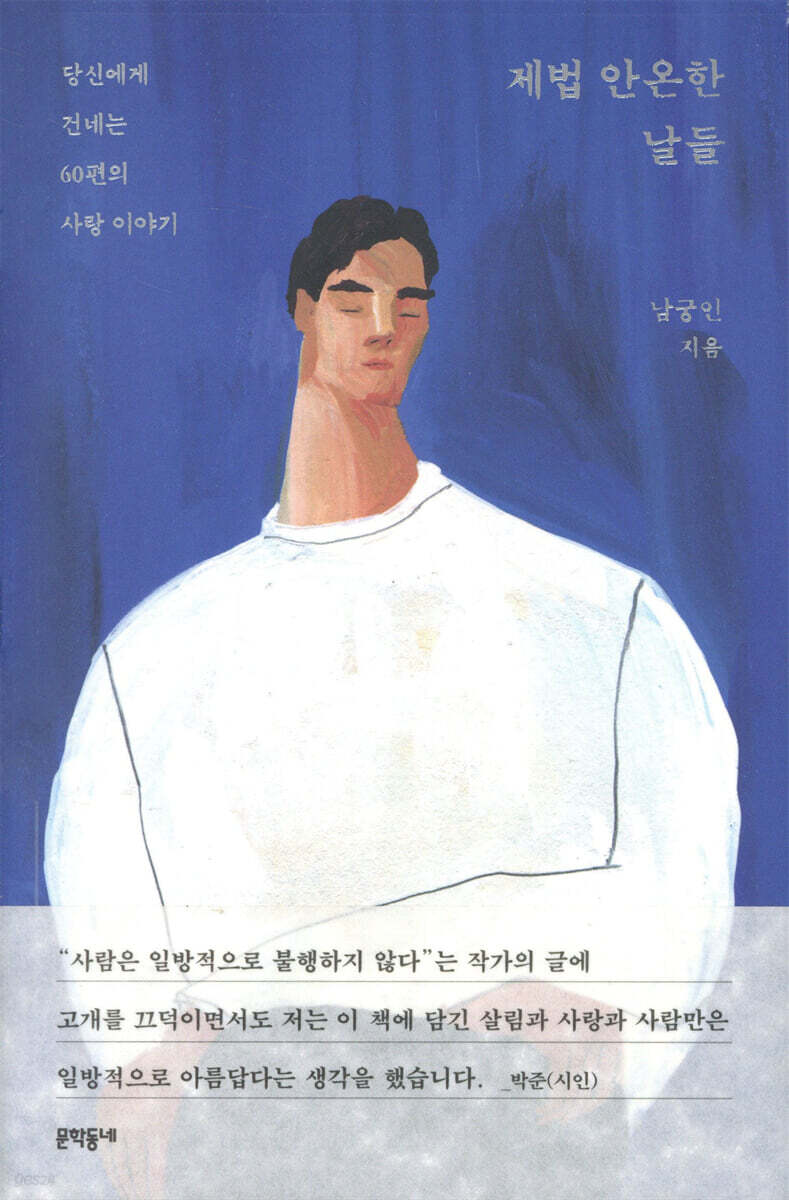 |
Description
Book Introduction
- A word from MD
-
A special love story for all of us ordinary peopleA new work by Dr. Namgung In, who has written about the intense life in the emergency room, where life and death are at stake.
This time, we talk about love that was rescued from moments of pain and despair.
This is the story of all of us, filled with the precious love of family and neighbors that gave us the strength to live proudly even in the face of sorrow.
March 10, 2020. Essay PD Kim Tae-hee
What emergency medicine doctors face in the fierce field of life
A special love story for all of us ordinary people
Emergency room doctor Namgung In visits readers with a slightly different essay.
In this book, he talks about life from a perspective closer to everyday life.
For him, who had to watch over the fate of humanity at the crossroads of life and death, everything was ultimately love.
The moment we are alive, the moment we lose something precious, and yet the moment is completed through memory.
The love story he tells, witnessing human suffering and the miraculous recovery that ultimately comes despite it all, is special in that it vividly confirms that we are ultimately alive here and now, with our loved ones.
A special love story for all of us ordinary people
Emergency room doctor Namgung In visits readers with a slightly different essay.
In this book, he talks about life from a perspective closer to everyday life.
For him, who had to watch over the fate of humanity at the crossroads of life and death, everything was ultimately love.
The moment we are alive, the moment we lose something precious, and yet the moment is completed through memory.
The love story he tells, witnessing human suffering and the miraculous recovery that ultimately comes despite it all, is special in that it vividly confirms that we are ultimately alive here and now, with our loved ones.
- You can preview some of the book's contents.
Preview
index
Part 1
To you in the country
Good luck for a lifetime
What kind of focus
confession
How to count people
taste buds
Salt doesn't go bad
Something that cannot be tolerated
wish
Breaking up
panic disorder
The reason for tears
The sadness that remains with humans
Anxiety and loneliness
anorexia
The smell of the air
Height and weight
ant
spotlight
Kei in Ueno
life
consideration
laceration
knee
My toes are especially sore
To say I don't know
Between consciousness and unconsciousness
The Last Bar
Sensory Homunculus
pain
wasp
Eternal Running
Part 2
To you in the emergency room
hugging shoulder
Warm stethoscope
Saying thank you
Cotton candy and mother
hope
Diagnosis
poverty
Poisoning
germ
Let's donate blood
Morning commute home
endoscopy
Medical staff's mistake
Adolescents and the Morning After Pill
The kernel is the kernel without the kernel
The transcendent being in the emergency room
A child protected with skin
A fact that seems like a lie
Remember death
Patients who don't cry
On deck
heatstroke
The right to one vote
courage to testify
colleague
mother
To you who read my writing across time
To you in the country
Good luck for a lifetime
What kind of focus
confession
How to count people
taste buds
Salt doesn't go bad
Something that cannot be tolerated
wish
Breaking up
panic disorder
The reason for tears
The sadness that remains with humans
Anxiety and loneliness
anorexia
The smell of the air
Height and weight
ant
spotlight
Kei in Ueno
life
consideration
laceration
knee
My toes are especially sore
To say I don't know
Between consciousness and unconsciousness
The Last Bar
Sensory Homunculus
pain
wasp
Eternal Running
Part 2
To you in the emergency room
hugging shoulder
Warm stethoscope
Saying thank you
Cotton candy and mother
hope
Diagnosis
poverty
Poisoning
germ
Let's donate blood
Morning commute home
endoscopy
Medical staff's mistake
Adolescents and the Morning After Pill
The kernel is the kernel without the kernel
The transcendent being in the emergency room
A child protected with skin
A fact that seems like a lie
Remember death
Patients who don't cry
On deck
heatstroke
The right to one vote
courage to testify
colleague
mother
To you who read my writing across time
Publisher's Review
Even if everything is gone, what we will remember in our last moments,
The one thing you will regret if you don't embrace it with all your might while you are alive
That's love
The question of why the doctor brought up a love story disappears when faced with the following question.
"What will we regret most in our final moments?" The money we didn't have? The power we didn't enjoy? The fame and popularity? No, no one would answer like that.
The love that was never fully expressed, the time spent with a loved one that was never fully spent, the feelings that were lost because of hesitation and delay.
I wonder if those things will remain as regrets.
So, it is natural for him, who always works on the edge of life and death, to talk about love.
Perhaps it was inevitable.
Because in the end, what remains for us is only love.
The love he witnesses at work is sometimes so touching that it brings tears to the eyes of even the most hardened doctors.
The story of a grandfather who has been a harlot his entire life holding his wife's hand for the last time after she suddenly passes away, the scene where a sanitation worker who was closer to his family than his own siblings cries at the death of a colleague, and the story of a father who stood with his bare body to protect his child at a fire scene all show the importance of love that we often forget while we are buried in our daily lives.
A doctor's special gaze on the fragile and finite human body and mind
“Humans are not unilaterally unhappy.”
This book is a little different from the previous works, “There Is No If” and “A Terrible Day.”
While his previous prose collections primarily conveyed vivid, up-close images of emergency rooms observed through a microscope, in this book he often retreats into the comfort of everyday life and observes from afar the human recovery that follows suffering.
The story of a family member who collapses and ends up in a wheelchair, but whose remaining family members take care of him and overcome their grief, recover and grow healthily ("Hope") is an anecdote about human misfortune, happiness, and vitality that cannot be judged arbitrarily by others.
Even when a family suffers an irreversible misfortune or the head of the household collapses and is confined to a wheelchair, people do not remain pessimistic about reality and just sit there.
Rather, the people around him embrace him and care for him, each finding their own path forward and experiencing joys and sorrows as they grow.
While I was looking at everything in the world with sad eyes, he was sitting in a wheelchair, finding his own place and enduring the world, and his family was taking care of him and helping him find his own place.
(…) At that time, my family and I were all healthy and there were no particular frustrations.
Yet, I have continued the habit of judging misfortune by the sight of someone screaming in the emergency room.
But sprouts sprout everywhere.
And the sprouts that grow in barren places sometimes bloom into even more splendid and beautiful flowers.
We are not beings who hesitate.
Everyone lives proudly and naturally, carrying their own sorrows.
Those who leave the hospital will overcome their ordeals and sometimes go on to live with a smile.
I was so caught up in the hardships of life that I overlooked that fact.
People are not unilaterally unhappy.
(Pages 194-195)
Is it wrong to be sick? Should you pay for death?
The mystery of the world that medicine alone could not solve
In writings like "Poverty," "Germs," and "Heatstroke," one can sense his voice speaking of the world's absurdities, keenly observed through the eyes of a doctor.
No matter how advanced modern medicine is, the human mind does not function in a scientific or rational manner.
When anxiety and fear consume people, sometimes irrational anger and finger-pointing can lead to helpless and inappropriate actions.
"Germs" reminds us of the tragedy of "Typhoid Mary," an asymptomatic carrier of typhoid who was forced to live isolated on an island for half her life.
He said, “Modern medicine may seem perfect, but in fact, even in the 1900s, medicine was ‘modern medicine.’
“We are not perfect even now,” he said. “In a world where irrational fears, finger-pointing, and prejudice still remain, and where it has become easier to blame someone, we must remember the innocent tragedy of Typhoid Mary.”
"Poverty" tells the story of a bus driver who said he would die without any treatment because he had no money, and "Heatstroke" contains memories of the summer of 2018, when a particularly large number of vulnerable people in medical blind spots were brought in as heatstroke patients.
What does it feel like when a doctor is sick?
A doctor's pain, and even an intimate love story
Meanwhile, this book also contains the doctor's own story, which can be read with a somewhat lighter heart.
“Are doctors afraid of going to the hospital?” This is a question that everyone has probably wondered at least once.
To conclude, even doctors are afraid of going to the hospital.
Perhaps it is even more frightening than patients who come to the hospital without knowing anything.
The doctors you meet at the hospital wear white coats and solemnly give instructions to patients, but in reality, they are all the same: they are scary and difficult when they are in pain.
His attitude in the face of universal human suffering shows the humanity of a doctor.
He is groaning with a bad knee injury, worried that he might have to have surgery ("Knee"), and recalls the memory of the toe anesthesia that was particularly painful when he was young, and says to a patient who came to get a toe anesthesia injection, "This is really, really painful.
Oh, please bear with me.
He even makes a grand preliminary declaration, saying, “This really, really hurts” (“My toes especially hurt”).
But sometimes, the 'personal pain' that is depicted in a rather humorous way can lead to a profound realization.
This is where his intimate stories are not necessarily read as personal.
I thought that a doctor who has experienced a lot of other people's suffering and accumulated knowledge can become a good doctor, but also a doctor who has experienced life for a long time and has observed it sensitively can become a good doctor.
(…) As life gets longer, the number of sufferings that can be understood increases.
The reason why people usually feel more trust in older doctors is because medicine is a discipline of experience that is strengthened through repetition, but it is also because as an individual doctor goes through life's ups and downs, his or her life becomes richer with more suffering, which increases the likelihood that the doctor will be able to empathize with the patient's emotions.
(…) As life goes on, I will get closer to real pain.
Then, wouldn't I be able to empathize more deeply with some, if not all, of my patients and offer them words of comfort?
I will understand their pain a little better, as if I had experienced it myself.
With that in mind, I hope to face various aspects of pain as I grow older.
(Pages 122-123)
The one thing you will regret if you don't embrace it with all your might while you are alive
That's love
The question of why the doctor brought up a love story disappears when faced with the following question.
"What will we regret most in our final moments?" The money we didn't have? The power we didn't enjoy? The fame and popularity? No, no one would answer like that.
The love that was never fully expressed, the time spent with a loved one that was never fully spent, the feelings that were lost because of hesitation and delay.
I wonder if those things will remain as regrets.
So, it is natural for him, who always works on the edge of life and death, to talk about love.
Perhaps it was inevitable.
Because in the end, what remains for us is only love.
The love he witnesses at work is sometimes so touching that it brings tears to the eyes of even the most hardened doctors.
The story of a grandfather who has been a harlot his entire life holding his wife's hand for the last time after she suddenly passes away, the scene where a sanitation worker who was closer to his family than his own siblings cries at the death of a colleague, and the story of a father who stood with his bare body to protect his child at a fire scene all show the importance of love that we often forget while we are buried in our daily lives.
A doctor's special gaze on the fragile and finite human body and mind
“Humans are not unilaterally unhappy.”
This book is a little different from the previous works, “There Is No If” and “A Terrible Day.”
While his previous prose collections primarily conveyed vivid, up-close images of emergency rooms observed through a microscope, in this book he often retreats into the comfort of everyday life and observes from afar the human recovery that follows suffering.
The story of a family member who collapses and ends up in a wheelchair, but whose remaining family members take care of him and overcome their grief, recover and grow healthily ("Hope") is an anecdote about human misfortune, happiness, and vitality that cannot be judged arbitrarily by others.
Even when a family suffers an irreversible misfortune or the head of the household collapses and is confined to a wheelchair, people do not remain pessimistic about reality and just sit there.
Rather, the people around him embrace him and care for him, each finding their own path forward and experiencing joys and sorrows as they grow.
While I was looking at everything in the world with sad eyes, he was sitting in a wheelchair, finding his own place and enduring the world, and his family was taking care of him and helping him find his own place.
(…) At that time, my family and I were all healthy and there were no particular frustrations.
Yet, I have continued the habit of judging misfortune by the sight of someone screaming in the emergency room.
But sprouts sprout everywhere.
And the sprouts that grow in barren places sometimes bloom into even more splendid and beautiful flowers.
We are not beings who hesitate.
Everyone lives proudly and naturally, carrying their own sorrows.
Those who leave the hospital will overcome their ordeals and sometimes go on to live with a smile.
I was so caught up in the hardships of life that I overlooked that fact.
People are not unilaterally unhappy.
(Pages 194-195)
Is it wrong to be sick? Should you pay for death?
The mystery of the world that medicine alone could not solve
In writings like "Poverty," "Germs," and "Heatstroke," one can sense his voice speaking of the world's absurdities, keenly observed through the eyes of a doctor.
No matter how advanced modern medicine is, the human mind does not function in a scientific or rational manner.
When anxiety and fear consume people, sometimes irrational anger and finger-pointing can lead to helpless and inappropriate actions.
"Germs" reminds us of the tragedy of "Typhoid Mary," an asymptomatic carrier of typhoid who was forced to live isolated on an island for half her life.
He said, “Modern medicine may seem perfect, but in fact, even in the 1900s, medicine was ‘modern medicine.’
“We are not perfect even now,” he said. “In a world where irrational fears, finger-pointing, and prejudice still remain, and where it has become easier to blame someone, we must remember the innocent tragedy of Typhoid Mary.”
"Poverty" tells the story of a bus driver who said he would die without any treatment because he had no money, and "Heatstroke" contains memories of the summer of 2018, when a particularly large number of vulnerable people in medical blind spots were brought in as heatstroke patients.
What does it feel like when a doctor is sick?
A doctor's pain, and even an intimate love story
Meanwhile, this book also contains the doctor's own story, which can be read with a somewhat lighter heart.
“Are doctors afraid of going to the hospital?” This is a question that everyone has probably wondered at least once.
To conclude, even doctors are afraid of going to the hospital.
Perhaps it is even more frightening than patients who come to the hospital without knowing anything.
The doctors you meet at the hospital wear white coats and solemnly give instructions to patients, but in reality, they are all the same: they are scary and difficult when they are in pain.
His attitude in the face of universal human suffering shows the humanity of a doctor.
He is groaning with a bad knee injury, worried that he might have to have surgery ("Knee"), and recalls the memory of the toe anesthesia that was particularly painful when he was young, and says to a patient who came to get a toe anesthesia injection, "This is really, really painful.
Oh, please bear with me.
He even makes a grand preliminary declaration, saying, “This really, really hurts” (“My toes especially hurt”).
But sometimes, the 'personal pain' that is depicted in a rather humorous way can lead to a profound realization.
This is where his intimate stories are not necessarily read as personal.
I thought that a doctor who has experienced a lot of other people's suffering and accumulated knowledge can become a good doctor, but also a doctor who has experienced life for a long time and has observed it sensitively can become a good doctor.
(…) As life gets longer, the number of sufferings that can be understood increases.
The reason why people usually feel more trust in older doctors is because medicine is a discipline of experience that is strengthened through repetition, but it is also because as an individual doctor goes through life's ups and downs, his or her life becomes richer with more suffering, which increases the likelihood that the doctor will be able to empathize with the patient's emotions.
(…) As life goes on, I will get closer to real pain.
Then, wouldn't I be able to empathize more deeply with some, if not all, of my patients and offer them words of comfort?
I will understand their pain a little better, as if I had experienced it myself.
With that in mind, I hope to face various aspects of pain as I grow older.
(Pages 122-123)
GOODS SPECIFICS
- Date of issue: March 5, 2020
- Page count, weight, size: 328 pages | 392g | 130*200*19mm
- ISBN13: 9788954670807
- ISBN10: 8954670806
You may also like
카테고리
korean


korean

![GQ KOREA Mark (Monthly): December [2025]](http://librairie.coreenne.fr/cdn/shop/files/8ef265dbbfbf186523ed75ba7319009d.jpg?v=1765340328&width=3840)


