![Mysteria: Issue 60 [2025]](http://librairie.coreenne.fr/cdn/shop/files/ac77eacaf970718083183a4691d9a72a.jpg?v=1765325897&width=3840)

Mysteria: Issue 60 [2025]
 |
Description
Book Introduction
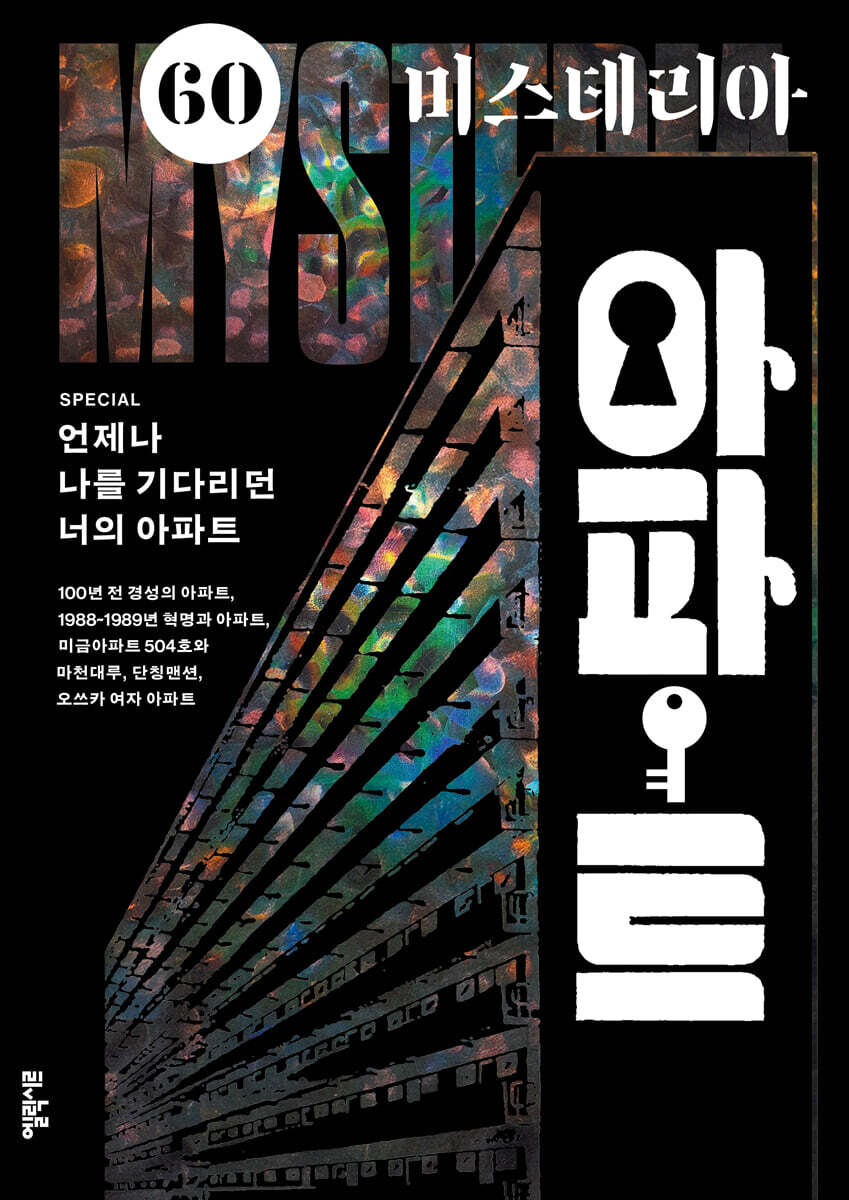
Following the special features in issue #22 (“People Don’t Know What’s In Their Homes”) and issue #39 (“Indoor Crime Guide”), issue #60 of Mysteria returns to the living space once again.
This time it's an apartment.
For Koreans, an apartment is not just a regular house, but rather a vast ecosystem where expectations, desires, and longings for wealth accumulation are intertwined, and where various layers of anger are accumulated.
In that respect, we looked back to when the word "apartment" first began to be used, that is, about 100 years ago, and traced back to the apartments in Gyeongseong. We looked at how the politicians of the time, who feared that a "revolution" might occur if they did not listen carefully to the demands of the ordinary people for social advancement and wealth accumulation under the slogan of "the era of ordinary people" in 1989, prepared for the "daily life of the 1990s" in Korea.
Director Yoon Jong-chan's film "Goosebumps" was also brought in, which depicted an apartment on the verge of demolition, a living thing that instills certain emotions in its residents, in order to visualize the great trauma of Korean society.
And we explore the hidden facets of death and desire in old apartments in Tokyo in the 1950s and high-density apartments in Taipei and Hong Kong in the 2020s.
This time it's an apartment.
For Koreans, an apartment is not just a regular house, but rather a vast ecosystem where expectations, desires, and longings for wealth accumulation are intertwined, and where various layers of anger are accumulated.
In that respect, we looked back to when the word "apartment" first began to be used, that is, about 100 years ago, and traced back to the apartments in Gyeongseong. We looked at how the politicians of the time, who feared that a "revolution" might occur if they did not listen carefully to the demands of the ordinary people for social advancement and wealth accumulation under the slogan of "the era of ordinary people" in 1989, prepared for the "daily life of the 1990s" in Korea.
Director Yoon Jong-chan's film "Goosebumps" was also brought in, which depicted an apartment on the verge of demolition, a living thing that instills certain emotions in its residents, in order to visualize the great trauma of Korean society.
And we explore the hidden facets of death and desire in old apartments in Tokyo in the 1950s and high-density apartments in Taipei and Hong Kong in the 2020s.
index
Editor's Letter
Rumors and facts
LIST
READING DIARY
Announcement and Judges' Comments for the 9th Elixir Mystery Awards
SPECIAL Your apartment that always waited for me
Gyeongseong Apartments: Communal Living Begins 100 Years Ago: Hwang Se-won
1988-89, Revolution and Apartments: Park Hae-cheon
Lullaby of Apartment 504 in Migeum - Yoon Jong-chan's film "Goosebumps": Jeong Seong-il
The Darkroom of Anonymity: Cheon-sae's Ma-cheon-dae-ru and Chan-ho-kei's Dan-ching Mansion: Park Eun-hye
The Master Key's Journey - Masako Togawa's "The Great Illusion": Sim Jeong-myeong
Is This Apartment a Good Place to Live? - Eight Books Read by the Editorial Board: Park Eul-jin, Kim Yu-jin, Han Na-rae, Kim Yong-eon
My hobby is reading
Liz Moore's The Forest God
Shinzo Mitsuda's "Serving Like a Haedama"
Gillian McAllister's The Other Missing Person
Seiichiro Oyama's "The Secret Room Collector"
Tamkim's "All Mr. Tsuu Must Die"
M.
W. Craven's "Black Summer"
Lian Zhang's "J is Dead"
Jun Kurachi's "Don't Play with Corpses, Adults"
Masahiro Imamura's "Dispel"
Paula Hawkins' Blue Hour
MYSTERY PEOPLE Re-employment Strategy Guide - Director Park Chan-wook of "Inevitable"
CULINARY The most universal cup of coffee - Henning Mankell's 'The Dogs of Riga': Eunji Jeong
PULP Steel Appears: Kwak Jae-sik
TOON: The "Characorosi" of New Generation Comics: Kim Hae-in
CHECK The Last Language of the Dead, Bloodstains: Mango
SCIENTIFIC Living Computer: Bae Yeon-woo
REAL STORY The Candy the Neighbor Gave Him - Taiwan's Child Serial Murder Case: Woody
SHORT STORY
Jeong Hae-yeon's "Murder of Lies"
Ronald Knox, "Motivation"
Rumors and facts
LIST
READING DIARY
Announcement and Judges' Comments for the 9th Elixir Mystery Awards
SPECIAL Your apartment that always waited for me
Gyeongseong Apartments: Communal Living Begins 100 Years Ago: Hwang Se-won
1988-89, Revolution and Apartments: Park Hae-cheon
Lullaby of Apartment 504 in Migeum - Yoon Jong-chan's film "Goosebumps": Jeong Seong-il
The Darkroom of Anonymity: Cheon-sae's Ma-cheon-dae-ru and Chan-ho-kei's Dan-ching Mansion: Park Eun-hye
The Master Key's Journey - Masako Togawa's "The Great Illusion": Sim Jeong-myeong
Is This Apartment a Good Place to Live? - Eight Books Read by the Editorial Board: Park Eul-jin, Kim Yu-jin, Han Na-rae, Kim Yong-eon
My hobby is reading
Liz Moore's The Forest God
Shinzo Mitsuda's "Serving Like a Haedama"
Gillian McAllister's The Other Missing Person
Seiichiro Oyama's "The Secret Room Collector"
Tamkim's "All Mr. Tsuu Must Die"
M.
W. Craven's "Black Summer"
Lian Zhang's "J is Dead"
Jun Kurachi's "Don't Play with Corpses, Adults"
Masahiro Imamura's "Dispel"
Paula Hawkins' Blue Hour
MYSTERY PEOPLE Re-employment Strategy Guide - Director Park Chan-wook of "Inevitable"
CULINARY The most universal cup of coffee - Henning Mankell's 'The Dogs of Riga': Eunji Jeong
PULP Steel Appears: Kwak Jae-sik
TOON: The "Characorosi" of New Generation Comics: Kim Hae-in
CHECK The Last Language of the Dead, Bloodstains: Mango
SCIENTIFIC Living Computer: Bae Yeon-woo
REAL STORY The Candy the Neighbor Gave Him - Taiwan's Child Serial Murder Case: Woody
SHORT STORY
Jeong Hae-yeon's "Murder of Lies"
Ronald Knox, "Motivation"
Publisher's Review
novel
The setting of author Jeong Hae-yeon's new work, "Murder of Lies," is Soul Moon, a "frozen city" in the northern tip of Alaska.
A Korean stranger who came here with a certain purpose makes a foolish plan, but unexpected events soon unfold.
This is a thriller short story that will be included in a new anthology that contains various incidents that occur in Soul Moon, a space where humans and non-humans live together.
The short story "Motive" is a 1937 work by Ronald Knox, a Golden Age mystery writer best known for "Knox's Ten Commandments."
When a suspicious attempted murder that began over a Christmas holiday leads to another suspicion, the expected conclusion turns out to be wrong again.
Feature article
Following the special features in issue #22 (“People Don’t Know What’s In Their Homes”) and issue #39 (“Indoor Crime Guide”), issue #60 of Mysteria returns to the living space once again.
This time it's an apartment.
For Koreans, an apartment is not just a regular house, but rather a vast ecosystem where expectations, desires, and longings for wealth accumulation are intertwined, and where various layers of anger are accumulated.
In that respect, we looked back to when the word "apartment" first began to be used, that is, about 100 years ago, and traced back to the apartments in Gyeongseong. We looked at how the politicians of the time, who feared that a "revolution" might occur if they did not listen carefully to the demands of the ordinary people for social advancement and wealth accumulation under the slogan of "the era of ordinary people" in 1989, prepared for the "daily life of the 1990s" in Korea.
Director Yoon Jong-chan's film "Goosebumps" was also brought in, which depicted an apartment on the verge of demolition, a living thing that instills certain emotions in its residents, in order to visualize the great trauma of Korean society.
And we explore the hidden facets of death and desire in old apartments in Tokyo in the 1950s and high-density apartments in Taipei and Hong Kong in the 2020s.
The main character of this 'MYSERY PEOPLE' corner is director Park Chan-wook of the movie 'No Choice.'
The book contains answers to questions about the differences from Donald Westlake's original novel, the relationship with director Costa-Gavras and producer Michelle Ray, who participated as producers, and the elements carefully added during the process of Koreanizing the American novel.
Meanwhile, writer Jeong Eun-ji, in Henning Mankell's "Dogs of Riga," chronicles the transformation of detective Kurt Wallander, who crosses to Latvia in the early 1990s, just before the collapse of the Soviet Union, and encounters the "privilege" of food there. ("CULINARY"). Writer Kwak Jae-sik begins with the claims of a group of people who saw a monster called "Kkangcheol" in the Yangsan area of Gyeongsangnam-do, which suffered from massive flood damage in August 1957, and examines the identity of "Kangcheol," who has been mentioned as the main character in numerous folk tales since the Joseon Dynasty. ("PULP"). Editor Kim Hae-in examines Weekly Shonen Jump's "Three Commanders": "Demon Slayer: Kimetsu no Yaiba," "Jujutsu Kaisen," and "Chainsaw Man," and suggests that the recent trend of even major characters dying without hesitation in popular comics may be due to changes in readers and the publishing system. ("TOON"). The "Worldview" team, which researches references and related information on reflecting realism in crime investigations, is affiliated with SBS. Taking the drama "Sign" as an example, it traces in detail how bloodstains, the most important clue at a crime scene, can serve as evidence of someone's last movements. ('CHECK') Author Bae Yeon-woo looks back at Hiroshi Mori's 1996 feature-length debut, "Everything Becomes F," and the surprising ideas that used now-familiar technologies like the Internet of Things and virtual reality as tricks. ('SCIENTIFIC') Translator Woody deals with the case of Chen Gao-lianye, an indiscriminate serial killer who shook Taiwan in the mid-1980s, as the second subject of a true crime story from the Greater China region.
It is a shocking incident in many ways, with opinions still divided on its background and motive. ('REAL STORY') The 9th Elixir Mystery Awards announcement and judges' comments, as well as information on the 2026 Mysteria subscription, have also been published.
In the 'Hobby is Reading' corner, which introduces notable new books, we have Liz Moore's 'The God of the Forest', Shinzo Mitsuda's 'Serving Like a Haedama', Tamkim's 'Mr. Tsuu Must All Die', M.
Selected works include W. Craven's "Black Summer," Lee An Chang's "J is Dead," and Paula Hawkins' "Blue Hour."
The setting of author Jeong Hae-yeon's new work, "Murder of Lies," is Soul Moon, a "frozen city" in the northern tip of Alaska.
A Korean stranger who came here with a certain purpose makes a foolish plan, but unexpected events soon unfold.
This is a thriller short story that will be included in a new anthology that contains various incidents that occur in Soul Moon, a space where humans and non-humans live together.
The short story "Motive" is a 1937 work by Ronald Knox, a Golden Age mystery writer best known for "Knox's Ten Commandments."
When a suspicious attempted murder that began over a Christmas holiday leads to another suspicion, the expected conclusion turns out to be wrong again.
Feature article
Following the special features in issue #22 (“People Don’t Know What’s In Their Homes”) and issue #39 (“Indoor Crime Guide”), issue #60 of Mysteria returns to the living space once again.
This time it's an apartment.
For Koreans, an apartment is not just a regular house, but rather a vast ecosystem where expectations, desires, and longings for wealth accumulation are intertwined, and where various layers of anger are accumulated.
In that respect, we looked back to when the word "apartment" first began to be used, that is, about 100 years ago, and traced back to the apartments in Gyeongseong. We looked at how the politicians of the time, who feared that a "revolution" might occur if they did not listen carefully to the demands of the ordinary people for social advancement and wealth accumulation under the slogan of "the era of ordinary people" in 1989, prepared for the "daily life of the 1990s" in Korea.
Director Yoon Jong-chan's film "Goosebumps" was also brought in, which depicted an apartment on the verge of demolition, a living thing that instills certain emotions in its residents, in order to visualize the great trauma of Korean society.
And we explore the hidden facets of death and desire in old apartments in Tokyo in the 1950s and high-density apartments in Taipei and Hong Kong in the 2020s.
The main character of this 'MYSERY PEOPLE' corner is director Park Chan-wook of the movie 'No Choice.'
The book contains answers to questions about the differences from Donald Westlake's original novel, the relationship with director Costa-Gavras and producer Michelle Ray, who participated as producers, and the elements carefully added during the process of Koreanizing the American novel.
Meanwhile, writer Jeong Eun-ji, in Henning Mankell's "Dogs of Riga," chronicles the transformation of detective Kurt Wallander, who crosses to Latvia in the early 1990s, just before the collapse of the Soviet Union, and encounters the "privilege" of food there. ("CULINARY"). Writer Kwak Jae-sik begins with the claims of a group of people who saw a monster called "Kkangcheol" in the Yangsan area of Gyeongsangnam-do, which suffered from massive flood damage in August 1957, and examines the identity of "Kangcheol," who has been mentioned as the main character in numerous folk tales since the Joseon Dynasty. ("PULP"). Editor Kim Hae-in examines Weekly Shonen Jump's "Three Commanders": "Demon Slayer: Kimetsu no Yaiba," "Jujutsu Kaisen," and "Chainsaw Man," and suggests that the recent trend of even major characters dying without hesitation in popular comics may be due to changes in readers and the publishing system. ("TOON"). The "Worldview" team, which researches references and related information on reflecting realism in crime investigations, is affiliated with SBS. Taking the drama "Sign" as an example, it traces in detail how bloodstains, the most important clue at a crime scene, can serve as evidence of someone's last movements. ('CHECK') Author Bae Yeon-woo looks back at Hiroshi Mori's 1996 feature-length debut, "Everything Becomes F," and the surprising ideas that used now-familiar technologies like the Internet of Things and virtual reality as tricks. ('SCIENTIFIC') Translator Woody deals with the case of Chen Gao-lianye, an indiscriminate serial killer who shook Taiwan in the mid-1980s, as the second subject of a true crime story from the Greater China region.
It is a shocking incident in many ways, with opinions still divided on its background and motive. ('REAL STORY') The 9th Elixir Mystery Awards announcement and judges' comments, as well as information on the 2026 Mysteria subscription, have also been published.
In the 'Hobby is Reading' corner, which introduces notable new books, we have Liz Moore's 'The God of the Forest', Shinzo Mitsuda's 'Serving Like a Haedama', Tamkim's 'Mr. Tsuu Must All Die', M.
Selected works include W. Craven's "Black Summer," Lee An Chang's "J is Dead," and Paula Hawkins' "Blue Hour."
GOODS SPECIFICS
- Date of issue: November 28, 2025
- Page count, weight, size: 232 pages | 170*240*20mm
- ISBN13: 9772384289005
- ISBN10: 2384289x
You may also like
카테고리
korean


korean

![GQ KOREA Mark (Monthly): December [2025]](http://librairie.coreenne.fr/cdn/shop/files/8ef265dbbfbf186523ed75ba7319009d.jpg?v=1765340328&width=3840)


