![Gnit 4: Disappearing Region [2023]](http://librairie.coreenne.fr/cdn/shop/files/1691a18747c38523f5b52d690031cc19.jpg?v=1765326588&width=3840)

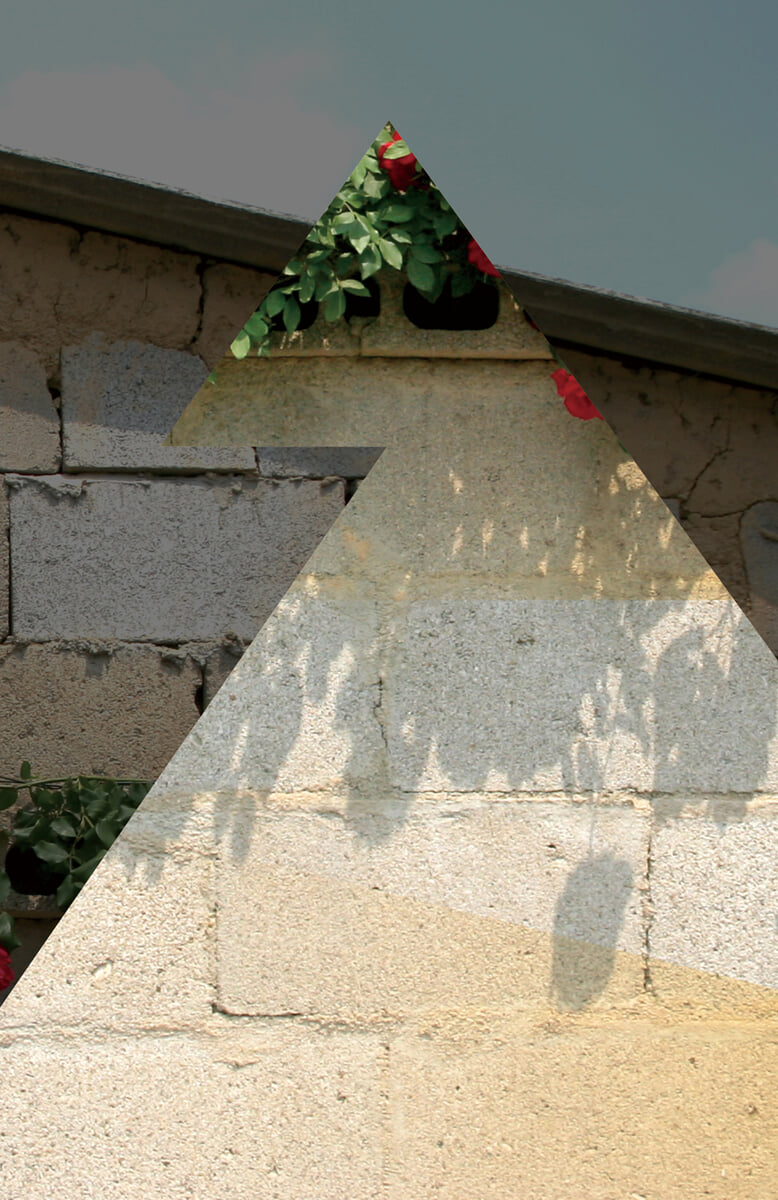
Gnet No. 4: Region, Disappearing [2023]
 |
Description
Book Introduction
『Gutnit』, a novel magazine that compiles one thematic essay and three short stories each season, focusing on a specific topic that cannot be overlooked in our times.
Issue 4 includes an essay on the theme of ‘regional extinction’ by Professor Jo Moon-young of Yonsei University’s Department of Cultural Anthropology, as well as short stories by Kim Tae-yong, Seo I-je, Son Bo-mi, and Yesoyeon.
Issue 4 includes an essay on the theme of ‘regional extinction’ by Professor Jo Moon-young of Yonsei University’s Department of Cultural Anthropology, as well as short stories by Kim Tae-yong, Seo I-je, Son Bo-mi, and Yesoyeon.
- You can preview some of the book's contents.
Preview
index
I, Regional Extinction Theory | Jo Moon-young
Words and Noise | Kim Tae-yong
Enter/Do | Seoije
The Law of Nature | Son Bo-mi
Palm | Yesoyeon
Words and Noise | Kim Tae-yong
Enter/Do | Seoije
The Law of Nature | Son Bo-mi
Palm | Yesoyeon
Detailed image
Into the book
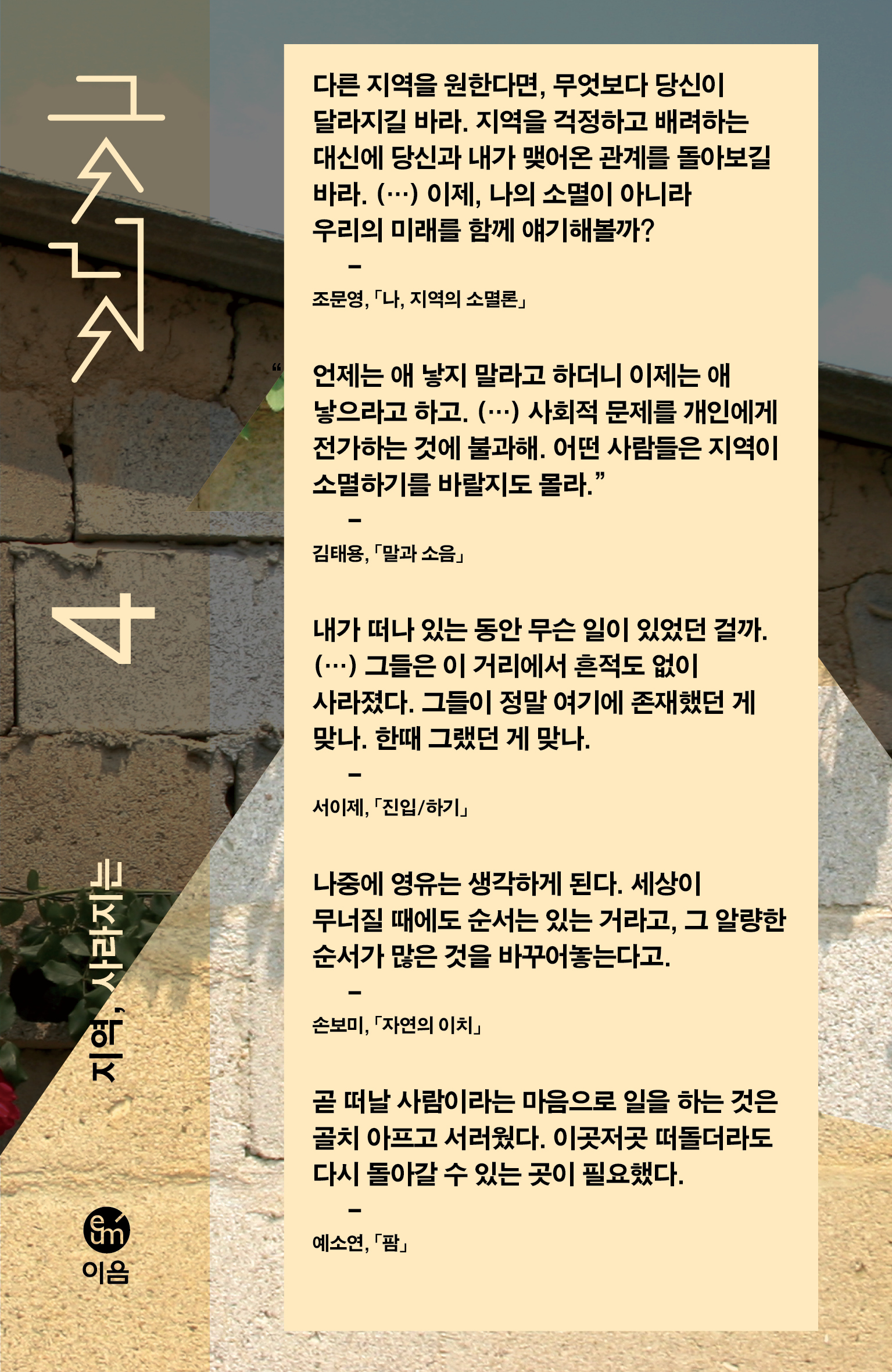
Whatever you call me, provincial, regional, or local, honestly, I don't really care.
The point is, as long as you keep the 'me-region' outside of you, our conversation will inevitably go around in circles.
I haven't been there in a while, but I'm lamenting the city center's desolation even on a weekend. Should I be grateful? Or is it an over-criticism if it resembles the nostalgia of an imperialist mourning his own destruction? If you want a different place, I hope you change more than anything.
Instead of worrying about and caring for the region, I hope you look back on the relationship you and I have built.
I hope you realize that the history of enforcing regional marginality is the history of the growth of metropolitan Seoul.
I hope you realize that you and I have been actively involved and complicit in this history.
Now, let's talk about our future together, not my demise.
---p.12 Jo Moon-young, "I, Theory of Regional Extinction"
Grandma's story must end here.
No one should read it.
(……)
There is no such grandmother in the world.
Since it does not exist in the world, it must exist in the novel.
There is a world that only novels can open up.
There are words and noises that can only be heard in novels.
There are characters who only exist in novels.
My grandmother is me.
But I can't be a grandmother.
I just reproduce my grandmother in words.
You may have to meet someone who doesn't speak the language.
---p.47 Kim Tae-yong, "Words and Noise"
As I write, I keep seeing the map of the area with red warning lights and the streetscapes where only human traces remain.
I wondered if, through the eyes of anxiety, we might be able to question the words surrounding regional extinction through the characters in the novel.
Is it really right for a region to disappear?
---p.47 Kim Tae-yong, "Words and Noise," author's note
We met at the playground every day.
At that time, we could do that every day without any special contact.
We met and dug the ground together, made fine soil, and picked stones.
We rode on swings and seesaws, and when we got bored, we gathered the kids together and played tag.
We played a lot of games and sometimes even played games of unknown identity.
The kids younger than us ordered kimchi.
No child was excluded.
At the playground, everyone could become friends after just one game without having to say their names.
It was a game where winning or losing didn't matter.
No, no one cared about winning or losing.
If you win, you win, and if you lose, you lose.
There was nothing good about winning and nothing bad about losing.
I just ran around to my heart's content and went home when the sun went down.
---p.53
What happened while I was struggling to get out of here?
I wonder what happened while I was away.
That guy, the one in overalls, those kids you could see anytime you went to the playground.
There was no more.
They disappeared from this street without a trace.
Are they really here?
Is that what it used to be like?
I couldn't trust my memory.
I wanted to call Jisoo right away and ask her if she remembered the kids she used to play with back then.
I was afraid that Jisoo might not remember anything.
---p.71 Seo Ije, "Entering/Doing"
The neighborhood where Young-yu lived was mostly populated by older people.
It wasn't like that when Young-yu was very young.
Before he became ill, Young-yu's father worked at an automobile factory in that city.
For a very long time, when people from other regions talked about the city where Young-yu lived, the automobile factory was always mentioned.
The city began to decline as the factory failed.
There have been several attempts at the city and provincial levels.
For example, developing tourist attractions and developing areas around large lakes in cities.
Land prices in the development area rose, and the people living there saw some benefits.
But it wasn't Young-Yu's neighborhood.
Yeong-Yu's neighborhood wasn't too far from a tourist attraction (it was far from the lake), but when development began, it began to decline rapidly, and the few young people who remained all left.
When he was in the fourth grade, the elementary school he attended closed.
After that, Young-yu had to take the bus for more than thirty minutes every morning.
Every time, tears welled up in my eyes.
The new school was in a development area near the lake, and the scenery was so different that it was hard to believe it was in the same city.
Later, Young-yu thinks about this time.
Even when the world falls apart, there is order, and that small order changes many things.
---p.82 Son Bo-mi, "The Law of Nature"
Hannah walked slowly through the land, which seemed quite large, but was actually less than thirty percent of the total area, a piece of land equal to her share.
What can we do here?
(……) It was a pain and sad to work with the mindset that I would be leaving soon.
Even if I wandered around here and there, I needed a place I could return to.
---p.146
Daejin used to say, as if it were a habit, that if you have nothing to do, you should settle down here.
Actually, it's not like Hannah didn't think about it at all.
However, after looking into it, it was found that among the young people who received the Youth Farmer Settlement Fund, very few have settled down properly.
He was not accustomed to physical labor, so he invested heavily in equipment, but was unable to recover his investment and returned to the city after a few years.
The point is, as long as you keep the 'me-region' outside of you, our conversation will inevitably go around in circles.
I haven't been there in a while, but I'm lamenting the city center's desolation even on a weekend. Should I be grateful? Or is it an over-criticism if it resembles the nostalgia of an imperialist mourning his own destruction? If you want a different place, I hope you change more than anything.
Instead of worrying about and caring for the region, I hope you look back on the relationship you and I have built.
I hope you realize that the history of enforcing regional marginality is the history of the growth of metropolitan Seoul.
I hope you realize that you and I have been actively involved and complicit in this history.
Now, let's talk about our future together, not my demise.
---p.12 Jo Moon-young, "I, Theory of Regional Extinction"
Grandma's story must end here.
No one should read it.
(……)
There is no such grandmother in the world.
Since it does not exist in the world, it must exist in the novel.
There is a world that only novels can open up.
There are words and noises that can only be heard in novels.
There are characters who only exist in novels.
My grandmother is me.
But I can't be a grandmother.
I just reproduce my grandmother in words.
You may have to meet someone who doesn't speak the language.
---p.47 Kim Tae-yong, "Words and Noise"
As I write, I keep seeing the map of the area with red warning lights and the streetscapes where only human traces remain.
I wondered if, through the eyes of anxiety, we might be able to question the words surrounding regional extinction through the characters in the novel.
Is it really right for a region to disappear?
---p.47 Kim Tae-yong, "Words and Noise," author's note
We met at the playground every day.
At that time, we could do that every day without any special contact.
We met and dug the ground together, made fine soil, and picked stones.
We rode on swings and seesaws, and when we got bored, we gathered the kids together and played tag.
We played a lot of games and sometimes even played games of unknown identity.
The kids younger than us ordered kimchi.
No child was excluded.
At the playground, everyone could become friends after just one game without having to say their names.
It was a game where winning or losing didn't matter.
No, no one cared about winning or losing.
If you win, you win, and if you lose, you lose.
There was nothing good about winning and nothing bad about losing.
I just ran around to my heart's content and went home when the sun went down.
---p.53
What happened while I was struggling to get out of here?
I wonder what happened while I was away.
That guy, the one in overalls, those kids you could see anytime you went to the playground.
There was no more.
They disappeared from this street without a trace.
Are they really here?
Is that what it used to be like?
I couldn't trust my memory.
I wanted to call Jisoo right away and ask her if she remembered the kids she used to play with back then.
I was afraid that Jisoo might not remember anything.
---p.71 Seo Ije, "Entering/Doing"
The neighborhood where Young-yu lived was mostly populated by older people.
It wasn't like that when Young-yu was very young.
Before he became ill, Young-yu's father worked at an automobile factory in that city.
For a very long time, when people from other regions talked about the city where Young-yu lived, the automobile factory was always mentioned.
The city began to decline as the factory failed.
There have been several attempts at the city and provincial levels.
For example, developing tourist attractions and developing areas around large lakes in cities.
Land prices in the development area rose, and the people living there saw some benefits.
But it wasn't Young-Yu's neighborhood.
Yeong-Yu's neighborhood wasn't too far from a tourist attraction (it was far from the lake), but when development began, it began to decline rapidly, and the few young people who remained all left.
When he was in the fourth grade, the elementary school he attended closed.
After that, Young-yu had to take the bus for more than thirty minutes every morning.
Every time, tears welled up in my eyes.
The new school was in a development area near the lake, and the scenery was so different that it was hard to believe it was in the same city.
Later, Young-yu thinks about this time.
Even when the world falls apart, there is order, and that small order changes many things.
---p.82 Son Bo-mi, "The Law of Nature"
Hannah walked slowly through the land, which seemed quite large, but was actually less than thirty percent of the total area, a piece of land equal to her share.
What can we do here?
(……) It was a pain and sad to work with the mindset that I would be leaving soon.
Even if I wandered around here and there, I needed a place I could return to.
---p.146
Daejin used to say, as if it were a habit, that if you have nothing to do, you should settle down here.
Actually, it's not like Hannah didn't think about it at all.
However, after looking into it, it was found that among the young people who received the Youth Farmer Settlement Fund, very few have settled down properly.
He was not accustomed to physical labor, so he invested heavily in equipment, but was unable to recover his investment and returned to the city after a few years.
---p.153 Yesoyeon, "Farm"
Publisher's Review
Stories can't tell us directly how others feel, but they can help us imagine how we might feel in their situations.
That is the power of empathy that stories possess.
Abstract arguments can provide some background, but stories are what get to the point directly and poignantly.
The novel magazine 『Gutnit』 believes in the power of such stories.
The story connects the world we live in with the world that is clearly there but is not easily visible and that we try to avoid seeing.
『Gutnit』 presents readers with one thematic essay and three short stories centered on specific topics and keywords that cannot be overlooked in our time.
『Gutnit』 announces a set topic in advance each issue and accepts submissions.
Despite receiving many submissions, we were unfortunately unable to present a selected work in the third issue. However, for the fourth issue, we have decided to read "Farm" by Yesoyeon.
A young writer has added strength to the concerns of 『Gutnit』 on how the province can 'come back to life'.
*
The main gates of the local university, once attended by thousands of students, now stand firmly closed.
The roofs and windows of the buildings visible through the barbed wire fences are torn off due to lack of maintenance, and the playgrounds are overgrown with weeds. However, the large buildings are not even sold, so they are just an eyesore.
Since 2000, 20 universities have closed across the country, 19 of which are located in local areas.
『Gutnit』 No. 4 talks about ‘regional extinction.’
According to Statistics Korea and the Korea Employment Information Service, as of February, 118 (51.8%) of the 228 basic local governments (cities, counties, and districts) across the country were classified as areas at risk of extinction.
Last year, the number of cities, counties, and districts at risk of extinction was 113, an increase of 5 this year, exceeding 50% of the total for the first time. Based on townships and districts, 1,951 are at risk of extinction.
The number increased by about 100 from 1,849 last year.
Among them, the number of 'high-risk extinction' areas is 23 in 2020, 36 in 2021, 45 in 2022, and 51 in 2023, and the pace is progressing at an unpredictable rate.
With the low birth rate and rapidly aging population, the young population is being sucked into the metropolitan area like a black hole.
This may be a natural result, as ‘prestigious universities’ and ‘good jobs’ are concentrated in the Seoul metropolitan area.
Currently, all of the 'high-risk' areas are rural, fishing, and county areas, but if the concentration in the metropolitan area worsens further, it is possible that small and medium-sized local cities will also be at risk of extinction one after another.
Along with the existence of local regions, the vicious cycle of population concentration leading to a declining quality of life in the metropolitan area is also an unavoidable problem.
『Gutnit』 Issue 4 presents four problematic stories about our lives surrounding the topic of fat loss, which can no longer be overlooked.
*
Perhaps 'we' who live in the metropolitan area may not have realized it yet, but for all the other 'us' who are seeking ways to survive in the disappearing regions, this is an extremely urgent issue. The authors who have thought about this issue together are Jo Moon-young (theme essay), Kim Tae-yong, Seo I-je, Son Bo-mi, and Ye So-yeon (short stories).
Professor Jo Moon-young of Yonsei University's Department of Anthropology's essay, "I, the Theory of Regional Extinction," concisely examines the problems of these places, each facing crisis, through the lens of the region.
From the concept of the local extinction risk index to low birth rates, the absence of local medical care, policies of the government and local governments that are superficially out of touch with reality, and various methods of exploration that do not involve local residents, these topics, which we only briefly glance over in articles every day, fill up a short page.
Kim Tae-yong's novel "Words and Noise" is a work that clearly reveals the author's unique novelistic concerns.
What power can be exerted by trying to find a novel alternative to a social problem whose causes are relatively clear but whose solutions are difficult to find?
The author brings to the forefront the psychological characteristics of a novelist wife, who drew her novelistic motif from the story of her husband, a local city newspaper reporter who wrote an article about regional extinction, and, by overlapping coincidence and imagination against the backdrop of regional extinction, novelly unravels this unsettling and unanswerable problem.
This novel retains Kim Tae-yong's unique style, but its thematic consciousness operates in a completely different way beneath the surface-level narrative.
Seo Yi-je's novel "Entering/Doing" is the story of 'I' who returns to my hometown, which I left a long time ago, because of the wedding of a hometown friend with whom I keep in touch from time to time.
Through the eyes of 'I', who has revisited the place I longed to leave behind after a long time, we encounter our hometown, which has changed from the past.
Parts of the city that at first glance seemed the same are now empty, and walking along the once bustling downtown area, you encounter almost no one.
Now those places—many of our hometowns—are no longer “livable” places.
The author ponders the “language” that ultimately distinguishes “what an individual has to turn his back on while striving for social mobility and entering a society.”
Son Bo-mi's novel "The Law of Nature" is a work that strongly displays the author's characteristically dramatic narrative.
In a small town in the countryside that began to decline when the automobile factory went bankrupt, the coming-of-age story of Young-yu (now eighteen) who had to take a bus for over thirty minutes to get to school because even his elementary school closed down unfolds in a time and space that could have happened anywhere except the metropolitan city of Seoul.
It's like watching a feature film, with vivid characters and tension that keeps you on the edge of your seat, while naturally making you think beyond the storyline.
*
Among the many works submitted to 『Gutnit』 No. 4, we introduce the novel "Farm" by author Ye So-yeon.
When we move from Seoul to the countryside, we don't just 'come and go', we 'go down'.
In a world where others are easily excluded and hated, the author asks through his novel how we can live safely, freely moving between the "provinces" and the metropolitan area.
Daejin, a father who participated in the democracy movement in his youth and now lives in a rural area, is concerned about the climate crisis, developing his own farming methods, and striving to create a sustainable world. His daughter, Hannah, wins a contest to name an eco-city and receives a considerable amount of prize money. This story is filled with many concerns.
That is the power of empathy that stories possess.
Abstract arguments can provide some background, but stories are what get to the point directly and poignantly.
The novel magazine 『Gutnit』 believes in the power of such stories.
The story connects the world we live in with the world that is clearly there but is not easily visible and that we try to avoid seeing.
『Gutnit』 presents readers with one thematic essay and three short stories centered on specific topics and keywords that cannot be overlooked in our time.
『Gutnit』 announces a set topic in advance each issue and accepts submissions.
Despite receiving many submissions, we were unfortunately unable to present a selected work in the third issue. However, for the fourth issue, we have decided to read "Farm" by Yesoyeon.
A young writer has added strength to the concerns of 『Gutnit』 on how the province can 'come back to life'.
*
The main gates of the local university, once attended by thousands of students, now stand firmly closed.
The roofs and windows of the buildings visible through the barbed wire fences are torn off due to lack of maintenance, and the playgrounds are overgrown with weeds. However, the large buildings are not even sold, so they are just an eyesore.
Since 2000, 20 universities have closed across the country, 19 of which are located in local areas.
『Gutnit』 No. 4 talks about ‘regional extinction.’
According to Statistics Korea and the Korea Employment Information Service, as of February, 118 (51.8%) of the 228 basic local governments (cities, counties, and districts) across the country were classified as areas at risk of extinction.
Last year, the number of cities, counties, and districts at risk of extinction was 113, an increase of 5 this year, exceeding 50% of the total for the first time. Based on townships and districts, 1,951 are at risk of extinction.
The number increased by about 100 from 1,849 last year.
Among them, the number of 'high-risk extinction' areas is 23 in 2020, 36 in 2021, 45 in 2022, and 51 in 2023, and the pace is progressing at an unpredictable rate.
With the low birth rate and rapidly aging population, the young population is being sucked into the metropolitan area like a black hole.
This may be a natural result, as ‘prestigious universities’ and ‘good jobs’ are concentrated in the Seoul metropolitan area.
Currently, all of the 'high-risk' areas are rural, fishing, and county areas, but if the concentration in the metropolitan area worsens further, it is possible that small and medium-sized local cities will also be at risk of extinction one after another.
Along with the existence of local regions, the vicious cycle of population concentration leading to a declining quality of life in the metropolitan area is also an unavoidable problem.
『Gutnit』 Issue 4 presents four problematic stories about our lives surrounding the topic of fat loss, which can no longer be overlooked.
*
Perhaps 'we' who live in the metropolitan area may not have realized it yet, but for all the other 'us' who are seeking ways to survive in the disappearing regions, this is an extremely urgent issue. The authors who have thought about this issue together are Jo Moon-young (theme essay), Kim Tae-yong, Seo I-je, Son Bo-mi, and Ye So-yeon (short stories).
Professor Jo Moon-young of Yonsei University's Department of Anthropology's essay, "I, the Theory of Regional Extinction," concisely examines the problems of these places, each facing crisis, through the lens of the region.
From the concept of the local extinction risk index to low birth rates, the absence of local medical care, policies of the government and local governments that are superficially out of touch with reality, and various methods of exploration that do not involve local residents, these topics, which we only briefly glance over in articles every day, fill up a short page.
Kim Tae-yong's novel "Words and Noise" is a work that clearly reveals the author's unique novelistic concerns.
What power can be exerted by trying to find a novel alternative to a social problem whose causes are relatively clear but whose solutions are difficult to find?
The author brings to the forefront the psychological characteristics of a novelist wife, who drew her novelistic motif from the story of her husband, a local city newspaper reporter who wrote an article about regional extinction, and, by overlapping coincidence and imagination against the backdrop of regional extinction, novelly unravels this unsettling and unanswerable problem.
This novel retains Kim Tae-yong's unique style, but its thematic consciousness operates in a completely different way beneath the surface-level narrative.
Seo Yi-je's novel "Entering/Doing" is the story of 'I' who returns to my hometown, which I left a long time ago, because of the wedding of a hometown friend with whom I keep in touch from time to time.
Through the eyes of 'I', who has revisited the place I longed to leave behind after a long time, we encounter our hometown, which has changed from the past.
Parts of the city that at first glance seemed the same are now empty, and walking along the once bustling downtown area, you encounter almost no one.
Now those places—many of our hometowns—are no longer “livable” places.
The author ponders the “language” that ultimately distinguishes “what an individual has to turn his back on while striving for social mobility and entering a society.”
Son Bo-mi's novel "The Law of Nature" is a work that strongly displays the author's characteristically dramatic narrative.
In a small town in the countryside that began to decline when the automobile factory went bankrupt, the coming-of-age story of Young-yu (now eighteen) who had to take a bus for over thirty minutes to get to school because even his elementary school closed down unfolds in a time and space that could have happened anywhere except the metropolitan city of Seoul.
It's like watching a feature film, with vivid characters and tension that keeps you on the edge of your seat, while naturally making you think beyond the storyline.
*
Among the many works submitted to 『Gutnit』 No. 4, we introduce the novel "Farm" by author Ye So-yeon.
When we move from Seoul to the countryside, we don't just 'come and go', we 'go down'.
In a world where others are easily excluded and hated, the author asks through his novel how we can live safely, freely moving between the "provinces" and the metropolitan area.
Daejin, a father who participated in the democracy movement in his youth and now lives in a rural area, is concerned about the climate crisis, developing his own farming methods, and striving to create a sustainable world. His daughter, Hannah, wins a contest to name an eco-city and receives a considerable amount of prize money. This story is filled with many concerns.
GOODS SPECIFICS
- Date of issue: June 5, 2023
- Page count, weight, size: 164 pages | 226g | 130*200*10mm
- ISBN13: 9772951413048
- ISBN10: 29514134
You may also like
카테고리
korean


korean

![GQ KOREA Mark (Monthly): December [2025]](http://librairie.coreenne.fr/cdn/shop/files/8ef265dbbfbf186523ed75ba7319009d.jpg?v=1765340328&width=3840)


