

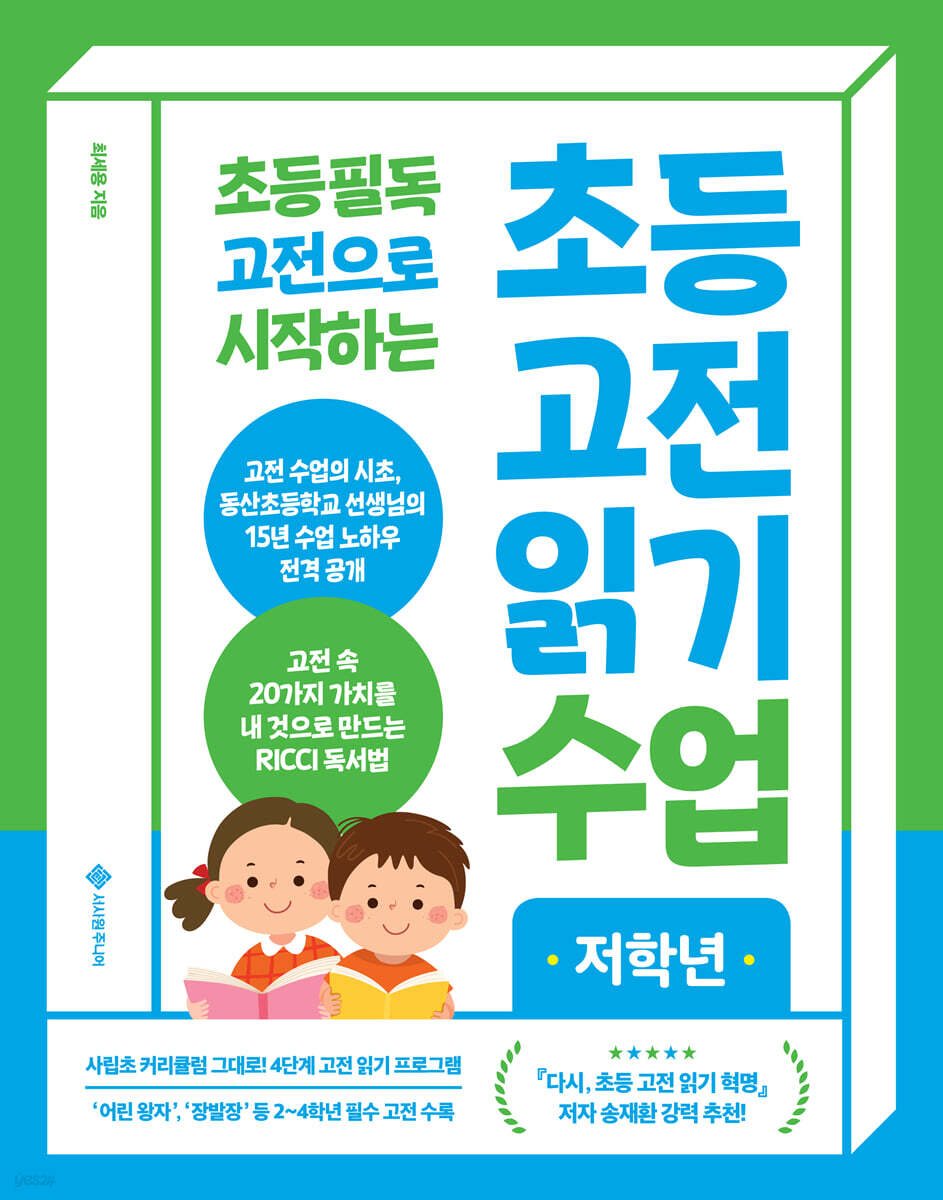
Elementary Classics Reading Class for Lower Grades
 |
Description
Book Introduction
“A book that squeezes out every nutrient from a classic by putting it through a juicer!”
Highly recommended by Song Jae-hwan, author of "Again, the Revolution in Reading Elementary Classics"
The origin of classical education, the curriculum of Dongsan Elementary School is exactly the same!
A private elementary school teacher reveals 15 years of teaching expertise.
Dongsan Elementary School in Seoul launched the first classical literature reading program for all students in 2011, and has been running it for 14 years.
Reading classics is included as a regular subject, and a total of 100 classics are read and discussed before graduation.
Numerous reviews from alumni and parents, such as "The power of reading classics shines brighter as students advance to middle and high school," and "It's not just about studying, but classes that build character," explain why Dongsan Elementary School ranks among the most competitive private elementary schools in Seoul for admission.
This book contains the know-how of the author, who worked as a teacher at Dongsan Elementary School for 15 years and taught classical education.
The content of the class, as taught by the teacher, was designed so that more children can easily approach the classics on their own.
By following the structure of the book step by step, you will not only read and understand the classics, but also discover the value contained within them and internalize it, making it your own.
It can be said to be similar to “putting a classic into a juicer and extracting all the nutrients contained within” (from the recommendation).
I recommend this to parents and teachers who want to have their children read classics but are unsure of where to start, or who are looking for an easy but effective way to read classics.
The author, who has spent a long time teaching students and researching effective classical teaching methods, will provide a guide to ignite interest in the classics.
Highly recommended by Song Jae-hwan, author of "Again, the Revolution in Reading Elementary Classics"
The origin of classical education, the curriculum of Dongsan Elementary School is exactly the same!
A private elementary school teacher reveals 15 years of teaching expertise.
Dongsan Elementary School in Seoul launched the first classical literature reading program for all students in 2011, and has been running it for 14 years.
Reading classics is included as a regular subject, and a total of 100 classics are read and discussed before graduation.
Numerous reviews from alumni and parents, such as "The power of reading classics shines brighter as students advance to middle and high school," and "It's not just about studying, but classes that build character," explain why Dongsan Elementary School ranks among the most competitive private elementary schools in Seoul for admission.
This book contains the know-how of the author, who worked as a teacher at Dongsan Elementary School for 15 years and taught classical education.
The content of the class, as taught by the teacher, was designed so that more children can easily approach the classics on their own.
By following the structure of the book step by step, you will not only read and understand the classics, but also discover the value contained within them and internalize it, making it your own.
It can be said to be similar to “putting a classic into a juicer and extracting all the nutrients contained within” (from the recommendation).
I recommend this to parents and teachers who want to have their children read classics but are unsure of where to start, or who are looking for an easy but effective way to read classics.
The author, who has spent a long time teaching students and researching effective classical teaching methods, will provide a guide to ignite interest in the classics.
- You can preview some of the book's contents.
Preview
index
Recommendation
To my parents
To the children
Structure and features of this book
Study plan
1 day gold axe silver axe
2 days Jean Valjean
The Happy Prince for 3 Days
4 days 15 boys drifting away
5 days of filial piety Simcheong
The Little Prince on the 6th
A mother with a son who sells straw sandals and a son who sells fans
Helen Keller on the 8th
9th Fox and Stork
The brother who threw away the gold nugget on the 10th
11th Ant and Grasshopper
The shoe repairman and the banker on the 12th
Hansel and Gretel on the 13th
14th Dangun myth
The mouse that repaid the favor on the 15th
16th Mannyeon Shirt
Last leaf on the 17th
The storehouse in the afterlife on the 18th
The Tiger and the Traveler on the 19th
The secret to a harmonious family on the 20th
Example Answer
To my parents
To the children
Structure and features of this book
Study plan
1 day gold axe silver axe
2 days Jean Valjean
The Happy Prince for 3 Days
4 days 15 boys drifting away
5 days of filial piety Simcheong
The Little Prince on the 6th
A mother with a son who sells straw sandals and a son who sells fans
Helen Keller on the 8th
9th Fox and Stork
The brother who threw away the gold nugget on the 10th
11th Ant and Grasshopper
The shoe repairman and the banker on the 12th
Hansel and Gretel on the 13th
14th Dangun myth
The mouse that repaid the favor on the 15th
16th Mannyeon Shirt
Last leaf on the 17th
The storehouse in the afterlife on the 18th
The Tiger and the Traveler on the 19th
The secret to a harmonious family on the 20th
Example Answer
Detailed image

Publisher's Review
I have made the 20 classics and all the values they contain mine.
They say that literacy determines grades in all subjects.
Dongsan Elementary School students who have already experienced the classic reading program have proven its effectiveness by improving their reading and learning skills.
The vocabulary, literacy, thinking skills, and writing skills developed while reading classics become the foundation for future learning.
But more important than that is the ‘meaning’ contained in the classics.
Classics contain wisdom that can help us understand humanity and the world, and foster better relationships with those around us.
This book aims not only to read classics, but also to understand their meaning and value and make them your own.
Just like a real class! 4-step post-reading activity
We study according to the 'RICCI 4-Step Classic Reading Program' designed by teacher Choi Se-yong, following the regular curriculum.
Step 1, “Encountering the Classics,” includes a selection of classics suitable for elementary school students, edited and presented in an easily accessible format.
After reading the passage, check the content with vocabulary study and reading quizzes.
In Step 2, “Encountering Values,” you will discover the core values contained in classics.
For example, in the Dangun myth, we find the value of ‘patience’, and in The Last Leaf, we find the value of ‘hope’.
In Step 3, “Encountering Reality,” we apply the values of classics to real life through various texts such as interviews, letters, and articles.
In the final fourth stage, “Make it your own,” you internalize the values in the classics.
It is the teacher's own method of making the value my own by writing, reading, and practicing it myself.
After going through these four steps, it's like swallowing a classic piece whole.
The Basics of Argumentation: Organizing Your Thoughts
After completing the 4-step activity, you will answer 'Questions to Think About' that connect to the values in the classics.
I practice organizing my thoughts on questions like, "Effort - Is it meaningful to put in effort even if the results aren't good?" and "Courage - What should I do when I know it's the right thing to do, but I'm too afraid to muster up the courage?"
If you can't think of an answer, refer to your teacher's thinking guide.
By systematically organizing your own thoughts on various topics, you will be able to build a solid foundation for elementary argumentation.
They say that literacy determines grades in all subjects.
Dongsan Elementary School students who have already experienced the classic reading program have proven its effectiveness by improving their reading and learning skills.
The vocabulary, literacy, thinking skills, and writing skills developed while reading classics become the foundation for future learning.
But more important than that is the ‘meaning’ contained in the classics.
Classics contain wisdom that can help us understand humanity and the world, and foster better relationships with those around us.
This book aims not only to read classics, but also to understand their meaning and value and make them your own.
Just like a real class! 4-step post-reading activity
We study according to the 'RICCI 4-Step Classic Reading Program' designed by teacher Choi Se-yong, following the regular curriculum.
Step 1, “Encountering the Classics,” includes a selection of classics suitable for elementary school students, edited and presented in an easily accessible format.
After reading the passage, check the content with vocabulary study and reading quizzes.
In Step 2, “Encountering Values,” you will discover the core values contained in classics.
For example, in the Dangun myth, we find the value of ‘patience’, and in The Last Leaf, we find the value of ‘hope’.
In Step 3, “Encountering Reality,” we apply the values of classics to real life through various texts such as interviews, letters, and articles.
In the final fourth stage, “Make it your own,” you internalize the values in the classics.
It is the teacher's own method of making the value my own by writing, reading, and practicing it myself.
After going through these four steps, it's like swallowing a classic piece whole.
The Basics of Argumentation: Organizing Your Thoughts
After completing the 4-step activity, you will answer 'Questions to Think About' that connect to the values in the classics.
I practice organizing my thoughts on questions like, "Effort - Is it meaningful to put in effort even if the results aren't good?" and "Courage - What should I do when I know it's the right thing to do, but I'm too afraid to muster up the courage?"
If you can't think of an answer, refer to your teacher's thinking guide.
By systematically organizing your own thoughts on various topics, you will be able to build a solid foundation for elementary argumentation.
GOODS SPECIFICS
- Date of issue: March 8, 2024
- Page count, weight, size: 184 pages | 220*280*20mm
- ISBN13: 9791168222670
- ISBN10: 1168222672
- KC Certification: Certification Type: Conformity Confirmation
You may also like
카테고리
korean


korean

![ELLE 엘르 스페셜 에디션 A형 : 12월 [2025]](http://librairie.coreenne.fr/cdn/shop/files/b8e27a3de6c9538896439686c6b0e8fb.jpg?v=1766436872&width=3840)


