

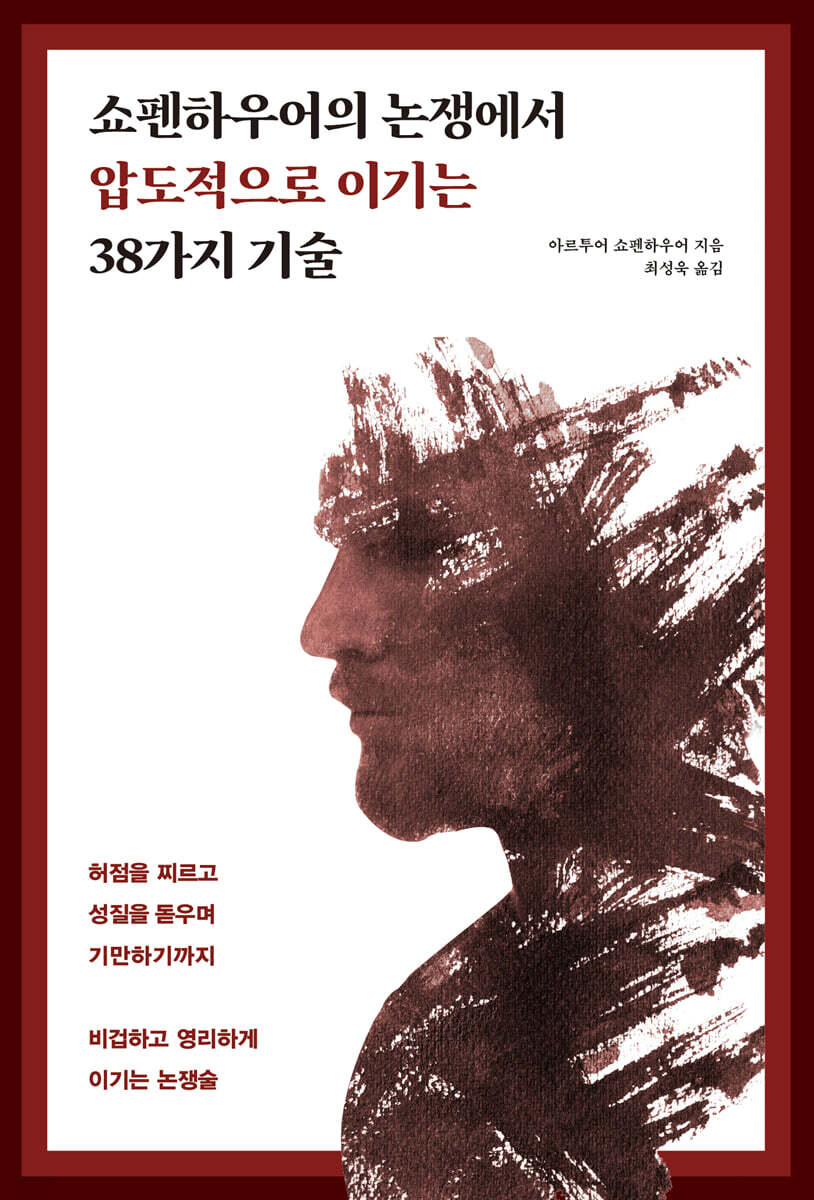
38 Techniques to Overwhelmingly Win in Schopenhauer's Arguments
 |
Description
Book Introduction
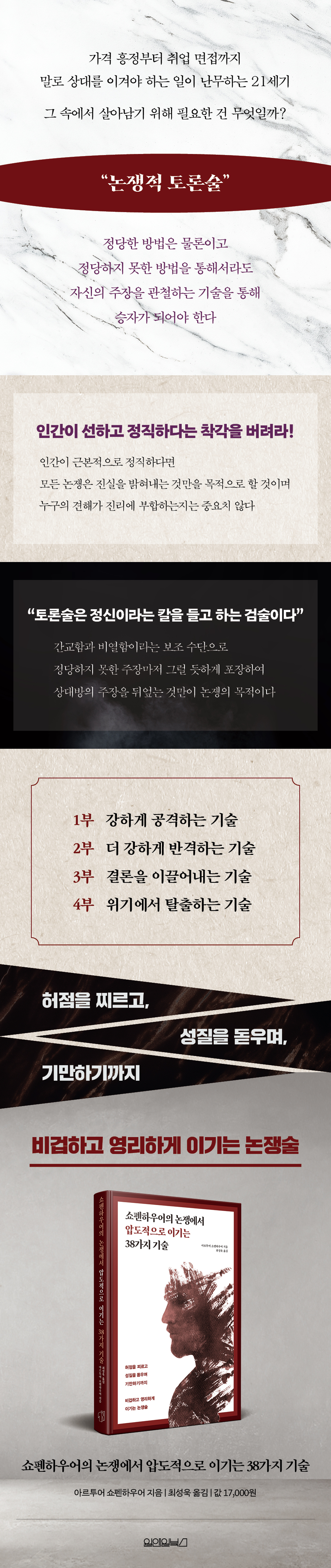
Exploiting vulnerabilities, provoking tempers, and even deceiving
Win the argument by being cowardly and clever!
When you hear the word "debate," what's the first thing that comes to mind? Most people probably picture a debate program on public television or a classroom setting where people raise their hands to speak.
But debate is a natural part of our daily lives.
We need to be able to persuade others of our will, not only when getting a job or promotion, but even when haggling over the price of an item in the market.
In other words, debate skills are a skill that must be acquired in order to survive in the fiercely competitive arena of survival.
Arthur Schopenhauer defined debate as 'sword fighting', using the head instead of the sword.
In a debate, it is important to strike down your opponent with sharp words, like a swordsman going into a duel.
If we do not confine the discussion to the realm of academia, there is no more appropriate metaphor.
The debates we encounter in everyday life do not determine the winner through sophisticated logic and high insight.
You must defend yourself from all kinds of vicious attacks and emerge victorious by attacking your opponent's arguments without leaving any room for refutation.
This book contains techniques for winning arguments, regardless of the means and methods.
But it is by no means a book that emphasizes only that.
Schopenhauer wanted you to detect and defeat your opponent's deception by thoroughly exposing the true nature of the tricks that pour out in the argument.
If you can't stick to the original purpose of the debate, which is to 'seek objective truth,' then you might as well prove how valid your argument is.
And in the process, I hope you will realize what Schopenhauer truly wanted to say.
Win the argument by being cowardly and clever!
When you hear the word "debate," what's the first thing that comes to mind? Most people probably picture a debate program on public television or a classroom setting where people raise their hands to speak.
But debate is a natural part of our daily lives.
We need to be able to persuade others of our will, not only when getting a job or promotion, but even when haggling over the price of an item in the market.
In other words, debate skills are a skill that must be acquired in order to survive in the fiercely competitive arena of survival.
Arthur Schopenhauer defined debate as 'sword fighting', using the head instead of the sword.
In a debate, it is important to strike down your opponent with sharp words, like a swordsman going into a duel.
If we do not confine the discussion to the realm of academia, there is no more appropriate metaphor.
The debates we encounter in everyday life do not determine the winner through sophisticated logic and high insight.
You must defend yourself from all kinds of vicious attacks and emerge victorious by attacking your opponent's arguments without leaving any room for refutation.
This book contains techniques for winning arguments, regardless of the means and methods.
But it is by no means a book that emphasizes only that.
Schopenhauer wanted you to detect and defeat your opponent's deception by thoroughly exposing the true nature of the tricks that pour out in the argument.
If you can't stick to the original purpose of the debate, which is to 'seek objective truth,' then you might as well prove how valid your argument is.
And in the process, I hope you will realize what Schopenhauer truly wanted to say.
- You can preview some of the book's contents.
Preview
index
Prologue: The Foundation of All Debate
Translator's Note: Schopenhauer's Masterpieces, Even More Useful in the 21st Century
Part 1: Strong attack technique
1.
Appeal to the will through motivation
2.
Make the most of the authority you have.
3.
Treating unproven facts as established facts and using them as premises
4.
Quickly choose a metaphor that suits you
5.
Present unreasonable counterarguments together to force a choice between the two.
6.
Transform empty words into profound and academic ones.
7.
Ensure the authenticity of your assertion based on the other person's response.
8.
Ask questions that elicit a 'yes' answer
9.
Make the other person angry and hinder their right judgment
10.
Provoking an argument and inducing unreasonable claims
11.
If you get unexpectedly angry, they will persistently pursue that part.
12.
The other person's silence is weakness.
Part 2: A technique to counterattack more powerfully
13.
Exaggerate the other person's argument by interpreting it as broadly as possible.
14.
A clever rebuttal using homonyms
15.
Reinterpret relative claims as absolute claims
16.
Use your audience's lack of expertise to refute your argument.
17.
Find the point where the other person's words and actions contradict each other.
18.
Counterattack by exploiting the opponent's arguments
19.
Overpower your opponent with just one counter-example.
20.
Generalize the issue and refute it from a universal perspective
21.
Putting the other person's argument into a category that has already been refuted
22.
Refuting even valid propositions using false evidence as an excuse
23.
Counter the opponent's sophistry with sophistry.
Part 3: Techniques for drawing conclusions
24.
Prevent the other person from predicting your conclusions in advance
25.
Ask questions that lead to conclusions without any order.
26.
If the true premise does not hold, the conclusion is drawn from the false premise.
27.
Draw a forced conclusion through false inference and distortion.
28.
Even unsubstantiated answers are used as the basis for conclusions.
29.
The poet of individual facts is regarded as the poet of universal truth.
30.
Just by acknowledging a few premises, we can quickly jump to conclusions.
Part 4: Techniques for escaping crisis
31.
Avoid crisis by carefully identifying the area that has been counterattacked.
32.
If the situation seems unfavorable, quickly change the issue.
33.
Arguments that favor the other party are dismissed as circular reasoning.
34.
If you feel like you're going to lose, suddenly start talking about something else with a serious attitude.
35.
If you have nothing to argue with, say you don't understand what I'm saying.
36.
It's true in theory, but they insist that it's wrong in practice.
37.
When it's difficult to prove an unreasonable claim, they make absurd propositions.
38.
Personal attacks are a last resort.
Epilogue_What is argumentative debate?
Translator's Note: Schopenhauer's Masterpieces, Even More Useful in the 21st Century
Part 1: Strong attack technique
1.
Appeal to the will through motivation
2.
Make the most of the authority you have.
3.
Treating unproven facts as established facts and using them as premises
4.
Quickly choose a metaphor that suits you
5.
Present unreasonable counterarguments together to force a choice between the two.
6.
Transform empty words into profound and academic ones.
7.
Ensure the authenticity of your assertion based on the other person's response.
8.
Ask questions that elicit a 'yes' answer
9.
Make the other person angry and hinder their right judgment
10.
Provoking an argument and inducing unreasonable claims
11.
If you get unexpectedly angry, they will persistently pursue that part.
12.
The other person's silence is weakness.
Part 2: A technique to counterattack more powerfully
13.
Exaggerate the other person's argument by interpreting it as broadly as possible.
14.
A clever rebuttal using homonyms
15.
Reinterpret relative claims as absolute claims
16.
Use your audience's lack of expertise to refute your argument.
17.
Find the point where the other person's words and actions contradict each other.
18.
Counterattack by exploiting the opponent's arguments
19.
Overpower your opponent with just one counter-example.
20.
Generalize the issue and refute it from a universal perspective
21.
Putting the other person's argument into a category that has already been refuted
22.
Refuting even valid propositions using false evidence as an excuse
23.
Counter the opponent's sophistry with sophistry.
Part 3: Techniques for drawing conclusions
24.
Prevent the other person from predicting your conclusions in advance
25.
Ask questions that lead to conclusions without any order.
26.
If the true premise does not hold, the conclusion is drawn from the false premise.
27.
Draw a forced conclusion through false inference and distortion.
28.
Even unsubstantiated answers are used as the basis for conclusions.
29.
The poet of individual facts is regarded as the poet of universal truth.
30.
Just by acknowledging a few premises, we can quickly jump to conclusions.
Part 4: Techniques for escaping crisis
31.
Avoid crisis by carefully identifying the area that has been counterattacked.
32.
If the situation seems unfavorable, quickly change the issue.
33.
Arguments that favor the other party are dismissed as circular reasoning.
34.
If you feel like you're going to lose, suddenly start talking about something else with a serious attitude.
35.
If you have nothing to argue with, say you don't understand what I'm saying.
36.
It's true in theory, but they insist that it's wrong in practice.
37.
When it's difficult to prove an unreasonable claim, they make absurd propositions.
38.
Personal attacks are a last resort.
Epilogue_What is argumentative debate?
Detailed image
Into the book
Now I will show you some argumentative techniques that do not objectively consider right or wrong.
Because no one can know for sure what objective facts are.
What is right will only be determined when the debate is over.
--- p.8
In fact, to win an argument, you must first think carefully and make a rational argument.
But unfortunately, humans are born with innate vanity, as well as stupidity and recklessness.
Our foolish claims deserve to be refuted by the other person, but we refuse to accept the other person's counter-argument and thereby acknowledge that he or she is smarter than we are.
--- p.10
Authority in a field that the other person has no understanding of is usually very effective.
A person who is not well-educated is likely to feel respect for a few meaningless Greek or Latin words.
Most people with such low culture are not very familiar with reading, and they don't even know how to read books.
--- p.27
In difficult and formal situations where debates are taking place, you need to adopt a questioning attitude to convey your opinion accurately and clearly.
Because we can infer the truth of an argument based on the answer that comes directly from the other person's mouth.
--- p.51
There are times when the other person does not directly answer or object to a question or argument, but instead asks a different question, gives an indirect answer, or tries to change the topic by saying something completely unrelated to the topic.
This is a clear sign that we have (unknowingly) touched the other person's weakness.
--- p.65
When someone makes a claim, we must examine whether his claim contradicts in any way what he has previously asserted or admitted, or whether it contradicts the principles of the school or sect he praises and approves, or the behavior of its adherents, or even the behavior of its insincere followers, or the behavior of the other person making such a claim.
--- p.93
If the other party uses rhetoric related to the argument, it is sufficient to counter it with counter-evidence related to the argument.
Rather than engaging in lengthy debates to determine the truth of an issue, it is much more time-efficient to use rhetoric that connects with your opponent, if possible.
--- p.113
By making false inferences and distorting the concepts used by the other party, you can force claims that are not included in the other party's argument, are not the other party's opinion, and are absurd and even dangerous.
--- p.127
If the topic being switched is related to the content of the argument so far, the change of topic will be done modestly and cautiously. However, if the topic being switched is related only to the opponent of the argument and does not mention the content of the argument at all, the change of topic will be done very brazenly.
--- p.150
Sometimes, when you make an unreasonable claim, it is difficult to prove it.
In this case, we must make a claim that the other person cannot immediately see as correct, and induce them to accept or reject it.
Of course, at this point we must give the impression that we are trying to prove our point based on the other person's choice.
--- p.161
If you think that it will be okay if you don't make personal attacks on the other person first, you are mistaken.
As we know in most cases of winning an argument, calmly showing the other person that they are wrong, that they are mistaken, that they have misjudged, is much more likely to upset them than hurling harsh and insulting words.
--- p.166
If we assume this, logic is free from all external compulsion and aims purely at the pursuit of truth.
In other words, logic is the study of the laws or rational workings of reason that enable us to discover truth through pure thought without any external compulsion.
Therefore, as rational beings who are not swayed by any external pressure, humans use logic when they ponder alone to find the truth.
Because no one can know for sure what objective facts are.
What is right will only be determined when the debate is over.
--- p.8
In fact, to win an argument, you must first think carefully and make a rational argument.
But unfortunately, humans are born with innate vanity, as well as stupidity and recklessness.
Our foolish claims deserve to be refuted by the other person, but we refuse to accept the other person's counter-argument and thereby acknowledge that he or she is smarter than we are.
--- p.10
Authority in a field that the other person has no understanding of is usually very effective.
A person who is not well-educated is likely to feel respect for a few meaningless Greek or Latin words.
Most people with such low culture are not very familiar with reading, and they don't even know how to read books.
--- p.27
In difficult and formal situations where debates are taking place, you need to adopt a questioning attitude to convey your opinion accurately and clearly.
Because we can infer the truth of an argument based on the answer that comes directly from the other person's mouth.
--- p.51
There are times when the other person does not directly answer or object to a question or argument, but instead asks a different question, gives an indirect answer, or tries to change the topic by saying something completely unrelated to the topic.
This is a clear sign that we have (unknowingly) touched the other person's weakness.
--- p.65
When someone makes a claim, we must examine whether his claim contradicts in any way what he has previously asserted or admitted, or whether it contradicts the principles of the school or sect he praises and approves, or the behavior of its adherents, or even the behavior of its insincere followers, or the behavior of the other person making such a claim.
--- p.93
If the other party uses rhetoric related to the argument, it is sufficient to counter it with counter-evidence related to the argument.
Rather than engaging in lengthy debates to determine the truth of an issue, it is much more time-efficient to use rhetoric that connects with your opponent, if possible.
--- p.113
By making false inferences and distorting the concepts used by the other party, you can force claims that are not included in the other party's argument, are not the other party's opinion, and are absurd and even dangerous.
--- p.127
If the topic being switched is related to the content of the argument so far, the change of topic will be done modestly and cautiously. However, if the topic being switched is related only to the opponent of the argument and does not mention the content of the argument at all, the change of topic will be done very brazenly.
--- p.150
Sometimes, when you make an unreasonable claim, it is difficult to prove it.
In this case, we must make a claim that the other person cannot immediately see as correct, and induce them to accept or reject it.
Of course, at this point we must give the impression that we are trying to prove our point based on the other person's choice.
--- p.161
If you think that it will be okay if you don't make personal attacks on the other person first, you are mistaken.
As we know in most cases of winning an argument, calmly showing the other person that they are wrong, that they are mistaken, that they have misjudged, is much more likely to upset them than hurling harsh and insulting words.
--- p.166
If we assume this, logic is free from all external compulsion and aims purely at the pursuit of truth.
In other words, logic is the study of the laws or rational workings of reason that enable us to discover truth through pure thought without any external compulsion.
Therefore, as rational beings who are not swayed by any external pressure, humans use logic when they ponder alone to find the truth.
--- p.174
Publisher's Review
Why are we so fascinated by Schopenhauer?
A book that explores human nature through paradox and irony!
This book is divided into four parts.
Part 1, "The Art of Attacking Hard," discusses how to assert your opinions strongly or attack first before your opponent can take up a defensive stance.
Part 2, 'Techniques for Counterattacking More Powerfully', teaches techniques for attacking based on the opponent's claims.
Part 3, "The Art of Drawing Conclusions," describes how to conclude a discussion in a way that leaves you a winner.
Finally, Part 4, "Escape Techniques," presents clever tricks to help you escape when you're cornered in a debate.
Schopenhauer attempted to reflect on the problems of human nature through the theme of 'the art of debate'.
Human beings' innate vanity is satisfied through the process of proving their superiority through comparison with others.
According to Schopenhauer, this vanity is particularly strong in the intellect, making it extremely averse to losing in arguments.
This is because they do not want to admit that their intelligence is inferior to that of the other person by accepting the other person's counter-argument.
Schopenhauer touches on this very point with the sharp blade of irony and paradox.
The awkward laughter that we sometimes feel while reading this book is probably similar to the laughter we let out when our ugly and secret thoughts are revealed.
Instead of hiding and feeling ashamed of revealing our nakedness, let us face the dark side of ourselves.
Foolishness is both a defect and a right that humans are born with.
If you don't blindly dismiss it, but rather look deeply into it, recognize the vanity that is human nature, and seek to explore it further, you will discover a more mature personality.
A book that explores human nature through paradox and irony!
This book is divided into four parts.
Part 1, "The Art of Attacking Hard," discusses how to assert your opinions strongly or attack first before your opponent can take up a defensive stance.
Part 2, 'Techniques for Counterattacking More Powerfully', teaches techniques for attacking based on the opponent's claims.
Part 3, "The Art of Drawing Conclusions," describes how to conclude a discussion in a way that leaves you a winner.
Finally, Part 4, "Escape Techniques," presents clever tricks to help you escape when you're cornered in a debate.
Schopenhauer attempted to reflect on the problems of human nature through the theme of 'the art of debate'.
Human beings' innate vanity is satisfied through the process of proving their superiority through comparison with others.
According to Schopenhauer, this vanity is particularly strong in the intellect, making it extremely averse to losing in arguments.
This is because they do not want to admit that their intelligence is inferior to that of the other person by accepting the other person's counter-argument.
Schopenhauer touches on this very point with the sharp blade of irony and paradox.
The awkward laughter that we sometimes feel while reading this book is probably similar to the laughter we let out when our ugly and secret thoughts are revealed.
Instead of hiding and feeling ashamed of revealing our nakedness, let us face the dark side of ourselves.
Foolishness is both a defect and a right that humans are born with.
If you don't blindly dismiss it, but rather look deeply into it, recognize the vanity that is human nature, and seek to explore it further, you will discover a more mature personality.
GOODS SPECIFICS
- Date of issue: January 30, 2024
- Format: Hardcover book binding method guide
- Page count, weight, size: 188 pages | 244g | 128*188*12mm
- ISBN13: 9791170434917
- ISBN10: 1170434916
You may also like
카테고리
korean


korean

![GQ KOREA Mark (Monthly): December [2025]](http://librairie.coreenne.fr/cdn/shop/files/8ef265dbbfbf186523ed75ba7319009d.jpg?v=1765340328&width=3840)


