

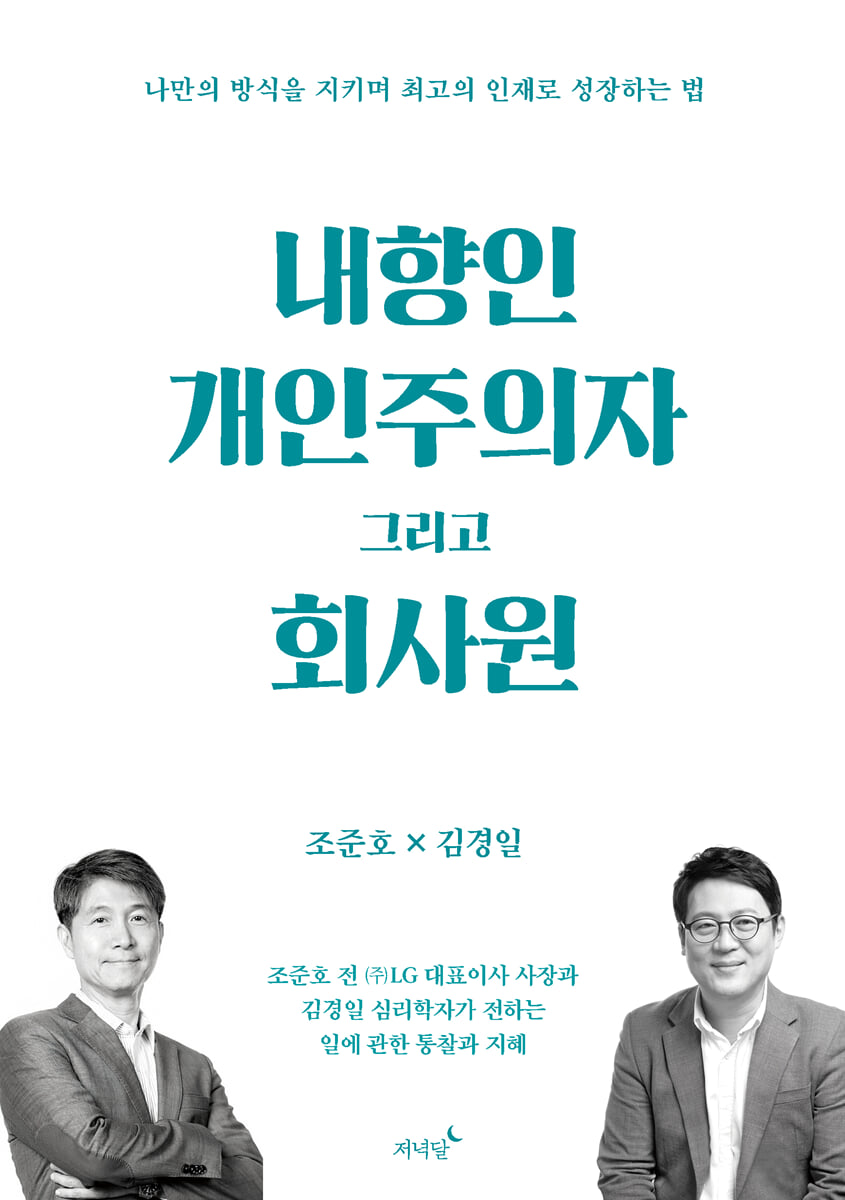
Introverted individualist and office worker
 |
Description
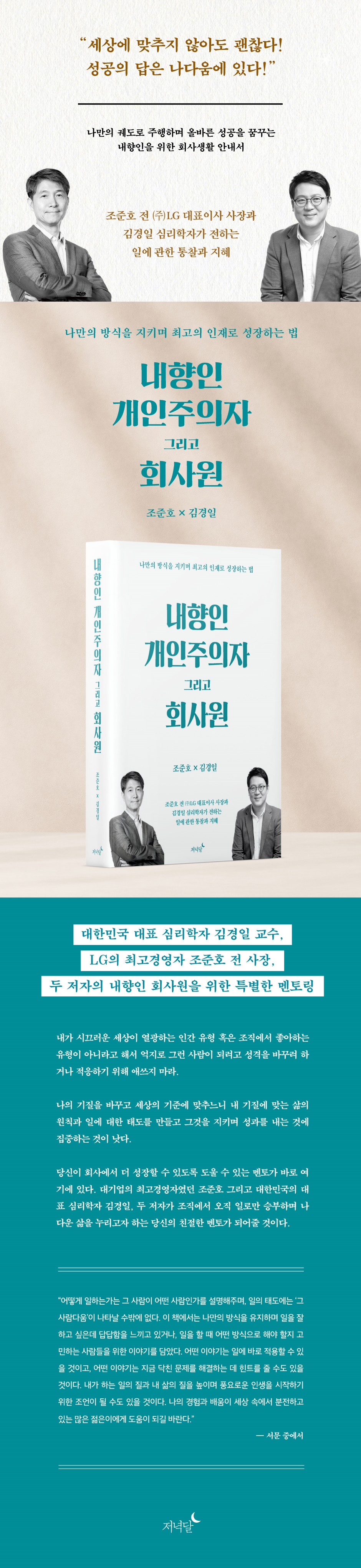
Book Introduction
Dreaming of the right success while driving on my own track
A Guide to Corporate Life for Introverts
Former LG CEO Cho Jun-ho and
Psychologist Kim Kyung-il tells us
Insights on work and wisdom for life
Just because I'm not the type of person who gets excited by the noisy world, or because I don't have the personality that the organization likes, don't try to force myself to change my personality.
Rather than changing my temperament and trying to fit in with the world's standards, it's better to focus on creating principles of life and an attitude toward work that suit my temperament, sticking to them, and achieving results.
If you try to improve what people point out as weaknesses, you may end up feeling like you've failed again and again.
Rather, it is a much smarter strategy to focus on honing your strengths, such as your meticulousness and perseverance, into your strongest weapons.
If you are evaluated as 'the most meticulous person in our company' or 'a person who perseveres through difficult projects', then that is creating your own path and becoming your own brand.
Being yourself always gives you the answer.
This book introduces the essential tasks for office workers who want to quietly achieve success, and how to become a successful individual who sticks to their own methods.
Former LG CEO Cho Jun-ho, who is always described as a "fast-tracked promotion, youngest executive, and gentle and wise strategist," and Professor Kim Kyung-il, a leading psychologist in South Korea, will be your mentors as you strive to win through work.
A Guide to Corporate Life for Introverts
Former LG CEO Cho Jun-ho and
Psychologist Kim Kyung-il tells us
Insights on work and wisdom for life
Just because I'm not the type of person who gets excited by the noisy world, or because I don't have the personality that the organization likes, don't try to force myself to change my personality.
Rather than changing my temperament and trying to fit in with the world's standards, it's better to focus on creating principles of life and an attitude toward work that suit my temperament, sticking to them, and achieving results.
If you try to improve what people point out as weaknesses, you may end up feeling like you've failed again and again.
Rather, it is a much smarter strategy to focus on honing your strengths, such as your meticulousness and perseverance, into your strongest weapons.
If you are evaluated as 'the most meticulous person in our company' or 'a person who perseveres through difficult projects', then that is creating your own path and becoming your own brand.
Being yourself always gives you the answer.
This book introduces the essential tasks for office workers who want to quietly achieve success, and how to become a successful individual who sticks to their own methods.
Former LG CEO Cho Jun-ho, who is always described as a "fast-tracked promotion, youngest executive, and gentle and wise strategist," and Professor Kim Kyung-il, a leading psychologist in South Korea, will be your mentors as you strive to win through work.
- You can preview some of the book's contents.
Preview
index
It's Okay Not to Fit in with the World - Jo Jun-ho, Former CEO and President of LG Corp.
Clever Suggestions for Introverts, Individualists, and Office Workers _Kim Kyung-il, Cognitive Psychologist
Chapter 1: Everything Starts with the Basics
Why Work as a Company Employee 54
Doing Things Well - Beyond 'Perfect' to 'Completely' 62
Even if you're not the owner of your company, you can still be the owner of your work. 69
79 Life Principles to Maintain Your Uniqueness
Companies need principled people 87
If you have the skills, they'll eventually find out 94
Do you like what you're doing now? 101
Chapter 2 | The outcome determines the outcome.
Those who prepare and challenge themselves achieve success. 110
2 Skills Highly Talented People Possess 120
128 Things You Need to Write a Good Report
If my thoughts differ from what my boss wants, 134
Look at the whole picture and set your goals high 141
147 To make good decisions
Sometimes You Have to Trust Your Intuition 154
If you want to achieve success, you must pave the way first. 159
The Power of Small but Powerful Details 168
Am I an important person in the company? 175
Create Your Own Intellectual Property 181
Chapter 3: Character is Everything
Good character beats worldly wisdom 188
You must have courage 194
Be humble 201
How to Strategically Say No 208
Have Discernment About Injustice and Negativity 215
Consideration and respect must be given 223
Between Anxiety and Complaints 235
Practice and Grow Every Day 244
Chapter 4: How Introverted Individualists Win in Organizations
You must choose the company you work for carefully. 252
We must make comrades 258
Thought Leadership 264
Jealousy and control in the workplace are constants. 270
276 Types of People You Should Avoid at All Costs
The Company is Not Me 283
How to Manage Stress 290
How to Protect Yourself from Burnout 296
Clever Suggestions for Introverts, Individualists, and Office Workers _Kim Kyung-il, Cognitive Psychologist
Chapter 1: Everything Starts with the Basics
Why Work as a Company Employee 54
Doing Things Well - Beyond 'Perfect' to 'Completely' 62
Even if you're not the owner of your company, you can still be the owner of your work. 69
79 Life Principles to Maintain Your Uniqueness
Companies need principled people 87
If you have the skills, they'll eventually find out 94
Do you like what you're doing now? 101
Chapter 2 | The outcome determines the outcome.
Those who prepare and challenge themselves achieve success. 110
2 Skills Highly Talented People Possess 120
128 Things You Need to Write a Good Report
If my thoughts differ from what my boss wants, 134
Look at the whole picture and set your goals high 141
147 To make good decisions
Sometimes You Have to Trust Your Intuition 154
If you want to achieve success, you must pave the way first. 159
The Power of Small but Powerful Details 168
Am I an important person in the company? 175
Create Your Own Intellectual Property 181
Chapter 3: Character is Everything
Good character beats worldly wisdom 188
You must have courage 194
Be humble 201
How to Strategically Say No 208
Have Discernment About Injustice and Negativity 215
Consideration and respect must be given 223
Between Anxiety and Complaints 235
Practice and Grow Every Day 244
Chapter 4: How Introverted Individualists Win in Organizations
You must choose the company you work for carefully. 252
We must make comrades 258
Thought Leadership 264
Jealousy and control in the workplace are constants. 270
276 Types of People You Should Avoid at All Costs
The Company is Not Me 283
How to Manage Stress 290
How to Protect Yourself from Burnout 296
Detailed image
Into the book
“In my opinion, Junho has a strong will to learn and is very curious.
I've been getting a lot of help by volunteering a lot of things.
However, if you don't change your 'student mentality,' it will be difficult to become someone who plays a major role in the company."
“What is student mentality?”
“They submit their work by the deadline, just like they would a final assignment in school, and then forget about it.
“At work, you have to do ‘complete work’ on any task you are assigned.”
It meant that when doing something, you must have the mindset to take responsibility and complete the task from beginning to end.
He also said that you have to be someone who finds problems, someone who finds ways to solve them, and someone who makes things happen.
It was the first reprimand I received at my first job.
Only then did I realize what kind of attitude a worker should have, and I came to my senses and reflected a lot.
Even though I had completed my MBA in the United States, I was just someone who did what I was told.
But it was after one more incident that I fully realized the meaning of 'complete work'.
A few days after the calculation error, my boss called me directly and asked me what was causing the significant drop in market share in the Detroit area in the previous month's market share analysis report and what I could do about it.
‘Ask that of a new employee who hasn’t even been with the company for a year…
I wondered if I had dialed the wrong number for my boss, but it was definitely me.
When a company delegates work, there is no such thing as meaningless work.
It may seem like they just did some simple number crunching, but they expected to understand the overall market share trends for the product and even devise countermeasures.
These two experiences completely changed my perspective on work.
Once you take on a job, you must take full responsibility for its quality and level.
It's the basics of work.
Even if the given task is simple, I should not stop there. I should think about where my work will be used and how it should proceed next, and then take the necessary measures to produce proper results.
If the first part is called 'perfect work', the second part is called 'complete work'.
No matter what task you undertake, you must always keep in mind what the ultimate purpose of that task is.
Then, naturally, I become the master of my own work.
--- From Chapter 1, "Doing a Good Job - Beyond 'Perfect' to 'Completely'"
The short story 『The Biography of Mr. Chabuduo』 by the modern Chinese novelist Hu Shih features a man named Chabuduo as the main character.
The Chinese character 差不多 means 'not much difference', 'more or less the same', or 'that's it'.
When his mother told him to buy brown sugar, he bought white sugar and said that brown sugar and white sugar are the same, so there is no difference. When he missed the train because he was two minutes late, instead of reflecting on it, he blamed the train for leaving on time, saying that it would be the same whether he went today or tomorrow.
Then one day, Mr. Cha Bu-du fell ill and was on the verge of death. His family could not find a doctor, Dr. Wang, so they ended up bringing in a veterinarian, Dr. Wang.
Chabudu knew he had brought the wrong doctor, but he said that whether it was Dr. Wang or Dr. Wang, the veterinarian, it was all the same and asked for treatment quickly.
Eventually, his illness worsened and he died, saying this.
“It’s either life or death, it’s the same thing.
“Why are you trying so hard to live?”
This novel satirizes the Chinese people's sloppy way of doing things, and it makes us think about whether our way of doing things is also sloppy.
In the past, we also considered people who nitpicked to be petty people, and we considered people who knew how to accept what was good rather than nitpicking to be gentlemen.
These days, it is said that the popular idea is that it is practical to work just enough to avoid getting fired, just enough to earn a decent salary.
While it may be a smart way to live, this defensive attitude at work can make it difficult to get opportunities to engage in more challenging and creative work.
That's why, instead of doing things half-heartedly, you need to set a goal of working thoroughly and perfectly and produce results so that you can prove your presence not only to yourself but also to others.
Having 'detail' or 'thoroughness' in your work means you have the opportunity to develop and create new opportunities.
--- From "Chapter 2: The Power of Small but Powerful Details"
I'm not saying you have to be a star player in whatever you're doing right now, but rather, don't complain if things aren't that great right now, and approach it with the mindset of doing a good job.
If you work hard, there will definitely be people who will recognize you.
Good opportunities are those that you create for yourself.
So there is no reason to envy others and feel self-pity, like, “Why am I the only one having such a hard time?”
Just live as you are, and when the opportunity comes to do well by making the most of your unique characteristics, just take the chance and that's it.
You can't tell if something is a good opportunity for you just by thinking about it.
You have to actually try hard and experience it to get the feel of it.
Looking at my experience and the people around me, if you try to find an opportunity that suits you, such an opportunity will come several times.
So it's important to do your best at what you're doing now.
I often hear that the most difficult thing in corporate life is relationships with people.
A boss who only nags and keeps track of your schedule without being of much help, a colleague who is always trying to pass on difficult and unimportant tasks, a junior who is incompetent at his job but is always trying to take advantage of his rights, a business partner who tries to avoid taking responsibility for something...
It seems like everyone you meet at work is annoying.
But what kind of person do I seem to others? I might be a subordinate who never keeps to schedules, a squeamish colleague who never bothers to contribute to shared tasks outside of his own, or a senior colleague who always passes on tasks he doesn't want to do.
From the client's perspective, I may be polite, but I may also be a bully whose true intentions are completely incomprehensible.
That's why people in the past said, "Put yourself in the other person's shoes" and always think from the other person's perspective.
If you have difficulties in interpersonal relationships, first try to change your perspective.
I've been getting a lot of help by volunteering a lot of things.
However, if you don't change your 'student mentality,' it will be difficult to become someone who plays a major role in the company."
“What is student mentality?”
“They submit their work by the deadline, just like they would a final assignment in school, and then forget about it.
“At work, you have to do ‘complete work’ on any task you are assigned.”
It meant that when doing something, you must have the mindset to take responsibility and complete the task from beginning to end.
He also said that you have to be someone who finds problems, someone who finds ways to solve them, and someone who makes things happen.
It was the first reprimand I received at my first job.
Only then did I realize what kind of attitude a worker should have, and I came to my senses and reflected a lot.
Even though I had completed my MBA in the United States, I was just someone who did what I was told.
But it was after one more incident that I fully realized the meaning of 'complete work'.
A few days after the calculation error, my boss called me directly and asked me what was causing the significant drop in market share in the Detroit area in the previous month's market share analysis report and what I could do about it.
‘Ask that of a new employee who hasn’t even been with the company for a year…
I wondered if I had dialed the wrong number for my boss, but it was definitely me.
When a company delegates work, there is no such thing as meaningless work.
It may seem like they just did some simple number crunching, but they expected to understand the overall market share trends for the product and even devise countermeasures.
These two experiences completely changed my perspective on work.
Once you take on a job, you must take full responsibility for its quality and level.
It's the basics of work.
Even if the given task is simple, I should not stop there. I should think about where my work will be used and how it should proceed next, and then take the necessary measures to produce proper results.
If the first part is called 'perfect work', the second part is called 'complete work'.
No matter what task you undertake, you must always keep in mind what the ultimate purpose of that task is.
Then, naturally, I become the master of my own work.
--- From Chapter 1, "Doing a Good Job - Beyond 'Perfect' to 'Completely'"
The short story 『The Biography of Mr. Chabuduo』 by the modern Chinese novelist Hu Shih features a man named Chabuduo as the main character.
The Chinese character 差不多 means 'not much difference', 'more or less the same', or 'that's it'.
When his mother told him to buy brown sugar, he bought white sugar and said that brown sugar and white sugar are the same, so there is no difference. When he missed the train because he was two minutes late, instead of reflecting on it, he blamed the train for leaving on time, saying that it would be the same whether he went today or tomorrow.
Then one day, Mr. Cha Bu-du fell ill and was on the verge of death. His family could not find a doctor, Dr. Wang, so they ended up bringing in a veterinarian, Dr. Wang.
Chabudu knew he had brought the wrong doctor, but he said that whether it was Dr. Wang or Dr. Wang, the veterinarian, it was all the same and asked for treatment quickly.
Eventually, his illness worsened and he died, saying this.
“It’s either life or death, it’s the same thing.
“Why are you trying so hard to live?”
This novel satirizes the Chinese people's sloppy way of doing things, and it makes us think about whether our way of doing things is also sloppy.
In the past, we also considered people who nitpicked to be petty people, and we considered people who knew how to accept what was good rather than nitpicking to be gentlemen.
These days, it is said that the popular idea is that it is practical to work just enough to avoid getting fired, just enough to earn a decent salary.
While it may be a smart way to live, this defensive attitude at work can make it difficult to get opportunities to engage in more challenging and creative work.
That's why, instead of doing things half-heartedly, you need to set a goal of working thoroughly and perfectly and produce results so that you can prove your presence not only to yourself but also to others.
Having 'detail' or 'thoroughness' in your work means you have the opportunity to develop and create new opportunities.
--- From "Chapter 2: The Power of Small but Powerful Details"
I'm not saying you have to be a star player in whatever you're doing right now, but rather, don't complain if things aren't that great right now, and approach it with the mindset of doing a good job.
If you work hard, there will definitely be people who will recognize you.
Good opportunities are those that you create for yourself.
So there is no reason to envy others and feel self-pity, like, “Why am I the only one having such a hard time?”
Just live as you are, and when the opportunity comes to do well by making the most of your unique characteristics, just take the chance and that's it.
You can't tell if something is a good opportunity for you just by thinking about it.
You have to actually try hard and experience it to get the feel of it.
Looking at my experience and the people around me, if you try to find an opportunity that suits you, such an opportunity will come several times.
So it's important to do your best at what you're doing now.
I often hear that the most difficult thing in corporate life is relationships with people.
A boss who only nags and keeps track of your schedule without being of much help, a colleague who is always trying to pass on difficult and unimportant tasks, a junior who is incompetent at his job but is always trying to take advantage of his rights, a business partner who tries to avoid taking responsibility for something...
It seems like everyone you meet at work is annoying.
But what kind of person do I seem to others? I might be a subordinate who never keeps to schedules, a squeamish colleague who never bothers to contribute to shared tasks outside of his own, or a senior colleague who always passes on tasks he doesn't want to do.
From the client's perspective, I may be polite, but I may also be a bully whose true intentions are completely incomprehensible.
That's why people in the past said, "Put yourself in the other person's shoes" and always think from the other person's perspective.
If you have difficulties in interpersonal relationships, first try to change your perspective.
--- From "Chapter 3: Between Anxiety and Complaints"
Publisher's Review
“It’s okay if you don’t fit in with the world!
The answer to success lies in being yourself!”
“If you meet and talk to a lot of people in a day, you will feel drained and tired.”
“It’s not easy to approach someone you just met.”
“At work, I don’t complain or express my dissatisfaction, and I just work silently.”
“I think communicating via email or messenger is more efficient for work than phone calls or face-to-face meetings.”
This is a characteristic that introverted office workers have.
Our society still has a lot of prejudice against introverts because they are considered to have cautious and quiet personalities.
Some advise that you need to change your personality to do well in the workplace, while others threaten that you must do so to survive.
Even job postings often mention that they prefer extroverts, but they also say that they don't like introverts because they are too timid and unenthusiastic and might not get along well with other people in the company.
More than a decade has passed since Susan Caine's book, Quiet, which preached the power of introversion, was published, and it has been translated into 40 languages and sold over 4 million copies worldwide. However, the misconceptions and prejudices about introverts, fostered by our extrovert-oriented society, remain as strong as an iron fortress.
So, let's think about whether most people who are successful in business are extroverts.
Even without necessarily citing research results that say 70% of successful people are introverts or that one-third of those around us are introverts, you can immediately see that many introverts are evaluated as being good at their jobs just by looking at the organization you currently belong to.
Whether you are good at something or not is not determined by whether you are introverted or extroverted, but by how persistent you are, how focused you are, and how skilled you are.
Professor Kim Kyung-il, a leading psychologist in our country, always emphasizes that personality does not change.
When an introvert tries to change his or her personality to become more like an extrovert, it's like trying to change something that can't be changed.
Rather than being swayed by trying to fit in with the world, we must have the mindset to grow with a more accepting and open attitude.
In the introduction to this book, Professor Kim Kyung-il offers psychological advice for introverts, individualists, and office workers, introducing ways to effectively utilize introverts' strengths and life guidelines for maintaining one's true self.
“My uniqueness always has the answer!”
A Guide to Corporate Life for Introverted Individualists
Just because you're not the type of person the noisy world raves about or the type of person an organization likes, don't try to force yourself to change your personality or adapt.
Rather than changing my temperament and trying to fit in with the world's standards, it's better to focus on creating principles of life and an attitude toward work that suit my temperament, sticking to them, and achieving results.
If you try to improve what people point out as weaknesses, you may only end up repeating the feeling of failure.
Rather, it is a much smarter strategy to focus on honing my strengths, such as my meticulousness and perseverance, into my strongest weapons.
If you are evaluated as “the most meticulous person in our company,” “the person who persistently pushes forward even difficult projects,” or “the most accepting and conflict-resolving person in our department,” then that is creating a trajectory for your own uniqueness and becomes your own brand.
Instead of wasting energy trying to do something that doesn't suit me, I should focus on developing my own work skills.
The reason why former LG Corp. CEO Cho Jun-ho was consistently evaluated as a top talent and was able to advance through the ranks with the modifiers “youngest” and “ultra-fast” was because of his rigorous self-reflection and focus on his goals.
In the past, in an organizational culture that was strongly collectivistic and relational, while others struggled to show loyalty to the company, he gave up wearing a mask that was not his own and boldly chose a different strategy.
I strived to become the most capable person in my field so that I could be recognized by my name alone, rather than as someone from LG.
Being yourself always gives you the answer.
A book that helps you solidify your own orbit and enjoy life flexibly.
This book looks back on the moments of joy and hardship experienced over the past 40 years as a company employee, and offers words of direct help to office workers who are working hard.
This story is for those who want to do their work well in their own way but feel frustrated, or are wondering how to do their work.
If you're an office worker who wants to quietly achieve success at your company, you'll learn what you absolutely must do now and how to become a successful individual who sticks to your own path.
Here's a mentor who can help you grow further within your company.
The two authors, Cho Jun-ho, former CEO of a major corporation, and Kim Kyung-il, a leading psychologist in South Korea, will serve as your kind mentors as you strive to live your own life, focusing solely on work within your organization.
The answer to success lies in being yourself!”
“If you meet and talk to a lot of people in a day, you will feel drained and tired.”
“It’s not easy to approach someone you just met.”
“At work, I don’t complain or express my dissatisfaction, and I just work silently.”
“I think communicating via email or messenger is more efficient for work than phone calls or face-to-face meetings.”
This is a characteristic that introverted office workers have.
Our society still has a lot of prejudice against introverts because they are considered to have cautious and quiet personalities.
Some advise that you need to change your personality to do well in the workplace, while others threaten that you must do so to survive.
Even job postings often mention that they prefer extroverts, but they also say that they don't like introverts because they are too timid and unenthusiastic and might not get along well with other people in the company.
More than a decade has passed since Susan Caine's book, Quiet, which preached the power of introversion, was published, and it has been translated into 40 languages and sold over 4 million copies worldwide. However, the misconceptions and prejudices about introverts, fostered by our extrovert-oriented society, remain as strong as an iron fortress.
So, let's think about whether most people who are successful in business are extroverts.
Even without necessarily citing research results that say 70% of successful people are introverts or that one-third of those around us are introverts, you can immediately see that many introverts are evaluated as being good at their jobs just by looking at the organization you currently belong to.
Whether you are good at something or not is not determined by whether you are introverted or extroverted, but by how persistent you are, how focused you are, and how skilled you are.
Professor Kim Kyung-il, a leading psychologist in our country, always emphasizes that personality does not change.
When an introvert tries to change his or her personality to become more like an extrovert, it's like trying to change something that can't be changed.
Rather than being swayed by trying to fit in with the world, we must have the mindset to grow with a more accepting and open attitude.
In the introduction to this book, Professor Kim Kyung-il offers psychological advice for introverts, individualists, and office workers, introducing ways to effectively utilize introverts' strengths and life guidelines for maintaining one's true self.
“My uniqueness always has the answer!”
A Guide to Corporate Life for Introverted Individualists
Just because you're not the type of person the noisy world raves about or the type of person an organization likes, don't try to force yourself to change your personality or adapt.
Rather than changing my temperament and trying to fit in with the world's standards, it's better to focus on creating principles of life and an attitude toward work that suit my temperament, sticking to them, and achieving results.
If you try to improve what people point out as weaknesses, you may only end up repeating the feeling of failure.
Rather, it is a much smarter strategy to focus on honing my strengths, such as my meticulousness and perseverance, into my strongest weapons.
If you are evaluated as “the most meticulous person in our company,” “the person who persistently pushes forward even difficult projects,” or “the most accepting and conflict-resolving person in our department,” then that is creating a trajectory for your own uniqueness and becomes your own brand.
Instead of wasting energy trying to do something that doesn't suit me, I should focus on developing my own work skills.
The reason why former LG Corp. CEO Cho Jun-ho was consistently evaluated as a top talent and was able to advance through the ranks with the modifiers “youngest” and “ultra-fast” was because of his rigorous self-reflection and focus on his goals.
In the past, in an organizational culture that was strongly collectivistic and relational, while others struggled to show loyalty to the company, he gave up wearing a mask that was not his own and boldly chose a different strategy.
I strived to become the most capable person in my field so that I could be recognized by my name alone, rather than as someone from LG.
Being yourself always gives you the answer.
A book that helps you solidify your own orbit and enjoy life flexibly.
This book looks back on the moments of joy and hardship experienced over the past 40 years as a company employee, and offers words of direct help to office workers who are working hard.
This story is for those who want to do their work well in their own way but feel frustrated, or are wondering how to do their work.
If you're an office worker who wants to quietly achieve success at your company, you'll learn what you absolutely must do now and how to become a successful individual who sticks to your own path.
Here's a mentor who can help you grow further within your company.
The two authors, Cho Jun-ho, former CEO of a major corporation, and Kim Kyung-il, a leading psychologist in South Korea, will serve as your kind mentors as you strive to live your own life, focusing solely on work within your organization.
GOODS SPECIFICS
- Date of issue: October 25, 2023
- Page count, weight, size: 304 pages | 520g | 148*210*25mm
- ISBN13: 9791189217204
- ISBN10: 1189217201
You may also like
카테고리
korean


korean

![GQ KOREA Mark (Monthly): December [2025]](http://librairie.coreenne.fr/cdn/shop/files/8ef265dbbfbf186523ed75ba7319009d.jpg?v=1765340328&width=3840)


