

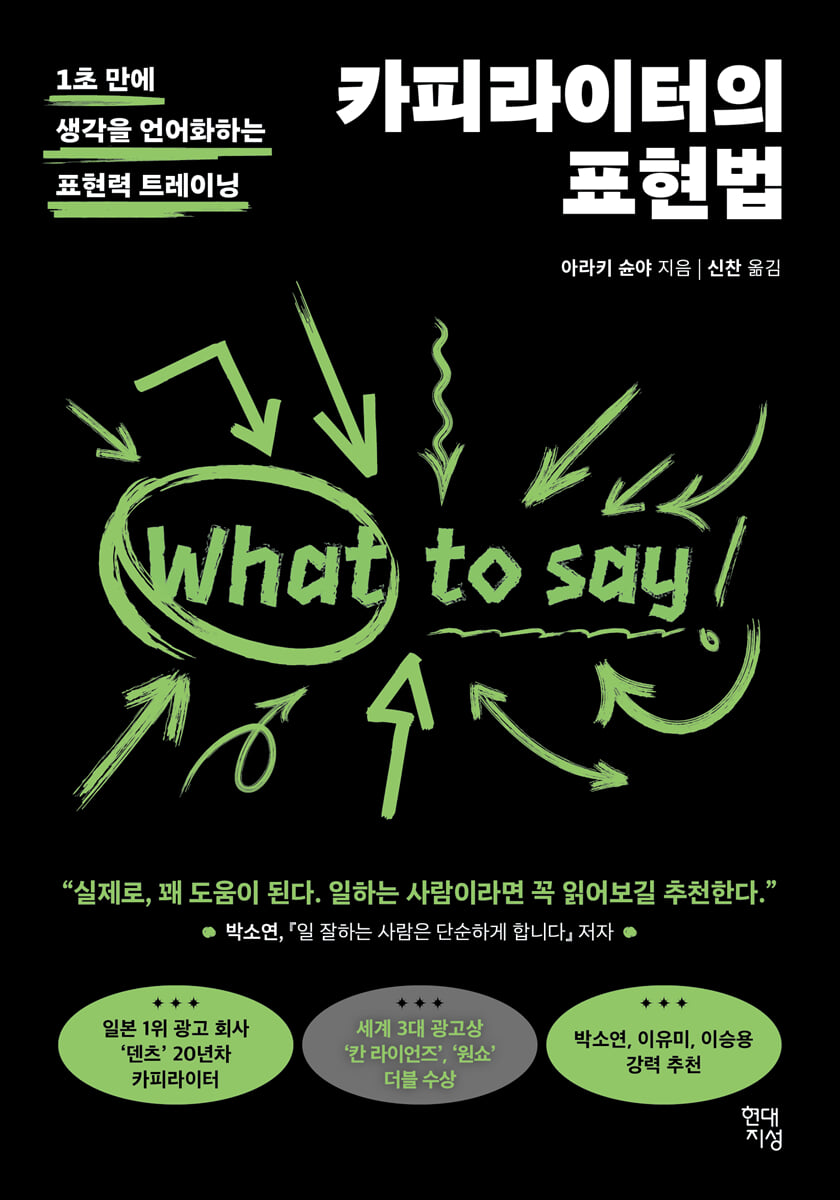
Copywriter's expressions
 |
Description
Book Introduction
Ideas floating around in my head
Expressing it in the most accurate language
The Amazing Power of 6 Minutes of Note-taking a Day
- Copywriter with 20 years of experience at Dentsu, Japan's No. 1 advertising company
- Double winner of the world's top three advertising awards, 'Cannes Lions' and 'One Show'
- Highly recommended by famous planners and copywriters such as Park So-yeon, Lee Yu-mi, and Lee Seung-yong.
Anyone who can express original ideas clearly and concisely in meetings or presentations is recognized everywhere.
Conversely, even if you have a good opinion, if you cannot express it clearly, it will be difficult for your abilities to be properly recognized.
The author, a 20-year veteran copywriter at Dentsu and winner of three of the world's top advertising awards, introduces the expressiveness training he uses when actually planning advertisements for people who "don't know what to say during meetings and presentations and go blank."
It's a simple method that can be done in just 6 minutes a day with just a pen and paper, but the effect is incredibly powerful.
First, prepare a blank piece of paper, write a question at the top, and divide the answer to that question into 'thoughts' and 'reasons', and repeat this exercise for 2 minutes three times a day.
If you practice this training consistently, you will soon find that thoughts that were dormant in the deep unconsciousness will suddenly rise up, and ideas that were only abstract images floating around in your head will unfold before your eyes in clear language.
The author generously shares all of his expertise, including specific methods for expressive training, various business cases, and 500 questions for self-training.
Let's try this training for just two weeks.
If you fill your mental storage of expressions with this book, you will no longer be afraid of any meeting, presentation, project, or conversation.
Expressing it in the most accurate language
The Amazing Power of 6 Minutes of Note-taking a Day
- Copywriter with 20 years of experience at Dentsu, Japan's No. 1 advertising company
- Double winner of the world's top three advertising awards, 'Cannes Lions' and 'One Show'
- Highly recommended by famous planners and copywriters such as Park So-yeon, Lee Yu-mi, and Lee Seung-yong.
Anyone who can express original ideas clearly and concisely in meetings or presentations is recognized everywhere.
Conversely, even if you have a good opinion, if you cannot express it clearly, it will be difficult for your abilities to be properly recognized.
The author, a 20-year veteran copywriter at Dentsu and winner of three of the world's top advertising awards, introduces the expressiveness training he uses when actually planning advertisements for people who "don't know what to say during meetings and presentations and go blank."
It's a simple method that can be done in just 6 minutes a day with just a pen and paper, but the effect is incredibly powerful.
First, prepare a blank piece of paper, write a question at the top, and divide the answer to that question into 'thoughts' and 'reasons', and repeat this exercise for 2 minutes three times a day.
If you practice this training consistently, you will soon find that thoughts that were dormant in the deep unconsciousness will suddenly rise up, and ideas that were only abstract images floating around in your head will unfold before your eyes in clear language.
The author generously shares all of his expertise, including specific methods for expressive training, various business cases, and 500 questions for self-training.
Let's try this training for just two weeks.
If you fill your mental storage of expressions with this book, you will no longer be afraid of any meeting, presentation, project, or conversation.
- You can preview some of the book's contents.
Preview
index
Recommendation
To begin with
Chapter 1: People are judged by their expressiveness rather than their ability to communicate.
A book that solves the problem of not being able to express thoughts properly
Many office workers have difficulty expressing their thoughts in words.
Learning how to communicate doesn't improve your expressive skills.
What to say is more important than how to say it.
The words that stick in people's minds are determined by their core message.
What to say is your own perspective.
An era where original perspectives are important
Chapter 2 How can I develop expressive power?
Anyone can develop expressive skills
We feel many things unconsciously
I already feel so much, I just don't realize it.
99% of our thoughts are pushed into the subconscious.
How to bring 99% of the unconscious into consciousness?
Notes express unconscious thoughts in words.
The amount determines the speed
Speed leads to depth
Chapter 3: Expressive Training on a Single Sheet of Paper
Make expressive training a habit
6-Step Note-Taking Method to Develop Expressive Power
The time limit is 2 minutes per page, up to 3 pages per day.
Making the most of your spare time
Increase the resolution of speech
Another benefit of notes
Chapter 4: 12 Situational Expressive Skills Training
Let's practice by answering various questions together.
[Meeting] What is our team's problem right now?
[Leadership] How can I manage my team?
[Collaboration] How can we solve our clients' concerns?
[Internal Presentation] What is the core of this project?
[Proposal] How to write a proposal that conveys the content well?
[Schedule Management] How can I speed up my work?
[Reporting/Contacting/Consulting] What should I do when a problem arises?
[Mental Health] What was the real reason I was feeling bad?
[Self-reflection] What do I really want to do?
[Job Change] Why do you want to change companies?
[Self-study] Why study English?
[Chat] What does healing mean to me?
Chapter 5: Copywriter Habits That Increase Resolution
Start from your own experience
Experience is the act of opening a drawer in memory.
Experience = Event + Feeling
Focus on emotions
Upgrading your expressiveness using SNS
The final step to increase expressiveness
How to communicate your thoughts effectively
Consciously question everything
In conclusion
Appendix: Self-Q&A | 500 Questions to Develop Expressive Power
To begin with
Chapter 1: People are judged by their expressiveness rather than their ability to communicate.
A book that solves the problem of not being able to express thoughts properly
Many office workers have difficulty expressing their thoughts in words.
Learning how to communicate doesn't improve your expressive skills.
What to say is more important than how to say it.
The words that stick in people's minds are determined by their core message.
What to say is your own perspective.
An era where original perspectives are important
Chapter 2 How can I develop expressive power?
Anyone can develop expressive skills
We feel many things unconsciously
I already feel so much, I just don't realize it.
99% of our thoughts are pushed into the subconscious.
How to bring 99% of the unconscious into consciousness?
Notes express unconscious thoughts in words.
The amount determines the speed
Speed leads to depth
Chapter 3: Expressive Training on a Single Sheet of Paper
Make expressive training a habit
6-Step Note-Taking Method to Develop Expressive Power
The time limit is 2 minutes per page, up to 3 pages per day.
Making the most of your spare time
Increase the resolution of speech
Another benefit of notes
Chapter 4: 12 Situational Expressive Skills Training
Let's practice by answering various questions together.
[Meeting] What is our team's problem right now?
[Leadership] How can I manage my team?
[Collaboration] How can we solve our clients' concerns?
[Internal Presentation] What is the core of this project?
[Proposal] How to write a proposal that conveys the content well?
[Schedule Management] How can I speed up my work?
[Reporting/Contacting/Consulting] What should I do when a problem arises?
[Mental Health] What was the real reason I was feeling bad?
[Self-reflection] What do I really want to do?
[Job Change] Why do you want to change companies?
[Self-study] Why study English?
[Chat] What does healing mean to me?
Chapter 5: Copywriter Habits That Increase Resolution
Start from your own experience
Experience is the act of opening a drawer in memory.
Experience = Event + Feeling
Focus on emotions
Upgrading your expressiveness using SNS
The final step to increase expressiveness
How to communicate your thoughts effectively
Consciously question everything
In conclusion
Appendix: Self-Q&A | 500 Questions to Develop Expressive Power
Detailed image

Into the book
People don't realize it, but the first thing a copywriter does is listen to the story of the client, the advertiser.
Most clients have a strong vision or image of their product or service, but they struggle to put it into words.
So, it's necessary to ask the client questions and think about 'what should I say' to convey their vision.
This is the process of putting their thoughts into language.
Next, I ask myself how the words will feel from the public's perspective, verify 'how to say it', and write the final copy.
Therefore, first of all, we spend a lot of time and effort converting the client's 'thoughts' into 'language'.
'How to say it' is the last step, and to put it extremely simply, it accounts for only about 5% of the workload.
95% of copywriting is 'verbalization' work.
--- p.14
If you ask someone who has never worked with a copywriter what a copywriter does, they will usually say that it's about writing advertising copy, that is, figuring out how to deliver it.
It's not entirely wrong, but writing advertising copy is only a small part of a copywriter's job.
To cut to the chase, it is no exaggeration to say that whether or not words stick in people's minds is largely determined by their content.
So copywriters spend more time thinking about 'what to say'.
In fact, a copywriter's ability to verbalize his or her thoughts is what determines his or her competence.
--- p.44
As we go about our daily lives, we unconsciously feel, realize, and think about various emotions.
But there aren't many opportunities to express it in words.
That's why most of the things we actually feel are just vague images that pass through our minds and are left in our subconscious.
Since you don't realize what you felt, you can't help but think that you don't have any thoughts.
It is natural that you cannot express or persuade someone by organizing your feelings in detail.
Realizing that the thoughts in your head are vague images and converting them into something that can be conveyed to someone is verbalization, and that ability is expressiveness.
--- p.69
Each individual has his or her own unique perspective in his or her unconscious thoughts.
Because no two people are born the same, grow up the same, and live in the same environment.
What you 'unconsciously feel' largely reflects your own life experiences.
In other words, it is very likely that the idea well reflects your original perspective.
So, if you continue to express the thoughts in your head in words and fill up your reservoir, you will accumulate many new, profound words that contain your own perspective.
If you think, 'I'm just a person who can only express ordinary opinions,' rest assured that this is absolutely not the case.
The idea that 'I just have that kind of opinion' is a misconception.
Everyone has their own point of view, they just don't realize it.
--- p.83
As a copywriter, I've had the opportunity to work on numerous TV commercials. TV commercials are often 15 seconds long, and it's often said, "You can only convey one message in 15 seconds."
Of course, I know that TV commercials are different from attending meetings or presentations.
However, when telling something to someone, you should always be mindful that pouring out a lot of words does not necessarily mean that your opinion will be conveyed well.
(…) Of course, there is not necessarily only one correct answer when refining a sentence.
Let's revise it over and over again until it becomes a sentence that can persuade someone.
This time spent refining sentences is not only the final stage of expressive power training, but also a valuable time for organizing thoughts and opinions.
Most clients have a strong vision or image of their product or service, but they struggle to put it into words.
So, it's necessary to ask the client questions and think about 'what should I say' to convey their vision.
This is the process of putting their thoughts into language.
Next, I ask myself how the words will feel from the public's perspective, verify 'how to say it', and write the final copy.
Therefore, first of all, we spend a lot of time and effort converting the client's 'thoughts' into 'language'.
'How to say it' is the last step, and to put it extremely simply, it accounts for only about 5% of the workload.
95% of copywriting is 'verbalization' work.
--- p.14
If you ask someone who has never worked with a copywriter what a copywriter does, they will usually say that it's about writing advertising copy, that is, figuring out how to deliver it.
It's not entirely wrong, but writing advertising copy is only a small part of a copywriter's job.
To cut to the chase, it is no exaggeration to say that whether or not words stick in people's minds is largely determined by their content.
So copywriters spend more time thinking about 'what to say'.
In fact, a copywriter's ability to verbalize his or her thoughts is what determines his or her competence.
--- p.44
As we go about our daily lives, we unconsciously feel, realize, and think about various emotions.
But there aren't many opportunities to express it in words.
That's why most of the things we actually feel are just vague images that pass through our minds and are left in our subconscious.
Since you don't realize what you felt, you can't help but think that you don't have any thoughts.
It is natural that you cannot express or persuade someone by organizing your feelings in detail.
Realizing that the thoughts in your head are vague images and converting them into something that can be conveyed to someone is verbalization, and that ability is expressiveness.
--- p.69
Each individual has his or her own unique perspective in his or her unconscious thoughts.
Because no two people are born the same, grow up the same, and live in the same environment.
What you 'unconsciously feel' largely reflects your own life experiences.
In other words, it is very likely that the idea well reflects your original perspective.
So, if you continue to express the thoughts in your head in words and fill up your reservoir, you will accumulate many new, profound words that contain your own perspective.
If you think, 'I'm just a person who can only express ordinary opinions,' rest assured that this is absolutely not the case.
The idea that 'I just have that kind of opinion' is a misconception.
Everyone has their own point of view, they just don't realize it.
--- p.83
As a copywriter, I've had the opportunity to work on numerous TV commercials. TV commercials are often 15 seconds long, and it's often said, "You can only convey one message in 15 seconds."
Of course, I know that TV commercials are different from attending meetings or presentations.
However, when telling something to someone, you should always be mindful that pouring out a lot of words does not necessarily mean that your opinion will be conveyed well.
(…) Of course, there is not necessarily only one correct answer when refining a sentence.
Let's revise it over and over again until it becomes a sentence that can persuade someone.
This time spent refining sentences is not only the final stage of expressive power training, but also a valuable time for organizing thoughts and opinions.
--- p.212
Publisher's Review
Everyone who is recognized in the company has it
The only ability is OO power!
Think of someone who is known for being good at their job at work.
What image comes to mind first? Most likely, you'll think of someone offering sharp opinions in meetings, leading new projects with creative ideas and initiatives, or earning recognition from their superiors for their flawless reporting.
What do they have in common? They are able to clearly express the abstract thoughts in their heads.
In this book, this ability is called 'expressive power'.
We experience various situations in our daily lives or at work, and feel numerous emotions in them.
However, most people are unaware of these thoughts and feelings and leave them in the realm of the unconscious.
If you leave your thoughts in your subconscious, it is difficult to immediately recall what you are thinking or what you should say.
That is, the expressive power is lacking.
So what happens when we bring these unconscious thoughts into the realm of consciousness?
A person who has a well-stocked mental storage of language can instantly express his thoughts in concrete language when asked any question.
Moreover, in the same situation, you may have different opinions than others.
Even when experiencing the same incident, the depth of thought is bound to be different between someone who simply feels, "Oh, this happened today," and someone who continues to ponder, "Why did this happen?"
People who consistently practice verbalizing their unconscious thoughts in this way are more likely to stand out in meetings or presentations and prove their capabilities in the company.
So how, specifically, can we cultivate this expressive power? This book introduces a simple yet powerful note-taking method that allows you to train your expressive skills in just six minutes a day, using only paper and pen.
All you need is 6 minutes a day, paper and a pen!
The power of simple yet powerful notes
The author of this book, Shunya Araki, did not demonstrate any outstanding writing skills until his college years.
After graduating, I joined Dentsu, Japan's number one advertising company, without even knowing what copywriting was. Even after joining the company, instead of receiving any proper training, I was told to "write something first," so I learned copywriting by writing anything I could, as if I was heading to the ground.
But surprisingly, this method actually worked.
Why is that?
Whenever I try to write anything, light thoughts that have already been verbalized in my head pop out.
Write that down on a piece of paper, a line or two at a time, and ask yourself this question:
“So what does that mean?” The brain that is asked the question thinks more deeply about the sentence and pulls out forgotten thoughts or experiences from the unconscious memory drawer of which it was not aware.
By putting your thoughts down on paper in this way, you can reach deeper thoughts.
The author also introduces various methods to add depth to simple training, strengthen thoughts, and improve the resolution of speech.
Readers can practice digging deeper by repeatedly asking a question, raising objections, and answering a question from different angles, thereby further concretizing what they want to say.
You'll also find in the book how to organize and simplify scattered sentences to convey your message more clearly.
From a novice copywriter to winner of one of the world's top three advertising awards.
Expressive Training That Turned My Career Around
The author's career as a copywriter changed 180 degrees after practicing this training.
At first, the response to the advertisement I was assigned to was not very good, so I even felt sorry towards the advertiser.
But from the moment I started practicing this method, amazing changes occurred.
I was in charge of advertising for global companies such as Honda and Lotte, and enjoyed the joy of winning double awards at Cannes Lions and One Show, two of the world's top three advertising awards.
Currently, we are in charge of not only corporate advertising, but also concept planning for local and international events, and startup branding.
The advertising slogan written by the author is still remembered as a 'legendary advertisement' and continues to inspire many people.
This book is filled with the author's 20 years of experience, knowledge, and know-how gained while working at an advertising agency.
It covers a variety of scenarios that not only copywriters but all working people can experience, using virtual meetings and 12 examples. It also includes various questions in the appendix to help readers consistently practice expressive skills training.
The author says that nothing will change if you read this book just once.
Instead, I can confidently say that if you practice consistently for just two weeks, you will experience amazing changes in your daily life.
If readers fill their mental reservoirs with this book, they will not be afraid of any meeting, presentation, project, or conversation.
“
Do it again and again
I imagine more and more
Keep moving your hands
Sometimes things go well
You're bound to hit a wall
How many times have I thought I was done… .
But clearly
Every time I fail
Getting closer to the future.
So don't be afraid,
Let's be people who try.
"
- From the author's 'Honda' advertising slogan (2014)
The only ability is OO power!
Think of someone who is known for being good at their job at work.
What image comes to mind first? Most likely, you'll think of someone offering sharp opinions in meetings, leading new projects with creative ideas and initiatives, or earning recognition from their superiors for their flawless reporting.
What do they have in common? They are able to clearly express the abstract thoughts in their heads.
In this book, this ability is called 'expressive power'.
We experience various situations in our daily lives or at work, and feel numerous emotions in them.
However, most people are unaware of these thoughts and feelings and leave them in the realm of the unconscious.
If you leave your thoughts in your subconscious, it is difficult to immediately recall what you are thinking or what you should say.
That is, the expressive power is lacking.
So what happens when we bring these unconscious thoughts into the realm of consciousness?
A person who has a well-stocked mental storage of language can instantly express his thoughts in concrete language when asked any question.
Moreover, in the same situation, you may have different opinions than others.
Even when experiencing the same incident, the depth of thought is bound to be different between someone who simply feels, "Oh, this happened today," and someone who continues to ponder, "Why did this happen?"
People who consistently practice verbalizing their unconscious thoughts in this way are more likely to stand out in meetings or presentations and prove their capabilities in the company.
So how, specifically, can we cultivate this expressive power? This book introduces a simple yet powerful note-taking method that allows you to train your expressive skills in just six minutes a day, using only paper and pen.
All you need is 6 minutes a day, paper and a pen!
The power of simple yet powerful notes
The author of this book, Shunya Araki, did not demonstrate any outstanding writing skills until his college years.
After graduating, I joined Dentsu, Japan's number one advertising company, without even knowing what copywriting was. Even after joining the company, instead of receiving any proper training, I was told to "write something first," so I learned copywriting by writing anything I could, as if I was heading to the ground.
But surprisingly, this method actually worked.
Why is that?
Whenever I try to write anything, light thoughts that have already been verbalized in my head pop out.
Write that down on a piece of paper, a line or two at a time, and ask yourself this question:
“So what does that mean?” The brain that is asked the question thinks more deeply about the sentence and pulls out forgotten thoughts or experiences from the unconscious memory drawer of which it was not aware.
By putting your thoughts down on paper in this way, you can reach deeper thoughts.
The author also introduces various methods to add depth to simple training, strengthen thoughts, and improve the resolution of speech.
Readers can practice digging deeper by repeatedly asking a question, raising objections, and answering a question from different angles, thereby further concretizing what they want to say.
You'll also find in the book how to organize and simplify scattered sentences to convey your message more clearly.
From a novice copywriter to winner of one of the world's top three advertising awards.
Expressive Training That Turned My Career Around
The author's career as a copywriter changed 180 degrees after practicing this training.
At first, the response to the advertisement I was assigned to was not very good, so I even felt sorry towards the advertiser.
But from the moment I started practicing this method, amazing changes occurred.
I was in charge of advertising for global companies such as Honda and Lotte, and enjoyed the joy of winning double awards at Cannes Lions and One Show, two of the world's top three advertising awards.
Currently, we are in charge of not only corporate advertising, but also concept planning for local and international events, and startup branding.
The advertising slogan written by the author is still remembered as a 'legendary advertisement' and continues to inspire many people.
This book is filled with the author's 20 years of experience, knowledge, and know-how gained while working at an advertising agency.
It covers a variety of scenarios that not only copywriters but all working people can experience, using virtual meetings and 12 examples. It also includes various questions in the appendix to help readers consistently practice expressive skills training.
The author says that nothing will change if you read this book just once.
Instead, I can confidently say that if you practice consistently for just two weeks, you will experience amazing changes in your daily life.
If readers fill their mental reservoirs with this book, they will not be afraid of any meeting, presentation, project, or conversation.
“
Do it again and again
I imagine more and more
Keep moving your hands
Sometimes things go well
You're bound to hit a wall
How many times have I thought I was done… .
But clearly
Every time I fail
Getting closer to the future.
So don't be afraid,
Let's be people who try.
"
- From the author's 'Honda' advertising slogan (2014)
GOODS SPECIFICS
- Date of issue: April 4, 2024
- Page count, weight, size: 254 pages | 322g | 140*200*16mm
- ISBN13: 9791139716740
- ISBN10: 1139716743
You may also like
카테고리
korean


korean

![GQ KOREA Mark (Monthly): December [2025]](http://librairie.coreenne.fr/cdn/shop/files/8ef265dbbfbf186523ed75ba7319009d.jpg?v=1765340328&width=3840)


