

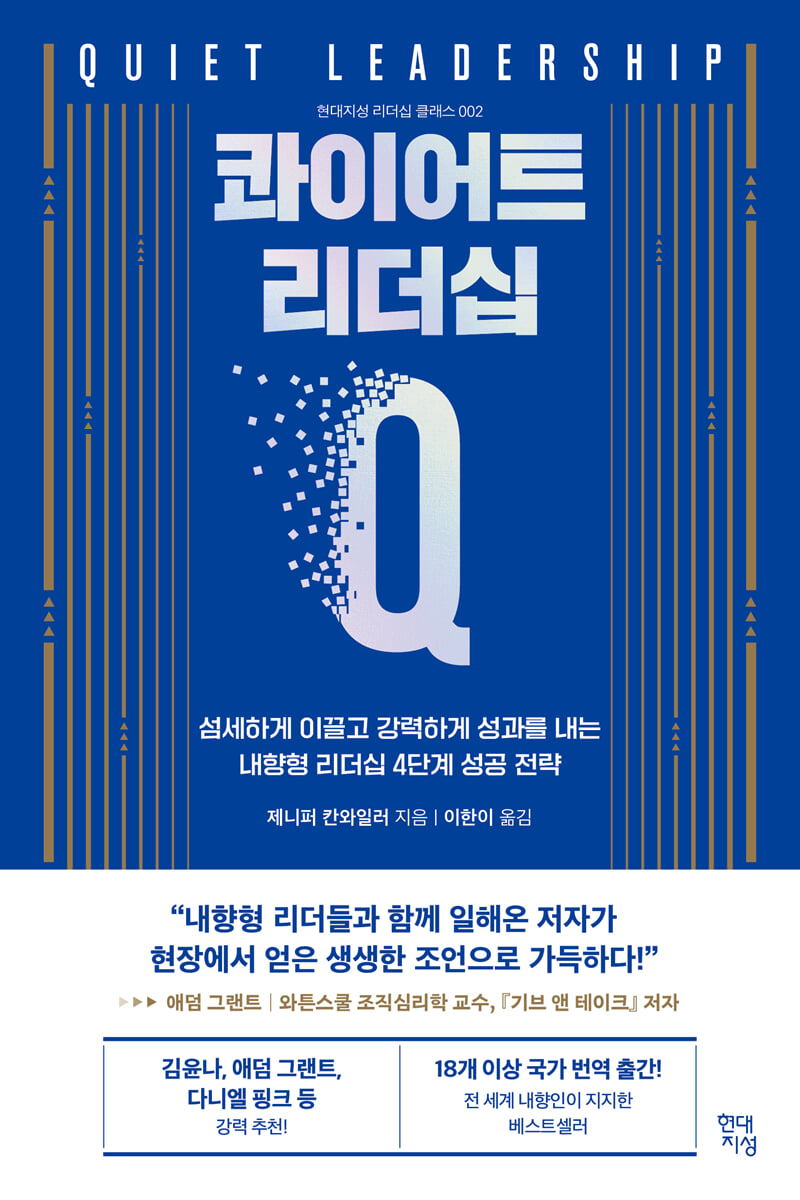
Quiet Leadership
 |
Description
Book Introduction
“Steve Jobs, Bill Gates, Warren Buffett,
Nelson Mandela, Abraham Lincoln…
“They were all excellent introverted leaders!”
*** A book for all introverts struggling to rise to leadership positions.
*** Highly recommended by Kim Yoon-na, Adam Grant, Daniel Pink, etc.
*** A global bestseller translated and published in over 18 countries.
Have you ever missed your chance to speak during a meeting and failed to properly convey your thoughts? Do you find face-to-face communication uncomfortable and prefer text messages or emails? Do you find it difficult to communicate closely with your superiors or subordinates? Introverts often feel their personality traits are disadvantageous and uncomfortable in the workplace.
Moreover, if it is a position of 'leader', you may feel that it is not suitable for you.
But this is not true.
Introverts already have the qualities of great leaders.
"Quiet Leadership" is a book for all introverts who are struggling to become leaders.
Jennifer Kahnweiler, author of "The Introverts' Guide," says that if introverts utilize their unique powers of observation, empathetic communication, and meticulous preparation, they can become outstanding leaders.
As a way to build introverted leadership, the author suggests the '4P process'.
The 4P Process is a leadership success strategy specifically for introverts, based on the author's experience and research working with hundreds of introverted leaders.
The book presents ways for introverted leaders to overcome various challenges they face in the workplace by utilizing the 4P process.
From leading teams and projects to leading meetings, delivering powerful presentations, and communicating and networking, this book presents effective leadership strategies that help introverted leaders fully utilize their talents.
As Wharton School professor Adam Grant says, we are currently experiencing a leadership renaissance for introverts.
So now there's no need to try so hard to be extroverted.
Let's cultivate the quiet strength of introversion within you! With "Quiet Leadership," you can become a true leader who neither loses your true self nor becomes trapped by it.
Nelson Mandela, Abraham Lincoln…
“They were all excellent introverted leaders!”
*** A book for all introverts struggling to rise to leadership positions.
*** Highly recommended by Kim Yoon-na, Adam Grant, Daniel Pink, etc.
*** A global bestseller translated and published in over 18 countries.
Have you ever missed your chance to speak during a meeting and failed to properly convey your thoughts? Do you find face-to-face communication uncomfortable and prefer text messages or emails? Do you find it difficult to communicate closely with your superiors or subordinates? Introverts often feel their personality traits are disadvantageous and uncomfortable in the workplace.
Moreover, if it is a position of 'leader', you may feel that it is not suitable for you.
But this is not true.
Introverts already have the qualities of great leaders.
"Quiet Leadership" is a book for all introverts who are struggling to become leaders.
Jennifer Kahnweiler, author of "The Introverts' Guide," says that if introverts utilize their unique powers of observation, empathetic communication, and meticulous preparation, they can become outstanding leaders.
As a way to build introverted leadership, the author suggests the '4P process'.
The 4P Process is a leadership success strategy specifically for introverts, based on the author's experience and research working with hundreds of introverted leaders.
The book presents ways for introverted leaders to overcome various challenges they face in the workplace by utilizing the 4P process.
From leading teams and projects to leading meetings, delivering powerful presentations, and communicating and networking, this book presents effective leadership strategies that help introverted leaders fully utilize their talents.
As Wharton School professor Adam Grant says, we are currently experiencing a leadership renaissance for introverts.
So now there's no need to try so hard to be extroverted.
Let's cultivate the quiet strength of introversion within you! With "Quiet Leadership," you can become a true leader who neither loses your true self nor becomes trapped by it.
- You can preview some of the book's contents.
Preview
index
Recommendation: Introverts are already born with leadership qualities.
- Douglas R.
Conant (former CEO of Campbell Soup)
About this book: The Quiet Revolution of Introverts
Introduction: The world needs introverted leaders.
Chapter 1: Six Challenges Introverted Leaders Must Overcome
Chapter 2: The 4P Process: The Introvert's Strength Revolution: Opening the Door to Success
Chapter 3: Leadership Tests for Introverts
Chapter 4: How Introverted Leaders Lead Teams and Projects
Chapter 5: Powerful Presentations Unique to Introverted Leaders
Chapter 6: How Introverted Leaders Lead Meetings
Chapter 7: Networking for Introverted Leaders
Chapter 8: Communication for Introverted Leaders
Chapter 9: How Introverted Leaders Deal with Their Bosses
Chapter 10 4P Process Success Stories
Chapter 11: Sustainable Leadership for Introverts
Americas
- Douglas R.
Conant (former CEO of Campbell Soup)
About this book: The Quiet Revolution of Introverts
Introduction: The world needs introverted leaders.
Chapter 1: Six Challenges Introverted Leaders Must Overcome
Chapter 2: The 4P Process: The Introvert's Strength Revolution: Opening the Door to Success
Chapter 3: Leadership Tests for Introverts
Chapter 4: How Introverted Leaders Lead Teams and Projects
Chapter 5: Powerful Presentations Unique to Introverted Leaders
Chapter 6: How Introverted Leaders Lead Meetings
Chapter 7: Networking for Introverted Leaders
Chapter 8: Communication for Introverted Leaders
Chapter 9: How Introverted Leaders Deal with Their Bosses
Chapter 10 4P Process Success Stories
Chapter 11: Sustainable Leadership for Introverts
Americas
Detailed image

Into the book
Introverts are turning the tables.
It is commonly believed that to be successful in the workplace, you need to be passionate and energetic.
But this is not true.
It is an overly simplistic view of reality.
People who seem incredibly quiet on the outside are incredibly noisy inside their heads.
Introverts have a lot of potential for success.
--- p.18, from “About this book: The quiet revolution brought about by introverts”
If introversion is to continue its rise and lead to the next wave of the "introversion revolution," it will require more than simply adapting to a world dominated by extroversion.
This revolution will transform culture more comprehensively.
Many organizations around the world are increasingly considering diversity across race, ethnicity, gender, and even style and personality.
--- p.20, from “About this book: The quiet revolution brought about by introverts”
Leadership models must now expand from emphasizing extroversion to embracing introversion.
Organizations today face enormous challenges.
More than half of the population is introverted, yet their talents go unrecognized, causing them great harm.
Introverts have tremendous strengths in leading teams.
By leveraging the quiet strengths inherent in introversion, you can become an outstanding leader.
Additionally, introverts are well-suited to leadership roles, leading team members to achieve positive outcomes.
Many smart and outstanding leaders from all walks of life attest to this fact.
--- p.26, from “Introduction: The World Wants Introverted Leaders”
The strengths of introversion are key capabilities that enable organizations to innovate, become competitive, and rise to leadership positions in a globalized, digitalized, and fragmented market environment.
Introverts' creativity and intelligence can spark new ideas and overturn the status quo.
It is absolutely essential to addressing global pressing issues such as the climate crisis and cancer treatment.
The qualities possessed by introverts today are essential for the success of teams and organizations.
--- p.32, from “Introduction: The World Wants Introverted Leaders”
There are countless methods and strategies available to introverts who want to excel in a leadership role.
How can we effectively lead without feeling overwhelmed? I studied successful introverted leaders and developed the concept of the "4P Process."
The 4Ps can be utilized in any situation a leader finds himself in.
Of course, it can also be used to solve the six challenges covered in Chapter 1.
The 4Ps stand for Prepare, Make Your Presence Stand Out, Push, and Practice.
--- p.49, from “Chapter 2 4P Process: The Revolution of Introverts’ Strengths that Opens the Door to Success”
A smart leader is one who leads his team based on his natural strengths, and that's when he's most trustworthy.
Practice pushing yourself and develop the strengths that come naturally to you.
This is a magical combination.
--- p.103, from “Chapter 4 How Introverted Leaders Lead Team Members and Projects”
Like other leadership skills, presentation skills are not related to extroversion.
Many introverts, including singer Beyoncé, IT mogul Bill Gates, actress Meryl Streep, and Facebook founder Mark Zuckerberg, have found success in careers that require presence and presentation skills—in other words, getting noticed.
They are all people who have acquired public speaking skills.
--- p.110, from “Chapter 5: Powerful Presentations Unique to Introverted Leaders”
Maintaining interest in and feeding your relationship is a key factor in achieving your goals.
As an introvert, you already have the ability to listen closely, observe sharply, and plan carefully.
Use these talents to manage your network.
Then, one day, the network will become the power that makes you achieve what you want.
--- p.171, from “Chapter 7 Networking for Introverted Leaders”
The innate preparedness of introverted leaders can lead to great success in communication situations.
Introverted leaders take the time to think deeply about and prepare the goals of any interaction, whether it's a personal encounter, a phone call, or a meeting.
--- p.179, from “Chapter 7 Communication of Introverted Leaders”
Build your quiet leadership strengths and find the best approach that works for you and your team.
If you do so, you too can become an outstanding introverted leader who leads delicately and achieves powerful results.
It is commonly believed that to be successful in the workplace, you need to be passionate and energetic.
But this is not true.
It is an overly simplistic view of reality.
People who seem incredibly quiet on the outside are incredibly noisy inside their heads.
Introverts have a lot of potential for success.
--- p.18, from “About this book: The quiet revolution brought about by introverts”
If introversion is to continue its rise and lead to the next wave of the "introversion revolution," it will require more than simply adapting to a world dominated by extroversion.
This revolution will transform culture more comprehensively.
Many organizations around the world are increasingly considering diversity across race, ethnicity, gender, and even style and personality.
--- p.20, from “About this book: The quiet revolution brought about by introverts”
Leadership models must now expand from emphasizing extroversion to embracing introversion.
Organizations today face enormous challenges.
More than half of the population is introverted, yet their talents go unrecognized, causing them great harm.
Introverts have tremendous strengths in leading teams.
By leveraging the quiet strengths inherent in introversion, you can become an outstanding leader.
Additionally, introverts are well-suited to leadership roles, leading team members to achieve positive outcomes.
Many smart and outstanding leaders from all walks of life attest to this fact.
--- p.26, from “Introduction: The World Wants Introverted Leaders”
The strengths of introversion are key capabilities that enable organizations to innovate, become competitive, and rise to leadership positions in a globalized, digitalized, and fragmented market environment.
Introverts' creativity and intelligence can spark new ideas and overturn the status quo.
It is absolutely essential to addressing global pressing issues such as the climate crisis and cancer treatment.
The qualities possessed by introverts today are essential for the success of teams and organizations.
--- p.32, from “Introduction: The World Wants Introverted Leaders”
There are countless methods and strategies available to introverts who want to excel in a leadership role.
How can we effectively lead without feeling overwhelmed? I studied successful introverted leaders and developed the concept of the "4P Process."
The 4Ps can be utilized in any situation a leader finds himself in.
Of course, it can also be used to solve the six challenges covered in Chapter 1.
The 4Ps stand for Prepare, Make Your Presence Stand Out, Push, and Practice.
--- p.49, from “Chapter 2 4P Process: The Revolution of Introverts’ Strengths that Opens the Door to Success”
A smart leader is one who leads his team based on his natural strengths, and that's when he's most trustworthy.
Practice pushing yourself and develop the strengths that come naturally to you.
This is a magical combination.
--- p.103, from “Chapter 4 How Introverted Leaders Lead Team Members and Projects”
Like other leadership skills, presentation skills are not related to extroversion.
Many introverts, including singer Beyoncé, IT mogul Bill Gates, actress Meryl Streep, and Facebook founder Mark Zuckerberg, have found success in careers that require presence and presentation skills—in other words, getting noticed.
They are all people who have acquired public speaking skills.
--- p.110, from “Chapter 5: Powerful Presentations Unique to Introverted Leaders”
Maintaining interest in and feeding your relationship is a key factor in achieving your goals.
As an introvert, you already have the ability to listen closely, observe sharply, and plan carefully.
Use these talents to manage your network.
Then, one day, the network will become the power that makes you achieve what you want.
--- p.171, from “Chapter 7 Networking for Introverted Leaders”
The innate preparedness of introverted leaders can lead to great success in communication situations.
Introverted leaders take the time to think deeply about and prepare the goals of any interaction, whether it's a personal encounter, a phone call, or a meeting.
--- p.179, from “Chapter 7 Communication of Introverted Leaders”
Build your quiet leadership strengths and find the best approach that works for you and your team.
If you do so, you too can become an outstanding introverted leader who leads delicately and achieves powerful results.
--- p.245, from “Chapter 11: Sustainable Leadership for Introverts”
Publisher's Review
The introversion of those who are strong without making a sound is
This is the talent of a leader this era demands.
Introverts usually work quietly at work.
I do my work quietly and alone, without showing it on the outside.
Even an introvert who works so quietly and diligently will one day get promoted and become a 'leader'.
From then on, the worries begin.
As a leader, is it okay to just quietly work alone like I do now? Can I really lead and lead others? If I'm a leader, wouldn't someone who's proactive and energetic be better suited than someone who's passive and quiet?
But you don't have to worry any longer.
Because introversion is the talent that this era wants in a leader.
Great leaders who have achieved innovations that will be remembered throughout history, such as Apple's Steve Jobs, Microsoft's Bill Gates, and Meta's Mark Zuckerberg, are all introverts.
They developed introverted leadership by leveraging their introversion as a strength.
Jennifer Kahnweiler, author of Quiet Leadership, was one of the first to recognize the strengths of introverts and pioneered the promotion of introverted leadership.
Having met and worked with hundreds of introverted leaders across a variety of business sectors, she has written several books on introvert growth and development based on her experiences and research. These books have been translated into 18 languages and have garnered enthusiastic support from introverts around the world.
"Quiet Leadership" is a book that contains the essence of Jennifer Kahnweiler's research on developing introverted leadership, and this time, it has been updated with the latest research results and experiences.
Anyone can easily follow along right now
Leadership Success Strategies Tailored for Introverts!
In "Quiet Leadership," we propose a four-step strategy, or 4P process, to develop introverted leadership by turning introversion into a quiet strength.
The 4P process stands for Prepare, Precense, Push, and Practice.
The book provides a guide to apply these four-step framework to situations where leadership is required.
It contains step-by-step, detailed advice on how to apply the 4P process to each situation, such as how to lead teams and projects, how to give powerful presentations, how to lead meetings, how to network and communicate, and how to deal with superiors.
‘Preparing’ is a step that utilizes the thorough preparation unique to introverts.
For example, before a meeting, there are ways to clearly establish the purpose and necessity of the meeting, and to create an environment and atmosphere that makes it easy for attendees to participate.
'Exposing your presence' is the stage where introverts reveal their presence and connect with others in their own way.
It contains methods for introverts to attract people's attention and show their presence without raising their voices, using their delicate observation skills and empathetic attitude.
'Pushing' may feel uncomfortable for introverts, but it is a step where you boldly take necessary actions.
It teaches you how to step out of your comfort zone and take on new challenges.
'Practice' is the stage where you consistently try to use the leadership skills you learned through the previous three stages until you become comfortable with them.
The book also provides a 4P implementation plan so that you can put the 4P process into practice one by one.
Chapter 3 also includes the "Introvert Leadership Test," which allows you to assess your leadership abilities. After assessing your leadership, try implementing the 4P process.
How Introversion Becomes a Leader's Weapon
For sustainable leadership of introverts
According to the 2023 Korean MBTI statistics provided by Testmoa, out of a total of 104,484 people who participated in the test, 57.11% were of the Type I (introverted) type.
Introverts make up more than half of the world's population.
Yet, the capabilities of introverts are still often underestimated.
It is also because of the extrovert-centric business environment and social culture that prevents introverts from demonstrating their full potential.
In "Quiet Leadership," six major challenges introverted leaders face in the workplace are presented.
These include fatigue from interpersonal relationships, slow pace, interrupting interrupters, the burden of self-promotion, a culture that emphasizes teamwork, and the negative image of introverts.
These six things come from an extrovert-biased work environment.
This situation is a huge loss not only for businesses and organizations, but also for the entire world.
If introverts could leverage their strengths and unleash their full potential, businesses and organizations could become more innovative and competitive than they are today.
"Quiet Leadership" is a guide to help introverts identify their strengths and strengthen their leadership skills.
This not only helps introverts in leadership roles to develop their own capabilities, but it is also a great help to extroverts who have introverts as colleagues.
This is because better understanding and understanding the colleagues you work with creates greater synergy in collaboration.
Strengthening introverted leadership is necessary to create a business environment that is open to everyone and to enable successful collaboration between both extroverts and introverts.
As Wharton School professor Adam Grant says, we are currently experiencing a leadership renaissance for introverts.
Introverts no longer have to remain silent or pretend to be extroverted.
With Quiet Leadership, you can turn your introversion into a leadership weapon.
In today's rapidly changing business environment, introversion will give you sustainable leadership.
This is the talent of a leader this era demands.
Introverts usually work quietly at work.
I do my work quietly and alone, without showing it on the outside.
Even an introvert who works so quietly and diligently will one day get promoted and become a 'leader'.
From then on, the worries begin.
As a leader, is it okay to just quietly work alone like I do now? Can I really lead and lead others? If I'm a leader, wouldn't someone who's proactive and energetic be better suited than someone who's passive and quiet?
But you don't have to worry any longer.
Because introversion is the talent that this era wants in a leader.
Great leaders who have achieved innovations that will be remembered throughout history, such as Apple's Steve Jobs, Microsoft's Bill Gates, and Meta's Mark Zuckerberg, are all introverts.
They developed introverted leadership by leveraging their introversion as a strength.
Jennifer Kahnweiler, author of Quiet Leadership, was one of the first to recognize the strengths of introverts and pioneered the promotion of introverted leadership.
Having met and worked with hundreds of introverted leaders across a variety of business sectors, she has written several books on introvert growth and development based on her experiences and research. These books have been translated into 18 languages and have garnered enthusiastic support from introverts around the world.
"Quiet Leadership" is a book that contains the essence of Jennifer Kahnweiler's research on developing introverted leadership, and this time, it has been updated with the latest research results and experiences.
Anyone can easily follow along right now
Leadership Success Strategies Tailored for Introverts!
In "Quiet Leadership," we propose a four-step strategy, or 4P process, to develop introverted leadership by turning introversion into a quiet strength.
The 4P process stands for Prepare, Precense, Push, and Practice.
The book provides a guide to apply these four-step framework to situations where leadership is required.
It contains step-by-step, detailed advice on how to apply the 4P process to each situation, such as how to lead teams and projects, how to give powerful presentations, how to lead meetings, how to network and communicate, and how to deal with superiors.
‘Preparing’ is a step that utilizes the thorough preparation unique to introverts.
For example, before a meeting, there are ways to clearly establish the purpose and necessity of the meeting, and to create an environment and atmosphere that makes it easy for attendees to participate.
'Exposing your presence' is the stage where introverts reveal their presence and connect with others in their own way.
It contains methods for introverts to attract people's attention and show their presence without raising their voices, using their delicate observation skills and empathetic attitude.
'Pushing' may feel uncomfortable for introverts, but it is a step where you boldly take necessary actions.
It teaches you how to step out of your comfort zone and take on new challenges.
'Practice' is the stage where you consistently try to use the leadership skills you learned through the previous three stages until you become comfortable with them.
The book also provides a 4P implementation plan so that you can put the 4P process into practice one by one.
Chapter 3 also includes the "Introvert Leadership Test," which allows you to assess your leadership abilities. After assessing your leadership, try implementing the 4P process.
How Introversion Becomes a Leader's Weapon
For sustainable leadership of introverts
According to the 2023 Korean MBTI statistics provided by Testmoa, out of a total of 104,484 people who participated in the test, 57.11% were of the Type I (introverted) type.
Introverts make up more than half of the world's population.
Yet, the capabilities of introverts are still often underestimated.
It is also because of the extrovert-centric business environment and social culture that prevents introverts from demonstrating their full potential.
In "Quiet Leadership," six major challenges introverted leaders face in the workplace are presented.
These include fatigue from interpersonal relationships, slow pace, interrupting interrupters, the burden of self-promotion, a culture that emphasizes teamwork, and the negative image of introverts.
These six things come from an extrovert-biased work environment.
This situation is a huge loss not only for businesses and organizations, but also for the entire world.
If introverts could leverage their strengths and unleash their full potential, businesses and organizations could become more innovative and competitive than they are today.
"Quiet Leadership" is a guide to help introverts identify their strengths and strengthen their leadership skills.
This not only helps introverts in leadership roles to develop their own capabilities, but it is also a great help to extroverts who have introverts as colleagues.
This is because better understanding and understanding the colleagues you work with creates greater synergy in collaboration.
Strengthening introverted leadership is necessary to create a business environment that is open to everyone and to enable successful collaboration between both extroverts and introverts.
As Wharton School professor Adam Grant says, we are currently experiencing a leadership renaissance for introverts.
Introverts no longer have to remain silent or pretend to be extroverted.
With Quiet Leadership, you can turn your introversion into a leadership weapon.
In today's rapidly changing business environment, introversion will give you sustainable leadership.
GOODS SPECIFICS
- Date of issue: December 20, 2023
- Page count, weight, size: 256 pages | 140*210*20mm
- ISBN13: 9791139716382
- ISBN10: 1139716387
You may also like
카테고리
korean


korean

![GQ KOREA Mark (Monthly): December [2025]](http://librairie.coreenne.fr/cdn/shop/files/8ef265dbbfbf186523ed75ba7319009d.jpg?v=1765340328&width=3840)


