

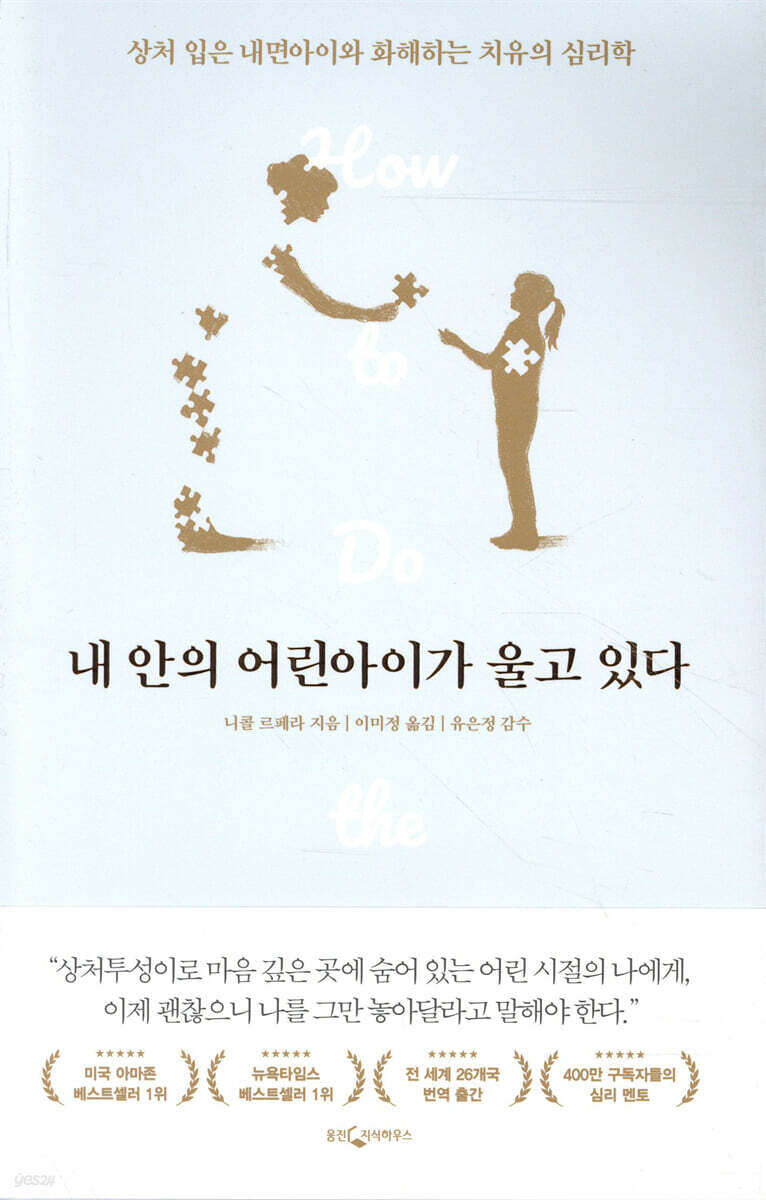
The child inside me is crying
 |
Description
Book Introduction
Loneliness and depression that cannot be filled no matter who you meet,
Deep in the hearts of people who repeat harmful relationships,
Unhealed trauma lurks
A hit that immediately reached number one on Amazon and the New York Times bestseller list!
How to save your body, mind, and soul from the wounds hidden deep within your memory.
There are people who have a 'dark night of the soul' even in broad daylight.
Those who suffer from chronic depression, helplessness, and loneliness often struggle with repetitive patterns of problems in their interpersonal relationships and daily lives.
The nature of the problem varies, including people who love their partner but cannot control their emotions when an argument starts, people who are slim but hate their bodies, and people who unilaterally sacrifice themselves to others because they think they have to be a good person.
Dr. Nicole LePera, a clinical psychologist who has been conducting research and providing psychological counseling for over 10 years, believes that these problematic situations have one thing in common.
All problems stem from the difference between ‘who you think you are’ and ‘who you really are.’
The experience of not being recognized as 'the real me' during childhood remains as a wound in the subconscious, and at this time, our inner child builds up a distorted story of the self to protect itself from the emotional wounds.
Various problems arise in daily life and interpersonal relationships due to the inner child being obsessed with protecting the ego.
Dr. Nicole Lepera guides readers on a journey of healing, from the wounded inner child to rediscovering their true selves.
This book solidly presents a vast body of academic knowledge, ranging from the author's areas of expertise—clinical psychology and psychoanalytic theory—to neoplasms and cutting-edge neuroscience.
At the same time, each chapter contains a variety of vivid cases based on actual counseling sessions with clients, allowing readers to empathize and find comfort by comparing them to their own psychological situations.
The author's words, which begin the story by confessing his own hidden trauma, will be felt as warm encouragement to readers who have not yet overcome their trauma.
This book by Dr. Nicole Lepera, which guides us step by step into the world of psychological healing in a gentle yet weighty tone, is the perfect psychological and healing book for all those who have been hurt.
Deep in the hearts of people who repeat harmful relationships,
Unhealed trauma lurks
A hit that immediately reached number one on Amazon and the New York Times bestseller list!
How to save your body, mind, and soul from the wounds hidden deep within your memory.
There are people who have a 'dark night of the soul' even in broad daylight.
Those who suffer from chronic depression, helplessness, and loneliness often struggle with repetitive patterns of problems in their interpersonal relationships and daily lives.
The nature of the problem varies, including people who love their partner but cannot control their emotions when an argument starts, people who are slim but hate their bodies, and people who unilaterally sacrifice themselves to others because they think they have to be a good person.
Dr. Nicole LePera, a clinical psychologist who has been conducting research and providing psychological counseling for over 10 years, believes that these problematic situations have one thing in common.
All problems stem from the difference between ‘who you think you are’ and ‘who you really are.’
The experience of not being recognized as 'the real me' during childhood remains as a wound in the subconscious, and at this time, our inner child builds up a distorted story of the self to protect itself from the emotional wounds.
Various problems arise in daily life and interpersonal relationships due to the inner child being obsessed with protecting the ego.
Dr. Nicole Lepera guides readers on a journey of healing, from the wounded inner child to rediscovering their true selves.
This book solidly presents a vast body of academic knowledge, ranging from the author's areas of expertise—clinical psychology and psychoanalytic theory—to neoplasms and cutting-edge neuroscience.
At the same time, each chapter contains a variety of vivid cases based on actual counseling sessions with clients, allowing readers to empathize and find comfort by comparing them to their own psychological situations.
The author's words, which begin the story by confessing his own hidden trauma, will be felt as warm encouragement to readers who have not yet overcome their trauma.
This book by Dr. Nicole Lepera, which guides us step by step into the world of psychological healing in a gentle yet weighty tone, is the perfect psychological and healing book for all those who have been hurt.
- You can preview some of the book's contents.
Preview
index
Prologue | Turning a Light on in the Dark Little Room of Your Heart
Chapter 01 The person who knows me best is me.
People Stuck in Problem Behaviors | Reflecting on My Own Path | The Connection Between Mind, Body, and Heart | Humans Are Not the Product of Their Genes | The Placebo and Nocebo Effects | Psychology that Embraces Body and Mind
** Mental Healing Practice | Turning a Light on in the Dark Little Room of Your Heart
** Journaling for Your Future Self | The First Step to Change
Chapter 02 The Moment of Realizing the Conscious Self
You are not your thoughts | The conscious and subconscious selves | The homeostatic urge to resist change | Breaking the vicious cycle | The power of belief
** Mind Healing Practice | Daily Habits for Clear Awareness
** Journaling for Your Future Self | Journaling to Awaken Consciousness
Chapter 03 Understanding Trauma
Trauma Myths | The Illusion of Being Trauma-Free | When Parents Fail to Be Trustworthy Guides | 6 Types of Childhood Trauma | Coping with Trauma | Trauma Can Be Healed
** Mind Healing Practice | Identifying Your Trauma Patterns
Chapter 04 A Body Exposed to Trauma
Trauma Changes the Cells of Your Body | How Trauma Changes Your World | The Need for a Sense of Safety | The Body Under Threat | Why We Don't Remember Traumatic Experiences | People Who Are Anxious About Strangers | Emotions Transmitted Through Co-Regulation | The Vicious Cycle of Emotional Addiction | The Path Back to Your Place
** Mindfulness Practice | Rebalancing Your Nervous System to Boost Your Resilience to Stress
** Journaling for Your Future Self | An Emotional Journal to Restore Nervous System Balance
Chapter 05 Healing the Body and Mind
Brain-Body Dialogue | The Link Between Chronic Stress and Gut Health | Healing Begins with Good Sleep | Breathing Therapy to Strengthen the Autonomic Nervous System | The Best Exercises for Resilience | Adults Need Play Therapy Too | Controlling Emotional Activation in Real Time
** Journaling for Your Future Self | Emotional Journaling to Help with Breathing Therapy
Chapter 06: The Core Beliefs of Childhood That Create the Self
The Origins of Belief | Subconscious Programming | Repeated Messages from Childhood
** Mind Healing Practice | Examining Your Core Beliefs
** Journaling for Your Future Self | Practice Developing New Core Beliefs
Chapter 07 The Wounded Inner Child
The Four Attachment Types | What is Your Inner Child? | People Who Overlay Fantasy into Childhood | Meet Your Inner Child | Anthony's Inner Child
**Heart Healing Exercise | Writing a Letter to Your Inner Child
Chapter 08 The Self is Just the Self
Encountering the Self | My Desperate Self Protecting Myself | Those Who Suppress Their Ego to Be Loved | Healing Work Begins with the Self
**Heart Healing Practice | Healing Work to Meet Your Shadow
** Journaling for Your Future Self | Emotional Journaling to Strengthen Your Self
Chapter 09 Traumatic Attachment Relationships
Attachment Theory in Adulthood | Shame, Addiction, and Traumatic Attachment | 6 Types of Traumatic Attachment | Traumatic Attachment Traps | True Love Is Feeling Safe
** Mind Healing Exercise | Identifying Your Traumatic Attachment Level
Chapter 10 Setting Boundaries
Highly Dependent Attachment | What is a Boundary? | Types of Boundaries | Emotional Oversharing and Passing On | How to Set Boundaries | Expectations and Compassion That Break Boundaries | The Ultimate Boundary
** Mental Healing Practice | Setting Boundaries to Protect a Healthy Mind
Chapter 11: Re-Cultivating My Inner Child
Re-Cultivating Your Inner Child | The Four Pillars of Re-Cultivation | Dealing with Loneliness, Disappointment, and Anger | My Case Study of Re-Cultivating Your Inner Child
** Mindfulness Practice | Think about what you need most right now.
Chapter 12 To Achieve Emotional Maturity
The 90-Second Rule | Responding with Emotional Maturity | The Best Thing a Parent Can Do for Their Child | Meditation and Maturity | Inner Emotional Maturity Reveals Outwardly
** Mind Healing Practice | Reconnecting with Emotions and Restoring Physical Balance
** Journaling for Your Future Self | An Emotional Journal Connecting Body and Mind
Chapter 13 Must be connected to each other
People Joining Hands to Heal Themselves | The Power of Community | The Security of True Love | Healing Yourself Is Healing the World
** Mindfulness Practice | Daily Practice for Building Codependence
A time to heal myself every day
Epilogue | You are the only creator of your own world.
Acknowledgements
Glossary of Terms
Chapter 01 The person who knows me best is me.
People Stuck in Problem Behaviors | Reflecting on My Own Path | The Connection Between Mind, Body, and Heart | Humans Are Not the Product of Their Genes | The Placebo and Nocebo Effects | Psychology that Embraces Body and Mind
** Mental Healing Practice | Turning a Light on in the Dark Little Room of Your Heart
** Journaling for Your Future Self | The First Step to Change
Chapter 02 The Moment of Realizing the Conscious Self
You are not your thoughts | The conscious and subconscious selves | The homeostatic urge to resist change | Breaking the vicious cycle | The power of belief
** Mind Healing Practice | Daily Habits for Clear Awareness
** Journaling for Your Future Self | Journaling to Awaken Consciousness
Chapter 03 Understanding Trauma
Trauma Myths | The Illusion of Being Trauma-Free | When Parents Fail to Be Trustworthy Guides | 6 Types of Childhood Trauma | Coping with Trauma | Trauma Can Be Healed
** Mind Healing Practice | Identifying Your Trauma Patterns
Chapter 04 A Body Exposed to Trauma
Trauma Changes the Cells of Your Body | How Trauma Changes Your World | The Need for a Sense of Safety | The Body Under Threat | Why We Don't Remember Traumatic Experiences | People Who Are Anxious About Strangers | Emotions Transmitted Through Co-Regulation | The Vicious Cycle of Emotional Addiction | The Path Back to Your Place
** Mindfulness Practice | Rebalancing Your Nervous System to Boost Your Resilience to Stress
** Journaling for Your Future Self | An Emotional Journal to Restore Nervous System Balance
Chapter 05 Healing the Body and Mind
Brain-Body Dialogue | The Link Between Chronic Stress and Gut Health | Healing Begins with Good Sleep | Breathing Therapy to Strengthen the Autonomic Nervous System | The Best Exercises for Resilience | Adults Need Play Therapy Too | Controlling Emotional Activation in Real Time
** Journaling for Your Future Self | Emotional Journaling to Help with Breathing Therapy
Chapter 06: The Core Beliefs of Childhood That Create the Self
The Origins of Belief | Subconscious Programming | Repeated Messages from Childhood
** Mind Healing Practice | Examining Your Core Beliefs
** Journaling for Your Future Self | Practice Developing New Core Beliefs
Chapter 07 The Wounded Inner Child
The Four Attachment Types | What is Your Inner Child? | People Who Overlay Fantasy into Childhood | Meet Your Inner Child | Anthony's Inner Child
**Heart Healing Exercise | Writing a Letter to Your Inner Child
Chapter 08 The Self is Just the Self
Encountering the Self | My Desperate Self Protecting Myself | Those Who Suppress Their Ego to Be Loved | Healing Work Begins with the Self
**Heart Healing Practice | Healing Work to Meet Your Shadow
** Journaling for Your Future Self | Emotional Journaling to Strengthen Your Self
Chapter 09 Traumatic Attachment Relationships
Attachment Theory in Adulthood | Shame, Addiction, and Traumatic Attachment | 6 Types of Traumatic Attachment | Traumatic Attachment Traps | True Love Is Feeling Safe
** Mind Healing Exercise | Identifying Your Traumatic Attachment Level
Chapter 10 Setting Boundaries
Highly Dependent Attachment | What is a Boundary? | Types of Boundaries | Emotional Oversharing and Passing On | How to Set Boundaries | Expectations and Compassion That Break Boundaries | The Ultimate Boundary
** Mental Healing Practice | Setting Boundaries to Protect a Healthy Mind
Chapter 11: Re-Cultivating My Inner Child
Re-Cultivating Your Inner Child | The Four Pillars of Re-Cultivation | Dealing with Loneliness, Disappointment, and Anger | My Case Study of Re-Cultivating Your Inner Child
** Mindfulness Practice | Think about what you need most right now.
Chapter 12 To Achieve Emotional Maturity
The 90-Second Rule | Responding with Emotional Maturity | The Best Thing a Parent Can Do for Their Child | Meditation and Maturity | Inner Emotional Maturity Reveals Outwardly
** Mind Healing Practice | Reconnecting with Emotions and Restoring Physical Balance
** Journaling for Your Future Self | An Emotional Journal Connecting Body and Mind
Chapter 13 Must be connected to each other
People Joining Hands to Heal Themselves | The Power of Community | The Security of True Love | Healing Yourself Is Healing the World
** Mindfulness Practice | Daily Practice for Building Codependence
A time to heal myself every day
Epilogue | You are the only creator of your own world.
Acknowledgements
Glossary of Terms
Detailed image
Into the book
Psychiatry once called itself 'the science (or study) of the mind or spirit.'
The focus of psychiatry today is excessively focused on biology.
That's why therapists are more likely to ask about a client's family history of mental illness and prescribe antidepressants than to ask about their childhood trauma or offer guidance on nutrition and lifestyle.
The field of psychiatry has fully embraced the Diagnostic and Statistical Manual of Mental Disorders, Fifth Edition (DSM-5), published by the American Psychiatric Association.
This handbook classifies symptoms as diagnostic tools, generally 'disorders of origin' that are genetic or congenital rather than environmental or acquired.
By uncovering genetic causes in this way, we naturally come to accept disease as a part of ourselves.
Once a diagnosis is made, the motivation to change or find the root cause inevitably diminishes.
--- p.34-35
The subconscious likes to stay in its comfort zone.
The safest place is where you used to be.
Because there, you can predict familiar outcomes.
Habits or actions that are performed repeatedly are the default mode of the subconscious mind.
(…) Every time we make a choice that deviates from our default program, our subconscious mind mounts a mental resistance, trying to revert back to a familiar state.
Mental resistance can manifest as mental or physical discomfort.
For example, it may appear as recurring thoughts such as, 'I can do this later' or 'I don't need to do this'.
Or it may express itself as physical symptoms, such as agitation, anxiety, or simply feeling like you are not yourself.
This is the subconscious voice protesting that the new area that needs change is uncomfortable.
--- pp.64-66
There was also a terrible secret that plagued Christine, who was unable to form a safe and stable relationship.
She began to be sexually assaulted by a man in his 40s who was close to her family when she was nine years old.
The perpetrator convinced Christine that she should keep it a secret, as telling anyone would get her in big trouble.
Christine's family even teased the man, saying that he only liked Christine.
Christine had a gut feeling that something was wrong, but she denied her instincts and began to believe the perpetrator.
He responded to that pain by becoming mentally detached while enduring physical abuse.
By repeatedly blocking out your own intuition, you eventually lose faith in yourself and rely on the thoughts, beliefs, and opinions of others.
Harry's behavior became Christine's default coping strategy.
Even as an adult, whenever Christine encountered uncomfortable feelings, she would escape the moment.
--- p.79-80
Emotional addiction is also common in human relationships.
Many clients find themselves in relationships with unexpected or untrustworthy people.
They suffer from anxiety because they are not sure of their feelings or cannot clearly understand them.
Most of my thoughts revolve around my lover and my feelings for him or her.
They overanalyze other people's actions or behaviors.
Also, they look for a lover who is completely different from them intellectually.
They want someone who is clear about their feelings and will be committed to them.
Yet, I always end up in the same human relationships.
Because I feel excited in that kind of relationship.
We are addicted to the cycle of uncertainty and the powerful biochemical reactions it produces, and we cannot escape it.
Over time (as with sugar, sex, drugs, and alcohol dependence), the body demands more and more intense experiences to experience the same chemical 'high'.
Eventually, driven by the subconscious, we seek out more and more powerful sources of excitement.
For example, we are fascinated by unexpected human relationships, news that arouses fear and anger, and social media that allows us to start arguments online.
This is also why they vent their emotions to their friends and become chronic complainers.
Because if you act like that, you can stay in a heightened state.
Inactive peace is boring and unfamiliar.
The body and mind pursue what is familiar, even if it is painful.
--- p.136-137
Few people meet their body's nutritional needs.
Rather, we tend to eat based on feelings like sadness, boredom, happiness, loneliness, and excitement.
Or, conversely, we choose foods that we eat because we need them, or out of habit or obligation.
Either way, the result is that the body's actual desires are blocked.
Babies move according to their essential needs.
When he's hungry, he cries, and when he's full, he turns his back.
Babies are very clear about what they like and what they don't like.
Then, as we grow older and discover other reasons for eating and drinking, we stop listening to our inner desires.
Chronic stress during childhood can make it harder for the body to rest and digest food properly.
This has been confirmed in repeated studies on the role of trauma and the development of gastrointestinal problems in adulthood.
If you look at your body more carefully, you can relearn things you have forgotten.
Because the body noisily communicates its intentions through messages sent between the gut and the brain.
There are about 500 million nerve cells in the stomach.
These neurons can 'talk' directly to the brain through a pathway known as the 'gut-brain axis'.
--- p.151-152
They say people tell their stories to survive.
Such stories are usually based on one's own real-life experiences.
For example, you may believe that you are an attractive person because someone liked you when you were young.
These stories are often created in childhood and are never updated, nor do they reflect current reality.
People who were shy as children, like me, continue to think of themselves as "shy" even if they no longer think or act that way.
(…) Sometimes the reality we face is so painful that we create alternative stories to help us overcome the darkness.
A child who feels ignored may make up stories about his parents doing something very 'important'.
This is because it allows us to explain the absence of parents without having to dig deeper into the truth.
--- p.175-176
The inner child, expressed through the subconscious, becomes wounded when its emotional, physical, and psychological needs from childhood are not met, and this has a lasting impact on the present self.
Most people feel like no one sees them, listens to them, or loves them.
I live with this pain my whole life.
Even narcissists cannot truly live in a state of extreme self-love.
Rather, they are like 'adult children' who respond to the inner child who is deeply suffering.
Anyone can become emotionally activated when their wounds are touched.
The person who activates such wounds most intensely is the lover.
You may slam doors or stomp your feet while having a loud argument with your lover or friend.
You can literally pick up your 'toys' and leave the 'sandpit'.
The inner child is the fearful part of the psyche that forms when our emotional coping capacity is limited.
That's why many people act like children and get stuck in a childish state when they feel threatened or upset.
A child in an adult's body is emotionally ignorant.
--- p.207-208
The ego, the great protector who protects the inner child, is the identity called ‘me.’
The ego is a great storyteller, and it creates and maintains a story about who it believes it is.
The core purpose of the ego is to always protect identity, no matter what.
The ego must become a strong protector to keep safe the softer and more defenseless part of itself (i.e. the inner child).
That's why the ego is very defensive and fear-driven.
The ego measures everything through the yardstick of strict dichotomies.
It is dividing things into good and bad, right and wrong.
The ego also has a deep attachment to its own views and believes that those views are who it is.
The ego believes that if someone questions its opinions, its core self is threatened.
As a result, the ego becomes overly anxious and self-esteem is low as it tries to defend 'ourselves' excessively.
Have you ever felt your blood boil over a slightly unpleasant remark from a coworker? Have you ever felt the urge to defend yourself, blame the other person, and win? This is the reactive state of your ego.
--- p.227-229
Reliance on others for survival and prosperity does not end in childhood.
Even as adults, they primarily crave attachment in romantic relationships.
In the 1980s, researchers Dr. Cindy Hazan and Dr. Phillip Shaver applied attachment theory to romantic partners.
A 'love quiz' was used to assess how stable the study participants' adult relationships were compared to the relationships they experienced in childhood.
The results of this study have confirmed what has long been suspected in the field of psychology.
It was the fact that attachments in infancy and childhood became the foundation of romantic relationships in adulthood.
While it's not something that's ever going to change, generally speaking, if you had a bond full of affection, support, and love in infancy, you're much more likely to have that bond in adulthood.
On the other hand, if you had distant, erratic, or abusive relationships as a child, you are more likely to have those same relationships as an adult.
--- p.254
Lack of emotional boundaries in childhood often manifests similarly as difficulty setting boundaries in adulthood.
In childhood, the family's 'groupthink' (we do it this way, not that way)
We don't like those people.
If we had gone along with the idea that (we are this kind of family) we would have often not had the opportunity to express our true selves.
Some parents, because of their life experiences and the emotional scars they carry, unconsciously view their children as a means to fulfill their own needs (they may confide in their children or treat them like their "best friend").
In these dynamics, emotional boundaries become blurred.
Because no one in the family has the space to be spontaneous or fully express their true self.
In this kind of close contact, they are entangled with each other and have extremely little separation.
Parents intervene too much in their children's lives.
Emotional activation spreads throughout the family.
You are not allowed to be separated from other family members.
If you do that, you may be punished.
Of course, contact is constant.
Parents fear losing control of their children, and children fear being rejected by their families.
No one can be their true self in a relationship like this.
The focus of psychiatry today is excessively focused on biology.
That's why therapists are more likely to ask about a client's family history of mental illness and prescribe antidepressants than to ask about their childhood trauma or offer guidance on nutrition and lifestyle.
The field of psychiatry has fully embraced the Diagnostic and Statistical Manual of Mental Disorders, Fifth Edition (DSM-5), published by the American Psychiatric Association.
This handbook classifies symptoms as diagnostic tools, generally 'disorders of origin' that are genetic or congenital rather than environmental or acquired.
By uncovering genetic causes in this way, we naturally come to accept disease as a part of ourselves.
Once a diagnosis is made, the motivation to change or find the root cause inevitably diminishes.
--- p.34-35
The subconscious likes to stay in its comfort zone.
The safest place is where you used to be.
Because there, you can predict familiar outcomes.
Habits or actions that are performed repeatedly are the default mode of the subconscious mind.
(…) Every time we make a choice that deviates from our default program, our subconscious mind mounts a mental resistance, trying to revert back to a familiar state.
Mental resistance can manifest as mental or physical discomfort.
For example, it may appear as recurring thoughts such as, 'I can do this later' or 'I don't need to do this'.
Or it may express itself as physical symptoms, such as agitation, anxiety, or simply feeling like you are not yourself.
This is the subconscious voice protesting that the new area that needs change is uncomfortable.
--- pp.64-66
There was also a terrible secret that plagued Christine, who was unable to form a safe and stable relationship.
She began to be sexually assaulted by a man in his 40s who was close to her family when she was nine years old.
The perpetrator convinced Christine that she should keep it a secret, as telling anyone would get her in big trouble.
Christine's family even teased the man, saying that he only liked Christine.
Christine had a gut feeling that something was wrong, but she denied her instincts and began to believe the perpetrator.
He responded to that pain by becoming mentally detached while enduring physical abuse.
By repeatedly blocking out your own intuition, you eventually lose faith in yourself and rely on the thoughts, beliefs, and opinions of others.
Harry's behavior became Christine's default coping strategy.
Even as an adult, whenever Christine encountered uncomfortable feelings, she would escape the moment.
--- p.79-80
Emotional addiction is also common in human relationships.
Many clients find themselves in relationships with unexpected or untrustworthy people.
They suffer from anxiety because they are not sure of their feelings or cannot clearly understand them.
Most of my thoughts revolve around my lover and my feelings for him or her.
They overanalyze other people's actions or behaviors.
Also, they look for a lover who is completely different from them intellectually.
They want someone who is clear about their feelings and will be committed to them.
Yet, I always end up in the same human relationships.
Because I feel excited in that kind of relationship.
We are addicted to the cycle of uncertainty and the powerful biochemical reactions it produces, and we cannot escape it.
Over time (as with sugar, sex, drugs, and alcohol dependence), the body demands more and more intense experiences to experience the same chemical 'high'.
Eventually, driven by the subconscious, we seek out more and more powerful sources of excitement.
For example, we are fascinated by unexpected human relationships, news that arouses fear and anger, and social media that allows us to start arguments online.
This is also why they vent their emotions to their friends and become chronic complainers.
Because if you act like that, you can stay in a heightened state.
Inactive peace is boring and unfamiliar.
The body and mind pursue what is familiar, even if it is painful.
--- p.136-137
Few people meet their body's nutritional needs.
Rather, we tend to eat based on feelings like sadness, boredom, happiness, loneliness, and excitement.
Or, conversely, we choose foods that we eat because we need them, or out of habit or obligation.
Either way, the result is that the body's actual desires are blocked.
Babies move according to their essential needs.
When he's hungry, he cries, and when he's full, he turns his back.
Babies are very clear about what they like and what they don't like.
Then, as we grow older and discover other reasons for eating and drinking, we stop listening to our inner desires.
Chronic stress during childhood can make it harder for the body to rest and digest food properly.
This has been confirmed in repeated studies on the role of trauma and the development of gastrointestinal problems in adulthood.
If you look at your body more carefully, you can relearn things you have forgotten.
Because the body noisily communicates its intentions through messages sent between the gut and the brain.
There are about 500 million nerve cells in the stomach.
These neurons can 'talk' directly to the brain through a pathway known as the 'gut-brain axis'.
--- p.151-152
They say people tell their stories to survive.
Such stories are usually based on one's own real-life experiences.
For example, you may believe that you are an attractive person because someone liked you when you were young.
These stories are often created in childhood and are never updated, nor do they reflect current reality.
People who were shy as children, like me, continue to think of themselves as "shy" even if they no longer think or act that way.
(…) Sometimes the reality we face is so painful that we create alternative stories to help us overcome the darkness.
A child who feels ignored may make up stories about his parents doing something very 'important'.
This is because it allows us to explain the absence of parents without having to dig deeper into the truth.
--- p.175-176
The inner child, expressed through the subconscious, becomes wounded when its emotional, physical, and psychological needs from childhood are not met, and this has a lasting impact on the present self.
Most people feel like no one sees them, listens to them, or loves them.
I live with this pain my whole life.
Even narcissists cannot truly live in a state of extreme self-love.
Rather, they are like 'adult children' who respond to the inner child who is deeply suffering.
Anyone can become emotionally activated when their wounds are touched.
The person who activates such wounds most intensely is the lover.
You may slam doors or stomp your feet while having a loud argument with your lover or friend.
You can literally pick up your 'toys' and leave the 'sandpit'.
The inner child is the fearful part of the psyche that forms when our emotional coping capacity is limited.
That's why many people act like children and get stuck in a childish state when they feel threatened or upset.
A child in an adult's body is emotionally ignorant.
--- p.207-208
The ego, the great protector who protects the inner child, is the identity called ‘me.’
The ego is a great storyteller, and it creates and maintains a story about who it believes it is.
The core purpose of the ego is to always protect identity, no matter what.
The ego must become a strong protector to keep safe the softer and more defenseless part of itself (i.e. the inner child).
That's why the ego is very defensive and fear-driven.
The ego measures everything through the yardstick of strict dichotomies.
It is dividing things into good and bad, right and wrong.
The ego also has a deep attachment to its own views and believes that those views are who it is.
The ego believes that if someone questions its opinions, its core self is threatened.
As a result, the ego becomes overly anxious and self-esteem is low as it tries to defend 'ourselves' excessively.
Have you ever felt your blood boil over a slightly unpleasant remark from a coworker? Have you ever felt the urge to defend yourself, blame the other person, and win? This is the reactive state of your ego.
--- p.227-229
Reliance on others for survival and prosperity does not end in childhood.
Even as adults, they primarily crave attachment in romantic relationships.
In the 1980s, researchers Dr. Cindy Hazan and Dr. Phillip Shaver applied attachment theory to romantic partners.
A 'love quiz' was used to assess how stable the study participants' adult relationships were compared to the relationships they experienced in childhood.
The results of this study have confirmed what has long been suspected in the field of psychology.
It was the fact that attachments in infancy and childhood became the foundation of romantic relationships in adulthood.
While it's not something that's ever going to change, generally speaking, if you had a bond full of affection, support, and love in infancy, you're much more likely to have that bond in adulthood.
On the other hand, if you had distant, erratic, or abusive relationships as a child, you are more likely to have those same relationships as an adult.
--- p.254
Lack of emotional boundaries in childhood often manifests similarly as difficulty setting boundaries in adulthood.
In childhood, the family's 'groupthink' (we do it this way, not that way)
We don't like those people.
If we had gone along with the idea that (we are this kind of family) we would have often not had the opportunity to express our true selves.
Some parents, because of their life experiences and the emotional scars they carry, unconsciously view their children as a means to fulfill their own needs (they may confide in their children or treat them like their "best friend").
In these dynamics, emotional boundaries become blurred.
Because no one in the family has the space to be spontaneous or fully express their true self.
In this kind of close contact, they are entangled with each other and have extremely little separation.
Parents intervene too much in their children's lives.
Emotional activation spreads throughout the family.
You are not allowed to be separated from other family members.
If you do that, you may be punished.
Of course, contact is constant.
Parents fear losing control of their children, and children fear being rejected by their families.
No one can be their true self in a relationship like this.
--- p.286-287
Publisher's Review
★ #1 Bestseller on Amazon in the US ★
★ New York Times #1 Bestseller ★
★ Published in 26 countries worldwide ★
★ Psychology Mentor for 4 Million Subscribers ★
Loneliness and depression that cannot be filled no matter who you meet,
Deep in the hearts of people who repeat harmful relationships,
Unhealed trauma lurks
There are people who have a 'dark night of the soul' even in broad daylight.
Those who suffer from chronic depression, helplessness, and loneliness hope to escape these feelings and become the person they want to be, but their plans always end up in vain.
I keep repeating the vicious cycle of blaming myself for being so weak.
Most of them have difficulties, big or small, in their interpersonal relationships.
Especially in romantic relationships, there are many cases where failure occurs in a repetitive pattern.
A person who cannot honestly express their feelings to others and instead hopes that others will read their mind, only to be disappointed and hurt.
Or, a person who pours out their emotions on the other person to the extreme even in minor conflicts, and ends up blaming the other person for their own angry feelings.
Or someone who pushes away those who try to approach them, while at the same time being afraid of being truly abandoned.
What kind of healing and prescription is needed for those who repeat harmful relationships, like drinking seawater until they are exhausted because they are thirsty?
“Only I can ultimately heal my heart.”
A hit that reached number one on the Amazon and New York Times bestseller lists immediately after its release.
Changing the paradigm of psychotherapy in America!
Dr. Nicole LePera, a clinical psychologist who has been conducting research and providing psychological counseling for over 10 years, began to experience severe panic attacks and fainting spells from time to time.
As usual, I collapsed while walking down the street, at a gathering with friends, or while on vacation, regardless of time or place.
Having counseled countless patients, he tried to figure out what was wrong with him from the perspective of a researcher and clinical psychologist.
Meanwhile, he had another task at hand.
Finding ways to more effectively improve the psychological state of patients who visit his clinic.
For some clients, it was difficult to bring about change with just 50 minutes of psychological counseling per week, and for these clients who did not improve easily, the psychological pain tended to be even greater.
Dr. Nicole Lepera had to find a way, both for herself and for her patients.
He found answers in the limitations of traditional psychotherapy.
Breaking away from the basic concept of Western medicine that treats the mind and body separately, it focused on the organic relationship between the body and mind.
The result was holistic psychology, which seeks integrated healing through the complementary interactions of body and mind.
“To my childhood self, who was covered in wounds and hidden deep in my heart,
Now that it's okay, you have to tell them to leave me alone.”
The cases of patients who visited Dr. Nicole Lepera's office were diverse.
There were all kinds of people: people who loved their partners but couldn't control their emotions when they started arguing, people who hated their stomachs and binge ate despite being slim, and people who maintained relationships where they only gave to their friends because they thought they had to be good people.
However, Dr. Nicole Lepera saw one thing in common in these problematic situations.
The pain you feel comes from the difference between ‘who you think you are’ and your ‘real self.’
Everyone is born into this world and grows up building a story about 'what kind of person I am.'
When we were very young, we could freely express ourselves as we were, but as we grew older and interacted with our parents, family, and friends, we began to feel that certain aspects of ourselves needed to be hidden or eliminated.
Or you may feel that some aspects of yourself need to be highlighted more.
This process gradually takes us away from our true selves, so our inner selves are gradually wounded.
At this time, our ego strengthens the idea that the person we should be is our true self in order to protect ourselves from emotional wounds, and we strive to defend ourselves from any situation that threatens this idea.
It is the inner self, the being inside me, that is trying desperately to protect myself, afraid that I will be hurt again, afraid that my barely built self will collapse.
“Many people live their lives unaware of their trauma.”
How to save your body, mind, and soul from the wounds hidden deep within your memory.
Dr. Nicole Lepera says that trauma can be caused by the inner child distorting the self, that is, the experience of not being accepted as 'the real me' during childhood.
Trauma is generally considered to be a psychological injury caused by a shocking event, but he argues that even stress resulting from negative experiences in childhood should be considered trauma.
This broadens the existing narrow definition of trauma.
Therefore, it can be said that the majority of people who grew up without being recognized for their innate temperament as children have trauma left in their hearts.
For example, children who are treated negatively for their inherent timid nature, children who are taught that expressing emotions like shame or sadness is weak, children who are treated as useless for their pure joys or interests, and children who believe that they can only be loved if they please others have trauma ingrained in their minds without their knowledge, which causes problems in every behavior they do as adults.
The author suggests an integrated healing path for body and mind to resolve this type of trauma.
Trauma not only puts us in a psychological prison, it often causes physical illness as well.
As a simple example, most people who come to counseling centers have chronic stomach problems.
If the mind can make the body sick, then it is also possible for the mind to heal the body, and for the mind and body to act in mutually beneficial ways to heal each other.
And the most important thing in this process is that we must go through a stage where we can find our true selves by breaking away from the inner child, the entity that distorts and defends our true selves to protect us from trauma.
A perfect psychological book for all those who have been hurt.
A detailed workbook for healing the mind
So how can we begin the integrative healing of body and mind, and the search for our true selves? The author outlines the healing process in three broad stages.
The first is ‘understanding the process by which trauma creates the self.’
We explore how negative emotional experiences in childhood become traumatic and how the inner child develops a sense of self-identity to protect itself from trauma.
The second is ‘recognizing my hidden trauma and meeting my inner child.’
To this end, at the end of each chapter, which consists of a total of 13 chapters, there are corners called 'Mind Healing Practice' and 'Writing a Diary for Your Future Self' where readers can personally check their psychological state and begin healing work.
Lastly, the third and most important thing is ‘re-parenting the wounded inner child.’
This is the stage where we re-teach our inner child, the distorted self created by trauma, how to healthily satisfy the needs that were not met during childhood.
Many people who were suppressed and denied their true selves as children are prone to denying their own reality as adults, rejecting their own desires, and developing the mistaken belief that they must prioritize the needs of those around them over their own.
As a result, psychological problems arise as people feel guilty or ashamed about wanting to follow their own desires and believe that living a life that conforms to others is right.
The beginning of reparenting is to look into your own pure desires and to rebuild the trust that 'I am a good person just as I am.'
“A wise ‘inner parent’ respects the inner child’s needs and fosters acceptance.
The inner child's need is to be seen for who he is, to be listened to, and to be valued for the true part of himself.
To raise a wise inner parent, you'll want to learn to trust yourself (perhaps for the first time in your life).
Lost trust can be rebuilt by making small promises to yourself to engage in self-care behaviors every day and consistently following through.
It can be very helpful to get into the habit of talking to yourself kindly, as if you were talking to a child in pain.
"What Can I Do for Myself Right Now?" / Pages 329-330, Chapter 11: Re-Cultivating My Inner Child
I really want to get out of this recurring psychological problem.
A healing book for you, me, parents, and children
This book solidly presents a vast body of academic knowledge that can aid psychological healing and mental health, ranging from the author's areas of expertise—clinical psychology and psychoanalytic theory—to neoplastic biology and cutting-edge neuroscience, including epigenetics and polyvagal theory.
At the same time, each chapter contains a variety of vivid cases based on actual counseling sessions with clients, allowing readers to empathize and find comfort by comparing them to their own psychological situations.
The author's words, which begin the story by confessing his own hidden trauma, will be felt as warm encouragement to readers who struggle day after day to escape psychological pain.
This book by Dr. Nicole Lepera, which guides us step by step into the world of psychological healing in a gentle yet weighty tone, is the perfect psychological and healing book for all those who have been hurt.
★ New York Times #1 Bestseller ★
★ Published in 26 countries worldwide ★
★ Psychology Mentor for 4 Million Subscribers ★
Loneliness and depression that cannot be filled no matter who you meet,
Deep in the hearts of people who repeat harmful relationships,
Unhealed trauma lurks
There are people who have a 'dark night of the soul' even in broad daylight.
Those who suffer from chronic depression, helplessness, and loneliness hope to escape these feelings and become the person they want to be, but their plans always end up in vain.
I keep repeating the vicious cycle of blaming myself for being so weak.
Most of them have difficulties, big or small, in their interpersonal relationships.
Especially in romantic relationships, there are many cases where failure occurs in a repetitive pattern.
A person who cannot honestly express their feelings to others and instead hopes that others will read their mind, only to be disappointed and hurt.
Or, a person who pours out their emotions on the other person to the extreme even in minor conflicts, and ends up blaming the other person for their own angry feelings.
Or someone who pushes away those who try to approach them, while at the same time being afraid of being truly abandoned.
What kind of healing and prescription is needed for those who repeat harmful relationships, like drinking seawater until they are exhausted because they are thirsty?
“Only I can ultimately heal my heart.”
A hit that reached number one on the Amazon and New York Times bestseller lists immediately after its release.
Changing the paradigm of psychotherapy in America!
Dr. Nicole LePera, a clinical psychologist who has been conducting research and providing psychological counseling for over 10 years, began to experience severe panic attacks and fainting spells from time to time.
As usual, I collapsed while walking down the street, at a gathering with friends, or while on vacation, regardless of time or place.
Having counseled countless patients, he tried to figure out what was wrong with him from the perspective of a researcher and clinical psychologist.
Meanwhile, he had another task at hand.
Finding ways to more effectively improve the psychological state of patients who visit his clinic.
For some clients, it was difficult to bring about change with just 50 minutes of psychological counseling per week, and for these clients who did not improve easily, the psychological pain tended to be even greater.
Dr. Nicole Lepera had to find a way, both for herself and for her patients.
He found answers in the limitations of traditional psychotherapy.
Breaking away from the basic concept of Western medicine that treats the mind and body separately, it focused on the organic relationship between the body and mind.
The result was holistic psychology, which seeks integrated healing through the complementary interactions of body and mind.
“To my childhood self, who was covered in wounds and hidden deep in my heart,
Now that it's okay, you have to tell them to leave me alone.”
The cases of patients who visited Dr. Nicole Lepera's office were diverse.
There were all kinds of people: people who loved their partners but couldn't control their emotions when they started arguing, people who hated their stomachs and binge ate despite being slim, and people who maintained relationships where they only gave to their friends because they thought they had to be good people.
However, Dr. Nicole Lepera saw one thing in common in these problematic situations.
The pain you feel comes from the difference between ‘who you think you are’ and your ‘real self.’
Everyone is born into this world and grows up building a story about 'what kind of person I am.'
When we were very young, we could freely express ourselves as we were, but as we grew older and interacted with our parents, family, and friends, we began to feel that certain aspects of ourselves needed to be hidden or eliminated.
Or you may feel that some aspects of yourself need to be highlighted more.
This process gradually takes us away from our true selves, so our inner selves are gradually wounded.
At this time, our ego strengthens the idea that the person we should be is our true self in order to protect ourselves from emotional wounds, and we strive to defend ourselves from any situation that threatens this idea.
It is the inner self, the being inside me, that is trying desperately to protect myself, afraid that I will be hurt again, afraid that my barely built self will collapse.
“Many people live their lives unaware of their trauma.”
How to save your body, mind, and soul from the wounds hidden deep within your memory.
Dr. Nicole Lepera says that trauma can be caused by the inner child distorting the self, that is, the experience of not being accepted as 'the real me' during childhood.
Trauma is generally considered to be a psychological injury caused by a shocking event, but he argues that even stress resulting from negative experiences in childhood should be considered trauma.
This broadens the existing narrow definition of trauma.
Therefore, it can be said that the majority of people who grew up without being recognized for their innate temperament as children have trauma left in their hearts.
For example, children who are treated negatively for their inherent timid nature, children who are taught that expressing emotions like shame or sadness is weak, children who are treated as useless for their pure joys or interests, and children who believe that they can only be loved if they please others have trauma ingrained in their minds without their knowledge, which causes problems in every behavior they do as adults.
The author suggests an integrated healing path for body and mind to resolve this type of trauma.
Trauma not only puts us in a psychological prison, it often causes physical illness as well.
As a simple example, most people who come to counseling centers have chronic stomach problems.
If the mind can make the body sick, then it is also possible for the mind to heal the body, and for the mind and body to act in mutually beneficial ways to heal each other.
And the most important thing in this process is that we must go through a stage where we can find our true selves by breaking away from the inner child, the entity that distorts and defends our true selves to protect us from trauma.
A perfect psychological book for all those who have been hurt.
A detailed workbook for healing the mind
So how can we begin the integrative healing of body and mind, and the search for our true selves? The author outlines the healing process in three broad stages.
The first is ‘understanding the process by which trauma creates the self.’
We explore how negative emotional experiences in childhood become traumatic and how the inner child develops a sense of self-identity to protect itself from trauma.
The second is ‘recognizing my hidden trauma and meeting my inner child.’
To this end, at the end of each chapter, which consists of a total of 13 chapters, there are corners called 'Mind Healing Practice' and 'Writing a Diary for Your Future Self' where readers can personally check their psychological state and begin healing work.
Lastly, the third and most important thing is ‘re-parenting the wounded inner child.’
This is the stage where we re-teach our inner child, the distorted self created by trauma, how to healthily satisfy the needs that were not met during childhood.
Many people who were suppressed and denied their true selves as children are prone to denying their own reality as adults, rejecting their own desires, and developing the mistaken belief that they must prioritize the needs of those around them over their own.
As a result, psychological problems arise as people feel guilty or ashamed about wanting to follow their own desires and believe that living a life that conforms to others is right.
The beginning of reparenting is to look into your own pure desires and to rebuild the trust that 'I am a good person just as I am.'
“A wise ‘inner parent’ respects the inner child’s needs and fosters acceptance.
The inner child's need is to be seen for who he is, to be listened to, and to be valued for the true part of himself.
To raise a wise inner parent, you'll want to learn to trust yourself (perhaps for the first time in your life).
Lost trust can be rebuilt by making small promises to yourself to engage in self-care behaviors every day and consistently following through.
It can be very helpful to get into the habit of talking to yourself kindly, as if you were talking to a child in pain.
"What Can I Do for Myself Right Now?" / Pages 329-330, Chapter 11: Re-Cultivating My Inner Child
I really want to get out of this recurring psychological problem.
A healing book for you, me, parents, and children
This book solidly presents a vast body of academic knowledge that can aid psychological healing and mental health, ranging from the author's areas of expertise—clinical psychology and psychoanalytic theory—to neoplastic biology and cutting-edge neuroscience, including epigenetics and polyvagal theory.
At the same time, each chapter contains a variety of vivid cases based on actual counseling sessions with clients, allowing readers to empathize and find comfort by comparing them to their own psychological situations.
The author's words, which begin the story by confessing his own hidden trauma, will be felt as warm encouragement to readers who struggle day after day to escape psychological pain.
This book by Dr. Nicole Lepera, which guides us step by step into the world of psychological healing in a gentle yet weighty tone, is the perfect psychological and healing book for all those who have been hurt.
GOODS SPECIFICS
- Date of issue: August 31, 2021
- Page count, weight, size: 416 pages | 676g | 140*220*30mm
- ISBN13: 9788901252148
- ISBN10: 8901252147
You may also like
카테고리
korean


korean

![GQ KOREA Mark (Monthly): December [2025]](http://librairie.coreenne.fr/cdn/shop/files/8ef265dbbfbf186523ed75ba7319009d.jpg?v=1765340328&width=3840)


