

When Hospitals Meet Robots
 |
Description
Book Introduction
KMI Healthcare Series 01
Survival Strategies for Future Hospitals in the Age of Robot Coexistence
The 'KMI Healthcare Series', planned and edited by young doctors and produced and sponsored by the KMI Korean Medical Research Institute, is a series of monographs that encompass core knowledge and insights across the entire healthcare field, including healthcare policy, humanities and social medicine, medical communication, and the recently emerging importance of future healthcare, patient experience, hospital innovation, and the healthcare industry.
It was planned to contribute to the development of Korea's medical system, medical culture, and related industries by continuously discovering excellent books in the field that were lacking in both quantity and quality.
This series, which will be published in 20 volumes, presents the most timely and innovative topic of all: the coexistence of robots and hospitals.
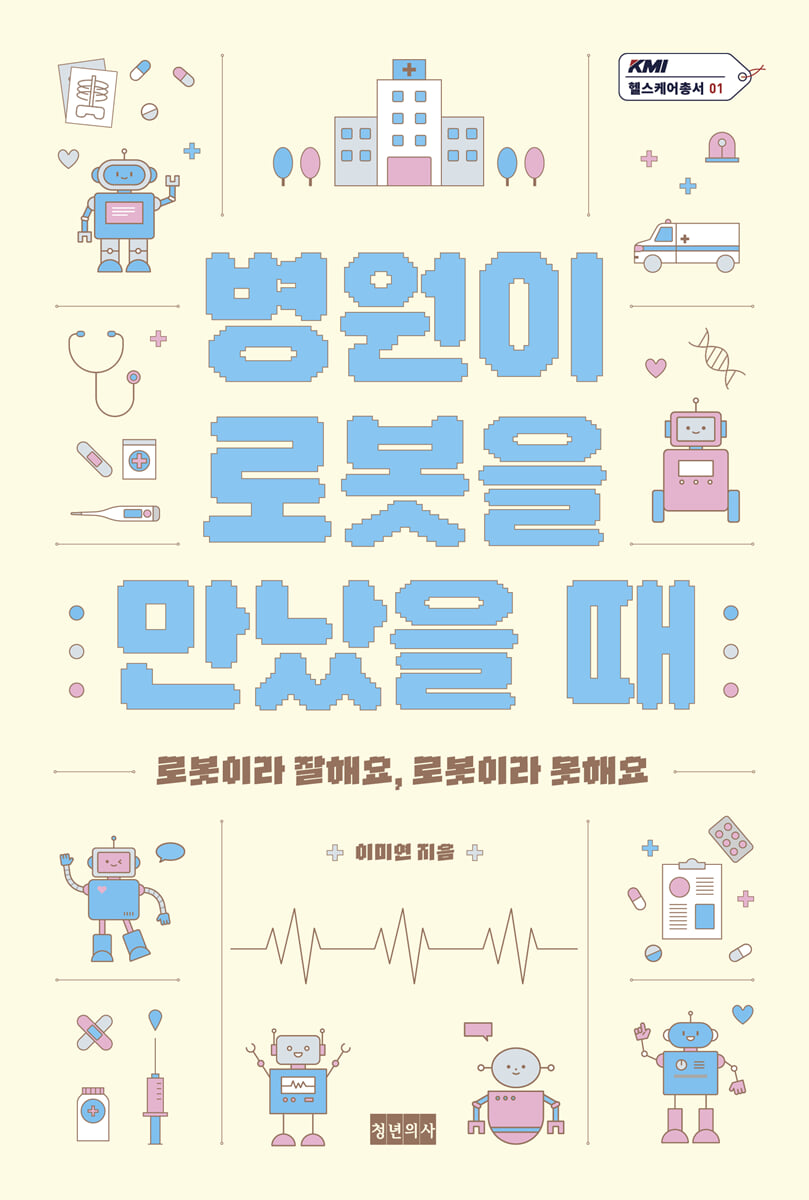
The first book in the KMI Healthcare Series, "When Hospitals Met Robots," is a book written by a practicing physician that examines the role and limitations of robots and the future direction of the medical system based on actual operational cases of service robots introduced in actual hospital settings.
The author is a professor in the Department of Radiation Oncology at Hallym University Sacred Heart Hospital. Since 2019, he has established a command center and has been operating medical AI, data-based treatment systems, and service robots.
This book vividly documents the introduction and application of "everyday service robots" that perform routine tasks in hospitals, such as transporting supplies, guiding patients, and performing quarantine work, rather than cutting-edge medical devices such as surgical or rehabilitation robots.
In addition, it presents concerns and solutions regarding the role robots can play as a "social care infrastructure" amid the care crisis of an aging society, as well as a roadmap for future hospital innovation.
"When Hospitals Met Robots" can be called a "survival strategy book for future hospitals in an era of labor shortages," bridging the gap between the ideals and realities of robotics technology.
Survival Strategies for Future Hospitals in the Age of Robot Coexistence
The 'KMI Healthcare Series', planned and edited by young doctors and produced and sponsored by the KMI Korean Medical Research Institute, is a series of monographs that encompass core knowledge and insights across the entire healthcare field, including healthcare policy, humanities and social medicine, medical communication, and the recently emerging importance of future healthcare, patient experience, hospital innovation, and the healthcare industry.
It was planned to contribute to the development of Korea's medical system, medical culture, and related industries by continuously discovering excellent books in the field that were lacking in both quantity and quality.
This series, which will be published in 20 volumes, presents the most timely and innovative topic of all: the coexistence of robots and hospitals.
The first book in the KMI Healthcare Series, "When Hospitals Met Robots," is a book written by a practicing physician that examines the role and limitations of robots and the future direction of the medical system based on actual operational cases of service robots introduced in actual hospital settings.
The author is a professor in the Department of Radiation Oncology at Hallym University Sacred Heart Hospital. Since 2019, he has established a command center and has been operating medical AI, data-based treatment systems, and service robots.
This book vividly documents the introduction and application of "everyday service robots" that perform routine tasks in hospitals, such as transporting supplies, guiding patients, and performing quarantine work, rather than cutting-edge medical devices such as surgical or rehabilitation robots.
In addition, it presents concerns and solutions regarding the role robots can play as a "social care infrastructure" amid the care crisis of an aging society, as well as a roadmap for future hospital innovation.
"When Hospitals Met Robots" can be called a "survival strategy book for future hospitals in an era of labor shortages," bridging the gap between the ideals and realities of robotics technology.
- You can preview some of the book's contents.
Preview
index
introduction
Chapter 1: Service Robots Deployed in Medical Settings
■ Are robots really working in hospitals?
■ Why 60,000 Robot Services Are Important
■ Do hospitals really need robots?
■ Various demand sources in dire need of robot assistance
Chapter 2: How far have robots come?
■ Current level of service robots
■ Concerns before introducing robots
■ Disappointments after introducing robots
■ What robots are good at and bad at
Chapter 3: Where Robots Work: Case Studies in Hospitals
■ Pharmaceutical Delivery - Case of Business Coordination
■ Case study of infrastructure construction for delivery
■ Specimen Delivery - Case of Business Process Change
■ Outdoor Delivery - Multiple Robot Utilization Cases
■ Outdoor Delivery - A Case Study of Building a Robot-Friendly Ecosystem
■ Patient Guidance - Case Study of Elderly-Friendly Robots
■ Delivery of patient supplies - Service examples for the vulnerable
■ The value that robots provide to humans is not just 'work'.
Chapter 4: Robot Introduction: How to Prepare
■ Step 0 - Knowing Myself
■ Step 1 - Getting to know the robot
■ Step 2 - Preparing to meet the robot
■ Step 3 - Creating a Home for Robots
■ Step 4 - Should we continue using robots?
■ The need for a dedicated organization for the future
Chapter 5: Preparing for the Future
■ The age of robots is coming
■ What should our society prepare for in the robot age?
Conclusion
Chapter 1: Service Robots Deployed in Medical Settings
■ Are robots really working in hospitals?
■ Why 60,000 Robot Services Are Important
■ Do hospitals really need robots?
■ Various demand sources in dire need of robot assistance
Chapter 2: How far have robots come?
■ Current level of service robots
■ Concerns before introducing robots
■ Disappointments after introducing robots
■ What robots are good at and bad at
Chapter 3: Where Robots Work: Case Studies in Hospitals
■ Pharmaceutical Delivery - Case of Business Coordination
■ Case study of infrastructure construction for delivery
■ Specimen Delivery - Case of Business Process Change
■ Outdoor Delivery - Multiple Robot Utilization Cases
■ Outdoor Delivery - A Case Study of Building a Robot-Friendly Ecosystem
■ Patient Guidance - Case Study of Elderly-Friendly Robots
■ Delivery of patient supplies - Service examples for the vulnerable
■ The value that robots provide to humans is not just 'work'.
Chapter 4: Robot Introduction: How to Prepare
■ Step 0 - Knowing Myself
■ Step 1 - Getting to know the robot
■ Step 2 - Preparing to meet the robot
■ Step 3 - Creating a Home for Robots
■ Step 4 - Should we continue using robots?
■ The need for a dedicated organization for the future
Chapter 5: Preparing for the Future
■ The age of robots is coming
■ What should our society prepare for in the robot age?
Conclusion
Into the book
Experience working extensively with robots is a very important and valuable asset.
Because it means that we have accumulated a lot of data on the use of robots.
Quantitative data generated and recorded by the robot itself, such as its driving log, time spent at each step, and frequency of use, will be utilized to develop additional functions, such as AI learning and various simulations.
In addition, various problem situations, problem occurrence patterns, user experiences, and unexpected operating environment variables that occur during actual robot operation are very important qualitative data.
In this way, robot data obtained from field use plays a crucial role in designing better robot operation strategies and improving the system.
This is data of truly important value that is difficult to obtain in a short period of time.
--- p.23
Currently, the most affordable commercially available robots are probably those that are roughly the same size as a 7-year-old child.
He can have basic conversations and does a pretty good job of completing tasks nine times out of ten, but he makes ridiculous mistakes every now and then, so he's not someone you can completely trust.
So, even when you think, 'I'd rather do it myself,' when you're really busy, the service robots that make you think, 'Still, this is amazing and I'm grateful.'
Perhaps in the near future, we will see robots that are as good at work as 15-year-olds or even adults, rather than 7-year-olds.
If that happens, we will be able to trust them with much more diverse tasks than we do now.
But until then, it seems like people will have to adapt and live with robots at their current level.
--- p.49
When deciding which tasks to deploy robots for, there are three factors to consider:
First, can the robot perform the task accurately?
Second, who benefits when robots take over that job?
Third, is it cost-effective enough?
Currently, robots require a lot of cost and effort not only for introduction but also for operation and maintenance.
Therefore, the introduced robots must be operated efficiently.
For example, if you only work once a day and spend most of your time waiting, there's no reason to buy an expensive robot.
From this perspective, the 'additional medicine delivery' sector, which has high delivery frequency and high service demand, was the sector that benefited the most from the introduction of robots.
In fact, our hospital's pharmaceutical delivery robots perform approximately 70 deliveries per day, operate for 320 hours per month, and travel a total of 200 kilometers.
If converted to a 40-hour workweek, this corresponds to the amount of work that two employees can handle.
--- p.80
Our hospital currently has 50 home care robots that we install in patients' homes.
This has led to a continued interest in the potential use of robots in non-hospital settings.
Especially for single-person households of elderly people, I thought that the function of being a companion and finding and playing the song they want could be more important than the function of reminding them to take their medication or detecting a crisis situation.
How far can the relationship between robots and humans develop in the future? As artificial intelligence technology advances to understand and express emotional responses, robots may go beyond mere machines and become deeply entrenched in our lives as "emotional companions."
--- p.142
When our hospital was first considering introducing robots, the National Cancer Center, which had introduced and successfully operated robots before us, provided us with two benchmarking opportunities.
Thanks to this, I was able to receive in-depth consideration and experience in advance on factors to consider when using robots, potential problems that may arise, and solutions to them, which helped me significantly reduce trial and error.
For that reason, our command center has provided benchmarking opportunities to over 20 organizations interested in seeing robots in action.
Rather than simply repeating the same content, we prepare customized explanatory materials based on the visiting organization's interests, tour robot use sites with them, and ultimately work with them to devise a suitable introduction direction for the visiting organization's circumstances.
Since the process usually takes about 2 to 3 hours and there is no charge, visitors often ask, “Why are you doing this to us?”
Every time that happens, we always give the same answer.
"I hope that more people will benefit from the effective use of robots." This is because I hope that better robots will enter the market, become cheaper, and become more convenient to use, ultimately allowing our hospital to utilize robots in a better environment.
This is why we want to contribute to the robotics ecosystem.
--- pp.179-180
These changes are an irreversible trend of the times.
AI, which felt distant just a few years ago, has now become deeply ingrained in our daily lives.
And we hear this more and more often.
“AI won’t take your job; those who are good at using AI will take your job if you’re not good at using AI.” This is no longer just a worry; it’s becoming a reality.
According to a paper published by Stanford University in August 2025, employment of young adults aged 22 to 25 in occupations with high exposure to AI decreased by approximately 13%.
New graduates are often tasked with simple, repetitive tasks rather than high-level tasks like problem solving or decision-making, and these tasks are increasingly being replaced by AI as they become automated.
As a result, experienced workers are choosing to leverage AI to maintain or increase productivity rather than handing over tasks to newcomers and training them.
The same goes for robots.
How well a company utilizes robots will soon become its competitive edge.
Even at the individual level, jobs that can be replaced by robots or that robots can do better will gradually disappear.
Instead, new jobs will emerge alongside robots.
Because it means that we have accumulated a lot of data on the use of robots.
Quantitative data generated and recorded by the robot itself, such as its driving log, time spent at each step, and frequency of use, will be utilized to develop additional functions, such as AI learning and various simulations.
In addition, various problem situations, problem occurrence patterns, user experiences, and unexpected operating environment variables that occur during actual robot operation are very important qualitative data.
In this way, robot data obtained from field use plays a crucial role in designing better robot operation strategies and improving the system.
This is data of truly important value that is difficult to obtain in a short period of time.
--- p.23
Currently, the most affordable commercially available robots are probably those that are roughly the same size as a 7-year-old child.
He can have basic conversations and does a pretty good job of completing tasks nine times out of ten, but he makes ridiculous mistakes every now and then, so he's not someone you can completely trust.
So, even when you think, 'I'd rather do it myself,' when you're really busy, the service robots that make you think, 'Still, this is amazing and I'm grateful.'
Perhaps in the near future, we will see robots that are as good at work as 15-year-olds or even adults, rather than 7-year-olds.
If that happens, we will be able to trust them with much more diverse tasks than we do now.
But until then, it seems like people will have to adapt and live with robots at their current level.
--- p.49
When deciding which tasks to deploy robots for, there are three factors to consider:
First, can the robot perform the task accurately?
Second, who benefits when robots take over that job?
Third, is it cost-effective enough?
Currently, robots require a lot of cost and effort not only for introduction but also for operation and maintenance.
Therefore, the introduced robots must be operated efficiently.
For example, if you only work once a day and spend most of your time waiting, there's no reason to buy an expensive robot.
From this perspective, the 'additional medicine delivery' sector, which has high delivery frequency and high service demand, was the sector that benefited the most from the introduction of robots.
In fact, our hospital's pharmaceutical delivery robots perform approximately 70 deliveries per day, operate for 320 hours per month, and travel a total of 200 kilometers.
If converted to a 40-hour workweek, this corresponds to the amount of work that two employees can handle.
--- p.80
Our hospital currently has 50 home care robots that we install in patients' homes.
This has led to a continued interest in the potential use of robots in non-hospital settings.
Especially for single-person households of elderly people, I thought that the function of being a companion and finding and playing the song they want could be more important than the function of reminding them to take their medication or detecting a crisis situation.
How far can the relationship between robots and humans develop in the future? As artificial intelligence technology advances to understand and express emotional responses, robots may go beyond mere machines and become deeply entrenched in our lives as "emotional companions."
--- p.142
When our hospital was first considering introducing robots, the National Cancer Center, which had introduced and successfully operated robots before us, provided us with two benchmarking opportunities.
Thanks to this, I was able to receive in-depth consideration and experience in advance on factors to consider when using robots, potential problems that may arise, and solutions to them, which helped me significantly reduce trial and error.
For that reason, our command center has provided benchmarking opportunities to over 20 organizations interested in seeing robots in action.
Rather than simply repeating the same content, we prepare customized explanatory materials based on the visiting organization's interests, tour robot use sites with them, and ultimately work with them to devise a suitable introduction direction for the visiting organization's circumstances.
Since the process usually takes about 2 to 3 hours and there is no charge, visitors often ask, “Why are you doing this to us?”
Every time that happens, we always give the same answer.
"I hope that more people will benefit from the effective use of robots." This is because I hope that better robots will enter the market, become cheaper, and become more convenient to use, ultimately allowing our hospital to utilize robots in a better environment.
This is why we want to contribute to the robotics ecosystem.
--- pp.179-180
These changes are an irreversible trend of the times.
AI, which felt distant just a few years ago, has now become deeply ingrained in our daily lives.
And we hear this more and more often.
“AI won’t take your job; those who are good at using AI will take your job if you’re not good at using AI.” This is no longer just a worry; it’s becoming a reality.
According to a paper published by Stanford University in August 2025, employment of young adults aged 22 to 25 in occupations with high exposure to AI decreased by approximately 13%.
New graduates are often tasked with simple, repetitive tasks rather than high-level tasks like problem solving or decision-making, and these tasks are increasingly being replaced by AI as they become automated.
As a result, experienced workers are choosing to leverage AI to maintain or increase productivity rather than handing over tasks to newcomers and training them.
The same goes for robots.
How well a company utilizes robots will soon become its competitive edge.
Even at the individual level, jobs that can be replaced by robots or that robots can do better will gradually disappear.
Instead, new jobs will emerge alongside robots.
--- pp.224-225
Publisher's Review
The paradox of robots giving humans back their time: what they excel at and what limitations they ultimately can't overcome.
The A to Z of Future Hospital Innovations, as Documented by Current Doctors
"When Hospitals Met Robots" is the first book in the KMI Healthcare Series and explores the survival strategies of the Korean healthcare system amidst the structural crises of a population cliff and a severe workforce shortage.
This book goes beyond a simple introduction to "robot technology." It's a practical record of how robots were introduced to labor-intensive hospital settings to innovate their systems. It's also a report from the medical field that considers how technology and people can coexist.
This book goes beyond the technical perspective of "where and how to introduce robots," focusing on the human-centered question of "what must people, space, and systems prepare?"
This book vividly documents the trials and errors and achievements experienced with medical staff, nurses, and hospital support personnel centered around the command center. The quantitative analysis based on over 60,000 accumulated robot utilization data adds unparalleled persuasiveness to the book.
In particular, the author realistically demonstrates how robots can complement the structural problems of an aging population and a shortage of personnel in the medical field, and proposes service robots as an inevitable alternative for the sustainability of care and medical care in an era where "the elderly care for the elderly."
Moreover, this book goes beyond the glamorous "ideals" of robot adoption and candidly reveals the process by which robots actually adapt and operate in the complex and dynamic space of a hospital, as well as the practical problems that arise within it.
It's packed with insights into robot path design, work process restructuring, the physical limitations of hospital space, unexpected trial and error, and the kind of insightful advice only someone who's used robots "until they're worn out" can offer.
The experience and data gained from actual practice, not theory, in the field rather than in the laboratory are the greatest strength and differentiating factor of this book.
We have now entered an era where we must live with robots, whether we like it or not.
"When Hospitals Met Robots" will serve as a roadmap for innovation and survival for hospital executives and policymakers, provide robot developers with concrete insights reflecting the needs of the field, and serve as a clear guide for general readers to understand the changes in future society where people, space, and technology are in harmony.
The A to Z of Future Hospital Innovations, as Documented by Current Doctors
"When Hospitals Met Robots" is the first book in the KMI Healthcare Series and explores the survival strategies of the Korean healthcare system amidst the structural crises of a population cliff and a severe workforce shortage.
This book goes beyond a simple introduction to "robot technology." It's a practical record of how robots were introduced to labor-intensive hospital settings to innovate their systems. It's also a report from the medical field that considers how technology and people can coexist.
This book goes beyond the technical perspective of "where and how to introduce robots," focusing on the human-centered question of "what must people, space, and systems prepare?"
This book vividly documents the trials and errors and achievements experienced with medical staff, nurses, and hospital support personnel centered around the command center. The quantitative analysis based on over 60,000 accumulated robot utilization data adds unparalleled persuasiveness to the book.
In particular, the author realistically demonstrates how robots can complement the structural problems of an aging population and a shortage of personnel in the medical field, and proposes service robots as an inevitable alternative for the sustainability of care and medical care in an era where "the elderly care for the elderly."
Moreover, this book goes beyond the glamorous "ideals" of robot adoption and candidly reveals the process by which robots actually adapt and operate in the complex and dynamic space of a hospital, as well as the practical problems that arise within it.
It's packed with insights into robot path design, work process restructuring, the physical limitations of hospital space, unexpected trial and error, and the kind of insightful advice only someone who's used robots "until they're worn out" can offer.
The experience and data gained from actual practice, not theory, in the field rather than in the laboratory are the greatest strength and differentiating factor of this book.
We have now entered an era where we must live with robots, whether we like it or not.
"When Hospitals Met Robots" will serve as a roadmap for innovation and survival for hospital executives and policymakers, provide robot developers with concrete insights reflecting the needs of the field, and serve as a clear guide for general readers to understand the changes in future society where people, space, and technology are in harmony.
GOODS SPECIFICS
- Date of issue: November 10, 2025
- Page count, weight, size: 248 pages | Checking size
- ISBN13: 9791193135358
- ISBN10: 1193135354
You may also like
카테고리
korean


korean

![GQ KOREA Mark (Monthly): December [2025]](http://librairie.coreenne.fr/cdn/shop/files/8ef265dbbfbf186523ed75ba7319009d.jpg?v=1765340328&width=3840)


