

Body, reborn through Oriental medicine
 |
Description
Book Introduction
“Medicine that treats after the person is already sick is nothing but a ‘shell’,
“The ‘cultivation’ that heals before one becomes ill is the ‘essence’.”
It is important to compare and understand the perspectives of Oriental and Western medicine on the human body.
Only by examining the essence of each medical system can we accurately understand the strengths, weaknesses, and limitations of Oriental and Western medicine.
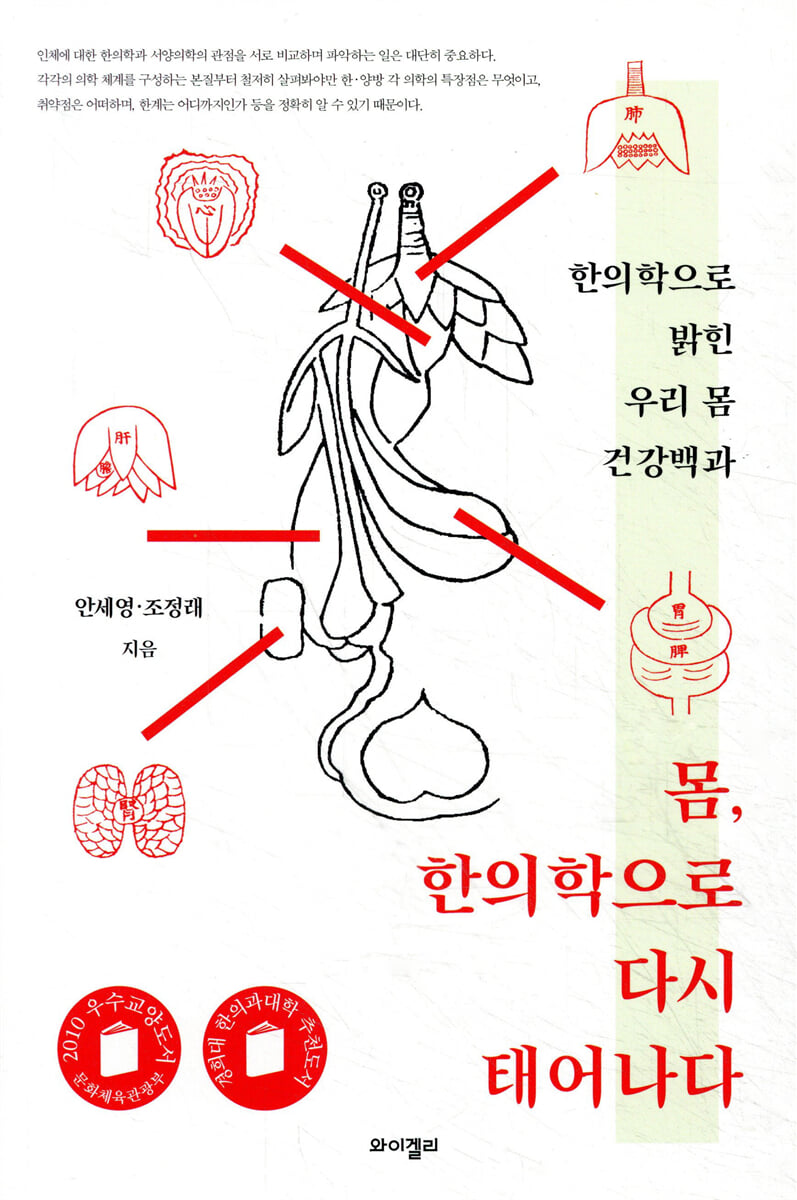
Unlike Western medicine, which focuses solely on the 'body' and analyzes it in detail, this book explores the essence of Oriental medicine, which views the human body as a 'microcosm' where body, mind, time, and space are combined, and is structured to enable readers to accurately understand our bodies.
We have selected 60 topics that can help treat diseases and promote health, and we introduce methods for healing by understanding the overall nature of our body.
『Donguibogam』 was interpreted in modern language and explained in an easy-to-understand way through everyday metaphors to help readers understand the core principles of Oriental medicine.
“The ‘cultivation’ that heals before one becomes ill is the ‘essence’.”
It is important to compare and understand the perspectives of Oriental and Western medicine on the human body.
Only by examining the essence of each medical system can we accurately understand the strengths, weaknesses, and limitations of Oriental and Western medicine.
Unlike Western medicine, which focuses solely on the 'body' and analyzes it in detail, this book explores the essence of Oriental medicine, which views the human body as a 'microcosm' where body, mind, time, and space are combined, and is structured to enable readers to accurately understand our bodies.
We have selected 60 topics that can help treat diseases and promote health, and we introduce methods for healing by understanding the overall nature of our body.
『Donguibogam』 was interpreted in modern language and explained in an easy-to-understand way through everyday metaphors to help readers understand the core principles of Oriental medicine.
- You can preview some of the book's contents.
Preview
index
introduction
1.
Hair - It is good to comb your hair often.
2.
Head - The human head is likened to the valley of heaven and holds the spirit.
3.
Head - Spirit (神) - God (神) is the subject of the body
4.
Head - Dream - Dreaming through the influence of the soul
5.
Headache - There is no headache caused by a cold head.
6.
Headache - Dizziness (眩暈) - Dizziness does not occur unless you are weak.
7.
Head-stroke (中風) - If only the external form is lush, the true energy that sustains the human body becomes weak.
8.
Face-Myeongdang (明堂) - The best doctor who can diagnose the patient's symptoms just by looking at them is called a divine doctor.
9.
Face - Complexion - The five colors that determine illness are determined solely by the face.
10.
Face - Forehead - The forehead is the garden of heaven.
11.
Face - Sweat Pores (玄府) - Sweat moistens the 玄府
12.
Eyes - Eyes (目) - The eyes are formed by the gathering of the essence of the five internal organs and six bowels.
13.
Eye-Eye Diseases - Eye diseases are caused by heat.
14.
Ears - Clear yang fills the arms and legs, and turbid yin is injected into the five internal organs.
15.
Ears and eyes become intelligent by receiving yang energy.
16.
Ear-Tinnitus - Ringing in the ears is a precursor to deafness.
17.
Nose - The mouth and nose are the male and female organs.
18.
Nose Disease - The nose is the cavity of the lungs.
19.
Mouth and Tongue - Mouth and Tongue - Saliva from the mouth moistens the tongue.
20.
Mouth and Tongue - Diseases of the Mouth and Tongue - Stop Spitting
21.
Teeth - Teeth are the excess part of bone.
22.
Teeth - Dental Disease - Exposed gums and loose teeth are due to weak kidney energy.
23.
Teeth - Dental Health - Nothing is more important to the health of the body than the mouth and teeth.
24.
Neck-neck (頸項) - The wind acupoints of the neck must be well protected.
25.
All diseases that occur in the throat fall into the category of fire and heat.
26.
Fox-like delusion and plum-core energy - To cure disease, one must first control the mind.
27.
Neck - Voice - The voice comes from the kidneys.
28.
Wood - Language - Speak less to cultivate inner energy.
29.
Back - Spine - There are three passages on the back, which serve as roads for the flow of vital energy.
30.
Controlling the mind through the path of the dantian (丹田) is the best way to cure illness.
31.
Back - Male and female - Men and women are complementary to each other, like yin and yang and qi and blood.
32.
Back pain - Back pain or stiffness is caused by overwork.
33.
Chest - thorax (胸廓) - There is a proper meaning to calling the chest the thorax (胸膈)
34.
Breasts - A man's kidneys and a woman's breasts are the foundation of life.
35.
Breast Diseases - If you don't have a baby, you should definitely stop breastfeeding.
36.
Heart - The heart is the organ of the king and controls the vital activities of the human body.
37.
Heart-heart pain - If you have a heart attack in the morning, you will die in the evening. If you have a heart attack in the evening, you will die the next morning.
38.
Lungs - Lungs - The lungs are like a prime minister, and their role is to govern and regulate.
39.
Lung-cough (咳嗽) - Cough is a disease of the lungs, but it is related to all five internal organs and six bowels.
40.
Lung-Asthma (喘息) - Shortness of breath is asthma (喘息).
41.
Hiccups - Hiccups are the sound of the air rising from below.
42.
Navel - Navel (臍) - The navel should be kept warm.
43.
The spleen and stomach are like a granary, and are the organs where the five tastes of sour, bitter, sweet, spicy, and salty come from.
44.
Spleen-Five Flavors - Spicy and sweet tastes have the effect of emitting energy and belong to yang, while sour and bitter tastes have the effect of causing vomiting and diarrhea and belong to yin.
45.
Spleen-Diarrhea - The spleen brings clear energy up, and the stomach brings turbid waste down.
46.
Liver - The liver is like a general and is in charge of planning.
47.
Liver-wine damage - Alcohol is the best of all medicines.
48.
Kidney - Kidney is the organ that strengthens and makes one strong, and skills come from it.
49.
Kidney-edema - Symptoms of stagnant Qi are often accompanied by edema.
50.
Back pain - Back pain is all caused by kidney deficiency.
51.
Uterus-Menstruation (Monthly Cycle) - When treating women's diseases, menstruation must be treated first.
52.
Children - Ten Secrets to Raising Children
53.
The reason for this is that the liver muscles are damaged due to excessive consumption of the body's energy.
54.
Anterior urethra - Urine - If the bladder does not flow smoothly, it becomes urination, and if it does not urinate properly, it becomes enuresis.
55.
Constipation - The body needs sufficient fluids to have normal bowel movements.
56.
Limbs - The arms and legs are the basis of all life activities in the human body.
57.
Obesity - Obese people are more likely to suffer from stroke.
58.
Skin-Skin Disease - When the blood and energy are in harmony and the skin becomes smooth, itching will go away on its own.
59.
Constitution - Constitution - The best medicine is to love wisdom and to delight in good deeds.
60.
Medicine - Eastern and Western Medicine - Medicine that treats after a person is already sick is just superficial, and the practice of treating before a person becomes sick is the essence.
1.
Hair - It is good to comb your hair often.
2.
Head - The human head is likened to the valley of heaven and holds the spirit.
3.
Head - Spirit (神) - God (神) is the subject of the body
4.
Head - Dream - Dreaming through the influence of the soul
5.
Headache - There is no headache caused by a cold head.
6.
Headache - Dizziness (眩暈) - Dizziness does not occur unless you are weak.
7.
Head-stroke (中風) - If only the external form is lush, the true energy that sustains the human body becomes weak.
8.
Face-Myeongdang (明堂) - The best doctor who can diagnose the patient's symptoms just by looking at them is called a divine doctor.
9.
Face - Complexion - The five colors that determine illness are determined solely by the face.
10.
Face - Forehead - The forehead is the garden of heaven.
11.
Face - Sweat Pores (玄府) - Sweat moistens the 玄府
12.
Eyes - Eyes (目) - The eyes are formed by the gathering of the essence of the five internal organs and six bowels.
13.
Eye-Eye Diseases - Eye diseases are caused by heat.
14.
Ears - Clear yang fills the arms and legs, and turbid yin is injected into the five internal organs.
15.
Ears and eyes become intelligent by receiving yang energy.
16.
Ear-Tinnitus - Ringing in the ears is a precursor to deafness.
17.
Nose - The mouth and nose are the male and female organs.
18.
Nose Disease - The nose is the cavity of the lungs.
19.
Mouth and Tongue - Mouth and Tongue - Saliva from the mouth moistens the tongue.
20.
Mouth and Tongue - Diseases of the Mouth and Tongue - Stop Spitting
21.
Teeth - Teeth are the excess part of bone.
22.
Teeth - Dental Disease - Exposed gums and loose teeth are due to weak kidney energy.
23.
Teeth - Dental Health - Nothing is more important to the health of the body than the mouth and teeth.
24.
Neck-neck (頸項) - The wind acupoints of the neck must be well protected.
25.
All diseases that occur in the throat fall into the category of fire and heat.
26.
Fox-like delusion and plum-core energy - To cure disease, one must first control the mind.
27.
Neck - Voice - The voice comes from the kidneys.
28.
Wood - Language - Speak less to cultivate inner energy.
29.
Back - Spine - There are three passages on the back, which serve as roads for the flow of vital energy.
30.
Controlling the mind through the path of the dantian (丹田) is the best way to cure illness.
31.
Back - Male and female - Men and women are complementary to each other, like yin and yang and qi and blood.
32.
Back pain - Back pain or stiffness is caused by overwork.
33.
Chest - thorax (胸廓) - There is a proper meaning to calling the chest the thorax (胸膈)
34.
Breasts - A man's kidneys and a woman's breasts are the foundation of life.
35.
Breast Diseases - If you don't have a baby, you should definitely stop breastfeeding.
36.
Heart - The heart is the organ of the king and controls the vital activities of the human body.
37.
Heart-heart pain - If you have a heart attack in the morning, you will die in the evening. If you have a heart attack in the evening, you will die the next morning.
38.
Lungs - Lungs - The lungs are like a prime minister, and their role is to govern and regulate.
39.
Lung-cough (咳嗽) - Cough is a disease of the lungs, but it is related to all five internal organs and six bowels.
40.
Lung-Asthma (喘息) - Shortness of breath is asthma (喘息).
41.
Hiccups - Hiccups are the sound of the air rising from below.
42.
Navel - Navel (臍) - The navel should be kept warm.
43.
The spleen and stomach are like a granary, and are the organs where the five tastes of sour, bitter, sweet, spicy, and salty come from.
44.
Spleen-Five Flavors - Spicy and sweet tastes have the effect of emitting energy and belong to yang, while sour and bitter tastes have the effect of causing vomiting and diarrhea and belong to yin.
45.
Spleen-Diarrhea - The spleen brings clear energy up, and the stomach brings turbid waste down.
46.
Liver - The liver is like a general and is in charge of planning.
47.
Liver-wine damage - Alcohol is the best of all medicines.
48.
Kidney - Kidney is the organ that strengthens and makes one strong, and skills come from it.
49.
Kidney-edema - Symptoms of stagnant Qi are often accompanied by edema.
50.
Back pain - Back pain is all caused by kidney deficiency.
51.
Uterus-Menstruation (Monthly Cycle) - When treating women's diseases, menstruation must be treated first.
52.
Children - Ten Secrets to Raising Children
53.
The reason for this is that the liver muscles are damaged due to excessive consumption of the body's energy.
54.
Anterior urethra - Urine - If the bladder does not flow smoothly, it becomes urination, and if it does not urinate properly, it becomes enuresis.
55.
Constipation - The body needs sufficient fluids to have normal bowel movements.
56.
Limbs - The arms and legs are the basis of all life activities in the human body.
57.
Obesity - Obese people are more likely to suffer from stroke.
58.
Skin-Skin Disease - When the blood and energy are in harmony and the skin becomes smooth, itching will go away on its own.
59.
Constitution - Constitution - The best medicine is to love wisdom and to delight in good deeds.
60.
Medicine - Eastern and Western Medicine - Medicine that treats after a person is already sick is just superficial, and the practice of treating before a person becomes sick is the essence.
Into the book
Let's uncover the truth behind the myth that "herbal medicine is harmful to the liver," which many people mistakenly believe.
To conclude, this statement is simply nonsense.
If herbal medicine is harmful to the liver, we should all starve to death starting today… … .
This is because not only familiar ginseng, deer antler, and licorice are herbal medicines, but also all the food we eat every day, such as grains like rice, barley, beans, and wheat; vegetables like cabbage, radish, cucumber, and spinach; meats like beef, chicken, and pork; fish like croaker, pollack, hairtail, and mackerel; and seasonings like soy sauce, soybean paste, red pepper paste, green onions, garlic, salt, and pepper.
Also, all kinds of fruits such as strawberries, melons, watermelons, and apples that grow in season are also herbal medicines, and all kinds of water, from purified well water to hot spring water that you want to soak your body in when you have a cold, are also herbal medicines.
The section of 『Donguibogam』 that contains only information on herbal medicine, called the ‘Tang-Aek-Pyeon (湯液篇)’ in Oriental medicine terminology, is divided into fifteen parts.
The so-called 'herbal medicine' is a collection of various natural substances from Mother Nature, classified by their characteristics into water, grain, fish, fruit, vegetable, and grass categories.
And of course, purified water and hot spring water are in the water section, rice and barley are in the grain section, croaker and pollack are in the fish section, watermelon and apples are in the fruit section, cabbage and radish are in the vegetable section, and ginseng and licorice are in the herb section.
Everything we eat and drink without fail at every meal is herbal medicine.
Even so, is herbal medicine harmful to the liver? Not only are we consuming herbal medicine on a daily basis, isn't this clear evidence of the saying, "Food is medicine," or "Medicine and food share the same origin"?
---From "Soy Sauce - Liver"
When we think of cold places, we often think of Siberia or the Kaema Plateau.
Because these two regions are synonymous with the North.
(…) The same goes for the head in the human body.
The head, located in the north of the body, should also have a cold energy befitting its location in the north.
If you keep doing things that make you, as the saying goes, “get hot,” and your head gets hotter than normal, then a headache is bound to come.
Just as it is normal for the Arctic to be cold and the equatorial region to be hot, the human body, which is a microcosm, should have a cold head in the north and a warm stomach in the south. In Oriental medicine, this is called “head without cold pain, stomach without heat pain.”
When you have a headache, you first put a cold towel on your forehead, and in Oriental medicine, cold-natured medicines are often used to treat headaches, all in this context.
---From "Headache"
It is impossible to summarize and understand the history of Oriental and Western medicine, which spans hundreds and thousands of years, in just a few sentences.
However, you will have a sufficient understanding of the perspectives of Oriental and Western medicine on the human body as a subject of study, as well as the advantages, disadvantages, and limitations thereof.
I repeat, there is such a huge difference in perspective between Eastern and Western medicine, even though they both treat the human body as their subject.
Western medicine, based on "analytical mechanism," and Oriental medicine, based on "comprehensive humanism!" Western medicine, which "treats disease," and Oriental medicine, which "heals the sick"! Western medicine, which is similar to "hunting," and Oriental medicine, which is similar to "farming"! Western medicine, which focuses on "the presence or absence of disease," and Oriental medicine, which focuses on "health"! Western medicine, which cries out, "It's your fault," and Oriental medicine, which blames, "It's my fault!" Western medicine, which seeks to "overcome" nature, and Oriental medicine, which advocates "adapting" to it!
If you understand and acknowledge that the two medical perspectives on the human body - the human body, disease, and medicine - are different, everything will be smooth sailing from then on.
From the patient's perspective, they can choose the medicine that best suits their health condition, and from the medical professional's perspective, they can further enhance the strengths of their respective medicines and complement their weaknesses.
Isn't the original goal and value of medicine, regardless of whether it's oriental or western, to liberate people from illness and further improve their health?
To conclude, this statement is simply nonsense.
If herbal medicine is harmful to the liver, we should all starve to death starting today… … .
This is because not only familiar ginseng, deer antler, and licorice are herbal medicines, but also all the food we eat every day, such as grains like rice, barley, beans, and wheat; vegetables like cabbage, radish, cucumber, and spinach; meats like beef, chicken, and pork; fish like croaker, pollack, hairtail, and mackerel; and seasonings like soy sauce, soybean paste, red pepper paste, green onions, garlic, salt, and pepper.
Also, all kinds of fruits such as strawberries, melons, watermelons, and apples that grow in season are also herbal medicines, and all kinds of water, from purified well water to hot spring water that you want to soak your body in when you have a cold, are also herbal medicines.
The section of 『Donguibogam』 that contains only information on herbal medicine, called the ‘Tang-Aek-Pyeon (湯液篇)’ in Oriental medicine terminology, is divided into fifteen parts.
The so-called 'herbal medicine' is a collection of various natural substances from Mother Nature, classified by their characteristics into water, grain, fish, fruit, vegetable, and grass categories.
And of course, purified water and hot spring water are in the water section, rice and barley are in the grain section, croaker and pollack are in the fish section, watermelon and apples are in the fruit section, cabbage and radish are in the vegetable section, and ginseng and licorice are in the herb section.
Everything we eat and drink without fail at every meal is herbal medicine.
Even so, is herbal medicine harmful to the liver? Not only are we consuming herbal medicine on a daily basis, isn't this clear evidence of the saying, "Food is medicine," or "Medicine and food share the same origin"?
---From "Soy Sauce - Liver"
When we think of cold places, we often think of Siberia or the Kaema Plateau.
Because these two regions are synonymous with the North.
(…) The same goes for the head in the human body.
The head, located in the north of the body, should also have a cold energy befitting its location in the north.
If you keep doing things that make you, as the saying goes, “get hot,” and your head gets hotter than normal, then a headache is bound to come.
Just as it is normal for the Arctic to be cold and the equatorial region to be hot, the human body, which is a microcosm, should have a cold head in the north and a warm stomach in the south. In Oriental medicine, this is called “head without cold pain, stomach without heat pain.”
When you have a headache, you first put a cold towel on your forehead, and in Oriental medicine, cold-natured medicines are often used to treat headaches, all in this context.
---From "Headache"
It is impossible to summarize and understand the history of Oriental and Western medicine, which spans hundreds and thousands of years, in just a few sentences.
However, you will have a sufficient understanding of the perspectives of Oriental and Western medicine on the human body as a subject of study, as well as the advantages, disadvantages, and limitations thereof.
I repeat, there is such a huge difference in perspective between Eastern and Western medicine, even though they both treat the human body as their subject.
Western medicine, based on "analytical mechanism," and Oriental medicine, based on "comprehensive humanism!" Western medicine, which "treats disease," and Oriental medicine, which "heals the sick"! Western medicine, which is similar to "hunting," and Oriental medicine, which is similar to "farming"! Western medicine, which focuses on "the presence or absence of disease," and Oriental medicine, which focuses on "health"! Western medicine, which cries out, "It's your fault," and Oriental medicine, which blames, "It's my fault!" Western medicine, which seeks to "overcome" nature, and Oriental medicine, which advocates "adapting" to it!
If you understand and acknowledge that the two medical perspectives on the human body - the human body, disease, and medicine - are different, everything will be smooth sailing from then on.
From the patient's perspective, they can choose the medicine that best suits their health condition, and from the medical professional's perspective, they can further enhance the strengths of their respective medicines and complement their weaknesses.
Isn't the original goal and value of medicine, regardless of whether it's oriental or western, to liberate people from illness and further improve their health?
---From "Medicine - Eastern and Western Medicine"
Publisher's Review
“Stroke, headache, obesity, constipation…
Health-related knowledge information that we commonly encounter,
“What is the fundamental principle underlying it?”
This is a new concept in oriental medicine health book by Ahn Se-young and Jo Jeong-rae, two people who studied together at Kyung Hee University's College of Oriental Medicine and its graduate school.
"Body, Reborn through Oriental Medicine" breaks away from the framework of existing health books and delves into the fundamental aspects of Oriental medicine.
It boldly breaks away from simple lists of various disease-related knowledge or vague explanations of what foods are good for your health, and explores the fundamental principles of Oriental medicine itself.
The original texts from the Donguibogam are quoted like slogans for a total of 60 topics including stroke, headache, obesity, and constipation, stimulating interest and helping readers understand the core principles of Oriental medicine by reading them step by step even if they do not know difficult Chinese characters and Oriental and Western medical terms.
This book, which aims to be a 'book on Oriental medicine health that resonates with our lives,' is the optimal guide for those who have been wandering around unable to find their way into the mysterious world of Oriental medicine, those who are weary of the aftereffects of a wrong scientific civilization and thirst for the necessity of humanistic medicine, and those who are more curious about the 'reason for it' than about common sense medical knowledge.
In other words, it is a must-read for students studying Oriental medicine, and a high-level general information book for the general public interested in health.
"Body, Reborn through Oriental Medicine" aims to communicate and interact with the vast field of Oriental medicine, with all of us who cannot help but be interested in health.
It explains unfamiliar Chinese characters and medical terms in detail so that anyone can understand them. It uses everyday metaphors to tell interesting stories for readers unfamiliar with Korean medical concepts. It also provides over 580 footnotes to help readers savor the original text of the classics.
As I read, I realized that Oriental medicine, which I had expected to be difficult and rigid, was approaching me in a pleasant way, and that the essence of 2,500 years of Oriental studies, which combined literature, history, philosophy, Confucianism, Buddhism, Taoism, astronomy, geography, and human affairs, was all condensed into Oriental medicine.
Finding the path to 21st-century health, where humanities and technology converge, through Oriental medicine!
If the 20th century was the age of technology, the 21st century is the age of the fusion of humanities and technology.
The value of humanities, or humanism, has been highlighted recently because of the phenomenon of people being neglected while only advocating for technology.
This trend is also actively reflected in medicine. Unlike Western medicine, which is based on ‘analytical mechanism,’ Oriental medicine is based on ‘comprehensive humanism.’
In other words, Oriental medicine regards the human body as a so-called 'microcosm' where body, mind, spirit and body are united.
It seeks to create a holistic, healthy human being by seeking harmony between humans and nature on the outside and balance in all parts of the body on the inside.
This is precisely why Oriental medicine is receiving more attention in today's world, where the negative consequences of scientific civilization are becoming increasingly apparent.
Therefore, the best way to prevent disease and promote health is to accurately understand the fundamental principles of the 'microcosm' based on the providence of Mother Nature and put them into practice.
Because we need to go beyond simply consuming a few foods that are good for our health.
60 Secrets of Our Microcosm You Should Know Before It's Too Late
This book consists of 60 chapters.
Authors who encounter patients every day have compiled only content that is helpful in treating diseases and promoting health.
Soon, we introduced a method of healing patients by learning about the nature of our entire body, including hair, face, eyes, ears, nose, mouth, teeth, neck, back, chest, heart, lungs, navel, spleen, liver, kidneys, waist, uterus, limbs, skin, and constitution.
From chronic skin diseases to life-threatening strokes and cancer, we learned about the nature of our bodies, which are like a microcosm, and developed healthy lifestyle habits that can be practiced in daily life.
This is a fun, informative, and high-quality, new-concept health book that can be read by not only students studying Oriental medicine but also anyone interested in health.
Health-related knowledge information that we commonly encounter,
“What is the fundamental principle underlying it?”
This is a new concept in oriental medicine health book by Ahn Se-young and Jo Jeong-rae, two people who studied together at Kyung Hee University's College of Oriental Medicine and its graduate school.
"Body, Reborn through Oriental Medicine" breaks away from the framework of existing health books and delves into the fundamental aspects of Oriental medicine.
It boldly breaks away from simple lists of various disease-related knowledge or vague explanations of what foods are good for your health, and explores the fundamental principles of Oriental medicine itself.
The original texts from the Donguibogam are quoted like slogans for a total of 60 topics including stroke, headache, obesity, and constipation, stimulating interest and helping readers understand the core principles of Oriental medicine by reading them step by step even if they do not know difficult Chinese characters and Oriental and Western medical terms.
This book, which aims to be a 'book on Oriental medicine health that resonates with our lives,' is the optimal guide for those who have been wandering around unable to find their way into the mysterious world of Oriental medicine, those who are weary of the aftereffects of a wrong scientific civilization and thirst for the necessity of humanistic medicine, and those who are more curious about the 'reason for it' than about common sense medical knowledge.
In other words, it is a must-read for students studying Oriental medicine, and a high-level general information book for the general public interested in health.
"Body, Reborn through Oriental Medicine" aims to communicate and interact with the vast field of Oriental medicine, with all of us who cannot help but be interested in health.
It explains unfamiliar Chinese characters and medical terms in detail so that anyone can understand them. It uses everyday metaphors to tell interesting stories for readers unfamiliar with Korean medical concepts. It also provides over 580 footnotes to help readers savor the original text of the classics.
As I read, I realized that Oriental medicine, which I had expected to be difficult and rigid, was approaching me in a pleasant way, and that the essence of 2,500 years of Oriental studies, which combined literature, history, philosophy, Confucianism, Buddhism, Taoism, astronomy, geography, and human affairs, was all condensed into Oriental medicine.
Finding the path to 21st-century health, where humanities and technology converge, through Oriental medicine!
If the 20th century was the age of technology, the 21st century is the age of the fusion of humanities and technology.
The value of humanities, or humanism, has been highlighted recently because of the phenomenon of people being neglected while only advocating for technology.
This trend is also actively reflected in medicine. Unlike Western medicine, which is based on ‘analytical mechanism,’ Oriental medicine is based on ‘comprehensive humanism.’
In other words, Oriental medicine regards the human body as a so-called 'microcosm' where body, mind, spirit and body are united.
It seeks to create a holistic, healthy human being by seeking harmony between humans and nature on the outside and balance in all parts of the body on the inside.
This is precisely why Oriental medicine is receiving more attention in today's world, where the negative consequences of scientific civilization are becoming increasingly apparent.
Therefore, the best way to prevent disease and promote health is to accurately understand the fundamental principles of the 'microcosm' based on the providence of Mother Nature and put them into practice.
Because we need to go beyond simply consuming a few foods that are good for our health.
60 Secrets of Our Microcosm You Should Know Before It's Too Late
This book consists of 60 chapters.
Authors who encounter patients every day have compiled only content that is helpful in treating diseases and promoting health.
Soon, we introduced a method of healing patients by learning about the nature of our entire body, including hair, face, eyes, ears, nose, mouth, teeth, neck, back, chest, heart, lungs, navel, spleen, liver, kidneys, waist, uterus, limbs, skin, and constitution.
From chronic skin diseases to life-threatening strokes and cancer, we learned about the nature of our bodies, which are like a microcosm, and developed healthy lifestyle habits that can be practiced in daily life.
This is a fun, informative, and high-quality, new-concept health book that can be read by not only students studying Oriental medicine but also anyone interested in health.
GOODS SPECIFICS
- Publication date: October 15, 2020
- Page count, weight, size: 404 pages | 628g | 153*224*28mm
- ISBN13: 9788994140391
- ISBN10: 8994140395
You may also like
카테고리
korean


korean

![GQ KOREA Mark (Monthly): December [2025]](http://librairie.coreenne.fr/cdn/shop/files/8ef265dbbfbf186523ed75ba7319009d.jpg?v=1765340328&width=3840)


