

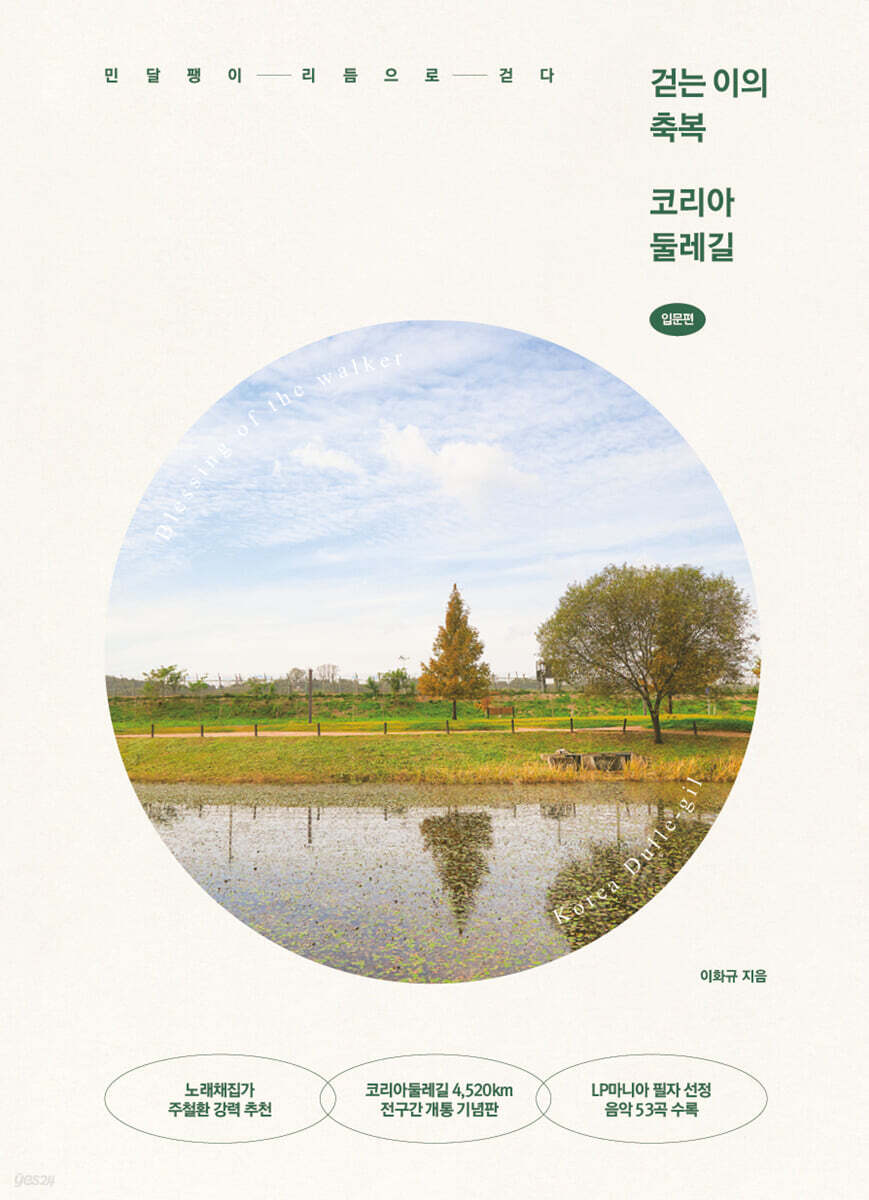
Blessings for Walkers: Korea Trail: Introduction
 |
Description
Book Introduction
The author, a master of slow, long walks, wrote an introductory article on the Korea Trail.
To date, 41 people have completed the Korea Trail and been inducted into the "Hall of Fame." This is the first book among those who completed the trail. For a long-distance walking tour to be successful, it must involve a network of like-minded individuals, unique accommodations, and small art galleries, all intertwined with a compelling story.
If you're wondering whether you're going at your own pace in an age where speed is emphasized, if you're curious about stories on the road, if you want to savor the blessings of walking on two feet, there are plenty of stories to explore.
The Korea Trail is a trekking path that connects the east, west, south, and north edges of South Korea.
The starting point is Oryukdo Island in Busan, and if you connect the Land's End Tower in Haenam, Jeollanam-do, the Peace Observatory in Ganghwa, Incheon, and the Unification Observatory in Goseong, Gangwon-do, a mouth shape is drawn.
Following the opening of the East Coast Haeparang Trail in 2016, the South Coast Namparang Trail, the West Coast Seohaerang Trail, and the DMZ Peace Trail in the Demilitarized Zone (DMZ) in September 2024, the world's longest trekking section of 4,520 km will be completed.
This means that we now have long-distance trekking trails like Spain's Camino de Santiago, the United States' John Muir Trail (JMT), the Pacific Crest Trail (PCT), New Zealand's Milford Track, Nepal's ABC Trek, EBC Trek, Annapurna Circuit, and Peru's Inca Trail. The walking culture has been spreading in Korea since the late 2000s.
As of 2021, there are approximately 600 walking trails, totaling 20,000 km, in Korea. Let's embark on the Korea Dulle-gil Cultural Trail, guided by the author, a domestic and international trekking trail expert and forest interpreter.
To date, 41 people have completed the Korea Trail and been inducted into the "Hall of Fame." This is the first book among those who completed the trail. For a long-distance walking tour to be successful, it must involve a network of like-minded individuals, unique accommodations, and small art galleries, all intertwined with a compelling story.
If you're wondering whether you're going at your own pace in an age where speed is emphasized, if you're curious about stories on the road, if you want to savor the blessings of walking on two feet, there are plenty of stories to explore.
The Korea Trail is a trekking path that connects the east, west, south, and north edges of South Korea.
The starting point is Oryukdo Island in Busan, and if you connect the Land's End Tower in Haenam, Jeollanam-do, the Peace Observatory in Ganghwa, Incheon, and the Unification Observatory in Goseong, Gangwon-do, a mouth shape is drawn.
Following the opening of the East Coast Haeparang Trail in 2016, the South Coast Namparang Trail, the West Coast Seohaerang Trail, and the DMZ Peace Trail in the Demilitarized Zone (DMZ) in September 2024, the world's longest trekking section of 4,520 km will be completed.
This means that we now have long-distance trekking trails like Spain's Camino de Santiago, the United States' John Muir Trail (JMT), the Pacific Crest Trail (PCT), New Zealand's Milford Track, Nepal's ABC Trek, EBC Trek, Annapurna Circuit, and Peru's Inca Trail. The walking culture has been spreading in Korea since the late 2000s.
As of 2021, there are approximately 600 walking trails, totaling 20,000 km, in Korea. Let's embark on the Korea Dulle-gil Cultural Trail, guided by the author, a domestic and international trekking trail expert and forest interpreter.
- You can preview some of the book's contents.
Preview
index
prolog
Chapter 1 Walking Time
Old Zelkova Tree, Older Ferry 15
Yeah, this is the rhythm 24
Who said we should put a deck on the riverside path? 32
Along the riverbank and along the shore 39
A beautiful sunset falls on the reed-covered riverbank 47
Standing Alone on the Road, Waking Me Up 53
Walking with the Wind and Listening to Its Song 59
Chapter 2 Inner Time
Song for All That Vanishes 69
Do lotus flowers bloom at the end of a tidal flat? 75
Walking barefoot through the fox pass 81
Bernechen and the Chicken Farmer's Son 87
The Thorny Path of Hatred and Contempt Walked by a Noble Soul 91
So what will you eat and where will you sleep? 95
It flows according to the melody, but when something goes wrong, 100
Experience the chaos of hot and cold waters, encounter a flock of magpies 106
Chapter 3 Story Time 1
Getting scolded on a bicycle and heading to Sodongryeong Village 113
Leading, following, or falling behind 120
Soldiers oxidized in the fog, and now, Park In-hwan, 127
A series of wasted steps, what can I do? That is the true nature of life. 132
Contemplation over a Cup of Convenience Store Coffee 138
Unification: The Fading Days 143
Walking through the autumn fields in the rain 149
After completing the entire 4,520km section of the Korea Trail, I fell into deep thought. 153
Chapter 4 Story Time 2
When did we learn to trust the sun? 161
So how should we live? 166
Jangdan Bean Curd and Apple Pie 172
178 Stories of the Red Cliffs on the Imjin River
What Song Does the Rain Sing on the Hillside? 184
In Search of the Home of My Solitude 191
A slow, dizzy, and crazy summer day 197
Why We Repeat the Same Mistakes 203
A rolling stone dislodges an entrenched stone 209
On a day drenched in autumn rain, soothe the sorrowful hunger of the body with flower flesh 215
Chapter 5 Ecology Time 1
Inbukcheon, Macro and Micro Worlds in My Senses 223
On the way to the Peace Dam, 'Rolling, rolling, rolling, rolling~!!' 228
Where does the poison of the bloodthirsty tree lie? 235
Where Does the Mountain Shadow Disappear? 241
"Deguldegul," Battle of Hwagang 247
Meeting Carter Magruder and 'sympathizing' with the flora 252
Autumn Scenery Interpreted Through Poetry 258
Explore Every Corner of Yeoncheon 263
The Comfort and Joy of Walking Alone 269
Encountering Autumn Vegetation in the Imjin River Tributaries 275
Chapter 6 Ecology Time 2
The Snail, the Gecko, and 'Four Strong Winds' 283
Have you heard of Pine Tree's "Eat-and-Drink Street"? 288
Can a Damaged Ecosystem Be Restored? 296
Sympathizing with the Plants, Telling the Story of Oak Trees Around the World 302
Starting with White Clover and Ending with Crimson Clover 309
Where will the birds close their eyes for the last time? 315
324 for the 31 innocent fir trees
When Do Baby Bees Get Their First Taste of Caffeine? 331
Enjoying Autumn 338
Epilogue
Appendix - List of music and videos with QR codes
Chapter 1 Walking Time
Old Zelkova Tree, Older Ferry 15
Yeah, this is the rhythm 24
Who said we should put a deck on the riverside path? 32
Along the riverbank and along the shore 39
A beautiful sunset falls on the reed-covered riverbank 47
Standing Alone on the Road, Waking Me Up 53
Walking with the Wind and Listening to Its Song 59
Chapter 2 Inner Time
Song for All That Vanishes 69
Do lotus flowers bloom at the end of a tidal flat? 75
Walking barefoot through the fox pass 81
Bernechen and the Chicken Farmer's Son 87
The Thorny Path of Hatred and Contempt Walked by a Noble Soul 91
So what will you eat and where will you sleep? 95
It flows according to the melody, but when something goes wrong, 100
Experience the chaos of hot and cold waters, encounter a flock of magpies 106
Chapter 3 Story Time 1
Getting scolded on a bicycle and heading to Sodongryeong Village 113
Leading, following, or falling behind 120
Soldiers oxidized in the fog, and now, Park In-hwan, 127
A series of wasted steps, what can I do? That is the true nature of life. 132
Contemplation over a Cup of Convenience Store Coffee 138
Unification: The Fading Days 143
Walking through the autumn fields in the rain 149
After completing the entire 4,520km section of the Korea Trail, I fell into deep thought. 153
Chapter 4 Story Time 2
When did we learn to trust the sun? 161
So how should we live? 166
Jangdan Bean Curd and Apple Pie 172
178 Stories of the Red Cliffs on the Imjin River
What Song Does the Rain Sing on the Hillside? 184
In Search of the Home of My Solitude 191
A slow, dizzy, and crazy summer day 197
Why We Repeat the Same Mistakes 203
A rolling stone dislodges an entrenched stone 209
On a day drenched in autumn rain, soothe the sorrowful hunger of the body with flower flesh 215
Chapter 5 Ecology Time 1
Inbukcheon, Macro and Micro Worlds in My Senses 223
On the way to the Peace Dam, 'Rolling, rolling, rolling, rolling~!!' 228
Where does the poison of the bloodthirsty tree lie? 235
Where Does the Mountain Shadow Disappear? 241
"Deguldegul," Battle of Hwagang 247
Meeting Carter Magruder and 'sympathizing' with the flora 252
Autumn Scenery Interpreted Through Poetry 258
Explore Every Corner of Yeoncheon 263
The Comfort and Joy of Walking Alone 269
Encountering Autumn Vegetation in the Imjin River Tributaries 275
Chapter 6 Ecology Time 2
The Snail, the Gecko, and 'Four Strong Winds' 283
Have you heard of Pine Tree's "Eat-and-Drink Street"? 288
Can a Damaged Ecosystem Be Restored? 296
Sympathizing with the Plants, Telling the Story of Oak Trees Around the World 302
Starting with White Clover and Ending with Crimson Clover 309
Where will the birds close their eyes for the last time? 315
324 for the 31 innocent fir trees
When Do Baby Bees Get Their First Taste of Caffeine? 331
Enjoying Autumn 338
Epilogue
Appendix - List of music and videos with QR codes
Detailed image

Into the book
Yeah, this is the rhythm.
Slowly move forward at a 'human pace', breathing in time with the rhythm.
This is my own pace.
I try to walk slower than a turtle if possible.
I walk slowly with the rhythm of a snail riding the sunlight after the rain.
I believe that walking slowly is the way to worship and walk on the earth that God created.
--- p.25, from "Yes, this is the rhythm"
A true hiker doesn't talk about how much they walked in a day, how much more they have to walk, or whether they received a certificate of completion.
They talk about the people and scenery they meet on the road.
We talk about the flowers, the grass, the trees, the buddleia we saw there, and the hummingbird moths we thought were hummingbirds.
--- p.49, from “The sunset falls beautifully on the reed riverbank”
My 'slowness' is not the exact opposite of 'fastness'.
Rather, it can be said to be the opposite concept of ‘impatience.’
One of the illusions we have is the belief that 'speed buys time'.
But if you rush and rush, time will pass more quickly.
If you walk slowly, time will pass.
That's why people who walk slowly live longer.
--- p.61, from “Walking with the Wind and Listening to the Wind’s Song”
As we entered the village, the rain stopped as if it had never rained.
I'm very confused because of the weather that goes back and forth between cold and hot water.
Not only has the rain stopped, but the bright sunlight begins to beat down.
Camels walking through the Taklamakan Desert turn their faces toward the sun when there is no shade to rest.
On the other hand, ostriches bury their faces in the ground when in danger.
Am I a camel person or an ostrich person?
--- p.187, from “What Song Do Raindrops Sing on the Hillside?”
'Whirl, swoosh, roll, roll, yum yum~!!' This is a new word I made up to describe the four ways plants move their seeds.
Different plants have different ways of sending their seeds far away.
The first one is 'whoosh whoosh'.
Asteraceae plants, such as thistles, dandelions, and chrysanthemums, primarily use the wind to disperse their seeds.
The calyx is modified to have feathers or hairs attached to the seeds so that they can be easily carried by the wind.
--- p.232, from "On the way to the Dam of Peace, 'Flutter, flutter, roll, roll, yum yum~!"
'Coming to know' may be influenced by human speculation and assertion, but 'figuring out' is accepting what nature tells us.
This is a great lesson to learn from spiders and their webs.
Don't blindly assume common sense and impose it on others.
Let's not force common sense on others. That's why sometimes we need the humility to reserve our opinions.
Mencius said, "The heart of resignation is the beginning of propriety."
It means, 'Humble yielding attitude is the basis of courtesy.'
--- From "Where is the poison in the bloody tree?"
The flesh of the blueberry fruit is digested in the bird's stomach, and the hard seed coat becomes soft due to stomach acid.
When the birds fly away and excrete the seeds they have digested, the dogwood tree finally begins to spread its offspring.
Trees that cannot move on their own have developed a survival strategy of sending their offspring far away with the help of birds.
In this way, the worlds in the forest are interconnected and coexist with each other, forming special relationships.
--- p.260, from “Autumn Scenery Interpreted Through Poetry”
There's nothing quite like taking a leisurely walk to engage your senses on the road.
Since the Industrial Revolution, rapid technological innovation has made humans obsessed with speed.
Even without explaining, the side effects are proportional to the increased convenience due to speed.
I believe that 'walking with your body' is the only way to solve these problems.
Slowly move forward at a 'human pace', breathing in time with the rhythm.
This is my own pace.
I try to walk slower than a turtle if possible.
I walk slowly with the rhythm of a snail riding the sunlight after the rain.
I believe that walking slowly is the way to worship and walk on the earth that God created.
--- p.25, from "Yes, this is the rhythm"
A true hiker doesn't talk about how much they walked in a day, how much more they have to walk, or whether they received a certificate of completion.
They talk about the people and scenery they meet on the road.
We talk about the flowers, the grass, the trees, the buddleia we saw there, and the hummingbird moths we thought were hummingbirds.
--- p.49, from “The sunset falls beautifully on the reed riverbank”
My 'slowness' is not the exact opposite of 'fastness'.
Rather, it can be said to be the opposite concept of ‘impatience.’
One of the illusions we have is the belief that 'speed buys time'.
But if you rush and rush, time will pass more quickly.
If you walk slowly, time will pass.
That's why people who walk slowly live longer.
--- p.61, from “Walking with the Wind and Listening to the Wind’s Song”
As we entered the village, the rain stopped as if it had never rained.
I'm very confused because of the weather that goes back and forth between cold and hot water.
Not only has the rain stopped, but the bright sunlight begins to beat down.
Camels walking through the Taklamakan Desert turn their faces toward the sun when there is no shade to rest.
On the other hand, ostriches bury their faces in the ground when in danger.
Am I a camel person or an ostrich person?
--- p.187, from “What Song Do Raindrops Sing on the Hillside?”
'Whirl, swoosh, roll, roll, yum yum~!!' This is a new word I made up to describe the four ways plants move their seeds.
Different plants have different ways of sending their seeds far away.
The first one is 'whoosh whoosh'.
Asteraceae plants, such as thistles, dandelions, and chrysanthemums, primarily use the wind to disperse their seeds.
The calyx is modified to have feathers or hairs attached to the seeds so that they can be easily carried by the wind.
--- p.232, from "On the way to the Dam of Peace, 'Flutter, flutter, roll, roll, yum yum~!"
'Coming to know' may be influenced by human speculation and assertion, but 'figuring out' is accepting what nature tells us.
This is a great lesson to learn from spiders and their webs.
Don't blindly assume common sense and impose it on others.
Let's not force common sense on others. That's why sometimes we need the humility to reserve our opinions.
Mencius said, "The heart of resignation is the beginning of propriety."
It means, 'Humble yielding attitude is the basis of courtesy.'
--- From "Where is the poison in the bloody tree?"
The flesh of the blueberry fruit is digested in the bird's stomach, and the hard seed coat becomes soft due to stomach acid.
When the birds fly away and excrete the seeds they have digested, the dogwood tree finally begins to spread its offspring.
Trees that cannot move on their own have developed a survival strategy of sending their offspring far away with the help of birds.
In this way, the worlds in the forest are interconnected and coexist with each other, forming special relationships.
--- p.260, from “Autumn Scenery Interpreted Through Poetry”
There's nothing quite like taking a leisurely walk to engage your senses on the road.
Since the Industrial Revolution, rapid technological innovation has made humans obsessed with speed.
Even without explaining, the side effects are proportional to the increased convenience due to speed.
I believe that 'walking with your body' is the only way to solve these problems.
--- p.350, from "Epilogue"
Publisher's Review
The Korea Trail covered in this book is the entire Gyeonggi Trail and the entire DMZ Peace Trail.
The Gyeongni Trail, which overlaps with the Korea Trail in some sections, is a place with a relatively rich history, and the DMZ Peace Trail was chosen because it is a place rich in stories of peace and ecology.
Chapters 1 and 2 cover the Gyeonggi Trail's courses 34-60 and 01-06, respectively. They discuss walking and the changes that occur within.
“As I walk, I become nothing.
Rather than being an individual carrying a private history, it moves as a flow of life that is nothing.
It takes a long walk to bring about such changes.
As you walk for a long time, you gradually become free from time and space.
“Gradually, we move away from the pressure of speed.”_Book, p. 40
In an age of profound numbness, the author says, simply placing your right foot after your left can restore a richer sense of touch.
Running or using a vehicle can cause sensory distortion.
This activity turns into a sport or challenge, again leading to competition through speed.
Long walks are not a sport or a challenge, but rather an inner journey.
Chapters 3 and 4 cover the DMZ Peace Trail Course 34-1 and the Gyeonggi Trail Course 05-24. To create an attractive trail, it must have a story, along with the infrastructure for the trail and accommodations.
Although it takes time for these three conditions to come together, the author diligently transcribes the stories he discovers along the way.
“I really don’t know why I put myself through such hardship.
However, as I walk along despite the blazing sun, reflection, contemplation, music, and classical stories come to mind.
“It seems to be the result of dividing the sun and feeling a sense of awe at life.” - Book, page 163
Poetry, music, and classical quotes that harmonize with the scenery encountered while walking unfold like a painting.
Chapters 5 and 6 are DMZ Peace Trail Courses 30-6 and Gyeonggi Trail Courses 19-35.
This chapter deals with plant identification.
Plant identification refers to the process of correctly determining the taxonomic affiliation or name of a plant.
The author, who is also a forest interpreter, explains the movement of seeds as “flutter, roll, roll, yum yum~” This means that seeds 1. use the wind, 2. stick to the body of an animal, or 3.
It is a new word created by the author to describe the method of falling as a fruit or being buried in the ground with animal excrement.
The story of the oak tree in Hwayasan Mountain, the fir tree in Bosanjeong, Danwol-myeon, clover, and bees and coffee is explained by dividing the relationship between spiders and spider webs into what is known, what has been learned, and what has been discovered.
What the author wants to emphasize through this is that 'we are all interconnected beings' and that we all have our own roles to play.
There is no such thing as a roleless being, and the human-centered concepts of 'benefit' and 'harm' also need to be examined more carefully.
The author points out 'Hyeongjangseong' as the point of difference between trekking literature and travelogues.
Thanks to what we see, hear, and feel on the ground, the thoughts and words that come to mind, and the stories we hear from people we meet, we can sit back and appreciate what is happening in our country.
The list of cafes and restaurants that are likened to oases in the desert is also interesting.
The Gyeongni Trail, which overlaps with the Korea Trail in some sections, is a place with a relatively rich history, and the DMZ Peace Trail was chosen because it is a place rich in stories of peace and ecology.
Chapters 1 and 2 cover the Gyeonggi Trail's courses 34-60 and 01-06, respectively. They discuss walking and the changes that occur within.
“As I walk, I become nothing.
Rather than being an individual carrying a private history, it moves as a flow of life that is nothing.
It takes a long walk to bring about such changes.
As you walk for a long time, you gradually become free from time and space.
“Gradually, we move away from the pressure of speed.”_Book, p. 40
In an age of profound numbness, the author says, simply placing your right foot after your left can restore a richer sense of touch.
Running or using a vehicle can cause sensory distortion.
This activity turns into a sport or challenge, again leading to competition through speed.
Long walks are not a sport or a challenge, but rather an inner journey.
Chapters 3 and 4 cover the DMZ Peace Trail Course 34-1 and the Gyeonggi Trail Course 05-24. To create an attractive trail, it must have a story, along with the infrastructure for the trail and accommodations.
Although it takes time for these three conditions to come together, the author diligently transcribes the stories he discovers along the way.
“I really don’t know why I put myself through such hardship.
However, as I walk along despite the blazing sun, reflection, contemplation, music, and classical stories come to mind.
“It seems to be the result of dividing the sun and feeling a sense of awe at life.” - Book, page 163
Poetry, music, and classical quotes that harmonize with the scenery encountered while walking unfold like a painting.
Chapters 5 and 6 are DMZ Peace Trail Courses 30-6 and Gyeonggi Trail Courses 19-35.
This chapter deals with plant identification.
Plant identification refers to the process of correctly determining the taxonomic affiliation or name of a plant.
The author, who is also a forest interpreter, explains the movement of seeds as “flutter, roll, roll, yum yum~” This means that seeds 1. use the wind, 2. stick to the body of an animal, or 3.
It is a new word created by the author to describe the method of falling as a fruit or being buried in the ground with animal excrement.
The story of the oak tree in Hwayasan Mountain, the fir tree in Bosanjeong, Danwol-myeon, clover, and bees and coffee is explained by dividing the relationship between spiders and spider webs into what is known, what has been learned, and what has been discovered.
What the author wants to emphasize through this is that 'we are all interconnected beings' and that we all have our own roles to play.
There is no such thing as a roleless being, and the human-centered concepts of 'benefit' and 'harm' also need to be examined more carefully.
The author points out 'Hyeongjangseong' as the point of difference between trekking literature and travelogues.
Thanks to what we see, hear, and feel on the ground, the thoughts and words that come to mind, and the stories we hear from people we meet, we can sit back and appreciate what is happening in our country.
The list of cafes and restaurants that are likened to oases in the desert is also interesting.
GOODS SPECIFICS
- Date of issue: April 30, 2025
- Page count, weight, size: 356 pages | 152*210*30mm
- ISBN13: 9791194294115
- ISBN10: 1194294111
You may also like
카테고리
korean


korean

![GQ KOREA Mark (Monthly): December [2025]](http://librairie.coreenne.fr/cdn/shop/files/8ef265dbbfbf186523ed75ba7319009d.jpg?v=1765340328&width=3840)


