

Korean language study for translators
 |
Description
Book Introduction
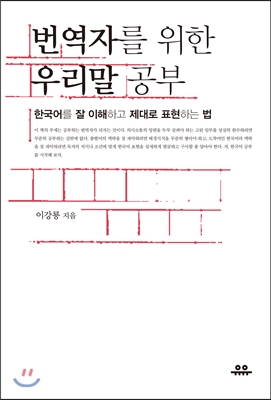
"Korean Language Study for Translators" (YuYu) written by Kangryong Lee, a translator and writing education expert, is a book that says that one must have proper Korean language skills to become a great translator.
He argues that translators need to develop good writing skills by developing good Korean communication habits in addition to analyzing original texts and studying foreign languages.
He argues that translators need to develop good writing skills by developing good Korean communication habits in addition to analyzing original texts and studying foreign languages.
- You can preview some of the book's contents.
Preview
index
preface
Chapter 1: Choosing a Good Text
1.
Is the topic clear?
2.
Is the source accurate?
3.
Is there sufficient evidence?
4.
Is responsibility clear?
Chapter 2: Terminology
1.
Distinguishing Similar Terms
2.
Analysis of misspelled words
3.
Suggest a new expression
Chapter 3: Context
1.
Context of the source language
2.
Context of the destination language
3.
Conditions for mistranslation
Chapter 4 Sentence Refining
1.
Reduce errors
2.
Eliminate clutter
3.
Matching sentence cases
4.
Foreign language two barugi
Chapter 5: Acquiring Grammar Knowledge
1.
Grammar study tips
2.
Use of punctuation marks
Chapter 6: Using Background Knowledge
1.
Translator's note
2.
commentary
Conclusion
References
Chapter 1: Choosing a Good Text
1.
Is the topic clear?
2.
Is the source accurate?
3.
Is there sufficient evidence?
4.
Is responsibility clear?
Chapter 2: Terminology
1.
Distinguishing Similar Terms
2.
Analysis of misspelled words
3.
Suggest a new expression
Chapter 3: Context
1.
Context of the source language
2.
Context of the destination language
3.
Conditions for mistranslation
Chapter 4 Sentence Refining
1.
Reduce errors
2.
Eliminate clutter
3.
Matching sentence cases
4.
Foreign language two barugi
Chapter 5: Acquiring Grammar Knowledge
1.
Grammar study tips
2.
Use of punctuation marks
Chapter 6: Using Background Knowledge
1.
Translator's note
2.
commentary
Conclusion
References
Publisher's Review
Ha Jung-woo's original surname is Kim - More Korean Expressions Koreans Should Learn
Why is it so difficult for Koreans to speak Korean with each other? If you've ever experienced this, it speaks to the problems of translation.
Translation is not just translating foreign words into Korean, but also translating specialized terms into general terms, translating general terms into everyday language, explaining adult expressions into children's expressions, and even interpreting women's speech as men's speech.
The term 'Angbuilgu' (仰釜日晷) is also translated as 'concave sundial'.
If you translate Angbuilgu directly, it is a 'sundial in the shape of an open cauldron', but it is appropriately translated as a 'concave sundial', which is easy for anyone to understand.
Another example of a good translation is that the phrase "company opportunity exploitation," which refers to internal transactions within a company, is changed to "work hoarding" in the article.
"Korean Language Study for Translators" (YuYu) written by Kangryong Lee, a translator and writing education expert, is a book that says that one must have proper Korean language skills to become a great translator.
He argues that translators need to develop good writing skills by developing good Korean communication habits in addition to analyzing original texts and studying foreign languages.
When I try to write a message on KakaoTalk or SNS or send a text message, I get confused as to whether it is correct to use '하마터면' or '하마터면'.
What should I do in that case? Just write 'if you're not careful'.
When you are confused about whether to do something 'a little bit' or 'a little bit', you can write 'a little bit'.
Then, the expressions 'almost' and 'almost' will disappear from everyday communication and will remain unfamiliar expressions.
“Actor Ha Jung-woo’s father is actor Kim Yong-gun.
Ha Jung-woo's original surname is Kim.
“The seed is now completely free from the halo of the father.” In the above quote, ‘씨’ is used in three ways.
When '씨' is attached to a surname, it becomes an affix indicating a family line. When it is placed after a surname or first name, it becomes a dependent noun that honors the person. When it is used alone, it becomes a pronoun.
The reason why ‘Mr. Ha Jung-woo’ is written with a space in the first sentence is because ‘Mr.’ is used as a dependent noun to honor Ha Jung-woo.
The reason why ‘Kim’ is written as a suffix in the second sentence is because ‘Kim’ is used as a suffix to confirm that it is a surname.
Although rare, it is possible to use '씨' as a pronoun, as in the third sentence.
It may seem confusing at first, but once you learn it well, you will be able to use it properly at the right time.
Even when the word 'She' appears in an English sentence, there are times when it should be translated as 'girl' or 'girl' depending on the context, and there are times when it should be written as 'lady' or 'woman' or 'wife' or 'old woman'.
Sometimes it's better to use a woman's name.
Mija, who appears in the film "Poetry" directed by Lee Chang-dong, is a typical literary girl when she goes to take a poetry class, but when she prepares a meal for her grandson, she becomes an ordinary grandmother, and when she prepares a settlement to prevent her grandson, who was involved in a sexual assault, from being put in handcuffs, she falls to the level of a pitiful woman who has thrown away her pride as a woman.
How bland it would be if we called all these diverse appearances 'her'.
It is not Korean to write a phrase in "Shower" that talks about a girl as "She is quite pitiful."
If you pay just a little attention to oak trees, you can tell whether they are oak, oak tree, oak tree, oak tree, oak tree, or oak tree.
Instead of using the general expression 'it is fermented', it would be better to use more nuanced expressions that fit the context, such as 'when salted seafood becomes fermented', 'when kimchi becomes ripe', and 'when soybean paste becomes fermented'.
Koreans know several terms for pollack.
Young pollack is called nogari, frozen pollack is called dongtae, dried pollack is called buk-eo, and dried pollack that has been repeatedly frozen and thawed is called hwangtae.
Codfish is dried pollack that has been dried just enough to be crunchy.
Foreigners who are not familiar with the subtle Korean expressions will likely use expressions like 'dried pollack' or 'frozen pollack', but Koreans who are familiar with these expressions will want to teach them properly.
While generic expressions are convenient, they have limitations in accurately expressing the original meaning. "Korean Language Study for Translators" encourages us to overcome the unfamiliarity of expressions and terminology and move toward a level of improved communication.
"Nanjung Ilgi" can be written entirely in Korean, but "Baekbeom Ilji" also requires Chinese characters - a translation that considers the reader's perspective.
Translators and editors, when organizing manuscripts, always worry about when to include Chinese characters or foreign language characters and when not to.
Kangryong Lee, author of “Korean Language Study for Translators” (Yuyu, 2014), explains it this way.
When writing the 『Nanjung Ilgi』, a record left by Admiral Yi Sun-sin during the war, there is no need to use separate Chinese characters.
This is because a general reader with common sense can guess the original meaning of ‘a diary written during a war.’
However, it is better to write 『Baekbeom Ilji』 written by Kim Gu with the Chinese characters '白凡逸志'.
Otherwise, readers may misunderstand the term 'Ilji' as the widely known term 'ilji' (日誌). The title 'Baekbeom Ilji', if translated loosely, means 'an unknown story written by Baekbeom (a pen name meaning an ordinary citizen)'.
There is no need to include 'New York' in the translation of "New York City in the United States is the center of culture and arts in the 21st century," but the translation of "Potosi in Bolivia is the city where Spanish invaders exploited silver" must clearly indicate 'Potosi.'
Otherwise, readers might misunderstand the city name as 'Photo'.
From the reader's perspective, it is easy to decide whether or not to include the original language.
For example, in the sentence, “The background music for animations created by director Hayao Miyazaki was mainly composed by Joe Hisaishi,” the original words in parentheses do not necessarily need to be included.
It's just cumbersome for the average reader to read the sentences in one breath.
There should be a clear purpose for citing a proper name in its original language. For example, in the case of 'Jekyll and Hyde', citing the original language when the name first appears or when it is needed again in context helps to better understand the work.
Because if you change one letter of the name, it becomes 'kill' and 'hide', and those two concepts are major components of the work.
It is the translator's duty to help the reader properly understand the original meaning.
Verdi's opera "La Traviata" is an adaptation of the novel "La Lady of the Camellias" by Dumas fils.
'La traviata' means 'the lost woman', and the original title of 'La Dame aux Camélias' means 'the woman of the camellias'.
The title of the original novel and opera was translated in Japanese as "Tsubakihime" (椿姬).
In Japan, camellia is written as 'tsubaki' (椿) rather than 'dongbaek' (冬栢).
'Hime' means woman, so 'Tsubakihime' is a concise translation that preserves the original meaning.
However, in Korea, they did not plan to directly translate the original title, but instead read the Chinese characters in the Japanese translation title in the Korean way and translated it as 'Chunhee'.
When the original text is not directly translated but translated into another language and then translated again, it is called 'retranslation', and the title 'Chunhee' shows a typical problem with retranslation.
It is nearly impossible for a Korean to recall the original meaning of 'woman of camellia flowers' when seeing or hearing the word 'Chunhee'.
Moreover, in Korea, the Chinese character 'Chun' (椿) refers to the bamboo tree, not the camellia tree, so even if you look at the Chinese characters written together, it is difficult to get close to the original meaning.
The Japanese people wrote the country name Deutschland as 'Doitsu' (獨逸, ドイツ) for easier reading and writing.
The Japanese-style Chinese characters that came over to the Korean Peninsula were changed to Korean-style pronunciation, becoming Germany.
It's like Coca-Cola becoming 'Kekoukele' (可口可樂) in China, and then changing to 'Gagugarak' (可口可樂) in Korea.
So, should we now change Germany to Deutschland? It would be advisable to do so.
However, since the term Germany has already become so entrenched, it will take a considerable amount of time to change it.
So, it is important to translate well from the beginning, and the responsibility lies with the translator.
"Korean Language Study for Translators" is not a translation textbook for improving foreign language skills, but rather a writing textbook that cultivates the ability to discern good writing and use excellent Korean expressions.
The readers of this book include current translators who feel that their Korean vocabulary and grammar sense have become dulled due to working solely on technical documents, interpreters who feel that their Korean expressiveness is lacking compared to their foreign language proficiency, novice translators who are just entering the world of translation, and foreign book editors who have to review numerous translations and judge the quality of manuscripts.
Why is it so difficult for Koreans to speak Korean with each other? If you've ever experienced this, it speaks to the problems of translation.
Translation is not just translating foreign words into Korean, but also translating specialized terms into general terms, translating general terms into everyday language, explaining adult expressions into children's expressions, and even interpreting women's speech as men's speech.
The term 'Angbuilgu' (仰釜日晷) is also translated as 'concave sundial'.
If you translate Angbuilgu directly, it is a 'sundial in the shape of an open cauldron', but it is appropriately translated as a 'concave sundial', which is easy for anyone to understand.
Another example of a good translation is that the phrase "company opportunity exploitation," which refers to internal transactions within a company, is changed to "work hoarding" in the article.
"Korean Language Study for Translators" (YuYu) written by Kangryong Lee, a translator and writing education expert, is a book that says that one must have proper Korean language skills to become a great translator.
He argues that translators need to develop good writing skills by developing good Korean communication habits in addition to analyzing original texts and studying foreign languages.
When I try to write a message on KakaoTalk or SNS or send a text message, I get confused as to whether it is correct to use '하마터면' or '하마터면'.
What should I do in that case? Just write 'if you're not careful'.
When you are confused about whether to do something 'a little bit' or 'a little bit', you can write 'a little bit'.
Then, the expressions 'almost' and 'almost' will disappear from everyday communication and will remain unfamiliar expressions.
“Actor Ha Jung-woo’s father is actor Kim Yong-gun.
Ha Jung-woo's original surname is Kim.
“The seed is now completely free from the halo of the father.” In the above quote, ‘씨’ is used in three ways.
When '씨' is attached to a surname, it becomes an affix indicating a family line. When it is placed after a surname or first name, it becomes a dependent noun that honors the person. When it is used alone, it becomes a pronoun.
The reason why ‘Mr. Ha Jung-woo’ is written with a space in the first sentence is because ‘Mr.’ is used as a dependent noun to honor Ha Jung-woo.
The reason why ‘Kim’ is written as a suffix in the second sentence is because ‘Kim’ is used as a suffix to confirm that it is a surname.
Although rare, it is possible to use '씨' as a pronoun, as in the third sentence.
It may seem confusing at first, but once you learn it well, you will be able to use it properly at the right time.
Even when the word 'She' appears in an English sentence, there are times when it should be translated as 'girl' or 'girl' depending on the context, and there are times when it should be written as 'lady' or 'woman' or 'wife' or 'old woman'.
Sometimes it's better to use a woman's name.
Mija, who appears in the film "Poetry" directed by Lee Chang-dong, is a typical literary girl when she goes to take a poetry class, but when she prepares a meal for her grandson, she becomes an ordinary grandmother, and when she prepares a settlement to prevent her grandson, who was involved in a sexual assault, from being put in handcuffs, she falls to the level of a pitiful woman who has thrown away her pride as a woman.
How bland it would be if we called all these diverse appearances 'her'.
It is not Korean to write a phrase in "Shower" that talks about a girl as "She is quite pitiful."
If you pay just a little attention to oak trees, you can tell whether they are oak, oak tree, oak tree, oak tree, oak tree, or oak tree.
Instead of using the general expression 'it is fermented', it would be better to use more nuanced expressions that fit the context, such as 'when salted seafood becomes fermented', 'when kimchi becomes ripe', and 'when soybean paste becomes fermented'.
Koreans know several terms for pollack.
Young pollack is called nogari, frozen pollack is called dongtae, dried pollack is called buk-eo, and dried pollack that has been repeatedly frozen and thawed is called hwangtae.
Codfish is dried pollack that has been dried just enough to be crunchy.
Foreigners who are not familiar with the subtle Korean expressions will likely use expressions like 'dried pollack' or 'frozen pollack', but Koreans who are familiar with these expressions will want to teach them properly.
While generic expressions are convenient, they have limitations in accurately expressing the original meaning. "Korean Language Study for Translators" encourages us to overcome the unfamiliarity of expressions and terminology and move toward a level of improved communication.
"Nanjung Ilgi" can be written entirely in Korean, but "Baekbeom Ilji" also requires Chinese characters - a translation that considers the reader's perspective.
Translators and editors, when organizing manuscripts, always worry about when to include Chinese characters or foreign language characters and when not to.
Kangryong Lee, author of “Korean Language Study for Translators” (Yuyu, 2014), explains it this way.
When writing the 『Nanjung Ilgi』, a record left by Admiral Yi Sun-sin during the war, there is no need to use separate Chinese characters.
This is because a general reader with common sense can guess the original meaning of ‘a diary written during a war.’
However, it is better to write 『Baekbeom Ilji』 written by Kim Gu with the Chinese characters '白凡逸志'.
Otherwise, readers may misunderstand the term 'Ilji' as the widely known term 'ilji' (日誌). The title 'Baekbeom Ilji', if translated loosely, means 'an unknown story written by Baekbeom (a pen name meaning an ordinary citizen)'.
There is no need to include 'New York' in the translation of "New York City in the United States is the center of culture and arts in the 21st century," but the translation of "Potosi in Bolivia is the city where Spanish invaders exploited silver" must clearly indicate 'Potosi.'
Otherwise, readers might misunderstand the city name as 'Photo'.
From the reader's perspective, it is easy to decide whether or not to include the original language.
For example, in the sentence, “The background music for animations created by director Hayao Miyazaki was mainly composed by Joe Hisaishi,” the original words in parentheses do not necessarily need to be included.
It's just cumbersome for the average reader to read the sentences in one breath.
There should be a clear purpose for citing a proper name in its original language. For example, in the case of 'Jekyll and Hyde', citing the original language when the name first appears or when it is needed again in context helps to better understand the work.
Because if you change one letter of the name, it becomes 'kill' and 'hide', and those two concepts are major components of the work.
It is the translator's duty to help the reader properly understand the original meaning.
Verdi's opera "La Traviata" is an adaptation of the novel "La Lady of the Camellias" by Dumas fils.
'La traviata' means 'the lost woman', and the original title of 'La Dame aux Camélias' means 'the woman of the camellias'.
The title of the original novel and opera was translated in Japanese as "Tsubakihime" (椿姬).
In Japan, camellia is written as 'tsubaki' (椿) rather than 'dongbaek' (冬栢).
'Hime' means woman, so 'Tsubakihime' is a concise translation that preserves the original meaning.
However, in Korea, they did not plan to directly translate the original title, but instead read the Chinese characters in the Japanese translation title in the Korean way and translated it as 'Chunhee'.
When the original text is not directly translated but translated into another language and then translated again, it is called 'retranslation', and the title 'Chunhee' shows a typical problem with retranslation.
It is nearly impossible for a Korean to recall the original meaning of 'woman of camellia flowers' when seeing or hearing the word 'Chunhee'.
Moreover, in Korea, the Chinese character 'Chun' (椿) refers to the bamboo tree, not the camellia tree, so even if you look at the Chinese characters written together, it is difficult to get close to the original meaning.
The Japanese people wrote the country name Deutschland as 'Doitsu' (獨逸, ドイツ) for easier reading and writing.
The Japanese-style Chinese characters that came over to the Korean Peninsula were changed to Korean-style pronunciation, becoming Germany.
It's like Coca-Cola becoming 'Kekoukele' (可口可樂) in China, and then changing to 'Gagugarak' (可口可樂) in Korea.
So, should we now change Germany to Deutschland? It would be advisable to do so.
However, since the term Germany has already become so entrenched, it will take a considerable amount of time to change it.
So, it is important to translate well from the beginning, and the responsibility lies with the translator.
"Korean Language Study for Translators" is not a translation textbook for improving foreign language skills, but rather a writing textbook that cultivates the ability to discern good writing and use excellent Korean expressions.
The readers of this book include current translators who feel that their Korean vocabulary and grammar sense have become dulled due to working solely on technical documents, interpreters who feel that their Korean expressiveness is lacking compared to their foreign language proficiency, novice translators who are just entering the world of translation, and foreign book editors who have to review numerous translations and judge the quality of manuscripts.
GOODS SPECIFICS
- Date of issue: March 4, 2014
- Page count, weight, size: 268 pages | 383g | 127*187*20mm
- ISBN13: 9791185152080
- ISBN10: 1185152083
You may also like
카테고리
korean


korean

![ELLE 엘르 스페셜 에디션 A형 : 12월 [2025]](http://librairie.coreenne.fr/cdn/shop/files/b8e27a3de6c9538896439686c6b0e8fb.jpg?v=1766436872&width=3840)


