

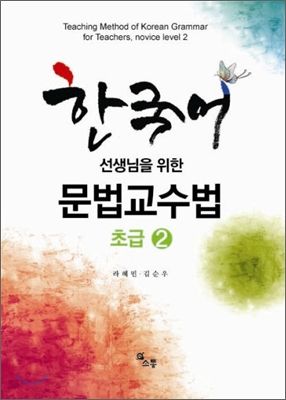
Grammar Teaching Methods for Korean Teachers
 |
Description
Book Introduction
This book aims to help Korean language teachers overcome the difficulties they face in the classroom by providing teaching methods for teaching Korean grammar to beginner learners.
It also helps learners of Korean improve their Korean language skills by allowing them to understand Korean sentence structures accurately.
These two books cover a total of 80 sentence patterns, which include most of the sentence patterns covered in the beginner level.
Additionally, this book presents 80 sentence patterns step by step, starting from the most basic 'Korean alphabet teaching'.
It also helps learners of Korean improve their Korean language skills by allowing them to understand Korean sentence structures accurately.
These two books cover a total of 80 sentence patterns, which include most of the sentence patterns covered in the beginner level.
Additionally, this book presents 80 sentence patterns step by step, starting from the most basic 'Korean alphabet teaching'.
index
1.
[형]ㄴ/은 [명]
2.
[Dong], [Hyeong]ㄹ/을
3.
[Dong], [Hyeong], shall we do it/do it?
4.
[Dong] Ah/uh/hey look
5.
From [Name 1] to [Name 2]
6.
From [Name 1] to [Name 2]
7.
Because it's [dong], [hyung]
8.
[Name]
9.
[Dong], [Hyung]?
10.
[Dong], [Hyung] Arthur/Eseo/Eseo
11.
[Dong]l/ can be, [Dong]l/ cannot be
12.
[Dong] can't
13.
[Dong] is [noun], [Dong]n/ is [noun], [Dong]r/ is [noun]
14.
'Le' irregular
15.
[Hyung]n/ seems to be
16.
It seems like [Dong], it seems like [Dong]n/, it seems like [Dong]r/
17.
[Dong]ro/eureo
18.
Before [the] period
19.
[Dong]n/eun after
20.
[Dong], [Hyeong] but
21.
Know how to pronounce [dong]r/, don't know how to pronounce [dong]r/
22.
'ㅎ' irregular
23.
[East] is going
24.
[Brother]ge [Dong]
25.
[Dong]Ah/uh/yeo please
26.
[Dong]n/eun ji
27.
Because of [dong] and [hyung]
28.
Because of [name]
29.
I have seen [Dong]A/Eo/Yeo, I have never seen [Dong]A/Eo/Yeo
30.
[East] try/try
31.
Than [name]
32.
[Dong]Ah/eo/yeodo is okay
33.
[East] side/if you don't like it, you can't
34.
[Dong]Da
35.
[Dong], [Hyeong] should be/are ...
36.
[Noun] while, [Dong] while
37.
When [dong], [hyung]ㄹ
38.
If [Dong], [Hyeong], then/if
39.
[East]Asher/Asher/Asher
40.
[Brother] Ah/uh/yejida
CD Image Table of Contents
[형]ㄴ/은 [명]
2.
[Dong], [Hyeong]ㄹ/을
3.
[Dong], [Hyeong], shall we do it/do it?
4.
[Dong] Ah/uh/hey look
5.
From [Name 1] to [Name 2]
6.
From [Name 1] to [Name 2]
7.
Because it's [dong], [hyung]
8.
[Name]
9.
[Dong], [Hyung]?
10.
[Dong], [Hyung] Arthur/Eseo/Eseo
11.
[Dong]l/ can be, [Dong]l/ cannot be
12.
[Dong] can't
13.
[Dong] is [noun], [Dong]n/ is [noun], [Dong]r/ is [noun]
14.
'Le' irregular
15.
[Hyung]n/ seems to be
16.
It seems like [Dong], it seems like [Dong]n/, it seems like [Dong]r/
17.
[Dong]ro/eureo
18.
Before [the] period
19.
[Dong]n/eun after
20.
[Dong], [Hyeong] but
21.
Know how to pronounce [dong]r/, don't know how to pronounce [dong]r/
22.
'ㅎ' irregular
23.
[East] is going
24.
[Brother]ge [Dong]
25.
[Dong]Ah/uh/yeo please
26.
[Dong]n/eun ji
27.
Because of [dong] and [hyung]
28.
Because of [name]
29.
I have seen [Dong]A/Eo/Yeo, I have never seen [Dong]A/Eo/Yeo
30.
[East] try/try
31.
Than [name]
32.
[Dong]Ah/eo/yeodo is okay
33.
[East] side/if you don't like it, you can't
34.
[Dong]Da
35.
[Dong], [Hyeong] should be/are ...
36.
[Noun] while, [Dong] while
37.
When [dong], [hyung]ㄹ
38.
If [Dong], [Hyeong], then/if
39.
[East]Asher/Asher/Asher
40.
[Brother] Ah/uh/yejida
CD Image Table of Contents
Publisher's Review
This book is divided into six stages as follows:
1.
Preliminary knowledge stage: The meaning, characteristics, and reference points of the target sentence structure are presented so that the teacher can understand it.
2.
Introduction stage: This is the stage where the target sentence structure is introduced to the learner.
This is a very important step because the introduction stage allows learners to guess the usage of the target sentence structure and understand the situations in which it is used.
The introductory situation in which the target sentence structure is used is presented through dialogue or related pictures.
3.
Presentation stage: Present the sentence structure to be studied and provide examples used in the introduction.
When presenting examples, examples that should be referenced, such as those with and without final consonants and irregular usage, are presented.
4.
Practice phase: Various methods, such as replacement practice and response practice, were provided to ensure that learners could practice sufficiently.
5.
Utilization stage: Various activity methods such as interview activities, information filling, songs, and games were suggested to enable students to use the target sentence structure in a fun and communicative way in classroom situations.
6.
Tip: Information on teaching materials needed to teach the target sentence structure and points to keep in mind when teaching the target sentence structure are provided.
1.
Preliminary knowledge stage: The meaning, characteristics, and reference points of the target sentence structure are presented so that the teacher can understand it.
2.
Introduction stage: This is the stage where the target sentence structure is introduced to the learner.
This is a very important step because the introduction stage allows learners to guess the usage of the target sentence structure and understand the situations in which it is used.
The introductory situation in which the target sentence structure is used is presented through dialogue or related pictures.
3.
Presentation stage: Present the sentence structure to be studied and provide examples used in the introduction.
When presenting examples, examples that should be referenced, such as those with and without final consonants and irregular usage, are presented.
4.
Practice phase: Various methods, such as replacement practice and response practice, were provided to ensure that learners could practice sufficiently.
5.
Utilization stage: Various activity methods such as interview activities, information filling, songs, and games were suggested to enable students to use the target sentence structure in a fun and communicative way in classroom situations.
6.
Tip: Information on teaching materials needed to teach the target sentence structure and points to keep in mind when teaching the target sentence structure are provided.
GOODS SPECIFICS
- Date of issue: May 21, 2011
- Page count, weight, size: 200 pages | 420g | Out of specification
- ISBN13: 9788993454482
- ISBN10: 8993454485
You may also like
카테고리
korean


korean

![ELLE 엘르 스페셜 에디션 A형 : 12월 [2025]](http://librairie.coreenne.fr/cdn/shop/files/b8e27a3de6c9538896439686c6b0e8fb.jpg?v=1766436872&width=3840)


