

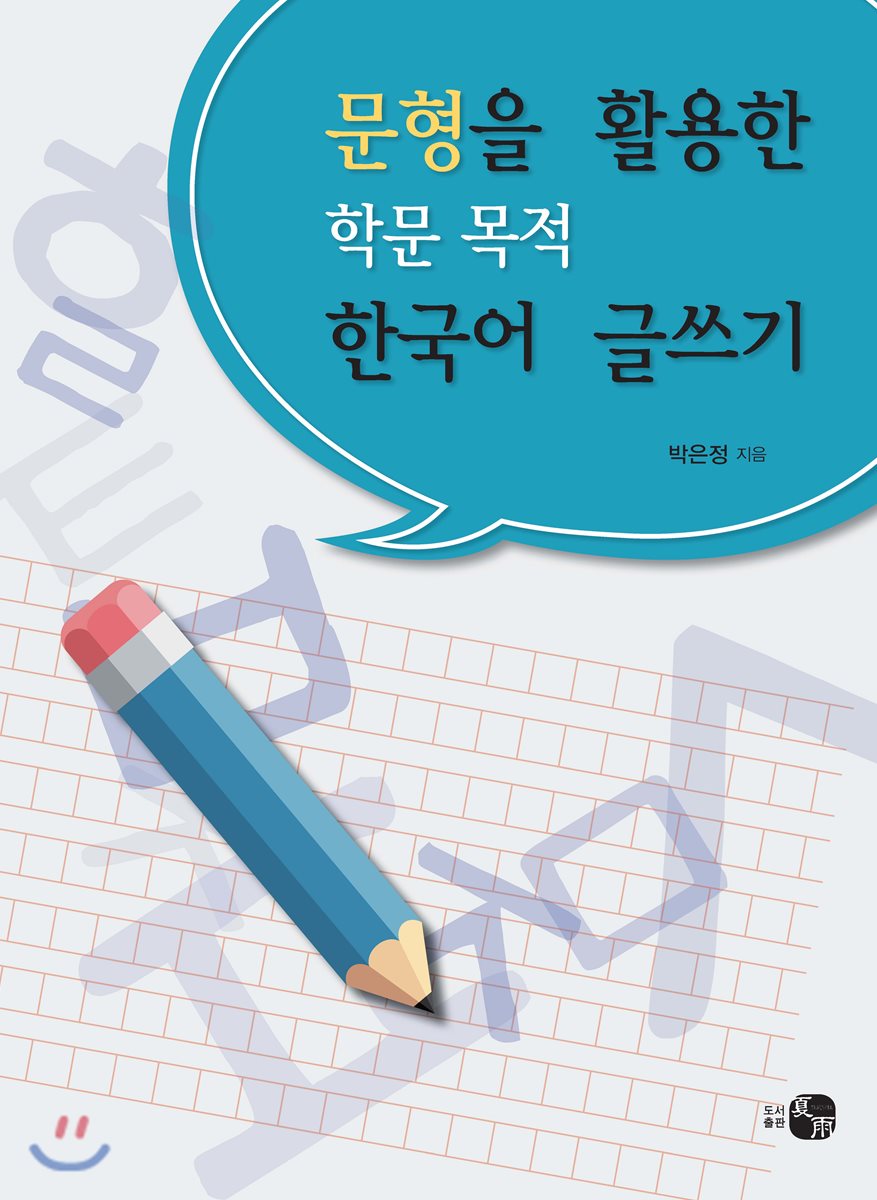
Academic Korean Writing Using Sentence Structure
 |
Description
Book Introduction
This textbook is designed to help foreign students learn Korean writing for academic purposes.
This textbook is designed to be particularly helpful for learners who have completed a language training course and are about to advance to undergraduate or graduate school, learners who have advanced to undergraduate or graduate school but are afraid of academic writing, and learners who have achieved a TOPIK level 3 or higher but are not confident in writing and want to build a solid foundation.
This textbook is designed to be particularly helpful for learners who have completed a language training course and are about to advance to undergraduate or graduate school, learners who have advanced to undergraduate or graduate school but are afraid of academic writing, and learners who have achieved a TOPIK level 3 or higher but are not confident in writing and want to build a solid foundation.
index
Part 1.
Korean Sentence Practice: Building Basic Sentences
1.
Sentence Making 1 Number of digits according to verb
2.
Sentence Making 2 Outline → Sentence, Sentence → Outline
3.
Sentence Making 3 Response
4.
Expanding sentences 1 Modifier + Modifier
5.
Sentence Extension 2 Conjunctive Adverbs
6.
Sentence Expansion 3 Prepositional Endings
7.
Sentence Extension 4 Conjunction Endings
8.
Expanding sentences 5 sentences + sentences + sentences
9.
spoken and written language
10.
Written endings
11.
Transliteration 1 Passive
12.
Change 2 verb
13.
Transliteration 3 Passive, causative voice
14.
Rewrite 4 Theme
15.
Paraphrase 5 Sentence Combination
16.
Rewriting 6 Word Order
17.
Paraphrase 7 Sentences with similar meaning
18.
Connective expressions that require special attention
Part 2-1.
Explaining how to write Korean sentences using sentence patterns
1.
Explain the pros and cons
2.
Compare
3.
Explaining the similarities and differences
4.
Explain the current situation
5.
Explain with source
6.
Explaining graph changes
7.
Quote a proverb
8.
Explain using means and mediation
9.
Explaining the statistical data
10.
Explain the reason 1
11.
Explain the cause
12.
List the causes
13.
Additional explanation 1
14.
Explain objectively
15.
Thematicization of sentences
16.
Define
17.
Introducing the subject
18.
To explain with an example
19.
Expressing classification
20.
Describing superior-subordinate relationships
21.
Expressing analysis
22.
Analyzing the change process
Part 2-2.
Arguing for writing Korean sentences using sentence patterns
1.
Make a strong claim
2.
Explaining the Reason 2 Claim + Reason
3.
Give an example of the cause
4.
Additional explanation 2
5.
Rebuttal
6.
Expressing other people's opinions/claims
7.
Objectification of Expressing One's Opinion/Argument 1
8.
Objectification of Expressing One's Opinion 2
9.
State your purpose
10.
Explain in detail Repeat explanation
11.
Judging values
12.
(Compare) Evaluate
13.
Point out the problem
14.
List the problems
15.
Request
16.
Emphasize the necessity
17.
Expressing Emphasis 1 Question Form
18.
Question format for expressing suggestions
19.
Expressing Emphasis 2 Adverbial Response
20.
Expressing Emphasis 3 Negative Words
21.
State the purpose of the text
22.
Limit
23.
Predicting the outcome
24.
Guess
25.
Describing the same category
26.
To make a metaphor
27.
List the circumstances
28.
Looking to the future
29.
Connecting interrogative sentences with interrogative words
Part 3.
Practice correcting actual errors for learners
1.
Intermediate sentence structure errors
2.
Advanced sentence structure errors
3.
Expression error
supplement
■ Model Answer
■ Error sentence answer
■ List of sentence patterns
Korean Sentence Practice: Building Basic Sentences
1.
Sentence Making 1 Number of digits according to verb
2.
Sentence Making 2 Outline → Sentence, Sentence → Outline
3.
Sentence Making 3 Response
4.
Expanding sentences 1 Modifier + Modifier
5.
Sentence Extension 2 Conjunctive Adverbs
6.
Sentence Expansion 3 Prepositional Endings
7.
Sentence Extension 4 Conjunction Endings
8.
Expanding sentences 5 sentences + sentences + sentences
9.
spoken and written language
10.
Written endings
11.
Transliteration 1 Passive
12.
Change 2 verb
13.
Transliteration 3 Passive, causative voice
14.
Rewrite 4 Theme
15.
Paraphrase 5 Sentence Combination
16.
Rewriting 6 Word Order
17.
Paraphrase 7 Sentences with similar meaning
18.
Connective expressions that require special attention
Part 2-1.
Explaining how to write Korean sentences using sentence patterns
1.
Explain the pros and cons
2.
Compare
3.
Explaining the similarities and differences
4.
Explain the current situation
5.
Explain with source
6.
Explaining graph changes
7.
Quote a proverb
8.
Explain using means and mediation
9.
Explaining the statistical data
10.
Explain the reason 1
11.
Explain the cause
12.
List the causes
13.
Additional explanation 1
14.
Explain objectively
15.
Thematicization of sentences
16.
Define
17.
Introducing the subject
18.
To explain with an example
19.
Expressing classification
20.
Describing superior-subordinate relationships
21.
Expressing analysis
22.
Analyzing the change process
Part 2-2.
Arguing for writing Korean sentences using sentence patterns
1.
Make a strong claim
2.
Explaining the Reason 2 Claim + Reason
3.
Give an example of the cause
4.
Additional explanation 2
5.
Rebuttal
6.
Expressing other people's opinions/claims
7.
Objectification of Expressing One's Opinion/Argument 1
8.
Objectification of Expressing One's Opinion 2
9.
State your purpose
10.
Explain in detail Repeat explanation
11.
Judging values
12.
(Compare) Evaluate
13.
Point out the problem
14.
List the problems
15.
Request
16.
Emphasize the necessity
17.
Expressing Emphasis 1 Question Form
18.
Question format for expressing suggestions
19.
Expressing Emphasis 2 Adverbial Response
20.
Expressing Emphasis 3 Negative Words
21.
State the purpose of the text
22.
Limit
23.
Predicting the outcome
24.
Guess
25.
Describing the same category
26.
To make a metaphor
27.
List the circumstances
28.
Looking to the future
29.
Connecting interrogative sentences with interrogative words
Part 3.
Practice correcting actual errors for learners
1.
Intermediate sentence structure errors
2.
Advanced sentence structure errors
3.
Expression error
supplement
■ Model Answer
■ Error sentence answer
■ List of sentence patterns
Publisher's Review
This textbook is designed to help foreign students learn Korean writing for academic purposes.
This textbook is designed to be particularly helpful for learners who have completed a language training course and are preparing to advance to undergraduate or graduate school, learners who have advanced to undergraduate or graduate school but are afraid of academic writing, and learners who have achieved a TOPIK level 3 or higher but lack confidence in writing and want to build a solid foundation.
This textbook is divided into parts 1, 2, and 3.
Part 1 focuses on building a solid foundation of sentence practice, including creating and expanding basic sentences, practicing writing them in written form, and practicing rewriting sentences without changing their meaning.
Part 2 presents sentence patterns necessary for explaining and arguing, which are frequently used in academic writing.
After learning the necessary sentence patterns, the content is organized so that you can learn them by connecting them to writing that uses those sentence patterns.
Part 3 presents learners with real errors and provides practice in correcting them.
These are error types that frequently appear regardless of the learners' language background, including error sentence patterns that are frequently mistaken even by advanced learners.
When students read, they think they know the things, but when they actually write, they can't write them accurately or use sentence structures that are appropriate for the context.
Rather than just understanding the sentence structures needed for writing, you need to practice actually creating sentences using those structures.
The sentences presented in 'Be careful' and 'Correct the incorrect sentences' are sentences that Korean learners actually wrote incorrectly in class.
There are also errors that occur because the grammar and form learned in language training courses are the same but the function is different, and the meaning is similar and can be used interchangeably, but the meaning changes depending on the context.
We have provided real-world examples to help you learn the correct sentence structure.
I hope that this textbook will help Korean language learners learn correct sentence structures and write using appropriate sentence structures and expressions that fit the topic of their writing.
This textbook is designed to be particularly helpful for learners who have completed a language training course and are preparing to advance to undergraduate or graduate school, learners who have advanced to undergraduate or graduate school but are afraid of academic writing, and learners who have achieved a TOPIK level 3 or higher but lack confidence in writing and want to build a solid foundation.
This textbook is divided into parts 1, 2, and 3.
Part 1 focuses on building a solid foundation of sentence practice, including creating and expanding basic sentences, practicing writing them in written form, and practicing rewriting sentences without changing their meaning.
Part 2 presents sentence patterns necessary for explaining and arguing, which are frequently used in academic writing.
After learning the necessary sentence patterns, the content is organized so that you can learn them by connecting them to writing that uses those sentence patterns.
Part 3 presents learners with real errors and provides practice in correcting them.
These are error types that frequently appear regardless of the learners' language background, including error sentence patterns that are frequently mistaken even by advanced learners.
When students read, they think they know the things, but when they actually write, they can't write them accurately or use sentence structures that are appropriate for the context.
Rather than just understanding the sentence structures needed for writing, you need to practice actually creating sentences using those structures.
The sentences presented in 'Be careful' and 'Correct the incorrect sentences' are sentences that Korean learners actually wrote incorrectly in class.
There are also errors that occur because the grammar and form learned in language training courses are the same but the function is different, and the meaning is similar and can be used interchangeably, but the meaning changes depending on the context.
We have provided real-world examples to help you learn the correct sentence structure.
I hope that this textbook will help Korean language learners learn correct sentence structures and write using appropriate sentence structures and expressions that fit the topic of their writing.
GOODS SPECIFICS
- Date of issue: September 1, 2018
- Page count, weight, size: 160 pages | 188*257*20mm
- ISBN13: 9791188568314
- ISBN10: 1188568310
You may also like
카테고리
korean


korean

![GQ KOREA Mark (Monthly): December [2025]](http://librairie.coreenne.fr/cdn/shop/files/8ef265dbbfbf186523ed75ba7319009d.jpg?v=1765340328&width=3840)


