

Essential Korean for Arabs
 |
Description
Book Introduction
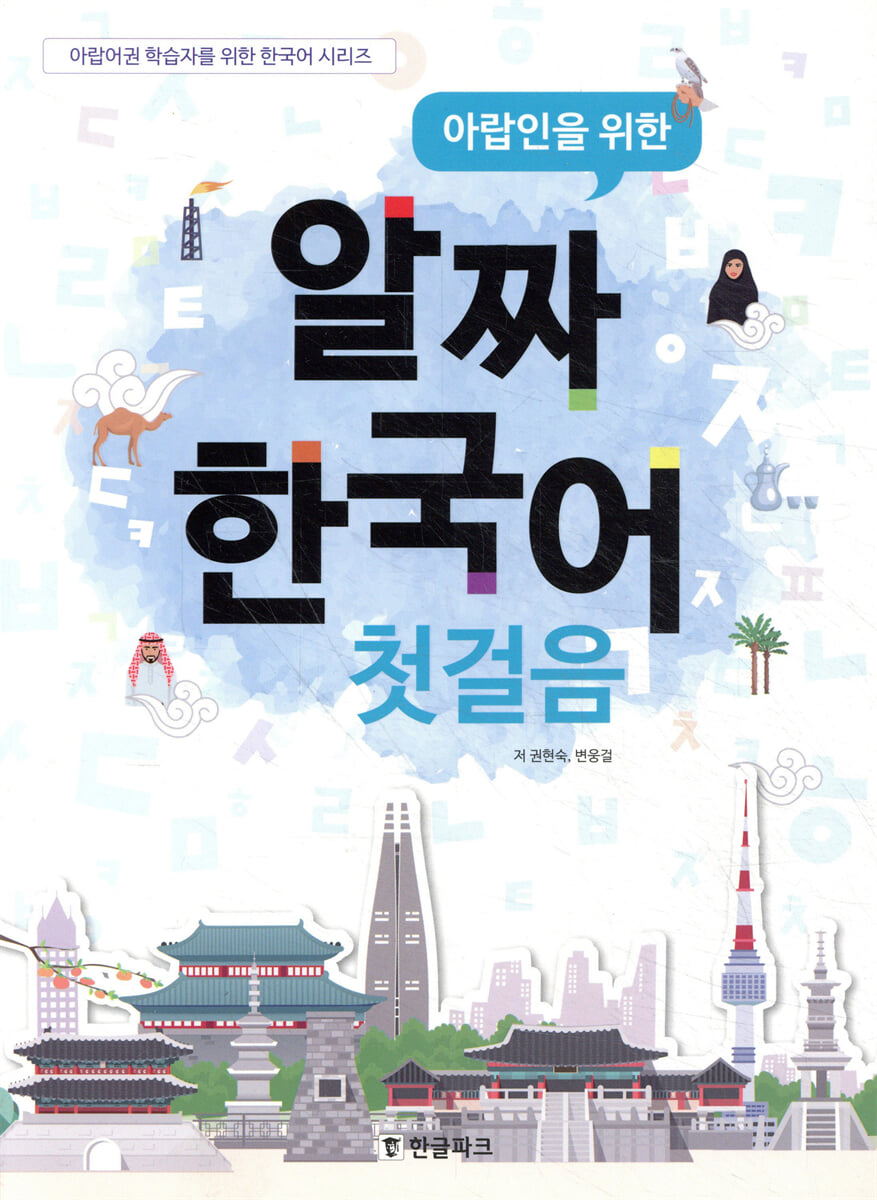
"Easy Korean" is a series of customized Korean textbooks for Arabs that takes into account the similarities and differences between Arabic and Korean, and addresses the difficulties learners face while learning Korean.
In the 'First Step' section, you can accurately understand the characteristics of Hangul and practice reading and writing Hangul letters perfectly.
It is also designed to minimize difficulties that may arise in the early stages of learning Korean, so that you can learn Korean in an enjoyable way.
In the 'First Step' section, you can accurately understand the characteristics of Hangul and practice reading and writing Hangul letters perfectly.
It is also designed to minimize difficulties that may arise in the early stages of learning Korean, so that you can learn Korean in an enjoyable way.
- You can preview some of the book's contents.
Preview
index
Learn Korean
Hangul and King Sejong
gather
consonant
Creating letters
Making sentences
Characteristics of the Korean language
Learning the alphabet Ⅰ
Lesson 1 Korean and the alphabet 1
Lesson 2 Korean and the alphabet 2
Lesson 3 Korean and the alphabet 3
Learning the alphabet II
Lesson 4 Korean and the Alphabet 4
Lesson 5 Korean and the Alphabet 5
Lesson 6 and consonants
Learn Korean
Lesson 7 Korean Vocabulary
Lesson 8 Korean Sentences
Lesson 9 Korean Expressions
supplement
Listening passage
Model answer
Vocabulary Index
Expression Index
Arabs' Korean writing errors
Hangul and King Sejong
gather
consonant
Creating letters
Making sentences
Characteristics of the Korean language
Learning the alphabet Ⅰ
Lesson 1 Korean and the alphabet 1
Lesson 2 Korean and the alphabet 2
Lesson 3 Korean and the alphabet 3
Learning the alphabet II
Lesson 4 Korean and the Alphabet 4
Lesson 5 Korean and the Alphabet 5
Lesson 6 and consonants
Learn Korean
Lesson 7 Korean Vocabulary
Lesson 8 Korean Sentences
Lesson 9 Korean Expressions
supplement
Listening passage
Model answer
Vocabulary Index
Expression Index
Arabs' Korean writing errors
Publisher's Review
It consists of four major units and nine sub-units: ‘Understanding Hangul’, ‘Learning the Alphabet I’, ‘Learning the Alphabet II’, and ‘Learning Korean’.
- Learn Korean
It provides an overview of the Korean language and its various characteristics, and provides examples and photos to help you understand them accurately.
- Learning the alphabet
It was presented by dividing it into I and II based on consonants, and also considering the characteristics of Arab learners, the vowels were presented by dividing them into ‘vertical’ and ‘horizontal’.
Hangul and Jamo 1 are composed of vertical vowel 1 and flat consonants, Hangul and Jamo 2 are composed of vertical vowel 2 and hard consonants, and Hangul and Jamo 3 are composed of horizontal vowel 1 and aspirated consonants.
This is organized and presented so that you can sufficiently practice consonants and vowels by composing the names of consonants and vowels, pronunciation, mouth shape, writing order, and writing practice.
In Hangul and Jamo 4, it is composed of horizontal vowel 2 and nasal consonants, in Hangul and Jamo 5, it is composed of horizontal vowel 3 and liquid and final consonants, and in Hangul and Jamo 6, it is composed of final consonants.
This is organized and presented so that you can sufficiently practice consonants and vowels by composing the names of consonants and vowels, pronunciation, mouth shape, writing order, and writing practice.
- practice
It is presented with a focus on helping learners learn Hangul through various forms of continuous practice of seeing, hearing, and writing.
Exercises 1 and 2 are designed to help you practice syllables made with the consonants and vowels you have learned.
In Exercise 3, words made from the syllables learned were presented, and Exercises 4 and 5 were designed to practice listening to and writing the words learned in Exercise 3.
It allows learners to fully understand the letters and syllables they have learned through repetition.
Exercise 6 is designed to allow you to comprehensively review the syllables, words, and corresponding pronunciations you have learned through listening, seeing, and writing.
In the activity, we presented the correct form of the learned syllables and words and drew images that were familiar to the learner, which made it more interesting to learn Korean.
In addition, to help children learn Korean easily, increase interest in the language, and become familiar with it quickly, we have provided children's songs with easy lyrics, such as 'Ganada Song' and 'Eommaya Noonaya', so that they can learn Korean more enjoyably.
- Learn Korean
Considering the learners' level and cultural characteristics, we have presented the basic vocabulary, sentences, and expressions necessary for learning Korean.
- Learn Korean
It provides an overview of the Korean language and its various characteristics, and provides examples and photos to help you understand them accurately.
- Learning the alphabet
It was presented by dividing it into I and II based on consonants, and also considering the characteristics of Arab learners, the vowels were presented by dividing them into ‘vertical’ and ‘horizontal’.
Hangul and Jamo 1 are composed of vertical vowel 1 and flat consonants, Hangul and Jamo 2 are composed of vertical vowel 2 and hard consonants, and Hangul and Jamo 3 are composed of horizontal vowel 1 and aspirated consonants.
This is organized and presented so that you can sufficiently practice consonants and vowels by composing the names of consonants and vowels, pronunciation, mouth shape, writing order, and writing practice.
In Hangul and Jamo 4, it is composed of horizontal vowel 2 and nasal consonants, in Hangul and Jamo 5, it is composed of horizontal vowel 3 and liquid and final consonants, and in Hangul and Jamo 6, it is composed of final consonants.
This is organized and presented so that you can sufficiently practice consonants and vowels by composing the names of consonants and vowels, pronunciation, mouth shape, writing order, and writing practice.
- practice
It is presented with a focus on helping learners learn Hangul through various forms of continuous practice of seeing, hearing, and writing.
Exercises 1 and 2 are designed to help you practice syllables made with the consonants and vowels you have learned.
In Exercise 3, words made from the syllables learned were presented, and Exercises 4 and 5 were designed to practice listening to and writing the words learned in Exercise 3.
It allows learners to fully understand the letters and syllables they have learned through repetition.
Exercise 6 is designed to allow you to comprehensively review the syllables, words, and corresponding pronunciations you have learned through listening, seeing, and writing.
In the activity, we presented the correct form of the learned syllables and words and drew images that were familiar to the learner, which made it more interesting to learn Korean.
In addition, to help children learn Korean easily, increase interest in the language, and become familiar with it quickly, we have provided children's songs with easy lyrics, such as 'Ganada Song' and 'Eommaya Noonaya', so that they can learn Korean more enjoyably.
- Learn Korean
Considering the learners' level and cultural characteristics, we have presented the basic vocabulary, sentences, and expressions necessary for learning Korean.
GOODS SPECIFICS
- Date of issue: May 21, 2018
- Page count, weight, size: 148 pages | 426g | 188*257*10mm
- ISBN13: 9788955185676
- ISBN10: 8955185677
You may also like
카테고리
korean


korean

![GQ KOREA Mark (Monthly): December [2025]](http://librairie.coreenne.fr/cdn/shop/files/8ef265dbbfbf186523ed75ba7319009d.jpg?v=1765340328&width=3840)


